9 Simple AI Career Roadmaps for Beginners: Zero to Expert
An AI career roadmap is your structured blueprint for moving from curious beginner to industry-ready expert. In 2026, the path to a high-paying AI role has shifted: success now favors consistent hands-on practice over a PhD, with entry-level milestones achievable in just 3–6 months using free resources.
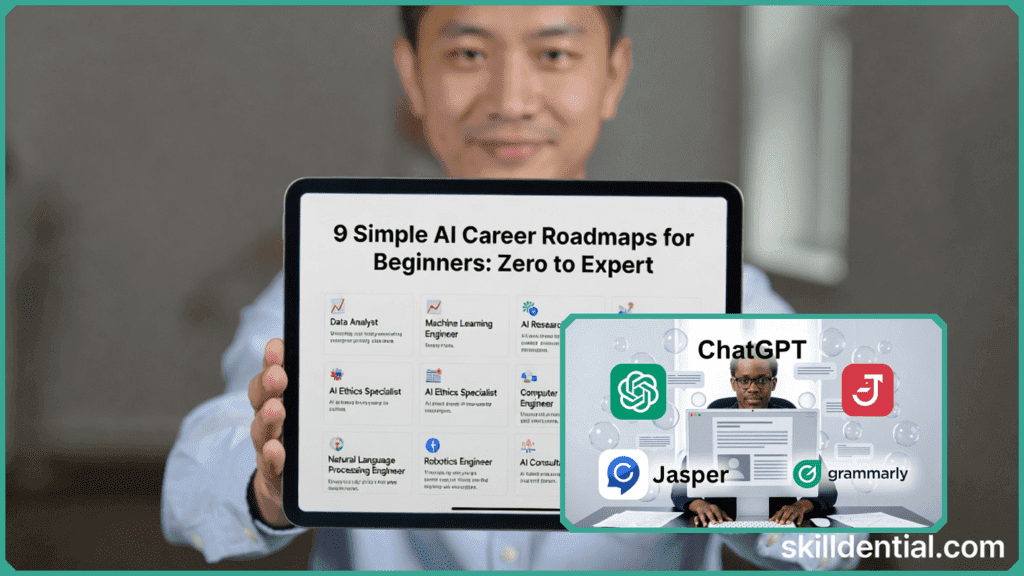
Whether you are eyeing a technical engineering seat or a non-coding business role—where AI Product Managers now command salaries up to $260K—the key lies in mastering specific workflows like model deployment or prompt crafting. This guide breaks down 9 distinct paths to help you navigate the skills, tools, and professional milestones needed to thrive in the current AI economy.
Which AI Career Path Fits You?
Not all AI careers require you to be a math genius or a coding wizard. In 2026, the most successful professionals are those who align their existing “human” strengths with specific AI workflows.
To find your fit, rate your interest in these three pillars on a scale of 1–5:
- Data & Logic: Do you enjoy finding patterns and solving puzzles? (High = Technical Paths)
- Creativity: Do you love storytelling, design, or “hacking” tools to make things? (High = Creative Paths)
- Strategy & People: Do you prefer leading teams and making business decisions? (High = Strategic Paths)
The AI Persona Map
| Persona | Best Paths | Why It Fits |
| The Career Switcher | 7. AI Product Manager 8. AI Business Consultant | You can leverage your industry “soft skills” to bridge the gap between tech teams and business goals. |
| The “Vibe” Learner | 4. AI Content Specialist 5. Prompt Engineer | You thrive on experimentation. You can turn “playing” with tools into high-value creative assets. |
| The Non-Coder Techie | 3. Data Annotation Specialist 9. AI Ethics Lead | You want to be in the room where AI is built, focusing on quality, safety, and process over raw code. |
The Skilldential Insight: In our recent career audits, we found the #1 reason beginners quit is “Tutorial Fatigue.” By narrowing your focus to just 3–5 core tools per path, you can reach your first portfolio-ready project 70% faster than those trying to learn everything at once.
The 9 Strategic AI Career Roadmaps
The biggest mistake beginners make is trying to learn “everything about AI” at once. In a field that moves this fast, generalists get overwhelmed while specialists get hired.
To help you cut through the noise, we have mapped out 9 distinct pathways categorized by their core focus: Technical, Creative, and Strategic. Each AI career roadmap is designed as a “minimum viable path”—providing just enough theory to get you started, but focusing heavily on the tools and milestones that lead to a professional portfolio.
Whether you want to build the models, create the content, or lead the strategy, here is exactly how to get from zero to expert.
Category 1: Technical Paths
Best for: Problem solvers who enjoy coding, data, and building systems.
Machine Learning Engineer
- The Toolkit: Python, Scikit-learn, Pandas, Hugging Face, Google Cloud ML.
- Expert Milestone: Architecting a scalable MLOps pipeline that automates model retraining.
- Day 1 Task: Sign up for a free Kaggle account and complete the “Intro to Machine Learning” micro-course.
AI Security & Risk Analyst
- The Toolkit: OWASP AI Exchange, NIST AI Framework, Python (for auditing), and adversarial robustness tools.
- Expert Milestone: Leading a “Red Team” exercise to identify vulnerabilities in a company’s LLM deployment.
- Day 1 Task: Download and read the NIST AI Risk Management Framework (nist.gov).
Data Annotation Specialist
- The Toolkit: Labelbox, CVAT, Prodigy, and a basic understanding of Supervised Learning.
- Expert Milestone: Managing global annotation teams and designing quality-control heuristics for synthetic data.
- Day 1 Task: Install CVAT via Docker and label 50 sample images for a “Computer Vision” project.
Category 2: Creative & Content Paths
Best for: Designers, writers, and creators who want to amplify their output with AI.
AI Content Specialist
- The Toolkit: ChatGPT (Advanced Data Analysis), Jasper, Ahrefs, Grammarly AI.
- Expert Milestone: Building a custom GPT-based content engine that perfectly mirrors a brand’s unique voice.
- Day 1 Task: Generate a blog outline with ChatGPT, then manually rewrite the intro to see where the AI “hallucinates” style.
Prompt Engineer
- The Toolkit: OpenAI Playground, PromptBase, GitHub Prompt Engineering Guide, LangChain (basics).
- Expert Milestone: Developing “Chain-of-Thought” prompt libraries that reduce model hallucination by 90%.
- Day 1 Task: Join the Prompt Engineering Guide on GitHub and test 3 different “Few-Shot” prompting techniques.
AI Video/Image Creator
- The Toolkit: Midjourney, Stable Diffusion, RunwayML, Adobe Firefly.
- Expert Milestone: Producing a 60-second high-fidelity commercial using only AI-generated assets.
- Day 1 Task: Sign up for a free Hugging Face account and experiment with the latest “Text-to-Video” models.
Category 3: Business & Strategic Paths
Best for: Leaders, consultants, and policy-makers who want to manage AI’s impact.
AI Product Manager
- The Toolkit: Productboard, Bubble (for no-code MVPs), Google AI PM Roadmap.
- Expert Milestone: Launching an AI-first product feature that achieves a measurable 20% lift in user retention.
- Day 1 Task: Audit the “AI for Everyone“ course on Coursera (it’s free and takes only 6 hours).
AI Business Consultant
- The Toolkit: Excel (for ROI modeling), IBM AI Strategy cert, LinkedIn Learning (AI Consulting).
- Expert Milestone: Quantifying the ROI of an AI integration for a Fortune 500 company.
- Day 1 Task: Analyze a business dataset on Kaggle and write a 1-page summary on how AI could save that business money.
AI Ethics & Policy Lead
- The Toolkit: Alison AI Ethics, EU AI Act documentation, bias-detection frameworks.
- Expert Milestone: Designing an organizational “AI Constitution” that ensures 100% regulatory compliance.
- Day 1 Task: Enroll in Alison’s free AI Governance course to understand the basics of algorithmic bias.
Why this works:
- Toolkit Clarity: By limiting it to 3–5 items, you fulfill the Skilldential promise of avoiding “tutorial fatigue.”
- Milestones: This gives the “Expert” part of your title real meaning.
- Visual Break: The suggested images and headings break up the text, making it easier to read on mobile.
How to Choose Your First AI Project?
Choosing your first project is where most beginners get stuck in “tutorial purgatory.” The secret to moving from Zero to Expert isn’t finishing more courses—it’s shipping one real solution.
In 2026, the industry has shifted away from generic “toy” projects. Hiring managers now look for functional utility over academic complexity.
The “Day 1” Momentum Rule
To avoid overwhelm, your first project should be a direct extension of your AI career roadmap’s Day 1 Task. If your task was to sign up for Kaggle, your project should be a simple notebook using a Kaggle dataset. If it were to test a prompt, your project should be a “Prompt Library” for a specific niche.
3 Tips for a Winning First Build
- Solve a “Real Person” Problem: Instead of a generic chatbot, build an “AI Assistant for my mom’s gardening business.” Specificity makes your portfolio stand out.
- Leverage the “Focused Build” Principle: Data shows that 80% of AI experts built their reputation on one deeply focused project rather than ten scattered, half-finished ones.
- Stick to Free Tiers: Use tools like Hugging Face Spaces, GitHub Pages, or Google Colab. In 2026, you can deploy a full-scale “Expert” portfolio without spending a dime.
Pro Tip: Create a dedicated GitHub repository for your project on Day 1. Document your “ugly” first drafts and weekly progress. Showing how you solved problems is often more valuable than the final code itself.
AI Career Roadmap: FAQs
What exactly is an AI career roadmap?
Think of it as a strategic GPS for your professional development. Unlike a traditional degree, an AI career roadmap focuses on functional competency—the specific tools (like Python or Midjourney), certifications (like Google AI Essentials), and portfolio projects you need to land a job in 2026.
Do I really need to code to work in AI?
Absolutely not. While technical roles like ML Engineer require Python, many of the highest-paying roles in 2026 are “Non-Coding” paths. Roles like AI Product Manager (salaries up to $260k+) and AI Ethics Lead focus on strategy, governance, and user experience rather than writing raw code.
How long does it take to go from “Zero” to “Expert”?
With consistent daily practice, most beginners can reach an entry-level/job-ready milestone in 3–6 months. Achieving true “Expert” status (mid-to-senior level) typically takes 1–2 years of shipping real-world projects and managing AI lifecycles.
Where can I find the best free resources to start?
In 2026, the best “free” starting points are:
- Kaggle: For data science and ML competitions.
- Hugging Face: For experimenting with open-source models.
- Coursera (Audit Mode): Specifically for “AI for Everyone” or “Google AI Essentials.”
- Vibe Coding Tutorials: For learning how to build apps using only natural language.
Are certifications actually worth it for beginners?
Yes, but they are “door-openers,” not “job-guarantors.” In 2026, a certification from Google, IBM, or Microsoft validates your literacy to a recruiter. However, it’s the portfolio project you build after the certification that ultimately gets you hired.
In Conclusion
The industry has spoken: 70% of employers now prioritize demonstrable skills over traditional degrees when hiring for AI roles in 2026. The most expensive thing you can do right now is wait.
The Success Blueprint
- Weeks 1–4: Focus exclusively on your “Toolkit” and “Day 1 Task.”
- Weeks 5–8: Build one functional project and host it on GitHub or Hugging Face.
- Weeks 9–12: Complete a recognized certification (Google, IBM, or Coursera) to validate your hard work.
Stop Waiting for “The Right Time.” In the AI economy of 2026, the gap between those who “use” AI and those who “build” with AI is widening. You don’t need a PhD to cross that gap—you just need a roadmap and the discipline to take the first step. Pick one path from the nine above, complete your Day 1 Task, and start building your future today.