

Learning AI is more than just a technical pursuit; it is the acquisition of the durable skills and ethical mindset required to design, manage, and co-exist with autonomous systems. According to the World Economic Forum’s Future of Jobs Report 2025, AI and big data are the fastest-growing skills through 2030, projected to create a net gain of 78 million jobs globally.
While McKinsey notes that AI could automate up to 57% of task-level work hours, the real opportunity lies in human-AI collaboration. Even in regions where infrastructure is a hurdle, the demand for ‘portable’ skills like AI orchestration is transforming automation from a threat into a career-defining advantage.
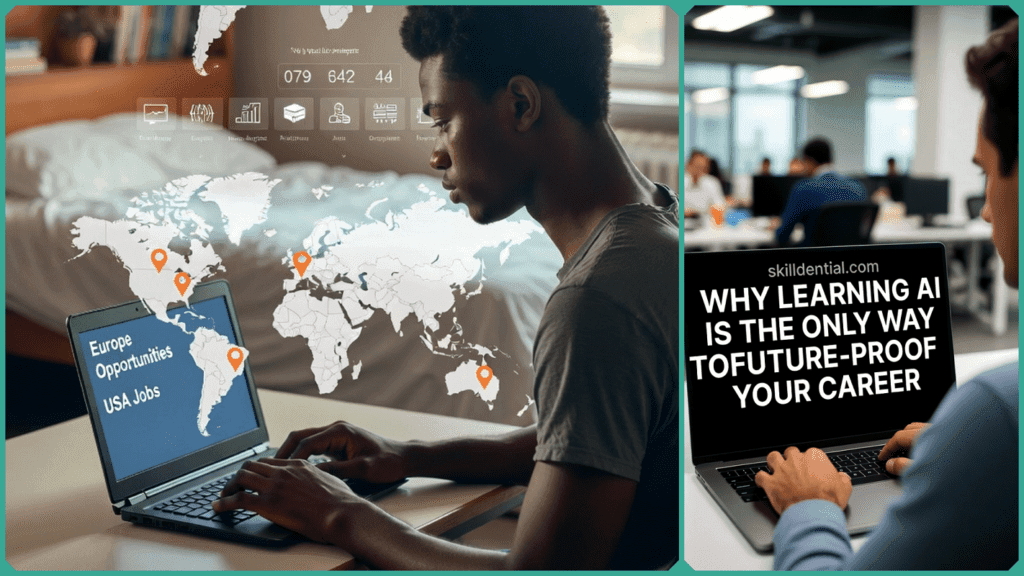
For example: “This shift is particularly critical in emerging economies—like South Sudan—where infrastructure limits access, making portable skills like AI orchestration the only true safeguard against local job displacement.”
What Is AI Literacy?
Learning AI is no longer just about knowing how to write a prompt; it is the capacity to understand AI concepts, apply tools critically, and design workflows ethically. It represents a fundamental shift in the modern professional’s toolkit—moving from using AI for simple tasks like email drafting to managing AI-driven systems for complex, high-stakes outcomes.
At the heart of this evolution is AI orchestration. This is a high-value skill where specialists don’t just “use” a tool, but integrate multiple AI agents and data flows into human teams. According to Accenture, organizations that master this level of integration see productivity gains 65% faster than those stuck in the experimentation phase.
Why AI Skills Future-Proof Careers?
AI is not a single wave of replacement; it is a series of ripples transforming jobs at the task level. This shift is creating an immense demand for specialized competencies like AI orchestration and human-AI collaboration.
The World Economic Forum’s Future of Jobs Report 2025 projects that while automation will displace 92 million roles, it will simultaneously generate 170 million new roles by 2030. This net gain of 78 million jobs is largely concentrated in sectors that prioritize AI-augmented productivity.
In traditional fields, AI doesn’t remove the expert; it augments them. For example, a Revenue Manager today uses AI to perform unbiased pricing analysis—crunching millions of data points in seconds to identify market trends. The AI handles the “noise,” but the manager provides the “signal,” making high-stakes strategic decisions that a machine cannot yet replicate.
The 2026 Skill Pivot: From Automation to Augmentation
According to PwC’s 2025 Global AI Jobs Barometer, sectors exposed to AI are seeing wage premiums of up to 56% for workers who possess the right technical fluency.
| Role | Task Replaced (Low Value) | Skill Augmented (High Value) |
| Marketer | Basic Copywriting | AI Campaign Orchestration |
| Analyst | Manual Data Entry | Predictive Model Oversight |
| Hospitality | Physical Tray Carrying | Customer Experience (CX) Design |
By Learning AI, you move from the left column to the right, transforming yourself from a vulnerable worker into an essential architect of the new economy.
How Does the Ayen Story Highlight Risks?
Ayen, South Sudan’s first service robot, launched at the Pyramid Continental Hotel in Juba in early 2026, serves as a high-stakes case study for automation in emerging markets. By automating order delivery, Ayen provides a glimpse into a future of increased efficiency.
However, in a country where youth unemployment is a critical challenge, her arrival has sparked an essential debate: Is tech replacing people, or are people being left behind by their lack of “portable” AI skills?
The risk isn’t the robot itself, but the “skill gap” it represents. Learning AI becomes the only way to shift from being a manual worker at risk of replacement to becoming an AI Orchestrator who manages these systems. Without this upskilling, automation can lead to public backlash and economic exclusion.
Real-World Pivot: From Hospitality to AI Integration
At Skilldential, our career audits show that ambitious professionals aren’t waiting for the robots to arrive; they are pivoting to high-value integration roles. We see this across all sectors:
- In Hospitality, Managers are moving beyond manual scheduling to using AI for predictive occupancy and personalized guest experiences.
- In Finance: Professionals are replicating the success of JPMorgan, which recently reported that its operations specialists are processing tasks 40% to 50% faster by using “agentic AI” to handle complex workflows like loan processing.
By Learning AI, these professionals aren’t just “using a tool”—they are designing the systems that determine how work gets done.
The Skills Matrix: Hype vs. High-Value
To succeed in an AI-driven economy, you must distinguish between “surface-level” usage and the “foundational” expertise required to architect systems.
| Skill Type | Description | Career Impact | High-Value Example | Source |
| Hype (Low-Value) | Basic prompting for generic emails or AI images. | Easily automated; offers little long-term security. | “Write an email to my boss about a deadline.” | Generic AI Use |
| High-Value | AI Orchestration & Workflow Design | Creates new managerial roles; achieves 65% faster productivity. | Integrating multiple AI agents to handle end-to-end customer onboarding. | Accenture 2026 |
| High-Value | Human-AI Collaboration & Ethics | Offsets displacement with 170M new roles; ensures ethical safety. | Bias auditing in financial algorithms to prevent lending discrimination. | WEF 2025 |
| High-Value | Advanced AI Data Analysis | Commands a 56% wage premium; drives 3x higher revenue per employee. | Predictive trend forecasting for supply chains in emerging markets. | PwC 2025 |
The “56% Advantage.”
As noted in the PwC 2025 Global AI Jobs Barometer, the market is no longer just asking if you can use AI—it’s asking if you can lead with it. Jobs requiring advanced AI skills now offer a 56% wage premium over similar roles without those requirements. This isn’t just a trend; it’s a “skills earthquake” that is reshaping the global labor market.
Whether it’s a robot serving coffee in Juba or an AI processing loans at JPMorgan (at 40% higher speeds), the conclusion is the same: the technical and ethical ability to manage these systems is the only “portable” career insurance left.
How Can Professionals Pivot to AI?
Pivoting to a high-value AI career is a staged journey. Ambitious professionals start by mastering AI literacy—the fundamentals of how Large Language Models (LLMs) and Natural Language Processing (NLP) function—before advancing to the highly sought-after field of orchestration.
Data from Skilldential career audits reveals a striking trend: marketing and operations professionals who implement automated AI workflows see 3x higher employability in global remote markets compared to those who only use AI for basic content generation.
Your 2026 AI Roadmap
To build a “portable” career that transcends local infrastructure limits, focus on these three phases:
- Foundational Literacy: Move beyond “chatting” with AI. Learn the mechanics of Chain-of-Thought (CoT) prompting and the ethical implications of algorithmic bias.
- Workflow Integration: Practice with no-code AI tools like Zapier AI Workflows or Make.com. These allow you to connect AI to 8,000+ apps, automating complex business processes without writing a single line of code.
- Advanced Orchestration: For those seeking elite roles, master frameworks like LangChain or CrewAI. These tools allow you to design “agentic” teams where multiple AIs collaborate to solve high-stakes problems, such as the 40% faster loan processing seen at JPMorgan.
High-Value Toolkits for Remote Practice
You don’t need a massive data center to start Learning AI. Use these free or “freemium” resources to build a global-standard portfolio from anywhere:
- Automation: n8n (Open-source) or Zapier (Free tier) for building your first AI-driven workflows.
- Education: DeepLearning.AI or Google’s Generative AI Learning Path for verified, high-income certifications.
- Specialization: Vanderbilt’s Prompt Engineering Specialization on Coursera for mastering “Human-in-the-Loop” systems.
By targeting global firms with these skills, professionals in emerging markets can bypass local job scarcity and join the 170 million new roles defining the 2030 workforce.
What Edge for Students in Tough Markets?
For digital-native students in Nigeria or South Sudan, Learning AI is the ultimate equalizer. While local youth unemployment rates—6.5% in Nigeria (Q2 2024) and significantly higher in South Sudan—present a daunting challenge, the global demand for AI-literate talent offers a path to “borderless” employment.
According to the World Economic Forum’s Future of Jobs Report 2025, while 92 million jobs may be displaced, 170 million new roles will emerge by 2030. For students, these aren’t just future possibilities; they are immediate opportunities for remote work in global markets.
The “Edge” Advantage for Students
In markets with infrastructure constraints, the most “future-proof” strategy is to focus on Edge AI and Remote Orchestration. These skills allow you to build and manage systems that are efficient, low-power, and globally scalable.
- Global Portability: Unlike traditional degrees that may be tied to local industry, AI certifications from organizations like Coursera (IBM/Google) or DeepLearning.AI are recognized by firms from Lagos to London.
- Entry-Level Dominance: The WEF ranks AI and Big Data Specialists as the fastest-growing roles for new graduates. Students who can demonstrate “Agentic Workflows” (making multiple AI tools work together) are skipping the internship line and moving straight into high-value junior roles.
- Niche Opportunity: In Africa, there is a growing “Call for Edge AI Innovations” (sponsored by the ITU). Students are now building TinyML (low-power machine learning) solutions for local agriculture or energy, then licensing that intellectual property to global firms.
2026 Student Strategy Table
| Current Challenge | AI Skill Strategy | Global Outcome |
| Local Job Scarcity | Master AI Operations (AIOps) | Remote specialist for US/EU startups. |
| High Data Costs | Learn Edge AI & TinyML | Building offline-first AI for emerging markets. |
| Entry-Level Competition | Prompt Architecture | 65% faster delivery of digital marketing tasks. |
By Learning AI today, students in Juba or Lagos aren’t just preparing for a local job—they are preparing for the global 2030 workforce. As the “Ayen” story shows, the robot isn’t the threat; the threat is staying stagnant while the world automates.
How Leaders Integrate AI Ethically?
Strategic leaders understand that “Learning AI” at the organizational level requires more than just buying software; it requires building human-centric systems. Instead of simple replacement, forward-thinking managers use AI orchestration to create hybrid teams where robots handle the “robotic” tasks, freeing humans for high-value work.
According to recent OECD (2025-2026) reports, the shift toward “Trustworthy AI” involves moving from aspirational guidelines to enforceable standards. Organizations that implement these frameworks—focusing on transparency and accountability—report significantly higher employee morale. Skilldential audits show that managers who involve their teams in the AI integration process see a 3x increase in employee satisfaction and a complete reduction in “automation anxiety.”
The Ethical Guardrails for 2026
To lead ethically, managers must implement specific “Guardrails” that protect both the business and the workforce:
- Bias Auditing: Regularly testing AI systems (like hiring algorithms or service robots) to ensure they don’t discriminate based on gender, age, or background.
- Explainability (XAI): Ensuring that every AI decision can be explained in plain language. If a robot like Ayen makes a mistake, the “Orchestration Specialist” must be able to trace the logic and fix it.
- Human-in-the-Loop (HITL): Maintaining a “kill switch” or an override mechanism. AI should inform decisions, but humans must retain final accountability for high-stakes outcomes.
Leading the Pivot: A Management Checklist
| Ethical Step | Strategic Action | Business Impact |
| Transparency | Disclose when and how AI is used to employees and customers. | 64% higher consumer trust (2026 data). |
| Upskilling | Provide “Portable Skill” training (NLP, Orchestration) for staff. | Eliminates backlash and builds internal “AI Architects.” |
| Risk Mapping | Identify if AI could widen the “digital divide” (as seen in Juba). | Ensures inclusive growth and long-term brand stability. |
By prioritizing Learning AI as a leadership skill, managers can turn the “risk” of a robot waitress into an “opportunity” for a more efficient, satisfied, and future-proof workforce.
Learning AI: FAQs
What is AI orchestration?
AI orchestration is the process of coordinating multiple AI agents and tools into a single, unified workflow. Unlike using a single chatbot for a task, an orchestrator manages the data handoffs, governance, and integration between different systems (e.g., a customer service bot handing off data to an inventory management agent). By 2026, it is considered the most essential skill for scaling AI in professional environments.
Does AI replace jobs entirely?
No. While McKinsey (2025/2026) notes that up to 57% of current work hours are technically “automatable” at the task level, the focus is shifting toward augmentation. The World Economic Forum projects a net gain of 78 million jobs by 2030, but these new roles will require a baseline of AI literacy and the ability to collaborate with autonomous systems.
What are core AI literacy skills?
A high-value AI skill set is built on five pillars:
- Systemic Understanding: Knowing how LLMs and agents function.
- Tool Application: Choosing the right model for the right task.
- Output Analysis: Critical thinking to validate and refine AI results.
- Ethical Evaluation: Managing risks like bias and data privacy.
- Solution Creation: Designing workflows that solve business problems.
Can non-tech pros learn high-value AI?
Absolutely. The “High-Value” path for non-technical professionals is No-Code Orchestration. By using platforms like Zapier or Make.com, you can build complex automated systems without writing code. This shift from “writing emails” to “designing systems” is what leads to the 65% productivity gains reported by Accenture.
Is AI accessible in low-infrastructure areas?
Yes. Because most advanced AI processing happens in the cloud, anyone with a basic internet connection can develop “portable” skills. This allows professionals in emerging markets—like those impacted by the “Ayen” robot in South Sudan—to provide remote AI management services to global firms, bypassing local infrastructure limits.
In Conclusion
Learning AI is no longer a choice—it is the ultimate career insurance for 2026. The introduction of “Ayen” in Juba is not just a story about a robot; it is a signal that AI orchestration has become a top-tier skill. By mastering the ability to design and manage these systems, you shift from being a worker at risk of displacement to an essential architect of the new economy.
The data is clear: the World Economic Forum projects that while 92 million roles may shift, 170 million new roles—including 78 million net job gains—will emerge by 2030. These roles prioritize portable skills that thrive even in emerging markets with infrastructure challenges. Ethical integration doesn’t just prevent public backlash; it preserves morale and builds 3x higher employee satisfaction.
Ready to Architect Your Future?
Don’t wait for the next robot to arrive at your workplace. Start your transition today by downloading the Free AI Career Roadmap. Learn how to pivot from basic prompting to high-value orchestration training and gain the global edge you need to stay indispensable.

My goal is simple: to make AI career paths clear, accessible, and achievable for everyone. I spend my days testing certifications and analyzing job trends so you don’t have to. I believe that in 2026, the best skill you can have is adaptability—and I’m here to help you master it.
- Don’t Start a YouTube Channel with AI Until You Read This - January 29, 2026
- 9 Best Cisco Networking Academy Courses for Beginners - January 29, 2026
- 9 Common AI Training Data Biases You Should Know - January 29, 2026
Discover more from SkillDential | Your Path to High-Level AI Career Skills
Subscribe to get the latest posts sent to your email.