

In the rapidly evolving landscape of 2026, the shift from conversational assistants to autonomous digital workers has reached a tipping point. An agentic AI platform is no longer just a trend; it is the essential software framework that enables the creation, deployment, and management of autonomous AI agents capable of executing multi-step tasks independently.
Unlike traditional chatbots that simply respond to queries, these platforms integrate large language models with external tools, long-term memory, and advanced reasoning capabilities. This allows them to handle complex workflows—such as autonomous supply chain adjustments or end-to-end customer resolution—without constant human intervention.
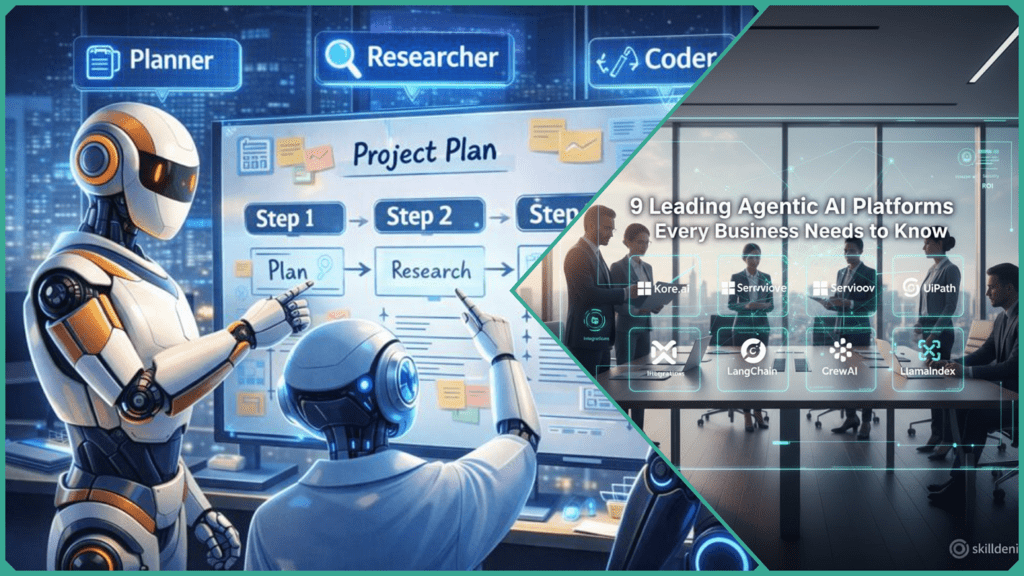
For the modern enterprise, these platforms provide the necessary layers of security governance and scalability, though successful adoption requires a strategic focus on integration testing to mitigate the risks of unauthorized autonomous actions.
9 Leading Agentic AI Platforms
These platforms have emerged as the frontrunners for enterprise deployment in 2026. While they share a focus on autonomy and ROI, each serves a specific niche—from low-code business tools to developer-centric frameworks.
Kore.ai: The Orchestration Powerhouse
Kore.ai is built for large-scale multi-agent orchestration. It excels at connecting fragmented data across silos to automate end-to-end business processes.
- Key Feature: Over 250 pre-built enterprise connectors and an “Agent Marketplace” with 300+ ready-to-deploy agents.
- Best For: Global enterprises requiring strict governance across Customer Experience (CX) and internal operations.
Microsoft Copilot Studio & AutoGen
Microsoft offers a two-pronged approach. Copilot Studio provides a low-code environment for business users, while AutoGen is the high-code framework for developers building complex conversational agents.
- Key Feature: “Computer Use” capabilities that allow agents to interact with legacy software UIs just like a human would.
- Best For: Companies deep in the Azure/Microsoft 365 ecosystem.
ServiceNow AI Agents
ServiceNow has integrated agentic AI directly into its Now Platform, focusing on “Action-First” automation for IT and HR.
- Key Feature: Native integration with ITSM workflows, allowing agents to autonomously trigger, enrich, and resolve support tickets.
- Best For: Standardizing internal service operations and employee support.
UiPath Autopilot
UiPath bridges the gap between Robotic Process Automation (RPA) and Agentic AI. It uses “agentic brains” to command “RPA hands.”
- Key Feature: Intelligent Document Processing (IDP) that structures data from invoices and contracts for agent use.
- Best For: Automating processes that involve older, “un-API-able” legacy systems.
Glean: The Knowledge Agent
Glean uses Agentic RAG (Retrieval-Augmented Generation) to turn a company’s internal knowledge into an actionable resource.
- Key Feature: High-security search and “Action” capabilities that allow agents to find info and then perform tasks based on it (e.g., “Find the project specs and draft the Jira tickets”).
- Best For: Knowledge-heavy industries like Law, Finance, and Engineering.
LangChain / LangGraph
LangChain remains the de facto framework for developers. Its LangGraph extension is specifically designed for non-linear, looping agent workflows.
- Key Feature: Ultimate flexibility and observability, allowing developers to see exactly why an agent made a specific decision.
- Best For: Engineering teams building highly customized, proprietary AI logic.
CrewAI: Role-Based Collaboration
CrewAI is the leader in collaborative intelligence. It allows you to define “Crews” where agents have specific roles (e.g., a “Researcher,” an “Editor,” and a “Publisher”).
- Key Feature: Sophisticated state management that ensures agents pass context to one another without losing the thread of the goal.
- Best For: Complex, multi-stage projects like content marketing or market research.
LlamaIndex: Data-Centric Agents
LlamaIndex focuses on the relationship between agents and data. It is the go-to for building agents that need to “reason” over massive, complex datasets.
- Key Feature: Advanced data indexing that allows agents to handle structured (SQL) and unstructured data with equal precision.
- Best For: Data-driven decision-making and automated business intelligence.
Google Vertex AI Agents
Part of the Google Cloud ecosystem, this platform is optimized for multimodal agents—those that can process text, images, and video in a single workflow.
- Key Feature: Native access to Gemini 1.5 Pro’s massive context window and Google’s world-class ML infrastructure.
- Best For: Cloud-native companies that need highly scalable, media-rich AI automation.
What Makes Agentic AI Different from Chat AI?
While Chat AI (Generative AI) has dominated headlines, the enterprise is rapidly moving toward Agentic AI. The fundamental difference lies in Agency vs. Response.
- Chat AI (Reactive): Operates on a request-response model. It waits for a human prompt, generates text or an image, and stops. It is a “tool” that requires a human to drive the workflow.
- Agentic AI (Proactive): Operates on a Goal-Action model. Once given a high-level objective (e.g., “Onboard this new client”), it breaks the goal into sub-tasks, selects the necessary tools, and executes the workflow autonomously.
The “Reasoning Loop” (Observe-Plan-Act)
At the heart of every agentic AI platform is a continuous feedback loop, often referred to as the ReAct (Reason + Act) paradigm. Unlike a standard chatbot that tries to solve a problem in one go, an agent iterates:
- Observe: The agent scans the environment (e.g., reading an email or checking a database).
- Plan: It reasons about what it knows and determines the next logical step.
- Act: It uses a tool (e.g., sending an API call to a CRM or updating a Jira ticket).
- Evaluate: It checks the result of its action. If the goal isn’t met, it loops back to step one with new information.
Case Study: From Siloed Experiments to Real ROI
In our recent career audits at Skilldential, we’ve observed a common trend: CIOs often struggle with “AI fatigue” caused by siloed experiments that fail to deliver measurable business value. Many companies have dozens of custom chatbots that save time on drafting emails, but don’t actually move the needle on operational costs.
The shift to Agentic AI platforms changes this dynamic by focusing on outcomes rather than outputs.
Real-World Impact: Organizations implementing platforms like Kore.ai for IT and customer service have reported up to a 40% faster incident response rate.
By allowing agents to autonomously triage tickets, query internal logs, and even apply known fixes without waiting for a human technician, these businesses aren’t just “chatting” with AI—they are deploying a digital workforce that scales.
Key Features Comparison: Choosing Your Strategic Fit
Selecting an agentic AI platform isn’t just a technical decision—it’s a move to bridge the gap between legacy software and modern intelligence. This matrix helps decision-makers evaluate platforms based on their ability to handle complex integrations and the critical “trust gap” in autonomous actions.
| Platform | Integrations | Security & Governance | Best Use Case | Pricing Model |
| Kore.ai | 250+ pre-built enterprise connectors (SAP, Salesforce) | Enterprise observability, Zero-Trust tool verification | Multi-agent orchestration for CX & global ops | Flexible (Session-based or Pay-as-you-go) |
| Microsoft Copilot | Deep 365/Azure ecosystem + “Computer Use” for legacy | Azure compliance, Entra ID, & DLP policies | Day-to-day employee productivity & workflows | Subscription ($30/user/mo + consumption) |
| ServiceNow | Native ITSM, HRSD, & multi-cloud workflows | Enterprise policies & rigid audit trails | IT Service Management & Employee Onboarding | Enterprise Licensing (Tiered) |
| UiPath | Seamless RPA + API hybrid connectivity | Governance built-in for bot-human handoffs | Scaling automation across legacy tech debt | Per-agent or Robot-based licensing |
| Glean | 100+ SaaS connectors (Slack, Jira, Drive) | Permission-aware RAG (respects user data access) | Knowledge retrieval & action-based search | Per-seat (Enterprise) |
| LangChain | Infinite via custom Python/JS & LangGraph | Full observability (LangSmith) & custom guardrails | Developers building highly bespoke AI logic | Open-source (Framework) / Usage (Cloud) |
| CrewAI | Flexible via LangChain & custom toolsets | Role-based workflow controls & state management | Team-like agent coordination (Research/Drafting) | Open-source / $40+ mo for Cloud/Enterprise |
Understanding the Comparison
When reviewing this list, focus on two primary factors:
- The Environment: If your data is siloed in legacy ERPs, UiPath or Kore.ai are your strongest bets. If you live in the cloud, Vertex AI or Glean offer faster setup.
- The User: Copilot Studio and Kore.ai offer low-code builders for business analysts, whereas LangChain and CrewAI require a dedicated engineering team to manage the underlying state and “reasoning” loops.
Final Thought: Mitigating the Trust Gap
As businesses shift from chat-based AI to action-oriented agents, the biggest hurdle is no longer “Will it work?” but “Should we let it?” Platforms like Vellum AI and Kore.ai are leading the way by providing “Circuit Breakers”—safety protocols that pause an agent and ask for human approval before it executes high-risk actions like financial transfers or database deletions.
How Do These Platforms Address Security Risks?
Unlike standard Generative AI, an agentic AI platform is designed with a “Secure-by-Design” architecture. They move away from the “black box” approach by implementing structured layers of oversight that treat AI agents as digital identities rather than just software tools.
Hardened Guardrails & NIST Compliance
To prevent “Hallucinations of Action”—where an agent confidently executes a task it wasn’t authorized to do or uses the wrong tool—platforms now enforce NIST-aligned governance. This includes:
- Role-Based Access Control (RBAC): Agents are assigned “Least Privilege” access. A “Support Agent” might have permission to view a customer’s order history but is strictly blocked from accessing the company’s payroll database.
- Execution Sandboxing: Agents perform actions in isolated environments, ensuring that a stray command cannot cascade into other critical business systems.
The “Human-in-the-Loop” (HITL) Circuit Breaker
Governance is not just about blocking; it’s about escalation. Leading platforms incorporate mandatory approval nodes for high-stakes actions.
- Example: An agent can autonomously draft a $50 refund, but any transaction over $500 triggers a “pause,” sending a notification to a human manager for a one-click approval before the action is finalized.
Identity and Access Management (IAM) Integration
For IT architects, the most significant security win is the ability to integrate agents with existing IAM systems (like Okta or Microsoft Entra ID). By treating each agent as a unique service identity with its own set of credentials:
- Auditability: Every action—from “Read Database” to “Send API Call”—is logged in an immutable audit trail.
- Risk Reduction: According to 2026 industry reports, enterprises that integrate agentic platforms with centralized IAM systems have seen a 63% reduction in breach risks compared to those using siloed, unmanaged AI experiments.
Key Takeaway: You shouldn’t think of agentic AI security as a “kill switch,” but as a digital fence. It defines exactly where the agent can play, who it must ask for permission, and what it must report back to the home base.
ROI Evidence for Enterprises
The primary driver for the rapid adoption of agentic AI platforms is the massive return on investment (ROI) that goes beyond simple productivity. By 2026, organizations will no longer just be looking for faster writing; they will be looking for autonomous outcome delivery.
Hard Savings through Risk Mitigation
One of the most compelling ROI metrics in 2026 comes from “Guardian Agents”—specialized agents that monitor other agents.
- Prevented Breaches: Early adopters have reported an average of $2.4M in annual savings specifically from data breaches that were prevented by autonomous security agents.
- Compliance Efficiency: By automating the data collection and reporting needed for global audits, firms are seeing 85% fewer audit issues and a significant reduction in the cost of regulatory “rework.”
Operational Efficiency & Conversion
Across the Fortune 2000, agentic systems are delivering a “step-change” in value rather than incremental gains:
- Average ROI: U.S. enterprises report an average ROI of 192% on their agentic deployments, significantly higher than traditional software-as-a-service (SaaS) tools.
- Cost Reduction: Automated workflow execution has led to up to 70% lower operational costs in departments like finance and supply chain, where agents handle multi-step tasks from invoice to payment.
- Sales Impact: GTM (Go-to-Market) platforms utilizing agents report 4x to 7x higher conversion rates because agents can qualify leads and nurture prospects 24/7 without human fatigue.
Case in Point: The “Efficiency Gap”
Data from Skilldential audits shows that firms using siloed AI (simple chatbots) struggle to break 10% ROI. In contrast, those using integrated platforms like Kore.ai or ServiceNow AI Agents have achieved:
- 40% faster incident response times.
- $1M+ annual savings in recruitment costs through autonomous screening and scheduling.
- 30% improvement in audit accuracy.
“The difference between 2024 and 2026 is that we’ve stopped asking AI to ‘write a summary’ and started asking it to ‘manage the pipeline.’ The ROI shift from output to outcome is where the billions are being made.” — 2026 CIO Trend Report
Agentic AI Platform FAQs
What exactly is an agentic AI platform?
An agentic AI platform is a specialized software environment designed to build “digital workers” rather than simple chatbots. While a chatbot generates text, an agentic platform enables an AI to reason through a goal, plan its own steps, and act by using external software tools (like email, CRMs, or databases) to complete a task from start to finish.
How do these platforms ensure enterprise-grade security?
Security in 2026 is handled through “Identity-First” AI governance. Platforms assign each agent a unique digital identity with short-lived credentials (often lasting only 5–15 minutes). They also enforce NIST-aligned guardrails, such as:
- Role-Based Access (RBAC): Limiting what data an agent can see.
- Human-in-the-Loop: Requiring human approval for high-risk actions (e.g., payments).
- Immutable Logs: Recording every single “thought” and “action” for audit purposes.
Can agentic AI truly integrate with legacy systems like SAP or Oracle?
Yes. Modern platforms use a hybrid approach of APIs and Agentic RPA. For example, UiPath and Kore.ai offer 250+ pre-built connectors. If an old system lacks an API, some agents can now “see” and “click” on traditional screen interfaces (GUI) just like a human would, bridging the gap between old and new tech.
What is the difference between LangChain and CrewAI?
Think of LangChain as the “toolbox” for building custom, single agents with complex memory. CrewAI is the “manager” framework that specializes in multi-agent orchestration. You use LangChain to build a smart agent, and you use CrewAI to make a team of those agents work together (e.g., a “Researcher” agent handing off its findings to a “Writer” agent).
Is it safe to put agentic AI into production in 2026?
According to recent reports, nearly half (46%) of AI proofs-of-concept have already moved into production this year. While “hallucinations of action” remain a concern, they are managed through AI Red Teaming and Observability layers. Most enterprises start with internal-facing “pilot” agents to prove ROI before moving to customer-facing roles.
In Conclusion
The shift toward agentic AI platforms marks the end of the “assistant” era and the beginning of the “digital worker” era. For businesses in 2026, these platforms are the essential nervous system that allows AI to move beyond the chat box and into the core of operational execution.
- Autonomy is the New Standard: Agentic platforms enable AI to act independently, bridging the gap between insight and action by integrating directly with enterprise tools.
- Trust is Managed, Not Assumed: Through NIST-aligned governance, IAM integrations, and human-in-the-loop triggers, enterprises can finally address the “trust gap” that stalled previous AI experiments.
- Strategy Beats Hype: With over 100 options in the market, curated lists and strategic frameworks are vital for saving vetting time and avoiding “agent-washing” from legacy vendors.
💡 Recommendation: Your 90-Day Roadmap
If your organization is ready to move past siloed experiments, follow this proven path to ROI:
- Select a High-Impact Pilot: Choose a process with clear data—like IT ticket triage or automated lead qualification.
- Pick Your Platform: Start with Microsoft Copilot Studio for internal productivity if you are a 365 shop, or Kore.ai for high-scale customer-facing processes.
- Establish Guardrails Early: Ensure your IT team integrates the platform with your existing Identity Management (IAM) from day one.
- Measure Outcomes, Not Activity: Focus on metrics like “Reduction in Resolution Time” rather than “Number of Chats.”
Key Takeaways for Decision-Makers
| Priority | Action Item |
| ROI | Shift focus from content generation to task completion. |
| Security | Implement short-lived credentials and audit logs for all agents. |
| Scalability | Prioritize platforms that support multi-agent orchestration. |

My goal is simple: to make AI career paths clear, accessible, and achievable for everyone. I spend my days testing certifications and analyzing job trends so you don’t have to. I believe that in 2026, the best skill you can have is adaptability—and I’m here to help you master it.
- Don’t Start a YouTube Channel with AI Until You Read This - January 29, 2026
- 9 Best Cisco Networking Academy Courses for Beginners - January 29, 2026
- 9 Common AI Training Data Biases You Should Know - January 29, 2026
Discover more from SkillDential | Your Path to High-Level AI Career Skills
Subscribe to get the latest posts sent to your email.