
Everyone is “studying AI,” but very few are actually winning because of it. While the world chases certificates and tool familiarity, the data tells a different story. Research shows that most AI training fails to improve job performance or wages when it’s disconnected from an applied context.
The hard truth? Workforce impact doesn’t come from knowledge accumulation; it comes from task redesign. Knowing what a Large Language Model is won’t save your job—knowing how to integrate it into a measurable business outcome will.
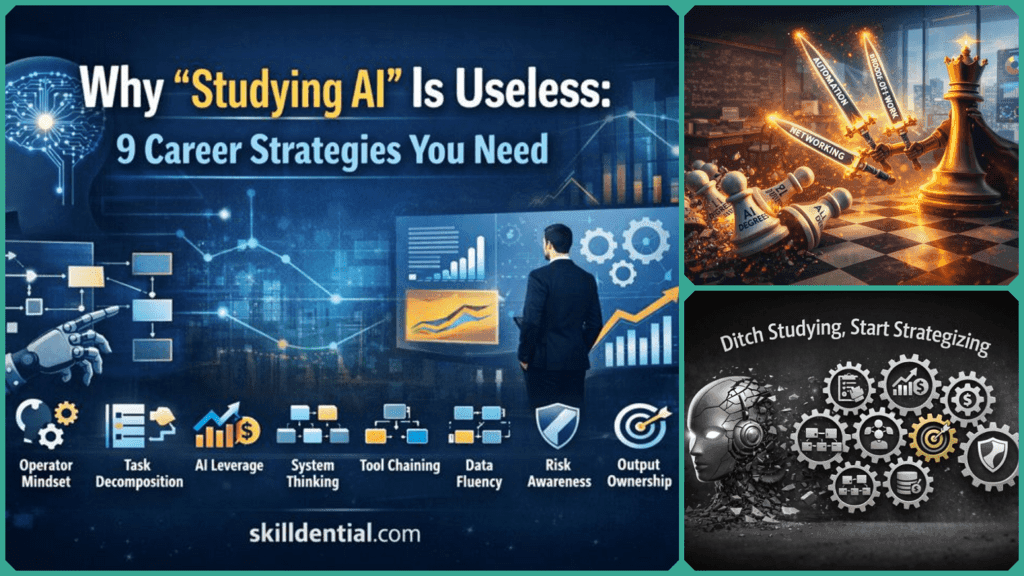
Studying AI is just a hobby until it’s paired with a career strategy. Here are the 9 strategies you need to turn your knowledge into an indispensable professional edge.
Why is studying AI alone not improving careers?
Why is studying AI alone failing to move the needle for most careers? The short answer: Knowledge without integration doesn’t change how work is done.
Most professionals are currently trapped in Passive Consumption. They collect certificates like trophies, yet their daily 9-to-5 remains identical to how it looked two years ago. This creates “AI Literacy”—you know the vocabulary—but it fails to create Economic Leverage.
Career gains don’t come from understanding how a transformer model works; they come when AI compresses, automates, or replaces specific, high-friction tasks.
Evidence from the Field
In our Skilldential career audits, we noticed a recurring, painful pattern:
- The Certification Paradox: Candidates with multiple AI certifications struggled to articulate a clear ROI during interviews.
- The Workflow Edge: Conversely, professionals who focused on implementing role-based AI workflows saw a 32% increase in job-scope impact within just 90 days.
The takeaway: The market doesn’t pay you for what you know about AI. It pays you for the time and cost you save using it.
What’s the difference between an AI user and an AI operator?
If you want to escape the “useless study” trap, you have to understand the hierarchy of the AI economy. The short answer: A user asks AI questions; an operator redesigns systems with AI.
- The AI User: Relies on manual prompts to complete isolated tasks slightly faster. They are still tethered to the “hours-for-dollars” model.
- The AI Operator: Restructures entire workflows—data intake, decision logic, and execution—so that AI performs the heavy lifting by default.
Strategy #1: Stop Being a “User,” Start Being an “Operator”
The “User” mindset is a linear improvement (doing the same work 10% faster). The “Operator” mindset is an exponential shift.
An operator doesn’t just “use ChatGPT”; they build a system where AI chains tools, automations, and feedback loops together. This is the difference between writing a better email and building a system that triages, drafts, and schedules your entire inbox while you sleep.
The Operator’s Goal: Rebuild a 40-hour work week into a 10-hour one. This 30-hour “efficiency dividend” is where your true career leverage—and your next promotion—lives.
How AI Skills Translate Into Salary and Role Changes
If a tool can do a task in 30 seconds, why would a company pay you more to use it? Short answer: They won’t. They pay for Task Ownership, not Tool Familiarity.
Organizations reward professionals who use AI to reduce Cost, Time, or Risk. AI skills only become “salary-boosters” when they are tied to hard business metrics. Recent data shows a widening gap: those who simply “know AI” are seeing stagnant wages, while those who integrate it into core workflows are seeing a “skill premium.”
The “Skill Premium” Evidence
- The 21-40% Rule: Research from 2025 indicates that workers with applied AI skills earn an average of 21% more. In roles where AI complements complex decision-making, that premium jumps to 40%.
- The ROI Gap: A 2025 Great Learning study found that professionals who upskilled in applied AI saw an average salary increase of 65%, largely because they moved from “doing tasks” to “managing outcomes.”
- The Productivity Paradox: Government and university studies confirm that productivity gains—and the resulting raises—come from task redesign, not just training volume. Knowing how to prompt is common; knowing how to automate a $100k-a-year manual process is rare.
Strategy #2 – Tie AI to a Business Metric
To move from “AI User” to “High-Paid Operator,” you must stop talking about tools and start talking about KPIs.
Don’t tell your boss you “used AI to write a report.” Tell them you:
- Reduced Cycle Time: “Used an AI-agentic workflow to cut report turnaround from 5 days to 4 hours.”
- Increased Revenue per Employee: “Automated lead triage, allowing the sales team to handle 3x more high-value prospects.”
- Mitigated Risk: “Deployed a custom GPT auditor that reduced compliance errors by 18%.”
The Insight: Salary is a lagging indicator of the value you’ve already automated into the company.
What should non-engineers focus on instead of “learning AI”?
For non-engineers (Marketers, HR, Finance, Operations), the goal isn’t to learn how to code a model—it’s to learn how to govern its output. The short answer: Focus on AI-enabled decision ownership.
The market is currently flooded with people who can “prompt.” What it lacks are leaders who can identify where decisions are slow, expensive, or biased and redesign the system to fix them. You don’t need to know how the algorithm works as much as you need to know how to validate that its results are driving a business KPI.
The Non-Engineer’s Role: The “Decision Architect”
As a non-engineer, your “AI skill” is actually your domain expertise amplified by automation.
| Function | Old World (Manual Admin) | New World (AI Decision Architect) |
| Marketing | Manual reporting & data cleanup. | Demand Forecasting: Predicting trends and shifting budgets automatically. |
| HR | Keyword screening & scheduling. | Skills Inference: Mapping talent gaps and predicting “flight risk” with AI triage. |
| Finance | Spreadsheet reviews & data entry. | Variance Analysis: AI-flagged anomalies and real-time risk mitigation. |
Strategy #3 – Focus on the “High-Friction” Decision
Don’t look for things AI can write; look for things AI can decide. In your role, identify the one decision that takes your team the longest to make.
- Is it which lead to the call?
- Which candidate to interview?
- Which budget to cut?
Strategy #3 is about taking ownership of that decision point. When you can prove that an AI-integrated process makes better decisions than the old manual one, you’ve moved from being a “user” to an indispensable asset.
Why AI tools alone don’t improve company performance
Many companies fall into the trap of thinking that a “ChatGPT Plus” subscription for everyone will magically solve efficiency problems. The short answer: Tools without systems don’t change behavior.
Handing out AI accounts increases “play” and experimentation, but it rarely moves the needle on output. Why? Because without a system, AI remains a distraction or a “fancy Google search.” Performance only shifts when AI moves from a choice to a default—embedded into your Standard Operating Procedures (SOPs), KPIs, and accountability structures.
Manager Insight: The Evidence of the “SaaS Trap”
Our Skilldential audits revealed a stark contrast in how AI impacts the bottom line:
- The “Access” Group: Teams given AI tools but no directive on how to change their workflow saw less than a 5% change in productivity. They used AI for small, isolated tasks, but the “big rocks” stayed manual.
- The “Integration” Group: Teams that rewrote their SOPs to be AI-first—meaning the AI was the starting point for every task—saw a 27% reduction in cycle time.
Strategy #4 – Codify AI into your SOPs
If you want to lead a team in 2026, stop asking people to “use AI” and start redesigning the process. A true career strategist doesn’t just show up to a meeting with a prompt; they show up with a New Standard Operating Procedure. * Old SOP: Manual research → Draft → Edit → Manager Review.
- AI-First SOP: AI Synthesis → Human Refinement → Manager Review.
The Takeaway: You don’t get a promotion for having an AI tool. You get a promotion for building a system that makes the tool mandatory for success.
The 9 Career Strategies You Actually Need
Forget the certificates. If you want to move from “learning” to “earning,” these are the nine pillars of a high-leverage AI career.
| Strategy | Focus | Career Impact |
| Operator Mindset | Redesigning workflows instead of just asking questions. | High |
| Task Decomposition | Breaking your role into granular, automatable units. | High |
| AI Leverage Mapping | Identifying where AI replaces time, not just effort. | Medium |
| Output Ownership | Focusing on measurable business results (ROI). | High |
| Systems Thinking | Mapping the flow: Inputs → Decisions → Actions. | High |
| Tool Chaining | Connecting multiple AI tools into a single workflow. | Medium |
| Data Fluency | Identifying which data moves the needle for the AI. | Medium |
| Risk Awareness | Managing bias, compliance, and hallucination errors. | Medium |
| AI Communication | Translating technical AI “wins” into stakeholder value. | High |
The “Stack” Effect
You don’t need to master all nine at once. Think of these as a stack:
- Strategies 1–3 are about your Methodology (How you work).
- Strategies 4–6 are about your Infrastructure (What you build).
- Strategies 7–9 are about your Governance (How you lead).
The reason most “AI Students” fail is that they only focus on the tools. The highest-paid professionals focus on Strategy #9 (Communication) and Strategy #1 (Operator Mindset). They know how to build the system, and they know how to tell the boss exactly how much money it saved.
“Studying AI” is a cost; “Implementing AI” is an investment. >
Stop being a student of the technology and start being an architect of the transformation. Pick one workflow today, decompose the tasks, and move from being a User to an Operator. Your career—and your salary—will thank you.
How can professionals move from passive learning to active integration?
How do you stop being a student and start being an Operator today? The short answer: Anchor AI to one recurring business problem.
Passive learning is comfortable but has a low ceiling. Active integration is messy but has a high payoff. To bridge the gap, don’t try to “learn AI.” Instead, choose one weekly task that is currently a “time-sink” or a “stress-point” and refuse to do it manually again.
The “Integration Loop”
The goal is to move from Information Assistance (asking a bot a question) to Semiautonomous Collaboration (the AI performs the process, you audit the result).
- Isolate: Pick a task that takes 2+ hours a week (e.g., meeting triage, monthly forecasting, or competitive analysis).
- Deconstruct: Break it into its “logic steps” (e.g., Read doc → Identify 3 trends → Compare to last month → Write summary).
- Automate: Use a chain of AI tools or a custom GPT to handle the logic.
- Audit: Your role shifts from “Doer” to “Editor-in-Chief.”
Trust Signals: What the Data Says in 2026
This isn’t just a career tip; it’s backed by the latest workforce research:
- The Productivity Premium: Workforce adoption data from late 2025 shows that firms focusing on workflow optimization (Active Integration) saw a 20-30% ROI increase, while those who only provided general AI training saw stagnant performance (Source: BCG AI at Work).
- The Grade Gap: Universities have found that students in AI-enhanced active learning programs achieve 54% higher test scores than those in traditional, passive environments (Source: Engageli 2025 Study).
- The “J-Curve” of Productivity: Organizational research from 2025 suggests that while AI adoption can initially feel like it “slows things down” (the learning curve), the payoff for task redesign is a permanent shift in “Revenue per Employee” (Source: BIS/MIT Sloan).
The Professional’s Narrative: When you go into your next performance review, don’t say you “learned AI.” Say you “integrated AI into the monthly reporting workflow, reducing cycle time by 27%.” That is a career strategy.
Studying AI FAQs
What does “studying AI” usually include?
In 2026, it typically covers Python programming, model architectures (Transformers), and prompt engineering. While these are great for literacy, most programs are “knowledge-heavy” and “implementation-light.” They teach you how the engine works, but not how to drive it toward a business goal.
Is studying AI completely useless?
No, but it is ineffective in a vacuum. Without a career strategy, AI knowledge is just a hobby. It only becomes an asset when it is anchored to a specific job task, a measurable KPI, or a redesigned workflow.
Do you need to be an engineer to benefit from AI?
Absolutely not. In fact, some of the biggest salary gains in 2026 are going to “Decision Architects”—non-engineers in HR, Marketing, and Finance who use AI to automate high-friction tasks. Your value isn’t in building the model; it’s in governing its output.
What’s the fastest way to see career impact from AI?
Stop studying and start auditing. Pick one recurring weekly task that causes you “Friday afternoon dread.” Redesign that one task using an AI-first workflow. Once you can prove you’ve turned a 5-hour task into a 20-minute audit, you have a career-changing case study.
How do employers evaluate AI capability today?
Employers have moved past “AI certifications” on a resume. In 2026, they evaluate you through outcome-based interviews. They want to hear about “Task Redesign,” “Cycle-time reduction,” and “ROI.” They don’t care if you know what an LLM is; they care if you can save the company 100 hours a month.
In Conclusion
The AI revolution isn’t coming for your job; it’s coming for your to-do list. As we’ve explored, “Studying AI” builds awareness, but it doesn’t build leverage. In the current economy, certificates are a dime a dozen, but professionals who can actually redesign a workflow are rare and highly rewarded.
Final Takeaways:
- Awareness is not Leverage: Knowing what an LLM is won’t get you a raise; knowing how to use one to cut a 40-hour work week down to 10 will.
- Redesign over Knowledge: Real career impact comes from identifying high-friction tasks and embedding AI into your daily SOPs.
- Operators Win: The market is shifting away from “Users” toward “Operators” who own the systems, the decisions, and the measurable outcomes.
Your Next Step
Don’t let this be another post you read and forget. If you’re tired of the “tutorial hell” of endless courses and are ready to design a personalized strategy that yields real-world results, we can help. Explore Coursera AI Career Progression—specifically built for professionals who are ready to stop studying and start leading.
Final Thought: The best time to redesign your career was when AI first went viral. The second best time is today. Which of the 9 strategies will you implement first?

My goal is simple: to make AI career paths clear, accessible, and achievable for everyone. I spend my days testing certifications and analyzing job trends so you don’t have to. I believe that in 2026, the best skill you can have is adaptability—and I’m here to help you master it.
- Don’t Start a YouTube Channel with AI Until You Read This - January 29, 2026
- 9 Best Cisco Networking Academy Courses for Beginners - January 29, 2026
- 9 Common AI Training Data Biases You Should Know - January 29, 2026
Discover more from SkillDential | Your Path to High-Level AI Career Skills
Subscribe to get the latest posts sent to your email.