7 Best AI Engineer Remote Career Roadmaps Without a Degree
An AI engineer remote career is a highly technical path focused on designing, building, and deploying AI-driven systems that run in production, often accessed via APIs or cloud-hosted services. In practice, most remote-first AI engineering roles emphasize implementation—specifically, engineering prompt structures, orchestration frameworks, vector databases, and scalable deployment pipelines—rather than PhD-level theoretical research.
Consequently, the barriers to entry are shifting; many global companies now hire professionals for an AI engineer remote career based entirely on demonstrated proof-of-work, including production-ready GitHub repositories, live-deployed applications, and clear system-design thinking, regardless of formal degree status.
However, navigating an AI engineer remote career successfully without a traditional pedigree requires a highly structured approach; credible portfolios, rigorous self-education, and continuous upskilling remain non-negotiable prerequisites for long-term employability in this competitive market.
Demystifying the AI Engineer vs. PhD Researcher
The core distinction lies in application versus invention. A PhD-level researcher invents new architectures, derives mathematical optimization functions, and publishes academic papers. Conversely, an applied AI engineer treats machine learning models and AI primitives as API-scale components to solve real-world business problems within production software systems.
For the vast majority of remote job openings, employers prioritize engineering competence over academic pedigree. The primary requirements are robust software engineering practices, efficient model orchestration, and reliable cloud deployments, not an advanced degree in theoretical mathematics.
The 80/20 Rule of Remote AI Engineering
To optimize for rapid employment without a formal degree, focus entirely on the engineering layer where the highest volume of remote market demand exists.
+------------------------------------------------------------+
|                  APPLIED AI ENGINEERING (80%)              |
|  - API Integration & Fine-Tuning                           |
|  - RAG Architecture & Vector Databases                     |
|  - Production Deployment (Docker, LLMOps)                  |
+------------------------------------------------------------+
| RESEARCH (20%)                                             |
| - Custom Architectures / Academic Novelty                  |
+------------------------------------------------------------+
The Engineering Layer (80% of Remote Market Value)
This is the execution-based core that non-degree candidates must master. It comprises three foundational pillars:
- API-Driven Architecture & Model Adaptation: Integrating foundation models from providers like OpenAI and Anthropic, alongside utilizing open-weight models via Hugging Face. This includes executing targeted parameter-efficient fine-tuning (PEFT/LoRA) to adapt models to specific domain data.
- Context Engineering & Retrieval-Augmented Generation (RAG): Structuring advanced prompt engineering frameworks, building robust RAG pipelines, and managing vector databases like Pinecone, Qdrant, or Weaviate to supply models with external, real-time context.
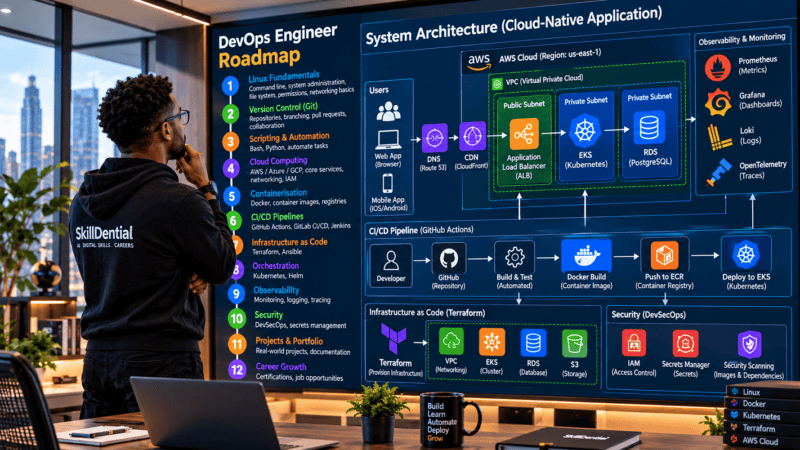
- Production Infrastructure & LLMOps: Packaging applications using containerization (Docker), managing deployments through orchestration tools, and using major cloud platforms (AWS, GCP, or Azure) to ensure scalable, low-latency model serving and monitoring.
The Research Layer (20% of Market Value)
This layer involves deep-learning architecture design, training foundational models from scratch, or building custom reinforcement learning pipelines. Because these roles typically require heavy academic validation or deep mathematical specialization, they are rarely entry-level.
For non-traditional paths, skipping this research layer entirely and specializing deeply in applied AI engineering represents the fastest, highest-leverage route to remote employability.
The Reality of a Degree-Free AI Engineer Remote Career
Remote AI engineering roles are fundamentally outcome-driven. In a distributed working environment, tracking inputs like university credentials is inefficient; employers prioritize verifiable output and deployment capability instead.
Consequently, many remote-first organizations explicitly state that they accept portfolio-based candidates, provided the applicant can clear the technical evaluation process.
However, operating without an academic credential requires you to intentionally compensate by stacking high-signal proof-of-work indicators. To bypass traditional HR filters, your public profile must display a combination of:
- Production-Grade Projects: Live, public-facing applications that solve distinct business or technical problems.
- Open-Source Contributions: Verifiable commits to recognized AI frameworks, orchestration tools, or libraries.
- Written Technical Analyses: Deep-dive articles or system design breakdowns that demonstrate your architectural reasoning and technical communication.
Data Insights: The Tutorial Trap vs. Job-Ready Systems
Data from internal Skilldential career audits indicates a critical point of failure for self-directed learners: the inability to properly frame technical work. Most non-degree candidates struggle because their portfolios look like a collection of generic course tutorials rather than production-grade systems.
To bridge this gap and establish immediate technical authority, you must transition from simple script-writing to building standardized, enterprise-ready repositories.
| Portfolio Element | The Tutorial Trap (Low-Signal) | The Job-Ready System (High-Signal) |
| Codebase State | Loose Python scripts running only in local Jupyter Notebooks. | Modular, object-oriented Python package with clear separation of concerns. |
| Testing | No formal testing; manual verification via print statements. | Automated suite using pytest covering edge cases and integration points. |
| Documentation | A brief README.md listing only the project title and dependencies. | Comprehensive documentation including system architecture diagrams, API references, and explicit setup guides. |
| Automation | Manual execution and local environment dependencies. | Integrated CI/CD pipelines (e.g., GitHub Actions) executing automated linting, testing, and container builds on every commit. |
Implementing this standardized portfolio template directly addresses the risk profile of a non-degree applicant. Audits show that shifting from tutorial-style presentation to this structured engineering framework results in an approximate 40% increase in remote interview callback rates.
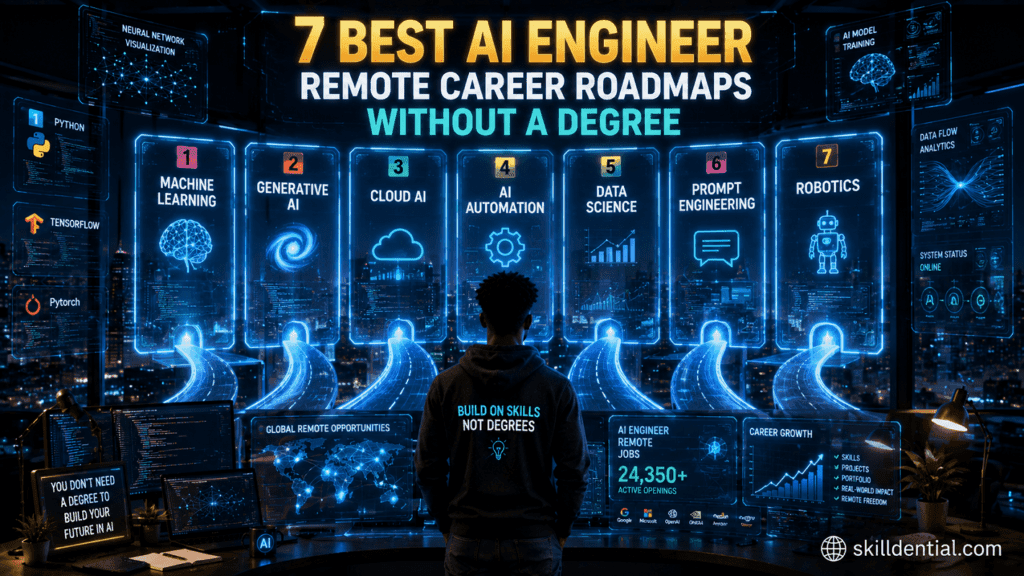
7 MECE AI Engineer Remote Career Roadmaps
Each roadmap below is mutually exclusive in focus but collectively exhaustive in covering the main remote-first AI engineering niches.
Open-Source AI Engineer (LLM-First)
- Focus: Transitioning into an expert or core contributor on open-source LLM orchestration and serving infrastructures to build highly customized, self-hosted AI stacks.
- Core Stack:
- Languages: Python, TypeScript
- Frameworks: LangChain, LlamaIndex, vLLM, Transformers
- Infrastructure: Docker, FastAPI, Hugging Face Hub, GitHub Actions
- Local Tools: Ollama, LiteLLM Proxy
- Execution Plan:
- Build 3 to 5 highly reusable tooling libraries, boilerplate code repositories, or infrastructure templates (e.g., an asynchronous RAG pipeline boilerplate or an agentic workflow template) and publish them cleanly on GitHub.
- Actively contribute bug fixes, performance optimizations, or deep documentation updates to at least two major open-source LLM projects (e.g., LangChain, vLLM, or mainstream vector database Python SDKs).
- Remote Job Fit: Early-stage startups, boutique AI development agencies, and technical founders who want to deploy self-hosted open-weights models to avoid SaaS API dependency, data privacy bottlenecks, or volatile token costs.
Full-Stack AI Engineer (AI Product Builder)
- Focus: Shipping end-to-end, user-facing AI products by managing everything from front-end user experience to back-end system execution and model integration.
- Core Stack:
- Frontend: React, Next.js, Tailwind CSS
- Backend: Node.js, Python (FastAPI or Django)
- AI Layer: LangChain/LlamaIndex, OpenAI/Anthropic APIs, vector databases
- Infrastructure: Vercel, Railway, Supabase, PostgreSQL, Docker, GitHub Actions
- Execution Plan:
- Design, build, and publicly deploy exactly 3 original apps: an AI-powered SaaS MVP (e.g., an automated content engine or an intelligent resume-tailoring application), a production-grade RAG chatbot optimized for internal company documentation, and an AI-enabled analytics dashboard.
- Document each project thoroughly as an individual technical case study breakdown detailing system architecture, API data flows, cost-per-request profiles, and system evaluation metrics.
- Remote Job Fit: Distributed startups and product-centric teams that require autonomous software engineers capable of owning both user experience design and applied AI logic.
Low-Code / No-Code AI Integrator
- Focus: Enabling non-technical business units to scale internal workflows and ship functional AI features using visual automation builders and API connectors.
- Core Stack:
- Platforms: Retool, Bubble, Make, Zapier, Airtable
- AI Connectors: OpenAI, Anthropic, Custom REST-based LLM endpoints
- Scripting: Python and JavaScript for custom glue code or data manipulation
- Orchestration: Airtable automations, Notion internal webhooks, custom Make scenarios
- Execution Plan:
- Build and test 3 comprehensive business automation suites: a sales operations assistant that handles automated lead scoring and dynamic email drafting, a customer support triage engine that executes ticket routing and drafts contextual responses, and an internal business operations dashboard surfacing automated data insights.
- Package these suites into clean, modular, and reusable templates accompanied by explicit setup documentation.
- Remote Job Fit: Growing SaaS organizations, operational agencies, and remote companies seeking to democratize AI capabilities across departments without dedicating full-stack software engineering hours to internal tooling.
Enterprise-Grade DevOps / LLMOps Engineer
- Focus: Deploying, scaling, and managing large-scale, production-ready AI workloads with a strict emphasis on system monitoring, reliability, data security, and cloud infrastructure cost-optimization.
- Core Stack:
- Cloud Services: AWS (SageMaker, EC2, Lambda), GCP (Vertex AI), or Azure Machine Learning
- Infrastructure Automation: Kubernetes, Docker, Terraform, GitHub Actions
- LLMOps Tooling: MLflow, Weights & Biases, LangSmith, Enterprise Vector DBs (e.g., Pinecone or Qdrant cluster deployments)
- Monitoring: Prometheus, Grafana, structured JSON logging frameworks
- Execution Plan:
- Design and implement a fully automated LLMOps pipeline for an open-weights model tracking the entire lifecycle: initial baseline evaluation, automated packaging, secure cloud deployment, centralized request logging, performance monitoring, and zero-downtime rollbacks.
- Publish a technical architecture report documenting engineering decisions regarding cost-versus-latency trade-offs, model quantization (e.g., FP8 vs. AWQ), A/B testing frameworks, and systemic error handling.
- Remote Job Fit: Mid-size to enterprise-scale technology companies migrating legacy operational workloads to AI architectures where infrastructure uptime, system latency, and compliance are paramount.
Data-First AI Engineer (Analytics + AI)
- Focus: Designing and maintaining robust data architectures and automated ETL pipelines, then layering applied machine learning and LLM capabilities on top to generate business intelligence.
- Core Stack:
- Data Pipelines: Python, SQL, Pandas, Apache Airflow, Prefect
- Data Infrastructure: PostgreSQL, Snowflake, Google BigQuery
- AI/ML Libraries: Scikit-learn, Hugging Face Transformers, LLMs for structured data synthesis
- Data Presentation: Power BI, Looker, Metabase, Streamlit
- Execution Plan:
- Construct a clean “data-to-AI” pipeline that ingests a massive, unformatted real-world public dataset, executes automated data cleaning, stores the processed data in a relational format, and uses an ML model or structured LLM pipeline for data classification or predictive scoring.
- Serve the resulting insights through a live Streamlit dashboard and publish a deep-dive data narrative breaking down the business impact of the findings.
- Remote Job Fit: Data-driven enterprises and remote teams requiring specialized engineers who can comfortably navigate complex database schemas before designing downstream predictive features or automation layers.
Computer Vision / Edge-AI Engineer
- Focus: Deploying optimized, low-latency computer vision and machine learning models directly onto resource-constrained edge devices or local hardware networks.
- Core Stack:
- Languages: Python, C++
- Frameworks: PyTorch, OpenCV, ONNX, TensorFlow Lite
- Optimization runtimes: ONNX Runtime, NVIDIA TensorRT, Intel OpenVINO, edge-optimized YOLO variants
- Deployment: Docker, edge-optimized runtimes
- Execution Plan:
- Engineer 3 highly optimized vision application projects: a real-time object detection application processing a live video stream, an edge-based anomaly detection script tailored for manufacturing defect identification, and a mobile-compatible vision model.
- Author a system configuration breakdown explaining your optimizations regarding hardware latency limits, model size reductions, and on-device compute constraints.
- Remote Job Fit: Hardware startups, robotics companies, logistics platforms, and industrial automation firms hiring distributed specialists to own localized computer vision and video analytics pipelines.
Applied AI Consultant (Remote-First Freelancer)
- Focus: Packaging specialized AI development and implementation skills into repeatable, high-margin freelance service contracts rather than traditional full-time employment roles.
- Core Stack:
- Core Tech: Python, LangChain, mainstream LLM APIs, production RAG configurations, cloud primitives
- Business Operations: Notion, Figma, Stripe, Calendly, professional landing pages
- Client Acquisition: LinkedIn, GitHub, structured technical case studies
- Execution Plan:
- Formulate 3 clearly scoped, fixed-price productized service offerings: an “AI Workflow Audit” (identifying and mapping 3 immediate automation vectors), an “AI-Powered App MVP in 2 Weeks” (shipping a functional product prototype), and an “Enterprise RAG Chatbot for Internal Docs.”
- Secure and deliver 5 paid projects for clients, documenting each successful implementation via anonymized, outcome-focused case studies showing measurable business metric improvements.
- Remote Job Fit: Independent consulting, fractional engineering arrangements, and specialized contract work for small-to-medium businesses that prioritize rapid execution and clear business outcomes over formal academic credentials.
Comparison Table: 7 Remote-First AI Engineer Paths
| Roadmap Focus | Core Skills (Simplified) | Typical Remote Fit |
| Open-Source AI Engineer (LLM-First) | Python, LangChain, vLLM, OSS contributions | LLM-tooling startups, infrastructure teams |
| Full-Stack AI Engineer | React, Next.js, FastAPI, RAG, deployment | Product-first startups, SaaS companies |
| Low-Code / No-Code AI Integrator | Retool, Bubble, Zapier, AI connectors, scripting | Internal operations teams, digital agencies |
| Enterprise-Grade DevOps/LLMOps | Cloud (AWS/GCP), Kubernetes, Docker, MLflow, observability | Enterprise-scale companies, regulated tech sectors |
| Data-First AI Engineer | SQL, Python, ETL analytics, basic ML, dashboards | Data-driven startups, BI business units |
| Computer-Vision / Edge-AI Engineer | PyTorch, OpenCV, ONNX, edge optimization tools | Hardware startups, robotics-adjacent teams |
| Applied AI Consultant (Freelancer) | LLMs, RAG configurations, client sales, case studies | Remote agencies, fractional contracts, SMBs |
How to Replace a Degree with a High‑Signal Portfolio
An academic degree functions as a proxy for trust. To bypass it, your portfolio must offer an identical level of technical validation. When an interviewer asks, “Show me what you have shipped,” your public repositories must serve as undeniable proof of engineering competence, structural discipline, and system reliability.
The Standardized GitHub Repository Blueprint
Every project repository in your portfolio must function as if it belongs to an enterprise-grade codebase. Avoid loose, undocumented script folders. Each repository requires the following structural components:
Production-Grade README.md
Your documentation must immediately communicate architectural competence. Structure it with these explicit sections:
- The Problem: The precise business or technical challenge the application addresses.
- Architecture Diagram: A clear flowchart mapping data ingestion, model orchestration, vector retrieval, and user-facing endpoints.
- Getting Started & Execution: Step-by-step instructions to clone, configure, and spin up the environment locally.
- Testing Guide: Explicit instructions on running the integrated test suites.
Automated Rigor (Testing and CI/CD)
- Test Coverage: Code must include both unit tests (e.g., verifying prompt parsers or data formatting functions) and integration tests (e.g., validating API response handling or database storage updates) using frameworks like
pytest. - Continuous Integration: Configure a
.github/workflowspipeline (e.g., GitHub Actions) that automatically runs linters, security scans, and your test suite on every code push or pull request.
Environment Security & Live Deployment
- Secrets Management: Never commit raw API keys or database passwords. Include a
.env.examplefile outlining all necessary environment variables. - The Live Signal: Every project must include a link to a functional, live-deployed demo or a recorded, high-resolution technical walkthrough proving the system functions beyond a local machine environment.
Portfolio Composition: The 3-Project Minimum Bar
To demonstrate versatility across the applied AI stack, your portfolio must contain at least three core projects covering distinct engineering challenges:
+--------------------------------------------------------------------------+
|                        THE APPLIED AI TRINITY                            |
+--------------------------+--------------------+--------------------------+
|        PROJECT 1         |     PROJECT 2      |        PROJECT 3         |
| Pure API-Driven Service  |  Full-Stack Product|  Infrastructure/LLMOps   |
|   (Core Logic & RAG)     | (UX & Architecture)| (Scale & Sustainability) |
+--------------------------+--------------------+--------------------------+
- The Pure API-Driven AI Service: Focuses heavily on the core AI logic. This includes advanced retrieval-augmented generation (RAG) pipelines, complex agentic workflows, or parameter-efficient model fine-tuning.
- The Full-Stack AI Product: Focuses on integration and user experience. This couples a responsive frontend with a reliable backend API, managing asynchronous state, user authentication, and secure streaming responses.
- The Infrastructure / LLMOps Pipeline: Focuses on scale and system sustainability. This involves automated model deployment, request monitoring, logging pipelines, or scalable data-to-AI ETL transformations.
Writing Technical Case Studies (Your Technical Capital)
Code alone does not fully convey engineering rationale. Treat every major project as a mini-architectural whitepaper. Document your decision-making framework and publish it as a case study.
The Case Study Structure
- Problem Statement: Define the operational constraints, scale requirements, or performance bottlenecks you set out to solve.
- Architectural Trade-Offs: Explicitly defend your technology choices based on first principles. Do not just list tools; explain why you chose LangChain over a bare-API implementation, or why you deployed and managed a vector database like Pinecone versus an in-memory solution like FAISS.
- System Evaluation Metrics: Provide hard data. Report on measurable system outcomes such as end-to-end request latency, retrieval accuracy, token cost optimization, and error handling thresholds under simulated load.
Distribution Strategy
Publish these case studies where hiring managers and technical founders look for engineering talent:
- Your personal engineering blog or directly within the project’s GitHub Wiki.
- Deep-dive technical articles shared on LinkedIn, Substack, or Medium to establish domain authority.
- Contributions to open-source project documentation or community tutorials, linking your work directly back to the wider AI developer ecosystem.
How to Get Remote AI Engineer Roles Without a Pedigree
Remote AI engineering hiring is heavily biased toward visible output and demonstrable system-design skills rather than traditional academic credentials. To successfully bypass HR filters, you must direct your search toward platforms that prioritize execution over pedigree.
High-Leverage Platforms
- Wellfound (formerly AngelList Talent): The primary hub for early-stage and growth-stage tech startups. Startups regularly favor portfolio-based verification because they need immediate builders over theoretical researchers.
- Specialized AI Job Boards: Focus on targeted niche platforms like
AIJobs.net,AIJobs.com, andAIJobs.aithat cater explicitly to teams looking for applied machine learning and language model engineering skill sets. - Remote-First Marketplaces: Consistently audit established distributed-work platforms, including
We Work Remotely,RemoteOK,FlexJobs, andRemotive.
Search Syntax and Keyword Optimization
Do not limit your queries exclusively to generic titles. Filter listings by targeting specific tooling layers and core infrastructure components within job descriptions:
+-------------------------------------------------------------------------+
|                       TARGET SEARCH ARCHITECTURE                        |
+--------------------------+--------------------+-------------------------+
|     ROLE-BASED TERMS     | ENGINE/STACK TERMS |    ARCHITECTURE TERMS   |
|   - AI Engineer          |   - MLOps          |   - RAG                 |
|   - LLM Engineer         |   - LLMOps         |   - LangChain / vLLM    |
|   - ML Engineer          |   - Docker / K8s   |   - Vector Databases    |
+--------------------------+--------------------+-------------------------+
Technical Positioning and Asynchronous Networking
Without a university pedigree, your public digital footprint must actively establish your engineering capability. You must convert passive browsing into active, technical proof of work.
Proof-of-Execution Content (LinkedIn & Substack)
- Publish 2 to 3 concise, highly technical implementation breakdowns every month.
- Avoid high-level concepts or generic explanations. Focus instead on structural execution: “How I engineered a production-grade RAG pipeline using vLLM and Qdrant to process 10,000 document queries under 200ms.”
- Include architectural diagrams, links to public repositories containing test suites, and explicit breakdowns of your optimization choices.
Strategic Micro-Networking
- Identify and follow core engineers, technical founders, and engineering managers at distributed AI startups or framework teams (e.g., LangChain, LlamaIndex, Pinecone).
- Engage with their technical posts directly. Avoid vague praise; provide specific, high-signal comments regarding code optimizations, architectural edge cases, or model deployment trade-offs.
Technical Interview Mastery: The System-Design Engine
Remote interview loops for non-traditional candidates heavily evaluate real-time system design capability and live API orchestration.
What to Expect in Live Assessments
- Applied API Integration: You will frequently be handed unformatted raw data (such as a messy CSV or an unstructured text file) and instructed to build a live, local document-search API utilizing an embedding model and a vector database within a fixed 45-minute window.
- Production-Grade Scripting: Code elegance, proper error handling, environment security (secrets isolation), and structural separation of concerns matter as much as the final output.
Navigating System-Design Case Studies
Interviewers routinely evaluate architecture via prompts such as: “Design a high-throughput, AI-powered internal customer support triage system for a global SaaS enterprise.”
To clear this benchmark, verbally articulate your engineering decisions out loud using an analytical framework:
- Latency Trade-Offs: Defend your choice of model size and quantization strategies (e.g., choosing an open-weights model running FP8 via vLLM for rapid inference over a larger closed SaaS API model).
- Cost Governance: Outline cache orchestration layers (like Semantic Caching via Redis) to prevent redundant upstream API token spending.
- Reliability Infrastructure: Diagram automated retry strategies with exponential backoff, structural fallback routes when primary API limits are exceeded, and evaluation suites (e.g., LangSmith or Phoenix) to monitor for context drift and hallucinations.
What is an AI engineer in a remote-first context?
An AI engineer in a remote-first context designs, builds, and maintains production-grade, AI-powered systems that run in cloud or distributed environments, often accessed via APIs, microservices, or web applications.
Unlike isolated research roles, remote AI engineers collaborate closely with asynchronous product, data, and infrastructure teams. They focus heavily on software engineering fundamentals, model orchestration, and cost-latency optimizations rather than theoretical algorithm design.
Can you become an AI engineer without a computer science degree?
Yes. The distributed tech market increasingly favors verifiable execution over traditional academic credentials. Many remote-first organizations bypass HR degree filters entirely for candidates who demonstrate strong, production-ready portfolios featuring comprehensive test suites, automated CI/CD pipelines, and clear system documentation.
Success without a degree requires executing a structured learning path, mastering the applied engineering layer, and demonstrating practical system-design thinking during technical evaluations.
What skills are most important for a remote AI engineer?
Technical competence and robust asynchronous communication habits are equally critical:
Core Engineering Stack: Proficiency in Python or TypeScript, REST/gRPC API design, relational and non-relational databases, and cloud platforms (AWS, GCP, or Azure).
AI Orchestration Layer: Deep familiarity with frameworks like LangChain, LlamaIndex, or vLLM, alongside vector databases (Pinecone, Qdrant, or Weaviate) for RAG implementation.
Remote-First Workflow Hygiene: Strict git discipline, structured logging, automated containerization (Docker), and explicit system documentation to allow distributed teams to easily review and maintain your code.
How long does it take to build a job-ready AI engineer portfolio?
For a highly motivated learner practicing full-time, building a job-ready portfolio typically requires 6 to 12 months, depending heavily on prior programming background.
This timeline is optimized by focusing entirely on the 80% applied engineering layer and omitting deep academic research and math. The objective is to ship 3 to 5 standardized, production-grade projects that span API-driven services, full-stack MVPs, and LLMOps deployment pipelines, each accompanied by a technical whitepaper or case study breakdown.
Are remote AI engineer roles usually contract or full-time?
The remote market offers a balanced mix of both arrangements, dictated largely by company maturity. Early-stage startups, boutique development agencies, and firms migrating legacy workflows often hire independent contractors or fractional engineers to spin up initial AI infrastructure rapidly.
Conversely, enterprise technology organizations and well-funded SaaS companies prioritize full-time remote hires to ensure long-term code ownership, system reliability, and compliance alignment.
In Conclusion
The landscape of an AI engineer remote career has structurally decoupled from traditional institutional gating. The market is overwhelmingly dominated by applied implementation work—orchestrating APIs, configuring vector databases, and managing containerized deployment pipelines—rather than theoretical machine learning research.
This pragmatism directly lowers the barrier to entry for high-agency, non-degree engineers. A high-signal engineering portfolio consisting of 3 to 5 production-grade projects completely replaces a university credential when it is rigorously paired with comprehensive documentation, automated testing, and technical case studies.
The seven mutually exclusive, collectively exhaustive roadmaps detailed above map out the precise terrain of the remote-first economy: LLM-tooling, full-stack applications, low-code integrations, LLMOps infrastructure, data-first AI, edge computer vision, and specialized freelance consulting.
The strategy for market entry requires absolute focus: select the one roadmap that aligns with your current technical strengths (whether that is web development, data engineering, or cloud operations), and commit to shipping exactly one end-to-end system per month for the next 3 to 6 months. Treat every deployment as an open-source whitepaper, document your architectural trade-offs, and let your running code serve as your primary credential.