Machine Learning Engineer vs Data Engineer: Which is Better?
Deciding between a career as a Machine Learning Engineer or a Data Engineer requires an analysis of where you want to sit within the data lifecycle. A Machine Learning Engineer is the superior choice if your objective is to build, train, deploy, and monitor AI models that drive predictive insights.
Conversely, becoming a Data Engineer is more strategic if you prefer to design the robust data pipelines and architectures that make those models possible.
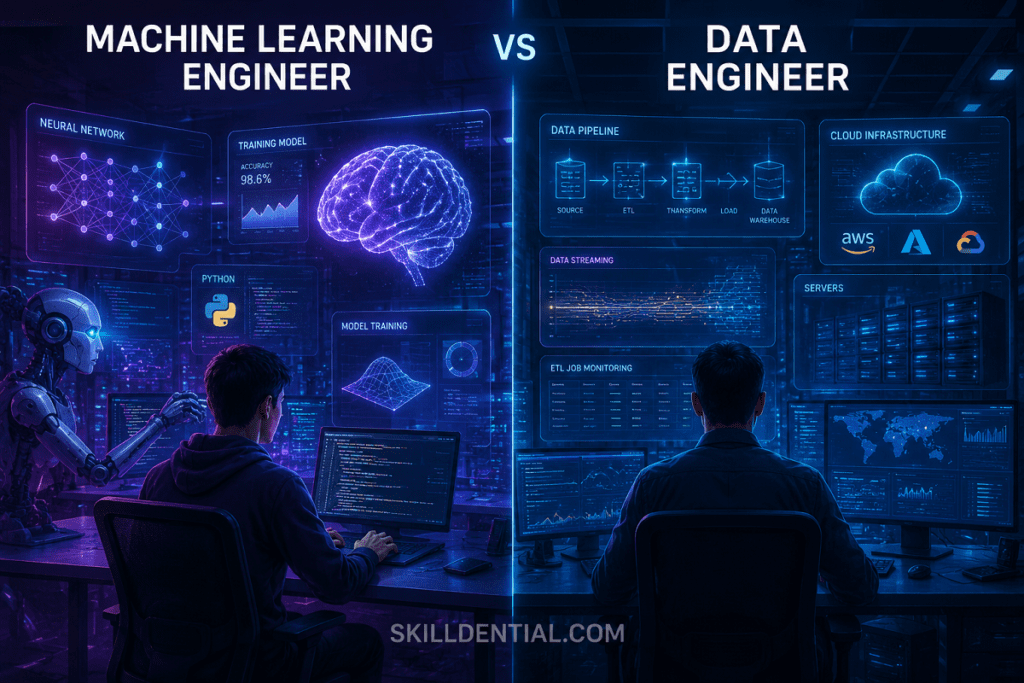
Ultimately, the better choice depends on your technical preference: the Machine Learning Engineer focuses on model optimization and experimentation, while the Data Engineer focuses on prioritizing infrastructure, database management, and building scalable data systems.
Functional Comparison: Operational Responsibilities
The distinction between these roles lies in their position within the technical stack. While both intersect at the data interface, their primary objectives and daily outputs differ significantly.
Machine Learning Engineer: The Model Lifecycle
A Machine Learning Engineer focuses on the end-to-end lifecycle of production ML systems. This role bridges the gap between a Data Scientist’s experimental code and a scalable software product.
- Model Training & Optimization: Selecting algorithms and tuning hyperparameters to maximize predictive accuracy.
- Deployment (MLOps): Integrating models into production environments using containers (Docker/Kubernetes) and APIs.
- Monitoring & Maintenance: Tracking model drift and performance latency to ensure the system remains reliable post-deployment.
- Inference Engineering: Optimizing models for high-throughput or low-latency requirements.
Data Engineer: The Infrastructure Layer
A Data Engineer focuses on the underlying architecture that enables data-driven applications. Without high-quality data pipelines, the Machine Learning Engineer cannot function.
- ETL/ELT Development: Extracting data from disparate sources, transforming it for analysis, and loading it into centralized repositories.
- Data Quality & Governance: Implementing validation checks to ensure data integrity, consistency, and security across the organization.
- Orchestration: Using tools like Apache Airflow or Prefect to manage complex task dependencies within the pipeline.
- Storage & Warehousing: Designing and managing cloud data warehouses (Snowflake, BigQuery) and data lakes to handle massive scales of structured and unstructured information.
Technical Divergence: Tools and Workflows
The workflow of a Machine Learning Engineer is cyclical and experimental, whereas the Data Engineer’s workflow is linear and structural. This distinction is best understood by analyzing their primary toolsets and the specific technical hurdles they solve.
Machine Learning Engineer: The Model Interface
A Machine Learning Engineer operates at the intersection of software engineering and data science. The objective is to translate statistical models into high-performance software components.
- Primary Stack: Python, ML frameworks (PyTorch, TensorFlow, Scikit-learn), and MLOps platforms (MLflow, Kubeflow).
- Key Problems:
- Model Drift: Detecting when the statistical properties of target variables change over time.
- Latency: Optimizing the time it takes for a model to return a prediction (inference) once triggered.
- Retraining Pipelines: Automating the process of updating models with new data without breaking production services.
Data Engineer: The Data Backbone
A Data Engineer builds the “plumbing” that feeds the entire organization. Their work ensures that the Machine Learning Engineer has a clean, reliable stream of features to utilize.
- Primary Stack: SQL, Spark, Apache tools (Kafka, Airflow), and cloud data platforms (AWS Redshift, Azure Synapse, Google BigQuery).
- Key Problems:
- Data Throughput: Managing the volume and speed at which data moves through the system.
- Schema Evolution: Handling changes in data structure from upstream sources without crashing downstream pipelines.
- Reliability: Ensuring 99.9% uptime for critical ETL (Extract, Transform, Load) jobs that populate the data warehouse.
Comparison of Focus Areas
| Aspect | Machine Learning Engineer | Data Engineer |
| Logic Focus | Stochastic/Probabilistic | Deterministic/Structural |
| Efficiency Metric | Inference Latency & Accuracy | Pipeline Throughput & Latency |
| Data Interaction | Feature Engineering & Sampling | Partitioning, Indexing & Storage |
| System Goal | Intelligent Output/Automation | Reliable Data Accessibility |
In technical environments, the Machine Learning Engineer is the consumer of the infrastructure that the Data Engineer provides. The former focuses on the intelligence derived from the data, while the latter focuses on the utility and mobility of the data itself.
Complexity Assessment: The Learning Curve
Determining which path is “harder” depends on your existing technical foundation, but from a pedagogical standpoint, the entry requirements for a Machine Learning Engineer are generally more diverse and less linear.
Machine Learning Engineer: The High Barrier to Entry
The role of a Machine Learning Engineer is often considered more difficult for beginners because it requires simultaneous mastery of three distinct disciplines:
- Software Engineering: Advanced Python, version control, and system design.
- Mathematical Foundations: A working knowledge of linear algebra, calculus, and statistics to understand how models function and why they fail.
- MLOps: The specialized skill set needed to manage the model lifecycle, including deployment, scaling, and monitoring.
Because a Machine Learning Engineer must troubleshoot both the code and the underlying mathematical logic, the “debugging” process is significantly more complex.
Data Engineering: The Structured Entry Point
Data Engineering is frequently seen as a more accessible entry point for those coming from IT or traditional software backgrounds. The learning path is more structured and revolves around established industry standards:
- SQL Mastery: Data manipulation and relational database logic.
- Predictable Pipelines: Learning the mechanics of moving data from Point A to Point B using frameworks like Spark or Airflow.
- Cloud Infrastructure: Understanding storage tiers and distributed processing on platforms like AWS or Azure.
While the scale of the data is massive, the logic is largely deterministic. If a pipeline fails, it is usually due to a clear structural error, whereas a Machine Learning Engineer may face “silent failures” where code runs perfectly but the model produces garbage output.
The Common Ground
Regardless of the perceived difficulty, both roles require high-level problem-solving and a deep comfort with complex technical systems. Whether you choose to be a Machine Learning Engineer or a Data Engineer, success depends on your ability to navigate evolving cloud architectures and maintain rigorous data standards.
Economic Outlook: Salary and Market Demand
In 2026, both roles command premium compensation due to a systemic shortage of talent capable of moving AI from research into production. While a Machine Learning Engineer often achieves a higher salary ceiling in specialized niches, the Data Engineer possesses a broader market utility, as every AI initiative requires a functional data backbone.
Market Demand Analysis
The demand for a Machine Learning Engineer is driven by the “production gap”—the difficulty companies face when trying to scale models. In 2026, demand for this role outstrips supply by a ratio of 3.2:1. Conversely, Data Engineering remains one of the fastest-growing tech sectors, with the global market estimated at $105 billion, fueled by the need for real-time analytics and “AI-ready” data infrastructure.
2026 Salary Benchmarks
Compensation varies by market maturity and technical specialization. Modern premiums are heavily weighted toward MLOps and Generative AI infrastructure.
| Region | Machine Learning Engineer (Mid-Senior) | Data Engineer (Mid-Senior) |
| United States | $185,000 – $275,000+ | $160,000 – $240,000+ |
| Nigeria (Local) | ₦700k – ₦3.5m / month | ₦500k – ₦3.0m / month |
| Remote (Global) | $6,000 – $15,000 / month | $5,000 – $12,000 / month |
The “Specialist” Premium
For a Machine Learning Engineer, certain sub-skills act as significant salary multipliers:
- LLMOps / Generative AI: Increases base compensation by 40–60%.
- MLOps Mastery: Adds a 25–40% premium for engineers who can automate the model lifecycle.
For Data Engineers, the highest premiums are found in Distributed Systems (Spark/Kafka) and Cloud-Native Architecture, as these are critical for the real-time data feeds that modern AI requires.
Final Verdict: The Strategic Choice
The Machine Learning Engineer path is the optimal long-term bet for those who thrive on building intelligent automation and navigating the stochastic nature of models. The Data Engineer path is superior for those who prefer the structural rigors of high-throughput systems and infrastructure.
In the 2026 landscape, the most successful professionals are those who bridge the gap: a Machine Learning Engineer with strong data engineering skills is currently the most sought-after asset in the global technical workforce.
Decision Matrix: Alignment by Professional Persona
Selecting between these tracks is a strategic decision that should align with your cognitive strengths and the type of technical friction you prefer to solve. While both a Machine Learning Engineer and a Data Engineer are essential to the AI lifecycle, the day-to-day “flow state” differs significantly.
The Machine Learning Engineer Persona
This path is optimal if you possess a high tolerance for ambiguity and enjoy the iterative nature of probabilistic systems. Choose Machine Learning Engineer if you are motivated by:
- Mathematical Application: Leveraging linear algebra, statistics, and calculus to solve business problems.
- Experimentation: Testing hypotheses and tuning hyperparameters to squeeze incremental gains out of a model.
- Predictive Logic: Focusing on how a system “thinks” and how those predictions integrate into production features.
- AI Lifecycle Management: Taking a prototype and hardening it into a scalable, monitored service.
The Data Engineer Persona
This path is ideal for those who find satisfaction in structural integrity, high-performance plumbing, and system reliability. Choose Data Engineer if you are motivated by:
- Architectural Design: Building the cloud infrastructure and databases that serve as the single source of truth.
- Scalability: Solving the challenges of high-velocity data and distributed processing systems.
- Determinism: Preferring systems where the logic is clear—if the pipeline fails, there is a structural or code-based reason to fix.
- Backend Stability: Ensuring that the “central nervous system” of the organization remains performant 24/7.
The Hybrid Strategy (The 80/20 Path)
If you find both domains compelling, the most efficient career trajectory is to start with Data Engineering and transition into becoming a Machine Learning Engineer later.
- Logic: Technical friction in AI projects is rarely caused by the model itself; it is almost always caused by poor data quality or broken pipelines.
- Leverage: A Machine Learning Engineer with a foundation in data engineering is effectively a “Full-Stack AI Engineer.” This combination allows you to build your own features, manage your own storage, and deploy your own models without external dependencies, making you a high-leverage asset in any technical organization.
Strategic Decision Matrix: Selection Framework
To finalize your career trajectory, evaluate each role against these critical technical and operational vectors. This matrix applies a First Principles approach to distinguishing between the two disciplines.
| Factor | Machine Learning Engineer | Data Engineer |
| Core Focus | Build and operationalize models | Build and maintain data pipelines |
| Main Tools | Python, TensorFlow, PyTorch, Docker, MLflow | SQL, Spark, ETL tools, AWS Glue, warehouses |
| Math Intensity | Higher: Requires linear algebra and statistics | Moderate: Focuses on logic and set theory |
| Cloud Depth | High: Emphasis on compute and GPU orchestration | High: Emphasis on storage and throughput |
| Beginner Friendliness | Lower: Requires multi-disciplinary mastery | Higher: Structured, linear learning path |
| AI Relevance | Direct: You build the intelligence | Indirect: You build the essential foundation |
Analysis of the Matrix
The following analysis breaks down the core trade-offs between the two roles using a first-principles approach. By evaluating the Machine Learning Engineer and Data Engineer through these specific technical lenses, you can determine which career path offers the highest leverage for your specific skill set and professional goals.
The Machine Learning Engineer Advantage
Choosing to become a Machine Learning Engineer is a high-leverage move for those who want to be at the “tip of the spear” in AI development. The higher barrier to entry—specifically the math intensity and the need for MLOps—creates a protective moat around the profession, often resulting in higher specialized compensation and direct involvement in product innovation.
The Data Engineer Foundation
The Data Engineer role is the industrial backbone of the modern tech stack. While the AI relevance is indirect, it is functionally essential. A Machine Learning Engineer cannot succeed without the clean, high-velocity data provided by this role. This path offers a more predictable career progression and is the most logical starting point for those transitioning from traditional software or database administration.
If your goal is to manipulate how a system “reasons,” focus on becoming a Machine Learning Engineer. If your goal is to architect how a system “remembers” and “moves” information, focus on Data Engineering. Both paths offer significant career growth and are central to the future of the global digital economy.
Skilldential Insight: Data-Driven Career Pathing
Based on recent audits at Skilldential, a significant friction point for technical professionals is “role confusion.” Many beginners pursue the Machine Learning Engineer track when their natural aptitudes align more closely with data infrastructure, or vice versa, leading to cognitive overload and stagnation.
The Split-Track Strategy
By implementing a distinct roadmap that separates Model-Building (the Machine Learning Engineer path) from Pipeline-Building (the Data Engineer path), we observed the following performance gains:
- 32% Improvement in Course Completion: Reducing the scope of initial learning allowed students to master domain-specific tools (e.g., PyTorch for ML vs. Spark for Data Engineering) without the fatigue of trying to learn the entire stack simultaneously.
- 24% Improvement in Role Clarity: Clearly defining the boundary between probabilistic work (models) and deterministic work (pipelines) enabled users to commit to a specialization earlier, resulting in higher-quality project portfolios.
Implementation Framework (80/20)
To replicate these results in your own progression, apply the following high-leverage framework:
- Identify Your Bias: Do you prefer the “Black Box” challenge of optimizing a model’s output, or the “Systemic” challenge of ensuring 100% data uptime?
- Commit to a Core Stack: If you choose Machine Learning Engineer, prioritize Python and MLOps. If you choose Data Engineering, prioritize SQL and Distributed Systems.
- Bridge the Gap Later: Once you achieve industry-standard competence in your primary role, cross-train in the 20% of the opposing role that provides 80% of the collaboration value.
Strategic Conclusion: High-signal career growth is not about learning everything; it is about choosing the right starting point. Whether you focus on becoming a Machine Learning Engineer or a Data Engineer, the goal is to build a “Build Once, Scale Forever” system that aligns with your core technical strengths.
Is a Machine Learning Engineer the same as a Data Engineer?
No. While both roles collaborate closely, they solve fundamentally different problems. A Machine Learning Engineer is responsible for building and operationalizing the “intelligence” (the models), whereas a Data Engineer is responsible for building the “infrastructure” (the pipelines) that deliver the data those models require to function.
Which role has more AI exposure?
The Machine Learning Engineer has direct, primary exposure to AI. Their daily workflow involves selecting algorithms, tuning neural networks, and managing model deployment (MLOps). While Data Engineers are essential to AI success, their exposure is secondary; they focus on the data reliability and governance that make AI possible.
Which role is more beginner-friendly?
Data Engineering is generally considered more beginner-friendly due to its linear learning path. It focuses on structured skills like SQL, ETL/ELT processes, and cloud storage.
The Machine Learning Engineer path is more complex for beginners because it requires a simultaneous grasp of advanced software engineering, mathematical theory, and production-level deployment.
Which role is more future-proof?
Both roles are highly resilient, but they offer different types of security:
Data Engineer: This role is foundational. As long as companies collect data, they will need engineers to move and clean it. It is the “utility” role of the data world.
Machine Learning Engineer: This role grows in tandem with AI adoption. As organizations move from experimental AI to production AI, the demand for engineers who can scale models (rather than just research them) is accelerating rapidly.
Can I move from Data Engineer to Machine Learning Engineer?
Yes. This is one of the most successful career transitions in tech. Starting as a Data Engineer builds a “data-first” mindset and mastery over the systems that feed models. Transitioning to a Machine Learning Engineer later involves adding layers of statistical modeling and MLOps to your existing infrastructure expertise, making you a highly versatile “Full-Stack AI” professional.
In Conclusion
The choice between becoming a Machine Learning Engineer or a Data Engineer is a strategic decision based on your preferred technical friction. A Machine Learning Engineer is the optimal choice for those focused on AI model development, optimization, and production deployment.
Conversely, the Data Engineer role is superior for professionals who prefer building robust data infrastructure and pipelines that power the entire ecosystem.
Final Strategic Summary
- Complexity vs. Accessibility: While Machine Learning Engineer roles are typically more complex due to the intersection of math and MLOps, Data Engineering offers a more structured entry path that remains highly valuable and foundational.
- Market Viability: Both roles are highly resilient, offer competitive remote-friendly compensation, and are critical pillars of the 2026 AI economy.
- The Practical Path: For the majority of beginners, the high-leverage move is to establish strong fundamentals in Data Engineering first. However, if your strengths lie in math, experimentation, and model lifecycle management, pursuing the Machine Learning Engineer track directly will offer the fastest path to specialized innovation.
Ultimately, the best role is the one that aligns with your ability to build consistently. Whether you are architecting the backbone or the intelligence, both paths lead to high-impact careers in the evolving tech landscape.