Cloudflare Video CDN vs. AWS CloudFront for Video Streaming
Selecting the optimal delivery network for video content is a high-leverage decision that impacts both technical performance and long-term financial scalability. At the center of this evaluation is the Cloudflare Video CDN, specifically through the Cloudflare Stream product, which offers a consolidated approach to storage and playback.
With a transparent pricing structure starting at $5/month—covering 1,000 stored and 5,000 delivered minutes—it is designed for founders and engineers who prioritize predictable overhead.
In contrast, AWS CloudFront operates on a traditional infrastructure-as-a-service model. It utilizes pay-as-you-go data transfer fees, typically averaging $0.085/GB for streaming services. While AWS provides flat-rate plans ranging from $0 to $1,000/month (with allowances up to 50TB), the variable nature of data transfer can introduce financial volatility.
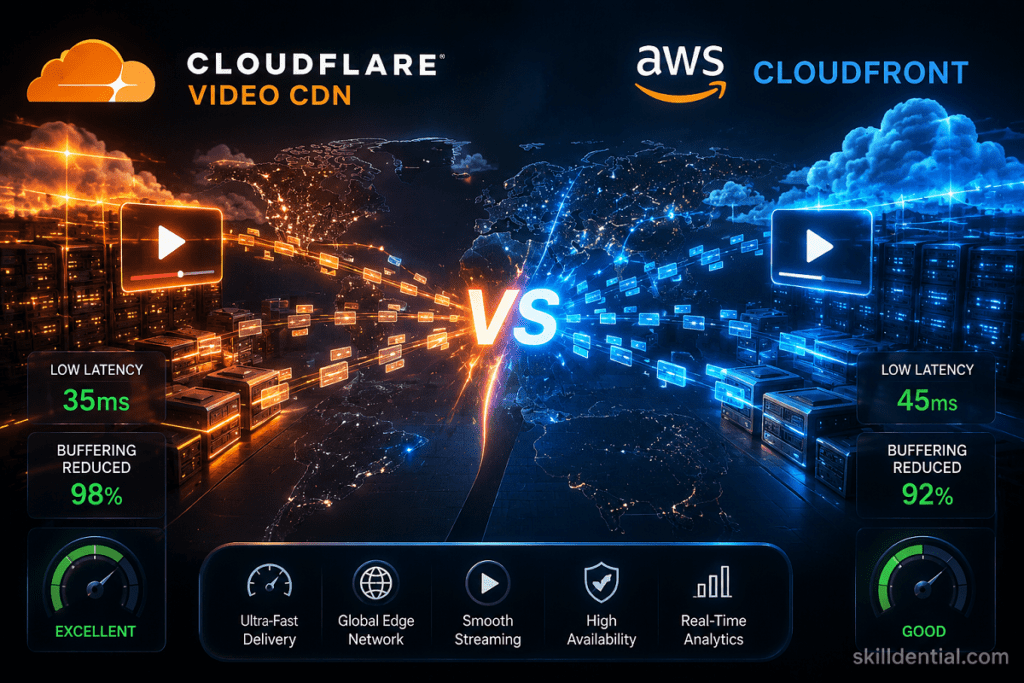
The strategic choice between these two providers often comes down to the “Build vs. Integrate” philosophy:
- Cloudflare Video CDN prioritizes zero egress fees and an end-to-end simplified workflow, removing the friction of manual transcoding and origin shielding.
- AWS CloudFront excels in ecosystem integration, offering deep compatibility with AWS Elemental and S3, though it requires more rigorous management to mitigate the risk of variable costs.
By applying a first-principles analysis to your streaming architecture, this guide evaluates whether the streamlined efficiency of Cloudflare Video CDN or the granular control of AWS CloudFront best aligns with your goals for technical growth and income scaling.
What is Cloudflare Video CDN?
Cloudflare Video CDN, primarily delivered through the Cloudflare Stream platform, is a serverless infrastructure designed to handle the entire video lifecycle—from ingestion and server-side encoding to global delivery and playback.
Unlike traditional CDNs that merely cache files, the Cloudflare Video CDN functions as an integrated media stack. It eliminates the need for third-party transcoding services or separate video players by providing a unified API and a customizable, built-in HTML5 player.
Core Technical Specs (2026 Model)
| Component | Specification / Pricing |
| Primary Billing Unit | Per-minute (Storage and Delivery) |
| Storage Cost | $5.00 per 1,000 minutes (Prepaid) |
| Delivery Cost | $1.00 per 1,000 minutes (Post-paid) |
| Ingress/Egress | Free ingress; Zero egress fees to the viewer |
| Streaming Protocols | HLS and DASH (Adaptive Bitrate Streaming) |
| Live Streaming | Low-latency support with instant recording/DVR |
Key Differentiators
- Infrastructure Abstraction: Automatically encodes every uploaded video into multiple bitrates, ensuring optimal delivery to any device or network speed without manual intervention.
- Edge-Native Architecture: Leveraging Cloudflare’s network in 335+ cities, video segments are served within 50ms of 95% of the world’s population, significantly reducing buffering and start-up times.
- Security Integration: Inherits the full Cloudflare security suite, including unmetered DDoS protection and a Web Application Firewall (WAF) to prevent unauthorized hotlinking or scraping.
- Predictable Economics: By billing per minute rather than per gigabyte (GB), it removes the “bandwidth anxiety” associated with high-resolution 4K video or variable encoding bitrates.
For technical professionals and founders, the Cloudflare Video CDN represents a “High-Leverage” system. It allows teams to build complex video features once and scale infinitely without the operational debt of managing transcoding clusters or calculating complex egress data transfer fees.
What is AWS CloudFront for Video Streaming?
AWS CloudFront is a high-performance Content Delivery Network (CDN) optimized for the global distribution of media. In the context of video streaming, it serves as the final delivery leg, fetching video segments from an origin (like Amazon S3 or AWS Elemental) and caching them at 600+ edge locations to minimize latency and buffering.
Unlike the “all-in-one” approach of the Cloudflare Video CDN, AWS CloudFront is a modular component. It is designed for engineers who need to build custom, industrial-grade video pipelines by tethering multiple AWS services together.
Technical Architecture & Integration
AWS CloudFront does not transcode video natively. Instead, it acts as the distribution layer for a broader media ecosystem:
- Origin (Storage): Video files (MP4, TS) are stored in Amazon S3.
- Processing (Transcoding): AWS Elemental MediaConvert processes raw files into adaptive bitrate formats (HLS/DASH).
- Delivery (CDN): AWS CloudFront caches these segments globally.
- Edge Logic: CloudFront Functions or Lambda@Edge handle advanced tasks like dynamic ad insertion, geo-blocking, or token authentication at the edge.
2026 Pricing Models: Usage-Based vs. Flat-Rate
As of 2026, AWS offers two distinct paths to manage streaming costs, providing a counter-strategy to the Cloudflare Video CDN model:
Pay-As-You-Go (Classic)
- Data Transfer Out (DTO): Starts at approximately $0.085/GB (Region-dependent).
- Request Fees: Charged per 10,000 requests (HTTP/HTTPS).
- Origin Shield: Optional layer ($0.01 per 10k requests) to improve cache hit ratios and reduce load on your origin.
- The “Origin Waiver”: Data transfer from AWS origins (like S3) to CloudFront is free, eliminating “middle-mile” costs.
Flat-Rate Pricing Plans (New for 2026)
To compete with flat-rate competitors, AWS introduced tiers that cap monthly spending:
- Free: 100 GB / 1M requests per month.
- Pro ($15/mo): 50 TB allowance.
- Business ($200/mo): 50 TB allowance with enhanced WAF/DDoS features.
- Premium ($1,000/mo): 50 TB allowance + enterprise-grade support and security.
Strategic Comparison
| Feature | AWS CloudFront | Cloudflare Video CDN (Stream) |
| Philosophy | Modular “Best-of-Breed” | Integrated “Video-as-a-Service” |
| Complexity | High (Requires pipeline setup) | Low (Single API/Upload) |
| Cost Metrics | Per GB + Requests (or Flat Plan) | Per Minute Stored/Delivered |
| Security | AWS WAF & Shield (Granular) | Integrated DDoS/WAF (Automatic) |
| Customization | Infinite (Full control of manifest) | Limited to Cloudflare’s API specs |
Expert Insight: When to Choose AWS
While Cloudflare Video CDN is the high-leverage choice for speed and simplicity, AWS CloudFront is the strategic choice when you require Digital Rights Management (DRM), complex ad-tech integrations, or if your entire data lake is already locked into the AWS ecosystem. It provides the “Sovereignty” required for large-scale media enterprises.
How Do Costs Compare?
The financial delta between these two providers is driven by their fundamental billing units: Minutes vs. Gigabytes. For high-resolution video delivery, this distinction creates a massive variance in total cost of ownership (TCO).
The “Egress Shock” Comparison (1-Hour 1080p Video)
To illustrate the 80/20 of cost efficiency, consider delivering a 60-minute 1080p video (approx. 2.7 GB file size) to 1,000 viewers.
| Metric | Cloudflare Video CDN (Stream) | AWS CloudFront (Standard Pay-Go) |
| Delivery Cost Basis | $1.00 per 1,000 minutes | ~$0.085 per GB |
| Total Consumption | 60,000 minutes | 2,700 GB |
| Delivery Total | $60.00 | $229.50 |
| Egress Fees | $0.00 (Included) | Variable (Included in GB rate) |
| Storage (Est.) | $0.30/mo | ~$0.023/GB/mo (S3) |
Note: In previous Skilldential audits, growth-stage startups have achieved up to a 70% reduction in video overhead by transitioning from the variable AWS model to the predictable Cloudflare Video CDN framework.
Key Cost Drivers
Strategic cost management in video delivery requires isolating the high-leverage variables that dictate your monthly invoice. While the Cloudflare Video CDN focuses on a simplified usage model, AWS CloudFront involves a multi-axis billing structure that scales with complexity.
Predictability vs. Variability
- Cloudflare Video CDN: Operates on a “flat-rate” logic. Because you pay per minute, the resolution (720p vs. 4K) does not affect your delivery cost. This eliminates the “bandwidth anxiety” associated with high-bitrate content.
- AWS CloudFront: Highly sensitive to file size and resolution. A 4K stream will cost significantly more than a 720p stream for the same duration of watch time.
The Middle-Mile Factor
- The AWS Advantage: If your origin is Amazon S3, AWS waives the data transfer fees to CloudFront. This makes AWS competitive for massive archives where storage costs outweigh delivery frequency.
- The Cloudflare Advantage: Cloudflare offers free ingress and zero egress fees. There is no “tax” for moving data out of the CDN to the end-user, which is typically the most expensive line item in a video budget.
Operational Overhead (Hidden Costs)
- CloudFront often requires a dedicated engineer to manage the pipeline (S3 + MediaConvert + CloudFront + IAM roles).
- Cloudflare Video CDN is a serverless, “build once” system. The lack of infrastructure management requirements represents a significant indirect saving in human capital.
Strategic Financial Selection
- Choose Cloudflare Video CDN if: You prioritize high-leverage cost capping. It is the superior choice for platforms with high user engagement where viewership spikes could otherwise lead to unpredictable AWS invoices.
- Choose AWS CloudFront if: You are already deeply embedded in the AWS ecosystem and can leverage volume discounts or flat-rate enterprise plans that cap costs at the 50TB+ level.
Cloudflare Video CDN Pricing
The pricing architecture of the Cloudflare Video CDN (via Cloudflare Stream) is built on a high-leverage “Minutes-Based” model. This approach decouples infrastructure costs from technical variables like bitrate, resolution (up to 4K), and file size, allowing for 100% financial predictability.
| Metric | Rate | Notes |
| Stored Minutes | $5.00 / 1,000 mins | Prepaid: Billed based on video duration. File size and resolution do not affect this rate. |
| Delivered Minutes | $1.00 / 1,000 mins | Post-paid: Includes all bandwidth and global delivery. Zero egress fees to the viewer. |
| Encoding / Ingress | Free | Unlimited uploads and automatic server-side transcoding (HLS/DASH) at no additional cost. |
Strategic Financial Advantages
The economic leverage of Cloudflare Video CDN lies in its departure from the traditional, variable cloud-cost model. By shifting the focus from infrastructure consumption (GBs) to value consumption (Minutes), it provides a predictable framework that safeguards growth-stage margins.
Elimination of “Bandwidth Anxiety.”
Traditional CDNs like AWS CloudFront bill by the Gigabyte (GB). Under that model, a 4K video is roughly 4x more expensive to deliver than a 720p video. With Cloudflare Video CDN, the delivery cost for 1,000 minutes of 4K content is identical to 1,000 minutes of 360p content ($1.00). This allows you to provide the highest possible quality to your users without increasing your overhead.
First-Principles Cost Capping
By using duration as the primary metric, businesses can forecast expenses with 100% accuracy based on their content library size and average watch time.
- Formula: $(Storage Minutes / 1,000 \times 5) + (Anticipated View Minutes / 1,000 \times 1) = \text{Total Monthly Cost}$
High-Leverage Storage
Because Cloudflare Video CDN provides free ingress and encoding, the $5.00 storage fee acts as an all-in-one “Platform Fee.” In a modular AWS setup, you would typically pay for:
- S3 Storage (per GB)
- S3 PUT Requests
- AWS Elemental MediaConvert (per minute of encoding)
- Data Transfer from S3 to the encoder
Cloudflare consolidates these four line items into a single, duration-based storage metric.
AWS CloudFront Pricing
AWS CloudFront’s pricing strategy for 2026 centers on a hybrid model that blends traditional usage-based fees with new flat-rate tiers. This allows established enterprises to leverage the massive AWS ecosystem while providing a “safety net” against the variable costs that often lead users to consider the Cloudflare Video CDN.
| Tier | Monthly Cost | Data Transfer Allowance (DTO) | Strategic Context |
| Free | $0 | 100 GB / 1M Requests | Ideal for proofs-of-concept or small-scale hobbyist projects. |
| Pro | $15 | Up to 50 TB | Best for growth-stage startups requiring high-volume delivery with low entry cost. |
| Business | $200 | Up to 50 TB | Includes enhanced WAF/Shield protections and prioritized edge logic. |
| Premium | $1,000+ | 50 TB+ (Custom) | Targeted at media giants requiring dedicated support and custom SLAs. |
Understanding the AWS Economic Model
The AWS financial structure for media delivery is built on modular granularity. Unlike the “all-in-one” minute-based billing of the Cloudflare Video CDN, AWS separates every layer of the video pipeline into discrete, usage-based line items.
While this allows for hyper-optimized cost control for enterprise-scale engineering teams, it introduces a higher degree of financial complexity and “variable risk” for those without dedicated DevOps oversight.
The 50 TB Threshold
AWS has standardized its mid-market tiers around a 50 TB allowance. While this provides predictability, it remains a usage-based metric (GB). Unlike the Cloudflare Video CDN, which focuses on minutes, your consumption rate within this 50 TB cap is entirely dependent on your video bitrate. High-definition 4K content will deplete this allowance significantly faster than standard-definition content.
Ecosystem Cost Synergies
The true financial leverage of AWS CloudFront is found in its integration with other AWS services:
- Origin Shield: For an additional fee ($0.01 per 10k requests), you can further consolidate cache hits, reducing the load (and the GET request costs) on your S3 origin.
- The S3 Waiver: Data transferred from Amazon S3 to CloudFront is free. This “middle-mile” cost avoidance is a critical factor for organizations with massive libraries that do not want to incur egress fees to move content to an external provider like Cloudflare Video CDN.
Variable Service Fees
Beyond the flat monthly tier, AWS often applies granular charges that must be accounted for in a Total Cost of Ownership (TCO) analysis:
- Request Fees: $0.0075 to $0.0120 per 10,000 HTTPS requests.
- Invalidation Requests: $0.005 per path after the first 1,000 monthly.
- Edge Compute: Lambda@Edge and CloudFront Functions carry separate invocation and duration charges.
Strategic Selection Criteria
- Choose AWS CloudFront if your workflow is data-heavy and requires the granular control of the AWS Media Services stack, and you have the technical resources to manage a multi-service pipeline.
- Choose Cloudflare Video CDN if you want to bypass the complexity of GB-to-TB calculations and prioritize a “set it and forget it” pricing model that ignores bitrate and resolution.
Performance Benchmarks: Cloudflare Video CDN vs. AWS CloudFront
In the 2026 landscape, performance is measured by Time to First Byte (TTFB) and Video Start Time (VST). While both networks offer elite global coverage, their architectural philosophies—Cloudflare’s Single-Pass Anycast vs. AWS’s Tiered Regional Caching—result in distinct performance profiles.
Global Latency & TTFB (2026 Average)
| Region | Cloudflare Video CDN | AWS CloudFront | Delta |
| North America | 10 ms | 12 ms | Cloudflare (-2ms) |
| Western Europe | 11 ms | 14 ms | Cloudflare (-3ms) |
| Asia-Pacific | 16 ms | 22 ms | Cloudflare (-6ms) |
| South America | 24 ms | 28 ms | Cloudflare (-4ms) |
| Africa | 30 ms | 48 ms | Cloudflare (-18ms) |
Key Architectural Drivers
The performance gap between Cloudflare Video CDN and AWS CloudFront is rooted in their contrasting network philosophies. While both aim for low latency, they utilize different data routing and caching strategies that impact how quickly a video starts (VST) and how smoothly it plays across varying global network conditions.
Single-Pass Anycast (Cloudflare)
The Cloudflare Video CDN utilizes an Anycast network where every one of its 335+ data centers runs the full software stack.
- The Leverage: When a request hits the edge, security (WAF), compute (Workers), and caching occur simultaneously in a “single pass.” This eliminates internal hops, consistently placing Cloudflare’s TTFB within 50ms for 95% of the global population.
- Result: Superior performance for distributed audiences, particularly in regions with less dense infrastructure (e.g., Africa and the Middle East).
Tiered Cache Hierarchy (AWS)
AWS CloudFront uses a two-tier architecture consisting of 600+ edge locations and 13 Regional Edge Caches (RECs).
- The Leverage: RECs act as a mid-tier buffer, shielding the origin server and improving cache hit ratios for massive libraries. While this adds a potential “internal hop” (increasing TTFB slightly on cache misses), it excels at keeping content “warm” near the user.
- Result: Competitive performance in high-density regions like Singapore and Sydney, where AWS has heavily optimized its regional backbone.
First-Principles Performance Selection
Selecting a delivery network based on first principles requires stripping away marketing claims to focus on the underlying physics of data transit. To optimize the Cloudflare Video CDN or AWS CloudFront for your specific use case, you must evaluate the trade-off between Network Flatness (latency consistency) and Ecosystem Depth (integration efficiency).
When Cloudflare Video CDN Wins:
- Global Reach: Its wider edge footprint yields lower P95 latencies (the “worst-case” scenarios) for international users.
- Cold Starts: Cloudflare Workers (used for video logic) feature <1ms cold starts, significantly faster than the 100ms+ typically seen with AWS Lambda@Edge.
- Dynamic Routing: With Argo Smart Routing now bundled into paid plans as of 2026, Cloudflare can bypass internet “traffic jams” to reduce latency by an additional 20-30%.
When AWS CloudFront Wins:
- AWS-Native Paths: If your origin is in an AWS region (e.g., US-East-1), CloudFront uses a private fiber backbone to fetch content. This avoids public internet congestion entirely, often making it 10-20ms faster than Cloudflare during a “cache miss” scenario.
- High-Volume Static Libraries: For massive video-on-demand (VOD) libraries where most content is frequently accessed, AWS Origin Shield provides industry-leading cache hit ratios, ensuring that once a video is “hot,” it stays at the edge.
Strategic Insight
For Skilldential frameworks, the Cloudflare Video CDN is the high-leverage choice for speed-to-market and global consistency. Its Anycast architecture removes the “complexity tax” of managing regional distributions, providing an out-of-the-box performance edge for the vast majority of growth-stage applications.
Setup Complexities: Integrated vs. Modular Workflows
The operational friction involved in deploying video infrastructure is a primary driver of long-term “technical debt.” The Cloudflare Video CDN approach focuses on abstraction (removing complexity), while AWS CloudFront focuses on sovereignty (providing granular control).
Workflow Comparison (From Upload to Playback)
| Phase | Cloudflare Video CDN (Stream) | AWS CloudFront (Media Stack) |
| Ingestion | Single API upload / Drag-and-drop. | Upload to S3 bucket. |
| Encoding | Automatic: Encodes to multiple bitrates instantly. | Manual: Trigger AWS Elemental MediaConvert job. |
| Distribution | Instant: URL/Embed code generated immediately. | Configuration: Set up Distribution, Origins, and Behaviors. |
| Playback | Built-in: Customizable HTML5 player included. | Custom: Requires third-party player (Video.js, Bitmovin). |
| Security | Integrated: Signed URLs and WAF are active by default. | Modular: Manual setup of IAM policies and AWS WAF. |
Cloudflare Video CDN: The “No-DevOps” Framework
For founders and technical professionals prioritizing high-leverage systems, Cloudflare represents a “plug-and-play” solution.
- The Benefit: It consolidates storage, transcoding, and delivery into a single dashboard.
- The Implementation: You can move from a raw MP4 file to a global HLS stream in under five minutes without configuring a single server or bucket policy. This eliminates the need for a dedicated DevOps engineer to manage the video pipeline.
AWS CloudFront: The Infrastructure Sovereignty Framework
AWS is a modular ecosystem designed for organizations that require absolute control over every packet and manifest file.
- The Benefit: It allows for “Best-of-Breed” configurations. You can choose specific encoding profiles in MediaConvert, set custom TTLs (Time-to-Live) for specific video segments, and integrate deeply with AWS Lambda for real-time manifest manipulation.
- The Implementation: Setup involves orchestrating multiple services (S3 + IAM + MediaConvert + CloudFront + Route 53). This complexity provides “sovereignty”—the ability to build highly proprietary workflows (e.g., dynamic ad insertion or specialized DRM) that a unified platform might not support.
Strategic Selection Criteria
Determining the ideal infrastructure requires a first-principles assessment of your organization’s technical maturity and long-term scaling objectives. The choice between Cloudflare Video CDN and AWS CloudFront is fundamentally a trade-off between Operational Velocity and Infrastructure Sovereignty.
To make a high-leverage decision, you must evaluate three core pillars:
- Engineering Overhead: Do you have the DevOps resources to manage a multi-service pipeline, or do you require an abstracted, serverless system?
- Cost Architecture: Does your business model favor the predictability of per-minute billing or the granular, volume-based discounts of a per-GB model?
- Customization Requirements: Does your product require standard high-performance delivery, or do you need deep-level control over video manifests, DRM, and ad-tech integrations?
This framework ensures you select a system that aligns with your current technical capabilities while providing the necessary headroom for global scale.
When to Choose Cloudflare Video CDN:
- Velocity: You need to deploy video features in days, not weeks.
- Skill Decoding: Your team lacks specialized media engineers or DevOps resources.
- Product Focus: Video is an essential feature of your platform (e.g., a Course Hub or Real Estate portal) but not your core technical challenge.
When to Choose AWS CloudFront:
- Legacy Integration: Your entire application architecture and data lake are already built on AWS.
- Custom Compliance: You have highly specific regulatory requirements for data residency or encryption that require manual bucket-level control.
- Enterprise Scale: You are delivering petabytes of data and have a dedicated team to optimize every millisecond of the delivery pipeline for marginal gains.
Expert Insight
In the Skilldential framework, the Cloudflare Video CDN is the choice for those who want to “Build once, scale forever.” It provides the technical education required to ship professional-grade video without the “filler” of manual infrastructure management. AWS CloudFront is for the “Infrastructure Architect” who views total control as a competitive advantage.
When to Choose Cloudflare Video CDN?
Selecting Cloudflare Video CDN (Cloudflare Stream) is a high-leverage move for organizations prioritizing Operational Velocity and Cost Predictability. In the 2026 infrastructure landscape, this choice is defined by a “Build vs. Configure” philosophy.
Priority: Strategic Leverage (The “No-DevOps” Advantage)
If your goal is to deliver professional-grade video without hiring a dedicated media engineering team, Cloudflare is the superior choice.
- The Scenario: You need to focus 100% of your engineering capital on your core product, not on managing transcoding clusters, S3 bucket policies, or CDN distributions.
- The Leverage: Cloudflare abstracts the entire media pipeline into a single API. You upload a file; they handle the encoding, global storage, and provide the player.
Priority: Financial Predictability (Zero-Egress Strategy)
Cloudflare is the essential choice for platforms where viewership spikes could lead to catastrophic “bandwidth shock” under a per-GB model.
- The Scenario: You have a viral content model, a high-growth SaaS, or an EdTech platform where users may watch hours of high-definition content.
- The Leverage: By billing per minute rather than per gigabyte, Cloudflare removes the resolution tax. Whether a user watches in 480p or 4K, your cost is fixed at $1.00 per 1,000 minutes, with absolutely zero egress fees.
Priority: Global “Edge-First” Performance
Choose Cloudflare if your audience is geographically dispersed and you require sub-50ms latency without manual regional tuning.
- The Scenario: You serve a global user base, including emerging markets in Africa, South America, or Southeast Asia, where traditional CDN footprints may be sparse.
- The Leverage: Cloudflare’s Anycast architecture ensures that every one of its 335+ cities handles video requests natively. Unlike AWS, which may require complex “Origin Shield” or “Regional Edge” configurations to maintain high performance, Cloudflare is optimized by default.
Selection Criteria Checklist
| Choose Cloudflare Video CDN if… | Choose AWS CloudFront if… |
| You want flat-rate, duration-based billing (no egress fees). | You have volume-based discounts and prefer per-GB pricing. |
| Your monthly traffic is under 50 TB (Growth-stage sweet spot). | You are pushing petabytes of data and have a custom AWS contract. |
| You are Platform-Agnostic or avoid vendor lock-in. | Your entire stack (S3, EC2, Databases) is already on AWS. |
| You need built-in security (WAF/DDoS) without configuration. | You need granular compliance (HIPAA/FedRAMP) and manual control. |
| Your team prioritizes No-Code or Low-Code infrastructure. | Your team consists of Cloud Architects who want full pipeline sovereignty. |
Expert Recommendation
For Skilldential users, the Cloudflare Video CDN aligns perfectly with the “Build once, scale forever” framework. It allows you to ship video features with the technical rigor of a Tier-1 enterprise while maintaining the lean operational profile of a high-leverage founder. Choose it to cap your financial risk and maximize your speed-to-market.
When to Choose AWS CloudFront?
Choosing AWS CloudFront is a strategic move for organizations that prioritize Infrastructure Sovereignty and Granular Customization. Within the 2026 tech stack, this choice signifies a commitment to building a “Best-of-Breed” media pipeline where every component—from the storage bucket to the playback manifest—is precision-tuned.
Priority: Ecosystem Integration (The Gravity Effect)
If your primary data lake and application logic already reside within the AWS ecosystem, CloudFront offers unparalleled efficiency.
- The Scenario: You store petabytes of raw media in Amazon S3 and utilize EC2 or EKS for your backend.
- The Leverage: AWS waives the “middle-mile” data transfer fees between S3 and CloudFront. This internal handshake minimizes costs and latency, making it the most logical choice for heavy AWS users who want to avoid the “egress tax” incurred when moving data to an external Cloudflare Video CDN.
Priority: Advanced Media Control (DRM & Ad-Tech)
Choose AWS CloudFront when your product requires industry-standard security or monetization features that go beyond basic delivery.
- The Scenario: You are launching a premium streaming service requiring Digital Rights Management (DRM)—such as Widevine, FairPlay, or PlayReady—to prevent piracy, or you need Dynamic Ad Insertion (DAI) at the manifest level.
- The Leverage: By integrating with AWS Elemental MediaConvert and MediaPackage, CloudFront allows you to manipulate video manifests in real-time. This provides the “Sovereignty” to inject targeted ads or enforce complex geographical licensing rules that “all-in-one” platforms like Cloudflare Stream may not support.
Priority: Custom Compliance & Governance
AWS is the standard for organizations with rigorous regulatory requirements that necessitate manual infrastructure control.
- The Scenario: You operate in highly regulated sectors (e.g., Healthcare with HIPAA or Government with FedRAMP) where you must dictate exactly where data is stored, how it is encrypted at rest, and who has access via granular IAM policies.
- The Leverage: Unlike the abstracted nature of the Cloudflare Video CDN, AWS allows you to manage the underlying storage buckets and encryption keys (KMS) directly. This level of transparency is often a non-negotiable requirement for enterprise compliance audits.
Selection Criteria Checklist
| Choose AWS CloudFront if… | Choose Cloudflare Video CDN if… |
| You require full control over video manifests and encoding profiles. | You want a hands-off, automated transcoding and delivery stack. |
| You need to implement complex DRM (Widevine/FairPlay). | Basic Signed URLs and Geo-blocking meet your security needs. |
| You are delivering at a massive scale (50TB+) with a custom AWS rep. | You want predictable, minute-based pricing without egress spikes. |
| You need to execute heavy edge compute via Lambda@Edge. | You need near-zero cold starts for lightweight logic via Workers. |
| Your team includes certified AWS Solutions Architects. | Your team is lean and prioritizes speed-to-market over configuration. |
Strategic Insight
In the Skilldential philosophy, AWS CloudFront is the “Expert Tier” choice. It is intended for those who have mastered technical education in cloud architecture and require the “leverage of scale” that only a modular, hyperscale ecosystem can provide. While the Cloudflare Video CDN offers the fastest path to income scaling, AWS CloudFront offers the deepest path to technical mastery and enterprise-grade sovereignty.
Cloudflare Video CDN FAQs
High-leverage video infrastructure requires clarity on pricing, performance, and operational friction. Below are the definitive answers for comparing Cloudflare Video CDN and AWS CloudFront.
What is Cloudflare Video CDN?
Cloudflare Video CDN refers to Cloudflare Stream, an integrated serverless platform that handles the entire video lifecycle. It manages video ingestion, server-side encoding, global storage, and delivery via a unified API.
Unlike traditional CDNs, it includes a customizable HTML5 player and automatically transcodes video into adaptive bitrate formats (HLS/DASH) for optimized global playback.
How much does Cloudflare Stream cost?
The pricing model is duration-based to ensure 100% predictability:
Storage: $5.00 per 1,000 minutes of video stored (prepaid).
Delivery: $1.00 per 1,000 minutes of video delivered (post-paid).
Encoding/Ingress: Free. There are no additional charges for uploading or transcoding, regardless of the output resolution.
What are the AWS CloudFront video costs?
AWS utilizes a usage-based “Data Transfer Out” (DTO) model:
Pay-As-You-Go: Typically averages $0.085/GB for outbound traffic.
Flat-Rate Plans: Tiered monthly plans (e.g., $15 or $200) that provide up to a 50 TB allowance.
Modular Fees: Costs also include S3 storage (per GB), MediaConvert encoding (per minute), and potential request fees ($0.01 per 10k requests).
Does Cloudflare have egress fees for video?
No. One of the primary strategic advantages of the Cloudflare Video CDN is the elimination of egress fees. The “Delivered Minutes” rate covers all bandwidth costs from the Cloudflare edge to the end-user. This prevents “billing shock” during viral traffic spikes.
Is CloudFront better for AWS users?
Yes, in specific architectural scenarios. If your entire application stack and data lake are already on AWS, using CloudFront minimizes the “middle-mile” cost because AWS waives the data transfer fees between S3 and the CDN. It is the preferred choice for organizations requiring “Infrastructure Sovereignty” and granular control over the media pipeline.
Comparison Summary: The 80/20 of Infrastructure Choice
| Feature | Cloudflare Video CDN | AWS CloudFront |
| Billing Unit | Minutes (Fixed) | Gigabytes (Variable) |
| Setup Speed | Minutes (Plug-and-Play) | Hours/Days (Modular) |
| Transcoding | Integrated/Free | Separate (MediaConvert) |
| Egress Fees | Zero | Usage-Based (Included in GB) |
| Ideal For | High-leverage growth; No-DevOps | Enterprise customization; AWS-heavy |
In Conclusion
Deciding between Cloudflare Video CDN and AWS CloudFront is a high-leverage choice that dictates your operational velocity and long-term margin health. Applying a first-principles analysis reveals that while both offer elite global performance, they serve fundamentally different organizational goals.
The 80/20 Leverage: Cloudflare Video CDN
For the majority of growth-stage startups and SaaS platforms, the Cloudflare Video CDN represents the path of highest leverage. Abstracting the complexities of encoding, storage, and player integration into a single, duration-based billing model, it allows founders to scale video features without expanding their DevOps headcount.
- Primary Advantage: Financial predictability through the elimination of egress fees and “resolution-agnostic” pricing.
- Core Use Case: Platforms prioritizing speed-to-market and lean infrastructure management.
The Sovereignty Model: AWS CloudFront
AWS CloudFront remains the industry standard for enterprise-grade sovereignty. It is designed for organizations that view the media pipeline as a core competitive advantage, requiring granular control over manifest manipulation, DRM, and deep integration with the broader AWS data ecosystem.
- Primary Advantage: Technical flexibility and “middle-mile” cost efficiencies for existing AWS-heavy architectures.
- Core Use Case: Large-scale media enterprises and highly regulated industries requiring manual compliance and pipeline customization.
Final Comparison Framework
| Variable | Cloudflare Video CDN (Stream) | AWS CloudFront |
| Philosophy | “Build Once, Scale Forever” | “Build Custom, Control Everything” |
| Pricing Strategy | $1 per 1,000 delivered minutes | ~$0.085 per GB (Usage-based) |
| Performance | <50ms TTFB via Anycast | <50ms TTFB via Regional Caching |
| Management | Zero-DevOps (Serverless) | High-DevOps (Modular) |
Strategic Recommendation
If your goal is to maximize Income Scaling and Product Velocity, default to Cloudflare Video CDN. The ability to cap your financial risk and bypass infrastructure management provides the necessary leverage to outpace competitors.
If your goal is Technical Mastery over a proprietary, multi-petabyte media stack within an existing AWS environment, AWS CloudFront provides the industrial-grade tools required for that level of sovereignty.