AI Engineer Remote Jobs vs Onsite AI Jobs: Which Pays More?
The landscape of technical compensation has fundamentally shifted, positioning the AI engineer remote job as a highly competitive alternative to traditional collocated positions. While remote roles often match or exceed onsite salaries, total compensation depends on seniority, company capitalization, and whether the employer uses localized indexing or global market-rate pricing models.
An AI engineer remote job effectively unlocks borderless hiring markets and premium global employers. Conversely, onsite roles often leverage localized benefits, accelerated internal promotion pathways, and distinct talent pools with lower immediate competition.
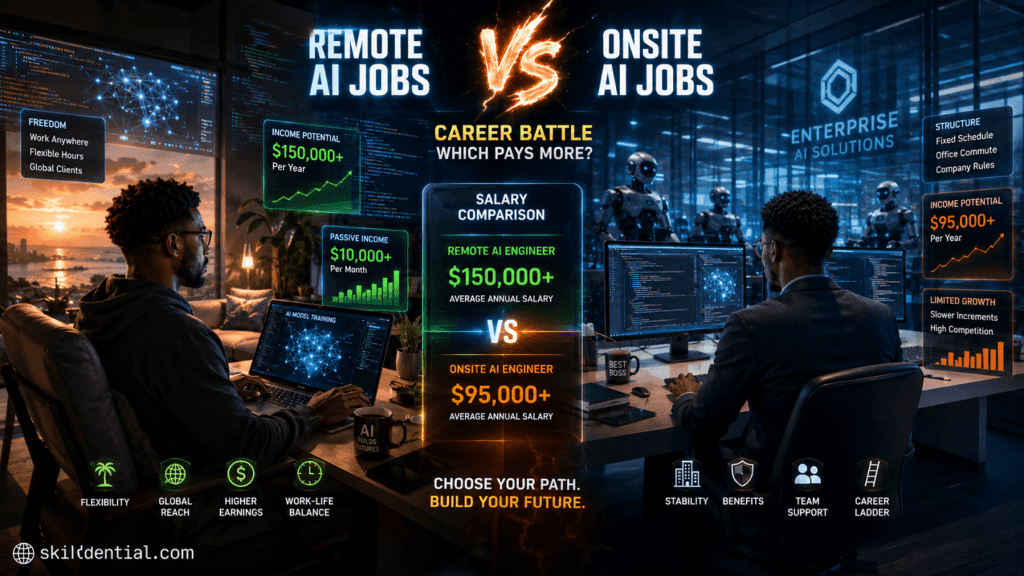
Ultimately, securing the highest-paying AI engineer remote job or onsite position depends on your specific skill tier, negotiation leverage, and strategic access to well-capitalized tech ecosystems.
Why do remote AI jobs sometimes pay more?
An AI engineer’s remote job frequently commands top-of-market compensation due to a shift from local salary indexing to global talent competition. The following key structural drivers explain why remote AI roles often financially outperform their onsite counterparts.
High-Value Skill Sets and Clear Business Impact
The highest compensation brackets for remote AI engineers are concentrated in infrastructure-heavy, model-heavy, or senior architectural roles. In these positions, the direct business impact—such as optimizing inference latency, training proprietary foundation models, or scaling distributed pipeline infrastructure—is highly quantifiable.
When output directly correlates with revenue or operational efficiency, organizations are willing to pay a premium, regardless of physical location.
Arbitrage of National and Global Salary Bands
Traditional onsite compensation strategies anchor salaries to local cost-of-living indexes. Remote-first organizations, however, frequently decouple compensation from local geographies, benchmarking instead against national or global salary bands.
This allows an AI engineer a remote job to command a Silicon Valley or Tier-1 tech hub salary while operating from a lower-cost region, creating a significant structural pay premium over local onsite alternatives.
Hyper-Competition for Scarce Technical Talent
The global demand for specialized artificial intelligence expertise vastly outpaces the localized supply. By expanding the recruitment matrix globally, employers are forced to compete on an open market.
To attract elite engineers capable of building production-grade ML systems, remote employers must outbid local market rates, resulting in elevated total compensation packages that outpace regional onsite benchmarks.
Statistical Sorting into High-Paying Cohorts
Data indicating higher average compensation for remote professional roles is partially driven by a sorting effect. Premium remote compensation is not merely a byproduct of location independence; rather, it reflects that highly capitalized, technologically mature companies (such as late-stage startups and global tech enterprises) are the most likely to offer fully remote structures. These organizations inherently possess the capital to pay top-of-market rates.
Why do onsite AI jobs sometimes pay more?
While a premium AI engineer remote job offers borderless capital access, traditional colocation models retain structural monopolies over specific high-paying vectors. The following factors explain why onsite architectures and specific industry constraints mandate elevated compensation packages.
High-Cost Tech Hub Location Premiums
Onsite roles are frequently anchored in Tier-1 tech hubs (such as San Francisco, New York, or Seattle) where corporate entities must inject geographic cost-of-living adjustments directly into the base salary.
While an AI engineer remote job might be subject to national or regional salary averaging, onsite engineers operating within these metropolitan clusters receive localized premiums designed to offset extreme real estate and living costs, inflating the baseline cash component.
Capitalization and Total Compensation Architecture
The most heavily capitalized organizations—including FAANG-tier enterprises, heavily backed AI research labs, and sovereign wealth-backed financial institutions—overwhelmingly mandate in-office or highly structured hybrid models for core engineering teams.
These organizations possess the capital depth to structure massive total compensation packages. Onsite engineering contracts regularly feature substantial liquid signing bonuses, performance incentives, and valuable Restricted Stock Units (RSUs) that vastly outpace the cash-dominant offers typical of mid-market remote employers.
Regulatory Compliance and Air-Gapped Infrastructure
Securing an AI engineer remote job becomes structurally impossible within highly regulated sectors such as defense technology, aerospace, and sovereign banking frameworks. Because these industries handle sensitive data, proprietary foundational models, and national security workloads, execution must occur within physically secure, air-gapped facilities or SCIFs (Sensitive Compartmented Information Facilities).
To attract elite machine learning talent willing to forgo location flexibility for strict security compliance, these institutions pay an explicit structural premium.
Career Velocity and Leadership Trajectory Sorting
Onsite environments naturally compress internal feedback loops and facilitate immediate alignment on complex architectural decisions. For early-career engineers, graduates, and career switchers, physical colocation mitigates the communication friction inherent in distributed teams, reducing the operational burden of providing self-management.
Consequently, enterprises heavily weigh onsite presence when selecting candidates for fast-track technical leadership, mentorship tracks, and specialized training budgets, compounding an individual’s long-term earning velocity.
Practical Analysis: Maximizing AI Engineer Total Compensation
In practice, neither path holds an absolute monopoly on the highest payout. Maximizing compensation depends on matching your specific career stage, technical specialization, and geographical positioning with the right operational framework.
Senior engineers with production-grade execution capabilities routinely extract premium payouts via an AI engineer remote job by tapping into borderless funding pools. Conversely, early-career engineers or professionals aiming for heavily capitalized Big Tech firms maximize their earnings through localized, asset-heavy onsite positions.
Strategic Compensation Matrix
| Candidate Profile & Market Scenario | Optimal Financial Vector | Primary Economic Catalyst |
| Junior / Entry-Level (0–2 years experience, limited production portfolio) | Onsite | Higher entry probability, direct technical oversight, and accelerated access to structured corporate mentorship. |
| Mid-Level Specialist (3–5 years experience, proven ML pipeline portfolio) | Remote | Mitigation of localized salary caps; direct access to broader, cross-regional base salary bands. |
| Senior / Principal Architect (6+ years experience, MLOps, LLM fine-tuning, infrastructure) | Remote | Global hyper-competition for scarce infrastructure talent eliminates regional indexing boundaries. |
| Tier-1 Tech Hub Resident (Based in SF Bay Area, NYC, Seattle) | Onsite | Access to heavy geographic cost-of-living premiums, massive signing bonuses, and highly liquid RSU tranches. |
| Emerging Market Candidate (Targeting international tech ecosystems) | Remote | High-leverage currency and salary arbitrage; direct engagement with well-capitalized foreign employers. |
What skills increase earning power?
To maximize compensation within the AI engineer remote job ecosystem, professionals must evolve beyond theoretical model architectures and master production-grade system design. The global market disproportionately rewards engineers who can bridge the gap between machine learning code and scalable, revenue-generating software infrastructure.
Advanced MLOps and Production Engineering
The ability to build, monitor, and maintain automated machine learning lifecycles is the single highest leverage point in salary negotiations. Top-tier compensation requires expertise in:
- Orchestration & Pipelines: Designing resilient training and inference data pipelines using tools like Apache Airflow, Prefect, or Kubeflow.
- CI/CD for ML: Implementing continuous integration and continuous deployment pipelines tailored for machine learning models, ensuring zero-downtime updates and automated testing.
- Observability: Deploying robust monitoring frameworks (e.g., Prometheus, Grafana, Arize) to detect data drift, model degradation, and inference latency regressions in real time.
Large Language Model (LLM) Engineering & Core Frameworks
As enterprises race to integrate generative capabilities, securing a premium AI engineer remote job hinges on mastering the implementation stack rather than just the underlying math:
- Enterprise Frameworks: Advanced application development using LangChain, LlamaIndex, or native API orchestrations.
- Optimization Vectors: Implementing high-leverage efficiency techniques, including Retrieval-Augmented Generation (RAG) optimization, prompt routing, fine-tuning (LoRA, QLoRA), and structured output enforcement.
- Execution Ecosystems: Absolute fluency in Python coupled with production frameworks such as PyTorch, Hugging Face, and high-performance inference engines like vLLM.
Cloud Architectures and Resource Optimization
AI initiatives fail most frequently due to unmanaged compute expenses. Engineers who understand cloud economics can command massive salary premiums by directly reducing corporate overhead:
- Cloud Infrastructure: Provisioning scale-ready, immutable AI infrastructure across AWS, Google Cloud Platform (GCP), or Microsoft Azure using Infrastructure as Code (IaC) tools like Terraform.
- Compute & Serving Efficiency: Containerizing workloads via Docker and orchestrating distributed microservices across Kubernetes clusters.
- Performance Engineering: Optimizing GPU utilization, managing distributed training workloads, and reducing inference costs to maximize company margin.
Portfolio Strategy: Monetizing Evidence Over Certification
Within the highly scrutinized domain of remote technical hiring, traditional credentials, bootcamps, and theoretical certifications have lost significant signaling power. Engineering managers operating in distributed environments evaluate candidates strictly on autonomous execution capacity and verifiable business impact.
Data from SkillDential career audits demonstrates that transitioning from course-dependent learning to a high-signal, project-first portfolio directly correlates with a 38% increase in interview callbacks. This framework succeeds because it forces engineering candidates to build identical systems to those used by well-capitalized remote organizations.
The High-Leverage Portfolio Framework
[Production Portfolio Asset]
 ├── Component 1: Deployed ML Model (Validated core engineering)
 ├── Component 2: Cloud-Based Production API (Validated system design)
 └── Component 3: Quantifiable Case Study (Validated business impact)
Code language: CSS (css)
To establish maximum pricing power during an interview process, an optimal portfolio must anchor on three specific pillars:
- One Deployed Model: A live, production-grade machine learning model actively handling asynchronous requests, utilizing real-world datasets, and displaying built-in drift protection.
- One Cloud-Based API: A highly documented, containerized, and secure microservice endpoint engineered on cloud infrastructure, proving your ability to integrate AI into existing corporate ecosystems.
- One Quantifiable Case Study: A technical breakdown detailing structural bottlenecks, architectural trade-offs (e.g., accuracy versus latency), resource cost reductions, and the exact business value delivered by the system.
Strategic Decision Framework for African Engineers
For tech professionals across Nigeria and the wider African continent, choosing between an AI engineer remote job and a local onsite placement is fundamentally a choice between currency arbitrage and entry velocity.
Local tech ecosystems provide vital institutional trust and immediate career entry, but global remote hiring unlocks dollar-denominated compensation packages that completely outpace local market limitations. Navigating this landscape requires an intentional, risk-mitigated career strategy.
Comparative Strategy Matrix for African Talent
| Career Dimension | The Onsite Blueprint (Local/Regional) | The Remote Strategy (Global Market) |
| Financial Yield | Paid in local fiat currency; constrained by regional corporate capital caps. | Paid in USD/EUR; leverages high-leverage currency arbitrage to maximize local purchasing power. |
| Barrier to Entry | Lower. Local hiring managers prioritize regional networks, university pedigree, and physical presence. | High. Competing directly against a global talent pool requires absolute proof of autonomous execution. |
| Communication Overhead | Standard professional communication; high context and shared cultural alignment. | Elite asynchronous communication required. Must document technical decisions with absolute precision. |
| Validation Metric | Institutional reputation, local network referrals, and direct managerial supervision. | Hyper-visible public portfolio, open-source contributions, and verified technical execution. |
The Phased Escalation Roadmap
To maximize long-term income while minimizing the risk of prolonged unemployment, the optimal tactical sequence is a phased transition rather than an immediate leap into the global remote market.
[Phase 1: Local Onsite Consolidation] -> [Phase 2: Global Portfolio Engineering] -> [Phase 3: Remote Dollar Acquisition]
Code language: CSS (css)
Phase 1: Local Consolidation (Months 1–12)
Secure an onsite or hybrid machine learning role within a well-capitalized local enterprise, tech hub, or regional agency. Focus heavily on acquiring structured mentorship, understanding team dynamics, and learning how business metrics drive technical requirements. The primary goal here is securing a stable runway and an official corporate title.
Phase 2: Portfolio Engineering (Months 12–24)
While maintaining your local role, begin shifting your public profile toward the international market. Transition your daily work into quantifiable case studies. Implement the SkillDential project-first roadmap: deploy live models, build cloud-hosted APIs, and aggressively document your engineering choices via GitHub and technical articles. This step builds the exact trust signal that international remote recruiters require.
Phase 3: Global Remote Acquisition (Month 24+)
Leverage your 12 to 24 months of verified, production-grade project experience to aggressively target your first international AI engineer remote job. Position your location as a timezone asset for European markets or an overlapping execution window for US East Coast teams.
By entering the global pipeline with proven corporate delivery and a production-ready portfolio, you command top-of-market dollar compensation from a position of absolute strength.
A Strategic Blueprint for Market Valuation
Ultimately, maximizing your earning power as an AI engineer requires shifting your focus from the location of the role to the market value of your technical output. The choice between an AI engineer remote job and an onsite position is a tactical decision based on your current career velocity and portfolio depth.
While remote architectures provide the highest compensation ceilings through global currency arbitrage, onsite roles offer the rapid feedback loops and structural alignment necessary to launch a career effectively.
The Execution Checklist
To optimize your career trajectory and secure top-tier offers regardless of the work model, prioritize the following three operational pillars:
Engineer High-Signal Proof of Delivery
Cease relying on passive certifications or theoretical credentials to validate your expertise. Build and maintain a hyper-visible, public portfolio that features at least one live, production-deployed machine learning model, a containerized and cloud-hosted API microservice, and a detailed technical case study. Remote and high-paying onsite employers look for clear, indisputable evidence of autonomous execution.
Standardize on High-Leverage MLOps and Automation
Focus your technical stack on the skills that directly impact corporate margins. Master production-grade automation, CI/CD pipelines for machine learning models, cloud resource optimization, and enterprise LLM infrastructure. The market rewards engineers who can seamlessly bridge the gap between initial model development and live, scalable system deployments.
Evaluate Total Package Capitalization
When navigating the interview and negotiation pipeline, avoid looking solely at the base salary. Run every offer through a strict total compensation analysis that accurately weighs cash components, liquid or late-stage equity packages, signing bonuses, health and wellness provisions, and allocated training budgets. Compare every remote offer directly against localized onsite cost-of-living adjustments to ensure you are capturing real financial upside.
What is an AI engineer remote job?
An AI engineer remote job is a professional software engineering or research position where you design, train, deploy, and maintain machine learning models and intelligent systems without being tethered to a physical corporate office.
These distributed roles rely heavily on cloud infrastructure, asynchronous workflows, git-based collaboration, and highly objective, output-driven performance metrics.
Do remote AI jobs always pay more than onsite jobs?
No. A remote AI engineer job offers incredible geographic salary arbitrage, allowing engineers to secure Silicon Valley-level base pay while living in lower-cost regions.
However, onsite roles within major Tier-1 tech hubs or heavily regulated sectors (like defense and quantitative finance) can offer higher overall compensation. This is due to massive localized cost-of-living adjustments, substantial liquid stock packages (RSUs), and specialized in-office signing bonuses.
Are onsite AI jobs better for beginners?
In most scenarios, yes. Onsite positions compress technical feedback loops and eliminate the communication friction inherent in distributed teams.
For early-career engineers, working alongside senior team members provides direct structural mentorship, faster onboarding, and easier alignment on complex architecture. This builds the fundamental execution baseline required to transition into a high-paying AI engineer remote job later.
Which AI skills help you get remote jobs faster?
Remote hiring managers prioritize independent, end-to-end execution capability over certifications. To secure an AI engineer remote job quickly, you must master:
Production-grade Python and ML frameworks (PyTorch).
Core MLOps principles (automated CI/CD pipelines, containerization with Docker, and orchestration with Kubernetes).
Cloud computing infrastructure (AWS, GCP, or Azure).
API integration, LLM orchestration frameworks (LangChain, LlamaIndex), and vector database management.
Can Africans get high-paying remote AI roles?
Absolutely. Global tech enterprises and well-capitalized startups routinely look to emerging markets like Nigeria to source top-tier engineering talent. The critical requirement is bypassing traditional credentials in favor of a hyper-visible, public portfolio—such as the SkillDential project roadmap featuring deployed production models and live cloud APIs.
Combined with stellar asynchronous communication, African engineers can successfully bypass local salary caps and secure premium, dollar-denominated compensation.
In Conclusion
Maximizing your valuation as an AI professional requires shifting focus from where you work to the market value of your technical output. The choice between an AI engineer remote job and an onsite position is a tactical decision based entirely on your current career velocity and portfolio depth.
While remote architectures unlock elite global compensation through currency arbitrage, onsite roles offer the rapid feedback loops and structural alignment necessary to build a bulletproof engineering foundation.
Actionable Execution Checklist
To optimize your trajectory and secure top-tier offers across either work model, prioritize three operational pillars:
- Build High-Signal Proof of Delivery: Cease relying on passive certifications. Build a hyper-visible public portfolio featuring a live, production-deployed machine learning model, a containerized cloud API, and a detailed technical case study mapping your work to business metrics.
- Master MLOps and Infrastructure Automation: Focus your stack on the high-leverage skills that directly impact corporate margins. Double down on automated CI/CD pipelines, container orchestration, and cloud resource efficiency to prove you can work autonomously.
- Evaluate Total Package Capitalization: When navigating offers, analyze the entire compensation structure. Benchmark localized onsite cost-of-living premiums and liquid equity packages against the flexibility and global salary upside of a cross-border AI engineer remote job.