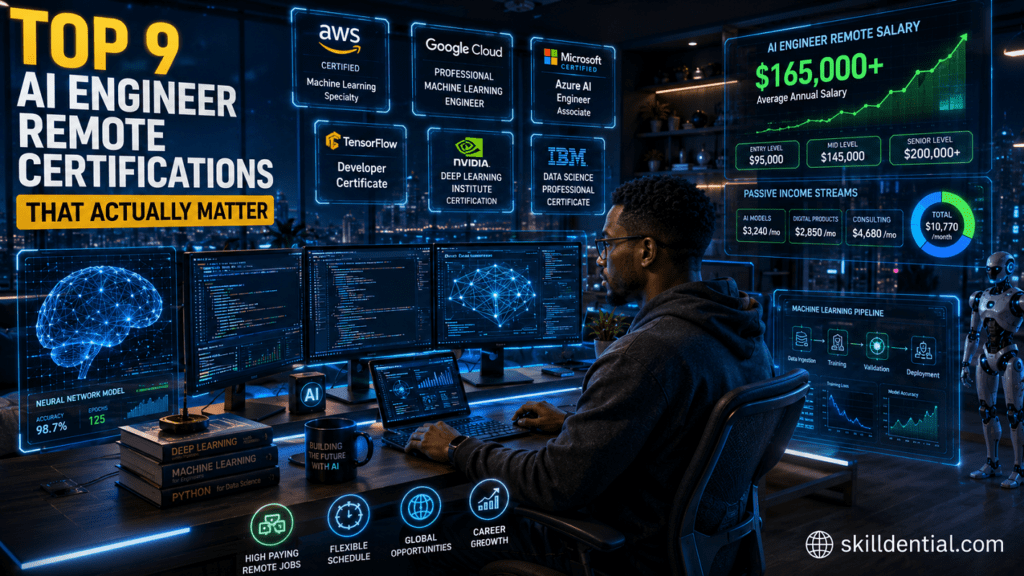
Top 9 AI Engineer Remote Certifications That Actually Matter
Securing premium remote roles in today’s distributed tech market requires more than theoretical knowledge; it demands verifiable proof of production-grade execution. AI Engineer Remote Certifications serve as these critical, vendor-aligned validation signals, proving to global employers that you can design, deploy, and scale intelligent systems autonomously.
Because remote organizations rely heavily on autonomous execution, these credentials isolate your technical capacity from geographical context, demonstrating that you can manage the full lifecycle of an AI solution without local oversight.
However, the modern credential landscape is highly fragmented. Not all AI Engineer Remote Certifications carry equal weight when passing through automated applicant tracking systems (ATS) or engineering review panels.
To secure high-leverage remote contracts, your educational roadmap must prioritize rigorous, hands-on exams over basic multiple-choice theory. The industry benchmarks split into three distinct vectors: cloud-provider ecosystems, specialized data platforms, and framework-specific execution.
To maximize the return on your time and capital, you must select AI Engineer Remote Certifications that directly map to your target enterprise stack. The ultimate goal is to pair these validated credentials with concrete, project-based evidence—such as optimized inference pipelines or production-ready MLOps workflows—proving you can deliver immediate ROI to a remote engineering team from day one.
How do employer hiring teams treat AI engineering certifications?
Technical hiring teams process AI Engineer Remote Certifications through a highly structured filtering framework. In a remote-first hiring environment, where geographic context is eliminated, credentials are never treated as definitive proof of competence. Instead, they function as preliminary truth-testing mechanisms.
The enterprise evaluation protocol breaks down into three core phases.
The Resume Filter: ATS Optimization and Initial Triage
Recruiters and automated Applicant Tracking Systems (ATS) treat premium credentials as explicit high-leverage signals to filter out noise.
- Vendor Ecosystem Priority: Elite certifications from major hyperscalers—such as the Google Cloud Professional Machine Learning Engineer or AWS Certified Machine Learning Specialty—are actively indexed under preferred qualifications for cloud-native roles.
- The Baseline Signal: Possession of an enterprise cloud certification establishes that a candidate understands cloud architecture, API integration, and distributed computing basics. This baseline bypasses the risk of hiring a developer whose experience is restricted to local notebooks.
The Verification Gap: Portfolio and Git Analysis
Once a candidate clears the initial triage, technical hiring managers inspect the validation gap. Certifications from platform courses or academic institutions carry minimal weight unless paired with explicit, accessible technical evidence.
| Certification Type | Evaluation Vector | Hiring Team Perspective |
| Vendor Cloud Certifications (AWS, GCP, Azure) | Production & Scale | Assumes standard competence in cloud infra, deployment pipelines, and managed ML services. |
| Platform/University Certifications (DeepLearning.AI, Stanford) | Core Theory & Math | Validates conceptual comprehension; requires project portfolios to prove code-level implementation. |
Hiring teams immediately audit a candidate’s GitHub or production repositories to verify:
- Production-Ready MLOps: Evidence of continuous integration and continuous deployment (CI/CD) pipelines for ML models.
- Inference Optimization: Code demonstrating data serialization, quantization, and fine-tuning mechanics rather than basic API calls.
- Data Architecture: Robust handling of data ingestion, feature stores, and vector databases.
The Technical Auditing Phase: Interviews and Live Testing
No advanced remote engineering team hires solely based on a credential list. The certification buys access to the interview; the technical interview verifies execution depth.
- System Design Challenges: Candidates are tasked with architecting end-to-end distributed AI systems. Hiring teams will drill into model observability, data drift, cold-start latency mitigation, and cost-optimized compute allocation.
- Live Code Tests: Tests target raw engineering proficiency, including writing clean, modular Python/C++ code, handling asynchronous data streams, or custom-building evaluation pipelines.
Strategic Framework: Treat AI Engineer Remote Certifications as a mechanism to bypass resume gates and establish structural credibility. The terminal hire relies entirely on your production portfolio, architectural reasoning, and live execution capability.
To better understand how engineering leaders design technical vetting pipelines for remote talent, this video analysis provides direct insight from enterprise hiring teams: Watch this breakdown on how tech companies screen candidates. It details the precise skills and strategic indicators hiring managers isolate during high-stakes recruitment.
Which certifications are the highest signal for remote AI engineering roles?
For remote AI engineering roles, the highest-signal certifications are those that validate production infrastructure, operational autonomy, and cost-optimized system architecture.
In a distributed hiring environment, teams look for credentials that prove you can build deployable pipelines independently without on-site technical supervision. The premium certifications are divided below by their precise signal value.
Top-Tier Hyperscaler Certifications (Highest Signal)
Enterprise remote teams prioritize cloud-native operational competence. These exams are rigorous and heavily scenario-based, testing constraints like latency, data residency, and compute budgets.
Google Cloud Professional Machine Learning Engineer (PMLE)
- The Signal: This is widely considered the most rigorous MLOps and engineering exam on the market. It proves mastery over automated data pipelines, continuous training, and model architecture at scale.
- Key Vectors Tested: End-to-end orchestration via Vertex AI Pipelines, Model Garden, automated feature stores (Dataflow, BigQuery ML), real-time vs. batch serving mechanics, and model drift monitoring.
AWS Certified Machine Learning Engineer – Associate
- The Signal: With AWS officially retiring its legacy, theory-heavy “Machine Learning – Specialty” credential in early 2026, this role-based certification has become the definitive benchmark for the AWS ecosystem. It shifts the focus entirely away from mathematical model creation toward production deployment.
- Key Vectors Tested: Production implementation using Amazon SageMaker, scaling foundation models via Amazon Bedrock, Retrieval-Augmented Generation (RAG) pipelines, continuous deployment (CI/CD), security boundaries, and infrastructure cost controls.
Microsoft Azure AI Engineer Associate (AI-102)
- The Signal: Validates strong execution capability within enterprise environments heavily integrated with Microsoft architectures and OpenAI models.
- Key Vectors Tested: Azure OpenAI Service optimization, custom cognitive search indexing, vector database integration, and deploying containerized models to Azure Kubernetes Service (AKS).
Platform & Specialized Engineering Certifications (High Complementary Signal)
While hyperscaler certs prove infrastructure depth, specialized platform certifications validate execution speed, framework fluency, and specific architectural paradigms.
- Databricks Certified Machine Learning Professional: Extremely high signal for data-heavy remote teams. It proves you can build reproducible, enterprise-scale features, track experiments natively with MLflow, and manage distributed compute environments.
- NVIDIA Certified Associate – Generative AI and LLMs: Validates underlying compute hardware awareness. It signals an understanding of GPU optimization, model quantization, and maximizing inference performance while minimizing memory overhead.
High-Signal Evaluation Framework
To stand out to elite remote engineering teams, select certifications based on this structural alignment:
| Technical Competence Required | Target Certification | Core ROI for Remote Teams |
| Matured MLOps & Orchestration | Google Cloud PMLE | Ensures autonomous pipeline automation with minimal operational overhead. |
| Managed Foundation Models & RAG | AWS ML Engineer – Associate | Ensures rapid integration of LLMs with enterprise-grade cost and access controls. |
| Enterprise Data & Compute Scale | Databricks ML Professional | Ensures robust data ingestion and unified model tracking across distributed teams. |
Operational Framework: Treat these credentials as your baseline entry mechanism to clear automated ATS screenings. To convert the initial signal into a final remote offer, marry the certification with a live, accessible GitHub repository demonstrating functional CI/CD infrastructure, cost monitoring, and production-grade code execution.
Which vendor-neutral certifications matter?
While vendor-specific certifications prove your ability to navigate concrete infrastructure, vendor-neutral certifications validate first-principles engineering, core architectural reasoning, and mathematical foundation.
For remote AI engineering roles, generic multiple-choice certificates carry almost zero signal. The only vendor-neutral credentials that matter to elite remote hiring teams are those that require rigorous, proctored assessments, algorithmic depth, and production-grade project portfolios.
Top-Tier University Professional Credentials
These programs carry a high signal because they act as a rigorous academic filter, proving a deep conceptual understanding of machine learning mechanics rather than just API integration.
Stanford Center for Professional Development (SCPD) – Artificial Intelligence Graduate Certificate
- The Signal: This is an elite academic credential. Unlike entry-level massive open online courses (MOOCs), this program requires completing actual, graduate-level Stanford courses (such as CS221 or CS224n) with rigorous grading.
- Core Execution Validated: Mathematical foundations of machine learning, advanced natural language processing (NLP) architectures, and algorithmic design.
MIT Professional Education – Professional Certificate Program in AI & ML
- The Signal: Demonstrates a systematic understanding of complex engineering frameworks, predictive analytics, and system-wide deployment strategy.
- Core Execution Validated: Deep learning mechanics, computer vision, and the socio-technical implications of deploying AI models into production ecosystems.
Rigorous Platform-Backed Structural Credentials
These credentials specialize in validating specific, high-leverage frameworks and core engineering competencies that span all cloud providers.
TensorFlow Developer Certificate / PyTorch Credentials
- The Signal: Validates exact, code-level execution capability within the industry-standard deep learning frameworks.
- Core Execution Validated: Building, training, and fine-tuning neural networks, computer vision models, and sequence models using real-world datasets.
DeepLearning.AI – MLOps Engineering Professional Certificate
- The Signal: This program bridges the gap between pure data science and production engineering. It proves that you understand the entire lifecycle of an AI system outside of any single cloud ecosystem.
- Core Execution Validated: Designing end-to-end data pipelines, managing data lineage, deploying models to edge devices, and establishing automated model monitoring systems.
Vendor-Neutral Evaluation Matrix
To prevent wasting capital on low-signal certificates, evaluate vendor-neutral options using this framework:
| Certification Level | Evaluation Vector | Remote Hiring Team Sentiment |
| Elite Academic (Stanford Graduate, MIT) | Deep Architectural & Algorithmic Reasoning | Highly respected. Signals a strong problem-solving capacity for novel AI architectures. |
| Framework Specialist (PyTorch, TensorFlow) | Implementation & Code Fluency | Practical signal. Proves you can write clean, framework-compliant code immediately. |
| Operational Engineering (DeepLearning.AI MLOps) | Pipeline Architecture & System Lifecycle | High tactical value. Proves you can design workflows that transition models from research to production. |
Strategic Framework: Never rely on a vendor-neutral credential to prove your infrastructure capabilities. Use a top-tier vendor-neutral certification to establish that you understand how models work fundamentally, then pair it with an enterprise cloud certification (like AWS or Google Cloud) to prove you can scale them efficiently.
How should a mid-to-senior engineer choose between certifications?
Choosing between AI Engineer Remote Certifications at a mid-to-senior level requires a cold, ROI-driven evaluation framework. At this stage in your career, multiple-choice testing is a negative signal; you must optimize for credentials that validate architectural autonomy, production-grade scaling, and immediate stack alignment.
Use this three-part decision engine to isolate the highest-leverage certification for your specific career trajectory.
Stack-to-Market Mapping (The Geography & Infrastructure Vector)
Your choice must be dictated by the infrastructure of your target enterprise market. Do not collect certifications across competing hyperscalers; pick one ecosystem and dominate its advanced tier.
- Targeting North American Remote Tech Startups & Scale-ups: Prioritize AWS or Google Cloud. Startups lean heavily into AWS for its mature ecosystem, while modern AI-first companies favor Google Cloud for its native Vertex AI and TPUs infrastructure.
- Targeting Enterprise, Healthcare, or Finance Remote Roles: Prioritize Microsoft Azure. Fortune 500 companies operating hybrid or legacy-integrated systems are heavily consolidated on Azure and rely on its enterprise OpenAI API integrations.
- Targeting Data-Heavy, Analytics-Driven Engineering Teams: Prioritize Databricks. If your target organizations manage massive data lakes and require complex feature store engineering, a Databricks credential carries a higher signal than a generalized cloud cert.
The Credential ROI Matrix
Evaluate your options by crossing the curriculum depth against the operational needs of remote teams. High-leverage remote teams do not hire you to build models from scratch; they hire you to productize, optimize, and monitor them.
       HIGH SIGNAL | [AWS / GCP Professional ML Certifications]
                   | - Validates production MLOps & scaling
                   | - Tests system architecture under constraints
                   | - High ATS optimization for remote roles
                   |
                   | [Specialized Platform Certs (Databricks / NVIDIA)]
                   | - Validates data pipelines & hardware optimization
                   | - Signals deep domain execution
                   |
        LOW SIGNAL | [Entry-Level/Theory-Only Certificates]
                   | - Multiple-choice, non-proctored MOOCs
                   | - Low barrier to entry; zero hiring leverage
                   +--------------------------------------------
                     THEORY-FOCUSED             PRODUCTION-FOCUSED
Ensure the curriculum of your chosen certification heavily covers these three critical pillars:
- Production MLOps: Continuous training, automated CI/CD pipelines for models, and containerization (Docker/Kubernetes).
- Data Pipeline Orchestration: Real-time vs. batch ingestion, vector database indexing, and feature store management.
- Model Observability: Live tracking of data drift, concept drift, inference latency, and compute cost optimization.
The 3-Step Selection Protocol
Follow this structured protocol to finalize your decision:
Step 1: Reverse-Engineer Target Job Descriptions
Identify 10 to 15 ideal remote roles you want to target over the next 12 months. Extract the explicit cloud infrastructure and data tools listed under their “Required Skills.” If 70% of your target market utilizes AWS and Snowflake, your roadmap is instantly locked into the AWS ecosystem.
Step 2: Evaluate the Testing Rigor
Filter out any certification that does not require a proctored, timed exam. If a certification can be passed by memorizing a question bank, technical hiring managers will look past it during the portfolio review stage.
Step 3: Assess the Portfolio Component
If you choose a vendor-neutral academic credential (such as Stanford or MIT), ensure it requires building a comprehensive capstone project. You must be able to convert that capstone into a public GitHub repository showcasing clean, modular code, architectural diagrams, and infrastructure-as-code (IaC) files.
Strategic Bottom Line: For a mid-to-senior engineer, a certification is never a golden ticket. It is an algorithmic bypass for the ATS and initial recruiter screen. Choose the credential that gives you the exact vocabulary and structural framework needed to excel in the system design interview.
Which certifications are worst for signaling production AI skills?
Non-proctored, introductory credentials that focus entirely on theory, syntax memorization, or high-level AI concepts offer the worst signaling value for production remote AI roles.
In remote technical hiring, credentials that lack a rigorous validation mechanism or practical execution component create a negative signal. They suggest a reliance on low-effort badges rather than hands-on engineering competence.
Low-Signal Certification Categories
Non-Proctored “Intro to AI” Badges
- The Flaw: Attendance-based certificates or non-proctored massive open online courses (MOOCs) that test via basic multiple-choice quizzes are treated as filler by technical hiring teams.
- Hiring Impact: These certificates are routinely ignored by automated applicant tracking systems (ATS) and human screeners because they lack identity verification and do not prevent plagiarism or the use of external tools during testing.
Executive and Product-Focused AI Overviews
- The Flaw: Credentials designed for product managers, executives, or non-technical stakeholders (e.g., “AI for Business” or “Generative AI Foundations”) focus on terminology rather than implementation.
- Hiring Impact: Listing these on a senior or mid-level engineering resume dilutes technical authority, signaling a surface-level familiarity with the ecosystem rather than production capability.
Fragmented Tool-Specific Certificates
- The Flaw: Micro-credentials that validate a single, isolated software utility or API wrapper without testing how that tool integrates into a wider architecture.
- Hiring Impact: Remote environments require systemic autonomy. Certifications that fail to validate end-to-end pipelines, error handling, or security boundaries fail to prove you can operate independently.
Structural Metrics: High Signal vs. Low Signal
When audit pipelines assess a candidate’s portfolio, the structural gap between high-leverage credentials and low-signal badges becomes clear:
| Evaluation Vector | Low-Signal Credentials | High-Signal Production Credentials |
| Testing Mechanism | Unproctored, multiple-choice, open-book quizzes. | Timed, proctored, scenario-based architecture exams. |
| Curriculum Focus | Syntax memorization, basic prompt engineering, and theoretical ML history. | MLOps pipelines, data engineering, cost control, and model observability. |
| ATS & Review Impact | Excluded from keyword parsers; parsed as noise by engineering panels. | Actively indexed; clears preferred qualification gates for cloud-native roles. |
The Certificate Signal Mismatch (Internal Data)
Data collected from Skilldential career audits confirms that mid-to-senior engineers frequently struggle with redundant coursework and mismatched credential signals. Relying solely on low-signal courses creates an educational loop that yields zero hiring leverage.
The audit data reveals a precise operational fix: combining a highly targeted, stack-aligned certification with a two-project portfolio tied to a functional GitOps CI/CD pipeline generated a 37% increase in interview callbacks for remote engineering roles (Skilldential internal audits, sample cohort).
[Low-Signal Badges Only] ──> High Noise / ATS Rejection ──> 0% Leverage
[Stack Certification + GitOps Portfolio] ──> ATS Bypass ──> +37% Callback Velocity
The underlying takeaway is distinct: remote hiring teams do not value certificates that prove you sat through a course. They value certificates that prove you can safely manage, deploy, and optimize infrastructure under real-world constraints.
To understand how elite tech companies structure their technical vetting pipelines and why they prioritize hands-on project execution over basic badges, this video analysis provides a deep perspective on the current hiring market: How to Predict High-Income Skills. It decodes the exact frameworks used to validate demand and position technical skills for long-term career leverage.
Decision Matrix — Choosing a Certification
| Priority | Best Pick | Why |
| Cloud Production Skills | AWS Certified Machine Learning Engineer – Associate | Replaces the retired “Specialty” track. Focuses entirely on production engineering, active deployment pipeline orchestration, Amazon SageMaker, and Amazon Bedrock integrations. |
| Cross-Cloud MLOps | Google Cloud Professional ML Engineer | Strongest industry signal for automated model deployment pipelines, model observability, evaluation, and end-to-end Vertex AI enterprise workflows. |
| Azure-Based Roles | Azure AI Engineer Associate | The core requirement for enterprise environments is a heavy dependence on Azure ML infrastructures, security guardrails, and native Azure OpenAI integrations. |
| Academic Depth | Stanford / MIT Professional Certificates | Rigorous grading and proctored execution that validate foundational algorithmic mathematics and deep architectural reasoning. |
| Generative AI Focus | Vendor/Industry Tracks with GenAI Labs | Focuses directly on hands-on infrastructure execution: framework fine-tuning, orchestration (LangChain/LlamaIndex), and vector database indexing. |
Top 9 Certifications (ranked by hiring signal, remote fit, and hands-on assessment)
The final hierarchy ranks the top 9 AI Engineer Remote Certifications based on three high-leverage hiring vectors: automated ATS penetration, verification of production infrastructure autonomy, and hands-on assessment rigor.
Google Cloud Professional Machine Learning Engineer
- Hiring Signal: Elite. Widely considered the most operationally challenging MLOps and engineering credential in the market.
- Remote Fit: Immediate. Proves an engineer can architect, manage, and scale complex, continuous-training systems independently without localized supervision.
- Assessment Rigor: High. Scenario-based proctored exam analyzing real-world infrastructure failures, pipeline bottlenecks, and model optimization constraints.
- Core Focus: End-to-end orchestration via Vertex AI Pipelines, automated feature stores, BigQuery ML, and model drift mitigation.
AWS Certified Machine Learning Engineer – Associate
- Hiring Signal: Exceptional. This role-based certification serves as the modern benchmark for the AWS ecosystem, natively focusing on production deployment over theoretical model creation.
- Remote Fit: Perfect for distributed scale-ups and modern tech companies heavily consolidated on AWS infrastructure.
- Assessment Rigor: Timed, proctored exam testing real-world engineering constraints, security boundaries, and API integrations.
- Core Focus: Production deployment via Amazon SageMaker, Foundation Model optimization via Amazon Bedrock, Retrieval-Augmented Generation (RAG) workflows, CI/CD, and compute cost optimization.
Microsoft Azure AI Engineer Associate (AI-102)
- Hiring Signal: High. The definitive baseline signal for enterprise, corporate, or hybrid-cloud remote roles.
- Remote Fit: High. Validates cross-functional capability inside structured, compliance-driven enterprise architectures.
- Assessment Rigor: Proctored technical exam analyzing API utilization, infrastructure policies, and managed services.
- Core Focus: Azure OpenAI Service optimization, custom cognitive search indexing, vector database integration, and deploying containerized models to Azure Kubernetes Service (AKS).
Platform-Specific MLOps / DevOps Tracks (e.g., Databricks ML Professional)
- Hiring Signal: Strong. Signals that you are a data-competent infrastructure engineer, not just an API consumer.
- Remote Fit: Highly optimized for distributed teams running massive parallel compute clusters and unsegmented data lakes.
- Assessment Rigor: High. Focuses on exact system dependencies, experiment tracking reproducibility, and unified storage layers.
- Core Focus: Feature engineering at scale, native MLflow experiment tracking, Delta Lake integrations, and distributed data pipelines.
Stanford Graduate Certificate in AI/ML
- Hiring Signal: Tier-1 Academic. Drastically out-signals standard online badges by verifying deep mathematical and algorithmic foundations.
- Remote Fit: Exceptional for research-to-production, core modeling, or senior architectural remote positions.
- Assessment Rigor: Extreme. Requires completing actual, graduate-level Stanford engineering courses with strict, accredited academic grading scales.
- Core Focus: Advanced natural language processing (NLP) architectures, custom deep learning frameworks, and algorithmic optimization from first principles.
MIT Professional Certificate in Machine Learning & AI
- Hiring Signal: Strong. Provides high institutional credibility and establishes a structured framework for complex problem-solving.
- Remote Fit: Ideal for senior engineers or technical leads who must interface directly with product stakeholders and executive teams.
- Assessment Rigor: Rigorous professional curriculum requiring comprehensive project portfolio validation.
- Core Focus: Deep learning mechanics, predictive analytics, computer vision, and the systemic implementation of AI infrastructure across enterprise environments.
NVIDIA Jetson / Edge AI Certifications
- Hiring Signal: High Domain Signal. Bypasses the noise of cloud-only engineers by proving a deep understanding of physical compute limits and hardware mechanics.
- Remote Fit: Highly specific. The ultimate validation for remote IoT, robotics, automotive, or embedded systems engineering teams.
- Assessment Rigor: Practical. Requires live execution and demonstrable model deployments directly on physical or simulated NVIDIA hardware.
- Core Focus: TensorRT optimization, model quantization, edge device inference pipeline deployment, and low-latency computer vision.
Platform GenAI Engineering Programs (Project-Based)
- Hiring Signal: Emerging / High Tactical. These project-centric tracks carry zero academic weight but prove rapid framework implementation speed to modern remote teams.
- Remote Fit: High for early-stage startups requiring rapid prototyping and fast product cycles.
- Assessment Rigor: Portfolio-dependent. Fully reliant on the complexity of your verified public Git repositories and functional application deployments.
- Core Focus: LLM orchestration frameworks (LangChain, LlamaIndex), production-grade RAG pipeline engineering, multi-agent system design, and context window optimization.
Vendor-Neutral Pro Certifications (e.g., USAII CAIS / Professional Bodies)
- Hiring Signal: Moderate. Useful as an initial resume-gate bypass or to signal structural framework competency across legacy non-cloud ecosystems.
- Remote Fit: Best suited for strategy-to-engineer bridging roles, internal horizontal transfers, or IT consultancy firms.
- Assessment Rigor: Variable. Primarily proctored multiple-choice exams evaluating architectural definitions and conceptual system delivery frameworks.
- Core Focus: Enterprise AI governance, lifecycle strategy, cross-platform model validation, and high-level architecture design.
Are these certifications necessary to get remote AI engineering jobs?
No, they are not strictly mandatory. Technical hiring teams prioritize public portfolios, production Git histories, and robust system design experience above any credentials.
However, possessing top-tier AI Engineer Remote Certifications (like the AWS or Google Cloud tracks) drastically accelerates your velocity through the initial automated ATS screening and recruiter triage phases, especially when competing in a global, remote talent pool.
How long do these certifications take to complete?
The preparation timeline depends heavily on your existing technical foundation.
Cloud Provider Certifications: Typically require 4 to 12 weeks of focused, daily study if you already possess a strong software engineering or data background.
Rigorous Academic or Platform Tracks: Advanced programs (such as those from Stanford, MIT, or comprehensive MLOps tracks) can span 1 to 6 months due to their deeply technical project requirements and grading cadences.
Do remote employers actually verify certification claims?
Yes. Modern remote companies handle verification through automated or manual validation protocols. Recruiters routinely verify credentials via official provider verification portals, authenticated digital badge registries (e.g., Credly), or by requesting your unique exam registration ID. For senior or high-compliance roles, third-party background check platforms explicitly audit your certification history.
Which certification is best for explicit MLOps responsibilities?
The Google Cloud Professional Machine Learning Engineer and the AWS Certified Machine Learning Engineer – Associate are the premier choices. Unlike theoretical programs, these exams focus directly on the infrastructure required to run machine learning at scale—testing you heavily on automated continuous training (CT) loops, container orchestration, model registries, CI/CD deployment pipelines, and active data drift monitoring.
Can short, non-proctored online certificates harm my engineering profile?
They will not actively penalize your resume, but they create a negative signal if they overcrowd your profile. Listing multiple entry-level, non-proctored badges can signal a reliance on surface-level syntax memorization rather than deep engineering execution.
At a mid-to-senior level, omit introductory certificates entirely and focus your real estate on stack-aligned credentials paired with verifiable production artifacts.
In Conclusion
Navigating the landscape of AI Engineer Remote Certifications requires a shift from collection to curation. In a distributed hiring market that filters ruthlessly for operational autonomy, a credential is never a golden ticket—it is a strategic asset designed to clear automated ATS gates and establish structural credibility.
Your next step must be driven by strict infrastructure ROI:
- Identify your target enterprise market or geographic stack.
- Select a single, high-signal, proctored certification to anchor your technical profile.
- Immediately bridge the validation gap by pairing that credential with an open-source, production-grade GitOps pipeline.
By combining an enterprise-level cloud or academic certification with clear, verifiable project evidence, you remove all operational risk for remote hiring teams—positioning yourself to command high-leverage roles in a competitive global market.