Why AI Literacy is the New Minimum Wage of the Job Market
In 1996, “computer literacy” meant knowing how to turn on a PC and navigate a folder. By 2006, it meant using the internet. By 2016, it was the ability to work in the cloud.
Today, in 2026, the baseline has shifted again—and the stakes are higher.
AI literacy—the set of competencies enabling individuals to understand, evaluate, use, and critically reflect on AI technologies—is no longer a “bonus skill” on a resume. It has become the new minimum wage of the global job market. It is the entry-level requirement for participation in the modern economy.
The Shift by the Numbers
The transition from “optional” to “essential” happened faster than many predicted:
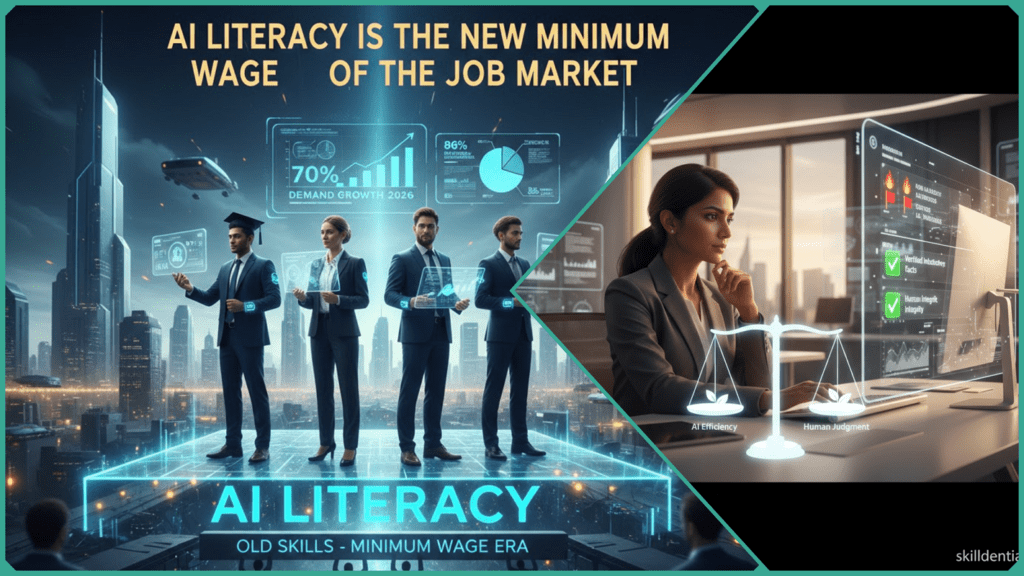
- Market Demand: As of early 2026, demand for AI literacy in US job postings has surged 70% year-over-year.
- Corporate Adoption: The World Economic Forum’s Future of Jobs Report 2025 confirms that AI skills are now essential for 86% of businesses transforming by 2030.
- The New Standard: This isn’t about becoming a data scientist or a coder. It is about non-specialists having the fluency to oversee AI outputs, catch hallucinations, and integrate automated workflows into their daily tasks.
If you aren’t speaking the language of AI, you aren’t just behind the curve—you’re increasingly off the map.
Why Has AI Literacy Become Essential in 2026?
In 2026, we have moved past the “experimental” phase of AI. It is no longer a shiny new tool sitting on the sidelines; it is the engine under the hood of every major enterprise software, from Excel to Salesforce.
Because AI is now ubiquitous, the job market has undergone a structural shift. Here is why AI literacy has officially become the “minimum wage” for modern employment.
The Productivity Floor Has Been Raised
In 2024, using AI made you a “superstar.” In 2026, it just makes you “on time.” Companies have recalibrated their expectations for how much work one person can do. Whether it’s drafting a legal brief, analyzing a pivot table, or creating a marketing campaign, the time-to-completion has dropped by 40%–60%. If you aren’t using AI to meet these new speed requirements, you aren’t just slower—you are considered under-equipped for the role.
The Rise of “Agentic” Workflows
We have transitioned from simple chatbots to AI Agents that can execute multi-step tasks.
- The New Requirement: Employers aren’t looking for “prompters” anymore; they are looking for orchestrators.
- The Skill: You must be able to delegate tasks to an AI, monitor its progress, and verify the accuracy of the result. As 2026 LinkedIn data shows, while AI has added 1.3 million new jobs globally, nearly all of them require the ability to manage these automated systems.
The “Judgment Gap” and Risk Management
As AI usage becomes universal, the biggest risk to a company isn’t a lack of AI—it’s bad AI usage.
- Leaders are worried: Approximately 60% of business leaders report a significant skill gap in their workforce regarding the “responsible” use of AI.
- The Literacy Floor: This is why “Minimum Wage” literacy now includes Critical Evaluation. Can you spot a hallucination in a financial report? Can you identify bias in an AI-generated hiring filter? If you can’t be trusted to catch the AI’s mistakes, you are a liability, not an asset.
The Skills Pyramid of 2026
To visualize where you stand, consider this hierarchy of literacy:
| Level | Capability | Market Status |
| Strategy | Designing AI ecosystems and ethical guardrails. | High-Value Leadership |
| Orchestration | Managing AI agents to complete complex projects. | Competitive Professional |
| Literacy | Using tools & verifying outputs for accuracy/bias. | The “Minimum Wage” (Entry Level) |
What Does AI Literacy Look Like in Practice?
In 2026, the gap between “having a ChatGPT tab open” and being truly AI-literate is the difference between a liability and an asset.
True literacy isn’t just about using tools; it’s about supervising them. Because AI systems are probabilistic—meaning they guess the next most likely piece of information rather than “knowing” facts—the literate professional treats AI output as a draft, not a final product.
The Four Pillars of Practical AI Literacy
To meet the “minimum wage” requirement of today’s market, you must move beyond basic prompting and master these four areas:
- Strategic Prompting (The “Orchestrator” Mindset): Gone are the days of one-sentence prompts like “Write a report.” In 2026, professionals use the R-G-C-F framework:
- Role: Giving the AI a specific persona (e.g., “Act as a Senior Auditor”).
- Goal: Defining the exact outcome.
- Context: Providing background data and constraints.
- Format: Specifying the structure (e.g., a table, markdown, or executive summary).
- The “Verification First” Protocol: With 40% of AI time-savings currently lost to fixing low-quality output, employers prize Verification Literacy. This involves:
- Cross-checking: Identifying the “load-bearing” facts in an AI response and verifying them against trusted primary sources.
- Stress-testing: Asking the AI, “What are the potential weaknesses or biases in the argument you just provided?”
- Workflow Integration (Moving from Task to Chain): Literacy means knowing how to string tools together. It’s the ability to take a meeting transcript from an AI note-taker, use a Large Language Model (LLM) to extract action items, and then feed those into a project management tool like Notion or Asana. You aren’t just “using AI”; you are designing an automated pipeline.
- Ethical & Risk Awareness: A literate worker knows the “No-Go Zones.” They understand data privacy (never pasting sensitive client data into public models) and can spot automation bias—the human tendency to trust a machine’s answer simply because it looks “clean” and authoritative.
In Practice: The AI-Literate vs. The Unskilled
| Task | The Unskilled Approach | The AI-Literate Approach (2026 Standard) |
| Market Research | Asks AI for a summary and pastes it into a deck. | Uses AI to cluster data, then manually verifies the three most critical statistics. |
| Email Management | Uses AI to “Reply” to everything. | Uses AI to draft responses, then edits for “Human Voice” and checks for hallucinations. |
| Data Analysis | Trusts the AI’s chart at face value. | Performs “Z-score” analysis or spot-checks 10% of the raw data to ensure the AI didn’t miss outliers. |
The 2026 Reality Check: Employers are no longer asking if you use AI. They are asking: “Can you be held accountable for the impact of the AI you use?
How Does Lack of AI Literacy Impact Job Prospects?
In 2026, the absence of AI literacy isn’t just a “missed opportunity”—it is a career risk. As companies transition from experimenting with AI to mandating agentic workflows, the barrier to entry has moved.
If you cannot oversee AI, you are essentially competing with it for the 40% of routine tasks it can now perform autonomously.
The Rejection Filter: Re-calibrated Hiring
Hiring has shifted from “years of experience” to “skills-based output.” In 2026, many Applicant Tracking Systems (ATS) specifically filter for AI fluency.
- The “Generalist” Trap: Recent LinkedIn data shows that while AI has created 1.3 million new roles, it is also driving a 70% year-over-year increase in roles that require explicit AI literacy.
- The Consequences: Job seekers without these markers often find their resumes stalled at the first gate. Employers aren’t just looking for “AI users”—they want people who can act as human-in-the-loop orchestrators to prevent errors.
The Narrowing Path for Traditional Roles
The U.S. Bureau of Labor Statistics (BLS) projects computer-related occupations to grow at 11.7%—significantly faster than the average. However, it’s the “non-AI” roles that are feeling the squeeze.
- The Stagnation Gap: While high-AI-exposure roles are seeing wage growth of up to 16.7%, traditional “legacy” roles are lagging at 7.9% or less.
- Economic Fragility: Without the ability to integrate AI into your workflow, you become a “bottleneck” in a high-speed company. In 2026, being a bottleneck is the fastest way to become redundant.
Case Study: The Skilldential Career Audit
In a recent audit conducted by Skilldential, a career-preparedness firm, a group of “anxious professionals” (mid-career workers without AI training) was compared against a “Literate” cohort.
- The Baseline: The untrained group took 35% longer to complete routine reporting and analysis tasks.
- The Outcome: After receiving targeted Prompt Refinement and Workflow Integration training, the same professionals saw a 35% increase in speed and a marked improvement in accuracy.
- The Lesson: Literacy doesn’t replace the professional; it scales them.
The Wage Premium vs. The Literacy Floor
For the first time, we are seeing a “split” in the economy:
- The AI Premium: Workers with specialized AI skills (like Machine Learning or TensorFlow) are commanding 56% wage premiums in 2026.
- The New Minimum: Even for non-tech roles—such as marketing, HR, or administration—AI literacy is now the baseline requirement to secure a standard entry-level salary.
The 2026 Bottom Line:You don’t have to be an engineer to survive the AI shift, but you do have to be a supervisor. If the AI is doing the work and you aren’t the one checking its homework, the market will eventually ask why it needs both of you.
Core Pillars of AI Literacy
To truly understand why AI literacy is the “minimum wage” of the current job market, we must examine the structural pillars that have altered the value of human labor.
In 2026, the market will be split into two groups: those who use AI as a tool and those who are being outpaced by it. Here are the three pillars defining this new economic reality.
The End of the “AI Premium.”
In 2024, knowing how to use generative AI was a “bonus” that could earn you a specialized salary bump. By 2026, that premium has evaporated because the skill is now expected.
- The Reality: Absence of AI literacy now leads to automatic rejection in 80% of mid-to-high-level corporate roles.
- The New Wage Gap: Recent data shows that workers who are AI-proficient now earn 56% more than their non-literate peers. This isn’t a “bonus”—it’s the market’s way of devaluing labor that hasn’t kept up with modern efficiency standards.
Efficiency Amplification (The 140% Rule)
The “minimum” level of acceptable output has shifted. If an AI agent can handle roughly 40% of a junior employee’s routine tasks (sorting data, drafting emails, scheduling), the company no longer values a human who only does that 40%.
- The Literate Approach: A literate worker manages the AI to handle the 40% while they focus on high-level strategy, resulting in a 140% total output.
- The Consequence: If you aren’t integrating AI, you are producing 60% less than your peers for the same cost to the company.
Human-in-the-Loop (HITL) Oversight
This is the most critical pillar for 2026. Employers aren’t looking for people to “push a button”; they need people to protect the company.
- Critical Judgment: AI literacy requires the ethical judgment to identify when a model is hallucinating or showing bias.
- The Liability Factor: An employee who blindly trusts AI output is a legal and reputational liability. Literacy means being the “final check” that ensures reliability.
Roadmap: AI Literacy by Persona
How you should approach this “minimum wage” requirement depends on where you are in your career:
| Audience | Pain Point | AI Literacy Solution | Expected Outcome |
| Anxious Professional | Fear of replacement by younger “AI-natives.” | Workflow Integration: Learning to chain AI tools into your existing expertise. | 140% Productivity: You become the irreplaceable “Architect” of your role. |
| Career Starter | A degree is no longer enough for entry-level. | Verification Basics: Mastering fact-checking and prompt engineering. | Market Entry: Meeting the baseline requirement for 21% faster job growth roles. |
| Talent/HR Leader | Struggling to find “AI-ready” talent. | HITL Framework: Creating job descriptions that prize human oversight over pure tech skills. | Future-Proofing: Closing the 53% skill gap in your current workforce. |
What Is the Human-in-the-Loop Requirement?
In 2026, the term “Human-in-the-Loop” (HITL) has moved from a technical machine-learning concept to a standard job requirement. It is the definitive answer to the question: “If the AI is doing the work, what is the human actually doing?”
The role of the human is no longer to be the “doer,” but to be the judge.
From Execution to Auditing
As AI handles the “heavy lifting” of data processing and content generation, the human’s primary responsibility shifts to Active Oversight. This isn’t a passive role; it involves high-stakes decision-making that AI is fundamentally incapable of:+1
- Contextual Nuance: Identifying when an AI-generated customer response is technically correct but emotionally tone-deaf.
- The 80/20 Rule: Treating AI as “the world’s best intern.” It can get a project 80% of the way there, but the final 20%—the part that ensures accuracy and brand alignment—requires a human “mentor.”
- Fact-Checking Protocols: In a world of “hallucinations,” HITL literacy means having a systematic process to verify AI outputs against primary sources before they reach a client.
The Rise of the “HITL Manager”
By 2026, we are seeing a new category of middle management: the Human-in-the-Loop Manager. Their job description is focused on auditing automated systems for errors that could lead to legal or reputational damage.
Example:In a 2026 HR setting, an AI might surface the top 10 candidates for a role.The HITL manager doesn’t just hire the #1 pick; they audit the list to ensure the AI didn’t inadvertently filter out qualified candidates due to “automation bias” or skewed training data.
Ethical Navigation and UNESCO Standards
The UNESCO AI Competency Framework (2025-2026) has codified “Human Agency” as a core pillar of literacy. This means:
- Transparency: Knowing when and how an AI system is making a decision.
- Accountability: Accepting that even if an AI makes a mistake, the human remains legally and professionally responsible for the outcome.
- Ethical Guardrails: The ability to pause or override an AI system when it risks violating privacy, fairness, or safety standards.
The HITL Checklist for 2026
To be “literate” in an oversight capacity, you must be able to answer “Yes” to these three questions for every task you perform:
- Verification: Did I cross-reference the AI’s “facts” with a known, reliable source?
- Bias Check: Is this output unfairly favoring one perspective or demographic?
- Human Value-Add: Have I added my own professional judgment or unique “voice” to this draft, or am I just rubber-stamping it?
AI Literacy FAQs
What is the precise definition of AI literacy in 2026?
AI literacy is the ability to critically understand, evaluate, and use AI systems ethically in daily life and professional settings. It builds upon traditional digital literacy by focusing on competencies like knowing how AI logic works (e.g., machine learning vs. generative models), interpreting outputs, and recognizing the societal impacts of these technologies.
Why is AI literacy a job market requirement now?
As of 2026, the World Economic Forum (WEF) reports that AI has become a transformative force for 86% of businesses. Because AI is now embedded in standard tools (like spreadsheets, CRMs, and email), employers no longer view it as a specialized skill but as a baseline utility. Demand for generative AI literacy in job postings has nearly tripled over the last two years, shifting the “floor” for employability.
What are the core components of being “AI Literate”?
UNESCO’s 2025–2026 guidelines break literacy into four practical pillars:
- Understanding: Knowing the capabilities and limits of AI (what it can’t do).
- Prompting & Interaction: Collaborating with AI to solve problems.
- Critical Evaluation: Verifying accuracy and identifying “hallucinations.”
- Ethical Oversight: Managing issues like data privacy and ownership.
How does AI literacy differ from AI expertise?
- AI Literacy is for generalists. It’s about being an “informed consumer” and a “competent supervisor” of AI tools. You don’t need to code to be AI literate.+1
- AI Expertise is for specialists. It involves building, fine-tuning, and maintaining the underlying models (Data Scientists, ML Engineers). Think of it like a car: Literacy is knowing how to drive safely and follow the rules of the road; Expertise is knowing how to rebuild the engine.
What are the risks of ignoring AI literacy?
Beyond the risk of career stagnation, a lack of literacy leads to ethical and legal liabilities:
- Bias Amplification: Without critical oversight, users may unintentionally perpetuate gender or racial biases present in AI training data.
- Privacy Breaches: Non-literate users often inadvertently feed sensitive company or client data into public AI models, leading to security violations.
- Automation Bias: The tendency to trust a machine’s “clean” output over one’s own professional judgment, even when the machine is wrong.
The “minimum wage” has changed. You can either stay at the legacy baseline or climb the value chain by mastering the tools of 2026.
In Conclusion
By January 2026, the transition is complete: AI literacy is no longer a “future” skill; it is the current floor for employability. With a 70% surge in demand for AI-literate roles and 86% of businesses now requiring these competencies to navigate their transformation, the “wait and see” period has officially ended. AI has shifted from a niche specialty to a universal utility, as fundamental to the modern office as reading, writing, or using a spreadsheet.
Lacking this literacy in 2026 doesn’t just put you behind—it puts you at risk of immediate screening by hiring systems and displacement by more efficient peers. However, for those who master the “Minimum Wage” pillars—strategic prompting, rigorous fact-checking, and Human-in-the-Loop oversight—the rewards are substantial, with AI-proficient professionals earning up to 56% more than their traditional counterparts.
The floor has moved. It’s time to step up.
30-Day AI Literacy Roadmap (The 2026 Quick-Start)
If you’re feeling behind, use this four-week plan to move from “Anxious” to “Literate.”
| Week | Focus | Action Item |
| Week 1 | Tool Fluency | Spend 15 minutes a day using ChatGPT, Claude, or Gemini for a routine task (e.g., drafting an email or summarizing a meeting). |
| Week 2 | Prompt Mastery | Practice the R-G-C-F framework (Role, Goal, Context, Format) to see how specificity changes your results. |
| Week 3 | Verification | Take an AI-generated output and manually fact-check every “statistic” or “source” it provides. Identify where it “hallucinates.” |
| Week 4 | Workflow Chain | Identify one repetitive task and use AI to automate the first 50%. Then, focus your energy on the final 50% “human review.” |
I’d love to hear from you: What is one AI tool that has become “minimum wage” (a baseline requirement) in your specific industry this year? Leave a comment below!
Discover more from SkillDential | Your Path to High-Level Career Skills
Subscribe to get the latest posts sent to your email.