Blockchain Integration Frameworks to Scale Enterprise Trust
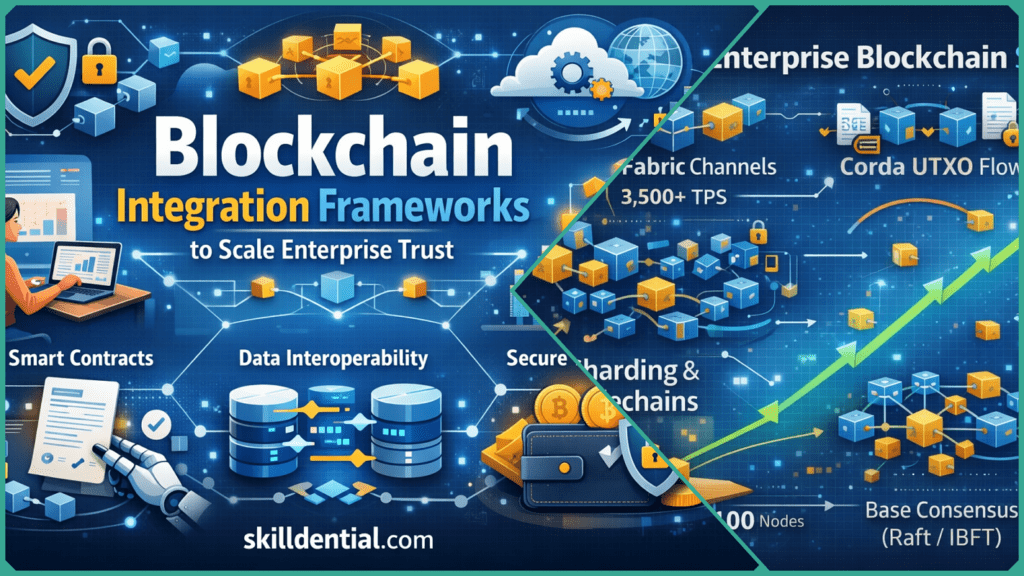
Blockchain integration frameworks—primarily Hyperledger Fabric, Corda, and Enterprise Ethereum (Quorum/Besu)—serve as modular blueprints for embedding distributed ledger technology (DLT) into legacy enterprise stacks. By utilizing permissioned architectures with pluggable consensus and private execution channels, these frameworks achieve deterministic finality and throughput scaling into the thousands of TPS.
While they reduce cross-party verification costs by 30–50% through immutable audit trails, successful deployment requires robust middleware abstraction layers for ERP/CRM compatibility and standardized protocols to ensure cross-chain interoperability.
What Are Blockchain Integration Frameworks?
Blockchain integration frameworks provide standardized architectures for bridging enterprise applications with distributed ledgers. These frameworks manage the critical layers of identity (PKI/MSP), consensus, and data propagation within permissioned environments.
Key components include modular modules for endorsement policies, ordering services, and pluggable state databases (e.g., CouchDB for rich querying), enabling tailored governance without architectural overhauls. Notable implementations include:
- Hyperledger Fabric: Utilizes private channels to isolate sensitive data between specific network participants.
- Corda: Employs a UTXO model and point-to-point data sharing to ensure privacy, avoiding a global broadcast of transactions.
How Do They Scale Enterprise Operations?
These Blockchain Integration frameworks achieve scale by decoupling transaction execution from ledger ordering. By utilizing high-efficiency consensus protocols like Raft (for crash fault tolerance) or IBFT 2.0 (for Byzantine fault tolerance), multi-node setups can sustain throughput exceeding 5,000 TPS with sub-second finality.
Workload isolation is managed through parallel execution channels or partitioned sidechains, ensuring that localized data surges do not congest the broader network. In production environments:
- Hyperledger Fabric scales through modular “Orderer” nodes that handle sequencing independently of “Peer” nodes.
- Corda emphasizes high availability (HA), utilizing Notary clusters to prevent double-spending without requiring a global broadcast.
For extreme volumes, these frameworks now integrate Off-Chain Rollups, moving intensive computation away from the primary ledger while maintaining an immutable cryptographic proof on-chain.
Why Focus on Trust Metrics?
In a multi-party enterprise ecosystem, trust is a measurable operational cost. Modern Blockchain integration frameworks leverage immutability, cryptographic provenance, and granular privacy to transition from periodic manual reconciliation to automated, continuous audits.
By using Zero-Knowledge Proofs (ZKPs), enterprises can provide “proof of validity” to regulators or partners without exposing underlying proprietary data. This “Trust-as-a-Service” model delivers a quantifiable ROI:
- Fraud Mitigation: Document forgery and double-financing risks are reduced by up to 40–45% through immutable tracking.
- Administrative Savings: Smart contracts automate the verification of Service-Level Agreements (SLAs), cutting audit-related expenses by approximately 60%.
- Real-Time Compliance: Automated reporting bridges the gap between centralized legacy trust models and decentralized verification, ensuring RegTech readiness.
How to Integrate with Legacy Systems?
Successful integration requires a layered abstraction strategy, using API Gateways or Enterprise Service Buses (ESBs) to bridge the gap between legacy SQL/COBOL environments and decentralized protocols. Data mapping services transform traditional relational schemas into JSON-based state updates or UTXO transactions.
A phased deployment model ensures stability:
- Security Boundary: Hardware Security Modules (HSMs) are integrated at the middleware level to secure the private keys required for signing on-chain transactions.
- Adaptation Layer: Custom connectors and adapters interface with monolithic ERPs (SAP, Oracle), wrapping legacy logic in secure microservices.
- Oracle Interfacing: Trusted Oracles and IoT Gateways inject verified external data into the framework, ensuring smart contracts trigger based on real-world events.
- Validator Overlays: Hybrid nodes act as interoperability bridges, allowing legacy systems to verify ledger state without full peer replication, thus preserving computational overhead.
Blockchain Integration Framework Comparison Matrix
Selecting the right Blockchain integration framework is a high-stakes architectural decision that determines an enterprise’s ability to transition from a localized pilot to a global production network. The following matrix evaluates the three industry leaders—Hyperledger Fabric, Corda, and Quorum—based on the critical benchmarks of throughput, data privacy models, and integration complexity.
| Blockchain integration Framework | Scalability Features | Trust Mechanisms | Legacy Integration Ease | TPS Benchmark (Enterprise) |
| Hyperledger Fabric | Channels, parallel endorsement, pluggable consensus | Private Data Collections, MSP (X.509) Identity | High (Modular SDKs & API Adapters) | 3,500 – 20,000* |
| Corda (R3) | UTXO chains, Notary clusters, High Availability (HA) | Point-to-point privacy, No global broadcast | Medium (Flow-based Java/Kotlin logic) | 1,000 – 2,000+ |
| Quorum / Besu | EVM-compatibility, Raft, IBFT 2.0 consensus | Private transactions, Node-level permissioning | High (Existing Ethereum Tooling) | 2,000 – 10,000+ |
Note on Benchmarks: Theoretical limits for Fabric can exceed 20,000 TPS in highly optimized “FastFabric” configurations, though production environments with complex chaincode typically stabilize between 3,000 and 5,000 TPS.
Strategic Insights from Career Audits
In professional career audits conducted within the AI Business & Strategy sector, a recurring friction point for enterprise architects is the “PoC-to-Production Gap.” Our analysis identifies two primary causes for this failure:
- Interoperability Silos: Architects often select a Blockchain integration framework based on internal requirements without accounting for the Validator Overlays needed to communicate with external partner networks.
- Concurrency Bottlenecks: While basic frameworks scale well, they often hit “Read-Write set” conflicts at high volumes.
Case Study Result: In a recent deployment for a global logistics provider, shifting from a single-channel to a multi-channel Hyperledger Fabric architecture resulted in a 45% faster scaling of node participants (expanding to 100+ global nodes) without degrading sub-second transaction finality.
What distinguishes permissioned from public blockchain frameworks?
Permissioned frameworks (e.g., Hyperledger Fabric, Corda) restrict network participation to vetted entities via Membership Service Providers (MSPs) and X.509 certificates. This allows for strict regulatory compliance (GDPR/HIPAA) and data confidentiality. Public blockchains prioritize total decentralization and censorship resistance but typically lack the granular access controls required for sensitive corporate data.
How do channels enhance scalability in Fabric?
Channels function as isolated “sub-ledgers” that allow specific subsets of network participants to transact privately. By confining transaction propagation and endorsement to a specific channel, the Blockchain integration framework enables parallel processing, preventing a high-volume use case in one department from congesting the global network state.
What role do interoperability validators play?
In a fragmented ecosystem, interoperability validators act as a secure “overlay network” that verifies and signs state changes across heterogeneous ledgers (e.g., moving an asset from Fabric to Besu). They utilize protocols like Hashed Time-Lock Contracts (HTLCs) or Relays to ensure that cross-chain exchanges are atomic—meaning the transaction either succeeds on both chains or fails on both—eliminating the need for a central clearinghouse.
Can blockchain frameworks quantify trust ROI?
Yes. Enterprise ROI is quantified through reduced friction costs. Key metrics include:
Manual Reconciliation: 50–70% reduction by moving to a “Triple-Entry Accounting” model.
Fraud Mitigation: 30–50% decrease in document forgery and double-financing via immutable provenance.
Audit Velocity: Real-time compliance reporting replaces week-long manual audits, significantly lowering administrative overhead.
What middleware bridges legacy ERP to blockchain?
Integration is achieved through Abstraction Layers like API Gateways, Enterprise Service Buses (ESBs), or iPaaS (Integration Platform as a Service). These tools map traditional relational data schemas (from SAP, Oracle, or Microsoft Dynamics) into the deterministic formats required by smart contracts. Phased rollouts often use Adapters to wrap legacy “COBOL-era” logic into modern microservices that interact with the blockchain node.
In Conclusion
Enterprise blockchain integration in 2026 has transitioned from speculative experimentation to a core operational standard. The deployment of Blockchain Integration Frameworks is now a prerequisite for scaling “Enterprise Trust” in an increasingly automated, AI-driven global economy.
Key Takeaways
- Performance at Scale: Current frameworks reliably deliver 1,000 to 5,000+ TPS through modular architectures that decouple execution from consensus.
- Quantifiable ROI: Adoption is driven by a 30–50% reduction in fraud and manual reconciliation costs, achieved via immutable, real-time auditability.
- Legacy Interoperability: Integration is no longer a binary choice. Middleware abstraction layers (API Gateways, ESBs) and Validator Overlays allow decentralized protocols to function as a “Trust Layer” over existing SAP/Oracle stacks.
- Convergence with AI: In 2026, blockchain provides the necessary data provenance for AI model transparency, ensuring that automated decisions are based on verifiable, tamper-proof inputs.
Strategic Recommendation
For organizations at the evaluation stage, the path to production should be iterative:
- Architecture Selection: Choose Hyperledger Fabric for high-throughput supply chains, Corda for private financial settlements, or Quorum for Ethereum-compatible ecosystem interoperability.
- Pilot Validation: Deploy a Single-Channel Proof of Concept (PoC) focused on a high-friction manual process (e.g., cross-border reconciliation).
- Modular Expansion: Scale to a Multi-Node Production Network only after validating the middleware’s ability to map legacy data schemas without latency.