
How to Build an AI Shopping Assistant Without Coding Skills
In 2026, the search bar is being replaced by conversation. An AI shopping assistant is an intelligent software agent that helps customers discover products and complete purchases through natural dialogue. By integrating directly with e-commerce platforms, these agents handle everything from real-time stock checks to multistep tasks across social channels like Instagram DMs.
While they once required a dev team to build, no-code tools now allow anyone to deploy these autonomous agents—provided you have the right data integrations to keep them accurate.
What Is an AI Shopping Assistant?
An AI shopping assistant is an advanced virtual helper that automates the shopping journey far beyond the capabilities of basic chatbots. While early chatbots followed a rigid “if this, then that” script, modern versions use Agentic AI.
The “Agentic” Difference
The word “Agentic” means the AI has the agency to decide, act, and optimize in real time. Instead of just answering questions, it performs tasks:
- Autonomy: It doesn’t just show a product link; it queries your inventory to see if the Large Blue shirt is actually in stock.
- Reasoning: If a customer asks, “What should I wear to a beach wedding?” the AI reasons through your catalog to find breathable fabrics and appropriate styles.
- Execution: It can guide a customer through the entire checkout process or initiate a return directly within a chat window like WhatsApp.
Why It Beats Traditional Bots
Unlike rule-based bots that break the moment a customer asks a question not in the script, AI assistants learn from every interaction. By connecting directly to your eCommerce platform’s data, they provide a personalized experience that feels less like a search engine and more like a dedicated personal shopper.
How Does Agentic AI Work in Shopping?
If a traditional chatbot is a digital brochure, Agentic AI is a digital employee. It doesn’t just retrieve text; it executes workflows. But how does it “know” what to do without a developer hard-coding every move?
It boils down to three core pillars:
Real-Time Data “Grounding”
For an assistant to be useful, it needs to be “grounded” in your store’s reality. Through no-code integrations, the AI connects to your Product Information Management (PIM) or your Shopify/Etsy backend.
- The Result: When a customer asks, “Is the sunset-orange vase available?” the AI doesn’t guess. It pings your inventory via API and sees that you have exactly 3 left in the warehouse.
Autonomous Reasoning (The “Brain”)
In 2026, agents use Model Context Protocols (MCP). This allows the AI to break down a vague request like “I need a gift for a 10-year-old who likes space” into a series of logical steps:
- Search the catalog for “space” + “age 10.”
- Filter by items with 4+ star reviews.
- Check if those items can arrive by Friday.
- Present the best 3 options to the user.
“Tool-Use” and Execution
This is the breakthrough for solopreneurs. Modern no-code builders allow you to give your AI “Tools.” These are pre-built permissions that allow the agent to:
- Modify Carts: Add or remove items based on the conversation.
- Apply Logic: Automatically trigger a “10% off” code if a customer hesitates at checkout.
- Cross-Channel Action: Carry the conversation from your website over to WhatsApp or Instagram DMs without losing the customer’s cart data.
Pro Tip: For Shopify and Etsy sellers, the Universal Commerce Protocol (UCP) launched in 2026 now allows these agents to “talk” to different apps natively. This means your AI assistant can talk to your shipping app and your loyalty program simultaneously to tell a customer: “Since you’re a Gold Member, I’ve upgraded you to Express Shipping for free!”
How to Build Your AI Assistant (Step-by-Step)
You don’t need to be a developer to build an “agentic” assistant. You just need to be a conductor of three specific types of tools.
Choose Your “Builder” Platform
The builder is your visual canvas. In 2026, these three platforms are the gold standard for eCommerce:
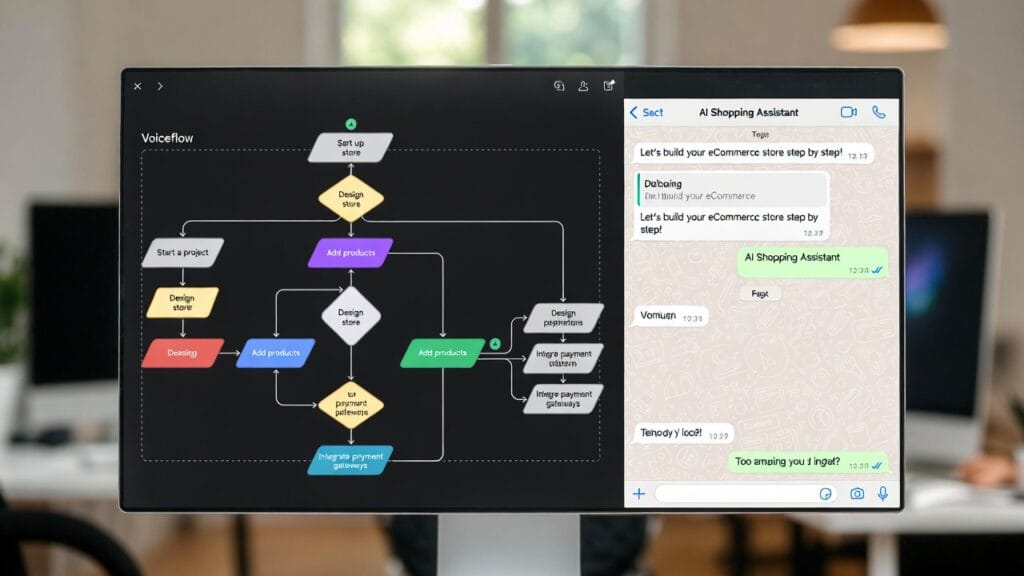
- Voiceflow: Best for “Visual Thinking.” Use it to map out the conversation like a flowchart. It has pre-built templates for Shopify Product Search and Order Tracking.
- n8n: The power-user’s choice. If you want your AI to do complex things—like checking a private Google Sheet for stock and then sending a custom discount via Slack—n8n is the best “glue” for your apps.
- Wassenger Flows: The “WhatsApp First” choice. If 90% of your customers are on WhatsApp or Instagram, Wassenger allows you to deploy an agent directly to your business number in minutes.
Connect Your “Store Brain”
Your AI needs to know what you sell. Instead of manually typing in products, you connect to a Knowledge Base:
- Direct Sync: Tools like AiSensy or Manifest AI offer “one-click” sync with Shopify.
- The Airtable Shortcut: If you have a custom catalog, connect an Airtable base to your builder. The AI will “query” the table every time a customer asks a question.
Set the Brand Persona
This is where you move from “Robot” to “Personal Shopper.” In your builder’s System Prompt, describe your store in natural language:
“You are ‘Sienna,’ a concierge for a high-end coffee roastery. Use a warm, expert tone. If a customer likes ‘dark roasts,’ suggest our Sumatra blend. Always check real-time stock before confirming an order.”
The “Test Drive”
Before going live, use the “Simulator” mode found in these tools. Try these three “stress test” queries:
- The Vague Request: “I need a gift for my mom who likes gardening.” (Tests recommendation logic).
- The Logistics Check: “Where is my order #1234?” (Tests API/Store connection).
- The Out-of-Stock Test: “Do you have the blue shirt in XL?” (Ensures it doesn’t “hallucinate” a product you don’t have).
No-Code AI Tools Comparison (2026)
Choosing a tool depends on whether you want a “plug-and-play” solution or a custom-built workflow. Here is how the top contenders for 2026 stack up:
| Tool | Best For… | Free Tier | Key Integrations | Pricing (Starting) |
| n8n + OpenAI | Technical solopreneurs & custom inventory flows. | Yes (Self-hosted) | Shopify, Airtable, WhatsApp, SQL | $20/mo (Cloud) |
| Gorgias AI | High-volume Shopify stores focused on support. | Trial | Shopify, Instagram, Recharge, Loop | $10/mo + $0.90 per fix |
| Wassenger | WhatsApp-first businesses & local retailers. | Limited | Meta APIs, Google Sheets, CRM | Pay-as-you-grow |
| ManyChat | Instagram/Facebook sales & marketing funnels. | Yes | Instagram DM, WhatsApp, OpenAI | $15/mo + $29 AI add-on |
| Alhena AI | All-in-one “Personal Shopper” for Shopify. | Yes (25 chats) | Shopify, Zendesk, Trustpilot | $199/mo |
Insights from the Field
In our recent career audits at Skilldential, we’ve seen a recurring trend: solopreneurs and non-technical marketing managers are drowning in “DM overload.” By shifting from manual replies to agentic AI agents (like those built on n8n or Voiceflow), businesses are seeing:
- 60% reduction in manual support tickets.
- 30% lift in conversions due to instant, 24/7 product recommendations.
- Zero missed leads during off-hours or holiday rushes.
The Verdict: If you are on Shopify and want something that “just works,” Alhena or Gorgias are your best bets. If you want a bespoke assistant that checks a specific Google Sheet or Airtable for “pre-order” stock, building via n8n or Voiceflow will give you the most freedom.
How to Prevent AI Hallucinations?
The secret to a reliable no-code agent is moving away from “Creative AI” and toward “Retrieval-Augmented Generation” (RAG). This ensures the AI only speaks using facts found in your actual data.
Grounding with “Clean” Data
“Garbage in, hallucinations out.” If your product descriptions are vague or your stock levels are outdated, the AI will fill in the blanks with its own imagination.
- The Fix: Use a structured source like Airtable or a clean Shopify Product Feed. In 2026, agents use “Agentic Chunking,” where the data is broken into small, logical pieces (like “Materials,” “Sizing,” and “Refund Policy”) so the AI can find exactly what it needs without guessing.
Implement System-Level Guardrails
Think of guardrails as the “Employee Handbook” for your AI. In your no-code builder (like Voiceflow or n8n), you should explicitly set these rules in the System Prompt:
- “Only provide information that is explicitly stated in the provided product catalog.”
- “If a customer asks for a discount not found in the ‘Promotions’ folder, politely decline and offer to check with a human.”
- “Never guess a price. If the price field is empty, say ‘Contact support for a custom quote.'”
Verification & Validation Steps
Advanced no-code workflows now include a “Self-Correction Loop.” Before the AI sends a message to the customer, a second, hidden check occurs:
- The Intent: Customer asks for a blue shirt.
- The Draft: AI finds a blue shirt in the catalog.
- The Validator: A sub-process checks: “Is this shirt actually in stock?”
- The Action: If yes, it sends the message. If no, it says: “I see we have that style, but it’s currently out of stock. Would you like to see it in green?”
Human-in-the-Loop (HITL)
Even the best AI needs a supervisor. Set a Confidence Threshold. If the AI is less than 85% sure about an answer (a common feature in tools like Gorgias or Yellow.ai), it should automatically flag a human agent to review the response before it goes live.
What ROI Can You Expect?
For most businesses, the return on investment comes from three main drivers: increased conversion, higher basket values, and dramatic overhead reduction.
The Conversion Multiplier
Meeting customers on the apps they already use—like WhatsApp and Instagram—removes the “friction” of navigating a website.
- The Stat: Conversational commerce yields 23–40% higher conversion rates compared to traditional web storefronts.
- Why? Instant responses eliminate the “consideration gap.” When a customer asks a question at 11 PM and gets an immediate, accurate answer, they buy. In 2026, businesses using agentic assistants report up to a 5x increase in checkout completion compared to standard email-led marketing.
Average Order Value (AOV) Boost
Unlike a search bar, an AI assistant can “bundle” and “upsell” naturally within a conversation.
- Smart Recommendations: Integrated agents analyze live context (e.g., “I’m going to a summer wedding”) to suggest a full outfit rather than a single item.
- The Result: Early 2026 data shows that AI-led discovery leads to a 10–20% increase in AOV.
Scaling Without the Headcount
For solopreneurs and micro-businesses, the most significant ROI is found in operational savings.
- Support Automation: Agentic AI now autonomously handles 45% of post-purchase queries (like “Where is my order?”) and 60% of first-line support tickets.
- 150x ROI Potential: By replacing the need for a part-time support hire with a $20–$50/month no-code tool, micro-businesses can see returns that scale almost infinitely as their traffic grows.
| Metric | Traditional eCommerce | With No-Code AI Agent (2026) |
| Response Time | 90 Minutes (Email) | < 2 Seconds |
| Conversion Rate | 2–3% (Global Avg) | 7–12% (Chat-to-Sale) |
| Support Overhead | High (Human-led) | Minimal (40-60% automated) |
| AOV Growth | Static | +15% on average |
No-Code AI for eCommerce Blog FAQs
What is agentic AI in eCommerce?
Agentic AI refers to systems that autonomously act on goals rather than just following a script. Unlike a standard chatbot that only answers “What is your return policy?”, an agentic assistant can decide to check your store’s warehouse, verify a customer’s order history, and initiate a return label—all without human intervention. It shifts the shopping experience from a static search to a proactive, action-oriented conversation.
Do AI shopping assistants integrate with Shopify?
Yes. In 2026, most no-code platforms offer “native connectors” for Shopify, WooCommerce, and Etsy. These tools use APIs to pull real-time data on stock levels, product descriptions, and order status.
Qualifying Condition: To minimize errors, ensure your store has a structured product feed (clean titles, tags, and SKUs). AI is only as accurate as the data you feed it.
What are common no-code builders?
For a DIY approach, the most popular 2026 platforms are:
- n8n: For complex, custom logic and inventory flows.
- Voiceflow: For designing a visual “map” of the shopping conversation.
- Wassenger & ManyChat: For deploying AI agents directly onto WhatsApp and Instagram DMs.
How do you set a brand persona?
You set a persona by providing the AI with System Instructions in plain English. Instead of code, you describe your brand: “You are ‘Max,’ a high-energy fitness expert. Use emojis, stay encouraging, and always suggest a high-protein snack when a customer buys a gym bag.” You can further refine this by uploading 5–10 examples of “perfect” customer interactions.
Are there free options for starters?
Absolutely. Many platforms follow a “Pay-as-you-go” model:
- n8n is open-source and free if you host it yourself.
- ManyChat and Voiceflow offer free tiers for small stores.
- Alhena and Gorgias typically offer free trials so you can prove the ROI before committing. Limit: Free tiers often cap the number of “resolutions” or conversations per month, making them better for testing than for high-volume sales.
In Conclusion
In 2026, the barrier between “having a vision” and “launching an AI agent” has officially collapsed. By leveraging agentic AI and no-code platforms, eCommerce owners are no longer just building chatbots; they are deploying digital employees capable of real-time reasoning and execution.
The Final Blueprint for Success
To wrap up your journey into no-code AI, keep these three pillars in mind:
- Focus on Agency: Don’t just settle for a bot that answers FAQs. Aim for an agent that can check your Shopify inventory or verify a shipping status.
- Data is Your Foundation: Use clean, structured data from tools like Airtable or Shopify. This “grounds” your AI, ensuring it doesn’t hallucinate fake discounts or non-existent products.
- Start Small, Scale Fast: You don’t need a massive budget. A simple workflow on a free tier can often handle up to 60% of your manual DM load, freeing you to focus on high-level growth.
Immediate Next Steps
- Select Your Builder: Sign up for the n8n Cloud Starter or self-host the open-source version for unlimited workflows.
- Connect Your Store: Use a native Shopify node or a “Custom App” API key to sync your product catalog.
- Define Your Persona: Write a 3-sentence “System Prompt” in plain English to give your agent its brand voice.
- Launch a “Test DM”: Deploy your agent to a test WhatsApp number and ask, “Do you have any blue shirts in stock?”