
Why Urban Planning Consultants Need to Master Agentic AI
Urban planning consultants have long been the vital architects of our civic future—the navigators of dense zoning codes, the analysts of complex GIS layers, and the mediators of high-stakes stakeholder engagement. Historically, success in this field was measured by the ability to balance regulatory compliance with sustainable growth through manual, labor-intensive site analysis.
But in 2026, the complexity of our cities has outpaced human bandwidth alone. Enter Agentic AI. Unlike the generative tools of the past that simply summarized text or drafted emails, Agentic AI acts as an autonomous professional partner. It doesn’t just “chat”; it executes.
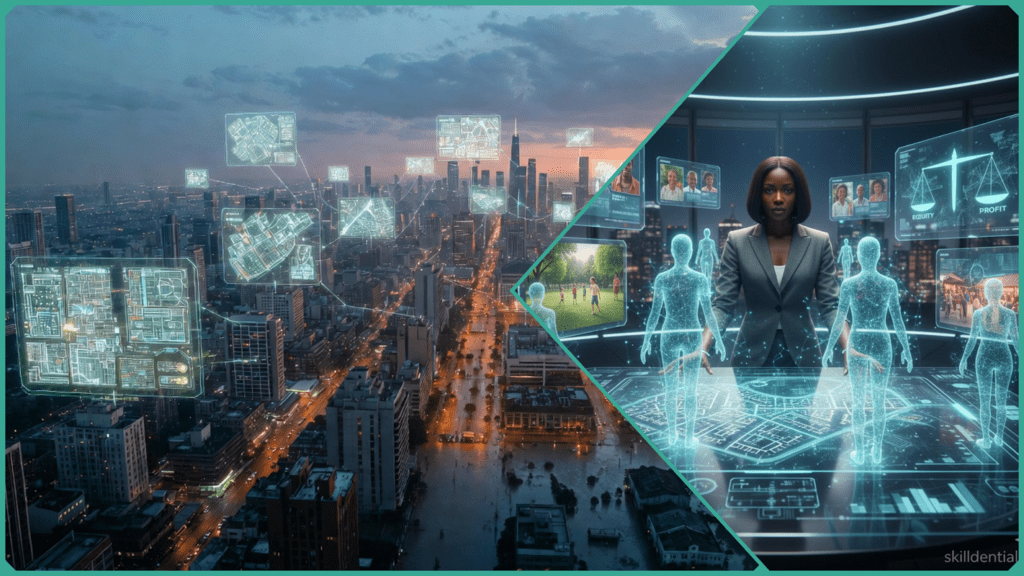
For a modern consultancy, this means deploying specialized AI agents that can cross-reference decades of zoning precedents in seconds, run real-time “Digital Twin” simulations to stress-test flood resilience, and proactively flag compliance issues before they reach a planning committee.
Mastering this technology is no longer a futuristic “nice-to-have”—it is the new baseline for staying ahead in an industry where speed, data-defensibility, and precision are the only currencies that matter.
The Urban Complexity Crisis: Why “Traditional” isn’t Enough
For decades, urban planning was a linear process. You conducted a feasibility study, drafted a plan, and navigated the bureaucracy of zoning approvals. But in 2026, the variables have multiplied exponentially. Cities are no longer just managing growth; they are battling a “Complexity Crisis” driven by three converging forces:
- Climate Volatility: Designing for a 100-year flood is no longer enough when “once-in-a-century” storms happen every three years.
- Infrastructure Strain: Aging grids and rapid population shifts require real-time updates that manual planning cycles (often taking 12–18 months) simply cannot catch.
- Regulatory Density: Zoning codes have become so layered and hyper-local that human error in compliance is almost inevitable.
The Agentic Solution: From Analysis to Action
Traditional AI (Generative AI) helped us summarize these problems. Agentic AI solves them. While a consultant might spend weeks manually overlaying GIS data with new environmental regulations, an AI Agent acts as a Digital Co-worker. It doesn’t just display the data; it autonomously stress-tests your design against thousands of “What-If” scenarios—simulating heat islands, traffic bottlenecks, and drainage failures simultaneously.
By mastering these agents, consultants move from being “data gatherers” to “strategic orchestrators.” You aren’t just faster; you are providing a level of data-defensibility that traditional methods can no longer match. In an era of rapid change, the ability to simulate the future is the only way to plan for it.
Key Points:
- The Scalability Gap: Human-led planning scales linearly; Agentic AI scales exponentially.
- Precision over Guesswork: Agents provide “Formal Verification” of zoning rules—guaranteeing zero violations before the first permit is even filed.
- Resource Allocation: AI can identify cost-saving measures in infrastructure by predicting asset failure years before it occurs.
What Is Agentic AI? (The Shift from Chat to Agency)
To master this new era, urban planning consultants must first understand that Agentic AI is a fundamental leap beyond the “Basic AI” of 2023–2024. While standard Generative AI (like early ChatGPT) is reactive—waiting for a prompt to write a paragraph or summarize a meeting—Agentic AI is proactive.
An “Agent” is a system designed with a goal, not just a prompt. It can plan multi-step workflows, utilize external software (such as GIS or CAD), and verify its own work without requiring human intervention at every step. In the context of an urban planning consultancy, this represents a shift from Automation (doing a task faster) to Orchestration (managing a digital workforce).
The Core Capabilities in Urban Planning:
- Autonomous Digital Twins: Unlike static 3D models, agentic digital twins continuously ingest real-time data from IoT sensors and city APIs. If traffic patterns shift or a new development is proposed, the agent automatically updates the simulation to show the long-term impact on noise, air quality, and infrastructure stress.
- Regulatory “Hard-Coding”: Instead of a consultant manually cross-referencing thousands of pages of zoning documents, an agent can be “assigned” to a project to act as a 24/7 compliance officer. It autonomously flags setbacks, height violations, or environmental non-compliance the moment a design change is made.
- Generative Scenario Iteration: A human might have time to draft three site variations. An agentic system can generate 300 scores, each one based on custom KPIs such as “walkability,” “solar gain,” and “carbon footprint,” and then present only the top 1% for professional review.
The Result: From Analyst to Orchestrator
This shift allows urban planning consultants to move away from “the grunt work” of data extraction and repetitive analysis. By mastering Agentic AI, your role evolves: you become the Strategic Pilot. You set the high-level goals and ethical guardrails, while your agents handle the heavy lifting of technical execution.
Key Takeaway:
Basic AI creates content; Agentic AI delivers outcomes. For an urban planning consultant, this means the difference between having a tool that helps you write a report and an assistant that helps you build a city.
Why Urban Planning Consultants Must Master Agentic AI
The transition to agentic workflows is not just a technological upgrade; it is a shift in the business model of consulting. Clients (municipalities and developers) no longer want static reports—they want dynamic, resilient, and defensible outcomes.
How Does Agentic AI Boost Efficiency?
In a traditional workflow, synthesizing GIS layers, population density, and environmental data can take weeks of manual labor. Agentic AI collapses this timeline by automating the data synthesis and initial scenario generation.
- 10x Variation Output: Firms can now generate 10 climate-resilient site variations in the time it once took to draft a single traditional plan. This allows consultants to explore a wider range of creative solutions without blowing the project budget.
- Proven Results: Recent implementations of AI-driven traffic management have seen congestion reduced by up to 30% and CO₂ emissions cut by 14–21% through real-time signal optimization and smart routing.
- Software Synergy: By mastering tools like ArcGIS (now featuring over 150 pre-trained deep learning models) or CARTO’s AI Agents, consultants can automate object detection in satellite imagery and predict infrastructure failures years before they happen.
What About Data Defensibility?
In urban planning, your recommendation is only as good as the data backing it. Agentic AI provides an unparalleled “audit trail” for every decision made.
- Traceable Compliance: An AI agent can ingest over 500 pages of local zoning codes and cross-reference them against a proposal in seconds. It flags potential violations with specific citations, ensuring that the consultant’s final submission is legally “bulletproof.”
- Winning the RFP: In the bidding process, “verifiable insights” are the winning currency. Using agentic systems to analyze historical data and past planning precedents allows firms to back their proposals with a high degree of statistical certainty, significantly increasing their win rate in competitive RFPs.
How Does It Enhance Climate Resilience?
As cities face increasing pressure from extreme weather, “sustainability” is no longer enough—plans must be resilient.
- Predictive Risk Modeling: Agents use high-resolution climate data (such as NVIDIA Earth-2 simulations) to forecast flooding and heat island risks with hyper-local precision.
- Adaptive Design: Instead of reactive fixes, AI generates Nature-based Solutions (NbS)—suggesting the optimal placement of green roofs, permeable pavements, and bioswales to maximize cooling and stormwater absorption.
- The Competitive Edge: Agencies that can demonstrate a 15–20% saving in future infrastructure budgets through predictive climate modeling are the ones winning the most significant long-term contracts in 2026.
The Evolution of the Planning Process: Traditional vs. Agentic
To truly understand why “mastery” is required, we must look at the fundamental shift in how work is performed. In the traditional model, the urban planning consultant is the primary “engine” of analysis. In the agentic model, the consultant is the Strategic Director of an autonomous digital workforce.
Workflow Comparison: At a Glance
| Aspect | Traditional Workflow | Agentic AI Workflow |
| Zoning & Compliance | Manual review of 500+ pages; prone to human oversight. | Autonomous scan of all regulations with instant conflict flagging. |
| Scenario Generation | 1-2 manual iterations due to time and budget constraints. | 10+ variations generated in hours, optimized for specific KPIs. |
| Time per Project | Weeks spent on data synthesis and baseline mapping. | Days to reach a final proposal with 30-40% efficiency gains. |
| Output Resilience | Static designs based on basic regulatory compliance. | Dynamic, climate-adaptive simulations with stress-tested outcomes. |
Why the Shift Matters for Your Bottom Line
The “Traditional” column represents a cap on your firm’s growth—there are only so many hours a human expert can work. The “Agentic” column represents scalability.
By moving the heavy lifting of zoning checks and baseline scenario generation to AI agents, your team is freed to do what humans do best: negotiating with community leaders, applying professional intuition to sensitive heritage sites, and solving the “impossible” creative puzzles of urban life.
Summary: The Path Forward
Mastering Agentic AI is about more than just adopting new software; it’s about reclaiming your time to focus on high-value consulting. As we move further into 2026, the gap between “Manual” and “Agentic” firms will only widen. The choice is clear: lead the orchestration, or be left behind by the speed of the algorithm.
Why Human Mastery Matters Ethically
As we move toward “Smart Cities,” the risk of algorithmic bias becomes a central concern. Agentic AI is powerful, but it lacks the “moral compass” and local empathy required for truly equitable urban design.
A 2025 industry audit of senior urban planners found that while AI could process data at a superhuman scale, it often struggled with the “nuance of place”—the historical and social significance of a neighborhood that isn’t captured in a GIS layer. Humans must remain the Orchestrators for three critical reasons:
- Preventing Algorithmic Redlining: AI models trained on historical data may inadvertently replicate past biases in housing or infrastructure investment. Human oversight ensures that AI-generated plans promote equity rather than reinforcing old inequalities.
- Empathy in Design: An AI can optimize for traffic flow, but a human consultant understands the value of a quiet community park or a culturally significant landmark.
- The “Orchestrator” Advantage: In practice, implementing agentic workflows isn’t about doing less; it’s about doing more with higher quality. In recent career audits, planners who pivoted to “Agent Orchestration” cut their data synthesis time by 40%, allowing them to spend that reclaimed time on high-value community engagement.
Your Roadmap to Mastery
Mastering Agentic AI is a journey, not a single software installation. Here is a 5-step roadmap to transition your consultancy into the agentic era:
- Audit Your Workflows: Identify the “low-hanging fruit.” Which tasks are repetitive and data-heavy? Start by targeting zoning compliance checks and baseline GIS synthesis.
- Experiment with “Agent-Ready” Tools: Don’t start from scratch. Use established platforms like Esri ArcGIS or Google Earth Engine, which now feature autonomous GIS agents that can “listen” to goals and execute complex spatial analysis.
- Upskill for Orchestration: Shift your team’s training from “how to use a tool” to “how to manage a workflow.” Focus on AI Orchestration—the ability to connect multiple agents to solve a larger problem (e.g., connecting a ‘Zoning Agent’ to a ‘Financial Feasibility Agent’).
- Integrate via Digital Twins: Begin your pilot projects by creating Digital Twins for site analysis. Use these as a “sandbox” to test how agents react to live data before moving to full-scale city proposals.
- Scale for the Win: Once you’ve proven the efficiency gains (aim for a 25% reduction in output time), use these verifiable metrics to strengthen your bids for major RFPs.
The future of urban planning isn’t just “smarter”—it’s faster, more resilient, and more complex. By mastering Agentic AI today, consultants aren’t just adopting a new tool; they are evolving their profession to meet the challenges of 2026 and beyond.
Urban Planning Consultants FAQs
What defines Agentic AI specifically in our field?
In 2026, Agentic AI is defined by autonomy and goal-orientation. Unlike a basic chatbot that waits for you to say “summarize this,” an AI agent is given a goal—such as “optimize this neighborhood for 15-minute walkability while meeting local height restrictions.” It then executes the multi-step research, spatial analysis, and design iteration needed to reach that goal without constant human prompting.
How does Agentic AI handle complex zoning?
It moves beyond keyword searching. Agents can “understand” the hierarchical logic of zoning ordinances—interpreting how overlay districts, setbacks, and density bonuses interact. By cross-referencing your site plan with 500+ pages of code in real-time, the agent identifies conflicts instantly, providing a traceable audit trail that consultants can use to justify their designs to planning boards.
Can Agentic AI actually replace urban consultants?
No. While it handles the “computational heavy lifting,” it lacks professional judgment and local empathy. In 2026, the consultant’s role has shifted to “Orchestrator.” You provide the ethical guardrails, negotiate with community stakeholders, and ensure that the AI’s optimized data doesn’t come at the cost of a neighborhood’s unique cultural fabric.
What tools are best for starting an agentic workflow?
The 2026 landscape is led by Esri ArcGIS Pro (with its integrated GeoAI agents) and Google Earth Engine for large-scale environmental monitoring. For design-heavy tasks, tools like ArcGIS Urban and Deepblocks allow for the “Generative Urban Design” mentioned earlier, bridging the gap between raw GIS data and actionable site variations.
How does this technology improve city resilience metrics?
Agentic systems excel at predictive modeling. By running thousands of climate simulations—from heat island effects to catastrophic flooding—AI identifies the “weak points” in a plan. Early adopters in the consultancy space are reporting 20–40% better performance in sustainability KPIs, giving them a significant edge when bidding on government climate-adaptation contracts.
In Conclusion
The transition from traditional methods to Agentic AI represents a structural shift in the urban planning profession. We are moving away from a world where consultants are limited by manual data synthesis and toward an era where they act as the Strategic Orchestrators of autonomous digital systems.
By mastering Agentic AI, your firm doesn’t just work faster—it works smarter. You provide clients with data-defensible plans that are legally bulletproof, and you design cities that are fundamentally more resilient to the climate challenges of 2026.
The competitive landscape is already shifting. Firms that integrate these autonomous agents today will be the ones leading the most significant RFPs of tomorrow. Don’t wait for the technology to become the industry standard—set the standard yourself.
Final Thoughts: The Path to Mastery
The “Complexity Crisis” in our cities is real, but so is the solution. By mastering the transition from manual analysis to Agentic Orchestration, you aren’t just improving your efficiency—you are ensuring your firm remains at the forefront of the most critical urban challenges of the decade.