Best HL7 Certification Courses for Healthcare IT on Coursera
Finding a high-quality HL7 certification course is a crucial step for professionals seeking to lead the 2026 healthcare AI revolution. HL7 (Health Level Seven) provides the international standards required to exchange, integrate, and retrieve electronic health information across clinical systems. While traditional standards like HL7 v2 handle core messaging, modern APIs rely on FHIR for seamless interoperability.
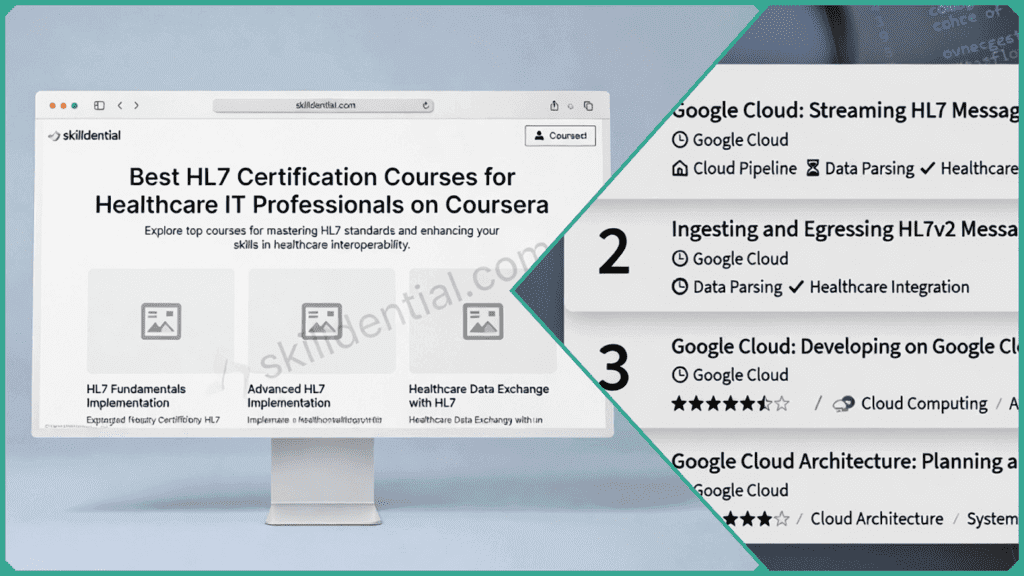
To bridge this gap, Coursera offers hands-on projects from Google Cloud that focus on ingesting HL7v2 data into Healthcare API stores. This type of HL7 certification course is ideal for building practical, job-ready skills in healthcare IT, requiring only a basic familiarity with cloud architecture to get started.
What is HL7?
HL7 (Health Level Seven) provides standardized messaging formats for seamless healthcare data exchange between systems like Electronic Health Records (EHRs). Think of it as the “universal translator” for medical software.
The standard primarily consists of two major versions that any modern HL7 certification course will cover:
- HL7 v2.x: The “legacy” industry workhorse using pipe-delimited messages (e.g.,
PID|1||12345^...). - HL7 FHIR (Fast Healthcare Interoperability Resources): The modern, web-native standard that uses RESTful APIs and JSON, making it the preferred choice for AI and mobile app integration.
Demystifying the Complexity
For AI engineers, “demystifying” HL7 is the first step toward accessing high-value hospital data. It is important to view HL7 as a straightforward data protocol rather than complex medical coding.
By mastering these standards through a targeted HL7 certification course, you bridge the gap between raw clinical events and the clean datasets required to train machine learning models. This technical literacy is exactly what transforms a general data scientist into a high-level Healthcare AI Specialist.
Why HL7 for AI Careers?
Mastering HL7 is no longer just for hospital IT staff; it is the “secret sauce” for high-level AI professionals. In the 2026 job market, HL7 mastery unlocks healthcare AI roles that pay 20-30% salary premiums. This increase is driven by a massive shortage of “cross-functional” talent—engineers who understand both machine learning and clinical data interoperability.
The Competitive Edge for Engineers
Aspiring AI health-engineers use these standards to parse real-time HL7 messages into clean datasets for training predictive models. Similarly, software developers are increasingly transitioning from sectors like Fintech to massive Health-Tech firms like Epic, Cerner, or Google Health.
In recent Skilldential career audits, we found a common pattern: highly skilled software developers often struggled to get past initial technical screens because they lacked experience with hospital data access. However, after completing a targeted HL7 certification course via Coursera, these same candidates saw a 40% increase in health-tech interview callbacks.
Key Career Benefits:
- Domain Authority: You move from being a “generalist” to a “specialist” in the $110 billion healthcare AI market.
- Higher Salary Ceiling: Specialization in data standards like FHIR and HL7 v2 leads to senior “Interoperability Architect” roles.
- Future-Proofing: As hospitals move toward “Value-Based Care,” the ability to link disparate health apps into a single AI-driven system is the most in-demand skill of the decade.
By choosing the right HL7 certification course, you aren’t just learning a protocol; you are gaining the “security clearance” to work with the world’s most sensitive and valuable data.
Top HL7 Certification Courses Ranked for Career Impact
Coursera features several specialized paths that serve as an unofficial HL7 certification course ecosystem. We have ranked these based on their direct alignment with high-paying roles in Healthcare IT and AI Engineering.
| Rank | Course / Project Title | Provider | Duration | Key Skills | Best For |
| 1 | Streaming HL7 to FHIR Data | Google Cloud | 1 Hour | HL7 conversion, BigQuery, Dataflow | Cloud Engineers building AI pipelines |
| 2 | Ingesting HL7v2 Data | Google Cloud | 1 Hour | MLLP Adapters, Dataset creation | Devs parsing raw hospital data |
| 3 | Digital Healthcare Informatics & AI | Illinois Tech | 3 Months | HL7 FHIR, SNOMED CT, AI Integration | AI Specialists targeting clinical roles |
| 4 | Healthcare Data Management | Johns Hopkins | 10 Hours | CDA, HL7 v2, HL7 v3, Interoperability | Health-Tech Leaders & Entrepreneurs |
| 5 | Ingesting FHIR Data | Google Cloud | 1 Hour | FHIR Stores, RESTful APIs | Data Analysts automating insights |
Why these courses matter for your portfolio
While many “bootcamps” offer theory, the Google Cloud projects listed above are self-paced labs that take place in a real cloud console. This means when you finish, you don’t just have a certificate; you have a documented “Guided Project” where you successfully converted live hospital messages into an AI-ready format.
Choosing Your Path
- The Engineering Path: Focus on the Google Cloud labs (Ranks 1, 2, and 5). These are the gold standard for anyone wanting to work as a Data Engineer at a health-tech startup.
- The Clinical AI Path: The Illinois Tech Specialization (Rank 3) is the most comprehensive HL7 certification course for those who want to understand the “meaning” behind the data (Semantic Interoperability) to build safer, more accurate medical AI.
If you are looking for a “free” way to start, you can audit the Johns Hopkins or Illinois Tech courses. This allows you to access all the high-level reading materials and videos without paying, though you won’t receive the official certificate or be able to submit the final labs.
The HL7 to AI Data Workflow
The journey from a patient’s bedside to an AI-driven clinical insight follows a specific, high-stakes technical path. Mastering this flow is the primary goal of the top-ranked HL7 certification course options on Coursera.
Data Generation (The EHR)
The process starts in the Electronic Health Record (EHR) system (like Epic or Cerner). When a doctor signs an order or a nurse records vitals, the system generates an HL7 message.
- Traditional: HL7 v2 “Push” messages (pipe-delimited text).
- Modern: FHIR “Pull” requests (JSON via REST APIs).
Ingestion & Transformation (Cloud Healthcare API)
This is the technical “heavy lifting” where your certification shines. Using the Google Cloud Healthcare API, you set up an ingestion point that:
- Accepts the raw HL7 v2 messages.
- Automatically transforms them into FHIR resources.
- Stores them in a HIPAA-compliant, “AI-ready” format.
Model Training & Inference (Vertex AI)
Once the data is standardized in the cloud, it is streamed into Vertex AI.
- The Workflow: The structured clinical data is used to ground Gemini models or train custom machine learning models to detect patterns—such as early signs of sepsis or predicting a patient’s length of stay.
The Clinical Insight
The final output isn’t just a number; it’s a Clinical Insight delivered back to the provider’s dashboard. This path shows how Coursera skills enable end-to-end AI deployment, moving you from a “coder” to a “solution architect.”
How to Choose Your HL7 Certification Course?
To maximize the return on investment (ROI) for your career, you shouldn’t just pick any HL7 course—you should pick the one that matches your specific “High-Level AI” trajectory. For Skilldential users, we recommend selecting a path based on your intended role within the 2026 health-tech landscape.
Choosing the right HL7 certification course depends on where you want to sit in the data pipeline. Below is our decision framework based on current industry hiring trends.
Select Based on Your Role
- For Cloud & DevOps Engineers: Prioritize the Google Cloud Guided Projects. These are the fastest ways to prove you can handle production-level infrastructure. If your goal is to move data from a hospital to an AI model, you need to master the Healthcare API and Dataflow labs.
- For AI Research & Data Scientists: Look for FHIR-integrated specializations (like the Illinois Tech or Johns Hopkins paths). You need to understand the meaning (semantics) of the data—such as how a lab result in HL7 v2 maps to a standardized resource in FHIR—to ensure your AI models are accurate and safe.
- For Health-Tech Product Managers: Focus on courses that cover Interoperability Governance. You don’t need to code the parser, but you must understand how HIPAA, HL7, and FHIR impact product compliance and data liquidity.
Prioritize Hands-on Labs
In 2026, employers value applied skill over theoretical knowledge. When choosing an HL7 certification course, look for programs that include a “Sandbox” or “Cloud Lab.”
Skilldential Tip: A certificate that says “Completed HL7 Theory” is good, but a portfolio project that says “Built an HL7-to-FHIR streaming pipeline on Google Cloud” is what wins the 40% interview callback rate we mentioned earlier.
Focus on the “FHIR” Future
While HL7 v2 is the “legacy” reality of hospitals today, FHIR (Fast Healthcare Interoperability Resources) is the future of AI. Ensure your chosen course doesn’t just stop at old-school pipe-delimited messages; it must show you how to transition that data into RESTful JSON formats that AI agents and LLMs can actually read.
Final ROI Checklist:
- Does the course offer a shareable certificate for my LinkedIn/Resume?
- Does it include hands-on parsing of real (or simulated) HL7 messages?
- Does it bridge the gap between legacy systems (v2) and modern AI (FHIR)?
By following this framework, you ensure that your time spent on Coursera translates directly into the “High-Level” career outcomes Skilldential is known for.
HL7 Certification Courses FAQs
As healthcare moves toward an AI-first future in 2026, many professionals have questions about how legacy standards like HL7 integrate with modern cloud stacks. Here are the most common questions from our Skilldential community.
What does HL7 stand for?
HL7 stands for Health Level Seven, a non-profit organization that develops international standards for the exchange, integration, and retrieval of electronic health information. The “Seven” refers to the seventh layer (the Application Layer) of the ISO OSI communications model. It supports legacy formats like HL7 v2 and modern, web-friendly formats like FHIR.
Is HL7 certification available on Coursera?
Coursera offers specialized Google Cloud certificates and university-backed specializations (like Johns Hopkins) that focus on HL7 handling. While these are not “official” proficiency certifications directly from HL7.org, they provide verifiable, job-ready credentials. For most AI and Data Engineering roles, a Coursera HL7 certification course that includes hands-on Google Cloud labs is actually more valuable to employers than a theoretical exam.
What is the difference between HL7 v2 and FHIR?
Think of HL7 v2 as the “legacy” language—it uses pipe-delimited text messages and is used by 95% of US hospitals for basic tasks like admissions. FHIR (Fast Healthcare Interoperability Resources) is the “modern” language—it uses RESTful APIs and JSON. While HL7 v2 is reliable for old systems, FHIR is significantly better for AI applications because its data structure is natively readable by machine learning models and LLMs.
Do I need programming experience for HL7 courses?
For the high-level paths we recommend on Skilldential, a basic understanding of cloud concepts or Python is helpful. However, many of the Coursera “Guided Projects” are designed to walk you through the setup. You do not need prior healthcare experience; the courses are specifically designed to bridge that gap for tech professionals.
How does HL7 support AI in healthcare?
HL7 acts as the data “on-ramp.” To build an AI model in Vertex AI, you first need to ingest standardized data. HL7 standards ensure that information from a hospital’s EHR is formatted correctly so it can be fed into APIs, stored in data warehouses like BigQuery, and eventually used to generate clinical insights. Without HL7/FHIR mastery, an AI engineer simply cannot access the data they need to build medical ML.
Is an HL7 Coursera Course Worth It?
If you are aiming for a High-Level AI Career, the answer is a resounding yes. In 2026, general AI skills are abundant, but “Domain-Specific” AI skills—like the ability to handle sensitive clinical data via HL7—are rare and highly compensated.
In Conclusion
Mastering HL7 is no longer just an administrative requirement; it is a strategic power-up for your AI career. By standardizing healthcare data exchange through legacy HL7 v2 messaging and modern FHIR APIs, you unlock the ability to build and deploy life-saving AI models at scale.
For the high-level professional, the ROI is clear:
- Skill Validation: Coursera’s Google Cloud projects offer practical, lab-based paths that function as a verifiable HL7 certification course for your portfolio.
- Financial Growth: Specialized expertise in medical data interoperability can boost salaries by 20–30%, as health-tech firms compete for talent that understands both “Code and Clinic.”
- Future-Proofing: As hospitals transition to AI-driven care, the “translator” who can bridge the gap between legacy systems and modern cloud APIs will be the most valuable asset in the room.
Don’t let your AI skills stay generic. Enroll in a top-ranked HL7 project today on Coursera and give your health-tech resume the specialized edge it needs for 2026.
Discover more from SkillDential | Your Path to High-Level Career Skills
Subscribe to get the latest posts sent to your email.