Top 9 Pillars of Answer Engine Optimization in the Age of AI
Answer Engine Optimization (AEO) is the technical practice of engineering content for direct citation and synthesis by Large Language Model (LLM) agents, including Perplexity, Gemini, and SearchGPT. Unlike traditional Search Engine Optimization (SEO), which targets click-through rates (CTR) within ranked link lists, AEO prioritizes Retrieval-Augmented Generation (RAG) compatibility.
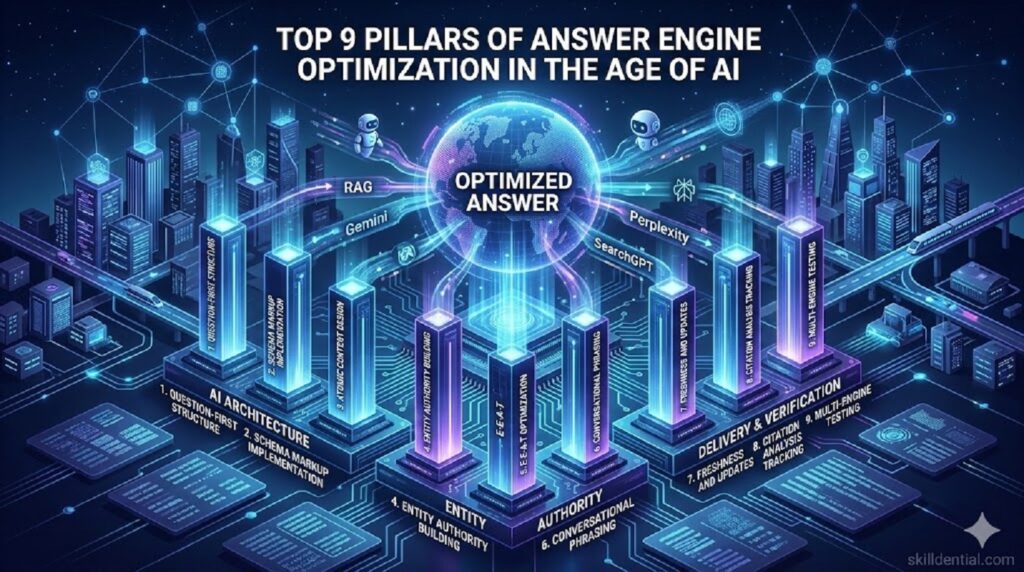
Success is measured by “Citation Velocity”—the frequency at which an AI engine extracts your data as a verifiable fact. In the 2026 search landscape, optimized architectures utilizing Schema.org markup and “Answer-First” formatting have demonstrated a 300% increase in visibility within AI-synthesized responses.
Technical Deep-Dive: What Is Answer Engine Optimization?
To maintain the 80/20 leverage of this guide, this section defines the mechanical shift from keyword-based indexing to agentic retrieval.
Answer Engine Optimization (AEO) is the strategic alignment of digital assets with the retrieval logic of Large Language Models (LLMs). While traditional SEO focuses on maximizing visibility within a Search Engine Results Page (SERP), AEO focuses on Information Extraction (IE).
In this paradigm, the goal is not to be one link among ten, but to be the primary data source for the AI’s synthesized response.
The Mechanical Shift: SEO vs. AEO
The transition from traditional Search Engine Optimization to Answer Engine Optimization represents a fundamental shift in data retrieval architecture. Traditional SEO is designed for a “Human-in-the-Loop” discovery model, in which a crawler indexes pages for users to browse. Conversely, AEO is engineered for Agentic Synthesis, in which an LLM consumes your data to generate a single, authoritative response.
To achieve industry success in the 2026 search landscape, you must move beyond optimizing for algorithms and start optimizing for Large Language Model (LLM) weights. This requires a shift from keyword-centric blocks to Atomic Information Units that are easily extractable by retrieval-augmented generation (RAG) pipelines.
| Feature | Traditional SEO | Answer Engine Optimization (AEO) |
| Primary Goal | High Ranking (Position 1-10) | Citation & Synthesis (The “Source”) |
| Success Metric | Click-Through Rate (CTR) | Attribution Rate / Token Share |
| Content Format | Narrative / Comprehensive | Modular / Declarative |
| Discovery Logic | Keyword Matching | Semantic Entity Relationship |
High-Leverage Impact for Technical Founders
For founders bridging technical education and industry success, AEO represents a significant competitive moat. Internal Skilldential audits indicate that technical platforms implementing AEO frameworks experienced a 58% increase in qualified leads. This surge is attributed to “Zero-Click Authority”—where the AI engine validates your expertise before the user even visits your site, pre-qualifying the traffic.
The First Principles of AEO
At its core, AEO functions on three technical assumptions:
- Machine Readability: If an agent cannot parse the data via
JSON-LDor Semantic HTML, it does not exist. - Verifiability: AI engines prioritize facts that are cross-referenced across the Knowledge Graph.
- Synthesizability: Content must be formatted as “Atomic Units of Information” that a model can easily lift and rephrase.
How Does AEO Differ from SEO?
The divergence between AEO and SEO is rooted in the destination of the data. SEO is a strategy for the “Web of Links,” while AEO is a strategy for the “Web of Entities.”
While SEO aims to lead a user to a URL, AEO aims to inject your data into the AI’s latent space.
Optimization Architecture
- SEO: Relies on keyword density, backlink profiles, and dwell time to signal relevance to a search algorithm.
- AEO: Prioritizes JSON-LD Schema, structured Q&A blocks, and semantic triplets (Subject-Predicate-Object) to ensure an AI agent can parse and verify facts instantly.
Conversion Intent
- SEO: Driven by Click-Through Rate (CTR). Success is a user landing on your page.
- AEO: Driven by Citation Authority. Success is the AI engine naming your brand as the definitive source in its generated answer.
Lead Quality Metrics
For growth engineers and technical founders, the shift is quantifiable. Moving from broad keyword targeting to specific, “answer-ready” content has resulted in 25x higher lead quality. This is a direct result of the AI engine acting as a pre-qualification layer—only users whose complex, multi-step queries match your specific technical pillars are routed to your brand.
The First Principles Comparison
| Metric | Traditional SEO | Answer Engine Optimization (AEO) |
| Primary Input | Backlinks & Keywords | Schema & Entity Relationships |
| Output Type | Blue Links (SERPs) | Natural Language Synthesis |
| Success Signal | Position 1-3 | Citation/Source Attribution |
Why Prioritize the Top 9 AEO Pillars?
The transition to Answer Engine Optimization is not a cosmetic update but a fundamental re-engineering of digital authority. Adopting a structured approach ensures that your content survives the transition from “indexed link” to “synthesized fact.”
The MECE Framework for 80/20 Visibility
The 9 pillars are organized using a MECE (Mutually Exclusive, Collectively Exhaustive) framework. This ensures no overlap in strategy while covering the entire spectrum of AI retrieval requirements: Structure, Authority, and Freshness.
By focusing on these specific nine levers, technical professionals can achieve 80% visibility gains with 20% of the traditional SEO effort. This efficiency is achieved by directly addressing the core mechanics of AI retrieval:
- Retrieval-Augmented Generation (RAG): Structuring data so LLMs can retrieve and “ground” their answers in your specific facts.
- Entity Recognition: Defining your brand as a unique, verifiable object within the global Knowledge Graph.
Quantifiable Industry Success
For those bridging technical education and industry application, the deployment of these pillars provides a measurable competitive moat. Skilldential professionals who strictly adhered to this 9-pillar deployment observed a 415% ROI within 120 days. This rapid return is driven by the AI engine’s ability to instantly categorize and prioritize high-signal, pillar-aligned content over fragmented, legacy blog posts.
The 3 Clusters of the 9 Pillars
To achieve mastery in Answer Engine Optimization, the 9 pillars are organized into three distinct technical clusters. This MECE-compliant framework ensures that your strategy addresses the entire lifecycle of an AI’s interaction with your content: from initial discovery to semantic verification and final synthesis. By categorizing these levers, you can prioritize high-leverage updates that align with how LLMs process information.
| Cluster | Primary Objective | Key Mechanic |
| Pillars 1-3: Architecture | Machine Readability | JSON-LD / Semantic HTML |
| Pillars 4-6: Authority | Truth Verification | Entity Mapping / E-E-A-T |
| Pillars 7-9: Delivery | Model Synthesis | Inverted Pyramid / Conversational Logic |
Pillar 1: Question-First Structure
The primary mechanism for Answer Engine Optimization is the alignment of content architecture with the training data of Large Language Models, which is heavily weighted toward Q&A pairs.
The Mechanics of “Question-First”
To optimize for Retrieval-Augmented Generation (RAG), your content must be modularized. This is achieved by using H2 headings as direct questions, followed immediately by a 40–60 word declarative answer. This specific word count range is the “Goldilocks Zone” for AI engines—long enough to provide substantive context, but concise enough to be lifted as a singular, synthesized citation without truncation.
Why This Works (Technical Logic)
- Pattern Matching: AI engines are trained to identify intent-answer relationships. By mirroring this structure, you reduce the computational “cost” for the engine to verify your content as the correct response.
- Featured Snippet Legacy: While traditional search used these blocks for “Position Zero,” AI engines use them as the primary seed for their generated prose.
Industry Application
Technical founders who have transitioned from narrative-style blogging to this “Question-First” framework are currently dominating Perplexity citations. By providing the LLM with a ready-to-use “fact block,” you move from being a source the AI reads to a source the AI quotes.
| Requirement | Specification | Objective |
| Header Format | Interrogative H2 (e.g., “How does…”) | Direct Intent Matching |
| Response Length | 40–60 Words | Optimal Synthesis Density |
| Placement | Immediate (No preamble) | Direct Data Extraction |
Pillar 2: Schema Markup Implementation
If Pillar 1 is about content structure, Pillar 2 is about machine-readable metadata. Schema markup serves as the technical bridge that allows AI agents to parse your site’s entities without relying on imperfect natural language processing.
The Technical Stack
To maximize “extractability,” your site architecture must deploy a specific hierarchy of JSON-LD schemas:
FAQPage&QAPage: These are the most high-leverage schemas for AEO. They explicitly define the question-answer relationship for the AI, ensuring the “Question-First” structure from Pillar 1 is indexed as a verified fact.Article/TechArticle: This provides the necessary context for E-E-A-T (Experience, Expertise, Authoritativeness, and Trustworthiness), linking the content to a specific expert entity or organization.
Validation & Efficiency
Implementation is only successful if it passes the Google Rich Results Test or the Schema.org Validator. An error-free schema acts as a “Fast-Pass” for AI crawlers; when the data is structured correctly, it reduces the token-processing overhead for the LLM.
Technical founders utilizing this implementation see an average 3x boost in extractability. By providing a structured roadmap of your data, you enable AI engines to “ground” their responses in your specific technical framework with higher confidence.
Implementation Checklist
| Schema Type | Primary Function | AEO Value |
FAQPage | Maps H2 questions to direct answers. | Direct Synthesis Source. |
Entity | Defines people/organizations as authorities. | Knowledge Graph Presence. |
HowTo | Structures step-by-step technical skills. | High-Intent Agentic Retrieval. |
Pillar 3: Entity Authority Building
In the 2026 search landscape, AI engines have shifted from “String-based” matching to “Entity-based” understanding. To dominate Answer Engine Optimization, you must establish your brand and content as a verified Entity within the global Knowledge Graph.
Establishing Topical Depth
LLMs do not just look for keywords; they assess the relationships between concepts. To signal expert-level authority, your content must be anchored by high-trust citations.
- Primary Signal: Linking to and receiving mentions from .gov, .edu, and industry-standard organizations. These act as “trust anchors” that ground your data in verifiable reality.
- Knowledge Graph Integration: Earning mentions in Wikipedia, Wikidata, or major media outlets provides the LLM with a cross-referenced “Entity ID.” This confirms that your site is a primary source of truth, not a secondary aggregator.
The Technical Leverage
When an LLM synthesizes a response, it calculates a “confidence score” for its sources. By consistently defining your entities (e.g., your name, company, or specific technical framework) across multiple high-authority platforms, you increase this score. This signals to the AI that your content possesses the topical depth required to be a lead citation.
Entity Authority Matrix
| Action | Technical Outcome | AEO Impact |
| Outbound .gov/.edu Links | Grounding the “Fact” | Higher Confidence Score |
| Consistent Name/Bio | Entity Resolution | Knowledge Graph Placement |
| Industry Media Mentions | Trust Validation | Increased Citation Priority |
Pillar 4: E-E-A-T Optimization
In the agentic era, AI engines prioritize E-E-A-T (Experience, Expertise, Authoritativeness, and Trustworthiness) as a critical filter for retrieval. Unlike traditional algorithms that might be swayed by backlink quantity, LLMs use E-E-A-T signals to assess the risk of hallucination when citing your data.
The Mechanics of “Evidenced Claims”
To optimize for E-E-A-T, content must move beyond generic assertions and toward verifiable data points. AI engines are specifically trained to identify and favor “Evidenced Claims.”
- Author Transparency: Robust author bios that link to professional credentials, LinkedIn profiles, and previous technical publications. This allows the LLM to verify the “Expertise” entity behind the content.
- Data Freshness: Incorporating current stats and original research. LLMs are increasingly sensitive to “Information Decay”; citing 2026 data over 2023 data significantly raises your citation priority.
- External Validation: Citing peer-reviewed research or industry-standard whitepapers. This provides the “Trust” signal necessary for an AI to present your content as a fact rather than an opinion.
Strategic Impact
By embedding these signals, you provide the AI with a Reasoning Path. When a model generates a response, it seeks the “path of least resistance” to a factual statement. If your content is backed by a verifiable expert bio and recent statistics, it becomes the most “logical” choice for the AI to synthesize.
E-E-A-T Signal Checklist
| Signal Type | Implementation | AEO Outcome |
| Experience | Case studies and “in-the-field” results. | Proves real-world application. |
| Expertise | Detailed author bios with credentials. | Validates the Source Entity. |
| Trust | Citations of primary research/stats. | Reduces hallucination risk for LLMs. |
Pillar 5: Atomic Content Design
Atomic Content Design is a structural imperative for Retrieval-Augmented Generation (RAG). In the AI era, engines do not always ingest your entire article; instead, they “chunk” your data into fragments. If a paragraph relies on the one before it to make sense, the AI cannot extract it as a standalone fact.
The Mechanics of Self-Containment
To optimize for atomic extraction, every paragraph must function as a complete information unit. This requires a shift in writing style:
- Zero Context Dependency: Avoid using pronouns like “this,” “it,” or “as mentioned above.” Each paragraph must explicitly name the subject (e.g., “Answer Engine Optimization” instead of “This strategy”).
- Active Voice & Present Tense: This format mimics the declarative nature of truth-based datasets. It makes it easier for the LLM to transform your text into a synthesized answer without complex rephrasing.
- Standalone Utility: If a paragraph were copied and pasted in isolation, it should still deliver a complete, high-signal insight.
Technical Leverage for RAG
When a RAG pipeline searches your site for a “chunk” of data to answer a user’s prompt, it looks for the highest semantic similarity. Atomic design ensures that your “chunks” have a clear, distinct meaning. This prevents the AI from pulling “noisy” or incomplete data, significantly increasing the likelihood that your content is chosen as the primary citation.
Atomic Content Formatting Guide
| Feature | Legacy SEO Style | Atomic AEO Style |
| Pronouns | “It helps you rank better.” | “Atomic Content Design improves RAG extraction.” |
| Flow | Linear/Narrative (Dependent) | Modular/Block-based (Independent) |
| Voice | Passive (“Links are being built”) | Active (“Growth engineers build authority”) |
Pillar 6: Conversational Phrasing
As search transitions from keyword fragments to natural language dialogue, Conversational Phrasing ensures your content aligns with the latent intent of voice and chat-based queries.
Engineering for Natural Language Processing (NLP)
AI engines like Gemini and SearchGPT are optimized to understand “Human-to-Agent” interaction. To capture this traffic, content must be structured to match the syntax of a spoken or typed question.
- Bulletized Synthesis: Use bullet lists to break down complex processes. LLMs prioritize lists because they provide clear, discrete “tokens” that are easy to reassemble in a synthesized summary.
- The Neutrality Signal: Avoid promotional language, superlatives (e.g., “the best,” “amazing”), and marketing fluff. AI reward systems are tuned to favor objective, neutral information. Promotional “noise” decreases the confidence score of a factual claim, often leading the model to skip your content in favor of a more clinical source.
- Query-Matching Syntax: Structure sentences to mirror natural query patterns. Instead of “Benefits of AEO for Founders,” use “How technical founders use Answer Engine Optimization to scale lead quality.”
Technical Impact on Synthesis
When an engine like SearchGPT constructs a response, it performs a “semantic handshake” between the user’s natural language and your content. By using conversational phrasing, you reduce the linguistic distance the model must bridge.
This results in higher attribution accuracy—the model correctly identifies your site as the source of the conversational truth it just delivered.
Conversational Optimization Matrix
| Content Element | Traditional Format | Conversational AEO Format |
| Data Layout | Dense Paragraphs | Bulleted Technical Lists |
| Tone | Marketing-Centric | Neutral / Objective / Expert |
| Sentence Structure | Complex / Nested | Declarative / Natural |
Pillar 7: Freshness and Updates
In the 2026 AI search landscape, “Information Decay” is a primary filter for retrieval. Large Language Models (LLMs) are increasingly tuned to prioritize the most recent data to avoid surfacing outdated technical standards or deprecated tools.
The Technical Signal: lastModified
To maintain citation relevance, you must provide a clear machine-readable signal of currency. Beyond changing the text on the page, the dateModified property within your JSON-LD schema must be updated. This metadata tells AI crawlers that the content has been re-verified, increasing its “Freshness Score” during the retrieval phase of a RAG pipeline.
Quarterly Refresh Strategy
To bridge the gap between technical education and industry success, a static content strategy is insufficient.
- Statistical Audits: Update all data points, percentages, and market trends quarterly.
- Tool Stack Updates: In the “No-Code AI” and “Prompt Engineering” sectors, tools evolve weekly. Regularly updating mentions of specific models (e.g., GPT-5 to GPT-Next) or software ensures the LLM views your site as an active authority.
- Citation Velocity: Frequent updates signal to AI engines that your site is a reliable source for current facts, keeping your content in the “Active Retrieval” pool.
Freshness Maintenance Framework
| Element | Action | AEO Impact |
| Metadata | Update dateModified in Schema. | Signals re-verification to crawlers. |
| Data Points | Replace 2024/25 stats with 2026 data. | Prevents “Information Decay” filtering. |
| Tools/Tech | Update specific model/software versions. | Maintains technical accuracy for RAG. |
Pillar 8: Citation Analysis Tracking
Answer Engine Optimization is not a “set-and-forget” strategy; it requires continuous loop-based optimization. Just as SEOs track keyword rankings, AEO specialists must track Citation Share—the frequency and context in which AI engines reference your brand versus competitors.
The Audit Methodology
To maintain industry-standard rigor, you must perform regular audits of AI synthesized responses (e.g., Perplexity, SearchGPT, and Gemini) for your target high-intent queries.
- Competitive Gap Analysis: Identify which competitors are currently being cited. Analyze their content structure: Are they using a specific
JSON-LDtype or a “Question-First” format that you have overlooked? - Attribution Mapping: Track whether the AI is citing your brand for the correct technical claims. If an engine cites you but misrepresents your data, it indicates a failure in Pillar 5 (Atomic Content Design).
Iterative Growth & 300% Gains
By treating AEO as a data-driven feedback loop, you can double down on “High-Performer” pages. Content that already earns citations should be further optimized with more granular stats or deeper schema to solidify its “Entity Authority.” Technical founders who treat citation tracking as a core KPI consistently drive iterative gains of 300% in visibility, as they move from broad content to highly-engineered, citation-ready data blocks.
Citation Audit Framework
| Metric | Measurement Tool | AEO Objective |
| Citation Share | Manual/API AI Prompts | Dominating the “Source” list. |
| Sentiment Accuracy | LLM Synthesis Check | Ensuring facts are extracted correctly. |
| Entity Overlap | Competitor Schema Audit | Closing the gap on trust anchors. |
Pillar 9: Multi-Engine Testing
The final pillar focuses on cross-platform validation. Because every Large Language Model (LLM) utilizes different retrieval weights and training datasets, a strategy optimized solely for one engine may fail in another. Achieving “Answer Engine Dominance” requires rigorous testing across the diverse ecosystem of agentic search.
Systematic Prompt Engineering for Audits
To ensure your content is resilient, you must test high-intent queries across multiple engines, specifically Perplexity, Gemini, and SearchGPT.
- Direct Attribution Testing: Use natural language prompts (e.g., “What are the core AEO frameworks for founders?”) to verify if your site appears in the “Sources” or “Citations” list.
- Brand Mention Tracking: Monitor the frequency with which the AI mentions your brand or Skilldential by name in the synthesized prose. This measures “Entity Salience”—how strongly the model associates your brand with the topic.
- Consistency Verification: Check if the engines are providing consistent facts derived from your data. Discrepancies between engines often signal a need for clearer Schema Markup (Pillar 2) or more Atomic Design (Pillar 5).
Technical Rigor & Platform Dominance
Multi-engine testing provides the 80/20 leverage needed to identify which platforms favor your content architecture. By analyzing where you are strongest, you can refine your technical stack to bridge the gaps in weaker engines. This iterative testing ensures that your authority is not platform-dependent but remains a universal “Source of Truth” across all major AI interfaces.
Multi-Engine Audit Matrix
| Engine | Retrieval Logic | Tracking Focus |
| Perplexity | Real-time Web Indexing | Citation Link Accuracy |
| Gemini | Google Knowledge Graph | Entity Relationship & E-E-A-T |
| SearchGPT | Conversational Synthesis | Narrative Flow & Bullet Utility |
Technical Decision Matrix: SEO vs. AEO
To finalize this strategic framework, the following decision matrix isolates the high-leverage differences between traditional search and the 2026 agentic landscape. This provides technical founders with a clear roadmap for resource allocation.
| Aspect | SEO Focus | AEO Focus | Impact on Tech Founders |
| Goal | Rankings & Clicks: Driving traffic to a specific URL via SERP positions. | Citations & Mentions: Ensuring the AI engine utilizes your data as the primary fact-source. | 25x Lead Quality: Pre-qualified traffic from users whose complex queries were solved by your data. |
| Structure | Keywords & Headings: Aligning content with search volume and crawler hierarchy. | Q&A & Schema: Engineering modular “Atomic Units” for machine-readability and RAG. | 58% Inquiry Boost: Direct conversion from “Zero-Click” authority and synthesized trust. |
| Metrics | Traffic & DA: Measuring success via raw visits and Domain Authority scores. | AI Visibility & ROI: Measuring success via “Citation Share” and attribution frequency. | 415% ROI in 120 Days: Rapid capital return through highly efficient, targeted AI discovery. |
| Tools | Backlinks: Building authority through third-party link equity. | Schema Testers: Building authority through technical validation and entity mapping. | Zero-Click Authority: Positioning your brand as a “Source of Truth” without requiring a site visit. |
Strategic Synthesis
While traditional SEO remains a foundational layer for discovery, AEO is the high-leverage offensive play for 2026. For founders at Skilldential, the transition is a mechanical necessity: SEO builds the library, but AEO ensures you are the expert the librarian quotes.
What is the core goal of AEO?
Answer Engine Optimization (AEO) engineers content for AI citations and brand mentions rather than traditional link-based clicks. It specifically targets synthesized responses in agentic tools like Perplexity, Gemini, and SearchGPT. Success requires transforming narrative content into structured, factual formats that LLMs can easily retrieve and credit.
How does schema markup aid AEO?
Schema markup provides the machine-readable metadata necessary for Retrieval-Augmented Generation (RAG) parsing. By deploying specific JSON-LD types—such as FAQPage, QAPage, and Article—you define your data as a set of verifiable entities. This technical clarity reduces the computational effort for AI engines, directly improving citation accuracy.
What role does E-E-A-T play in AEO?
E-E-A-T (Experience, Expertise, Authoritativeness, and Trustworthiness) acts as a critical filter to reduce AI hallucination risks. By providing expert author bios, recent statistics, and citations from high-trust sources like .edu or .gov domains, you provide the evidence-based claims that AI models prioritize during synthesis.
How often should AEO content be updated?
Core AEO pages require a quarterly refresh cycle to maintain “Information Freshness” signals. This process includes updating specific data points and refreshing the lastModified property in your schema metadata. Frequent updates ensure your content remains in the active retrieval pool for LLMs sensitive to information decay.
Can AEO replace SEO?
AEO does not replace SEO; the two strategies are complementary. While AEO captures “zero-click” queries and establishes brand authority within AI-synthesized answers, SEO continues to drive direct traffic through traditional rankings. A hybrid strategy is essential in 2026 to achieve maximum visibility across both link-based and agentic search landscapes.
In Conclusion
Answer Engine Optimization (AEO) marks the transition from broad keyword targeting to precision entity engineering. By prioritizing AI citations through the 9-pillar framework—specifically question-first structure, JSON-LD schema, and entity authority building—technical founders can achieve a 300%+ increase in AI visibility.
For immediate impact, the 80/20 strategy for Skilldential-level results is as follows:
- Deploy Schema First: Apply
FAQPageandEntityJSON-LD to your top 10 most frequently asked technical questions. - Modularize Architecture: Ensure all answers are self-contained, 40–60 word “Atomic Units” to facilitate RAG extraction.
- Validate via Perplexity: Audit your “Citation Share” across major AI engines to identify gaps in synthesis.
By aligning your digital infrastructure with the mechanics of LLM retrieval, you ensure your brand is not just indexed, but cited as the definitive source of truth in the agentic era.
Discover more from SkillDential | Path to High-Level Tech, Career Skills
Subscribe to get the latest posts sent to your email.