Conversational AI agents have moved out of the demo stage and into real work. They resolve customer tickets, draft documents, schedule meetings, and guide users through multi-step workflows.
Yet the difference between a rigid chatbot that frustrates users and an autonomous agent that drives outcomes rarely comes down to the underlying model—it comes down to the person who architected, integrated, and governs it.
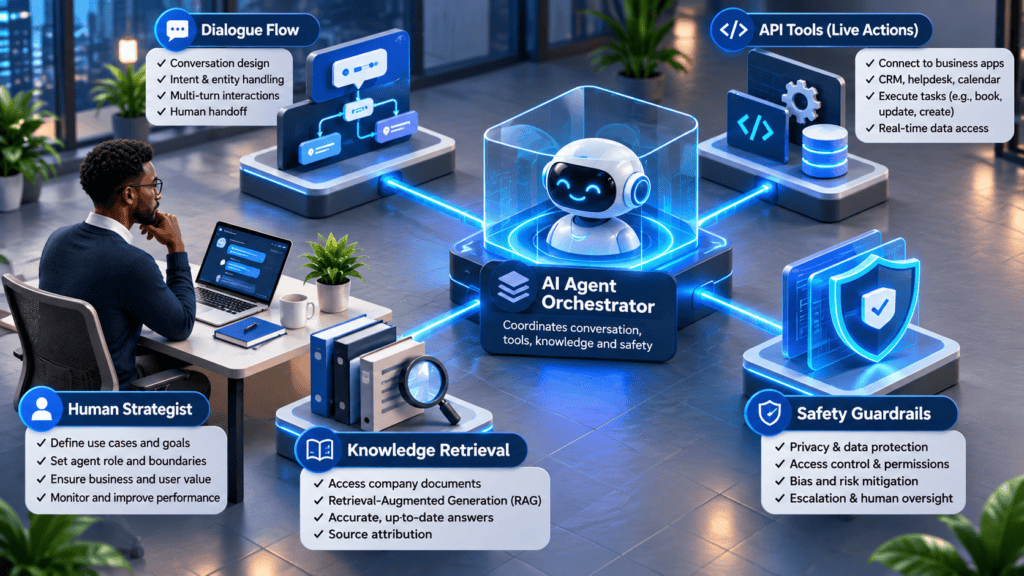
This reality has created a clear market divide. Basic prompting is now a baseline expectation, not a differentiator. Organizations increasingly rely on professionals who possess specialized conversational AI agent skills—the ability to structure dialogue flows, connect models to live APIs, evaluate reliability, and enforce guardrails.
This guide breaks down the seven core conversational AI agent skills you need to master, followed by a practical 30-day roadmap to build them.
What Is a Conversational AI Agent?
A conversational AI agent is an AI system that interacts with users through natural language and executes defined workflows using instructions, knowledge sources, and connected tools.
Consider the difference in a customer support scenario:
- Traditional chatbot: Answers a static question about a company’s refund policy.
- Conversational AI agent: Interprets the customer’s refund request, queries the order database, verifies policy eligibility, triggers an authorized refund workflow via API, and escalates edge cases to a human representative.
The defining distinction is autonomous execution. Rather than merely generating text, an agent participates in multi-step workflows and takes action across external software.
Core Architecture of a Conversational AI Agent
As outlined in OpenAI’s official Practical Guide to Building Agents, production agents rely on interconnected architectural layers rather than a standalone model:
| Component | Core Function |
| Large Language Models (LLMs) | Serve as the reasoning engine to interpret intent, plan steps, and generate responses. |
| Instructions & Orchestration | Define the agent’s role, decision logic, and multi-step execution loop. |
| Knowledge Sources (RAG) | Ground responses in live company documentation, policies, and reference data. |
| Tools & Integrations | Connect the agent to external APIs and databases to retrieve data or trigger actions. |
| Memory & Context Management | Retain user state, session history, and constraints across multi-turn conversations. |
| Guardrails | Enforce boundaries—blocking prompt injections, PII leaks, off-topic queries, and unauthorized high-risk actions. |
| Evaluation & Monitoring | Track accuracy, latency, and edge-case failures through automated benchmarks and tracing. |
Why Are Conversational AI Agent Skills Becoming Important?
Organizations are shifting budgets from passive chat interfaces to action-oriented systems that absorb operational workload. By the end of 2026, Gartner projects that 40% of enterprise applications will embed task-specific AI agents—yet nearly half of organizations cite system integration and reliability as their primary deployment bottlenecks.
In practice, high-volume teams deploy agents to triage inbound requests, verify user records, update CRM entries, and route complex escalations across key sectors:
- Banking & Financial Services: Fraud triage, account inquiries, and guided compliance workflows.
- Healthcare Administration: Patient intake, appointment scheduling, and insurance verification.
- E-Commerce & Retail: Order tracking, automated returns, and personalized product troubleshooting.
- Education & Online Learning: Adaptive tutoring, syllabus navigation, and student onboarding.
- Human Resources & Operations: Employee onboarding, IT ticket resolution, and internal policy guidance.
- Travel & Hospitality: Dynamic itinerary rebooking and loyalty account management.
- Software Development: Automated bug triage, documentation querying, and incident escalation.
Selecting a foundational model is now the easiest part of the stack. Real-world reliability depends on professionals with conversational AI agent skills—practitioners who can translate business rules into structured instructions, scope tool permissions safely, design seamless human handoffs, and build evaluation loops that prevent silent failures in production.
Essential Conversational AI Agent Skills Professionals Need to Learn
Building reliable, action-oriented AI systems requires moving beyond basic prompting toward full-stack workflow engineering. While foundational coding and ad-hoc chat interactions are rapidly commoditizing, high-impact practitioners differentiate themselves by mastering problem decomposition, context design, tool integration, and rigorous evaluation.
The seven core conversational AI agent skills below define the modern competency stack for designing, deploying, and governing production-ready agents.
Conversation Design and Prompt Architecture
An agent is only as reliable as its instructions. Conversation design and prompt architecture is the discipline of structuring system-level directives—defining what the agent is, how it reasons, how it communicates, and where its hard boundaries sit—so an LLM executes consistently across unpredictable user interactions.
Unlike ad-hoc chatting, production prompt architecture separates static rules from dynamic context. A well-engineered system prompt covers four core elements:
- Role & Scope: Defines the agent’s identity and primary objective in one or two direct sentences.
- Action Boundaries: Explicitly states what the agent is authorized to execute versus when it must stop and escalate (e.g., “You may process refunds under $50; escalate all higher-value requests to Tier-2 support”).
- Fallback & Uncertainty Protocols: Dictates how the agent responds when data is missing or confidence is low—preventing hallucinations by enforcing clear “I don’t know” or clarification pathways.
- Tone & Formatting Constraints: Controls verbosity, persona, and structured output rules so responses stay concise and scannable.
Designing for real-world deployment also requires planning for multi-turn conversational repair. Users rarely state their full intent in a single message—they provide partial details, change their minds mid-flow, or correct earlier inputs.
Strong conversation designers build explicit rules for progressive clarification (asking one targeted question at a time rather than overwhelming the user) and maintain a curated library of golden example dialogues (few-shot exemplars) to test edge cases before deployment.
Practical Rule of Thumb:
Script the ideal multi-turn conversation—including one failure or correction path—before writing a single line of configuration. If you cannot map the exact decision logic on paper, the model will not reliably invent it in production.
Tool Use and API Integration
The defining leap from a passive chatbot to an autonomous agent is tool execution. An agent limited to text generation can only advise; an agent connected to external APIs can query live order databases, verify calendar availability, update CRM records, and complete end-to-end tasks.
At the technical core of this skill is function calling (and standardized integration layers like the Model Context Protocol)—teaching the model to select the right tool, format valid JSON parameters, and interpret the returned payload. Reliable tool integration rests on three engineering practices:
- Descriptive Schema Design: Models rely on tool metadata to decide when and how to act. A function named
search_orderswith an explicit description of its parameters, edge cases, and return format—paired with strict type validation—will execute accurately far more often than an ambiguous wrapper with generic field names.
- Least-Privilege Tool Scoping: Every additional tool expands the model’s decision surface and increases the probability of wrong tool selection or parameter hallucination. Start with the minimum viable toolset required to solve the core workflow, and separate read-only actions (e.g.,
get_account_balance) from high-impact write actions (e.g.,process_refund).
- Graceful Error Handling & Fallbacks: External APIs inevitably time out, hit rate limits, or return empty records. Rather than passing raw stack traces back to the model—which often triggers hallucinated workarounds—return structured, plain-language error states (e.g.,
"Order lookup timed out; inform the user and offer to escalate") so the agent recovers transparently.
Practical Rule of Thumb:
Treat tool descriptions like user-facing documentation written specifically for an LLM. Before scaling an agent, test its tool-calling accuracy against ambiguous user queries to verify it asks for missing parameters instead of guessing them.
Context and Memory Management
Every large language model operates within a finite context window, and performance degrades well before that window hits capacity.
Without active state architecture, agents lose track of user constraints, repeat resolved questions, or suffer from “context rot” as long transcripts accumulate noise. Context and memory management is the discipline of dynamically curating what information enters the model’s working memory at each turn.
Production agents rely on three complementary memory layers:
- Rolling Summarization & Compaction: When a multi-turn session exceeds a set token threshold, older dialogue turns are compressed into a concise state summary (capturing confirmed decisions, open questions, and user intent) while keeping only the most recent exchanges verbatim.
- Just-in-Time Knowledge Retrieval (RAG): Rather than overloading the system prompt with static manuals, the agent queries a vector or hybrid knowledge base at runtime to pull only the specific policy chunks or records relevant to the current turn.
- Persistent Structured Memory: Key-value facts—such as account IDs, tier status, formatting preferences, or past resolution outcomes—are extracted and stored externally in a database, allowing the agent to retrieve verified user state across separate sessions.
A frequent anti-pattern is prompt stuffing—dumping ten full policy documents into the base instructions hoping the model will sort through them.
In practice, bloated prompts dilute attention, spike latency and token costs, and degrade reasoning accuracy. High-performing practitioners engineer lean context pipelines that inject only the minimum viable facts required to execute the immediate step.
Practical Rule of Thumb:
Treat the context window like high-speed RAM, not a hard drive. Keep persistent data in external storage, retrieve only the top-ranked chunks needed for the active turn, and prune stale conversation history aggressively.
Evaluation and Testing
You cannot improve what you do not measure. Evaluation and testing is the discipline that separates production-grade practitioners from hobbyists—and it remains the most commonly skipped step in agent development.
Because LLMs are non-deterministic, a single impressive demo proves nothing; reliability requires systematic verification across both outcomes and execution trajectories.
As highlighted in Anthropic’s engineering guidance on building and evaluating effective agents, teams should start with a focused suite of 20 to 50 realistic test tasks drawn from real user workflows, edge cases, and known failure modes before scaling complexity. A complete evaluation loop rests on three core practices:
- Track Outcome & Operational Metrics: Move beyond subjective “vibe checks” by measuring task success rate (whether the underlying goal was actually completed, not merely whether the agent finished talking), tool-call accuracy (whether it selected the right function and passed valid parameters), and escalation rate (how often it cleanly hands off high-risk or ambiguous cases to a human).
- Run Multi-Trial Regression Suites: Re-run your benchmark suite every time you modify a system prompt, swap models, or update a tool schema to catch silent regressions. Because single-run scores can mask flakiness, evaluate repeated trials across critical scenarios to ensure consistent execution rather than lucky passes.
- Audit Live Conversation Traces: Automated benchmarks cannot anticipate every quirk of human phrasing. Reviewing five end-to-end user transcripts—pinpointing exact turns where users repeat themselves, override the agent, or abandon the session—reveals high-leverage failure clusters that should immediately be converted into new regression test cases.
Practical Rule of Thumb:
Never treat “completed conversation” as “successful task”. Grade the actual state change in your target system (e.g., was the CRM record updated or the refund issued?), and feed every real-world user failure back into your test dataset.
Guardrails, Safety, and Reliability
An agent interacting with live customers operates as an extension of your brand—and a single unguarded mistake can erase user trust or trigger compliance failures. Guardrails, safety, and reliability is the discipline of wrapping probabilistic models in deterministic controls to prevent the three highest-risk production failures: hallucinations, unauthorized actions, and data leakage.
Effective governance enforces defense-in-depth across three control layers:
- Strict Grounding Against Hallucinations: Require the agent to anchor factual claims exclusively in verified tool outputs or retrieved knowledge base chunks rather than parametric training memory. Pair system instructions with explicit refusal rules so that when retrieved context lacks an answer, the agent states what is missing and routes to a human rather than fabricating policies or figures.
- Scoped Permissions & Human-in-the-Loop (HITL) Gates: Classify every tool into read-only operations (e.g., checking order status) versus state-changing actions (e.g., issuing refunds, modifying permissions, or sending external emails). Enforce deterministic confirmation gates—requiring explicit user or supervisor approval—before executing irreversible or high-value actions, and write every tool invocation to an immutable audit log.
- Data Isolation & PII Redaction: Strip API keys, credentials, and unnecessary personally identifiable information (PII) from prompt payloads before inference, enforce strict tenant and session boundaries so cross-user memory leakage is impossible, and deploy input/output classifiers to block prompt-injection attempts.
Practical Rule of Thumb:
Never rely solely on polite system-prompt instructions to enforce security. Implement hard validation checks, permission scopes, and confirmation gates in your application code outside the LLM so unsafe actions are structurally impossible.
Domain Knowledge and Workflow Design
The highest-performing agents are built by practitioners who deeply understand the underlying business operation.
A customer support agent must reflect real triage logic, escalation thresholds, and resolution standards; a sales agent must navigate buyer qualification, objection handling, and CRM handoff rules. No amount of prompt engineering can compensate for a broken or poorly understood business process.
Before configuring a single model or API, map the end-to-end operational workflow and apply three core design steps:
- Audit Current-State Execution: Document every step in the existing human workflow—who performs it, what data inputs are required, what business rules govern decisions, and where bottlenecks or errors routinely occur.
- Define Human-Agent Task Boundaries: Partition the workflow using an 80/20 automation lens. Assign high-volume, deterministic, and data-lookup steps to the agent while keeping ambiguous, high-stakes, or relationship-critical decisions with human specialists—designing seamless context transfer at every handoff point.
- Identify Strategic Non-Automation Zones: Recognize where automation creates friction rather than leverage. High-emotion disputes, complex ethical trade-offs, and situations requiring human accountability should bypass full automation entirely and route immediately to a person.
Practical Rule of Thumb:
Treat your process map—not your prompt—as the primary design document. Automate clear, repeatable decision paths first, and build frictionless escalation triggers for everything else.
Deployment, Monitoring, and Iteration
Shipping an agent to production is the starting line, not the finish. Deployment, monitoring, and iteration is the operational discipline of observing live behavior, diagnosing root-cause failures, and tightening performance through continuous, data-driven release cycles.
High-performing teams treat production operations as a closed feedback loop built on three core practices:
- Instrument End-to-End Observability from Day One: Log full execution traces—capturing user inputs, retrieved context chunks, tool calls, latency, token costs, and final outcomes. Track live task success rate, escalation rate, and user satisfaction (CSAT) against your pre-launch baselines to spot drift immediately.
- Perform Root-Cause Failure Triage: When a production session fails, trace the exact failure layer rather than patching surface symptoms. Determine whether the breakdown stemmed from ambiguous system instructions, stale knowledge-base documents, malformed tool schemas, or overly restrictive guardrails—fix the underlying component, convert the failure into a new regression test, and verify before redeploying.
- Prioritize Weekly Iteration Cadence Over Launch Perfection: Real user phrasing exposes edge cases no lab test can predict. Teams that ship a scoped MVP early, audit a structured sample of live transcripts every week, and deploy targeted improvements compound reliability far faster than teams spending months polishing an untested build. For organizations looking to accelerate initial deployment without engineering the entire infrastructure stack from scratch, partnering with specialized AI Assistant Development Services can provide a production-ready foundation while internal teams focus on continuous iteration.
Practical Rule of Thumb:
Establish a weekly “trace review” ritual—audit 10 failed or escalated live sessions, isolate the top recurring failure mode, fix the root component, and validate against your regression suite before pushing updates.
A Practical 30-Day Learning Plan
Here is a realistic way to build these skills in a month, spending about an hour a day.
Week one is foundations. Pick one use case, such as answering questions from a help centre, and write the ideal conversation as a script. Build a simple agent with a clear system prompt and test it with ten realistic requests. Write down everything that goes wrong.
Week two is tools and context. Add one tool, such as a search over your own documents, and learn retrieval. Add a second tool only when a real request needs it. Practice summarising long conversations and watch how the agent’s answers change.
Week three is evaluation and guardrails. Build a test set of thirty requests, score the agent, and fix the three most common failures. Add one guardrail: a rule that the agent must say it does not know when the information is not in the retrieved material. Add logging so you can review real conversations.
Week four is a small launch. Let five real users try the agent and watch their conversations. Fix the top three problems you see, re-run your test set, and write down what you learned. You will finish the month with a working agent, a test set, and a list of real improvements, which is more than most teams have after a year.
Mistakes That Hold Beginners Back
Most early failures in conversational AI agent skills come from prioritizing novelty or speed over disciplined engineering. Beginners routinely fall into four predictable traps:
- Automating the Wrong Workflow First: Teams often tackle their most complex, branching process right out of the gate and stall. Start with a high-frequency, narrow workflow that has clear rules and low risk—early wins establish operational trust and surface real integration lessons quickly.
- Mistaking a Polished Demo for Production Readiness: Passing five rehearsed prompts proves very little. Real users type with typos, drop half-finished thoughts, supply partial data, and change direction mid-thread; test against messy, unscripted inputs before launch.
- Skipping Systematic Evaluation: Editing prompts or tools without a repeatable test set turns iteration into guesswork, where fixing one edge case silently introduces two regressions. Run a fixed benchmark suite after every change to catch breakage early.
- Treating Human Handoff as an Afterthought: An agent that resists escalation creates friction rather than reliability. Design smooth escalation paths—complete with conversation context, collected details, and clear triggers—because handoff moments determine whether users trust the system.
Practical Rule of Thumb:
Build for boring reliability on a narrow workflow first, validate against messy real-world inputs with a regression suite, and treat clean escalation as a core feature rather than a fallback.
What are the most important conversational AI agent skills to learn first?
Start with conversation design and prompt architecture, tool use (function calling), and evaluation.
Together, these three conversational AI agent skills let you define clear agent boundaries, connect the model to real business data or APIs, and verify that changes improve reliability rather than creating silent regressions.
Do I need a computer science degree or advanced coding skills to build conversational AI agents?
No. While production-scale orchestration benefits from Python or TypeScript familiarity, non-engineers can build high-impact agents using visual workflow platforms, structured JSON schemas, and no-code API connectors.
Core conversational AI agent skills rely more on logical process mapping, clear instruction writing, and rigorous testing than on writing algorithms from scratch.
How is building a conversational AI agent different from traditional prompt engineering?
Traditional prompt engineering focuses on generating a single accurate text output from one user prompt.
Building a conversational AI agent requires managing multi-turn state, tool execution, retrieval-augmented generation (RAG), guardrails, and human escalation paths so the system can safely complete real workflows across multiple steps.
Which tools and frameworks should I learn to practice conversational AI agent skills?
Focus on transferable architectural patterns rather than locking into a single vendor. Practice building with an LLM API that supports native function calling and structured outputs, a knowledge retrieval layer (vector or hybrid search), a workflow orchestration framework (such as LangGraph, OpenAI Agents SDK, or visual platforms like n8n), and an evaluation/tracing tool to log multi-turn runs.
How long does it take to learn job-ready conversational AI agent skills?
With focused daily practice, professionals can build a functional, evaluated portfolio agent in 30 days.
Spending week one on prompt architecture and workflow mapping, week two on tool integration and retrieval, week three on guardrails and evaluation suites, and week four on live iteration produces practical proof of capability faster than passive tutorials.
Which roles benefit most from conversational AI agent skills?
Conversational AI agent skills create immediate career leverage for AI engineers, product managers, technical support leads, operations analysts, solutions architects, and automation consultants.
Any professional responsible for turning manual, repetitive customer or internal workflows into scalable systems gains an edge by mastering agent design and governance.
In Conclusion
Mastering conversational AI agent skills comes down to seven practical disciplines: prompt architecture, tool integration, context management, systematic evaluation, deterministic guardrails, domain workflow design, and continuous production iteration.
None of these competencies requires a research degree—every one of them is built by scoping a narrow agent, testing it against messy real-world inputs, and tightening reliability week by week.
As organizations shift from experimental chatbots to autonomous workflow execution, professionals who combine operational judgment with hands-on conversational AI agent skills will become the indispensable builders teams rely on.
Choose one high-frequency use case, ship a minimal working version this week, and start your 30-day learning sprint—real mastery begins the moment live users interact with what you build.

Frank is the Founder of CodeCones, a San Francisco-based AI product development company specialising in building AI-powered software, SaaS solutions, and cloud platforms. He writes about practical applications of artificial intelligence, software development, and professional skills.