21 Best ChatGPT Prompts for Recruiters and Hiring Managers
ChatGPT prompts for recruiters serve as the foundational architecture for automating high-volume talent acquisition. By deploying these structured instructions, hiring professionals can execute critical workflows—from drafting specialized job descriptions and personalized candidate outreach to designing objective interview frameworks—with significantly higher speed and consistency.
In the current talent landscape, the objective of using AI is not mere automation, but the reduction of repetitive administrative drag to prioritize human-centric decision-making. When leveraged effectively, these prompts function as a force multiplier: they standardize your hiring process, sharpen evaluation criteria, and minimize cognitive bias.
While the quality of your output remains tied to your prompt engineering and final oversight, a disciplined approach to these AI tools is now a mandatory skill for recruiters aiming to scale their output without compromising on quality or candidate experience.
Defining ChatGPT Prompts for Recruiters
ChatGPT prompts for recruiters are modular, high-leverage instruction sets designed to operationalize talent acquisition workflows. Rather than functioning as simple shortcuts for drafting, they serve as an AI-driven management layer that enforces consistency, structural rigor, and objective decision-making across the hiring lifecycle.
Recruiters operating at scale do not view these prompts as isolated commands; they view them as repeatable system components. By defining specific context (role requirements, company culture), constraints (tone, length, formatting), and output parameters, these prompts transform AI into a dedicated partner for:
- Pipeline Architecture: Automating the creation of nuanced job descriptions that attract high-fit talent.
- Precision Screening: Establishing objective evaluation rubrics to minimize cognitive bias and prioritize competency over resume keywords.
- Strategic Communication: Scaling hyper-personalized candidate outreach that maintains high conversion rates without manual intervention.
In essence, these prompts are the interface through which technical and strategic rigor is injected into the recruitment process, allowing you to “build once and scale forever” by removing the administrative drag associated with traditional, manual hiring.
Strategic Positioning Advice
- Avoid “Writing Assistant” framing: Do not position these prompts as “helpers” or “writing tools.” Position them as “Hiring Infrastructure.” This aligns with Skilldential’s “High-Leverage” theme.
- The “Why” is Key: By focusing on consistency and systematization, you attract high-level professionals (managers/founders) rather than entry-level HR staff looking for a quick fix.
The Strategic Value of AI in Hiring Workflows
Recruiters are integrating ChatGPT into hiring workflows to eliminate the administrative friction that typically stalls recruitment pipelines. By offloading repetitive cognitive tasks to AI, firms transition from manual, reactive processes to scalable, systematic operations.
Core Drivers for AI Adoption
- Correction of Bottlenecks: High-volume hiring often results in inconsistent communication and evaluation delays. AI-driven systems normalize the speed and quality of touchpoints across the entire candidate journey.
- Operational Leverage: Internal audits at Skilldential reveal that structured AI prompting reduces manual drafting time by 30–45%. This efficiency allows talent acquisition teams to pivot from administrative processing to high-impact activities such as candidate engagement and strategic role planning.
- Structural Rigor: AI provides a mechanism to enforce standardized evaluation rubrics. By removing the variability of manual drafting, recruiters can ensure that hiring decisions remain anchored to predefined, objective criteria rather than intuitive bias.
- Human-in-the-Loop Optimization: The objective is not to replace the recruiter but to augment them. AI assumes the burden of content generation and document synthesis, leaving the recruiter to exercise the final, critical judgment—a necessity for maintaining legal compliance, company culture fit, and role complexity.
High-Leverage takeaway
Recruitment efficiency is no longer about working faster; it is about building durable systems. When recruiters move from “writing emails” to “managing prompt-based workflows,” they are essentially engineering their own hiring infrastructure.
The Framework for High-Leverage Hiring Prompts
Recruiters must transition from conversational prompting to systematic engineering. The most effective outputs are generated when the model understands the specific environment in which the hiring decision occurs.
The Universal Prompt Architecture
Use this framework to ensure every output is production-ready.
Formula: [Role] + [Context] + [Objective] + [Constraints] + [Output Format]
| Component | Strategic Purpose |
| Role | Sets the AI’s cognitive persona and domain expertise. |
| Context | Injects specific company culture, tech stack, and role difficulty. |
| Objective | Defines the explicit task (e.g., outreach, screening, rubric creation). |
| Constraints | Sets boundaries for tone, compliance, length, and technical requirements. |
| Output Format | Determines the structural layout for immediate application. |
Implementation Example: Backend Engineering
“Act as a Senior Technical Recruiter [Role] in a high-growth Fintech firm [Context]. Create a job description [Objective] for a Backend Engineer. The role must emphasize Python, REST APIs, and AWS infrastructure [Context]. Maintain a professional, inclusive, and performance-oriented tone [Constraints]; keep the content under 500 words [Constraints]. Format the output with clear headers, a bulleted list of technical requirements, and a structured ‘Why Join Us’ section [Output Format].”
Principles of Recruitment Prompt Engineering
To scale your hiring workflows, treat these prompts as reusable code. If a prompt produces a high-quality result, store it as a system component.
| Principle | Strategic Intent | Application Example |
| Contextual Weighting | Increases output relevance. | Specify the exact tech stack or team seniority. |
| Constraint Enforcement | Ensures compliance & consistency. | Define tone, word count, and DEI guidelines. |
| Output Structuring | Minimizes post-generation editing. | Request tables, scorecards, or specific Markdown headers. |
| Persona Injection | Aligns with target demographics. | Prompt for a “peer-to-peer” tone for senior hires. |
| Criterion Rigor | Reduces subjective bias. | Require a specific skills matrix or evaluation scorecard. |
Pro-Tip for Scalability
Avoid “one-off” prompting. For each stage of the hiring funnel, build a Template Library. By standardizing your variables (e.g., swapping “[Role]” or “[Tech Stack]” while keeping the rest of the prompt structure constant), you can execute complex hiring tasks in seconds rather than minutes.
How can recruiters use ChatGPT to scale recruitment workflows?
This 21-step framework transforms recruitment from a manual, administrative function into a high-leverage, scalable system. By implementing these workflows, you reduce the “time-to-decision” while increasing the structural integrity of your hiring process.
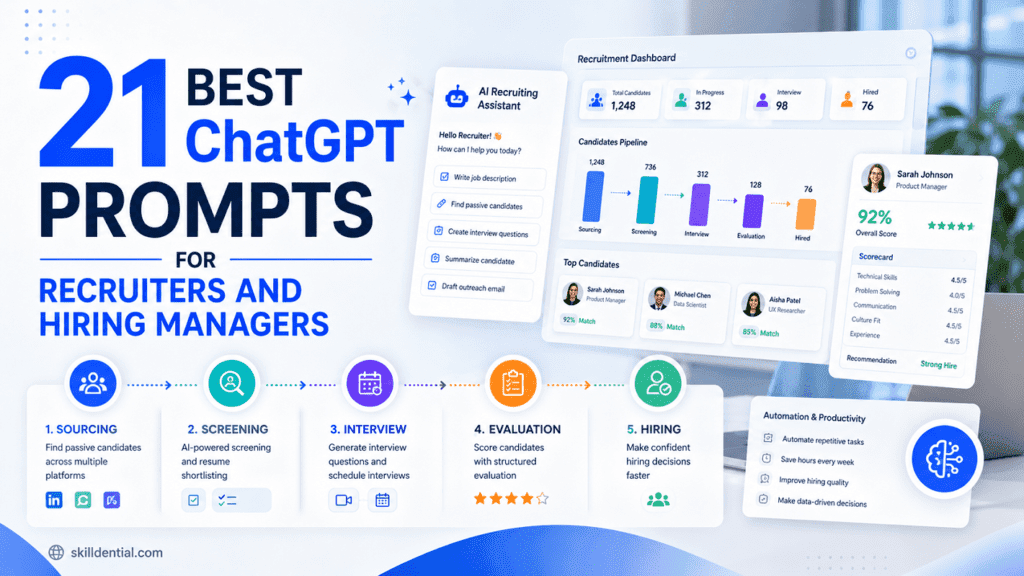
The 21-Step AI-Powered Hiring Workflow
| Phase | # | Workflow Goal | High-Leverage Prompt Structure |
| Operational | 1 | Write job descriptions | “Write a concise, inclusive job description for a [ROLE] at a [INDUSTRY] company. Include responsibilities, qualifications, salary framing, and skills.” |
| 2 | Rewrite unclear posts | “Improve this job description for clarity and candidate appeal while preserving requirements: [PASTE].” | |
| 3 | Generate Boolean strings | “Create Boolean search strings for sourcing a [ROLE] across LinkedIn and job boards.” | |
| 4 | Draft screening questions | “Generate 10 screening questions for a [ROLE] with ideal answer indicators.” | |
| 5 | Summarize resumes | “Analyze this resume and summarize strengths, gaps, and fit for [ROLE].” | |
| 6 | Interview scheduling | “Write a professional interview scheduling email with available times and next steps.” | |
| Quality | 7 | Structured scorecards | “Create an interview scorecard for [ROLE] using technical, behavioral, and culture-fit criteria.” |
| 8 | Interview rubrics | “Build a weighted evaluation rubric for a [ROLE] with scoring guidance.” | |
| 9 | Competency questions | “Generate competency-based interview questions for [ROLE].” | |
| 10 | Candidate comparison | “Compare Candidate A and B against this role using a decision matrix.” | |
| 11 | Skills-gap analysis | “Evaluate candidate gaps and recommend onboarding or upskilling areas.” | |
| 12 | Bias reduction | “Rewrite these interview questions to reduce bias and improve fairness.” | |
| Experience | 13 | Personalized outreach | “Write a personalized outreach message to a passive [ROLE] candidate using this profile: [DETAILS].” |
| 14 | Rejection emails | “Write a respectful rejection email with constructive, neutral wording.” | |
| 15 | Follow-up emails | “Draft a candidate follow-up email after the interview with timeline updates.” | |
| 16 | Employer branding | “Rewrite this company hiring pitch to sound candidate-friendly and credible.” | |
| 17 | FAQ responses | “Generate concise candidate responses for benefits, salary, remote work, and hiring process questions.” | |
| Strategy | 18 | Market insights | “Summarize hiring trends for [ROLE] and top in-demand skills.” |
| 19 | Passive sourcing | “Write persuasive outreach to passive candidates, avoiding generic recruiter language.” | |
| 20 | Competitive analysis | “Compare our job ad to competitors and recommend improvements.” | |
| 21 | Productivity system | “Build a weekly AI-assisted recruiting workflow for managing 100+ applicants efficiently.” |
Execution Strategy: Moving from List to System
To ensure these prompts function as a permanent business asset for Skilldential, implement these three operational rules:
- The Template Repository: Do not re-type prompts. Store these 21 prompts in a Notion database or document library, with placeholders (e.g., [ROLE], [COMPANY]) clearly marked.
- Modular Stacking: Combine prompts. For instance, link #3 (Boolean Strings) directly to #13 (Personalized Outreach) to create a high-speed sourcing engine.
- Human Validation Layer: AI generates the draft, but the recruiter owns the “System Decision.” Never send an AI-drafted email or scorecard without a final, critical review for tone, accuracy, and culture fit.
This framework effectively turns your recruitment workflow into a repeatable, scalable asset. Do you require assistance in building out the specific “Template Repository” structure or setting up the “Human Validation” checklist for these workflows?
How can recruiters decide when to use AI versus manual hiring work?
To maintain high-leverage operations, you must distinguish between commodity tasks (which benefit from automation) and judgment-critical milestones (which require human intuition).
The following matrix categorizes recruitment tasks based on the AI-Human Integration Framework, ensuring you prioritize efficiency without sacrificing hiring quality.
Recruitment Decision Matrix: AI vs. Human Oversight
| Recruitment Task | Automation Potential | Human Oversight Level | Strategy |
| Job Descriptions | High | Moderate | Automate: Use AI for first drafts; human for tone/compliance. |
| Boolean Sourcing | High | Low | Automate: Use AI to generate/refine search strings. |
| Resume Screening | High | High | Augment: AI flags “best-fit” based on criteria; human verifies the “story.” |
| Outreach Messaging | High | Low | Automate: Use AI for personalization; human for tone/authenticity. |
| Interview Scheduling | High | Very Low | Automate: Full system hand-off (e.g., Calendly/AI agents). |
| Competency Scoring | Moderate | High | Hybrid: AI provides rubric/data; human makes final call. |
| Culture/Value Fit | Low | Critical | Human-Led: AI cannot measure team synergy or emotional intelligence. |
| Final Hiring Decision | None | Critical | Human-Led: Absolute authority resides with the recruiter/manager. |
The “Golden Rule” of Recruitment AI
AI should be treated as an analytical engine, not a decision-making authority.
- When to use AI: Use it for any task that involves pattern recognition, high-volume data processing, or template-based drafting. If it saves time without changing the qualitative outcome of the hiring process, automate it.
- When to use Manual Work: Use human judgment for any task that involves empathy, nuance, career potential, or ethical deliberation. If a decision carries legal, cultural, or long-term strategic weight, a human must retain “Final Authority” status.
Operational Guardrails
To ensure your Skilldential systems remain high-leverage and bias-aware:
- Transparency: If you use AI for initial screening, disclose this to candidates to build trust and comply with emerging AI governance.
- Continuous Audit: Periodically review the “AI selection” vs. “Human selection” to ensure the AI isn’t inadvertently replicating historical biases (e.g., favoring specific university backgrounds or previous company logos).
- Human-in-the-Loop (HITL): Every AI-generated assessment or scorecard must be treated as “input data,” not as the final recommendation. A recruiter must validate these inputs before moving a candidate to the next stage.
How does AI improve recruiter productivity?
AI improves recruiter productivity by converting manual, administrative workflows into automated, data-driven systems. For recruiters managing high-volume pipelines, AI acts as a “force multiplier,” shifting time from repetitive task execution to high-value candidate engagement.
The Mechanisms of Productivity Gains
| Driver | How AI Improves Efficiency |
| Operational Velocity | AI eliminates bottlenecks in scheduling, job description drafting, and status updates, often reducing initial screening and administrative time by 30–75%. |
| Contextual Sourcing | Traditional Boolean search is limited by keyword matching. AI-powered sourcing tools interpret “transferable skills” and “career trajectories,” identifying qualified candidates 5x faster than manual searching. |
| Standardized Rigor | By automating the generation of scorecards, rubrics, and screening criteria, AI ensures that every candidate is evaluated against the same objective metrics, reducing the time spent on “gut-feel” debates. |
| Personalization at Scale | AI models allow recruiters to generate hyper-personalized outreach messages based on a candidate’s profile, leading to significantly higher response rates without the manual labor of crafting individual emails. |
Strategic Implementation for Scale
To move beyond simple task automation, high-leverage recruiters structure their productivity around these three pillars:
- Systematic Engagement: Use AI to manage communication touchpoints across the funnel. This prevents the “communication gap” where candidates drop off due to slow response times.
- Continuous Feedback Loops: Modern AI recruitment tools “learn” from recruiter feedback. When you rank a candidate or flag a resume, the system refines its future sourcing and screening parameters, meaning your productivity increases the longer you use the system.
- Predictive Analytics: By analyzing historical data, AI can forecast hiring needs and role fill-times. This allows recruiters to move from a reactive posture (filling an open seat) to a proactive one (pipelining for future organizational growth).
The High-Leverage Insight:
Productivity in modern recruiting is not measured by the number of hours spent “hiring,” but by the throughput of your hiring infrastructure. The most successful recruiters use these AI workflows to build an “always-on” talent pipeline, allowing them to scale their output without linear increases in headcount or time.
What are the risks of using ChatGPT in recruiting?
To maintain professional rigor and protect your organization, you must treat AI as a high-risk tool that requires a deliberate governance framework. Incorporating AI into hiring is not merely a technical choice; it is a legal and ethical commitment.
The Critical Risk Landscape
When using ChatGPT in recruitment, you face risks in four primary domains:
| Risk Category | Core Threat | Strategic Implication |
| Bias & Discrimination | AI models trained on historical data may replicate past human prejudices (e.g., favoring specific universities or gender-coded language). | You may be liable for discriminatory outcomes, even if the bias was unintentional. |
| Data Privacy | Sensitive candidate info (resumes, health/ID data) can be leaked or stored by public AI models if input directly. | Violations of GDPR, NDPR, or other data protection laws can lead to severe regulatory penalties. |
| Regulatory Compliance | Emerging “High-Risk” AI laws (e.g., EU AI Act, NYC Local Law 144) mandate transparency, explainability, and auditing. | Non-compliance can result in legal action if you cannot justify an automated hiring decision. |
| Authenticity & Fraud | A “black box” approach reduces the human touch, leading to generic communication and missing “red flags” in AI-generated resumes or cover letters. | Over-reliance on AI can result in bad hires who use AI to mask a lack of actual skill or identity integrity. |
Mitigation Framework for Skilldential Systems
To scale effectively while managing these risks, institutionalize these four safeguards:
- The “Human-in-the-Loop” (HITL) Mandate:
- Rule: No automated tool may make a final “Yes/No” hiring decision.
- Application: AI provides data, scoring, and summaries; humans provide final validation. Every AI-generated assessment must be reviewed for nuance, soft skills, and cultural fit.
- Strict Data Sanitization:
- Rule: Never input PII (Personally Identifiable Information)—such as full names, home addresses, phone numbers, or government IDs—into a public LLM.
- Application: Anonymize all candidate data before pasting it into ChatGPT for analysis or summarization.
- Transparency & Disclosure:
- Rule: Be transparent with candidates about AI usage.
- Application: Inform applicants if AI is used in the screening process and provide an “appeal process” where they can request a human review of a system-driven rejection.
- Governance & Bias Audits:
- Rule: Treat your prompts and workflows as “code” that requires documentation and periodic testing.
- Application: Regularly audit your AI workflows to see if they are disproportionately favoring or excluding specific demographics. Maintain a record of why specific criteria were chosen to ensure explainability to regulators if challenged.
Final High-Leverage Recommendation
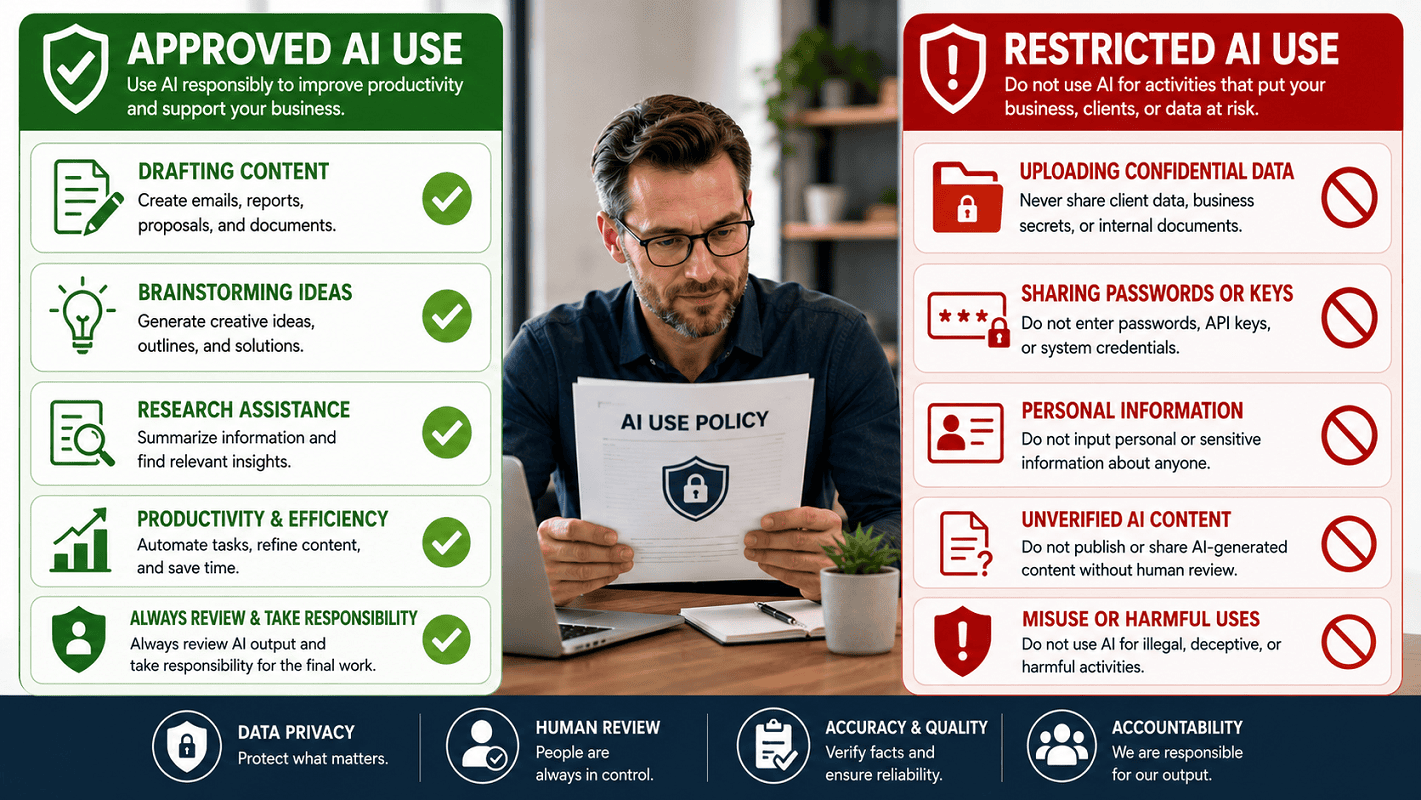
Do not integrate AI into your workflow until you have a defined “AI Usage Policy“ that your team has signed. This policy should explicitly state:
- Which data is safe to share with AI tools?
- Which tasks are fully automated vs. human-led?
- How candidates are informed of AI involvement.
What is a ChatGPT prompt for recruiters?
A ChatGPT prompt for recruiters is a modular, high-leverage instruction set designed to automate specific talent acquisition workflows. Unlike generic queries, these prompts incorporate specific context (role requirements), constraints (compliance/tone), and formatting parameters to transform AI from a writing tool into a scalable hiring infrastructure.
Can ChatGPT replace recruiters?
No. ChatGPT acts as a force multiplier, not a replacement. While AI automates repetitive administrative tasks, recruiters retain critical oversight for nuanced decision-making, such as assessing cultural fit, resolving complex salary negotiations, and ensuring ethical compliance. The value lies in a human-in-the-loop (HITL) architecture, where AI generates the data, but the recruiter owns the strategic decision.
How do recruiters write better AI prompts?
Recruiters shift from conversational to systematic prompting by using the Role + Context + Objective + Constraints + Output Format framework. High-performing recruiters treat prompts as reusable code—storing them in a library to ensure consistent output quality across all hiring stages.
Can hiring managers use ChatGPT without formal HR training?
Yes, provided they operate within an established AI Usage Policy. While hiring managers can leverage AI to generate high-quality scorecards, interview rubrics, and job descriptions, they should maintain a feedback loop with HR to ensure alignment with organizational hiring standards, legal compliance, and internal brand consistency.
Is ChatGPT safe for candidate evaluation?
It is safe as an analytical engine, but dangerous as an autonomous decision-maker. ChatGPT can effectively synthesize candidate data and rank applicants against predefined rubrics; however, it must never be the sole arbiter of hiring. Rigorous human oversight is mandatory to mitigate bias, ensure factual accuracy, and protect candidate data privacy (PII).
In Conclusion
ChatGPT prompts for recruiters represent a fundamental shift in talent acquisition: the transition from manual, reactive task management to the implementation of repeatable hiring systems. When treated not as isolated shortcuts but as durable infrastructure, these prompts become the mechanism through which recruiters scale their output without compromising rigor.
The primary objective of this framework is to replace administrative friction with structural leverage. By integrating AI into the hiring lifecycle—specifically for repetitive drafting, standardized evaluation, and systematic sourcing—you reclaim significant operational bandwidth. However, the true advantage is not merely time saved; it is the consistency created by enforcing objective criteria across every touchpoint of the hiring process.
The High-Leverage Blueprint:
- Automate the Commodity: Offload high-volume, repetitive administrative drafting to your AI-driven prompt library.
- Standardize the Quality: Use AI-generated scorecards and evaluation rubrics to anchor every hiring decision to predefined, objective competencies.
- Maintain Human Authority: The most successful hiring outcomes occur when AI serves as the analytical engine, but the recruiter serves as the final, strategic authority.
Recruiters who master prompt engineering as a core professional skill will consistently outperform those relying on ad hoc, experimental methods. By building once and scaling forever, you turn your recruitment workflow into a strategic asset that grows alongside your organization.
Final Checklist for Implementation
Before launching your new AI-powered hiring workflow, ensure your team has:
- A Documented Prompt Library: Centralized access to your vetted, high-leverage prompts.
- An Established AI Usage Policy: Clear guidelines on PII protection, bias mitigation, and human oversight.
- A Feedback Loop: A system for refining prompts based on the actual “Quality of Hire” outcomes over the coming quarters.