Funding a degree in science, technology, engineering, or mathematics abroad doesn’t have to mean taking on massive student debt—dozens of fully funded STEM scholarships for international students cover tuition, living stipends, airfare, and research costs across the globe.
Whether you are applying for an undergraduate degree, a specialized master’s, or a funded PhD fellowship, this guide breaks down 25 top opportunities, their exact eligibility criteria, funding coverage, and direct links to official application portals.
Editorial Scope & Methodology
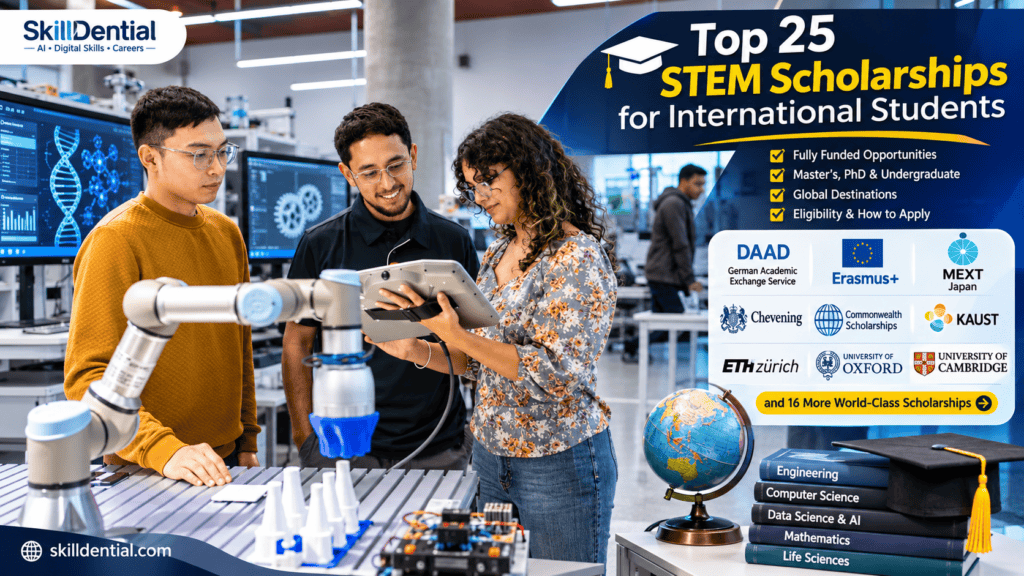
This shortlist is a curated global overview rather than an exhaustive database of every award in every country. While several listings are dedicated STEM scholarships for international students, others are prestigious, merit-based graduate fellowships that fully fund eligible science and engineering tracks.
Because funding bodies enforce strict criteria around nationality, gender, institutional affiliation, and specific sub-disciplines, always verify your exact profile against the linked official portals.
Verification & Cycle Note: Last verified: 21 November 2026. All eligibility rules and coverage details are benchmarked against the 2027 intake cycle wherever official guidelines have been published.
What Are STEM Scholarships for International Students?
STEM scholarships for international students are non-repayable financial awards designed to help foreign applicants fund undergraduate degrees, postgraduate coursework, or doctoral research across four core technical disciplines:
- Science: Biology, chemistry, physics, biotechnology, and environmental science.
- Technology: Computer science, artificial intelligence, cybersecurity, data science, and information technology.
- Engineering: Civil, mechanical, electrical, chemical, and aerospace engineering.
- Mathematics: Applied mathematics, statistics, computational mathematics, and quantitative modeling.
Unlike student loans, these awards do not need to be repaid and are funded by national governments, host universities, private foundations, research institutions, and international development organizations.
Depending on whether an award is partial or fully funded, coverage typically includes tuition waivers, monthly living stipends, university accommodation, round-trip airfare, health insurance, and dedicated laboratory or research grants.
Top 25 STEM Scholarships for International Students
The following STEM scholarships for international students were selected using four core benchmarks:
- Full & Partial Funding Depth: Priority is given to awards covering full tuition, monthly living stipends, travel grants, and research allowances.
- Institutional & Government Credibility: All listed programmes are backed by accredited universities, national ministries, or established global foundations.
- Broad Discipline Eligibility: Opportunities span undergraduate, master’s, and PhD tracks across core science, technology, engineering, and mathematics fields.
- Global & Developing-Nation Access: Strong weight is placed on awards open to applicants from developing economies alongside global merit-based fellowships.
DAAD Study Scholarships for STEM Disciplines (Germany)
The German Academic Exchange Service (DAAD) offers Study Scholarships for STEM Disciplines to high-achieving graduates from developing and emerging countries pursuing a full-time master’s degree in Germany.
The award specifically funds programmes in mathematics, computer science, natural sciences, and engineering (as well as interdisciplinary degrees with a designated STEM focus).
Category: STEM-Specific
- Study Level: Master’s (full-time, on-campus)
- Host Country: Germany
- Eligible Applicants: Graduates from eligible developing and emerging countries whose last degree is less than 6 years old and who do not already hold a master’s degree
- Funding Coverage: €992 monthly stipend, €460 annual study allowance, health/accident/personal liability insurance, and a travel allowance (plus optional rent or family subsidies where applicable)
- Duration: 10–24 months (depending on standard programme length)
- Application Deadline: Typically September–October for the following Winter Semester (varies by country; verify exact dates in the DAAD database)
- Official Portal: DAAD Scholarship Database – Study Scholarships for STEM Disciplines
Key Takeaway:
Because DAAD does not pay tuition fees under this scheme, your chosen master’s programme at a state or state-recognised German university must be tuition-free. You must also apply separately to your target German universities for admission.
DAAD Development-Related Postgraduate Courses – EPOS (Germany)
The DAAD EPOS (Entwicklungsbezogene Postgraduiertenstudiengänge) programme funds qualified professionals from developing and newly industrialised countries pursuing sustainability- and development-oriented postgraduate degrees at selected German universities.
Eligible technical tracks include engineering, environmental management, water resources, renewable energy, agricultural sciences, and public health, depending on the official annual course list.
Category: STEM-Eligible (Development Focus)
- Study Level: Master’s (and selected structured doctoral programmes)
- Host Country: Germany
- Eligible Applicants: Graduates from DAC-listed developing countries with an above-average bachelor’s degree (normally ≤6 years old) and at least 2 years of relevant post-graduation professional experience
- Funding Coverage: Monthly living stipend (€992 for master’s / €1,300 for doctoral), health/accident/liability insurance, travel allowance, and optional rent or family subsidies
- Duration: 12–36 months (varies by specific degree programme)
- Application Deadline: Varies by university and course (typically August–December for the following year’s intake)
- Official Portal: DAAD Scholarship Database – Development-Related Postgraduate Courses (EPOS)
Key Takeaway:
EPOS is not an open STEM scholarship—you can only apply to a curated list of ~25 approved courses (maximum 3 choices), and fresh graduates without two years of documented work experience are ineligible. Applications are submitted directly to the host university rather than the DAAD portal.
Hong Kong PhD Fellowship Scheme – HKPFS (Hong Kong)
Established by the Research Grants Council (RGC), the Hong Kong PhD Fellowship Scheme (HKPFS) recruits top international researchers to pursue full-time doctoral studies at any of Hong Kong’s eight UGC-funded universities.
With 400 fellowships awarded for the 2027/28 cycle, it is a premier option for doctoral candidates in engineering, computer science, artificial intelligence, biotechnology, data science, mathematics, and physical sciences.
Category: STEM-Eligible (High-Value Research Funding)
- Study Level: PhD (full-time)
- Host Country: Hong Kong
- Eligible Applicants: Open to all nationalities worldwide seeking admission as a new full-time PhD student
- Funding Coverage: Annual stipend of HK$344,400 (~US$44,150) plus an annual conference and research travel allowance of HK$14,400 (~US$1,850), alongside institutional top-ups (such as full tuition fee waivers, Year 1 housing guarantees, and cash recruitment awards at host universities like HKU and HKUST)
- Duration: 3 years (with host universities routinely funding the 4th year for students on a 4-year doctoral track)
- 2027/28 Application Deadline: 1 December 2026 (12:00 noon HKT) for the initial RGC application, followed immediately by full university admission submissions (closing 1 December 2026 at 11:59 pm HKT across all eight participating institutions)
- Official Portal: Research Grants Council – Hong Kong PhD Fellowship Scheme (HKPFS)
Key Takeaway:
HKPFS requires a strict two-step application on the same day: you must first register on the RGC Electronic System by 12:00 noon HKT to generate an HKPFS Reference Number, then quote that number in your full PhD admission applications (up to two programmes across one or two universities) before the 11:59 pm HKT university deadline.
Even if you miss out on the main fellowship, participating universities automatically consider strong HKPFS applicants for standard funded postgraduate studentships.
Erasmus Mundus Joint Masters Scholarships (Europe)
Funded by the European Union, the Erasmus Mundus Joint Masters (EMJM) programme offers some of the most flexible STEM scholarships for international students, enabling recipients to study across at least two (and often three or four) European universities within a single integrated degree. Dozens of consortia in the official catalogue specialize in high-demand technical fields, including:
Category: STEM-Eligible (Multi-Country Mobility)
- Artificial Intelligence & Data Science: Machine learning, robotics, cybersecurity, and intelligent decision-making.
- Engineering & Advanced Materials: Chemical, electrical, mechanical, semiconductor, and biomedical engineering.
- Environmental & Energy Systems: Renewable energy, sustainable food systems, and earth observation.
- Mathematics & Computational Science: Applied mathematics, scientific computing, and quantitative modeling.
- Biotechnology & Life Sciences: Biological engineering, medical image analysis, and infectious diseases.
Programme Specifications:
- Study Level: Master’s (60, 90, or 120 ECTS; 12–24 months)
- Host Countries: Consortia of universities across EU Member States and associated third countries (with optional partner-country mobility)
- Eligible Applicants: Students worldwide who hold a first higher-education degree (or are in their final year) and have not previously received an EMJM scholarship
- Funding Coverage: Full tuition/participation fee waiver, comprehensive health/accident/travel insurance, and a flat €1,400 monthly stipend (up to €33,600 over 24 months) designed to cover living, travel, visa, and installation expenses
- Application Deadline: Varies by consortium, typically October–January for the following September intake
- Official Portals: European Commission – Erasmus Mundus Joint Masters | EACEA Official Programme Catalogue
Key Takeaway:
There is no central application portal for these STEM scholarships for international students—you apply directly on each individual consortium’s website (with no application fee).
Because EU rules cap awards at no more than 10% per nationality within any single programme, shortlist 3–4 STEM consortia whose curricula closely match your undergraduate projects and tailor each motivation letter separately.
MEXT Japanese Government Scholarship – Research Students (Japan)
Administered by Japan’s Ministry of Education, Culture, Sports, Science and Technology (MEXT), the MEXT Research Student Scholarship is one of the most comprehensive STEM scholarships for international students, supporting graduate-level research, master’s degrees, and doctoral programmes in Japan.
It is especially well-suited for graduates specializing in engineering, computer science, robotics, physics, chemistry, materials science, and biological sciences.
Category: STEM-Eligible (Government Research Funding)
- Study Level: Non-degree graduate research, Master’s, and PhD pathways
- Host Country: Japan
- Eligible Applicants: Citizens of countries with diplomatic relations with Japan who are under 35 years of age and hold a bachelor’s or master’s degree in a related field
- Funding Coverage: 100% tuition, entrance, and matriculation fee waivers, round-trip economy airfare, and a monthly stipend of ¥143,000 (non-regular research/preparatory), ¥144,000 (Master’s), or ¥145,000 (PhD), plus a ¥2,000–¥3,000/month regional supplement in high-cost areas
- Duration: Up to 2 years as a non-degree research student, or the full standard duration of a Master’s (2 years) or PhD (3 years) degree—with an optional 6-month Japanese language preparatory period where required
- Application Deadline: April–May annually for the Embassy Recommendation track; October–January (varies by department) for the University Recommendation track
- Official Portal: Study in Japan – Japanese Government (MEXT) Scholarships
Key Takeaway:
There are two distinct routes into these STEM scholarships for international students: the Embassy Recommendation (submitted via your local Japanese embassy/consulate, involving written language exams and interviews before university placement) and the University Recommendation (submitted directly through a Japanese faculty supervisor without an embassy exam).
Because the 2027 Embassy Recommendation cycle closed in mid-2026, prospective 2028 intake applicants should prepare their research proposals ahead of the April–May 2027 embassy calls, or target direct University Recommendation openings for Autumn 2027 entry.
MEXT Japanese Government Scholarship – Undergraduate Students (Japan)
Administered by Japan’s Ministry of Education, Culture, Sports, Science and Technology (MEXT), the MEXT Undergraduate Scholarship is one of the few fully funded STEM scholarships for international students available directly after secondary school.
Applicants applying under the Natural Sciences track can select up to three preferred majors across Natural Sciences A (mathematics, physics, chemistry, electrical/electronic engineering, information engineering, mechanical engineering, civil engineering, architecture, and applied chemistry) as well as Natural Sciences B and C (agricultural, biological, pharmaceutical, and health sciences).
Category: STEM-Eligible (Fully Funded Undergraduate)
- Study Level: Undergraduate (Bachelor’s degree)
- Host Country: Japan (national universities)
- Eligible Applicants: Citizens of countries with diplomatic relations with Japan who are under 25 years of age and have completed (or will complete) 12 years of formal schooling equivalent to Japanese upper secondary education
- Funding Coverage: 100% exemption from entrance, matriculation, and tuition fees, round-trip economy airfare, and a monthly living stipend of ¥117,000 (plus an extra ¥2,000–¥3,000/month in designated high-cost regions)
- Duration: 5 years (1 year of intensive Japanese language and preparatory training followed by a 4-year bachelor’s degree; 7 years for 6-year pharmacy, medicine, dentistry, or veterinary medicine)
- Application Deadline: Set individually by each Japanese embassy or consulate, typically closing in May–June each year for the following April intake (expected April–May 2027 call for the 2028 cycle)
- Official Portal: Study in Japan – Japanese Government (MEXT) Undergraduate Scholarships
Key Takeaway:
Unlike the graduate research track, these undergraduate STEM scholarships for international students require mandatory subject-specific written exams at your local Japanese embassy—Mathematics, English, and Japanese, plus Physics and Chemistry for engineering/physical science tracks (Natural Sciences A) or Chemistry and Biology for life/agricultural science tracks (Natural Sciences B/C).
Direct placement into an English-taught degree without the 1-year preparatory course is also possible if you already meet the university’s language requirements.
KAUST Fellowship – King Abdullah University of Science and Technology (Saudi Arabia)
The KAUST Fellowship is one of the most generous all-inclusive STEM scholarships for international students, automatically funding admitted master’s and doctoral candidates at King Abdullah University of Science and Technology in Thuwal, Saudi Arabia.
Because KAUST is an exclusively graduate-level science and technology research institution, every degree track focuses directly on high-impact technical fields—including bioscience, computer science, artificial intelligence, electrical and mechanical engineering, applied mathematics, physical sciences, energy, and environmental science.
Category: STEM-Specific (Fully Funded Graduate Research)
- Study Level: Master’s (M.S.), PhD, and integrated M.S./PhD tracks
- Host Country: Saudi Arabia (Thuwal)
- Eligible Applicants: Qualified graduates of any nationality holding a relevant bachelor’s or master’s degree (minimum 3.0/4.0 GPA or international equivalent; GRE is optional)
- Funding Coverage: 100% tuition and laboratory bench fees (valued up to US$35,000/year), free on-campus housing (including utilities), comprehensive medical and dental insurance, and relocation support covering visas and flights
- Annual Stipend: US$20,000/year (~US$1,667/month) for M.S. students and **US$25,000–US$30,000/year** (~US$2,083–US$2,500/month) for PhD students depending on qualifications and academic progression
- Duration: Full standard duration of the degree (typically 1.5–2 years for M.S.; 3–4 years for PhD), contingent on maintaining satisfactory academic standing
- Application Deadline: Rolling admission rounds across Autumn, Winter, and Spring intakes (typically closing between October and January for Fall entry)
- Official Portal: KAUST Graduate Admissions – Fees & Funding
Key Takeaway:
Unlike external STEM scholarships for international students that require a separate funding application, every student admitted to a KAUST graduate degree receives the KAUST Fellowship automatically (unless sponsored by an external employer or government).
Your entire effort goes into securing academic admission—make sure your transcripts include an official university grading scale, and contact a prospective KAUST faculty advisor early if you are applying directly for a PhD.
Swedish Institute Pioneering Women in STEM Scholarship (Sweden)
Administered by the Swedish Institute (SI), the Pioneering Women in STEM Scholarship is one of the highest-impact STEM scholarships for international students dedicated to increasing female leadership in technical fields.
It funds full-time, English-taught master’s programmes in Sweden across computer science, artificial intelligence, engineering, renewable energy, environmental science, biotechnology, bioinformatics, applied biostatistics, chemistry, and mathematical sciences.
Category: STEM-Specific (Women in STEM)
- Study Level: Master’s (1- or 2-year full-time, English-taught programmes)
- Host Country: Sweden
- Eligible Applicants: Female citizens of 10 eligible countries for the 2027/28 cycle: Nigeria, Kenya, Rwanda, South Africa (Africa) and Bangladesh, Indonesia, Malaysia, the Philippines, Thailand, Vietnam (Asia). Applicants must be liable for Swedish university tuition fees and have documented work, entrepreneurship, or civil-society leadership experience.
- Funding Coverage: 100% tuition fee coverage (paid directly to the Swedish university), a monthly living allowance of SEK 12,000, a one-time travel grant of SEK 15,000, and membership in the SI Network for Global Professionals (NFGP) and Sweden Alumni Network
- Duration: Full standard duration of the master’s programme (10–24 months)
- 2027/28 Application Deadlines:
- University Admissions: 16 October 2026 – 15 January 2027 via UniversityAdmissions.se
- SI Scholarship Portal: 8 February – 24 February 2027 (closes 14:59 CET)
- Official Portal: Swedish Institute – Pioneering Women in STEM Scholarship
Key Takeaway:
Unlike open-ended STEM scholarships for international students, this award follows a strict two-step timeline and mandatory document formatting.
You must first apply to up to four eligible STEM master’s programmes on UniversityAdmissions.se by 15 January 2027 to receive your 8-digit personal application number, then submit your scholarship file in February using SI’s official 2027/28 templates for your CV (maximum 3 pages), proof of work/leadership experience, and two reference letters.
(Note: Ghana is excluded from the 2027/28 country list, and applicants must be admitted—not waitlisted—on 1 April 2027 to remain eligible.)
Commonwealth Shared Scholarships (United Kingdom)
Jointly funded by the UK Foreign, Commonwealth & Development Office (FCDO) and participating UK universities, Commonwealth Shared Scholarships are high-impact STEM scholarships for international students from low- and middle-income Commonwealth countries.
Under the Commission’s Science and Technology for Development and Strengthening Resilience and Response to Crises themes, participating universities offer dozens of approved technical master’s degrees—including artificial intelligence, data science, biomedical engineering, sustainable energy engineering, biotechnology, electrochemistry, and climate science.
Category: STEM-Eligible (Development-Focused Master’s)
- Study Level: Master’s (1-year full-time taught programmes)
- Host Country: United Kingdom
- Eligible Applicants: Citizens or refugees permanently resident in an eligible least-developed or lower-middle-income Commonwealth country who hold at least an upper second-class (2:1) undergraduate degree (or a lower second-class degree plus a relevant postgraduate qualification), have not studied or worked for 1 academic year or more in a high-income country, and cannot afford UK study without funding
- Funding Coverage: 100% approved tuition fees, round-trip airfare to and from the UK, a monthly living stipend of £1,712 (or £2,000/month at universities within the London metropolitan area), thesis/study travel grants, and child allowances where applicable
- Duration: 12 months (full duration of the approved master’s course)
- 2027/28 Application Window: Opened 10 November 2026; closes 8 December 2026 at 16:00 GMT
- Official Portals: Commonwealth Scholarship Commission – Shared Scholarships | 2027 Eligible Courses Directory
Key Takeaway:
Unlike nomination-based STEM scholarships for international students that route through national agencies, Commonwealth Shared Scholarships are submitted directly online via the CSC Central portal alongside a separate admission application to your chosen UK university.
You may apply for more than one approved course across multiple participating universities (though you can accept only one offer), and your referees must upload signed PDF references directly to CSC Central before the 8 December 2026 cutoff.
Clarendon Scholarships – University of Oxford (United Kingdom)
Awarding more than 200 fully funded places every year, the Clarendon Fund offers some of the most prestigious STEM scholarships for international students admitted to graduate study at the University of Oxford.
Because the scholarship is open across every subject area in Oxford’s Mathematical, Physical and Life Sciences (MPLS) and Medical Sciences divisions, it is a premier funding route for master’s and doctoral candidates in engineering science, computer science, physics, chemistry, mathematics, statistics, biology, and earth sciences.
Category: STEM-Eligible (Merit-Based Graduate Funding)
- Study Level: Master’s (MSc, MPhil) and DPhil (PhD), both full-time and part-time
- Host Country: United Kingdom (Oxford)
- Eligible Applicants: All nationalities worldwide, with selection based purely on academic excellence and research potential (typically requiring a first-class undergraduate degree or international equivalent)
- Funding Coverage: 100% of course and college fees plus a generous annual grant for living expenses for full-time scholars (aligned with the UKRI doctoral stipend minimum), or a study support grant for part-time scholars
- Duration: Full period of fee liability for the chosen graduate degree
- 2027/28 Application Deadline: Your specific course’s December 2026 or January 2027 funding deadline (12:00 midday UK time)
- Official Portal: University of Oxford – Clarendon Fund
Key Takeaway:
Unlike separate-form STEM scholarships for international students, there is no separate Clarendon application—you are automatically entered into the competition simply by submitting a complete Oxford graduate application before your programme’s December or January funding cutoff.
Be careful not to miss that early date: even if a course remains open into March for self-funded admission, late submissions lose automatic Clarendon consideration. (Note: Clarendon covers fees and living expenses, but does not cover international flights or UK visa/IHS fees.)
Reach Oxford Scholarship – University of Oxford (United Kingdom)
Supported by several Oxford colleges, the Reach Oxford Scholarship is one of the rarest fully funded undergraduate STEM scholarships for international students from low-income countries who cannot study for a degree in their home country due to financial, political, or educational barriers.
It covers all undergraduate courses at Oxford except medicine—making it eligible for bachelor’s programmes in computer science, engineering science, mathematics, physics, chemistry, biology, materials science, and earth sciences.
Category: STEM-Eligible (Need- & Merit-Based Undergraduate)
- Study Level: Undergraduate (3- or 4-year Bachelor’s / integrated Master’s programmes)
- Host Country: United Kingdom (Oxford)
- Eligible Applicants: Nationals of OECD DAC-listed developing countries (including Nigeria, Ghana, Kenya, and other eligible low-income nations) who hold an Oxford undergraduate admission offer, demonstrate strong financial need and social commitment, and intend to return home after graduating
- Funding Coverage: 100% of course and college fees, a full living-expenses grant, and one return airfare per year
- Duration: 3 or 4 years, depending on standard course length
- 2027/28 Application Deadline: 26 January 2027 (12:00 noon UK time) (for applicants who submitted their UCAS application by the 15 October 2026 deadline and received an admission offer)
- Official Portal: University of Oxford – Reach Oxford Scholarship
Key Takeaway:
Because Oxford awards only 2–3 Reach Oxford Scholarships per year, competition is intense and follows a strict sequence: you must apply through UCAS by 15 October 2026, secure a conditional or unconditional admission offer in January 2027, and then submit the separate online Undergraduate Scholarships form before 12:00 noon UK time on 26 January 2027.
Even if your accepting Oxford college does not directly fund a Reach Oxford place that year, you remain eligible to apply and be reassigned if selected.
ETH Zurich Excellence Scholarship & Opportunity Programme – ESOP (Switzerland)
Awarding roughly 60 fellowships per year, the Excellence Scholarship & Opportunity Programme (ESOP) at ETH Zurich ranks among the world’s most prestigious STEM scholarships for international students pursuing a master’s degree in Europe.
Consistently ranked among the top technical universities globally, ETH Zurich offers ESOP across its entire portfolio of science and engineering master’s programmes—including computer science, data science, robotics, electrical and mechanical engineering, quantum engineering, mathematics, physics, chemistry, and biotechnology.
Category: STEM-Specific (Merit-Based Master’s)
- Study Level: Master’s (3- or 4-semester full-time programmes; Master of Advanced Studies/MAS excluded)
- Host Country: Switzerland (Zurich)
- Eligible Applicants: Domestic and international bachelor’s graduates ranked in the top 10% of their undergraduate cohort (Grade A) who do not already hold a master’s degree
- Funding Coverage: 100% tuition fee waiver plus a living and study grant increased to CHF 13,500 per semester starting in Autumn 2027 (up from CHF 12,000), alongside dedicated faculty mentorship and access to the ETH Foundation network
- Duration: Full regular duration of the master’s degree (3 or 4 semesters)
- 2027/28 Application Window: 1 November – 30 November 2026 (11:59 CET) via eApply (first admission window only)
- Official Portal: ETH Zurich – Excellence Scholarship & Opportunity Programme (ESOP)
Key Takeaway:
Unlike separate-portal STEM scholarships for international students, ESOP must be requested simultaneously inside your first-window Master’s admission application by 30 November 2026 (11:59 CET).
Beyond standard transcripts, you must upload an original, self-authored master’s thesis pre-proposal following ETH’s citation guidelines—shortlisted candidates are contacted for a phone or video interview in February, with final decisions released at the end of March.
Australian Government Research Training Program – RTP (Australia)
Funded by the Australian Government Department of Education, the Research Training Program (RTP) provides block grants to accredited Australian universities to fund STEM scholarships for international students and domestic researchers pursuing higher degrees by research.
It is the primary national funding mechanism for research-intensive degrees in engineering, computer science, artificial intelligence, biomedical and health sciences, environmental science, physics, chemistry, and agricultural technology.
Category: STEM-Eligible (Government Research Funding)
- Study Level: Master’s by Research and PhD (Higher Degrees by Research)
- Host Country: Australia (40+ eligible Australian universities)
- Eligible Applicants: International and domestic graduates meeting the host university’s research admission criteria (typically a first-class Honours degree, research master’s, or equivalent)
- Funding Coverage: Up to three components—an RTP Fees Offset (100% tuition coverage), a tax-free RTP Living Stipend set for 2027 between AUD $35,550 (base) and AUD $55,537 (maximum) per year depending on the university, plus RTP Allowances covering Overseas Student Health Cover (OSHC), relocation, and thesis publication
- Duration: Up to 2 years for a Research Master’s and 3 to 4 years for a PhD
- Application Deadline: Set individually by each university (typically August–October for Semester 1 entry and March–May for Semester 2 entry)
- Official Portal: Australian Government Department of Education – Research Training Program (RTP)
Key Takeaway:
There is no central government application for these STEM scholarships for international students—individual Australian universities administer their own RTP allocations and cap international spending at 10% of their block grant, making international slots fiercely competitive.
Secure a prospective faculty supervisor first, verify your target university’s exact 2027 stipend rate (many Group of Eight universities top up the base rate to AUD $40,000–$44,000+), and submit your research admission application before the university’s international scholarship cutoff.
University of Twente Scholarship – UTS (Netherlands)
Designed for high-achieving non-EU/EEA applicants, the University of Twente Scholarship (UTS) offers merit-based STEM scholarships for international students admitted to qualifying English-taught MSc programmes in the Netherlands.
Known for its strong engineering and applied tech focus, the University of Twente funds master’s degrees across computer science, data science, robotics, electrical and mechanical engineering, chemical science and engineering, biomedical engineering, nanotechnology, and applied mathematics.
Category: STEM-Eligible (Partial Merit Award)
- Study Level: Master’s (1- or 2-year MSc programmes)
- Host Country: Netherlands (Enschede)
- Eligible Applicants: Non-EU/EEA nationals ranked in the top 5% to 10% of their graduating class who hold a (provisional) admission letter and student number for an eligible September 2027 MSc programme
- Funding Coverage: €3,000 to €22,000 for one year (paid as a flexible study-cost grant rather than a direct tuition deduction); 2-year MSc recipients can renew for Year 2 by achieving at least 50% of European Credits (ECTS) and an average grade of 7/10 by the end of the third quartile
- Duration: 1 year (renewable for Year 2 on 2-year MSc tracks)
- 2027/28 Application Window: Opens 15 October 2026 (09:00 CET); closes 1 April 2027 (16:00 CET) for September 2027 intake
- Official Portal: University of Twente – Scholarship Finder (UTS)
Key Takeaway:
Because UTS is a partial-funding award that does not automatically cover full statutory tuition or Dutch living expenses, budget carefully before accepting an offer.
Apply for academic admission at least 8 weeks before the 1 April 2027 deadline so you receive your mandatory student number in time—and if you are from a developing country, check eligibility for the Kipaji Scholarship, an additional top-up grant awarded exclusively to selected UTS recipients.
Lester B. Pearson International Scholarship – University of Toronto (Canada)
Awarded to approximately 37 incoming undergraduates each year, the Lester B. Pearson International Scholarship is the University of Toronto’s flagship merit award and one of the most comprehensive undergraduate STEM scholarships for international students in North America.
It supports first-entry bachelor’s programmes across U of T’s St. George, Scarborough, and Mississauga campuses—covering top-ranked tracks in computer science, mechanical/electrical/chemical engineering, mathematics, statistics, physics, chemistry, and life sciences.
Category: STEM-Eligible (Fully Funded Undergraduate)
- Study Level: Undergraduate (4-year first-entry Bachelor’s programmes)
- Host Country: Canada (Toronto)
- Eligible Applicants: International secondary-school students (requiring a Canadian study permit) in their final year of high school—or graduated no earlier than June 2026—who are formally nominated by a participating high school and beginning studies in September 2027
- Funding Coverage: 100% tuition fees, required books, incidental fees, and full on-campus residence support for 4 years
- Duration: 4 years (full undergraduate degree)
- 2027/28 Cycle Status: Closed for September 2027 intake (school nominations closed 9 October 2026, OUAC admission closed 16 October 2026, and student scholarship submissions closed 6 November 2026). Prospective September 2028 applicants should verify their high school’s participation before July 2027.
- Official Portal: University of Toronto – Lester B. Pearson International Scholarship
Key Takeaway:
Unlike self-nominated STEM scholarships for international students, you cannot apply for the Pearson Scholarship until your high school’s guidance counsellor or principal nominates you and you submit your OUAC admission application.
Note also that while you may apply to up to three U of T programmes on your admission form, the Pearson Scholarship is strictly tied to your first-choice programme at the time scholarship decisions are made.
Mastercard Foundation Scholars Program at Carnegie Mellon University Africa (Rwanda)
Through its flagship partnership with Carnegie Mellon University Africa (CMU-Africa) in Kigali, the Mastercard Foundation Scholars Program funds high-potential African graduates pursuing U.S.-accredited engineering and computing master’s degrees on the continent.
Located in Kigali Innovation City, CMU-Africa delivers three specialized, industry-aligned technical programmes: Master of Science in Information Technology (MSIT), Master of Science in Electrical and Computer Engineering (MSECE), and Master of Science in Engineering Artificial Intelligence (MSEAI).
Category: STEM-Specific (Fully Funded African Tech Master’s)
- Study Level: Master’s (full-time, on-campus in Kigali)
- Host Country: Rwanda (Kigali)
- Eligible Applicants: Citizens of African countries (with strong priority given to women, refugees/displaced youth, and applicants with disabilities or financial barriers) who hold an accredited bachelor’s degree in a relevant engineering, computing, or quantitative field
- Funding Coverage: Comprehensive financial package covering full tuition and academic fees, orientation/induction costs, housing, monthly living stipend, health insurance, laptop/learning materials, and travel support
- Duration: 16–20 months (full duration of the CMU-Africa master’s programme)
- 2027/28 Application Deadlines: 15 December 2026 (Early Admission Deadline) and 15 January 2027 (Final Admission Deadline) for Fall 2027 entry
- Official Portals: CMU-Africa – Admissions & Financial Aid | Mastercard Foundation – Partner Institutions
Key Takeaway:
CMU-Africa charges no application fee, and there is no separate external portal for these STEM scholarships for international students—you apply directly for admission to MSIT, MSECE, or MSEAI and complete the financial aid section inside your application account.
Applying by the 15 December 2026 early deadline carries a major financial perk: qualifying first-time applicants receive a complimentary Duolingo English Test (DET) fee waiver directly from the university.
Mastercard Foundation Scholars Program at the African Institute for Mathematical Sciences (AIMS)
The African Institute for Mathematical Sciences (AIMS) operates a pan-African network of postgraduate centres dedicated to accelerating scientific and quantitative leadership across Africa.
In partnership with the Mastercard Foundation, AIMS has funded structured master’s and research pathways in applied mathematics, data science, machine learning, computational science, climate modeling, and mathematical biology across participating centres in South Africa, Senegal, Ghana, Cameroon, and Rwanda.
Category: STEM-Specific (Pan-African Mathematical Sciences)
- Study Level: Structured Master’s in Mathematical Sciences (and selected co-operative/research master’s tracks)
- Host Countries: Participating AIMS centres across Africa (South Africa, Senegal, Ghana, Cameroon, Rwanda)
- Eligible Applicants: African nationals holding (or completing by programme start) a 4-year bachelor’s degree in mathematics or any science/engineering discipline with a strong mathematical component
- Funding Coverage: Full tuition, on-campus accommodation, meals, travel expenses, health insurance, and a monthly stipend administered through the AIMS–Mastercard Foundation partnership
- Duration: 10 months (Structured Master’s) to 18 months (Co-operative Master’s tracks)
- Application Status & Deadlines: Verify current cohort status before applying—the Mastercard Foundation partner directory currently lists the AIMS Scholars cohort status as closed while individual AIMS centres open their annual Structured Master’s calls on centre-specific schedules (typically January–March for the August/September intake).
- Official Portals: AIMS Global Network | Mastercard Foundation – Partner Directory
Key Takeaway:
Because the Mastercard Foundation’s multi-year partner allocation at AIMS operates in discrete cohorts and currently shows as closed on the Foundation’s central directory, applicants looking for STEM scholarships for international students in mathematical sciences should monitor both the AIMS Global Application Portal (applications.aimsric.org) and individual country centre calls, as AIMS routinely awards full institutional bursaries even outside active Mastercard Foundation cohort windows.
Gates Cambridge Scholarship – University of Cambridge (United Kingdom)
Awarding roughly 70 full-cost scholarships annually, the Gates Cambridge Scholarship is one of the world’s most selective STEM scholarships for international students pursuing postgraduate study at the University of Cambridge.
Open to applicants across every faculty outside the UK, it fully funds PhD, MSc, MLitt, and one-year postgraduate courses across Cambridge’s School of Technology and School of the Physical Sciences—including engineering, computer science, artificial intelligence, physics, chemistry, materials science, applied mathematics, and biotechnology.
Category: STEM-Eligible (Full-Cost Postgraduate Fellowship)
- Study Level: PhD, MLitt, and full-time one-year Master’s courses (MPhil, MRes, MASt; MBA/MFin/undergraduate degrees excluded)
- Host Country: United Kingdom (Cambridge)
- Eligible Applicants: Citizens of any country outside the United Kingdom who demonstrate outstanding intellectual ability, clear reasons for choosing their Cambridge course, leadership potential, and a commitment to improving the lives of others
- Funding Coverage: 100% of University Composition Fees, a single-student maintenance allowance (£23,152 for 12 months at the 2026/27 baseline, indexed annually for up to 4 years for PhD scholars), one economy single airfare at the start and end of the course, plus inbound visa and Immigration Health Surcharge (IHS) costs (alongside discretionary academic development and family allowances)
- Duration: Up to 4 years for PhD candidates; full course length for eligible 1-year Master’s programmes
- 2027/28 Application Deadlines:
- US Citizens Resident in the USA: 14 October 2026 (closed)
- All Other International Applicants (including US citizens living/studying abroad): 8 December 2026 or 6 January 2027 (23:59 UK time), depending on your specific course’s funding deadline in the Cambridge Course Directory
- Official Portal: Gates Cambridge – How to Apply & Timeline
Key Takeaway:
Unlike automatic-consideration STEM scholarships for international students, Gates Cambridge requires you to complete a dedicated Gates Cambridge section inside the standard Cambridge postgraduate application portal—including a 500-word personal statement addressing the four selection criteria and a specific Gates Cambridge reference from a referee briefed on your leadership and social impact (plus a research proposal for PhD applicants).
Make sure all referees upload their letters before your 8 December 2026 or 6 January 2027 course cutoff, as incomplete applications are automatically excluded.
Cambridge International Scholarship – Cambridge Trust (United Kingdom)
Administered by the Cambridge Commonwealth, European & International Trust, the Cambridge International Scholarship awards approximately 60 full-cost doctoral fellowships annually to the highest-ranked overseas research applicants at the University of Cambridge.
Selection is based strictly on academic merit and research potential, making it one of the most reliable STEM scholarships for international students applying for PhD research in engineering, computer science, physical sciences, biological sciences, clinical medicine, and mathematics.
Category: STEM-Eligible (Full-Cost Doctoral Funding)
- Study Level: PhD (full-time or part-time; Master’s applicants are considered separately for partial or co-funded Cambridge Trust awards rather than this flagship PhD scheme)
- Host Country: United Kingdom (Cambridge)
- Eligible Applicants: Overseas-fee-status applicants from any country outside the UK and Ireland admitted to an eligible Cambridge PhD programme
- Funding Coverage: 100% of international University tuition fees, an annual maintenance allowance for a single student, student visa fees, and the Immigration Health Surcharge (IHS)—with up to 6 additional months of write-up maintenance funding available upon application
- Duration: Standard funded period of the PhD (typically 3 to 3.5 years, extendable by up to 6 months for thesis write-up)
- 2027/28 Application Deadlines: 8 December 2026 or 6 January 2027 (23:59 GMT), depending on your chosen PhD programme’s funding deadline
- Official Portal: Cambridge Trust – Cambridge International Scholarship
Key Takeaway:
There is no separate application form for these STEM scholarships for international students—you simply tick “Yes” in the funding section of the Cambridge Applicant Portal and submit your complete PhD application (including references) by your department’s 8 December 2026 or 6 January 2027 funding cutoff.
Awards are allocated on a rolling basis between mid-February and the end of July 2027, meaning strong candidates remain under active consideration for reallocated fellowships throughout spring and summer.
Cambridge Africa Changemakers Scholarship – University of Cambridge (United Kingdom)
Offered through the Cambridge Trust in collaboration with Cambridge-Africa, the Cambridge Africa Changemakers Scholarship is one of the most comprehensive STEM scholarships for international students from Africa pursuing doctoral research at the University of Cambridge.
Open to citizens of all 54 African nations across nearly every academic department, it prioritizes PhD projects that drive sustainable, climate-resilient futures across the continent—making it ideal for researchers in engineering, climate and environmental science, agricultural technology, renewable energy, public health, and data science.
Category: STEM-Eligible (Fully Funded African Doctoral Award)
- Study Level: PhD (full-time; standalone master’s courses are excluded)
- Host Country: United Kingdom (Cambridge)
- Eligible Applicants: Citizens of any African country who hold overseas fee status, demonstrate financial need, and propose research aligned with Africa’s sustainable development
- Funding Coverage: 100% international University tuition fees, an annual single-student maintenance stipend, UK student visa costs, the Immigration Health Surcharge (IHS), plus dedicated travel and research expenses
- Duration: Standard funded length of the PhD (typically 3 to 3.5 years)
- 2027/28 Application Deadlines: 8 December 2026 or 6 January 2027 (23:59 UK time), depending on your specific PhD course’s funding deadline in the Cambridge Postgraduate Course Directory
- Official Portal: Cambridge Trust – Cambridge Africa Changemakers Scholarship
Key Takeaway:
Unlike separate-application STEM scholarships for international students, you do not submit a standalone form for Changemakers—simply tick the funding box in the Cambridge Applicant Portal by your course’s December 2026 or January 2027 funding deadline.
Because selection hinges on continent-wide impact, frame African development and climate resilience as the core thesis of your research proposal rather than a brief closing paragraph.
Jameel Education Foundation Cambridge Scholarship – University of Cambridge (United Kingdom)
Offered in partnership with the Jameel Education Foundation UK, this Cambridge Trust award funds high-achieving doctoral candidates from 36 eligible countries across Africa, Asia, and the Middle East.
Unlike general university bursaries, it targets high-impact technical disciplines—specifically supporting PhD research across biological sciences, engineering, clinical medicine, physical sciences, and technology.
Category: STEM-Specific (Fully Funded Doctoral Research)
- Study Level: PhD (full-time)
- Host Country: United Kingdom (Cambridge)
- Eligible Applicants: Citizens and residents of 36 eligible countries (including Nigeria, Egypt, Pakistan, Bangladesh, Indonesia, and others on the Cambridge Trust country list) with overseas fee status, with priority given to research benefiting the applicant’s home country or region
- Funding Coverage: 100% international University tuition fees, annual maintenance stipend, student visa fees, Immigration Health Surcharge (IHS), approved research, skills training, and academic travel expenses, plus optional dependent stipends (spouse/partner and up to two children living in Cambridge) and up to 6 months of PhD write-up funding
- Duration: Full standard PhD course length (plus up to 6 months write-up extension upon application)
- 2027/28 Application Deadlines: 8 December 2026 or 6 January 2027 (23:59 UK time), matching your chosen PhD programme’s funding deadline
- Official Portal: Cambridge Trust – Jameel Education Foundation Cambridge Scholarship
Key Takeaway: Among Cambridge’s STEM scholarships for international students, the Jameel award stands out for offering family dependent allowances alongside research and conference budgets. No separate scholarship application is required—apply for PhD admission by your department’s December/January funding cutoff, tick the funding box, and remain under rolling consideration between mid-February and July 2027.
Commonwealth (Cambridge) Scholarship – University of Cambridge (United Kingdom)
Jointly funded by the Cambridge Trust and the UK Commonwealth Scholarship Commission (CSC), the Commonwealth (Cambridge) Scholarship awards roughly 5 fully funded places per year to master’s students from 43 developing Commonwealth countries.
It covers 179 eligible full-time, one-year master’s courses across Cambridge (excluding premium-fee programmes like the MBA or MFin)—making it a strong option for applicants in engineering, computer science, mathematical sciences, environmental technology, biotechnology, and physical sciences.
Category: STEM-Eligible (Developing Commonwealth Master’s)
- Study Level: Master’s (1-year full-time programmes; MPhil, MRes, MASt)
- Host Country: United Kingdom (Cambridge)
- Eligible Applicants: Citizens/permanent residents of 43 eligible developing Commonwealth countries who meet CSC academic and financial-need criteria and commit to returning home after graduating
- Funding Coverage: 100% international University tuition fees, monthly living maintenance, round-trip airfare, and standard CSC arrival/thesis allowances
- Duration: 12 months (full master’s course length)
- 2027/28 Application Deadlines: Requires both an external CSC application (governed by your national nominating agency or CSC’s annual autumn window) and your Cambridge admission application submitted by your course’s December 2026 or January 2027 funding deadline
- Official Portals: Cambridge Postgraduate Funding Search – Commonwealth (Cambridge) Scholarship | Commonwealth Scholarship Commission
Key Takeaway:
Unlike automatic Cambridge Trust STEM scholarships for international students, this co-funded award requires a dual application: you must opt into funding inside the Cambridge Applicant Portal and submit a separate external application through the Commonwealth Scholarship Commission (via your home country’s nominating agency or approved NGO). Verify that your chosen Cambridge STEM course appears on CSC’s eligible subject list before submitting.
Cambridge Masters Studentship (International Fees) – University of Cambridge (United Kingdom)
Awarding approximately 10 scholarships per year, the Cambridge Masters Studentship (International Fees) is a merit-based Cambridge Trust award for overseas students undertaking a full-time, one-year postgraduate degree.
It spans all non-premium subjects at the University—including technical master’s degrees such as the MASt in Mathematics (Part III), MASt in Physics, MASt in Astrophysics, MPhil in Machine Learning and Machine Intelligence, and MPhil in Engineering.
Category: STEM-Eligible (Tuition-Only Master’s Award)
- Study Level: Master’s (1-year full-time programmes, including MASt; part-time MSt courses and applicants who already hold a master’s or PhD are ineligible)
- Host Country: United Kingdom (Cambridge)
- Eligible Applicants: Overseas-fee-status applicants of any nationality who do not already hold (and are not about to complete) a master’s or doctoral degree
- Funding Coverage: 100% of University international tuition fees (plus the College fee specifically for eligible MASt courses)
- Duration: 1 academic year (full course length)
- 2027/28 Application Deadlines: 8 December 2026 or 6 January 2027 (23:59 UK time), matching your chosen master’s course funding deadline
- Official Portal: Cambridge Trust – Cambridge Masters Studentship (International Fees)
Key Takeaway:
Because this studentship covers tuition fees only (and excludes living maintenance, flights, and UK visa/IHS costs), treat it as a high-value fee waiver rather than an all-inclusive package when comparing STEM scholarships for international students.
You are automatically considered when you apply by your course’s funding cutoff and tick the Cambridge Trust funding box—with awards rolling out between March and July 2027.
Nanyang President’s Graduate Scholarship – NPGS (Singapore)
Offered by Nanyang Technological University (NTU Singapore), the Nanyang President’s Graduate Scholarship (NPGS) is one of Asia’s highest-paying STEM scholarships for international students pursuing a full-time PhD.
Consistently ranked among the world’s top engineering and technology universities, NTU awards NPGS across its colleges of engineering, computing and data science, science, and medicine—supporting research in artificial intelligence, robotics, semiconductor engineering, materials science, chemical and biomedical engineering, physics, and biological sciences.
Category: STEM-Eligible (Premier Asian Doctoral Fellowship)
- Study Level: PhD (full-time; no post-graduation bond attached)
- Host Country: Singapore
- Eligible Applicants: Graduates of any nationality holding a bachelor’s degree with Honours (Highest Distinction / First Class) or international equivalent (final-year undergraduates may apply with provisional transcripts)
- Funding Coverage: 100% annual tuition fees, a monthly stipend of S$4,300 for international scholars (S$4,800 for Singapore PRs; S$5,300 for Singapore Citizens), an overseas conference allowance up to S$5,000/year, a one-time S$1,500 IT allowance, an annual S$500 book allowance, a S$600 thesis allowance, and priority campus housing
- Duration: Renewable annually for up to 4 years, subject to satisfactory academic progress
- 2027/28 Application Window: 1 November – 31 December 2026 (23:59 SGT) for the August 2027 intake (note: select non-STEM schools close earlier)
- Official Portal: NTU Singapore – Nanyang President’s Graduate Scholarship (NPGS)
Key Takeaway:
Unlike passive-stipend STEM scholarships for international students, international NPGS recipients are required to perform teaching or laboratory supervision duties under NTU’s Graduate Assistantship Programme (GAP).
Selection is strictly by school nomination followed by a university panel interview (with decisions issued 3–6 weeks post-interview)—and even if you miss out on NPGS, top applicants are automatically considered for the NTU Research Scholarship.
TaiwanICDF International Higher Education Scholarship (Taiwan)
Administered by Taiwan’s International Cooperation and Development Fund (TaiwanICDF), this government-backed programme provides all-inclusive STEM scholarships for international students from eligible partner nations to study English-taught degrees at premier Taiwanese universities (such as National Tsing Hua University, National Yang Ming Chiao Tung University, and National Cheng Kung University).
Participating programmes span electrical and mechanical engineering, information systems, smart healthcare, environmental engineering, tropical agriculture, and aquaculture science.
Category: STEM-Eligible (Fully Funded Partner-Country Award)
- Study Level: Undergraduate, Master’s, and PhD (limited strictly to the annual list of approved English-taught partner programmes)
- Host Country: Taiwan
- Eligible Applicants: Citizens of eligible TaiwanICDF partner countries (including diplomatic allies and designated countries across Africa, Asia-Pacific, Latin America/Caribbean, and Europe) who meet both TaiwanICDF and partner university admission rules
- Funding Coverage: 100% tuition and credit fees, round-trip economy airfare, on-campus dormitory housing, comprehensive medical insurance, required textbook costs, and a monthly living allowance of NT$15,000 (Undergraduate), NT$18,000 (Master’s), or NT$20,000 (PhD)
- Duration: Up to 4 years for Undergraduate, 2 years for Master’s, and 4 years for PhD (Autumn semester entry only)
- 2027/28 Application Window: 1 December 2026 – 15 March 2027 for the Autumn 2027 intake (note: individual university admission deadlines may close earlier than 15 March)
- Official Portal: TaiwanICDF – International Higher Education Scholarship Program
Key Takeaway:
Applying for these STEM scholarships for international students requires a three-part submission before 15 March 2027: (1) submit the TaiwanICDF online scholarship form, (2) submit a separate admission application to your chosen participating Taiwanese university programme, and (3) deliver your required application package to the ROC (Taiwan) Embassy or Representative Office covering your country for the mandatory first-round diplomatic review (completed by 31 March, with final results announced by 10 June 2027).
Side-by-Side Comparison of the Top 25 STEM Scholarships for International Students
Use the matrix below to quickly filter these STEM scholarships for international students by host destination, eligible degree level, and funding structure before reviewing the full application requirements above.
| # | Scholarship Programme | Destination | Study Level | Funding Coverage |
| 1 | DAAD STEM Scholarships | Germany | Master’s | Monthly stipend (€992) + allowances (tuition-free programmes) |
| 2 | DAAD EPOS | Germany | Master’s / PhD | Full scholarship (approved development courses only) |
| 3 | Hong Kong PhD Fellowship (HKPFS) | Hong Kong | PhD | Full stipend (HK$344,400/yr) + research travel + university waivers |
| 4 | Erasmus Mundus Joint Masters | Europe (Multi-Country) | Master’s | Full tuition waiver + €1,400/month stipend + insurance |
| 5 | MEXT Research Students | Japan | Research / Master’s / PhD | Fully funded (tuition, monthly stipend & return airfare) |
| 6 | MEXT Undergraduate Students | Japan | Bachelor’s | Fully funded (tuition, monthly stipend & return airfare) |
| 7 | KAUST Fellowship | Saudi Arabia | Master’s / PhD | Fully funded (tuition, housing, relocation & US$20k–$30k stipend) |
| 8 | SI Pioneering Women in STEM | Sweden | Master’s | Fully funded (tuition, SEK 12,000/month stipend & travel grant) |
| 9 | Commonwealth Shared Scholarships | United Kingdom | Master’s | Fully funded (tuition, £1,712–£2,000/month stipend & airfare) |
| 10 | Clarendon Scholarships (Oxford) | United Kingdom | Master’s / DPhil (PhD) | Full course fees + living-expenses grant |
| 11 | Reach Oxford Scholarship | United Kingdom | Bachelor’s | Fully funded (fees, living grant & annual return airfare) |
| 12 | ETH Zurich ESOP | Switzerland | Master’s | Full tuition waiver + CHF 13,500/semester living grant |
| 13 | Australian Government RTP | Australia | Research Master’s / PhD | Variable (tuition offset + AUD $35,550–$55,537/yr stipend) |
| 14 | University of Twente Scholarship | Netherlands | Master’s | Partial grant (€3,000–€22,000 for 1 year; renewable) |
| 15 | Lester B. Pearson (U of Toronto) | Canada | Bachelor’s | Fully funded (4-year tuition, books, fees & residence) |
| 16 | Mastercard Foundation at CMU-Africa | Rwanda | Master’s | Fully funded (tuition, housing, stipend, laptop & travel) |
| 17 | Mastercard Foundation at AIMS | Africa (Multi-Country) | Master’s | Fully funded (partner-administered tuition, board & stipend) |
| 18 | Gates Cambridge Scholarship | United Kingdom | Master’s / PhD | Full-cost funding (fees, £23,152/yr stipend, flights & visa/IHS) |
| 19 | Cambridge International Scholarship | United Kingdom | PhD | Full-cost funding (fees, maintenance, visa/IHS & write-up option) |
| 20 | Cambridge Africa Changemakers | United Kingdom | PhD | Full-cost funding (fees, maintenance, visa/IHS & research travel) |
| 21 | Jameel Education Foundation (Cambridge) | United Kingdom | PhD | Full-cost funding (fees, maintenance, research & dependent grants) |
| 22 | Commonwealth (Cambridge) Scholarship | United Kingdom | Master’s | Full-cost funding (fees, maintenance, airfare & CSC allowances) |
| 23 | Cambridge Masters Studentship | United Kingdom | Master’s | Tuition-only award (100% international fees; MASt college fee) |
| 24 | Nanyang President’s (NPGS) | Singapore | PhD | Full tuition + S$4,300/month stipend + conference/IT grants |
| 25 | TaiwanICDF Higher Education | Taiwan | Bachelor’s / Master’s / PhD | Fully funded (tuition, housing, monthly stipend & return airfare) |
Note:
Funding classifications summarize published programme terms for the 2027/28 cycle. Exact financial packages, allowances, and net stipends depend on your host university, degree track, and individual offer letter.
Best STEM Scholarships for International Students from Africa and Nigeria
Because national quotas and regional funding rules determine eligibility, African applicants can dramatically improve their odds by targeting STEM scholarships for international students that either ring-fence places for developing countries or restrict applications to African nationals.
The matrix below highlights the highest-leverage awards from this guide for African applicants:
| # | Scholarship Programme | Study Level | Why African Applicants Should Prioritize It |
| 1 | DAAD STEM Scholarships (Germany) | Master’s | Explicitly reserves funding for graduates from DAC-listed developing and emerging nations studying tuition-free German STEM degrees. |
| 8 | SI Pioneering Women in STEM (Sweden) | Master’s | Dedicated exclusively to female citizens of 10 eligible countries, including Nigeria, Kenya, Rwanda, and South Africa for the 2027/28 cycle. |
| 9 | Commonwealth Shared Scholarships (UK) | Master’s | Fully funds 1-year UK master’s degrees for citizens of eligible developing Commonwealth nations (including Nigeria, Ghana, Kenya, Uganda, and Rwanda). |
| 11 | Reach Oxford Scholarship (UK) | Bachelor’s | Covers full undergraduate fees, living costs, and annual flights for students from OECD DAC-listed low-income countries who hold an Oxford offer. |
| 16 | Mastercard Foundation at CMU-Africa (Rwanda) | Master’s | Restricted solely to African citizens pursuing U.S.-accredited MSIT, MSECE, or MSEAI degrees in Kigali—with no application fee. |
| 17 | Mastercard Foundation at AIMS (Pan-African) | Master’s | Exclusively trains African graduates in mathematical sciences, data science, and quantitative modeling across five African centres. |
| 20 | Cambridge Africa Changemakers (UK) | PhD | Open to citizens of all 54 African countries pursuing doctoral research aligned with Africa’s sustainable, climate-resilient future. |
| 21 | Jameel Education Foundation (UK) | PhD | Targets 36 eligible countries (including Nigeria and Egypt) for fully funded Cambridge PhDs in engineering, technology, and physical/biological sciences. |
| 25 | TaiwanICDF Higher Education (Taiwan) | Bachelor’s / Master’s / PhD | Reserves full scholarships for citizens of eligible partner countries across Africa (note: Bachelor’s tracks require formal diplomatic ties with Taiwan). |
Priority Picks for Nigerian STEM Applicants (2027/28 Cycle)
If you are applying from Nigeria, four programmes stand out for high acceptance leverage and active 2027/28 windows:
- Best Overall Master’s Route (Open to All Genders): Commonwealth Shared Scholarships (#9). Nigeria is an eligible country, there is no upper age limit, and the Commission requires no separate IELTS score (subject to your UK university’s waiver policy). Applications for the 2027/28 cycle close 8 December 2026 (5:00 pm WAT / 16:00 GMT).
- Best Dedicated Award for Nigerian Women: Swedish Institute Pioneering Women in STEM (#8). Nigerian female STEM graduates with documented work or leadership experience compete within a capped 10-country pool for full tuition, SEK 12,000/month, and a SEK 15,000 travel grant (university applications close 15 January 2027; SI portal opens 8–24 February 2027).
- Best Pan-African Tech Master’s (No Visa Hurdles): Mastercard Foundation at CMU-Africa (#16). Nigerian graduates enjoy ECOWAS/African mobility to Kigali, zero application fees, and a complimentary Duolingo English Test waiver when applying by the 15 December 2026 early deadline.
- Best Fully Funded Doctoral & Undergraduate Routes: Jameel Education Foundation (#21) and Cambridge Africa Changemakers (#20) for PhD candidates (closing 8 December 2026 or 6 January 2027), and Reach Oxford (#11) for high-achieving secondary-school leavers who already hold an Oxford undergraduate admission offer (closing 26 January 2027).
Before starting any application, verify that your exact degree specialization appears on the programme’s approved 2027/28 course list and confirm whether your target scheme requires a post-study home-country return commitment.
How to Apply for STEM Scholarships for International Students (7-Step Roadmap)
Winning competitive STEM scholarships for international students requires treating the application process like a structured project rather than a last-minute rush. Start preparing 6 to 12 months before your target intake and follow these seven steps:
Define Your STEM Specialization and Degree Track
Lock in both your exact technical sub-discipline and your target qualification before searching for funding:
- Discipline Focus:
- Computer science and AI,
- Civil/mechanical/electrical engineering,
- Data science and statistics,
- Biotechnology and life sciences,
- Environmental and climate science,
- Pure/applied mathematics and physics.
- Study Level:
- Undergraduate (Bachelor’s),
- Taught Master’s (MSc/MEng),
- Research Master’s (MPhil/MRes),
- Doctoral (PhD/DPhil).
Filtering by both variables immediately eliminates awards that exclude your degree level or specific department.
Audit Eligibility and National Quotas Before Preparing Documents
Read the official funding guidelines line by line to verify you meet every hard filter before investing weeks into essays:
- Nationality & Residency: Confirm your citizenship appears on the eligible country list and check for prior residency limits in high-income countries.
- Academic & Grade Floors: Verify minimum GPA/degree classifications (e.g., First Class or Upper Second Class / 2:1) and degree-age cutoffs (such as DAAD’s 6-year rule).
- Age, Work Experience & Prerequisites: Check upper age limits (e.g., MEXT), mandatory post-graduation work experience (e.g., DAAD EPOS), and whether a separate university admission offer or school nomination is required first.
Assemble and Standardize Your Application Dossier
Gather core credentials early so you are not blocked by institutional delays:
- Official academic transcripts (including an official university grading scale) and degree certificates.
- An academic or technical CV/résumé highlighting lab work, software/engineering projects, publications, and quantitative skills.
- Valid international passport or national identification.
- English-language proficiency scores (IELTS, TOEFL, or Duolingo English Test) or an official Medium of Instruction waiver letter, where accepted.
- Two to three academic or professional recommendation letters (brief your referees at least 4 weeks early with your CV and programme summary).
- Certified English translations for any documents issued in another language.
Write a High-Signal Statement of Purpose (SOP)
Avoid generic templates that could be sent to any university. Structure your Statement of Purpose around six concrete pillars:
- Academic & Technical Foundation: Highlight relevant coursework, lab methods, coding/engineering projects, and quantitative results.
- Discipline Motivation: Explain the specific scientific or engineering problem driving your specialization.
- Institutional Fit: Name specific faculty members, research labs, or specialized modules at your target university.
- Short- and Long-Term Career Goals: Define your immediate post-graduation technical trajectory.
- Financial & Strategic Need: Explain how the scholarship unlocks research or training otherwise out of reach.
- Home-Country or Global Impact: Show how you will apply your technical skills after graduating.
Draft a Focused Research Proposal (Master’s by Research & PhD)
For research-led degrees and fellowships (such as HKPFS, ETH ESOP, Australian RTP, and Cambridge PhD awards), your research proposal is often the decisive ranking factor. Keep it tightly scoped around six elements:
- Research Problem & Knowledge Gap: What specific technical bottleneck remains unsolved in current literature?
- Research Objectives: Clear, testable hypotheses or engineering targets.
- Proposed Methodology: Experimental design, datasets, simulation tools, or analytical frameworks you will use.
- Feasibility & Departmental Fit: Why your chosen supervisor’s lab has the exact equipment or expertise required.
- Expected Contributions: Practical, industrial, or theoretical outcomes.
- Core References: Recent peer-reviewed citations proving command of the field.
Submit Through Official Portals—and Never Assume Automatic Consideration
Always apply exclusively through official university or government portals. When applying for STEM scholarships for international students, verify whether your target scheme uses:
- Automatic Consideration: Submitting your admission application by an early funding cutoff enters you automatically (e.g., Oxford Clarendon, KAUST Fellowship).
- Integrated Opt-In / Separate Section: You must tick a funding box or complete a dedicated scholarship essay inside the university portal (e.g., Gates Cambridge, Cambridge Trust, ETH ESOP).
- Dual External Submission: You must apply separately to both the host university and an external agency or embassy (e.g., Commonwealth Shared, TaiwanICDF, MEXT).
Manage Deadlines with an Application Tracker
- Run a single spreadsheet tracking every active application across eight columns:
- Scholarship Name,
- Host University,
- Portal Open Date,
- Hard Cutoff (with Time Zone),
- Document Checklist,
- Referee Upload Status,
- Admission Status,
- Scholarship Status.
Aim to submit at least 72 hours before the official deadline so missing referee uploads or portal traffic spikes never disqualify a strong file.
Common Mistakes to Avoid When Applying for STEM Scholarships for International Students
Even academically qualified candidates frequently lose out on top STEM scholarships for international students due to preventable administrative and strategic errors. Avoid these eight pitfalls:
- Applying Without Verifying Nationality and Residency Rules: Many schemes restrict eligibility to specific countries, diplomatic allies, or applicants who have not recently studied or worked in a high-income nation. Always check the current cycle’s country list before drafting a single essay.
- Confusing Tuition Waivers with Full-Cost Funding: A scholarship that covers 100% of international tuition fees (such as the Cambridge Masters Studentship) or offers a partial grant (such as the University of Twente Scholarship) does not automatically cover accommodation, living stipends, visas, or flights. Calculate the total net funding gap before accepting an offer.
- Ignoring the Approved Course List: Eligibility is often restricted to specific departments or development-aligned degrees (such as DAAD EPOS or TaiwanICDF). Confirm that your exact STEM specialization is explicitly listed for the 2027/28 intake.
- Submitting Generic Motivation Letters: Committees immediately spot recycled templates. Tailor every Statement of Purpose to explain why your specific technical background fits that university’s labs, faculty, and curriculum.
- Missing Early University Admission Cutoffs: Many programmes require a separate admission application—and sometimes a conditional offer or school nomination—weeks before the scholarship deadline. Track both admission and funding cutoffs independently (including exact time zones).
- Using Unofficial Agents or Third-Party Portals: Never pay middlemen or submit personal documents through unverified websites. Apply strictly through official university admissions systems, government embassies, or recognized scholarship portals.
- Waiting Until the Final Week to Request Documents: Official transcripts, certified translations, English proficiency tests, and referee uploads regularly take weeks to process. Brief your referees at least 4–6 weeks early and aim to submit 72 hours ahead of the deadline.
- Overlooking Post-Award Conditions and Obligations: Some awards enforce strict GPA renewal thresholds, mandatory teaching or lab assistantships (such as NTU’s Graduate Assistantship Programme), or post-graduation home-country return commitments. Read the full award terms before applying.
For a visual breakdown of the most common scholarship application mistakes and how selection committees evaluate submissions, watch the video above, STOP Making These 5 Scholarship Mistakes. It highlights critical pitfalls that can lead to preventable application rejections.
Can international students get fully funded STEM scholarships?
Yes. Several flagship STEM scholarships for international students cover 100% of tuition fees alongside monthly living stipends, accommodation, health insurance, and return airfare.
Top examples in this guide include the KAUST Fellowship (#7) in Saudi Arabia, ETH Zurich ESOP (#12) in Switzerland, Gates Cambridge (#18) and Oxford Clarendon (#10) in the UK, MEXT Scholarships (#5–#6) in Japan, and Erasmus Mundus Joint Masters (#4) across Europe.
Exact coverage varies by award—always distinguish full-cost packages from tuition-only or partial grants before applying.
Can Nigerian students apply for STEM scholarships abroad?
Yes. Nigerian applicants are eligible for a wide range of STEM scholarships for international students, including Commonwealth Shared Scholarships (#9), DAAD STEM (#1) and DAAD EPOS (#2), Mastercard Foundation Scholars at CMU-Africa (#16), Reach Oxford (#11), Cambridge Africa Changemakers (#20), and the Jameel Education Foundation Cambridge Scholarship (#21).
For the 2027/28 cycle, Nigeria is also explicitly included on the 10-country eligibility list for the Swedish Institute Pioneering Women in STEM Scholarship (#8).
Which countries offer the best STEM scholarships to international students?
The top global destinations offering generous STEM scholarships for international students include:
Europe & UK: United Kingdom (Oxford, Cambridge, Commonwealth), Germany (DAAD), Switzerland (ETH Zurich), Sweden (Swedish Institute), Netherlands (University of Twente), and multi-country EU consortia (Erasmus Mundus).
Asia-Pacific & Middle East: Japan (MEXT), Singapore (NTU NPGS), Hong Kong (HKPFS), Taiwan (TaiwanICDF), Australia (RTP), and Saudi Arabia (KAUST).
North America: Canada (Lester B. Pearson at the University of Toronto) and the United States (university-level fellowships).
Are there fully funded STEM scholarships for undergraduate students?
Yes, though they are fewer in number than postgraduate awards. Prominent undergraduate STEM scholarships for international students include the MEXT Undergraduate Scholarship (#6) in Japan, the Lester B. Pearson International Scholarship (#15) at the University of Toronto in Canada, the Reach Oxford Scholarship (#11) in the UK (for eligible low-income countries), and TaiwanICDF (#25) for citizens of eligible partner nations.
Are there STEM scholarships specifically for women?
Yes. The Swedish Institute Pioneering Women in STEM Scholarship (#8) is dedicated exclusively to female citizens of 10 eligible African and Asian countries pursuing master’s degrees in Sweden.
In addition, programmes like the Mastercard Foundation Scholars Program at CMU-Africa (#16) strongly prioritize female applicants in engineering and artificial intelligence, and bodies such as the British Council and Zonta International run dedicated Women in STEM fellowships.
Do STEM scholarships require IELTS?
Not always. Most STEM scholarships for international students follow the host university’s admission language policy rather than enforcing a separate scholarship test rule.
Many universities in the UK, Europe, Africa, and Asia accept alternative proofs—such as TOEFL, the Duolingo English Test (which CMU-Africa even waives for early applicants), or an official Medium of Instruction (MOI) certificate confirming your previous degree was taught in English.
Can I apply for multiple STEM scholarships at the same time?
Yes. You can apply to as many STEM scholarships for international students as you qualify for—and applying to 4–6 programmes significantly improves your odds of winning at least one full-ride offer.
However, most full-cost fellowships prohibit double-dipping (holding two full living stipends simultaneously), so you must disclose other awards and formally accept only one primary full funding package if selected by multiple providers.
When should I start applying for 2027 STEM scholarships?
Start preparing 6 to 12 months ahead of your target intake. For Autumn 2027 entry, major deadlines are already active in late November and December 2026—including ETH Zurich ESOP (#12) on 30 November 2026, Hong Kong PhD Fellowship (#3) on 1 December 2026, Commonwealth Shared Scholarships (#9) on 8 December 2026, CMU-Africa (#16) on 15 December 2026, and NTU NPGS (#24) on 31 December 2026—while other programmes (such as SI Pioneering Women in STEM, TaiwanICDF, and University of Twente) run from January through April 2027.
In Conclusion
Securing competitive STEM scholarships for international students unlocks world-class laboratories, global research networks, and high-growth technical careers without the burden of heavy student debt.
Yet the highest-value award on paper is rarely the best strategic target—the strongest fit is the programme whose nationality rules, degree level, technical specialization, and post-study terms align directly with your profile.
Rather than scattering generic applications across dozens of portals, apply an 80/20 approach to your 2027/28 application cycle:
- Shortlist 3 to 5 High-Fit Programmes: Combine one or two ultra-competitive global fellowships (such as Gates Cambridge, Oxford Clarendon, or ETH Zurich ESOP) with two or three targeted regional or discipline-specific awards (such as DAAD STEM, Commonwealth Shared, SI Pioneering Women in STEM, or Mastercard Foundation at CMU-Africa).
- Audit Official 2027/28 Guidelines First: Verify exact course lists, GPA floors, work-experience prerequisites, and whether university admission must be submitted weeks before the scholarship deadline.
- Build a Backwards Timeline: Lock in your referee requests, transcripts, and tailored Statement of Purpose at least 4 to 6 weeks ahead of your earliest cutoff—especially for the November and December 2026 deadlines closing imminently.
Open the official portals for your top three choices today, confirm your eligibility against the current intake call, and map out your submission dates before the next deadline closes.