Ecommerce PPC Agency: What They Do & How to Choose One
Running an online store means balancing traffic acquisition, conversion rates, and gross margins across increasingly fragmented paid channels. When managing campaigns internally hits a ceiling—or when scaling ad spend risks eroding profitability—partnering with an ecommerce PPC agency provides the specialized expertise and operational capacity needed to break through.
An ecommerce PPC agency designs, executes, and optimizes paid advertising campaigns explicitly structured to drive profitable revenue for online stores. Beyond managing day-to-day operations across Google Search, Shopping, Performance Max, and social channels, a high-performing ecommerce PPC agency handles critical technical infrastructure like product-feed optimization, advanced conversion tracking, and multi-channel attribution modeling.
Ultimately, the right ecommerce PPC agency does more than simply spend your ad budget; it ties every paid-media decision directly to your core business metrics, including customer acquisition cost (CAC), lifetime value (LTV), and net operating margins.
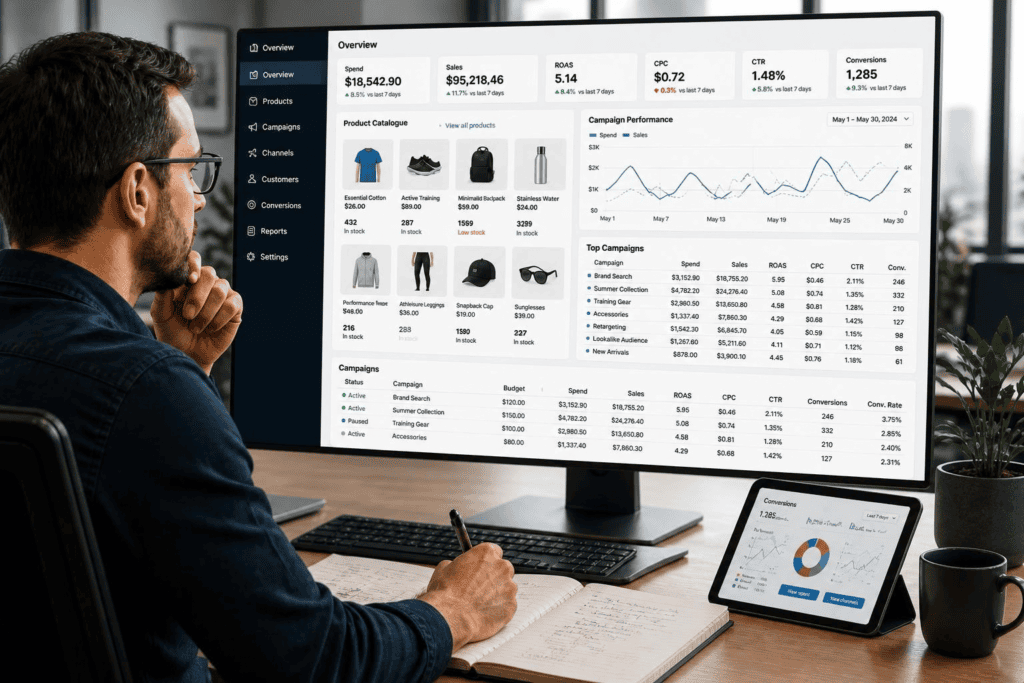
However, evaluating an ecommerce PPC agency requires moving past vanity metrics, impressive ROAS screenshots, and opaque monthly retainers. To make a high-leverage hiring decision for your Shopify, WooCommerce, or Magento store, you must evaluate:
- Scope of Work: Exactly what technical and strategic tasks the ecommerce PPC agency executes in-house versus outsourcing.
- Account Ownership: Ensuring your brand retains full administrative access and asset ownership.
- Fee Structures: Analyzing whether retainer models, performance incentives, or hybrid structures align with your unit economics.
- Strategic Fit: Verifying that the ecommerce PPC agency has proven experience scaling brands within your specific vertical and revenue tier.
What Is an Ecommerce PPC Agency?
An ecommerce PPC agency is a specialized digital marketing partner dedicated to planning, executing, and scaling paid advertising campaigns specifically for online retailers.
While PPC literally stands for pay-per-click, modern performance marketing extends far beyond traditional text ads. Contemporary ecommerce campaigns rely on complex automated bidding engines, dynamic product feeds, first-party audience signals, conversion API data, creative asset iteration, and multi-channel placements across search, social, and video networks.
Core Pillars of Modern Ecommerce PPC
- Feed Optimization: Google Shopping and Meta Catalog campaigns depend heavily on the underlying product data feed from tools like Google Merchant Center. Attributes such as precise product titles, structured descriptions, tier pricing, inventory status, custom labels, and accurate product identifiers dictate algorithmic visibility and impression share.
- The Strategic Bridge: An elite ecommerce PPC agency acts as an operational translator between high-level financial goals (e.g., target ROAS or blended MER) and platform-level mechanics, continuously running structured tests, adjusting attribution models, and refining campaign structures.
The Boundaries of Agency Impact
An agency is a growth accelerator, not a fix for a broken business model. Sustainable paid media performance relies on variables that sit outside direct ad management:
- Product-Market Fit & Unit Economics: Gross margins must support the customer acquisition costs required to scale.
- Store Infrastructure: Site speed, checkout friction, and conversion rate optimization (CRO) directly impact how efficiently ad spend converts into revenue.
- Operations & Data Integrity: Inventory depth, fulfillment reliability, and server-side tracking accuracy dictate whether algorithms have the clean signals needed to optimize effectively.
What Does an Ecommerce PPC Agency Do?
A high-performing ecommerce PPC agency extends far beyond basic ad creation and daily bid adjustments. Instead, it operates an integrated, data-driven system across multiple technical and strategic pillars to maximize profitable revenue.
The core scope of work handled by an elite ecommerce PPC agency typically spans:
PPC Strategy and Account Planning
Before a competent ecommerce PPC agency touches a single bidding lever or drafts an ad creative, it must reverse-engineer your unit economics. Deploying capital without a rigorous discovery phase turns paid media into an expensive guessing game.
An elite ecommerce PPC agency begins account planning by conducting a deep diagnostic audit across key business vectors:
- Catalog Dynamics: Analyzing products, product categories, and inventory depth to identify hero SKUs, high-margin items, and clearance priorities.
- Financial Guardrails: Mapping average order value (AOV), gross profit margins, and customer lifetime value (LTV) to establish true profitability thresholds.
- Unit Economics & Targets: Establishing realistic customer acquisition cost (CAC) targets and blended marketing efficiency ratios (MER) rather than relying on vanity metrics.
- Conversion & Funnel Metrics: Evaluating existing site-wide and channel-specific conversion rates, checkout drop-off points, and post-click user experiences.
- Market Landscape: Factoring in seasonal demand curves, geographical expansion targets, competitor positioning, and baseline historical performance.
Why Economic Alignment Matters
The overarching objective of this planning phase is simple: determine which advertising activities actually make economic sense for your business model.
For example, a luxury home goods brand with a high AOV and 70% gross margins can comfortably tolerate a significantly higher customer acquisition cost—and a lower initial ROAS—than a fast-moving consumer goods (FMCG) brand selling low-margin items that requires strict immediate payback.
This financial distinction is vital. ROAS (Return on Ad Spend) alone does not tell you whether advertising is profitable. An ecommerce PPC agency that optimizes purely for a high ROAS without factoring in product margins, shipping costs, and overhead can easily starve a profitable brand of cash flow or stunt its long-term growth.
Google Search Campaign Management
Google Search campaigns capture high-intent demand, connecting your store with consumers actively searching for the exact products or solutions you offer. However, capturing generic traffic can quickly burn through a budget without generating profitable sales.
An elite ecommerce PPC agency manages search campaigns with surgical precision across multiple operational layers:
- Intent-Driven Keyword Research & Mapping: Identifying high-intent transactional queries (e.g., brand-name alternatives, specific product categories, problem-solving searches) rather than broad, low-converting terms.
- Match-Type Architecture & Search-Term Analysis: Leveraging a disciplined match-type strategy (exact, phrase, and controlled broad match) combined with rigorous, continuous search-term scrubbing to eliminate wasted spend on irrelevant queries.
- Negative Keyword Governance: Maintaining comprehensive negative keyword lists to prevent your ads from triggering on informational, low-intent, or competitor-unaligned searches.
- Ad Copy & Extension Optimization: Crafting compelling, benefit-driven ad copy and utilizing structured assets (Sitelinks, Callouts, Price extensions) to maximize click-through rate (CTR) and Quality Score.
- Bid Strategy & Budget Allocation: Deploying automated bidding frameworks (such as Maximize Conversion Value with target ROAS constraints) while dynamically allocating daily budgets to top-performing campaigns, regions, and high-margin product lines.
- Landing Page Alignment: Ensuring that the post-click landing page experience directly matches user intent, offering frictionless navigation and clear value propositions.
The True Objective of Search Management
The goal of a high-performing ecommerce PPC agency is not simply to generate high click volumes or low cost-per-click (CPC) metrics. Instead, the focus is entirely economic: identifying and scaling the specific search queries capable of acquiring high-intent customers who drive sustainable profitability for your store.
Google Shopping and Product Advertising
Google Shopping and Performance Max campaigns form the absolute engine room of paid acquisition for online stores. Because users see vital product data—such as high-resolution images, real-time pricing, stock availability, store names, and reviews—before they even click, Shopping ads act as a powerful pre-qualification filter.
However, because these campaigns do not rely on traditional keyword targeting, ad performance is dictated almost entirely by the underlying technical data layer. A skilled ecommerce PPC agency invests substantial time engineering, optimizing, and maintaining the product feed that powers these ecosystems.
Key Technical Pillars of Product Advertising
- Product Feed Architecture: Ensuring product data syncs seamlessly from platforms like Shopify or Magento into Google Merchant Center without data loss or latency.
- Title & Description Optimization: Restructuring product titles with high-value search attributes (e.g., Brand + Material + Size + Color + Core Keyword) to maximize algorithmic relevance and impression share.
- Feed Health & Governance: Resolving feed errors, policy warnings, and item-level disapprovals swiftly to prevent sudden traffic drops and account suspensions.
- Pricing & Inventory Synchronization: Maintaining real-time accuracy for stock status and dynamic pricing to avoid paying for clicks on out-of-stock items.
- Variant & Taxonomy Mapping: Correctly categorizing product types using Google’s official product taxonomy and optimizing variant structures (size, color, material) to capture nuanced long-tail search queries.
- Custom Labels & Segmentation: Utilizing Merchant Center custom labels (e.g., by profit margin, best-sellers, clearance status, or ROAS tier) to build granular bidding structures in Google Ads.
Why Inexperienced Agencies Fail Here
Inexperienced agencies often treat product feeds as a “set-and-forget” CSV upload. In reality, platform updates, inventory shifts, and strict Merchant Center compliance guidelines require constant technical oversight.
As Google’s Merchant Center documentation consistently emphasizes, inaccurate, missing, or poorly formatted product data directly triggers item disapprovals, limited ad eligibility, and wasted budget. An elite ecommerce PPC agency recognizes that feed optimization is just as critical to performance as bidding strategy.
Performance Max Campaign Management
Performance Max (PMax) is Google’s automated, goal-based campaign type designed to access inventory across the entire Google ecosystem—including Search, YouTube, Display, Discover, Gmail, and Maps. For online retailers, PMax acts as an omnichannel expansion engine, leveraging product data from Google Merchant Center to serve dynamic ads wherever high-intent shoppers browse.
However, because PMax relies heavily on machine learning and black-box automation, managing it requires sophisticated strategic oversight rather than passive trust. An elite ecommerce PPC agency actively controls and optimizes the core inputs that dictate algorithmic performance:
- Asset Group & Creative Architecture: Structuring high-converting asset groups with diverse text variants, high-resolution lifestyle/product imagery, video assets, and clear calls-to-action tailored to specific audience segments.
- Product Feed Segmentation: Grouping products strategically rather than dumping an entire catalog into a single catch-all campaign, allowing for precise budget allocation between hero SKUs, high-margin items, and clearance inventory.
- Audience Signals & First-Party Data: Feeding the machine learning algorithms with high-value proprietary data—such as customer match lists, purchaser email uploads, and high-intent site-behavior signals—to accelerate the learning phase and target lookalike intent.
- Conversion Values & Offline Data: Setting up value-based bidding rules by assigning dynamic conversion values based on profit margins, repeat purchase likelihood, or order size rather than flat revenue tracking.
- Guardrails & Brand Safety: Implementing strict brand exclusions, negative keyword lists through Google support channels, and search theme controls to prevent wasted spend on irrelevant queries or unwanted placements.
Navigating the Automation Trap
Because PMax relies on machine learning, Google officially recommends giving campaigns adequate time to gather data and avoiding major structural alterations during the initial learning period.
However, an inexperienced agency often misinterprets this guideline as an excuse to abandon an account for weeks on end. A top-tier ecommerce PPC agency understands the vital distinction between disruptive structural changes (which reset the machine learning phase) and routine, high-leverage optimizations (such as refreshing ad creatives, updating audience signals, or adjusting asset group priorities).
They use strict statistical frameworks to determine when an experiment has gathered enough evidence to warrant strategic action, ensuring automation works for your bottom line rather than against it.
Conversion Tracking and Measurement
Accurate measurement forms the absolute foundation of profitable paid advertising. If an ecommerce PPC agency cannot reliably attribute revenue back to specific campaigns, ad groups, products, or audience segments, optimization becomes pure guesswork, and scaling ad spend simply burns cash.
Google Ads conversion tracking measures user interactions across the entire purchase journey, utilizing advanced website tags and server-side integrations to feed conversion data back into bidding algorithms. For online retailers, a comprehensive measurement framework goes far beyond basic purchase tracking:
- E-commerce Funnel Events: Tracking granular micro-conversions, including add-to-cart actions, initiate-checkout steps, and cart abandonment triggers.
- Granular Value Assignment: Transmitting dynamic purchase values, order IDs, and margin-adjusted revenue data rather than static conversion values.
- Customer Segmentation Data: Differentiating between first-time buyer purchases and returning customer repeat orders to calculate true net-new customer acquisition costs (CAC).
- Multi-Channel & Campaign Attribution: Analyzing revenue by campaign, ad group, and keyword to identify top-of-funnel discovery drivers versus bottom-of-funnel conversion closers.
- Advanced Infrastructure (Enhanced Conversions): Implementing Google’s enhanced conversions and Meta’s Conversions API (CAPI) to capture offline and cross-device conversions using hashed first-party customer data, overcoming modern browser privacy restrictions and cookie loss.
The Essential Vetting Question
Because reporting dashboards can easily be manipulated to highlight vanity metrics like click-through rates or impression share, prospective clients must look past superficial metrics.
When evaluating an ecommerce PPC agency, never simply ask: “Does the agency provide reporting?”
Instead, ask: “Can the agency demonstrate how advertising data is connected to actual business outcomes, gross margins, and net profitability?” An elite agency will readily show you how their tracking architecture prevents data loss, attributes revenue accurately, and ties ad spend directly to your bottom-line growth.
Landing-Page and Conversion-Rate Recommendations
An elite ecommerce PPC agency does not treat your website as a black box where traffic disappears after a click. Because advertising economics rely entirely on how efficiently visitors convert into paying customers, a high-performing agency must analyze the post-click experience and identify conversion bottlenecks that sabotage paid media efficiency.
While an ecommerce PPC agency is primarily focused on paid acquisition rather than full-service web design, it should actively audit and provide actionable recommendations across critical conversion rate optimization (CRO) vectors:
- Product-Page Structure & Clarity: Evaluating whether hero images, value propositions, bulleted feature lists, and buy boxes are immediately visible above the fold.
- Technical Performance & Mobile Usability: Assessing page speed metrics, Core Web Vitals, and mobile layout responsiveness, since slow load times or clunky mobile navigation instantly spike bounce rates.
- Pricing & Trust Presentation: Reviewing how tier pricing, discounts, shipping thresholds, return policies, and trust signals (reviews, security badges, guarantees) are communicated at decision points.
- Checkout Friction: Identifying unnecessary form fields, limited payment gateway options (e.g., missing Shop Pay, Apple Pay, or PayPal), or unexpected surcharges that cause cart abandonment.
The Danger of Scaling Broken Funnels
The fundamental principle every store owner must understand is simple: sending more traffic to a weak product page does not solve the underlying problem.
If a store converts at 1% due to poor UX, confusing product copy, or hidden shipping fees, doubling your ad budget will only double your wasted spend, drive up your customer acquisition cost (CAC), and strain your cash flow. A top-tier ecommerce PPC agency looks beyond bids and budgets, serving as a strategic partner that diagnoses site-level friction so that every dollar of ad spend works harder for your bottom line.
Ongoing Testing and Optimization
Paid advertising is never a “set-and-forget” exercise. Algorithms shift, consumer behavior evolves, competitors enter auctions, and creative fatigue sets in rapidly across digital channels. To maintain profitable scale, an elite ecommerce PPC agency runs a continuous, systematic testing and optimization framework across multiple account layers:
- Campaign & Structural Tests: Evaluating segmented PMax asset groups, margin-based product tiering, and match-type portfolio shifts.
- Bidding & Budget Experiments: A/B testing target ROAS thresholds, value-based bidding models, and incremental budget scaling curves.
- Creative & Messaging Iteration: Rotating static graphics, video variations, user-generated content (UGC), and ad copy hooks based on performance decay rates.
- Audience & Geographic Testing: Refining customer match uploads, first-party data signals, and regional geo-holdouts to measure true incrementality.
Activity vs. Value Creation
A critical trap for e-commerce brands is confusing sheer activity with actual progress. Inexperienced agencies often log hundreds of minor, arbitrary changes every month—such as tweaking a budget by $5 or adjusting ad copy punctuation—solely to generate a long change-history log that creates the illusion of constant work.
A long list of account changes does not automatically mean an agency is improving your business. True optimization is grounded in the scientific method: forming a clear hypothesis, running a controlled test, and measuring the financial outcome.
When working with an ecommerce PPC agency, you should always demand operational transparency by holding every optimization cycle accountable to five core questions:
- What was changed? (The exact structural, bid, or creative adjustment made).
- Why was it changed? (The diagnostic data or strategic hypothesis driving the decision).
- What was expected to happen? (The projected impact on ROAS, CAC, or conversion volume).
- What actually happened? (The empirical result measured against the hypothesis).
- What will happen next? (The iteration, scaling plan, or pivot based on those findings).
Reporting and Performance Reviews
A professional reporting process should strip away platform complexity, transforming raw ad data into crystal-clear business intelligence that every founder or marketing director can act on immediately.
An elite ecommerce PPC agency avoids vanity metrics like high click-through rates or impression share, focusing instead on financial metrics that dictate cash flow and profitability. A comprehensive monthly performance report typically synthesizes several critical data layers:
- Ad Spend: Quantifies your total capital investment across Google, Meta, and other channels.
- Attributed Revenue: Measures total tracked sales value generated directly by paid media.
- Return on Ad Spend (ROAS): Compares tracked revenue against advertising spend to gauge baseline campaign efficiency.
- Cost Per Acquisition / Customer Acquisition Cost (CPA/CAC): Calculates the exact cost required to acquire a customer.
- Conversion Rate: Tracks how effectively incoming traffic completes a purchase on your site.
- Average Order Value (AOV): Provides crucial revenue context to help determine how hard your ad dollars need to work.
- New-Customer Revenue: Isolates first-time buyers to accurately assess true customer acquisition versus repeat-purchase retention.
- Product-Level Performance: Identifies hero SKUs, profit drivers, and inventory dead weight where ad spend is producing real value.
- Search-Term Performance: Exposes high-intent queries capturing valuable demand while highlighting wasted spend on irrelevant searches.
Tailoring Metrics to Your Business Model
The exact metrics tracked should never be a one-size-fits-all template; they must align directly with your unique business model and unit economics.
For example, a consumable goods brand with a high subscription rate and substantial repeat purchases must evaluate customer lifetime value (LTV) and blended retention metrics rather than judging every top-of-funnel campaign purely on immediate, first-click ROAS. A top-tier ecommerce PPC agency builds custom reporting frameworks that reflect your actual financial reality, ensuring you can make confident, data-driven scaling decisions.
What Should an Ecommerce PPC Agency Be Accountable For?
A professional ecommerce PPC agency must be held strictly accountable for the levers it controls, but setting realistic boundaries is essential. No agency can reasonably guarantee every single business outcome, as paid media operates within a broader commercial ecosystem.
What the Agency Controls & Owns
An elite ecommerce PPC agency takes absolute ownership of the technical execution and strategic direction of your ad accounts, including:
- Account Architecture & Campaign Structure: Building, segmenting, and organizing campaigns across Google, Meta, and other channels.
- Budget Allocation & Bidding: Managing daily spend velocity and deploying advanced bidding strategies to maximize return.
- Product-Feed Management: Optimizing Google Merchant Center feeds, fixing errors, and ensuring accurate product attribute mapping.
- Tracking & Attribution Infrastructure: Implementing clean conversion tags, server-side APIs, and accurate event tracking.
- Continuous Testing & Optimization: Executing systematic experiments across ad creative, audience signals, and keyword match types.
- Reporting & Strategic Communication: Delivering transparent, data-backed performance reviews tied to business metrics.
What the Agency Cannot Control
External variables heavily influence ultimate commercial success. An ecommerce PPC agency cannot fully control or override:
- Product-Market Fit & Quality: Whether consumers actually desire your product at the price point offered.
- Competitor Pricing & Market Dynamics: Aggressive discounting, market saturation, or sudden shifts in consumer demand.
- Supply Chain & Inventory: Stockouts, shipping delays, or manufacturing bottlenecks that halt ad momentum.
- Store Infrastructure & User Experience: Website downtime, slow page speeds, or high checkout friction that kills conversion rates.
- Platform Policy Changes: Sudden algorithm updates, policy restrictions, or unexpected suspensions imposed by Google or Meta.
The Red Flag: Guaranteed ROAS
Because external factors dictate ultimate sales velocity, you should exercise extreme caution when evaluating an ecommerce PPC agency that promises specific revenue figures or guarantees an exact ROAS without qualifying the underlying assumptions. Sustainable growth requires partnership, rigorous unit-economic alignment, and technical precision—not empty guarantees.
ROAS Is Useful—but It Is Not the Whole Business
Return on Ad Spend, or ROAS, remains one of the most widely cited metrics in digital advertising. It is mathematically straightforward:
$$\text{ROAS} = \frac{\text{Attributed Revenue}}{\text{Advertising Spend}}$$
For example, if an ecommerce PPC agency runs campaigns that spend $10,000 and attribute $40,000 in revenue to those ads, the resulting ROAS is $4.0\text{x}$ (or 400%).
However, a 4.0x ROAS does not automatically mean your business is profitable.
The Unit Economics Reality Check
Consider a store generating $40,000 in attributed revenue with a 4.0x ROAS. When you factor in the true operational costs required to fulfill those orders, the financial picture changes drastically:
- Attributed Revenue: $40,000
- Advertising Spend: -$10,000
- Product & Fulfillment Costs (COGS & Shipping): -$20,000
- Other Variable Costs (Merchant fees, packaging, taxes): -$5,000
- Remaining Contribution Margin:$5,000
Out of $40,000 in top-line revenue, only $5,000 remains to cover fixed overhead, software subscriptions, team salaries, and owner distributions before reaching net profit. If fixed overhead exceeds that remaining contribution, the business is actually losing money—despite an impressive 4.0x ROAS on the dashboard.
This fundamental disconnect is why hiring an elite ecommerce PPC agency requires looking far beyond surface-level advertising metrics. A top-tier partner must deeply understand your underlying unit economics, gross margins, and cash flow requirements to ensure that every dollar of ad spend builds sustainable profitability rather than draining your bottom line.
How to Choose an Ecommerce PPC Agency
Selecting an ecommerce PPC agency should never be treated as a casual vendor search or a race to find the flashiest sales deck. Instead, it requires a rigorous due diligence exercise modeled after corporate vetting or investment evaluation.
Because handing over management of your ad spend directly impacts your cash flow and brand reputation, you must strip away polished marketing pitches and evaluate prospective partners against a consistent, objective set of criteria:
Look for Relevant Ecommerce Experience
Not all digital marketing agencies are built the same. An agency that successfully scales lead-generation funnels for local service providers will likely fail when managing a complex, multi-channel catalog for a Shopify Plus brand. When evaluating an ecommerce PPC agency, you must look past generic marketing claims and assess whether their operational track record matches your specific commercial reality.
True domain expertise is defined by relevance across several critical vectors:
- Product Category & Vertical Complexity: Does the agency understand the nuances of your niche (e.g., high-consideration luxury goods versus fast-moving consumable goods, or regulated products with advertising restrictions)?
- Average Order Value (AOV) & Unit Economics: Do they know how to structure campaigns for low-AOV impulse buys versus high-AOV purchases that require multi-touch attribution and retargeting?
- Platform Architecture & Tech Stack: Are they deeply experienced with your specific e-commerce platform (Shopify, WooCommerce, Magento/Adobe Commerce, or custom headless setups) and its associated ecosystem apps?
- Ad Spend & Business Scale: Has the agency successfully managed accounts at your target budget tier? An agency accustomed to managing $5,000/month local campaigns will not have the advanced bidding architecture, data infrastructure, or inventory-feed management required to scale a brand spending $100,000+/month.
- Acquisition Channels & Funnel Dynamics: Do they have proven expertise balancing Google Shopping, Performance Max, Meta Ads, and YouTube to capture both high-intent bottom-of-funnel demand and top-of-funnel discovery?
Relevance Over Longevity
When vetting prospective partners, experience should be judged by relevance, not simply by the number of years an agency has existed. An innovative, three-year-old ecommerce PPC agency that specializes exclusively in DTC Shopify brands scaling from $1M to $10M will bring far more relevant, modern tactical execution to your business than a ten-year-old traditional agency whose primary experience lies in legacy display ads or local SEO. Always ask for case studies and references from brands operating at your exact stage of growth.
Ask Which Channels They Actually Manage
Never assume that an agency branded broadly as a “PPC agency” or “performance marketing partner” possesses deep, world-class expertise across every advertising platform. In practice, many agencies excel at Google Search and Shopping while treating social channels as an afterthought, or vice versa.
When vetting an ecommerce PPC agency, you must audit its core competencies across the specific channels where your customers actually discover, evaluate, and purchase products:
- Google Search: Capturing high-intent text queries with rigorous keyword and match-type governance.
- Google Shopping & Performance Max: Managing complex product feeds, Merchant Center health, and automated omnichannel inventory.
- Meta Ads (Facebook & Instagram): Scaling top-of-funnel customer acquisition through creative iteration, dynamic product catalogs, and first-party data signals.
- Amazon Ads: Winning buy-box visibility and sponsored product auctions within major online marketplaces.
- Microsoft Advertising (Bing): Capturing high-intent, often overlooked demographic search traffic with typically lower CPCs.
- YouTube Advertising: Driving top-of-funnel consideration and video-led direct response.
- Dedicated Retargeting: Re-engaging cart abandoners and site visitors across multi-channel display and social networks.
Focus on Channel Relevance, Not Channel Count
Your business does not necessarily need an agency that manages every single advertising platform under the sun. Spreading a modest budget across too many channels too early often dilutes performance and starves algorithms of necessary data.
The critical question to ask prospective partners is simple: Does the agency have proven, specialized expertise in the exact channels that matter most to your customers and unit economics? Look for depth of execution where it counts, rather than a jack-of-all-trades approach that delivers mediocre results everywhere.
Examine How They Handle Product Feeds
For any online retailer running Google Shopping or Performance Max campaigns, the product data feed is the absolute bedrock of performance. Yet, it is one of the most commonly neglected areas by agencies that focus solely on top-level campaign settings.
When interviewing a prospective ecommerce PPC agency, you must dig deep into their technical workflow regarding product data management by asking six critical vetting questions:
- Who manages the Merchant Center feed? Find out whether feed optimization is handled directly in-house by experienced data specialists or if it is outsourced to third-party tools and automated apps without human oversight.
- How are product disapprovals handled? Ask about their proactive monitoring workflow for policy violations, custom label errors, and item-level disapprovals that kill impression share.
- How are product variants managed? Verify how they handle complex variant structures (e.g., size, color, material, and bundle packs) to ensure proper indexing and bidding control.
- How are price and availability mismatches detected? Inquire about their automated alerts and sync frequencies to prevent the costly error of advertising out-of-stock items or incorrect pricing.
- How frequently is the feed reviewed? Confirm whether product data audits are conducted on a continuous weekly basis or only when performance abruptly drops.
- Who is responsible when products stop serving? Establish clear operational ownership for emergency troubleshooting when Google Merchant Center suspends items or flags policy errors.
Avoiding the Data Quality Blind Spot
Google’s official product feed specifications make it unequivocally clear: accurate, optimized product information is foundational to successful Shopping advertising.
If an ecommerce PPC agency focuses exclusively on bid strategies and budget allocations while ignoring the underlying product-data layer, it creates a massive structural blind spot. Poor data quality leads to disapprovals, limited impressions, and wasted ad spend. An elite agency treats feed optimization with the same strategic rigor as campaign management, ensuring algorithms always receive clean, pristine data to maximize your return on ad spend.
Ask How Conversion Tracking Is Audited
Many agencies gloss over technical measurement discussions, assuring clients that “tracking is already installed.” For an online store, accepting that superficial answer is a dangerous mistake. If your conversion data is flawed, every bid optimization, budget reallocation, and ROAS calculation is built on compromised intelligence.
When interviewing a prospective ecommerce PPC agency, demand a clear, plain-language explanation of their measurement infrastructure. Use these core auditing questions to evaluate their technical depth:
- What counts as a conversion? Determine whether they track macro-conversions (completed purchases) alongside high-value micro-conversions (add-to-cart actions, newsletter sign-ups, or initiate-checkout steps).
- Where does purchase data originate? Verify whether tracking relies solely on client-side browser pixels or utilizes robust server-side integrations (like Google Tag Manager Server-Side or Meta’s Conversions API).
- Are purchase values passed correctly? Confirm that dynamic order values, tax exemptions, and shipping fees are parsed accurately so algorithms optimize for true net revenue rather than inflated gross totals.
- How are duplicate conversions prevented? Ask how they utilize unique transaction IDs and de-duplication rules to ensure cross-device or multi-pixel events are never counted twice.
- How are tracking errors detected? Inquire about their proactive monitoring workflows to catch broken tags, missing parameters, or browser-blocking script failures before they corrupt campaign data.
- Is enhanced conversion measurement enabled? Check if they leverage hashed first-party customer data (such as customer emails and phone numbers) through Google Enhanced Conversions and Meta CAPI to recover visibility lost to modern privacy restrictions.
- How do they reconcile platform data with actual sales? Ask how they cross-reference ad-platform attribution reports against your e-commerce backend platform (Shopify, WooCommerce, Magento) to account for view-through attribution overlap and discrepancy gaps.
Demanding Decision-Quality Data
Do not accept “tracking is installed” as a complete answer from any ecommerce PPC agency.
The fundamental question every store owner must ask is whether the tracking produces decision-quality data. An elite agency will readily walk you through their measurement architecture, proving that the data feeding your ad accounts is pristine, reliable, and strictly aligned with your actual business revenue.
Ask Who Owns the Advertising Accounts
One of the most critical contractual safeguards when hiring an ecommerce PPC agency is establishing clear, uncompromised asset ownership. Unfortunately, many unsuspecting business owners learn too late that their agency built ad accounts, merchant centers, or analytics profiles under the agency’s umbrella master account, holding critical digital assets hostage if the relationship sours.
Before signing any contract or statement of work, you must clarify administrative ownership and access across every core digital asset:
- Google Ads: Ensuring your corporate entity is the direct billing administrator and owner of the primary ad account.
- Google Merchant Center: Verifying that your domain owns the primary Merchant Center account rather than an agency-owned MCC (Manager Account).
- Google Analytics & Tag Manager: Confirming your business retains Super Admin rights while the agency is granted user-level management access.
- Meta Business Suite & Ad Accounts: Ensuring your business manager owns the pixel, ad accounts, catalog feeds, and page assets.
- Product Feeds & Creative Assets: Confirming that custom data feed optimization files, unbranded design files, custom video assets, and ad copy variations remain your intellectual property.
- Landing Pages & Reporting Dashboards: Verifying ownership of custom-built landing page templates, domain DNS configurations, and reporting data studios.
Access Is Not Ownership
An ecommerce PPC agency unquestionably needs high-level administrative access to operate your campaigns efficiently, but access and ownership are two entirely different things.
Always ask explicitly: “What happens to the accounts, historical data, custom audiences, and campaign structures if our relationship ends?” A reputable, professional agency will always build accounts directly inside your business ecosystem, ensuring you maintain absolute autonomy, complete data history, and total control over your digital infrastructure from day one.
Understand the Pricing Model
Pricing structures vary significantly across the industry, and each model comes with distinct operational trade-offs. Before signing a contract with an ecommerce PPC agency, you must evaluate how their fee structure impacts your cash flow, risk profile, and long-term incentives.
The four most common agency pricing models include:
- Percentage of Ad Spend: The agency charges a tiered percentage (typically 10% to 20%) of your total monthly advertising budget.
- Potential Advantage: Fees naturally scale up or down with your account size, aligning agency effort with account growth.
- Potential Limitation: It can create misaligned incentives, as the agency stands to make more money simply by recommending higher ad spend—even if scaling spend erodes your net margins.
- Flat Monthly Retainer: You pay a predictable, fixed management fee regardless of monthly ad spend fluctuations.
- Potential Advantage: Budget forecasting is straightforward and predictable.
- Potential Limitation: A rigid fee may fail to account for dramatic increases in workload during major seasonal pushes (e.g., Black Friday/Cyber Monday) or catalog expansions.
- Performance-Based Pricing: The agency’s compensation is linked directly to defined financial outcomes, such as hitting a specific ROAS threshold or generating incremental revenue.
- Potential Advantage: It directly aligns part of the agency’s compensation with your bottom-line success.
- Potential Limitation: “Performance” must be defined with extreme precision. Discrepancies in attribution windows, return rates, chargebacks, canceled orders, and external market factors can easily turn performance calculations into a legal and operational headache.
- Hybrid Pricing: Combines a reduced base retainer with a variable performance incentive or tiered spend component to balance predictability with growth rewards.
Transparency Over Any Single Model
There is no single “correct” pricing model for every business. The most critical factor is transparency.
When evaluating an ecommerce PPC agency, ensure the pricing structure is crystal clear, that you understand what specific scope of work is included, and that both parties agree on how success and compensation are calculated.
Ask What Is Included in the Retainer
Comparing prospective partners based solely on monthly price is one of the fastest ways to make a costly hiring mistake. A lower monthly retainer often conceals an intentionally stripped-down scope of work, meaning critical services are either neglected entirely or billed separately as expensive “out-of-scope” add-ons.
When evaluating a proposal from an ecommerce PPC agency, you must conduct a rigorous line-by-line scope comparison. Never assume a task is included just because the agency is managing your ads. Ask explicitly whether the retainer covers:
- Account Setup & Restructuring: Initial architectural builds, campaign migrations, and historical audits.
- Ongoing Campaign Management: Daily bid monitoring, negative keyword scrubbing, and budget adjustments.
- Product-Feed Management: Regular Google Merchant Center optimization, variant mapping, and error resolution.
- Conversion Tracking & Measurement: Setup and maintenance of server-side tracking, CAPI, and enhanced conversions.
- Creative Development: Designing ad variations, writing ad copy hooks, and producing static or video assets (or managing creator-led UGC briefs).
- Landing-Page Recommendations: Post-click UX audits, conversion rate optimization (CRO) insights, and funnel friction analysis.
- Reporting & Dashboards: Building custom, real-time data studios tied directly to business metrics rather than vanity dashboards.
- Strategy Meetings: Frequency and depth of recurring live syncs with senior strategists rather than junior account managers.
- Testing Frameworks: Designing, executing, and analyzing structured A/B tests, geo-holdouts, and bidding experiments.
- Analytics & Attribution: Reconciling platform data with backend e-commerce sales and multi-touch attribution models.
- Emergency Support: Defined response times and protocols for account suspensions, policy violations, or broken tracking.
- Additional Platform Expansion: Seamlessly integrating new channels (like Meta, TikTok, or Amazon Ads) as your scaling goals evolve.
The Hidden Cost of “Cheaper” Proposals
A seemingly inexpensive proposal can quickly become far more expensive than a premium retainer if essential technical services—such as product feed optimization, custom tracking setups, or creative asset production—are billed separately as high-hourly-rate add-ons.
An elite ecommerce PPC agency provides complete transparency into its scope of work, ensuring you know precisely what operational leverage you are buying for your investment.
Request Relevant Case Studies
Case studies are often used as primary marketing bait by agencies showcasing massive percentage spikes or record-breaking ROAS numbers. However, polished success stories can easily mask underlying nuances, temporary anomalies, or unsustainable strategies.
When reviewing case studies from an ecommerce PPC agency, you must approach them with a critical, analytical eye rather than taking them at face value. Ask probing questions to uncover the real story behind the numbers:
- What was the starting point? Determine the brand’s baseline revenue, ad spend, and operational maturity before the agency stepped in. A 300% growth metric means very little if the brand was starting from a broken account spending $500 a month.
- What was the advertising spend? Scale matters significantly. Scaling an account from $5,000 to $15,000 a month requires a very different level of sophistication than managing a multi-million-dollar annual ad budget where diminishing returns set in fast.
- Over what period was performance measured? Check whether the case study highlights a sustainable multi-quarter trajectory or simply cherry-picks a single anomalous month (such as a Black Friday peak or a short-lived promotional window).
- What changed structurally? Inquire about the specific levers pulled—did performance improve due to brilliant media buying, a complete website redesign, a massive influx of brand-new hero products, or heavy discounting?
- What external factors affected the result? Assess whether seasonal tailwinds, macroeconomic shifts, viral social media moments, or PR spikes drove the results rather than agency management.
- Was revenue platform-attributed or actual store revenue? Verify whether the reported revenue figures rely on inflated ad-platform attribution windows (e.g., 7-day click / 1-day view) or reconcile directly with actual net sales deposited into the store’s backend.
- Was the campaign profitable after product costs? Ask if the case study accounts for contribution margin and unit economics, or if it merely celebrates top-line ROAS while the brand actually bled cash on discounted volume.
- What exact role did the agency play? Clarify whether the agency executed everything independently or simply rode the coattails of an in-house creative team and conversion rate optimization (CRO) squad.
Beware the Percentage Increase Trap
You should be particularly cautious with case studies that show only a large percentage increase without explaining the baseline. Claiming a “500% increase in ad revenue” sounds phenomenal until you discover the account grew from $1,000 a month to $5,000 a month while doubling customer acquisition costs and wiping out gross margins. An elite ecommerce PPC agency will provide transparent, holistic case studies that prove sustainable unit-economic growth, not just vanity percentages.
Red Flags When Hiring an Ecommerce PPC Agency
Navigating agency pitches requires a sharp eye for warning signs. When evaluating a prospective ecommerce PPC agency, keep your guard up if you encounter any of these eight critical red flags:
- Guaranteed Results Without Assumptions: No agency can completely control external market demand, product unit economics, inventory fluctuations, aggressive competitors, or sudden platform algorithm changes. Be extremely skeptical of any partner promising a specific revenue figure or guaranteed ROAS without stating underlying assumptions.
- Obsession with Vanity Metrics: If an agency leans heavily on high impressions, massive click volumes, or a thick change-history log to prove its value, it is confusing sheer activity with actual business progress.
- Zero Discussion of Margins: If the agency never asks about your cost of goods sold (COGS), shipping fees, average order value, or gross margins, it is optimizing your ad accounts blind—treating top-line revenue as success while potentially eroding your net profits.
- Poor Account Transparency: If an agency insists on housing your Google Ads, Merchant Center, or Meta assets under its own master umbrella accounts rather than granting your corporate entity primary ownership, walk away immediately.
- Long Contracts with Unclear Exit Terms: Be wary of draconian lock-in periods, restrictive notice clauses, or ambiguous termination provisions that make it difficult or costly to part ways if performance falters.
- Reporting Without Explanation: A dashboard full of complex charts and uncontextualized numbers is not useful reporting. Your agency should act as a strategic advisor, translating raw data into clear narratives detailing what changed, why it changed, and what decisions follow.
- Excessive Focus on ROAS: If an agency evaluates success strictly by a 4.0x ROAS dashboard metric without factoring in repeat purchase behavior, customer acquisition costs, and net contribution margins, it is optimizing for platform algorithms rather than your bank account.
- No Clear Testing Process: If an agency cannot explain its structured methodology for forming hypotheses, running controlled A/B experiments, and evaluating performance data, it lacks a systematic framework for driving long-term growth.
Ecommerce PPC Agency vs. Freelancer vs. In-House Team
Choosing the right operational model to manage your paid media depends entirely on your current revenue tier, catalog complexity, internal bandwidth, and growth goals. There is no universally correct structure—each model comes with distinct structural trade-offs across cost, capacity, and control.
The table below breaks down the core options available to online retailers:
| Option | Potential Strengths | Potential Limitations |
| Ecommerce PPC Agency | Broad specialist resources, established cross-channel processes, multi-platform expertise, and backup coverage if personnel change. | Higher baseline management cost and potentially less direct, daily control over individual account tasks. |
| PPC Freelancer | Direct, hands-on access to a single specialist, flexible arrangements, and typically lower monthly overhead. | Strict capacity limits, potential single-point-of-failure risk, and narrower specialist coverage across complex multi-channel ecosystems. |
| In-House Team | Absolute internal control, deep brand integration, and full-time dedication to your product catalog and company culture. | High fixed overhead (salaries, recruitment, training, benefits, and specialized software licenses) plus management bandwidth drain. |
| Hybrid Model | Combines intimate internal business knowledge with elite external specialist support for advanced technical execution. | Requires exceptionally clear role ownership, rigorous communication, and disciplined project management. |
Choosing the Right Model for Your Scale
For early-stage stores or niche catalogues with modest ad spend, a skilled PPC freelancer can provide cost-effective execution. As ad spend scales past $10k–$30k+/month and technical requirements—such as multi-tier Google Shopping feeds, server-side tracking, and multi-channel attribution—become critical, partnering with an established ecommerce PPC agency typically delivers better operational leverage.
For mature, high-growth e-commerce brands, many executives adopt a hybrid model: retaining core creative strategy, product development, and overall financial governance internally, while leveraging an external ecommerce PPC agency to execute specialized media buying, feed optimization, and algorithmic scaling across complex paid networks.
Questions to Ask an Ecommerce PPC Agency Before Hiring
When you reach the interview stage with prospective partners, cut through the sales pitch by asking direct, probing questions. Use this structured checklist during your vetting calls:
- Relevant Experience: Which e-commerce businesses similar to ours in catalog size, average order value, and revenue tier have you successfully managed?
- Platform Specialization: Which advertising platforms do you genuinely specialize in, and where do you rely on outside support?
- Team Allocation: Who will actually manage our account on a day-to-day basis, and what is their level of experience?
- Feed & Technical Execution: How do you approach Google Shopping, product-feed architecture, and Merchant Center error resolution?
- Measurement Integrity: How do you audit conversion tracking, handle attribution, and implement server-side APIs?
- Success Definitions: How do you define a successful campaign beyond top-line ROAS?
- Financial Data Requirements: Which business metrics, cost inputs, and margin data do you need from us to build realistic targets?
- Margin Alignment: How do you account for product gross margins and fulfillment costs when establishing bidding targets?
- Reporting Cadence: How frequently will we receive reports, and do they connect ad data to actual business outcomes?
- Asset Ownership: Who owns the Google Ads, Merchant Center, Meta, and analytics accounts from day one?
- Retainer Scope: Exactly what is included in the monthly management fee versus billed as an add-on?
- Hidden Costs: Are there any setup fees, technology licensing costs, or onboarding charges we should anticipate?
- Testing Frameworks: How do you form, execute, and evaluate structured tests for creative, bidding, and campaign structures?
- Contingency Protocols: What happens if performance declines, and what is your documented remediation process?
- Termination & Handover: What exact process and asset transfer happens if we decide to terminate the contract?
A strong, professional ecommerce PPC agency will welcome these questions, answering them with absolute transparency and technical depth.
Choosing the right ecommerce PPC agency is one of the highest-leverage decisions you will make as an online retailer. By moving past polished sales decks, vanity metrics, and opaque monthly retainers, you can evaluate prospective partners through the lens of technical competence, unit economic alignment, and operational transparency.
Whether you are scaling past $10k a month in ad spend or managing a complex multi-channel enterprise catalog, the right partner will treat your ad budget not as money to be spent, but as capital invested to drive sustainable, profitable growth.
A Practical Ecommerce PPC Agency Evaluation Framework
Before making your final hiring decision, do not rely on subjective impressions or polished sales presentations. Instead, score each prospective ecommerce PPC agency against a consistent, evidence-based evaluation framework.
Rather than calculating a single, arbitrary “best agency” score, document the specific evidence gathered across six critical dimensions:
- Strategy
- Key Questions: Does the agency understand your unique business model and catalog complexity? Do they factor your gross margins and unit economics into their acquisition targets? Can they articulate a clear, multi-channel acquisition strategy?
- Documentation: Record specific examples of how they propose to align ad spend with your net profitability goals rather than top-line revenue.
- Technical Capability
- Key Questions: Can they expertly manage, optimize, and troubleshoot Google Merchant Center feeds? Do they proactively handle item disapprovals, variant mapping, and pricing mismatches? Can they implement and audit advanced conversion tracking (Server-side CAPI, Enhanced Conversions)?
- Documentation: Note their specific technical answers regarding feed architecture and tracking infrastructure.
- Advertising Expertise
- Key Questions: Do they demonstrate relevant, proven experience within your specific industry, AOV bracket, and revenue tier? Can they explain the rationale behind their campaign structures and bidding decisions? Do they rely on a systematic, hypothesis-driven testing process?
- Documentation: Review case studies against these criteria and check for concrete proof of methodical experimentation.
- Measurement
- Key Questions: Are their definitions of conversions and revenue crystal clear? Can their reporting distinguish between inflated platform-reported results and actual backend sales data? Does their reporting directly support business decision-making?
- Documentation: Inspect sample reporting dashboards to verify they track meaningful metrics rather than vanity numbers.
- Transparency
- Key Questions: Will your corporate entity retain absolute administrative ownership of all ad accounts, analytics, and assets? Is the pricing model transparently documented with zero hidden fees? Are operational responsibilities clearly defined?
- Documentation: Review proposed contract clauses regarding account ownership, master access, and handover protocols.
- Commercial Fit
- Key Questions: Does the agency’s fee structure make sound financial sense relative to your monthly advertising budget? Are contract terms, lock-in periods, and notice clauses reasonable? Is the proposed scope comprehensive enough for your current growth stage?
- Documentation: Compare line-by-line proposals to ensure you are buying operational leverage rather than paying for an inflated, misaligned retainer.
By utilizing this structured evaluation framework, you eliminate emotional decision-making, protect your cash flow, and partner with an ecommerce PPC agency engineered to drive sustainable, profitable scale for your online store.
What Should You Provide to an Ecommerce PPC Agency?
An ecommerce PPC agency cannot operate effectively in a vacuum. To build high-performing campaigns that drive net profitability rather than vanity metrics, your prospective or newly hired partner needs complete visibility into your commercial reality.
Before kickoff, assemble a comprehensive onboarding package containing 13 essential data points:
- Access to Relevant Advertising Accounts: Secure administrative or manager-level access to existing Google Ads, Meta Business Suite, and other historical channels.
- E-Commerce Platform Information: Detailed access, theme configurations, and app stack insights for your Shopify, WooCommerce, or Magento/Adobe Commerce store.
- Product Catalog Data: Clean product feeds, inventory depth metrics, and SKU categorizations.
- Product Margins or Margin Ranges: Clear cost-of-goods-sold (COGS) data and gross margin breakdowns across hero categories to establish true profitability thresholds.
- Average Order Value (AOV): Baseline historical AOV metrics to guide bidding algorithms and customer acquisition cost (CAC) targets.
- Historical Advertising Performance: Raw data exports, past campaign structures, and historical ROAS/CPA benchmarks from previous months or years.
- Analytics Access: Proper user or admin permissions for Google Analytics 4 (GA4), Google Tag Manager, and server-side tracking setups.
- Conversion Definitions: Clear definitions outlining what constitutes a macro-conversion (purchase) versus micro-conversions (add-to-cart, email sign-ups).
- Geographic Markets: Specific target countries, states, or zip codes where you are licensed, stocked, and prepared to fulfill orders efficiently.
- Business Goals: Defined targets for revenue growth, blended marketing efficiency ratios (MER), customer acquisition volume, and brand positioning.
- Seasonal Considerations: Historical sales spikes, holiday promotions, inventory lead times, and seasonal demand curves unique to your niche.
- Inventory Information: Supplier lead times, stock level statuses, and upcoming restock schedules to prevent paying for ads on out-of-stock items.
- Previous Agency or Campaign History: Honest context on what worked, what failed, and why you parted ways with prior agencies or internal teams.
Distinguishing Ad Problems from Business Problems
The better an ecommerce PPC agency understands your complete commercial context, the faster both teams can diagnose issues accurately. With full visibility into your margins, inventory, and analytics, you eliminate guesswork—making it immediately clear whether a dip in sales stems from an advertising optimization issue or a broader e-commerce challenge (such as site speed friction, pricing shifts, or product-market fit).
Common Mistakes E-commerce Brands Make
When scaling paid acquisition, store owners often stumble into recurring strategic traps. Avoiding these five critical mistakes will protect your cash flow and ensure your partnership with an ecommerce PPC agency delivers genuine business leverage:
- Hiring and Evaluating Based Solely on ROAS: Chasing an inflated 5.0x ROAS can easily blind you to low sales volume, poor revenue incrementality, or weak overall profitability. A campaign can look incredible on an ad platform dashboard while bleeding cash after factoring in COGS, shipping, and merchant fees.
- Changing Campaigns Too Frequently: Tweaking budgets, bidding strategies, or asset groups every 48 hours destroys algorithmic momentum. As platforms like Google explicitly warn for automated campaigns like Performance Max, constantly interrupting the learning phase prevents machine learning models from gathering the data needed to optimize efficiently.
- Ignoring Product-Feed Quality: Treating product feeds as a lazy, set-and-forget CSV upload creates a massive performance ceiling. No amount of advanced bidding wizardry can compensate indefinitely for missing product attributes, incorrect pricing, or broken Merchant Center data.
- Giving an Agency Responsibility Without Authority: Holding an ecommerce PPC agency accountable for revenue while denying them access to your analytics, website infrastructure, or conversion tracking setup sets the relationship up to fail. If an agency spots conversion rate friction or data tracking errors, it must have the operational authority to flag and address them.
- Measuring Advertising in a Silo: Analyzing ad accounts in complete isolation from your core business metrics creates a dangerous disconnect. Ad data must constantly be reconciled with backend sales, inventory turnover, net contribution margins, and actual bank deposits.
What is an ecommerce PPC agency?
An ecommerce PPC agency is a specialized digital marketing partner that manages paid advertising campaigns explicitly for online retailers. Services typically encompass Google Search, Shopping, Performance Max, product-feed architecture, advanced conversion tracking, continuous campaign optimization, reporting, and strategic consulting.
How much does an ecommerce PPC agency cost?
There is no universal pricing standard. Agencies typically structure fees using a percentage of ad spend (ranging from 10% to 20%), a fixed monthly retainer, performance-based models, or hybrid arrangements. Costs scale based on account complexity, monthly ad spend volume, technical scope, and geographic markets.
Is an ecommerce PPC agency worth it?
Partnering with an ecommerce PPC agency is worthwhile when paid media management outgrows internal capacity, or when campaigns require advanced technical specialization (such as server-side tracking, multi-channel attribution, and complex feed optimization). Value is measured by the return on the agency’s expertise relative to its cost, rather than unverified guarantees.
What is the difference between PPC and ecommerce PPC?
PPC is a broad umbrella term for paid advertising models across search, social, and display networks. E-commerce PPC focuses specifically on driving online product sales, requiring specialized infrastructure like dynamic product feeds, Google Shopping optimization, transaction-level conversion tracking, and net revenue measurement.
Should an ecommerce PPC agency manage Google Merchant Center?
Yes. Because modern Google Shopping and Performance Max campaigns rely entirely on product data health, an ecommerce PPC agency should ideally manage or closely audit Merchant Center feeds, error resolution, and product taxonomy. Responsibilities for inventory sync and policy disapprovals must be clearly outlined in the service agreement.
What metrics should an ecommerce PPC agency report?
Effective reporting tracks ad spend, attributed revenue, return on ad spend (ROAS), customer acquisition cost (CAC), conversion rates, and product-level performance. Crucially, top-line metrics must be contextualized alongside gross margins, repeat purchase rates, and net contribution margins to reflect true business health.
In Conclusion
Choosing and partnering with the right ecommerce PPC agency is a foundational decision for scaling your online store profitably. By prioritizing technical competence, transparent measurement, unit economic alignment, and rigorous vetting over flashy sales pitches, you turn ad spend into predictable, sustainable growth.
An ecommerce PPC agency should be more than a vendor that creates advertisements and sends automated monthly reports. A capable partner should deeply understand the unbroken commercial chain:
$$\text{Products} \rightarrow \text{Product Data} \rightarrow \text{Advertising} \rightarrow \text{Traffic} \rightarrow \text{Conversions} \rightarrow \text{Revenue} \rightarrow \text{Profitability}$$
When evaluating prospective partners, pay particular attention to five core areas:
- Relevant Ecommerce Experience: Proven track record within your specific vertical, AOV tier, and revenue scale.
- Technical PPC & Product-Feed Expertise: Mastery of Google Merchant Center optimization, feed governance, and error resolution.
- Reliable Conversion Measurement: Robust server-side tracking, multi-channel attribution, and clean data pipelines.
- Transparent Pricing & Account Ownership: Clear fee structures with zero hidden margins, coupled with absolute administrative control of your ad assets.
- Business Economic Alignment: A firm commitment to connecting platform-level ad metrics directly to net contribution margins and bottom-line profitability.
The most useful next step is to build a structured evaluation sheet before requesting proposals. Ask every candidate the exact same questions, document their responses objectively, compare scope and commercial terms line-by-line, and verify precisely how each ecommerce PPC agency intends to measure success.
Applying this rigorous framework ensures your next hiring decision relies on verifiable operational evidence rather than polished sales presentations.