11 Cold Outreach Tips to Help You Get Freelance Clients
Cold outreach works for freelancers when it is specific, short, and focused on the prospect’s problem rather than your biography. Mastering effective cold outreach tips separates freelancers stuck on race-to-the-bottom platforms from those building predictable, direct-client pipelines. The 11 cold outreach tips below walk you through choosing a niche, finding qualified prospects, writing personalised messages that get replies, following up without spamming, and turning positive responses into paid work.
Who this guide is for: This article is for beginner and intermediate freelancers (writers, designers, developers, marketers, VAs, video editors) who:
- Have marketable skills but few or no inbound leads
- Rely heavily on platforms like Fiverr or Upwork and want direct clients
- Send pitches that get ignored or marked as spam
- Feel unsure how to approach prospects without sounding desperate or generic
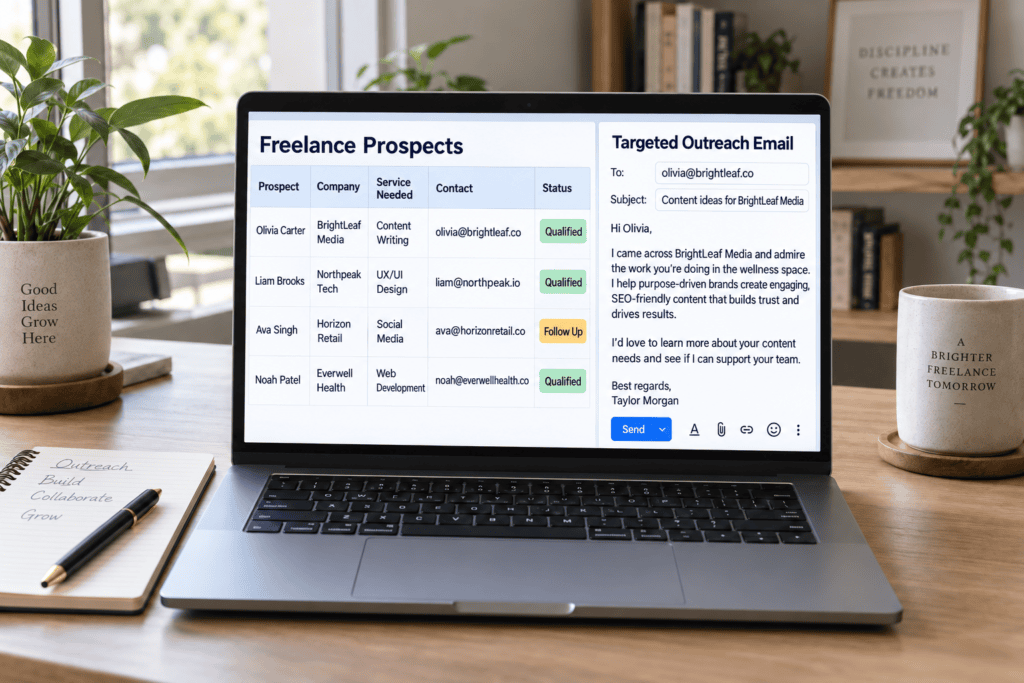
Applying these actionable cold outreach tips ensures you build a repeatable outreach system you can run weekly to attract both local and international clients.
Define a specific service and ideal client before you reach out
Vague offers (“I do graphic design”) get ignored. Specific offers tied to a clear outcome (“I design high-converting landing pages for SaaS startups”) attract replies. Applying these foundational cold outreach tips ensures your positioning cuts through the noise.
Why it works: Prospects scan messages in seconds. If they cannot immediately see how you help someone like them, they move on.
How to do it:
- Write a one-line offer: “I help [type of business] achieve [specific result] by [your service].”
- Choose 1–2 industries to start: Focus on specific niches like e-commerce, B2B SaaS, real estate, or digital coaches.
- List 3–5 credible outcomes: Pinpoint exact value drivers such as generating more leads, accelerating site speed, streamlining onboarding, or improving retention.
Example:
“I help e-commerce brands increase email revenue by designing and automating Klaviyo flows.”
Build a small, qualified prospect list instead of spraying hundreds of messages
Quality beats quantity. A curated list of 30 to 50 well-researched prospects significantly outperforms 500 random contacts. These targeted cold outreach tips protect your sender reputation and maximize your conversion rates.
Why it works: Personalisation and relevance drive replies. You cannot effectively personalise at scale without burning out or resorting to generic templates that land in the spam folder.
Where to find prospects:
- LinkedIn: Search and filter by industry, exact decision-maker role, and company size.
- Niche directories: Utilize platform-specific databases like Thingtesting for DTC brands or targeted local business directories.
- Job boards and hiring signals: Track “we’re hiring” posts as a primary indicator that the company has both an active pain point and allocated budget.
- Trigger events: Monitor newsletters, funding announcements, and product launches, as growing companies frequently need immediate freelance support.
Simple tracking:
Maintain a clean spreadsheet or Airtable dashboard with these essential columns:
- Company name
- Contact name and decision-maker role
- Verified email address or LinkedIn profile URL
- Personalisation notes (recent company post, identified pain point, or trigger event)
- Outreach tracking status (not contacted, sent, replied, call booked)
Research each prospect for 3–5 minutes before writing
A message that references something specific about the prospect’s business generates exponentially more replies than a generic template. Executing this step correctly is one of the most reliable cold outreach tips for converting cold traffic into warm conversations.
What to look for:
- Recent activity: Review their latest LinkedIn posts, company updates, or industry news mentions.
- Website and asset friction points: Identify immediate technical or design issues like slow-loading pages, broken conversion flows, weak copy, or missing email capture mechanisms.
- Tech stack signals: Detect tools they currently run (such as Shopify, HubSpot, or Klaviyo) by checking the page source code or email marketing links.
- Decision-maker context: Confirm the exact role of the person you are targeting (founder, marketing manager, or head of product) to tailor your value proposition to their specific KPIs.
Turn research into relevance:
- Generic (Avoid): “I’m a web designer looking for clients.”
- Targeted (Use): “I noticed your checkout page takes 6+ seconds to load on mobile. That’s likely costing you sales. I specialise in speeding up Shopify stores and recently cut load time by 40% for a similar brand.”
Choose the right channel: email, LinkedIn, or DM
Use the channel where your ideal clients are most active and where your message feels like a natural interruption rather than an intrusion. Selecting the proper platform is one of the foundational cold outreach tips that directly dictates your open and reply rates.
Guidelines by platform:
- Cold email: Best for B2B companies, agencies, funded startups, and e-commerce brands where decision-makers check their inboxes professionally.
- LinkedIn: Strong for B2B professional services, high-end consultants, recruiters, and SaaS executives.
- Instagram or X (Twitter) DMs: Works well for digital creators, online coaches, small e-commerce brands, and local businesses.
Best practices for multi-channel execution:
- Prioritize email: If you can find a verified direct email address, start there; it remains the most reliable channel for detailed business pitches.
- Warm up LinkedIn: If you only have a LinkedIn profile, send a blank connection request or a short, non-salesy note. Wait until they accept before pitching.
- Avoid instant pitching: Never send a connection request immediately followed by a hard-sell paragraph in the same breath; this automated pattern triggers instant spam perception.
Write subject lines and openers that earn the click and first line
Subject lines and first lines decide whether your message gets opened and read. Short, specific, curiosity-driven lines perform best when applying these targeted cold outreach tips.
Subject line principles:
- Keep it concise: Aim for 3 to 7 words where possible to ensure high readability on mobile and desktop email clients.
- Focus on them: Highlight their desired outcome or a specific observation rather than wasting space on your own introduction.
- Personalize naturally: Include their name or company name only when it flows naturally into the sentence.
Examples that work:
- “Quick idea for {Company}’s onboarding”
- “Noticed {Company} is {observation} – can I help?”
- “{First name}, quick question about {goal}”
- “One fix for {Company}’s checkout flow”
Opener structure (first 1–2 sentences):
- Mention something specific you noticed about their business.
- State the underlying problem or opportunity using their terminology.
- Hint at a simple, low-friction way you can help solve it.
Example email opener:
“Hi Tunde,
I just went through your onboarding flow and noticed new users have to fill 12 fields before seeing any value. That’s likely hurting activation. I help B2B SaaS teams simplify onboarding and recently cut drop-off by 30% for a fintech startup.”
Keep messages short, scannable, and focused on their problem
Long, self-focused pitches get skipped. Short, mobile-friendly messages focused squarely on the prospect’s outcome get replies when you execute these core cold outreach tips.
Structure for a cold email or LinkedIn message:
- Personalised opener (1–2 sentences): Reference something specific you found during your research.
- Problem or observation (1–2 sentences): Show clear proof that you understand their current operational or technical situation.
- Credibility (1 sentence): Share one relevant result, case study snippet, or strong portfolio sample.
- Soft CTA (1 sentence): Propose a low-commitment next step to open the conversation.
Example full message:
Subject: Quick win for {Company}’s sign-up flow
Hi Amina,
I tried signing up for {Company} last night and had to scroll through four pages before seeing pricing. That friction is probably costing you leads.
I specialise in simplifying sign-up flows for B2B tools. Recently, I helped an HR SaaS reduce drop-off by 25% after a redesign.
Would a 15-minute call this week make sense to explore ideas?
Best,
[Your Name]
[Portfolio link]
Key rules to remember:
- Avoid long, self-congratulatory bios.
- Eliminate generic filler lines like “I’m passionate about…” or “Hope this email finds you well.”
- Keep your focus razor-sharp with one clear ask rather than giving multiple confusing options.
Show credibility with relevant samples, not a full portfolio dump
Prospects do not need your entire portfolio. They need rapid proof that you can solve their exact type of problem when applying these practical cold outreach tips.
How to demonstrate credibility:
- Curate tightly: Link only 1 to 3 samples that directly match their industry, business model, or technical use case.
- Quantify the outcome: Include a 1- to 2-line result for each sample (e.g., “Landing page that increased sign-ups by 18%”).
- Use spec work if needed: If you lack direct client history, include spec projects or before-and-after redesigns backed by clear strategic reasoning.
Where to put links:
- Email signature: Place your main portfolio link cleanly at the bottom.
- Contextual body links: Weave 1 to 2 relevant links naturally into the message body (e.g., “Here’s a similar onboarding flow I redesigned: [link]”).
What to avoid:
Never attach large PDFs or document files to your initial cold email; these heavy attachments trigger spam filters and annoy busy decision-makers.
Follow up 2–4 times without sounding pushy or desperate
Most positive replies come after the second or third follow-up rather than the initial message. Executing a structured follow-up sequence is one of the most critical cold outreach tips for capturing high-value freelance clients who missed your first note.
Follow-up rules:
- Space them out: Leave 2 to 4 days between each touchpoint to avoid looking impatient.
- Keep them brief: Make each follow-up message shorter and lighter than your original email.
- Add incremental value: Bring a new angle, micro-insight, or mini-audit with each follow-up instead of just saying “bumping this to the top of your inbox.”
Example follow-up sequence:
- Follow-up 1 (3 days later):
“Hi Amina, just bumping this in case it got buried. Happy to share a 2-minute Loom walking through 3 quick fixes for your sign-up flow if useful.” - Follow-up 2 (4 days later):
“Hi Amina, I put together a quick sketch of a simplified sign-up flow for {Company}. Want me to send it over?” - Follow-up 3 (5–7 days later):
“Hi Amina, last try from me. If now’s not a good time, no worries. If you’d like, I can send the sign-up flow sketch anyway for you to use internally.”
This consultative approach remains helpful rather than pushy, preserves your professional reputation, and always provides an easy exit door for the prospect.
Track responses and iterate your messaging like a system
Outreach improves exponentially when you treat it as a measurable feedback loop rather than a one-off emotional task. Applying these analytical cold outreach tips turns your pipeline into a predictable client-acquisition machine.
What to track (a simple sheet is enough):
- Number of messages sent per week
- Number of total replies received
- Number of positive replies
- Number of sales calls booked
- Number of closed deals
Core performance metrics:
- Reply rate: Total replies divided by messages sent.
- Positive reply rate: Positive replies divided by messages sent.
- Call booking rate: Calls booked divided by positive replies.
How to diagnose and use the data:
- If your reply rate sits below 10% to 15%: Test completely new subject lines, shorter hooks, and more tailored pain points.
- If you get replies but zero booked calls: Your call-to-action is too heavy, or your offer lacks immediate clarity. Switch to a lower-friction ask.
- If you get calls but no closed deals: Your outreach messaging is working, but you need to refine your discovery call framework, objection handling, or pricing strategy.
Recommended tracking tools:
Use lightweight tools like Mailtrack, HubSpot, Instantly, or a clean Airtable or Google Sheets template to monitor opens and response rates without overcomplicating your tech stack.
Avoid common cold-outreach mistakes that kill response rates
Certain patterns instantly label your messages as spammy or low-effort, neutralizing even the strongest service offerings. Eliminating these pitfalls is one of the most effective cold outreach tips for safeguarding your reputation and lifting your response rates.
Mistakes to avoid:
- Burning your main domain: Sending high volumes of cold messages from your primary business inbox destroys your domain reputation and lands your emails in spam. Use a dedicated secondary domain or keep daily volumes low.
- Lazy copy-pasting: Spraying generic templates with zero tailored personalization signals instant irrelevance.
- Self-centered introductions: Wasting the first half of your message talking about your background, degree, or passions instead of their immediate problem.
- Zero proof of work: Pitching without anchoring your claims with relevant samples, quantifiable results, or brief case studies.
- The hard sell upfront: Trying to close a full contract in the first message rather than opening a low-friction dialogue.
- Blind over-automation: Relying on automated tools to blast hundreds of poorly checked messages with superficial personalization tokens.
- Overlooking obvious friction: Ignoring glaring technical flaws, broken links, or slow pages on their site that could have served as your best hook.
Quick checklist before hitting send:
- Did I mention something specific and accurate about this prospect?
- Is my message kept tight under roughly 120 to 150 words?
- Is the call-to-action clear and low-friction?
- Have I included 1 to 2 relevant samples or quantifiable results?
Turn positive replies into discovery calls and paid projects
A positive reply is not a closed deal. You need a simple, repeatable process to move a prospect smoothly from an expression of interest to a signed, paid project when applying these final cold outreach tips.
When they reply positively:
- Respond quickly: Reply within a few hours to capitalize on their immediate attention and momentum.
- Propose a focused call: Invite them to a brief 15 to 30-minute conversation and offer 2 to 3 specific time slots.
- Set expectations: Clearly state the purpose of the call so they know exactly what value to expect.
Example reply to a positive response:
“Thanks, Tunde. Glad this resonated.
Would a 20-minute call this week work to explore how we could simplify your onboarding? I’m free:
- Tue 3–4 pm WAT
- Wed 11 am–12 pm WAT
- Thu 2–3 pm WAT
On the call, I’ll ask a few questions about your current flow and share 2–3 concrete ideas you can use either way.”
On the discovery call:
- Diagnose first: Ask targeted questions about their current workflows, overarching business goals, and operational constraints.
- Deliver immediate value: Share 1 to 2 specific ideas live on the call, using a screen-share if it helps clarify your concept.
- Propose a low-risk entry point: If there is a clear strategic fit, outline a simple next step—such as a paid pilot project, a detailed audit, or a scoped-down first phase.
- Recap promptly: Send a short follow-up email summarizing the key insights you discussed and clearly outlining the agreed-upon next step.
Cold outreach examples by channel
The best cold outreach message depends on where you contact the prospect. Email allows more detail, while LinkedIn and social media messages should be brief and conversational. The following examples show how to adapt your pitch to each channel while keeping it personalised, relevant, and focused on the client’s needs.
Cold email template (freelance designer/developer)
Subject: Quick fix for {Company}’s mobile checkout
Hi {First name},
I just tried checking out on {Company} from my phone and the payment step froze twice. That’s likely costing you sales.
I specialise in fixing mobile checkout issues for e-commerce brands. Recently, I helped a fashion store recover an estimated 15% in lost mobile revenue after a redesign.
Would a 15-minute call this week make sense to explore ideas?
Best,
{Your Name}
{Portfolio link}
LinkedIn connection note
Hi {First name}, I’ve been following {Company}’s growth in {industry}. I work with similar brands on {specific outcome, e.g. “simplifying onboarding”}. Would be great to connect.
LinkedIn follow-up after they accept
Thanks for connecting, {First name}.
I noticed {specific observation, e.g. “your sign-up flow has 5 steps before users see pricing”}. That often hurts conversion for B2B tools.
I help teams like yours simplify onboarding and improve activation. If useful, I can share 2–3 quick ideas tailored to {Company}. Want me to send them over?
DM script for Instagram/X (coach or small brand)
Hey {First name}, loved your recent post on {topic}.
I help {type of business} with {specific outcome, e.g. “turning reels into booked calls”}.
If you’re open to it, I can send a short audit of your profile with 3 ideas to increase inbound leads. No pressure either way.
How many outreach messages should I send per week?
Aim for consistency over raw volume. For most beginners, 20 to 50 well-researched messages per week is a strong starting point when executing these cold outreach tips. High-quality personalization and structured follow-ups always matter more than sheer numbers.
What if I have no portfolio or client results yet?
Build spec work: Create 1 to 2 spec projects for real or fictional brands—such as redesigning a landing page, rewriting a sales page, or building a demo dashboard.
Document your thinking: Show your step-by-step process, research, and design reasoning clearly.
Frame it transparently: Present these as “concept projects,” focusing heavily on the problem solved and the strategic logic behind your decisions.
Is cold outreach still effective?
Yes, but “spray and pray” tactics no longer work. Modern success depends entirely on tighter targeting, strong personalization, protected deliverability, and treating outreach as a systematic, ongoing business process rather than a one-off campaign.
How do I avoid sounding spammy or desperate?
Lead with the prospect’s operational or technical problem, not your need for work.
Keep your messages exceptionally short, scannable, and helpful.
Offer upfront value through actionable ideas, mini-audits, or relevant examples.
Use low-friction, soft CTAs such as “Would it make sense…?” or “Want me to send…?”
In Conclusion
Mastering cold outreach is the fastest way to break free from race-to-the-bottom freelance platforms and build a predictable pipeline of high-paying direct clients. By defining a specific niche, targeting a curated list of prospects, and leading with relevant value rather than a self-focused pitch, you turn a tedious chore into a systematic growth engine.
Start small this week: build your first list of 30 qualified prospects, craft tailored messages using these cold outreach tips, and commit to running your follow-up sequence consistently. The clients are out there—you just need to reach them the right way.