11 ChatGPT Prompts to Help You Build More Income Streams
Professional success in the digital economy is no longer about human labor capacity alone; it is about the mastery of AI-assisted systems. ChatGPT prompts are the foundational interface for these systems. When treated as structured instructions rather than simple queries, these ChatGPT prompts transform AI from a writing assistant into an engine for market validation, rapid asset production, and operational automation.
At Skilldential, we define high-leverage work as the ability to build once and scale forever. By applying rigorous frameworks to your ChatGPT prompts, you eliminate the inconsistency of ad-hoc usage and replace it with repeatable, high-output business workflows.
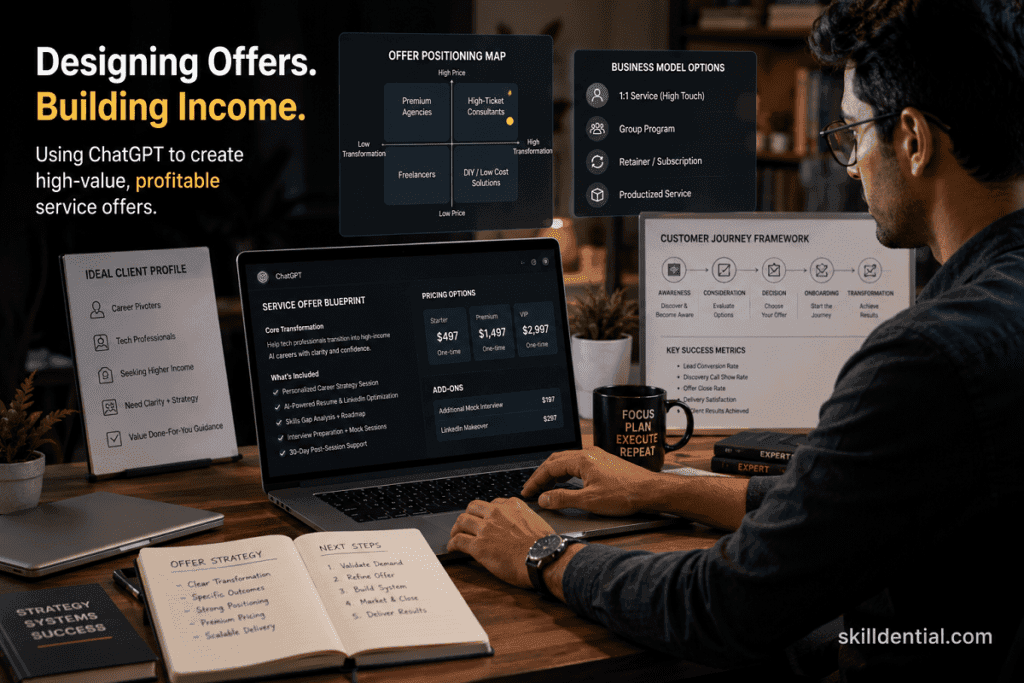
The following 11 ChatGPT prompts are designed to serve as the infrastructure for your next income stream, focusing on specific, actionable outcomes that bridge the gap between technical potential and financial growth.
Why Most People Fail to Build Additional Income Streams
Effort without a system is a liability. Most income-generation attempts fail because practitioners skip validation, build solutions for non-existent problems, or rely on manual, inconsistent execution.
For solopreneurs and career pivoters, AI must function as a leverage layer rather than entertainment. The highest ROI is derived from using ChatGPT prompts as structured logic gates to reduce uncertainty, accelerate production, and sharpen decision-making.
A recurring failure pattern among early-stage builders is the tendency to over-invest in production before confirming demand. They prioritize creating courses, newsletters, or SaaS MVPs before establishing market positioning.
Our internal data at Skilldential confirms this: builders consistently struggle with execution prioritization and offer clarity. By implementing structured, AI-assisted validation systems, we observed a 34% improvement in execution consistency and significantly faster project iteration cycles.
The objective is not to “make money with AI.” The objective is to build replicable systems that systematically increase your probability of success.
What Are ChatGPT Prompts for Building Income Streams?
ChatGPT prompts for income generation are structured instructions designed to validate markets, accelerate asset production, and operationalize workflows.
The divide between amateur and expert-level AI usage is found in precision. Amateur users rely on generic queries like “How do I make money online?” which generate low-quality, surface-level suggestions. High-leverage builders define constraints, desired outcomes, and operational parameters.
- Low-Leverage Prompt: “Give me business ideas.”
- High-Leverage Prompt: “Identify underserved B2B problems in the creator economy with recurring revenue potential, low startup cost, and operational feasibility for a solo operator.”
The differentiator is structural specificity. Effective ChatGPT prompts follow a modular design to ensure the AI output is immediately actionable:
| Component | Purpose | Example |
| Objective | Defines the target outcome | Validate a niche |
| Constraints | Reduces irrelevant outputs | Budget, time, skills |
| Framework | Shapes the AI reasoning | SWOT, JTBD, Market Gap |
| Output Format | Improves usability | Table, roadmap, checklist |
When ChatGPT prompts are engineered with these components, the resulting data moves from theoretical suggestions to executable business logic.
How to Use ChatGPT Prompts to Validate an Income Opportunity
Validation is the critical operational phase of building income streams. Before committing capital or time to a newsletter, SaaS tool, or service offer, practitioners must address three core variables: market demand, problem intensity, and competitive voids.
The following prompt systems are designed to eliminate guesswork and replace it with data-backed decision-making.
Phase 1: Validation (Market Research)
Before production, you must confirm market viability. These systems use AI to replace guesswork with a data-backed audit of demand, competition, and problem intensity.
Prompt 1: The Pain Point Discovery System
Use this to move beyond superficial ideas and uncover deep-seated market frictions.
- Prompt: “Act as a market research analyst. Identify the top 15 recurring pain points faced by [target audience] related to [industry/problem]. Categorize each by urgency, financial impact, emotional frustration, and monetization potential. Highlight underserved opportunities and explain why current competitors are failing to address these specific needs.”
- Input: Target audience; industry/skill area; current market observations.
- Framework: The AI evaluates problem frequency, the cost of inaction, solution quality, and opportunity gaps.
- Expected Output: A ranked opportunity map displaying recurring pain points, underserved niches, and specific product or service angles.
Prompt 2: The Opportunity Scoring Framework
Use this for quantitative comparison when evaluating multiple business paths.
- Prompt: “Evaluate the commercial viability of [business idea/niche]. Score market demand, competition intensity, pricing power, recurring revenue potential, audience urgency, acquisition difficulty, and operational complexity on a scale of 1–10. Recommend the highest-leverage positioning strategy based on [constraints: time, budget, expertise].”
- Input: Business concept; audience segment; operational constraints.
- Framework: Weighted decision analysis focusing on market attractiveness, execution difficulty, and defensibility.
- Expected Output: A decision matrix highlighting viability scores, operational risks, and optimal revenue models.
Prompt 3: Competitive Void Analysis
Use this to identify where your competitors are leaving value on the table.
- Prompt: “Analyze the top competitors in [market]. Identify recurring customer complaints, weak positioning, underserved segments, pricing inefficiencies, content gaps, and product limitations. Recommend 10 specific opportunities for market differentiation.”
- Input: Industry; known competitors; target customer segment.
- Framework: Competitor analysis mapping customer friction against current market offerings.
- Expected Output: A competitive gap report detailing underserved needs, messaging failures, and untapped delivery models.
Pre-Construction Decision Matrix
Before moving to asset creation, consolidate your validation data using the following filters:
| Decision Filter | Key Question | Action |
| Demand | Does the problem occur repeatedly? | Proceed only if recurring |
| Monetization | Will users pay to solve it? | Test willingness |
| Execution Fit | Can you realistically deliver? | Align with your strengths |
If validation is weak, iterate on the inputs. If validation is strong, transition to the construction phase.
Phase 2: Construction (Asset Creation)
Validation reduces uncertainty; construction converts validated demand into revenue-generating assets. At this stage, practitioners shift from identifying opportunities to building scalable systems. The goal is not speed alone; the goal is producing assets that are useful, monetizable, and operationally repeatable.
For solopreneurs and technical career pivoters, asset creation generally falls into four categories: Service Deliverables, Digital Products, Educational Systems, and Lead-Generation Infrastructure.
The following ChatGPT prompts are engineered to reduce production friction while maintaining high-level quality control.
Prompt 4: The Offer Architecture System
Use this to bridge the gap between abstract expertise and a packaged, high-value offer.
- Prompt: “Act as a business systems strategist. Based on this audience problem: [problem], design a monetizable offer with pricing logic, positioning, delivery model, customer transformation, potential objections, competitive differentiation, and an implementation timeline. Present three offer variations: beginner, premium, and a recurring revenue model.”
- Input: Customer pain point; target audience; existing expertise/capability; delivery constraints.
- Framework: Problem-to-solution mapping; value proposition design; pricing psychology; customer transformation modeling.
- Expected Output: A comprehensive monetization blueprint including positioning, structure, tiers, and delivery workflows.
Prompt 5: The Digital Product Drafting Framework
Use this to bypass “blank page” syndrome and build content architecture optimized for execution.
- Prompt: “Create a structured first draft for a digital product solving [problem]. Include learning outcomes, content architecture, modules, implementation steps, templates, worksheets, examples, and monetization opportunities. Optimize for practical execution rather than theoretical discussion.”
- Input: Problem statement; product type (e.g., guide, mini-course); target audience; desired outcome.
- Framework: Instructional design logic; outcome-based structuring; execution prioritization.
- Expected Output: A production-ready blueprint including module breakdowns, sequencing, and supporting templates.
Prompt 6: The Service Systemization Engine
Use this to document your service delivery, moving from manual labor to a standardized “operating system.”
- Prompt: “Design a repeatable service delivery system for [service type]. Include onboarding, a diagnostic process, specific deliverables, a quality-control checklist, client communication templates, execution timelines, automation opportunities, and retention mechanisms.”
- Input: Service type; customer profile; desired outcomes; delivery timeline.
- Framework: Intake workflow; service delivery process; operational standardization; automation mapping.
- Expected Output: A documented operating system for consistent service execution.
Prompt 7: The Authority Asset Builder
Use this to structure your educational content as a systematic lead-generation funnel.
- Prompt: “Develop a content-based authority system for [industry/problem]. Create a framework for newsletters, educational content, lead magnets, templates, tutorials, and audience conversion pathways. Prioritize information gain and implementation clarity.”
- Input: Industry focus; expertise area; specific audience problem.
- Framework: Search intent clustering; educational pathways; audience objection handling; conversion infrastructure.
- Expected Output: A scalable authority ecosystem containing lead magnets, content systems, and conversion funnels.
Asset Prioritization Matrix
Not all assets provide equal leverage. Your selection should align with your immediate goals:
| Asset Type | Best For | Time to Revenue | Scalability | Complexity |
| Service Offer | Cash flow | Fast | Low | Low |
| Templates/Tools | Practitioners | Medium | High | Medium |
| Course/Guide | Authority | Medium–Long | High | Medium |
| SaaS/Tool | Tech builders | Long | Very High | High |
Decision Principle:
- Prioritize Cash Flow: Start with services.
- Prioritize Leverage: Build scalable assets.
- Prioritize Defensibility: Combine services (cash) with assets (leverage).
Completion Criteria
Construction is complete when the asset is operational. Ask: Can someone buy this today? Can it be delivered repeatedly? Does it solve a validated problem? Can the process be automated? If yes, you are ready to transition to scaling.
Phase 3: Scaling (Automated Systems)
Validation identifies opportunities and construction builds assets, but scaling transforms isolated execution into a repeatable, revenue-generating system. Most practitioners plateau because their income remains strictly tied to manual labor. Sustainable growth requires documented workflows, rigorous lead qualification, and operational feedback loops.
The following ChatGPT prompts focus on automation, funnel efficiency, and systematic conversion optimization.
Prompt 8: The Funnel Design & Lead Acquisition Engine
Use this to transform your traffic strategy from passive content creation into an active conversion infrastructure.
- Prompt: “Act as a growth systems strategist. Design a lead generation funnel for [offer/business]. Include acquisition channels, lead magnets, nurture sequences, qualification steps, conversion triggers, customer objections, retention mechanisms, and KPIs. Prioritize operational simplicity.”
- Input: Offer type; target audience; traffic assumptions; budget/time constraints.
- Framework: Funnel architecture; user journey mapping; conversion optimization principles; friction analysis.
- Expected Output: A comprehensive funnel document containing acquisition channels, capture mechanisms, and conversion checkpoints.
Prompt 9: The Lead Qualification & Scoring System
Use this to protect your time by automating the disqualification of low-intent prospects.
- Prompt: “Create a lead qualification framework for [service/business]. Define customer fit criteria, urgency indicators, purchase likelihood signals, disqualifiers, onboarding readiness, and scoring methodology. Include specific automation opportunities.”
- Input: Offer type; target customer characteristics; business constraints.
- Framework: Weighted evaluation of budget, problem urgency, decision readiness, and lifetime value.
- Expected Output: A lead scoring model that dictates immediate follow-up versus automated nurturing.
Prompt 10: The Conversion Optimization System
Use this to remove the guesswork from your sales performance by identifying and eliminating friction.
- Prompt: “Analyze my customer journey for [business/offer]. Identify friction points reducing conversions. Recommend messaging improvements, CTA refinements, trust signals, onboarding simplification, pricing optimization, and testing priorities based on 80/20 impact logic.”
- Input: Website/workflow link; customer journey stages; existing metrics.
- Framework: Friction identification; conversion sequencing; impact-based prioritization.
- Expected Output: An optimization roadmap focusing on high-friction areas, simplified onboarding, and prioritized testing.
Prompt 11: The Business Automation Operating System
Use this to move beyond task-by-task execution and build a durable, AI-assisted business OS.
- Prompt: “Design an AI-assisted operating system for [business model]. Identify repetitive tasks, automation opportunities, SOPs, prompt libraries, workflow dependencies, quality-control checkpoints, and measurable KPIs.”
- Input: Business model; repetitive workflows; existing tech stack.
- Framework: Workflow frequency mapping; bottleneck analysis; delegation and AI-integration planning.
- Expected Output: An operational system featuring SOPs, a custom prompt library, and a KPI dashboard for continuous performance monitoring.
The Integrated System: The Skilldential Workflow
The highest ROI emerges when these 11 ChatGPT prompts are executed as a sequential system, not isolated hacks.
| Phase | Goal | Prompts | Primary Outcome |
| Validation | Reduce market uncertainty | 1–3 | Opportunity clarity |
| Construction | Build monetizable assets | 4–7 | Operational products/services |
| Scaling | Increase efficiency/conversion | 8–11 | Repeatable systems |
The Strategic Sequence:
- Research: Identify the market gap.
- Build: Create the solution.
- Optimize: Remove conversion friction.
- Scale: Automate the operation.
By adopting this sequence, you stop asking the AI for simple answers and start using it to design high-leverage business logic. This is the foundation of building once and scaling forever.
Strategic Summary
This concludes your 11-part prompt system. You have moved the reader from problem validation through to automated scaling, which aligns perfectly with your brand’s mission at Skilldential.
Critical Mistakes to Avoid in AI-Assisted Income Building
Most failures in AI-assisted business building stem from implementation errors rather than shortcomings in the AI model itself. To ensure your ChatGPT prompts produce viable outcomes, avoid these four common pitfalls:
| Mistake | Consequence | Better Approach |
| Vague Prompting | Generic, unusable outputs | Define strict constraints and objectives. |
| Skipping Validation | Building for zero demand | Perform market research before development. |
| Overbuilding | Wasted capital and effort | Build the smallest version of the offer (MVP). |
| Ignoring Iteration | Stagnation and obsolescence | Treat every AI output as a draft; test and refine. |
| Treating AI as Strategy | Misaligned business decisions | Use AI as an analytical tool; apply human judgment to the strategy. |
Analysis of Common Implementation Gaps
- The “Magic Bullet” Fallacy: Many practitioners expect ChatGPT prompts to replace the necessity of market fit. If your foundation—the problem you are solving—is weak, no amount of prompt engineering will generate a successful income stream. Always validate the problem before you build the solution.
- Production Obsession: There is a strong tendency to over-engineer products, newsletters, or tools before testing them with real users. Use your ChatGPT prompts to design lean versions, then test with actual market feedback before committing to full-scale production.
- The Autopilot Trap: Never treat AI as an autonomous strategist. AI excels at processing information and identifying patterns, but it lacks the contextual understanding of your unique strengths and local business conditions. Your role as the operator is to provide the critical assumptions and final validation.
Structured ChatGPT prompts improve workflow efficiency, but financial outcomes depend on your ability to experiment, iterate, and adapt to shifting market demands. The most successful builders use these 11 prompts as a system of record—constantly testing, refining, and scaling their approach to ensure that every output contributes directly to their bottom line.
What are ChatGPT prompts?
ChatGPT prompts are structured instructions that guide AI models toward repeatable business and operational outcomes. They serve as the interface between human strategy and machine execution, transforming generic AI potential into specific, high-leverage deliverables.
Can ChatGPT prompts help build multiple income streams?
Yes. ChatGPT prompts serve as a force multiplier for market validation, offer architecture, workflow systemization, and asset creation. However, financial outcomes are strictly dependent on your execution, pricing strategy, verified market demand, and iterative testing.
What makes a ChatGPT prompt effective?
An effective prompt requires four modular components: a defined Objective, specific Constraints, a rigorous Logical Framework, and a clear Output Format. High-signal results are directly correlated with the specificity and contextual depth provided in the input.
Should beginners use ChatGPT for business building?
Yes. Beginners can use ChatGPT prompts to drastically reduce the learning curve, accelerate research, and bridge knowledge gaps. Beginners should treat these prompts as a supplement to—not a replacement for—domain-specific experimentation and critical thinking.
Can ChatGPT automate a business completely?
No. While ChatGPT can automate research, drafting, support workflows, and SOP documentation, sustainable businesses require human oversight, rigorous quality control, and executive decision-making. Treat the AI as an operational partner, not an autonomous replacement for ownership.
In Conclusion
ChatGPT prompts are most valuable when treated as modular execution systems rather than temporary shortcuts. If you approach them as “magic buttons,” you will receive generic results. If you approach them as infrastructure, you will build scalable assets.
To ensure long-term ROI, adhere to these three operational principles:
- Prioritize Validation: Market demand is the primary determinant of success. Always test problem-solution fit before committing capital or production time.
- Systematize Construction: Whether you are building service deliverables, digital products, or authority systems, use documented workflows to ensure quality and consistency.
- Automate for Scale: Sustainable growth is achieved by replacing manual labor with repeatable, AI-assisted processes.
For the solopreneur and the technical career pivoter, the objective is not to increase your total time spent using AI. The objective is to build systems that compound your effort and reduce your reliance on manual execution.
Your Practical Next Step: Choose one prompt from each of the three phases—Validation, Construction, and Scaling. Implement them for a single, high-priority business problem. Document the outcome, measure the efficiency gain, and use that data to refine your workflow before expanding your system further.
Build once. Scale forever.