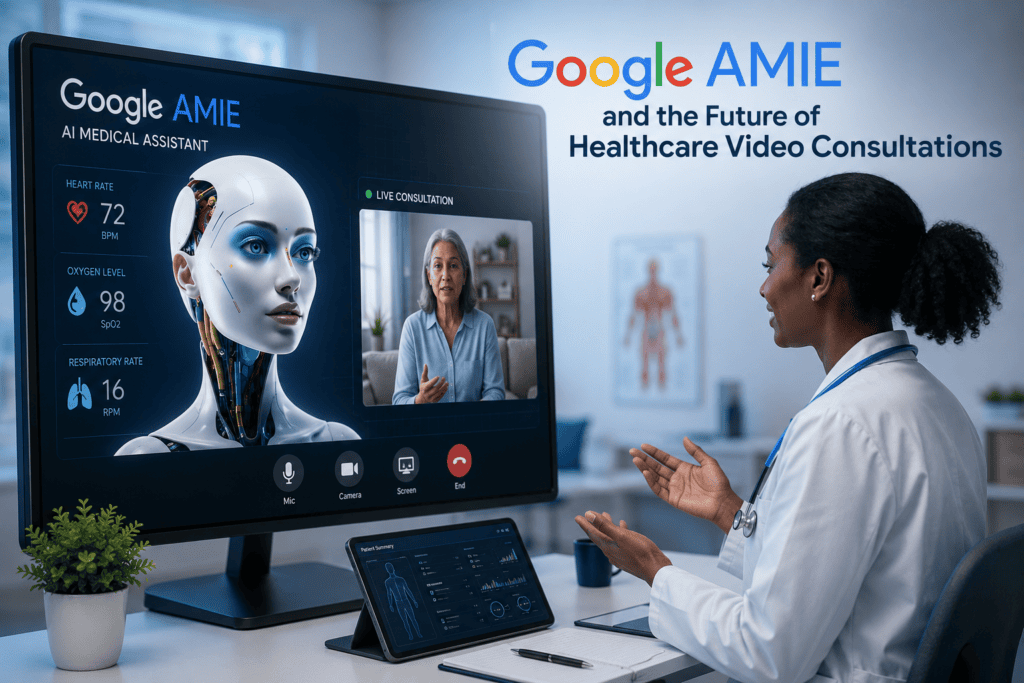
Google AMIE and the Future of Healthcare Video Consultations
Google AMIE (Articulate Medical Intelligence Explorer) is a research AI system from Google Research and DeepMind that can now conduct real-time video consultations. By leveraging a multi-agent architecture built on Gemini and Project Astra, Google AMIE interprets speech, evaluates facial cues, and guides patients through virtual physical exam maneuvers in real time.
In simulated studies, Google AMIE’s video capabilities performed on par with primary care physicians across key clinical competencies. While Google AMIE remains strictly experimental and is not yet deployed for real patient care, its underlying technology signals a major evolution in virtual healthcare.
This article explores what Google AMIE is, how its multi-agent video architecture operates, what the latest research data reveals, and what the Articulate Medical Intelligence Explorer means for the future of telemedicine, patient safety, and health-tech careers.
Who this article is for:
This piece is designed for healthcare professionals, medical students, health-tech practitioners, and AI enthusiasts who want a clear, evidence-based breakdown of Google AMIE’s video capabilities and its realistic implications for AI-driven virtual care.
What is Google AMIE?
Google AMIE (Articulate Medical Intelligence Explorer) is a specialized research AI system developed by Google Research and DeepMind specifically for expert-level clinical reasoning, medical dialogue, and diagnostic history-taking.
Initially introduced as a text-based medical AI model, Google AMIE was engineered to emulate the diagnostic precision, empathetic communication style, and structured clinical reasoning of experienced physicians.
Rather than acting as a simple Q&A assistant, Google AMIE approaches clinical encounters dynamically—asking targeted follow-up questions, formulating differential diagnoses, and synthesizing complex patient histories.
As part of Google’s broader research into multimodal AI, Google AMIE has evolved across three key development phases:
- Text-Based Diagnostic Dialogue: The initial version of Google AMIE focused on text-only simulated patient consultations, demonstrating superior diagnostic accuracy and conversational quality compared to board-certified primary care physicians in blind tests.
- Longitudinal Disease Management: Subsequent iterations expanded Google AMIE’s capabilities to support multi-visit care, enabling the system to manage chronic conditions, track diagnostic trajectories over time, and adjust treatment plans across multiple patient touchpoints.
- Real-Time Video Consultations (AMIE Video): The latest advancement integrates low-latency audio-visual capabilities powered by Gemini and Project Astra. In this mode, the Articulate Medical Intelligence Explorer conducts live video consultations—analyzing non-verbal cues, interpreting speech in real time, and guiding patients through self-administered physical examination maneuvers.
What is AMIE Video?
AMIE Video is the experimental, multimodal configuration of the Articulate Medical Intelligence Explorer designed to conduct real-time, synchronous video consultations. Unlike earlier text-based iterations, AMIE Video leverages low-latency audio-visual models to simultaneously listen to speech, observe visual patient cues, and interact dynamically during a virtual visit.
During a simulated consultation, AMIE Video continuously processes multiple streams of clinical data:
- Real-Time Visual Processing: AMIE Video watches the patient to assess non-verbal cues (such as visible distress, posture, or skin tone changes) and guides patients step-by-step through self-administered physical exam maneuvers in front of the camera.
- Synchronous Conversational Reasoning: Built on Google’s Gemini and Project Astra frameworks, AMIE Video maintains natural, empathetic dialogue while concurrently updating its internal diagnostic hypotheses and recommending next steps.
Crucial Distinction: AMIE Video is strictly an experimental research prototype evaluated in controlled, simulated settings with trained actor-patients. It is not a consumer product, a live telehealth platform, or a certified medical device approved for clinical deployment.
How Google AMIE’s Video Consultation Technology Works
To conduct a live video consultation effectively, an AI must manage competing performance demands: it needs to respond immediately at natural conversational speeds while simultaneously digesting continuous visual streams and performing complex clinical reasoning.
If a single AI model tries to handle all of these tasks in sequence, the deep reasoning phase creates awkward, unnatural pauses that erode patient trust.
To solve this challenge, Google AMIE (Video) uses an asynchronous multi-agent architecture built on top of Google’s Gemini foundation models and Project Astra real-time multimodal processing. Rather than relying on one monolithic model, the Articulate Medical Intelligence Explorer divides the clinical workload across three specialized AI agents operating in parallel:
- The Talker Agent (Patient Interaction): The Talker agent drives the patient-facing side of the video call. It handles live spoken interaction, manages natural conversational turn-taking, and delivers empathetic, low-latency responses using speech synthesis. To keep conversations fluid, the Talker agent pulls the latest available background context from the other agents without waiting for a full re-computation before every spoken turn.
- The Planner Agent (Background Clinical Reasoning): Operating continuously in the background, the Planner agent functions as Google AMIE’s diagnostic engine. It maintains a persistent summary of the patient’s case, continuously updates differential diagnoses, prioritizes clinical goals, identifies missing information, and formulates care plans. By running asynchronously, the Planner can execute deep clinical analysis without interrupting or delaying the live video dialogue.
- The Perception Agent (Audio-Visual Stream Analysis): The Perception Agent continuously analyzes the live audio and video feeds during the consultation. It detects subtle visual and auditory non-verbal cues—such as changes in skin tone, breathing patterns, facial affect, or signs of distress—and contextualizes those observations directly into Google AMIE’s running clinical memory. It also assesses patient positioning when guiding them through self-administered physical exam maneuvers in front of the camera.
By decoupling conversational fluidity from deep diagnostic processing, Google AMIE achieves low-latency audio-visual interactions without compromising the thoroughness of its underlying medical evaluation.
The video above provides a direct breakdown of Google AMIE’s multi-agent architecture and its performance in real-time virtual medical consultations.
What Google AMIE Can Do in a Live Video Call
During a simulated virtual consultation, Google AMIE (Video) extends traditional tele-triage by executing multiple continuous clinical tasks simultaneously:
- Real-Time Spoken Clinical History: Google AMIE conducts low-latency, empathetic verbal dialogue—gathering chief complaints, clarifying symptom timelines, and systematically taking a comprehensive medical history.
- Multimodal Cue Observation: Google AMIE continuously observes the visual and auditory stream to identify critical non-verbal cues, such as changes in facial affect, respiratory distress patterns, or altered gait.
- Guided Virtual Physical Exam Maneuvers: The Articulate Medical Intelligence Explorer actively instructs patients on how to position themselves in front of the camera and guides them through self-administered physical exam actions (e.g., showing specific joint movements, pointing to precise pain locations, or demonstrating range of motion).
- Dynamic Diagnostic & Management Planning: Running parallel background reasoning, Google AMIE continuously updates differential diagnoses and formulates evidence-based clinical management plans aligned with established medical guidelines.
What Does the Research Actually Show About Google AMIE?
Google has published two major strands of research relevant to understanding AMIE’s capabilities: one examining text-based disease management and another evaluating real-time audio-visual clinical consultations.
Proof of Concept: Google AMIE in Text-Based Disease Management (Nature, 2026)
Before introducing real-time video capabilities, Google established the underlying clinical reasoning framework for Google AMIE in a landmark Nature study evaluating long-term, multi-visit patient care.
In a blinded, randomized virtual Objective Structured Clinical Examination (OSCE) trial, Google AMIE was tested against 21 primary care physicians (PCPs) across 100 multi-visit case scenarios spanning multiple medical specialties. Evaluating the system across simulated follow-up visits, specialist physician reviewers found that:
- Non-Inferior Reasoning: Google AMIE demonstrated non-inferiority to PCPs in overall clinical management reasoning.
- Superior Precision: Google AMIE scored significantly higher than human physicians in treatment selection, diagnostic investigation precision, and strict adherence to established clinical guidelines (such as UK NICE and BMJ Best Practice).
- Explicit Guideline Grounding: While both Google AMIE and the physicians selected appropriate clinical protocols, the Articulate Medical Intelligence Explorer far more consistently grounded its recommendations explicitly in authoritative medical literature and drug formularies.
Key Takeaway
This research proves that Google AMIE’s underlying architecture can reliably handle complex, longitudinal diagnostic logic—providing the critical clinical foundation required for its latest real-time video consultations.
Google AMIE (Video) in Simulated Video Consultations
In a large, multi-arm randomized OSCE-style study, Google researchers evaluated Google AMIE (Video) directly against 30 board-certified primary care physicians (PCPs) across 100 clinical scenarios and 300 live simulated consultations using trained patient actors.
Independent, experienced physician evaluators reviewed the encounters using standardized clinical rubrics covering history-taking thoroughness, diagnostic accuracy, management appropriateness, and communication quality.
Key Findings from the Study
- Expert-Level Clinical Performance: Independent clinical evaluators rated Google AMIE (Video) on par with primary care physicians across all core clinical competencies, demonstrating that the system’s asynchronous multi-agent architecture can deliver expert-level diagnostic reasoning in a live video format.
- Superior Physical Observation & Exam Guidance: Google AMIE (Video) received significantly higher average scores than both board-certified PCPs and text-based Google AMIE at eliciting physical signs and actively guiding patient actors through virtual physical examination maneuvers in front of the camera.
- Strong Patient Actor Preference: Professional patient actors strongly preferred the Articulate Medical Intelligence Explorer synchronous video interface over text-based chat, rating it easier to use and more effective for explaining their health concerns. The actors also rated Google AMIE (Video) favorably on rapport, empathy, and confidence in care compared to text alternatives.
Important Research Context
While these trial results are promising, these data points reflect controlled, simulated consultations with professional actors and predefined clinical scenarios—not real-world patients presenting with undiagnosed, unscripted conditions.
Will AI Systems Like Google AMIE Replace Doctors?
Based on current research data, the answer is no. While Google AMIE represents a massive leap forward in clinical reasoning and multimodal interaction, it is explicitly designed and evaluated as a research prototype—not an autonomous replacement for human physicians.
To understand why Google AMIE will augment rather than replace healthcare providers, several critical factors must be considered:
- Simulated Benchmarks vs. Complex Real-World Care: The majority of Google AMIE’s video evaluations rely on OSCE-style simulations using professional patient actors with standardized, scripted complaints. Real-world patients present with messy histories, layered comorbidities, non-verbal subtleties, and unpredictable social determinants of health that fall outside predefined scenarios. While Google recently completed its first prospective real-world feasibility study with real patients, human physicians monitored every interaction live to ensure patient safety.
- Constrained Scope of Medical Conditions: Simulation studies naturally constrain the range of conditions tested to those that can be authentically portrayed by actors. This excludes a vast spectrum of acute medical emergencies, complex physical exam presentations, and rare systemic diseases where hands-on human clinical judgment is indispensable.
- Perceptual, Logic, and Technical Edge Cases: Automated system analyses highlight that even state-of-the-art multimodal AI like Google AMIE experiences occasional perceptual oversights, reasoning errors, or technical processing delays. In medicine, where minor errors can have severe consequences, human clinician oversight remains essential.
- Regulatory Compliance and Safety Approval: The Articulate Medical Intelligence Explorer is not a certified medical device or a licensed provider. Regulatory bodies require rigorous multi-phase clinical trial evidence, robust data security protocols, and clear accountability frameworks before any diagnostic AI can operate autonomously in live clinical settings.
The Future: “Triadic Care” and Clinical Augmentation
Rather than replacing doctors, systems like Google AMIE point toward a model of AI-augmented “triadic care”—a collaborative relationship where the patient, an AI co-clinician, and a human physician work together:
Plaintext
[ Patient ] <---> [ Google AMIE (AI Intake & Triage) ] <---> [ Human Physician (Final Decision) ]
Code language: CSS (css)
In this model, the Articulate Medical Intelligence Explorer handles time-consuming administrative tasks—gathering detailed pre-visit histories, updating differential diagnosis options, and organizing guideline-grounded care plans.
This allows human physicians to spend less time typing into electronic health records and more time delivering hands-on care, addressing complex diagnostic edge cases, and building meaningful human relationships with their patients.
Limitations and Risks to Take Seriously with Google AMIE
Even as future iterations of Google AMIE approach or match human physician performance across specialized tasks, several critical clinical, regulatory, and technical risks must be thoroughly addressed before any real-world deployment can occur:
Patient Safety & Diagnostic Error
- Perceptual and Logic Failure Modes: Like all multimodal AI systems, Google AMIE can make perceptual errors (e.g., misinterpreting visual symptoms or video frame artifacts) or clinical reasoning mistakes. In complex or atypical case presentations, these errors can result in missed diagnoses or delayed interventions.
- Automation Bias: Over-reliance on Google AMIE’s recommendations without rigorous, critical review by a licensed human clinician risks amplifying diagnostic errors and compromising patient outcomes.
Privacy, Data Security, and Regulatory Governance
- Sensitive Visual Data Handling: Live video consultations involve capturing highly sensitive real-time biometric audio, facial feeds, and personal health information (PHI). This demands end-to-end encryption, strict data minimization, granular access controls, and comprehensive audit trails.
- Regulatory Compliance: The Articulate Medical Intelligence Explorer cannot enter clinical practice without demonstrating strict compliance with international healthcare regulations, including HIPAA in the US and GDPR in the EU. It must also obtain formal medical device clearance (such as FDA Software as a Medical Device / SaMD certification).
Algorithmic Bias and Health Equity
- Training Data Representation: If Google AMIE’s underlying Gemini models are trained on non-representative datasets, the system risks perpetuating clinical disparities across age, sex, ethnicity, accent, or socioeconomic status.
- Required Mitigations: Deployment requires ongoing independent fairness audits, diverse multi-demographic validation trials, and continuous model monitoring to prevent discriminatory diagnostic recommendations.
Accountability and Medico-Legal Liability
- Unclear Ambiguity in Liability: In cases where Google AMIE provides a flawed differential diagnosis or misses a critical physical exam cue, responsibility becomes blurred between the attending human clinician, the healthcare provider organization, and Google as the AI vendor.
- Human-in-the-Loop Policies: Establishing clear legal frameworks, governance standards, and institutional risk policies is necessary to maintain clear clinical accountability.
Technical Infrastructure and Operational Barriers
- Digital Divide Constraints: Conducting real-time video consultations via Google AMIE requires reliable high-speed broadband, adequate camera resolution, and baseline digital literacy—gaps that disproportionately impact low-income and rural populations.
- System Integration: Retrofitting Google AMIE’s multi-agent architecture into legacy Electronic Health Record (EHR) systems and existing telehealth workflows introduces significant technical complexity and financial investment for health systems.
What This Means for the Future of Telemedicine
If research continues to demonstrate safe, beneficial performance and clear regulatory pathways mature, systems like Google AMIE could fundamentally transform the telemedicine landscape in several distinct ways:
- More Accessible, Higher-Capacity Virtual Care: AI-assisted video consultations powered by Google AMIE could expand care access in medically underserved and rural regions by executing initial triage, post-operative follow-ups, and routine chronic disease check-ins under direct physician oversight. By automating early history-taking and structured documentation, Google AMIE frees human clinicians to focus on high-stakes clinical decision-making and empathetic patient relationship-building.
- Richer Remote Physical Assessments: Audio-visual AI capable of actively guiding and interpreting parts of a physical exam transforms virtual care from simple verbal Q&A into dynamic clinical evaluations. Combined with consumer wearables, smart home diagnostic tools, and remote patient monitoring (RPM) sensors, Google AMIE enables continuous, data-rich virtual care environments.
- New Care Models & Streamlined Workflows:
- Hybrid Intake Protocols: Google AMIE acts as an initial AI triage agent, taking structured histories and running preliminary examination routines before seamlessly escalating the case summary to a human doctor.
- Real-Time Clinical “Second Reader”: Operating continuously in the background, Google AMIE assists attending physicians by monitoring live consultation feeds, verifying medical guideline adherence, flagging potential diagnostic red flags, and proposing evidence-based care options for review.
The Path Ahead
Realizing this future depends entirely on transitioning from simulated actor trials to real-world clinical validation, establishing transparent governance frameworks, and securing formal medical device clearance—ensuring patient safety remains at the core of AI-driven virtual care.
What is Google AMIE?
Google AMIE (Articulate Medical Intelligence Explorer) is a specialized research AI system developed by Google Research and DeepMind specifically for expert-level clinical reasoning, medical dialogue, and diagnostic history-taking.
Initially introduced as a text-based medical AI model, Google AMIE was engineered to emulate the diagnostic precision, empathetic communication style, and structured clinical reasoning of experienced physicians. Rather than acting as a simple Q&A assistant, Google AMIE approaches clinical encounters dynamically—asking targeted follow-up questions, formulating differential diagnoses, and synthesizing complex patient histories.
As part of Google’s broader research into multimodal AI, Google AMIE has evolved across three key development phases:
- Text-Based Diagnostic Dialogue: The initial version of Google AMIE focused on text-only simulated patient consultations, demonstrating superior diagnostic accuracy and conversational quality compared to board-certified primary care physicians in blind tests.
- Longitudinal Disease Management: Subsequent iterations expanded Google AMIE’s capabilities to support multi-visit care, enabling the system to manage chronic conditions, track diagnostic trajectories over time, and adjust treatment plans across multiple patient touchpoints.
- Real-Time Video Consultations (AMIE Video): The latest advancement integrates low-latency audio-visual capabilities powered by Gemini and Project Astra. In this mode, Google AMIE conducts live video consultations—analyzing non-verbal cues, interpreting speech in real time, and guiding patients through self-administered physical examination maneuvers.
Prerequisites for Routine Clinical Deployment of Google AMIE
Before real-time audio-visual medical AI like Google AMIE (Video) can transition from experimental research into standard clinical care, several critical technical, clinical, and regulatory milestones must be achieved:
- Prospective Real-World Clinical Trials: While initial prospective feasibility trials (such as text-chat intake evaluations at academic medical centers like Beth Israel Deaconess) show zero safety interventions and high diagnostic accuracy, large-scale prospective trials using live video in diverse, unscripted patient populations are required to establish safety and clinical efficacy.
- Formal Regulatory Clearance: Systems must secure approval from global regulatory authorities—such as the U.S. FDA, European Medicines Agency (EMA), or national equivalents—formally classifying the software as a Medical Device (SaMD) with rigorous performance metrics.
- Institutional Governance & Escalation Policies: Healthcare organizations must define clear protocols covering real-time human physician oversight, fallback mechanisms during technical degradation, automated clinical summaries, and clear lines of medico-legal accountability.
- EHR Interoperability & Workflow Integration: Google AMIE must achieve seamless API integration with Electronic Health Record (EHR) systems (e.g., Epic, Cerner) and existing telehealth software to eliminate manual data entry and naturally fit into existing physician schedules.
- Digital Equity & Access Protocols: Deployment strategies must ensure that AI-driven video care does not widen existing healthcare gaps due to high bandwidth demands, device limitations, or language barriers among vulnerable populations.
Until these regulatory, technical, and operational safeguards are established, Google AMIE remains a promising research framework rather than a ready-to-deploy clinical tool.
What is Google AMIE and how does it differ from a standard AI chatbot?
Google AMIE (Articulate Medical Intelligence Explorer) is a specialized research AI developed by Google Research and Google DeepMind for clinical reasoning and diagnostic dialogue.
Unlike general-purpose chatbots that generate plain Q&A responses, Google AMIE utilizes a multi-agent architecture optimized specifically for healthcare. It dynamically takes medical histories, asks targeted follow-up questions, formulates differential diagnoses, and evaluates live visual data during simulated video consultations.
How does Google AMIE handle real-time video calls without lag?
Google AMIE (Video) solves conversational latency by splitting tasks across three specialized agents operating asynchronously in parallel:
Talker Agent: Manages patient-facing speech synthesis in real time for fluid, natural dialogue.
Planner Agent: Operates continuously in the background to update diagnostic hypotheses and care plans without interrupting spoken interaction.
Perception Agent: Analyzes live audio and video feeds to track non-verbal cues and guide physical exam maneuvers.
Is Google AMIE available for public use or approved by the FDA?
No. Google AMIE is strictly an experimental research prototype evaluated in controlled, simulated settings. It is not a certified medical device, a licensed clinician, or a consumer product approved for public clinical deployment.
Any future commercial or clinical application will require extensive prospective real-world trials, safety validation, and formal regulatory clearance (such as FDA Software as a Medical Device / SaMD approval).
Can Google AMIE perform physical exams during a telehealth visit?
Google AMIE cannot perform direct physical contact, but its Perception Agent guides patients through self-administered physical exam maneuvers in front of their camera.
During simulated trials, Google AMIE scored higher than human primary care physicians at instructing patient-actors on how to position themselves, demonstrate joint range of motion, or show specific anatomical locations.
Will Google AMIE replace human primary care physicians?
No. Research indicates that Google AMIE is best suited to augment human clinicians rather than replace them.
The expected future model is AI-assisted triadic care, where Google AMIE handles preliminary intake, structured history-taking, and clinical documentation, allowing human doctors to focus on complex decision-making, direct patient relationships, and high-stakes treatments.
In Conclusion
Google AMIE demonstrates how conversational and multimodal AI is shifting from static, text-based Q&A toward real-time, interactive clinical care. By utilizing Gemini and Project Astra within an asynchronous multi-agent architecture, Google AMIE (Video) achieves natural, low-latency video dialogue while conducting deep clinical reasoning and real-time physical exam observation.
In rigorous, randomized OSCE simulation studies, Google AMIE (Video) performed on par with board-certified primary care physicians across core measures—including history-taking thoroughness, diagnostic accuracy, and communication quality—while receiving strong preference ratings from patient actors.
However, context matters. These findings reflect controlled, simulated encounters with professional actors. Google AMIE is strictly an experimental research model, not an approved medical device or autonomous clinician. Transitioning AI like Google AMIE into routine clinical care will require significant progress across several frontiers:
- Rigorous Real-World Validation: Moving from synthetic actor scenarios to prospective clinical trials involving diverse patient populations and unscripted health conditions.
- Safety, Equity & Data Privacy: Developing robust safeguards against diagnostic errors, ensuring HIPAA/GDPR compliance for real-time video streams, and conducting algorithmic fairness audits to eliminate healthcare disparities.
- Interoperability & Governance: Establishing clear legal accountability frameworks, human-in-the-loop protocols, and seamless API integrations with existing EHR systems.
For healthcare providers, health-tech engineers, and digital skill builders, the rise of multimodal clinical platforms like Google AMIE marks a clear turning point. Future high-value opportunities will belong to those who cultivate cross-disciplinary skills at the intersection of AI literacy, clinical governance, multi-agent system design, and human-centered healthcare workflows.
Recommended Next Step
If you operate in healthcare, technology, or content strategy, choose one actionable milestone to focus on this month:
- For Clinicians & Healthcare Professionals: Complete an introductory module or clinical guideline on evaluating AI outputs and safe human-in-the-loop AI delegation.
- For Technologists & AI Practitioners: Analyze an established healthcare AI governance framework (such as the FDA SaMD or NOHARM framework) and map its safety, logging, and evaluation metrics to an AI product in your pipeline.