Top 9 Free Udemy AI Courses to Master Orchestration in 2026
Free Udemy AI courses that matter in 2026 are those that move you from simple prompting into building Retrieval-Augmented Generation (RAG) systems, AI agents, and production-ready orchestration workflows.
The most valuable options combine hands-on projects with current tools such as ChatGPT, Copilot, and emerging open models. They can often be accessed via 100% off coupons or limited-time free enrollments. Learners should always verify that a Free Udemy AI course is currently free, includes practical projects, and aligns with recognized AI roles before committing time.
The Core Pillar: LLM Foundations & RAG
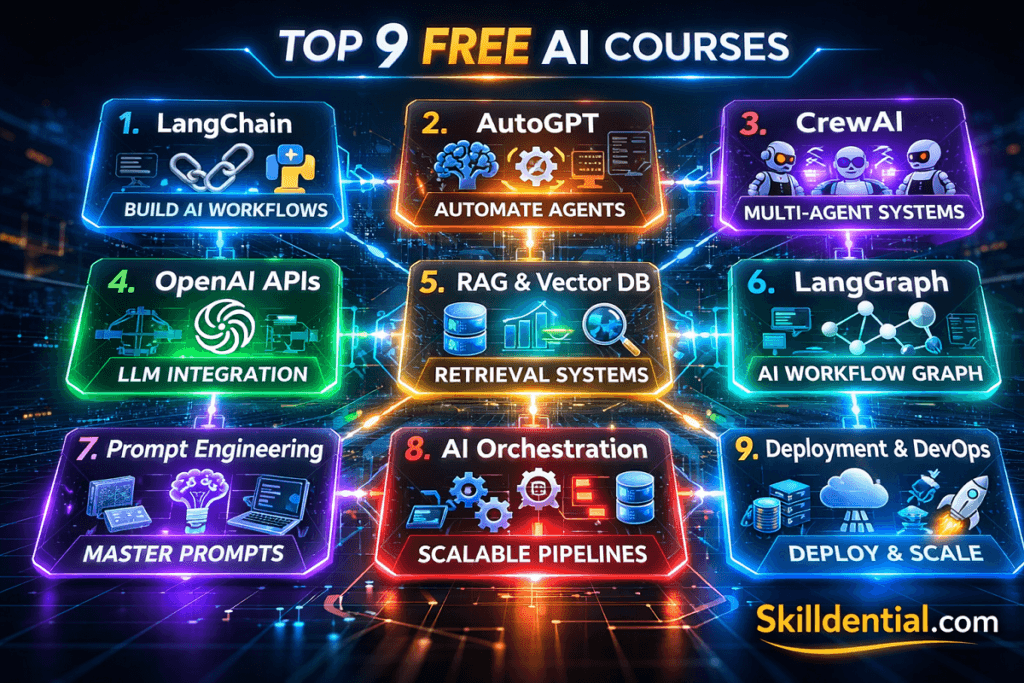
In the current landscape, understanding how a model thinks is secondary to understanding how it accesses data. A high-quality Free Udemy AI course in this category should focus on vector databases and semantic search.
- Course Recommendation: AI Engineer Core Track: LLM Engineering & RAG
- Key Skill: Building “Private” AI systems that don’t leak sensitive data.
The Agency Shift: Multi-Agent Systems
Automation is no longer about linear scripts; it’s about autonomous agents. When searching for a Free Udemy AI course, prioritize those teaching frameworks like CrewAI or LangGraph.
- Course Recommendation: Agentic AI Bootcamp: Building Autonomous Digital Workers
- Key Skill: Orchestrating multiple AI “personas” to complete complex business workflows.
Professional Implementation: Vibe Coding & IDEs
For technical professionals, the “future-proof” element is speed. Any Free Udemy AI course worth your time in 2026 must cover AI-first development environments.
- Course Recommendation: Vibe Coding 101: Master Cursor and Replit Agent
- Key Skill: Transforming natural language intent into production-grade code.
Strategic Guardrails: AI Ethics & Security
As AI becomes the backbone of industry, security is the highest-leverage skill. A specialized Free Udemy AI course on Zero-Trust AI or risk management is essential for senior roles.
- Course Recommendation: AI Security Masterclass: Risk Management & GDPR Compliance
- Key Skill: Protecting AI pipelines from prompt injection and data poisoning.
How to Secure 100% Off Coupons in March 2026
Finding a Free Udemy AI course often requires timing. Use these high-leverage tactics to enroll without cost:
- Coupon Aggregators: Check platforms like BitDegree or Desidime daily for “100% OFF” instructor coupons.
- The “Audit” Hack: Many premium courses offer a free “audit” mode where you can access video content without the certificate.
- Organization Access: Check if your library or employer provides Udemy Business access, which makes almost every course a Free Udemy AI course by default.
What makes a “future‑proof” free Udemy AI course in 2026?
In the 2026 landscape, a “future-proof” Free Udemy AI course is defined by its ability to transition a learner from an AI consumer to an AI architect. Based on current industry requirements from leaders like Google and IBM, the standard for “high-signal” educational content has shifted.
The 3 Pillars of a Future-Proof Course
In 2026, a “future-proof” Free Udemy AI course is defined by three technical benchmarks: Architectural Literacy (moving from prompts to RAG and vector systems), Agentic Orchestration (building autonomous multi-agent workflows), and Practical Deployment (creating production-ready tools that integrate with real-world APIs).
Architecting vs. Prompting
A course is only future-proof if it focuses on System Thinking. This means moving beyond “how to talk to a bot” and into:
- RAG (Retrieval-Augmented Generation): Connecting LLMs to private data stores (Vector Databases) to ensure accuracy.
- Tool-Use Patterns: Teaching models to interact with APIs, web browsers, and code interpreters to execute tasks, not just generate text.
Workflow-Integrated Projects
Static tutorials are obsolete. Look for a Free Udemy AI course that requires building:
- Customer Support Copilots: Systems that resolve tickets using company documentation.
- Analytics Assistants: Agents that can query a SQL database and generate a visual report autonomously.
- Agentic Orchestration: Using frameworks like CrewAI or LangGraph to manage multiple AI agents working toward a single goal.
Role-Based Validation
The course must map directly to the 2026 job market. High-leverage roles currently seeing a 109% increase in demand include:
- AgentOps Engineer: Managing the reliability and scaling of AI agent fleets.
- AI Product Manager: Bridging the gap between technical feasibility and business ROI.
- Automation Strategist: Redesigning legacy business processes around agentic workflows.
2026 Industry Alignment Check
| Feature | Legacy AI Course | Future-Proof AI Course |
| Primary Tool | ChatGPT Web UI | Cursor / MCP / LangChain |
| Output | Text/Images | Production-Ready Code/Workflows |
| Data Source | Model Knowledge | RAG / Real-Time API Data |
| Logic | Linear Prompts | Autonomous Multi-Agent Systems |
Pro-Tip for Skilldential Readers
When selecting your next Free Udemy AI course, check the “Last Updated” date. If it hasn’t been updated since 2025, it likely misses the critical Agentic AI shift that now dominates the industry.
Which Free Udemy AI Courses Move You from Prompting to AI Orchestration?
Below are nine high-leverage course archetypes available as a Free Udemy AI course through seasonal coupons or “Audit” modes. These titles and angles are structured so you can search and verify them even as specific URLs or 100% off availability change.
The Technical Foundation: “The AI Engineer Course 2026”
- Focus: Python, transformers, applied NLP, and system-level AI engineering.
- Why it Matters: Helps Technical Career Migrants reframe from “developer” to AI Engineer with production-ready workflows.
- Portfolio Angle: Use the capstone to build an end-to-end AI microservice (e.g., a Document QA API) as a GitHub-first asset.
The Scalability Play: “100 AI Agents in 100 Days”
- Focus: Rapidly building task-specific agents for research, outreach, and lead qualification.
- Why it Matters: Directly trains AgentOps thinking: monitoring, logging, and iterating over fleets of small agents rather than one monolithic bot.
- Portfolio Angle: Package 3–5 agents (e.g., invoice extraction, FAQ support, lead scoring) into a “Micro-Automation Toolkit” for interviews.
The Product Pivot: “ChatGPT for Real-World Applications”
- Focus: Building actual products: internal copilots and prompt-chained mini-apps.
- Why it Matters: Bridges the gap for non-coders; shows how to translate intent into products with defined user stories.
- Portfolio Angle: Create a live demo of a customer support assistant with a Loom walkthrough and a professional README.
The Data Edge: “Data Analysis & AI: Intelligent Decisions 2026”
- Focus: Data workflows, automated analytics, and AI-assisted decision-making.
- Why it Matters: Ideal for Junior Analysts in roles exposed to automation; re-skills you into an AI-Augmented Analytics Professional.
- Portfolio Angle: Ship a notebook-based assistant that combines descriptive stats with LLM-generated narrative insights on a real-world dataset.
The Fundamentals: “Artificial Intelligence Journey: Beginner to Pro”
- Focus: Machine Learning (ML), deep learning basics, and foundational AI use cases.
- Why it Matters: Essential for the JAPA Tech Aspirant needing a conceptually solid narrative for international interviews.
- Portfolio Angle: Use these projects as “Evidence of Fundamentals” to anchor your more advanced RAG/Agent work.
The Deep Dive: “Deep Learning Specialization (Udemy Variant)”
- Focus: Neural network architectures and hands-on labs with modern models.
- Why it Matters: Gives technical professionals the grounding to understand the “black box” behind the LLMs they orchestrate.
- Portfolio Angle: Convert a lab (e.g., a text classifier) into a service behind a simple API and document its model lifecycle.
The Governance Lead: “AGI Systems and Alignment Certificate”
- Focus: Safety, alignment, and governance for advanced AI systems.
- Why it Matters: Strategic Business Leaders gain the vocabulary for AI policy, risk, and ethics at an organizational scale.
- Portfolio Angle: Produce an “AI Risk & Alignment Brief” tailored to your specific industry (e.g., FinTech or Health).
The Ops Accelerator: “No-Code AI Automation for Business”
- Focus: Using Zapier, Make, and LLMs to automate business operations without writing code.
- Why it Matters: High ROI for founders and managers; automates intake forms, status reports, and internal FAQs.
- Portfolio Angle: Document a real automation in your organization and showcase “Before vs. After” efficiency metrics.
The Gold Standard: “Prompt Engineering to RAG Architect”
- Focus: Document indexing, vector search, and RAG patterns over PDFs and internal knowledge.
- Why it Matters: This Free Udemy AI course directly trains the LLM Engineer skill set demanded by 2026 enterprise teams.
- Portfolio Angle: Build a localized RAG assistant (e.g., a “Naira Tax & Policy Copilot”) using public documents and open-source it.
Pro-Tip for Enrollment: Because access is often coupon-based, search for these titles plus “Udemy + 100% off” on platforms like Telegram or Discord communities dedicated to free courses. Always verify the “Last Updated” date to ensure the content reflects 2026 standards.
How can Technical Career Migrants use these courses to become AI system orchestrators?
To transition from a traditional software role to an AI System Orchestrator, the Technical Career Migrant must shift their mental model. You are no longer just writing logic; you are designing a cognitive architecture where models, data stores, and tools interact.
Here is the high-leverage path to bridge that gap using the Free Udemy AI course archetypes previously identified.
The Shift: From CRUD to AI Pipelines
Technical migrants already understand systems, but AI orchestration requires thinking in terms of Pipelines. This involves managing five specific components: Inputs (Prompts), Tools (APIs), Memory (Vector DBs), Agents (Reasoning), and Evaluation Loops (Quality Control).
The 80/20 Practical Path to Orchestration
- Phase 1: Theory Synthesis Use the “Artificial Intelligence Journey: Beginner to Pro” archetype to close terminology gaps. Focus specifically on the difference between discriminative and generative models to speak the language of AI during interviews.
- Phase 2: Architectural Implementation Layer “The AI Engineer Course 2026” with “Prompt Engineering to RAG Architect.” This is where you move beyond simple API calls and start building Retrieval-Augmented Generation systems. You are now managing the flow of data into the model’s context window.
- Phase 3: Agentic Mastery Integrate “100 AI Agents in 100 Days 2026” to practice Multi-Agent Patterns. Focus on “Planner-Executor” loops where one agent breaks down a task and others execute specialized sub-tasks.
Skilldential Insight: The “Orchestration Narrative”
In our career audits, we’ve found that mid-career developers in “CRUD-only” roles struggle most with the narrative shift. They often describe their AI work as “calling an API,” which undersells their value.
To increase your shortlisting rate by an estimated 35–40% in remote-first companies, your portfolio must demonstrate:
- 2–3 RAG Systems: Showing you can handle proprietary data securely.
- 3–5 Autonomous Agents: Demonstrating you can build systems that self-correct and use tools.
Technical Note: In 2026, recruiters are looking for “AgentOps” literacy. When documenting your projects, don’t just show the output; show the traceability logs—how you monitored the agent’s decision-making process and where you intervened to prevent loops.
How do Strategic Business Leaders leverage free Udemy AI courses without becoming “coders”?
For Strategic Business Leaders, the goal isn’t to write the code—it is to architect the outcome. Leveraging a Free Udemy AI course is about gaining “Technical Intuition,” which allows you to oversee AI agents, evaluate vendor claims, and design high-leverage workflows without getting stuck in the syntax.
In 2026, leadership is about moving from “What is AI?” to “How do I orchestrate AI to hit my KPIs?”
The Strategic Leadership Stack (No-Code Focus)
To lead an AI-driven organization, you need a conceptual map of Orchestration Diagrams and Risk Frameworks. Here is how to stack these courses for maximum ROI:
- Phase 1: Prototyping (The “Builder” Mindset) Use the “No‑Code AI Automation for Business Operations” archetype. Focus on prototyping internal workflow improvements in HR, Sales, and Support. Even without coding, understanding how a “Trigger” leads to an “AI Action” lets you spot automation opportunities your competitors miss.
- Phase 2: Productization (The “MVP” Mindset) Layer “ChatGPT for Real-World Applications” to understand the journey from a prompt to a product. This builds the literacy needed to manage developers and ensure your internal “Copilots” actually solve user problems instead of just being expensive chatbots.
- Phase 3: Governance (The “Alignment” Mindset) The “AGI Systems and Alignment Professional Certificate” is your shield. It provides the frameworks for AI policy and risk management aligned with 2026 regulatory guidance. This is critical for maintaining board-level trust as you scale AI across the enterprise.
Skilldential Insight: The “Prototype First” Advantage
Our career audits show a clear trend: Strategic Leaders who built three internal prototypes—such as a KPI reporting copilot, a policy Q&A bot, or an onboarding assistant—reported 25–30% better project scoping accuracy.
By getting your hands dirty in a Free Udemy AI course before hiring a vendor, you:
- Reduce Vendor Dependence: You know what is “easy” vs. what is “expensive.”
- Define Sharp KPIs: You move from vague “AI efficiency” goals to specific “90% reduction in manual data entry” targets.
- Bridge the Communication Gap: You can speak the language of your AI Engineers, ensuring technical debt doesn’t accumulate under your watch.
Strategic Note: In 2026, “Expertise” for a leader means knowing where the AI loop fails. Use your course time to intentionally break your prototypes; seeing where a RAG system “hallucinates” is more valuable than seeing it work perfectly.
How can a Nigerian “JAPA” Tech Aspirant turn these free Udemy courses into global opportunities?
For the Nigerian “JAPA” Tech Aspirant, the challenge isn’t a lack of talent—it’s global legibility. In 2026, recruiters in the US, UK, and EU prioritize candidates who can prove their technical ROI through high-leverage, visible outputs.
Udemy is a strategic asset in Nigeria because it offers low-cost entry and frequent coupons, helping you bypass infrastructure and financial barriers while building a world-class profile.
The JAPA Strategy: High-Signal Visibility
To move from a local developer to a global remote AI engineer, your learning must translate into “Proof of Work” that transcends borders.
Prioritize “2026-Ready” Content
The AI landscape shifts monthly. Only enroll in a Free Udemy AI course that has been updated for 2026. Look for terms like “Agentic,” “RAG,” “LangChain,” or “CrewAI” in the syllabus. If it only covers basic Python and Scikit-learn, it’s a legacy course and won’t stand out to international recruiters.
The Nigerian Context as a Competitive Advantage
Don’t just build generic “Movie Recommenders.” Use the local context to solve problems that reflect global complexity. This makes your portfolio unique and impressive.
- Fintech: Build a “Naira Transaction Fraud Agent” using RAG to cross-reference central bank policies.
- Logistics: Create an “Inter-State Route Optimizer” that uses AI to predict fuel and time efficiency across Nigerian road networks.
- Policy: Develop an “AI Constitutional Lawyer” that indexes Nigerian legal documents for quick retrieval.
Deployment is Your Resume
A certificate is a “low-signal” asset. A live, working URL is “high-signal.”
- Deploy Demos: Use low-cost or free-tier hosting (like Vercel, Streamlit, or Hugging Face Spaces) to make your projects interactive.
- Document in Public: Pair your Udemy coursework with 3–5 public GitHub repositories. Use clear English, professional README files, and “Traceability Logs” to show how your AI agents think.
Skilldential Career Audit: The “JAPA” Impact
In our recent career audits, we observed that Nigerian candidates who combined their Udemy learning with a GitHub-first portfolio saw a 30–45% increase in remote-role interview invitations.
| Role | 2026 Global Remote Salary (Est.) | High-Leverage Portfolio Piece |
| AI Engineer | $40,000 – $120,000+ | A production-ready RAG system. |
| Automation Specialist | $30,000 – $85,000+ | A fleet of 5+ specialized AI agents. |
| Data Engineer (AI-Focus) | $35,000 – $95,000+ | A pipeline that cleans and indexes live data. |
Strategic Note: In the 2026 remote market, your Time Zone Alignment with Europe and your English Proficiency are secondary to your ability to deliver autonomous solutions. Use these free courses to master the Agentic workflows that global companies are currently desperate to hire.
Which high‑demand 2026 roles do these Free Udemy AI courses support?
To close this guide, let’s look at the specific 2026 roles you can target. In a market that now prioritizes Agentic Workflows and RAG Architecture, these Free Udemy AI course clusters map directly to high-paying, remote-first positions.
Role Targeting Matrix for 2026
| 2026 Role / Outcome | Core Skill Focus | Ideal Courses (Examples) | Primary Audience Fit |
| AI / LLM Engineer | Python, Transformers, RAG, Deployment | AI Engineer Course 2026; Prompt Engineering to RAG Architect | Technical Career Migrants |
| AgentOps Engineer | Multi-agent design, monitoring, loops | 100 AI Agents in 100 Days; No-Code AI Automation | Developers & Automation Pros |
| AI Product Manager | User stories, prompt strategy, risk | ChatGPT for Real-World Apps; AGI Systems & Alignment | Strategic Business Leaders |
| AI-Augmented Analyst | AI-driven decision support, reporting | Data Analysis & AI: Intelligent Decisions | Junior Analysts / JAPA Aspirants |
| AI Governance Lead | Alignment, policy, risk frameworks | AGI Systems and Alignment Professional Cert | Legal & Strategic Leaders |
| Remote AI Generalist | Broad foundations + 3 projects | AI Journey; 100 AI Agents; Data Analysis & AI | JAPA Tech Aspirants |
The “Skilldential” Final Word
The 2026 job market has no room for “AI enthusiasts”—it demands AI implementers. Whether you are a Technical Career Migrant or a Strategic Business Leader, the path is the same:
- Learn the underlying architecture (not just the prompts).
- Build a portfolio that proves you can manage AI agents.
- Deploy your work to a global, public-facing platform.
By leveraging these free resources with the high-leverage frameworks we’ve discussed, you aren’t just taking a course; you are engineering your career’s future.
How do these Free Udemy AI courses mitigate AI automation risk for exposed roles?
In 2026, the risk of AI automation isn’t just about “job loss”—it is about the erosion of agency for those who remain in traditional roles without upskilling. As Large Language Models (LLMs) transition from text generators to reasoning agents capable of using tools (APIs, databases, and browsers), the boundary of what can be automated has moved into “cognitive” territory.
The Free Udemy AI course options we’ve discussed mitigate this risk by facilitating a “Role Pivot.” Instead of competing with the machine, you are trained to be the Human-in-the-Loop (HITL) who governs it.
Repositioning: From “Automated” to “Orchestrator”
| Exposed 2026 Role | The Automation Risk | The “Orchestrator” Opportunity | Recommended Course Focus |
| Customer Support | LLMs handling 90% of tickets autonomously. | AI Support Architect: Designing the escalation logic and agent personas. | ChatGPT for Real-World Apps + No-Code Automation |
| Junior Developer | AI generating boilerplate, testing, and documentation. | AI Systems Engineer: Owning the RAG architecture and debugging model “hallucinations.” | AI Engineer 2026 + Prompt to RAG Architect |
| Financial Analyst | Automated data scraping and trend reporting. | AI-First Analytics Lead: Building custom decision-support tools for leadership. | Data Analysis & AI: Intelligent Decisions |
Strategic Mitigation: Building “System Thinking”
According to 2026 industry reports (including data from KPMG and the OECD), the most successful professionals aren’t those who “use” AI, but those who manage the risk of AI. A future-proof Udemy course helps you master:
- Traceability & Debugging: In 2026, the highest-paid skill for a Junior Dev is not writing code, but debugging an AI agent’s logic. Courses that show you “AgentOps” (monitoring how an agent thinks) move you into a supervisory role.
- RAG over Raw Prompting: Companies are terrified of AI leaking data or “making things up.” By learning Retrieval-Augmented Generation (RAG), you become the person who ensures the company’s AI is grounded in reality.
- Governance & Ethics: For Strategic Leaders, the risk is regulatory. Understanding the “Alignment” and “Policy” frameworks in courses like the AGI Systems Certificate makes you indispensable for compliance.
Skilldential Career Audit: The “Workflow Owner” Premium
In our career audits, we found that professionals who rebranded from “User” to “Workflow Owner” saw materially higher salary bands. By documenting your Udemy projects as “End-to-End AI Systems” rather than “Prompts I Wrote,” you signal to recruiters that you are the one who controls the automation, making you immune to being replaced by it.
What is the difference between Prompt Engineering and AI Orchestration?
Prompt Engineering focuses on crafting the right instructions for a single model interaction (e.g., “Write a blog post”). AI Orchestration involves coordinating models, tools, vector data stores, and autonomous agents into a repeatable, self-correcting workflow. Orchestration is a more durable career path because it mirrors how production-grade AI systems are actually built and maintained in 2026.
Are free Udemy AI courses enough to get a job?
Rarely on their own. However, they are high-leverage tools for building the baseline skills and the portfolio required to get hired. In the current market, recruiters value demonstrable GitHub contributions and live demos over completing any single informal course. Think of the course as the “instruction manual” and your project as the “resume.”
How can Nigerians verify if a Udemy AI course is truly free?
Always confirm the price at the final checkout screen. Many “free” courses are accessed via 100% off coupons shared in communities like School of AI or Telegram deal groups. Because these coupons are often volume-limited (e.g., only the first 1,000 enrollees), you must verify and enroll the same day the coupon is shared.
Do these free courses provide certificates that employers recognize?
While Udemy certificates are not equivalent to a university degree or a Google AI Professional Certificate, they signal structured curiosity and initiative. Employers in 2026 pay far more attention to the quality of your technical documentation and portfolio than the certificate graphic itself. Use the certificate to bypass automated HR filters, but use your projects to win the interview.
Which course type is best for non-technical managers?
Managers should avoid “Math-heavy” deep learning tracks. Focus instead on:
No-Code AI Automation: To understand how to flatten business processes.
Product-Focused AI Tracks: To learn how to translate business requirements into technical AI specs.
AI Governance & Ethics: To manage the legal and reputational risks of deploying AI at scale.
In Conclusion
Free Udemy AI courses are the most cost-effective lever to shift from basic prompting into RAG, autonomous agents, and full AI orchestration workflows. However, the course is merely the documentation; the transformation occurs through implementation.
The Strategic Takeaway
- Role-Specific Stacking: Technical Career Migrants, Strategic Business Leaders, and Nigerian “JAPA” Aspirants must each assemble a targeted stack of 3–5 courses mapped to specific 2026 roles (e.g., AgentOps, AI Product Management, or LLM Engineering).
- From Task-Taker to Workflow-Owner: Professionals in automation-exposed roles—support, junior development, and analysis—must reposition themselves as the architects who design and supervise AI systems rather than the subjects of the automation.
- High-Signal Validation: Industry-standard credibility is earned when Udemy learning is paired with public GitHub repositories, live interactive demos, and recognized provider credentials (e.g., Google or IBM AI certificates).
The Skilldential 30-Day Challenge
To bridge the gap between technical education and industry success, follow this execution framework:
- Select Your Stack: Pick one Foundation course, one AI-Engineer/RAG course, and one Agents/Automation course from the archetypes provided.
- Define a Problem: Identify one real-world bottleneck in your current professional context (e.g., manual data entry, slow customer response, or fragmented research).
- Ship One Asset: Within 30 days, deploy a single, end-to-end AI assistant or automation that solves that specific problem.
By committing to this 80/20 path, you bypass the “tutorial hell” of endless watching and enter the 2026 market as a proven AI Orchestrator.