CT Tech Salary vs. MRI Tech Salary: Which Career Pays More?
The modern radiology landscape rewards specialization, yet many professionals remain stalled in single-modality roles without a clear strategy for income growth. If you are evaluating your next professional move, analyzing the CT Tech Salary versus the MRI technologist’s earning potential is a critical first step in optimizing your career ROI.
While both roles command above-average wages, MRI typically offers superior compensation over a full career arc. Recent national data places the median CT Tech Salary in the high-$70k to low-$80k range, while MRI technologists consistently cluster in the high-$80k to mid-$90k bracket.
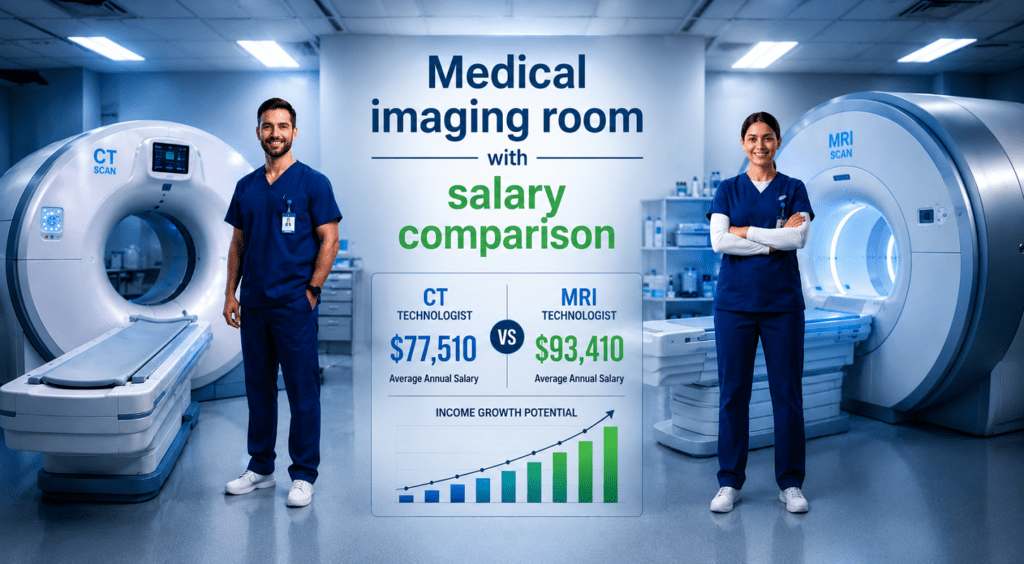
Independent compensation datasets and travel-contract agencies confirm a recurring $10k–$15k annual gap favoring MRI roles, a margin that widens significantly at higher experience levels. However, the true financial upside is not found in choosing one over the other; it is found in stacking these skills into a dual-modality profile.
By bridging these technologies, you transform your career from a static position into a high-leverage asset, commanding the strongest rates for travel contracts and ensuring long-term market resilience.
What is the real salary difference between CT techs and MRI techs?
While federal data (BLS) provides a baseline, it often masks the true earning potential by grouping all “radiologic technologists” together. Based on 2026 industry data, here is the breakdown of the compensation delta:
| Metric | CT Technologist | MRI Technologist |
| Median Base Pay | ~$78,000–$85,000 | ~$88,000–$95,000 |
| Market Delta | Baseline | +$10,000 to +$15,000 |
| Top 10% Potential | $100,000+ | $115,000+ |
Why the Gap Exists
The $10k–$15k spread is not arbitrary; it reflects the market’s valuation of specific technical and environmental demands:
- Workflow Intensity: CT roles typically handle higher patient volumes with faster throughput. MRI roles involve longer scan times, higher technical complexity (pulse sequences, parameter optimization), and more intensive patient screening/safety protocols.
- Specialization Premium: MRI requires a more specialized, non-ionizing skill set that is in constant demand by high-revenue outpatient imaging centers and specialized hospital departments, driving up the base rate.
- The “Travel” Multiplier: Travel agencies often offer significant premiums for MRI, frequently pushing the annual earnings gap even wider than the base-pay difference for permanent staff.
Strategic Nuance for Your Article
To maintain your expert “Skilldential” authority, frame the difference not as “MRI is better than CT,” but as “MRI is a higher-value asset for your portfolio.”
- The “Dual-Modality” Advantage: Emphasize that the highest earners aren’t just one or the other. They are professionals who cross-trained into the second modality, making them the most “indispensable” asset in the department.
- Addressing Data Lag: Explicitly state that government reports (like BLS) are lagging indicators that group multiple entry-level roles. Your readers are looking for current, high-signal market reality, not stagnant 2024–2025 averages.
- The ROI Break-Even: Use the $10,000 gap as the basis for your ROI argument. If a certification costs $6,000, the “break-even” on the salary upgrade is achieved in less than one year—a classic “high-leverage” career move.
CT vs. MRI Compensation Snapshot (2026)
This table provides a high-signal comparison of current market rates. Use this data to articulate the clear financial “step-up” associated with MRI specialization and dual-modality stacking.
| Role Type | Typical Range (Staff) | Median Signal | Strategic Notes |
| CT Tech (Staff) | $75k–$85k | ~$80k | Often obscured in “Rad Tech” reporting, high volume/fast throughput. |
| MRI Tech (Staff) | $85k–$95k | ~$90k | Clearer specialization premium; higher technical complexity. |
| CT Tech (Travel) | $2.3k–$3.0k/wk | ~$2,600/wk | Annualized ~$120k+; sensitive to hospital throughput demand. |
| MRI Tech (Travel) | $2.6k–$3.3k/wk | ~$2,900/wk | Stronger base anchor; high demand in outpatient imaging centers. |
| Dual (CT + MRI) | $120k–$160k+ | Varies | Highest leverage. Commands the best contracts and scheduling priority. |
The Strategic Takeaway for Your Readers
The data confirms that the MRI advantage is not merely a higher midpoint—it acts as a superior negotiating anchor.
- The Multiplier Effect: While the base pay gap for permanent staff is consistently $10k–$15k, the real upside is the negotiating floor created by dual certification. When you hold both credentials, you solve a critical operational problem for facilities: staffing flexibility.
- Asset-Based Career Management: From a Skilldential perspective, you should frame MRI certification as a leverage-acquisition event. The $10k–$15k annual difference represents a compounding ROI. If you treat your career as a portfolio, adding MRI to a CT foundation is akin to adding a high-yield asset to your mix, effectively raising your “market rate” for every future negotiation.
Pro-Tip for Content Structure: When publishing, emphasize that the “travel” figures provided are estimates based on 2026 market demand. Note that the gap widens in high-acuity environments (Stroke centers, Level 1 Trauma) where the combination of CT speed and MRI diagnostic complexity makes a technologist virtually indispensable.
Why are CT and MRI salary numbers so confusing in the data?
The confusion stems from how occupational data is categorized, which often obscures the true CT Tech Salary signal. Most public statistics aggregate CT technologists under broad “radiologic technologist” buckets, while MRI technologists are increasingly broken out as a distinct occupation. This creates an apples-to-oranges comparison if you fail to read the specific data footnotes.
Regulatory datasets—such as those from the Bureau of Labor Statistics—typically group “radiologic technologists and technicians” into a single occupational category. This massive umbrella includes general X-ray, fluoroscopy, and CT, effectively diluting the CT Tech Salary data with lower-paying generalist roles. In contrast, MRI technologists often carry their own dedicated occupation code, leading to cleaner, more accurate median wage reporting.
Furthermore, private salary platforms frequently aggregate staff, per-diem, and high-paying travel roles into one “average,” which further blurs the reality for a professional trying to benchmark their worth.
For Skilldential readers, the actionable move is to treat broad federal data as a low-resolution baseline, then refine your career strategy using modality-specific sources that isolate the CT Tech Salary from generalist radiologic pay. By ignoring the blended averages, you gain a clearer picture of your actual market value and the true earning potential of your credentials.
What is the difference between technicians and technologists in CT and MRI?
In formal healthcare definitions, a distinction exists between “technicians” and “technologists,” but in the context of CT Tech Salary and MRI roles, these terms are often used interchangeably in clinical practice.
The Technical Distinction
- Technologists (The Professional Standard): Typically hold an associate or bachelor’s degree, possess ARRT certification, and maintain a broad scope of practice. This includes patient assessment, protocol selection, image quality optimization, and direct collaboration with radiologists.
- Technicians (The Narrow Scope): Historically, this term implies a more limited, task-oriented role focused on equipment maintenance or basic image capture under close supervision, often without the same depth of educational credentialing or professional certification.
The Market Reality
Despite these textbook differences, your Skilldential audience will find that modern job postings almost exclusively utilize “tech” as a shorthand for “technologist.” Whether a listing reads “CT Technologist” or “CT Tech,” the expectation is nearly identical: you are the credentialed professional responsible for the diagnostic workflow.
| Feature | Technologist | Technician (Formal) | Market Usage |
| Education | Associate/Bachelor’s Degree | Vocational/On-the-job | Expects Degree + ARRT |
| Responsibility | High (Protocol, QA, Patient Care) | Low (Task-oriented) | High |
| Credentialing | Required (ARRT, State License) | Often optional/variable | Required |
| Compensation | Premium (Based on skill) | Baseline (Entry-level) | Professional (Tech-level) |
Strategic Insight for Your Content
When discussing CT Tech Salary or MRI compensation, avoid getting bogged down in semantic debates. Instead, frame your content around “Scope of Practice” and “Certification Value.”
- The “Technologist” Signal: Emphasize that in the current 2026 market, “tech” is a colloquialism. What actually moves the needle on salary is your ARRT status, your modality-specific certifications (like CT or MR), and your ability to perform at a technologist level—regardless of the title on your badge.
- Actionable Advice: Remind your readers that if a job posting lists “technician” requirements but asks for “technologist” duties, they should anchor their salary expectations to the higher, technologist-level responsibilities.
By dismissing the title-confusion as an outdated relic of broad federal reporting and focusing on high-leverage certification metrics, you maintain the authoritative tone your platform requires.
How do the workflow and lifestyle differ between CT tech and MRI tech roles?
The workflow and lifestyle differences between CT and MRI roles represent a classic trade-off between volume-driven efficiency and precision-driven complexity.
Understanding these differences is critical for your audience, as your choice here dictates your daily “stress profile” and long-term career fatigue.
The Workflow Divergence
| Feature | CT Technologist | MRI Technologist |
| Primary Driver | Throughput/Speed | Accuracy/Complexity |
| Patient Volume | High (20–40+ per shift) | Low (12–20 per shift) |
| Exam Duration | 5–20 minutes | 30–90 minutes |
| Cognitive Load | Rapid-fire decision making; trauma/acute triage. | Technical sequence optimization; safety screening. |
| Environment | Often “emergency-adjacent” or high-volume hospital. | Usually planned, outpatient, or specialized imaging. |
Strategic Breakdown for Skilldential Readers
To optimize your career trajectory, you must understand the operational trade-offs inherent in these roles. The following breakdown maps the structural differences between CT and MRI, helping you determine where to anchor your expertise for maximum professional leverage.
The CT “High-Volume Engine”
- The Reality: CT is the heartbeat of a hospital’s emergency department. The work is transactional, fast, and requires managing a constant queue. You are the “first responder” of imaging.
- The Stressor: “List management.” The pressure comes from the sheer number of STAT orders and the need to move patients rapidly to prevent bottlenecks in the ER.
- Skilldential Leverage: Because you are the primary engine of facility throughput, you have immense job security. You are the professional who makes the hospital “work.”
The MRI “Complexity Layer”
- The Reality: MRI is a precision-based craft. The work is deeper, quieter, and requires extensive patient preparation (screening for implants, managing claustrophobia, coaching motion).
- The Stressor: “Safety & Technical Precision.” The pressure comes from the high stakes of magnetic safety and the complexity of managing scan sequences/artifacts. One mistake can be dangerous or result in an unreadable scan.
- Skilldential Leverage: You are the “specialist.” Because the threshold for entry and competence is higher, MRI roles often command a higher base salary. You aren’t just scanning; you are curating a complex diagnostic data set.
The “Dual-Modality” Synthesis
For a career architect, the most high-leverage move is not choosing between these lifestyles, but mastering both.
- The Strategic Move: Start with CT to build your baseline efficiency and speed. Once you understand the “high-volume engine,” transition into MRI to acquire the “complexity layer.”
- The Career Multiplier: A dual-modality technologist can pivot between the fast-paced, high-income travel contracts of CT and the stable, specialized, and often better-compensated roles in MRI outpatient centers.
Expert Insight: If you crave immediate impact and enjoy the adrenaline of trauma/ED work, prioritize CT. If you prefer deep work, technical mastery, and a lower-velocity—though higher-complexity—day, prioritize MRI. Both, when combined, create a “career floor” that allows you to dictate your market value rather than accepting the standard wage for a single-modality role.
When does MRI certification pay for itself for a CT tech (the breakpoint)?
For an experienced CT technologist, the transition to MRI is not merely “additional schooling”—it is a capital investment in your earning capacity. Based on 2026 industry benchmarks, here is the breakdown of the “breakpoint” where the certification pays for itself.
The Investment: What It Actually Costs
While the sticker price of a post-primary MRI program ranges from $3,000 to $8,000 for tuition, you must account for the full lifecycle cost to arrive at an accurate ROI:
- Tuition & Fees: $3,000–$8,000
- Compliance & Exam Fees: $500–$1,000 (Credentialing, background checks, registry fees)
- Clinical Opportunity Costs: Varies (Commute and potential reduction in overtime capacity during training)
- Total “Real” Investment: $4,000–$10,000
The Payback: The Multiplier Effect
The salary delta between a CT technologist and an MRI technologist consistently sits at $10,000–$15,000 annually.
- The Math: If you secure a role or a “dual-modality” premium that nets you an additional $12,000 per year, your initial $8,000 investment is fully recouped in roughly 8 months.
- Accelerators: If you leverage your new credential to secure higher-paying travel contracts (where MRI premiums often exceed CT base rates by over 15%), the break-even point can occur in as little as one contract cycle.
| ROI Scenario | Annual Gain | Break-Even Timeframe |
| Conservative (Staff) | +$10,000 | ~10–12 Months |
| Aggressive (Travel) | +$15,000+ | ~6–8 Months |
Strategic Insight for Skilldential Readers
The “breakpoint” is almost always under 18 months, making this one of the most high-leverage moves in the imaging field.
- Avoid the “Degree Trap”: For currently certified technologists, steer clear of expensive four-year degree-based programs unless they are required for your long-term management goals. Focus on ARRT-recognized post-primary certificate programs that offer streamlined didactic/clinical pathways.
- Negotiate the Training: Many high-acuity facilities are desperate for dual-modality staff. If you have a strong record as a CT tech, approach your current employer about tuition reimbursement or employer-sponsored training in exchange for a retention commitment. This effectively reduces your out-of-pocket investment to zero, making the ROI infinite.
- The Leverage Anchor: Once you are dual-certified, you are no longer competing for “generalist” pay. You become a “limited resource” in the job market, allowing you to anchor your salary requirements at the top of the MRI range, regardless of the facility’s initial offer.
How does dual‑modality (CT + MRI) impact long‑term income and market resilience?
In the landscape of modern radiology, the “dual-modality” professional—specifically one who bridges CT and MRI—functions as a high-leverage asset. This is not just a certification add-on; it is a structural upgrade to your professional value.
The Compensation Pyramid
Dual-modality technologists consistently occupy the highest tier of the compensation structure. While a single-specialty technologist is limited by the demand for that specific modality, a dual-certified professional resolves operational inefficiencies for employers.
- The Premium: Facilities and travel agencies pay a 5–15% premium for dual-certified staff because you eliminate the need for redundant hires. You are the “Swiss Army knife” of the imaging department, capable of pivoting between the high-volume engine of CT and the high-complexity precision of MRI as departmental needs shift.
- Negotiating Power: Because your skill set is a limited resource, you gain significant leverage. In contract negotiations—whether staff or travel—your ability to cover both modalities allows you to demand a higher “floor” for your salary, rather than negotiating within the narrower band of a single specialty.
The Resilience Factor: “Labor-Market Insurance”
From a career-systems perspective, cross-modality training is your primary defense against market volatility.
- Diversification: If elective MRI volumes soften due to regional economic shifts, your CT skills—essential for trauma and emergency care—keep you shielded. Conversely, if local demand for routine CT dips, your MRI expertise remains highly sought after by specialty outpatient centers and oncology-focused clinics.
- Career Continuity: In the travel world, dual-modality techs see fewer “gaps” between contracts. Agencies prioritize candidates who can fill multiple roles because it minimizes the administrative and recruitment burden of staffing a facility. You are essentially de-risking your income stream.
Strategic Summary
For Skilldential readers, the data is clear: Income follows leverage.
| Metric | Single-Modality | Dual-Modality (CT + MRI) |
| Market Value | Commodity-based | Limited-Asset |
| Negotiating Floor | Baseline (Standard) | Premium (Leveraged) |
| Job Security | Modality-Dependent | Market-Resilient |
| Travel Access | Narrower Scope | Widest Availability |
The Bottom Line: Aiming for dual-modality status transforms your career from a static role into a dynamic portfolio. By stacking CT and MRI certifications, you aren’t just “doing more work”—you are acquiring the flexibility and indispensability required to command top-tier rates in any healthcare economy.
Which career path is better if you are planning a 5‑year CT/MRI roadmap?
For a 5-year CT/MRI roadmap, the “better” path is not a binary choice, but a strategic sequence. Because CT is faster to master and serves as a high-volume foundation for hospital operations, while MRI represents a higher-complexity, higher-margin specialization, the “CT-First, MRI-Second” sequence is the industry standard for maximizing professional ROI.
The 5-Year Dual-Modality Roadmap
| Phase | Strategic Focus | Leverage Gain |
| Year 0–1 | Foundation: Radiography (X-Ray) certification & clinical basics. | Core credibility; baseline hospital experience. |
| Year 1–2 | CT Specialization: Intensive focus on trauma, ED throughput, and protocol speed. | Increased marketability; “High-Volume Engine” status. |
| Year 3–4 | MRI Acquisition: Clinical cross-training/certification in an outpatient or hospital setting. | “Complexity Layer” added to your portfolio. |
| Year 5+ | Dual-Modality Leverage: Transition to travel, lead, or hybrid roles. | Maximum compensation floor; market resilience. |
Why “CT First” is the High-ROI Move
- Speed to Competence: CT protocols are more standardized, and the workflow is more accessible for recent graduates. You will build confidence and clinical volume faster, which is essential for surviving the high-pressure environment of emergency radiology.
- Operational Necessity: Hospitals are perennially short-staffed for CT. By becoming an efficient CT technologist first, you make yourself immediately indispensable, which often leads to employers being more willing to fund your subsequent MRI cross-training.
- The “Dual” Advantage: When you eventually layer in MRI, you aren’t a “new tech” looking for a job; you are a proven, high-volume CT asset who can now solve complex imaging problems. This narrative—”I have the speed of CT and the precision of MRI”—is exactly what drives the $120k–$160k+ travel contract rates.
Strategic Advice for Your 5-Year Plan
- Avoid the “Degree Trap”: For your MRI stage (Year 3), prioritize ARRT-recognized post-primary certificate programs or clinical cross-training partnerships over new degree programs. Your objective is the credential and the clinical hours, not a redundant academic title.
- Aggressive Credentialing: Use the 24-month recertification cycle to your advantage. Plan your CE credits around emerging technologies like AI-assisted reconstruction or advanced cardiac sequences, which set you apart from generalists.
- Target the “Anchor” Facilities: During your Year 3 MRI transition, seek roles in high-acuity trauma centers or specialized outpatient clinics. These environments are the most likely to support your cross-training and provide the complex case volume needed to truly master the modality.
The “Skilldential” Insight: View these five years as leveraging up. Your goal is to move from a generalist (X-Ray) to a high-volume operator (CT) to a specialized expert (MRI). By the end of Year 5, you shouldn’t be competing for jobs; you should be selecting contracts that require your specific “dual-modality” expertise.
Decision matrix: CT only vs. MRI only vs. Dual‑Modality
This decision matrix is designed to serve as a high-leverage diagnostic tool for your readers. By benchmarking the CT Tech Salary alongside MRI and dual-modality benchmarks, you provide a clear visual path for career optimization.
Career Architect Decision Matrix
| Dimension | CT-Only Technologist | MRI-Only Technologist | Dual CT + MRI Technologist |
| Typical Staff Pay | ~$77k–$85k/yr | ~$85k–$95k+/yr | ~$90k–$115k+ |
| Travel Potential | Strong (Trauma Focus) | Higher Base Anchor | Highest (Contract Leverage) |
| Workflow | High-Volume / Fast-Paced | High-Complexity / Precision | Adaptive (Market-Dependent) |
| Resilience | Solid (Trauma/Acute) | Solid (Specialty/Elective) | Maximum (Hedging Strategy) |
| Training ROI | Baseline | 12–18 Month Payback | Rapid (Multiplier Effect) |
| Career Persona | Efficiency Expert | Technical Specialist | Career Architect |
Key Tactical Insights for Your Audience
- The Pay Anchors: While federal data still drags “Radiologic Technologist” and “CT” averages down toward the high-$70k range, the real-world market signal for experienced, certified professionals is increasingly moving toward $90k+ for MRI and six figures for dual-modality practitioners.
- The Travel Multiplier: In 2026, travel contracts for MRI often offer a higher weekly base than CT, but the “Dual-Modality” status is the true differentiator. Dual-certified professionals are the first to be recruited for high-acuity assignments, allowing them to command rates in the $120k–$160k annualized range.
- Market Resilience: Relying solely on CT makes you dependent on acute-care patient volume. Relying solely on MRI makes you dependent on elective/outpatient imaging trends. Being dual-certified allows you to rotate your focus based on current hiring demand, making you virtually immune to localized downturns in one modality or the other.
Skilldential Pro-Tip
Use this matrix to encourage readers to perform a “Personal Audit.” Ask them to identify their current pillar (CT vs. MRI) and measure the cost of adding the second. If the cost of the certification is less than the projected annual salary delta ($10k+), the ROI is positive within the first year. From that point forward, every dollar of the salary increase is pure, compounded yield on their initial professional investment.
Is the MRI tech salary always higher than the CT tech salary?
While MRI technologists consistently hold a higher median salary—typically an annual gap of $10,000–$15,000—the “real” difference is nuanced. Experienced CT technologists in high-acuity trauma centers or those optimizing their income through overtime and call differentials can frequently match the base pay of MRI specialists. However, MRI maintains a higher “floor” as a specialized modality with a smaller, more exclusive talent pool.
How much does a CT tech make per hour in the U.S.?
In 2026, the average base hourly rate for a CT technologist is approximately $40, typically landing between $34 and $46 per hour depending on region and experience. Annualized, this generally places staff CT technologists in the $75,000 to $90,000 range. High-performing travel CT technologists operate in a different tier, with weekly packages often ranging from $2,400 to $3,800 when fully booked.
How much does an MRI tech make per year in the U.S.?
The national median for MRI technologists is approximately $95,500 per year (roughly $46 per hour), though top-tier earners in specialized markets or senior roles frequently exceed $120,000+. Entry-level roles typically start in the $55,000–$70,000 range, scaling rapidly with experience and the acquisition of additional certifications.
Is dual CT and MRI certification worth it financially?
Yes. From a Skilldential perspective, dual certification is a “leverage-acquisition event.” It moves you from a commodity-based generalist to a limited-resource asset. Data shows that dual-modality technologists can command salaries in the $110,000–$150,000+ range, particularly in travel and high-acuity hospital settings. Because the certification investment is relatively low ($4k–$10k), the break-even point is often reached within 6–12 months.
Can I go straight into MRI without working in CT first?
While some pathways allow you to specialize in MRI directly after radiography, a Career Architect roadmap usually targets CT first. CT provides the high-volume, rapid-decision-making experience required to master hospital throughput. Adding MRI as your second pillar creates a more robust “leverage stack” that makes you virtually indispensable to both hospitals and outpatient imaging centers.
In Conclusion
Both CT and MRI technologists command high incomes, yet MRI consistently maintains a $10k–$15k annual lead in most U.S. markets. While CT relies on high-volume efficiency, MRI rewards technical complexity and precision, explaining its higher base pay band. The ultimate leverage, however, lies in dual-modality stacking.
Professionals who bridge these two specialties sit at the top of the opportunity stack, commanding the highest travel rates, maximum market resilience, and superior negotiating power.
Whether you are a Pivot Professional or a Market Architect, the path is clear: use CT as your high-volume foundation, then intentionally acquire MRI certification as your leverage-building second pillar. Don’t leave your earning potential on the table—use online certification and career path resources to translate this leverage into documented, negotiated income.