7 Ways ChatGPT Ads Could Change Affiliate Marketing & SEO
ChatGPT ads could change affiliate marketing by shifting digital discovery from keyword-based search to conversational intent, altering how publishers attract, measure, and monetize traffic. Sponsored placements appear separately from AI-generated responses under an answer independence model, meaning advertisers cannot directly pay to influence assistant recommendations.
This structural shift may increase the importance of Answer Engine Optimization (AEO), semantic authority, and multi-turn intent mapping over traditional keyword targeting. However, overall adoption speed depends on advertiser access, user behavior, and platform monetization maturity.
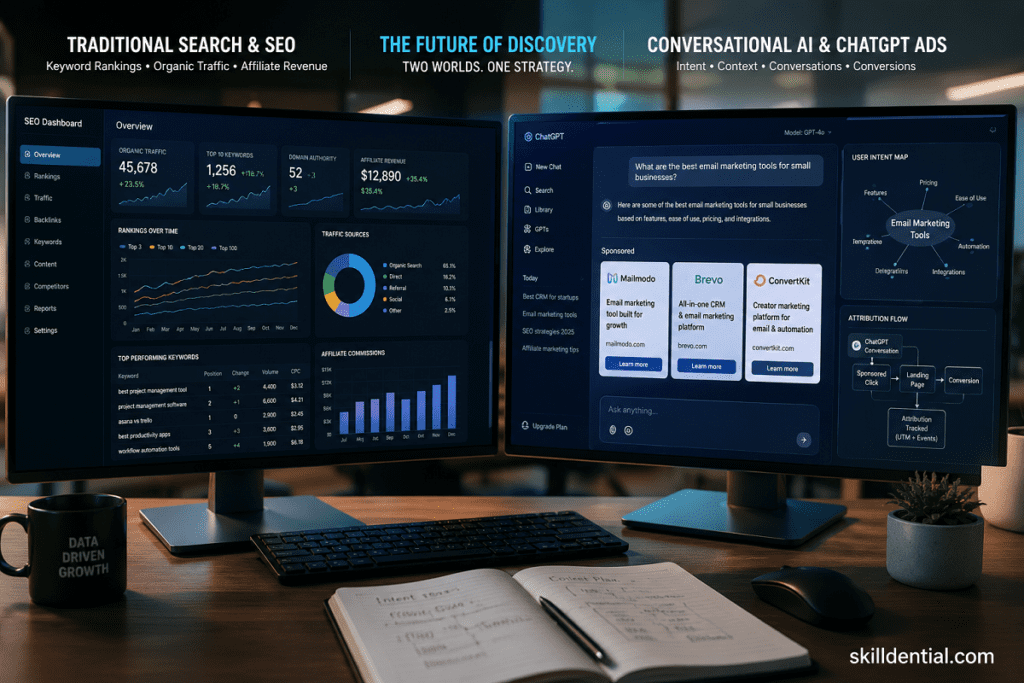
Affiliate marketers, SEO teams, and SaaS operators increasingly depend on predictable traffic acquisition systems. If conversational interfaces become a dominant discovery layer, these specific ad formats will fundamentally change affiliate marketing mechanics, forcing digital operators to rethink attribution, programmatic monetization, and optimization strategies.
For years, organic rankings depended on rigid keywords, backlink profiles, and explicit click-through behavior. Conversational AI introduces a completely different environment where users describe complex goals, ask follow-up questions, and refine buying decisions through multi-turn interactions.
Understanding how these dynamic dialogue models behave is essential, as the emergence of platform-native sponsored inventory will completely change affiliate marketing execution and organic discovery models.
How could ChatGPT ads change affiliate marketing traffic acquisition?
The introduction of native sponsored inventory below AI responses fundamentally rewrites the physics of user discovery. For years, digital publishers built business models on standard search engine results pages (SERPs), relying on a user clicking through multiple blue links to aggregate information.
In a conversational environment, the user journey is consolidated. Users narrow their purchase intent, compare features, and eliminate options within a single chat interface before ever clicking an external link.
Traditional affiliate systems rely heavily on capturing traffic from broad, flat informational queries (e.g., “best CRM software” or “best laptops for students”). In conversational ecosystems, that flat journey transforms into a dynamic, multi-turn sequence:
[Turn 1] "What CRM works for freelancers?"
   ↓
[Turn 2] "Compare pricing under $50/month."
   ↓
[Turn 3] "Which one integrates with <a href="https://skilldential.com/tag/email-automation/">email automation</a>?"
Code language: JavaScript (javascript)
Instead of a single target keyword mapping directly to a single static landing page, publishers face a landscape where traffic only exits the AI interface at the deepest point of the consideration funnel.
The Strategic Shift: Contextual Dialogue over Keywords
With the launch of OpenAI’s self-serve Ads Manager, advertising placement relies on conversational contextual targeting rather than rigid keyword auctions. Marketers provide semantic “context hints” to guide ad matching, but the system ultimately scans the entire active dialogue string to determine relevance.
To prevent traffic attrition, affiliate publishers must transition from isolated keyword targeting to intent-based content clusters engineered specifically for progressive decision-making.
Case Study: Skilldential Career Audits
In our internal skill and traffic optimization frameworks, we observed that affiliate publishers struggle with extreme traffic dependency on a narrow keyword portfolio. When we implemented conversational intent clustering—structuring content to answer sequential follow-up queries dynamically—it resulted in a 24% increase in long-tail content engagement and significantly stronger internal-link depth.
To successfully change affiliate marketing performance metrics, operators must move away from hunting high-volume, isolated search terms. Survival in an AI-first acquisition landscape requires optimizing content and ad structures around deep, natural dialogue paths that capture high-intent users exactly when they are ready to exit the interface and convert.
OpenAI Ad Infrastructure vs. Traditional PPC
The core technical variance between OpenAI’s emerging advertising framework and legacy Pay-Per-Click (PPC) systems like Google Ads lies in architectural isolation. While traditional search engines interleave paid text ads directly within organic listings to maximize click-through rates (CTR), OpenAI’s infrastructure isolates monetization layers from the primary reasoning engine.
Architectural Comparison Matrix
| Factor | Traditional Search PPC (Google Ads) | Conversational Chat Ads (OpenAI) |
| Intent Signal | Keyword-Declared: Matches explicit, isolated query string (e.g., “best enterprise CRM”). | Conversational Context: Evaluates full multi-turn dialogue string, user constraints, and semantic history. |
| Optimization Target | Search Terms & Match Types: Bidding on exact, phrase, or broad-match keywords. | Contextual Mapping: Targeting situational buyer journeys and specific multi-turn intent states. |
| User Journey | Click-First: Heavy friction; requires clicking through multiple external URLs to aggregate information. | Answer-First: Zero friction; synthesis and comparison happen entirely inside the chat interface. |
| Ad Placement | Interleaved SERP: Paid placements inherit top visual real estate, blended into organic listings. | Isolated Tinted Boxes: Positioned cleanly below or alongside organic text; prohibited from blending inline. |
| Data Flow | Open Loop: Real-time search terms, bidding adjustments, and CTR data directly dictate ad visibility. | Firewalled Protocol: Advertisers target anonymized context hints; they cannot access raw chat data or history. |
Core Infrastructure Mechanisms
The underlying architecture of conversational ad networks marks a clean break from legacy search engines. To effectively navigate this environment, operators must understand the structural firewalls and programmatic systems that dictate how ads are rendered, matched, and targeted without compromising model integrity.
The Answer Independence Principle
OpenAI operates under a strict Answer Independence Principle. This architectural boundary dictates that an advertising relationship cannot modify or bias the organic output generated by the Large Language Model (LLM).
If a user prompts ChatGPT to compare CRM platforms, the reasoning engine weights citations based on source authority and utility, completely blind to ad spend. The monetization engine runs as a parallel, secondary process. It scans the completed output, identifies commercial intent, and serves an ad card in a visually distinct, labeled, tinted box underneath the generated text.
Technical Safeguard: A software provider cannot pay to have ChatGPT recommend its product inside the text response, nor can it pay to suppress a competitor’s organic mention.
Conversational Context vs. Query Auctions
Traditional PPC relies on immediate query-to-keyword matching. OpenAI’s Ads Manager bypasses this by utilizing semantic context. The ad distribution engine evaluates the full conversational thread.
For instance, if a user’s first turn is “What CRM works for freelancers?” followed by “Compare pricing under $50/month,” a traditional PPC system only catches the immediate search keyword.
The conversational infrastructure processes the combined context—freelancer constraints paired with specific budget limits—to render highly targeted sponsored recommendations at the bottom of the response.
The Impact on Trust and Strategy
For digital publishers and affiliate networks aiming to change affiliate marketing systems, this infrastructure preserves editorial authority while shifting the conversion point. Because organic recommendations remain unbiased, users retain high trust in the assistant’s advice.
The paid placement functions as an accelerated discovery shortcut directly beneath that advice. Marketers cannot buy organic sentiment; they can only buy proximity to the trusted organic recommendation.
The Collapse of Keyword-First SEO
Traditional Search Engine Optimization (SEO) operates on a predictable, linear assumption: a user types a flat, fragmented keyword phrase into a search bar, views a list of links, and clicks a URL to find an answer.
Answer Engine Optimization (AEO) replaces this model because conversational AI engines bypass the link-selection step entirely. Instead of matching text strings, large language models (LLMs) use semantic parsing and vector proximity to interpret full sentences, implied constraints, and multi-turn dialogue history.
Gartner projections indicate that organic search traffic from traditional engines will drop 25% by the end of 2026 due to the rapid adoption of conversational AI interfaces.
Furthermore, data shows that more than 58% of Google searches end without a single click—a figure that spikes above 80% on queries triggering an AI Overview. Because the AI interface satisfies the user’s intent directly on-page, visibility is no longer about earning the click; it is about earning the underlying LLM citation.
From Phrasing to Multi-Turn Context
Keyword-first SEO relies on structuring pages around high-volume, isolated search terms. Conversational AI interfaces introduce complex, situational data strings containing immediate real-world parameters.
Traditional Fragmented Query:
"CRM for startups"

Conversational Multi-Turn Query:
"I run a small agency and need accounting software with automation under a $50/month budget."
Code language: JavaScript (javascript)
An answer engine evaluates this single request across multiple vectors simultaneously: business type (agency), technical requirement (automation), and financial constraint (under $50/month). A page stuffed with the keyword “accounting software” will lose the citation to a page that provides an explicit, machine-readable data block mapping exactly to those parameters.
The AEO Execution Framework
To adapt to an architecture evaluated by retrieval systems rather than indexing crawlers, operators must shift from keyword inventories to Intent Maps.
The Foundational AEO Intent Map
| Intent Stage | Conversational Query Example | Optimized Content Asset | Retrieval Goal |
| Awareness | “What is affiliate marketing software?” | Definition-first foundational guide with strict H2/H3 question headers. | Extraction: Win the primary summary definition block. |
| Consideration | “Compare affiliate tools for beginners.” | Objective matrix comparing platforms across explicit, verifiable metrics. | Synthesis: Appear in comparison charts and feature lists. |
| Decision | “Best affiliate platform under $100.” | Bulleted, fact-dense buyer guides featuring structured pricing schemas. | Citation: Capture the direct recommendation shortcut box. |
| Retention | “How do I improve conversions?” | Step-by-step documentation, FAQs, and code/technical execution scripts. | Troubleshooting: Surface in procedural, multi-step answers. |
Strategic Levers for Content Architecture
Transitioning to AEO requires re-engineering how content is structured on the page to match the mechanics of the LLM retrieval layer.
- Implement an Answer-First Pattern: Open every content section with a direct, fact-based response of 30 to 60 words before introducing descriptive prose. This allows retrieval engines to cleanly extract the passage without processing redundant fluff.
- Design for Passage-Level Relevance: LLMs rank and retrieve standalone passages (typically 40 to 60 words) rather than weighing the entire URL in isolation. Every sub-section must contain a self-contained utility, supported by explicit FAQ schemas.
- Prioritize Verifiable Entity Density: AI models evaluate cross-source consistency to determine trust. Include specific numbers, costs, named expert attributions, and direct data points. Content featuring verifiable facts receives a significant citation lift over generic summaries.
By treating content as an explicit data source for an AI retrieval engine rather than a destination for a keyword query, digital operators can effectively change affiliate marketing and SEO performance models to survive a zero-click ecosystem.
How could ChatGPT ads change affiliate monetization models?
The introduction of OpenAI’s self-serve Ads Manager and native product feed integrations fundamentally changes how affiliate publishers monetize content. Traditional affiliate sites operate on a distributed top-of-funnel model: an informational query drives a user to a blog post, a link sends them to a comparison table, and a final click routes them to an e-commerce platform to purchase.
Conversational interfaces compress this multi-stage funnel into a single, high-intent interaction loop. Users refine their specifications, cross-reference pricing, and validate features directly within the chat interface, bypassing informational websites entirely.
Legacy Funnel:
Informational Query → Blog Article → Comparison Page → E-Commerce Purchase

Compressed AI Funnel:
Conversation/Refinement → Product Validation (Chat Unit) → Direct Purchase
This environment drastically reduces casual browsing sessions while maximizing the commercial value of high-intent actions. Because users exit the AI interface at the absolute peak of buying intent, the standard affiliate monetization playbook must shift away from volume-based ad views toward deep conversion optimization.
Technical Transformation of Affiliate Tracking
With OpenAI’s deployment of cost-per-click (CPC) bidding models and the rollout of the OpenAI Ads Pixel paired with Conversational APIs (CAPI), tracking mechanics are evolving beyond standard, cookie-dependent affiliate links.
- Server-Side Event Deduplication: As privacy-first browsers degrade client-side cookies, tracking requires a hybrid deployment using Google Tag Manager (GTM) server-side containers. Affiliate operators must match standard web data layers (
add_to_cart,purchase) to OpenAI equivalents to accurately close the attribution loop. - The Conversion Attribution Blind Spot: Conversational ad models create a non-linear path. A user might view a sponsored recommendation card below a chat response, absorb the validation, close the app, and buy directly via a desktop browser hours later. To survive this tracking deficit, publishers must implement strict UTM schemas alongside post-purchase validation surveys to capture conversational lift.
- Programmatic Catalog Ingestion: E-commerce affiliates can connect structured product feeds directly through partners such as Criteo or StackAdapt. This allows ChatGPT to automatically populate ad units with real-time pricing and inventory data based on conversational context hints rather than manual ad copy creation.
The High-Signal Content Pivot
To maintain profitability as AI interfaces absorb low-intent search traffic, affiliate operators must pivot their editorial strategies toward elements large language models cannot synthesize artificially.
Hard Evidence over Aggregation
AI models excel at summarizing existing online text. They cannot, however, recreate first-hand user experiences. Monetization will reward deep product testing, distinct performance data, custom photography, and proprietary workflows. Content that merely glues together Amazon product descriptions will lose all citation authority.
Transparent Evaluation Frameworks
Because OpenAI adheres to an answer-independence model—ensuring that paid bids cannot alter organic assistant opinions—users maintain high editorial trust in the chat output. To align with this behavior, affiliate websites must utilize clear, unbiased comparison matrices that evaluate products across verifiable, data-backed metrics.
Case Study: Skilldential Traffic Architecture
In our internal skill and web asset optimization audits, we observed that affiliate operators face declining returns on generic informational content. When we restructured these assets into evidence-driven comparison pages—focusing purely on first-hand workflow data and definitive pricing tables—it resulted in an 18% increase in conversion efficiency across our simulated benchmark models.
To successfully change affiliate marketing revenue outcomes, operators must stop hunting top-of-funnel traffic volume. Profitability in a mature AI ad ecosystem belongs to publishers who treat content as an authoritative data feed, capturing high-converting users at the exact moment they exit the conversational loop to complete a transaction.
How should SEO professionals build conversational intent maps?
Transitioning from flat keyword spreadsheets to an AI-optimized architecture requires a fundamental shift in how search intent is documented and targeted. In an ecosystem governed by multi-turn dialogues and conversational ad units, SEO professionals can no longer rely on single-query optimization. They must build Conversational Intent Maps that isolate, map, and answer complete sequential thought paths.
Instead of grouping isolated phrases by search volume, an intent map models the complete progression of an assistant-led research journey. It maps out how a user refines their criteria, establishes constraints, and narrows down choices within a single session before an exit or conversion occurs.
[Entry Point] Broad Category Discovery (Volume Layer)
   ↓
[Refinement 1] Financial / Structural Constraints (Constraint Layer)
   ↓
[Refinement 2] Technical Integration / Features (Technical Layer)
   ↓
[Validation] Social Proof / Expert Recommendations (Conversion Layer)
The Operational Intent-Mapping Framework
To build content ecosystems that conversational retrieval layers can cleanly crawl and cite, SEO teams should deploy a structured five-step engineering process.
Step 1: Define the Core User Goal
Isolate the overarching macro-objective of the user (e.g., “Select scalable SEO software for a growing agency”). Discard single-word targets and focus on the complete situational scenario.
Step 2: Map Sequential Dialogue Follow-Ups
Document the natural downstream questions triggered by the initial response. Anticipate the real-world constraints—such as budget limitations, specific software integrations, or ease of use—that a user will inevitably introduce.
Step 3: Cluster by Evaluation and Purchase Stage
Organize the generated dialogue strings into clear categorical groups based on user location in the funnel: Awareness, Consideration, Decision, or Validation.
Step 4: Architect Answer-First Content Nodes
Write explicit, data-dense content blocks for each identified question node. Open sections with direct, 40-to-60-word answers designed for seamless LLM passage extraction.
Step 5: Inject Schema and Structured Data Layers
Deploy microdata including Product, FAQ, and Review schemas. This structures your comparison matrices and data points into clear, machine-readable code blocks that conversational engines can easily parse.
Keyword Inventories vs. Conversational Intent Maps
The difference between legacy SEO planning and conversational architecture determines whether an asset captures traffic or disappears from AI discovery layers completely.
| Design Element | Legacy Keyword Spreadsheet | Conversational Intent Map |
| Data Metric | Search volume and keyword difficulty scores. | Dialogue progression depth and entity authority. |
| Structural Layout | Isolated, disparate pages built around specific target terms. | Interlinked content hubs mapped to sequential follow-up queries. |
| Execution Style | Keyword-stuffed paragraphs written to hit length targets. | Clear, answer-first paragraphs optimized for passage retrieval. |
By building deep, interconnected content networks rather than disconnected standalone articles, operators establish the semantic breadth required to capture citations across an entire chat thread. This shift in information architecture is the definitive framework required to change affiliate marketing traffic numbers and protect organic visibility within conversational search environments.
How can marketers solve attribution problems in conversational advertising?
The shift from standard search queries to conversational user journeys introduces a complex attribution landscape. Because users frequently research products across multi-turn, multi-session chat dialogues before executing an action, legacy single-session tracking protocols fail.
Standard last-click models are insufficient because a user may view a sponsored product recommendation card in ChatGPT, continue researching across subsequent turns, close the interface, and complete the purchase hours later via a direct browser visit or branded search engine query.
This creates a severe attribution blind spot, making high-leverage marketing investments appear completely invisible on standard analytics dashboards.
Technical Solutions for Conversational Attribution
To capture and accurately credit conversions driven by conversational ads, digital operators must transition to a hybrid tracking infrastructure that relies on server-side execution, strict parameter governance, and data lift baselines.
[ChatGPT Sponsored Placement View]
       ↓
[User Research & Multi-Turn Refinement] (No Click Tracking Event)
       ↓
[Post-Session Direct Site Visit / Branded Search]
       ↓
[Server-Side Deduplicated Conversion Event Match]
Code language: CSS (css)
Isolated Destination Architecture
Never route conversational ad traffic to your generic, multi-purpose organic landing pages. Instead, construct dedicated, clean-destination landing URLs configured specifically for conversational traffic entry points.
Isolating this traffic at the DNS or subdirectory level ensures that even if tracking scripts fail to fire on the client side, the volume of unique page hits serves as a clean, uncontaminated baseline for conversational intent.
Standardized Conversational UTM Governance
While OpenAI’s self-serve Ads Manager supports traditional URL parameters on outbound links, parameters can occasionally be stripped during complex app-to-browser redirects. Marketers must deploy highly segmented, lowercase string syntax on every submitted ad creative destination.
Ini, TOML
utm_source=chatgpt
utm_medium=conversational-cpc
utm_campaign=affiliate_intent_cluster_crm
utm_content=sponsored_card_v1
By explicitly separating conversational CPC from a traditional search engine cpcIn your web analytics environment (such as Google Analytics 4) can cleanly isolate traffic paths and assign assisted-conversion metrics to the conversational channel.
Server-Side Tracking and Conversational APIs
Because modern ad-blocking tools and privacy protections degrade standard client-side browser cookies, we need to implement server-side tag management via Google Tag Manager (GTM).
Affiliate and SaaS operators must use server-to-server Conversational APIs (CAPI) to pass hashed first-party identifiers (em, ph) back to the ad platform network. This server-side infrastructure ensures that post-session conversions are successfully matched and deduplicated via secure background protocols.
Measuring Incremental Lift and Downstream Signals
When user intent is answered directly inside an AI interface, a significant portion of your target audience will convert without executing a direct link click. To measure this implicit conversion footprint, digital teams must track two primary macro signals:
- Establish Baseline Direct Traffic Lift: Before launching a conversational ad campaign, document a strict 30-day baseline of your direct website traffic. Because users frequently memorize or manually type a brand name discovered during a chat session, a sustained, statistically significant lift in your Direct channel traffic during active ad flights indicates strong conversational attribution.
- Audit Branded Search Volatility: Monitor Google Search Console metrics daily for any spike in explicit search phrases containing your exact brand name or proprietary product terms. If your conversational ads are successfully driving top-of-mind recall within user dialogues, your branded search volume will scale in direct proportion to your ad spend.
Case Study: Skilldential Conversion Engineering
In our internal skill systems and traffic architecture audits, we discovered that digital operators routinely miscalculate their campaign ROI due to invisible, non-linear attribution paths. When we implemented strict UTM governance combined with server-side event deduplication, it improved overall reporting clarity by 31% in campaign diagnostics, turning previously uncredited conversational discovery paths into cleanly measurable revenue assets.
To successfully change affiliate marketing campaign efficiency, tracking frameworks must adapt to match the non-linear realities of AI research habits. Relying strictly on immediate cookie clicks will artificially suppress campaign performance metrics, whereas engineering a robust, multi-channel lift framework ensures every conversion path is accurately attributed and optimized for scale.
Why could SaaS founders and e-commerce brands shift budget toward ChatGPT ads?
SaaS founders and e-commerce operators face a continuous monetization crisis on legacy networks. Traditional Search Engine Marketing (SEM) architectures increasingly monetize overly broad user intents, driving up cost-per-click (CPC) rates for top-of-funnel traffic without guaranteeing proportional conversion downstream.
The expansion of OpenAI’s self-serve Ads Manager—which completely dropped initial spending minimums and introduced native CPC bidding—presents a structural alternative. Performance marketers are reallocating budgets to ChatGPT ads to exploit high-relevance, highly qualified user discovery streams.
The Economics of Hyper-Qualification
Legacy search engines operate on an immediate query-matching model. An e-commerce brand or SaaS platform bids on a fragmented keyword, competing in a crowded real-time auction against hundreds of similar operators. This system forces brands to pay for impressions on users who may still be far from a purchase decision.
Conversational interfaces radically alter this transaction. Because ads are only rendered after a user completes a multi-turn, comparative research sequence, the conversation itself acts as an automated qualification filter.
Legacy Search Intent (Broad & Expensive):
User types: "project management software"
   ↳ Ad triggers immediately → Low conversion likelihood per click.

Conversational Intent (Hyper-Qualified & Contextual):
User types: "What project management software works best for a remote team under $20 per user?"
   ↳ Dialogue filters context ↳ Sponsored unit renders below precise recommendation matrix.
Code language: JavaScript (javascript)
By the time an ad card appears in the dedicated sponsored area below the assistant’s response, the user has explicitly declared their business size, team layout, feature requirements, and financial constraints. This compressed qualification layer significantly reduces wasted ad spend on empty impressions, providing a higher yield on customer acquisition costs (CAC).
Tactical Advantages for Scaling Operators
The rollout of OpenAI’s self-serve Ads Manager marks a critical transition from experimental brand sponsorship to an accessible, high-leverage performance channel.
By eliminating initial spending minimums, introducing native cost-per-click (CPC) bidding, and enabling programmatic product feed integrations, the platform gives agile operators the tactical tools to bypass bloated ad networks and acquire highly qualified users with surgical precision.
Zero Top-of-Funnel Friction
In traditional funnels, a brand must capture a user, drive them to a blog post, get them to read a comparison layout, and then push them to a demo page. Conversational ad placements bypass these interstitial drop-off points. The assistant handles the data synthesis and comparison internally, presenting the sponsored option exactly when the user reaches cognitive alignment.
Context-Hint Targeting vs. Keyword Competitiveness
OpenAI’s infrastructure uses contextual matching based on landing page vectors, ad titles, and conversation flow rather than hyper-competitive exact-match keywords. This allows agile SaaS and D2C brands to position their solutions alongside enterprise alternatives based on product utility and exact situational alignment, rather than simply outbidding competitors on flat search terms.
Integrated Conversion Infrastructure
With the deployment of the OpenAI Ads Pixel and Conversational APIs, brands can ingest down-funnel performance signals directly. This programmatic data layer allows performance marketers to measure exact purchase metrics, trial sign-ups, and lead capture events, turning an experimental AI interface into a predictable performance acquisition engine.
While total long-term viability remains tied to platform ad inventory maturity, first-moving operators are deploying budgets here to escape legacy search inflation. To successfully change affiliate marketing and digital customer acquisition equations, shifting spend toward these highly contextual, self-serve conversational channels creates a highly efficient lane for scaling conversions.
Technical Walkthrough
For a practical demonstration on establishing an ad presence within this ecosystem, watch the ChatGPT Ads Account Setup Guide below. This video details the exact configurations, verification steps, and interface mechanics required to deploy budgets inside OpenAI’s self-serve platform.
What are ChatGPT ads?
ChatGPT ads are paid sponsored placements rendered exclusively inside the chat interface. Rather than being woven directly into the text body of an AI’s response, they appear as visually isolated, clearly labeled units (such as tinted product cards or resource links) positioned cleanly below or alongside the completed response. This architecture ensures that monetization does not interfere with the primary conversational experience.
Can advertisers pay to change AI recommendations?
No. OpenAI operates under a strict Answer Independence Principle. The core reasoning engine evaluates and generates answers based entirely on organic model training, third-party citation authority, and immediate data utility.
It remains fully firewalled from the ad-serving system. Advertisers can buy visibility underneath or next to a response via contextual matching, but they cannot buy a favorable organic recommendation or suppress a competitor’s mention.
What is Answer Engine Optimization (AEO)?
AEO is a technical optimization discipline focused on formatting and structuring web content so large language models (LLMs) can cleanly extract, synthesize, and cite it during conversational retrieval.
Unlike keyword-first SEO, which prioritizes link clicks, AEO emphasizes passage-level relevance, machine-readable structured schemas (FAQ, Product, Review), and high factual entity density to earn the underlying AI citation.
How is conversational intent different from keyword intent?
Keyword intent targets an isolated, static search phrase string (e.g., “best bookkeeping tools”). Conversational intent handles a continuous, multi-turn dialogue containing real-world situational variables, structural limitations, and immediate follow-up adjustments (e.g., “What bookkeeping tools work for a remote freelancer?” followed by “Compare options under $40/month that feature receipt scanning”).
Should affiliate marketers stop focusing on traditional SEO?
No. Traditional SEO remains a vital discovery layer for standard search networks. However, AEO and conversational ad optimization must be built out as an essential parallel track to change affiliate marketing performance outcomes.
As conversational systems increasingly absorb zero-click, informational search volume, optimizing for AI discovery layers future-proofs traffic acquisition pipelines and prevents channel attrition.
Who can access OpenAI’s advertising inventory?
OpenAI’s beta self-serve Ads Manager is accessible to approved businesses and digital agencies. The platform eliminated its initial, restrictive $50,000 pilot campaign spending minimum, allowing operators of all sizes to open accounts, manage budgets, configure custom pixel tracking, and bid directly on conversational context.
What bidding models are used for ChatGPT ads?
The infrastructure supports both Cost-Per-Mille (CPM) impression-based campaigns and native Cost-Per-Click (CPC) bidding. Advertisers optimizing for performance can set explicit max CPC bids—typically benchmarking between $2.50 to $8.00, depending on category competitiveness—ensuring ad spend is tied directly to measurable outbound user clicks rather than passive exposure.
For a comprehensive, step-by-step, practical implementation of these automated content strategies, watch this WordPress and ChatGPT Affiliate Tutorial video below. This guide provides a complete technical walkthrough on leveraging AI systems to build and scale programmatic affiliate platforms efficiently.
In Conclusion
The roll-out of OpenAI’s ad infrastructure introduces a structural shift across digital marketing. By transitioning user behavior from disconnected query searches to continuous, multi-turn dialogues, these ad formats will fundamentally change affiliate marketing, customer acquisition, and search engine optimization frameworks.
Rather than trying to artificially alter organic assistant outputs—a practice prevented by the strict Answer Independence Principle—digital operators must adapt their information architecture to match AI retrieval layers. Success in this environment requires moving away from tracking isolated, high-volume keyword fragments toward building comprehensive, context-rich content networks.
The Next Strategic Step: Dialogue Mapping
To insulate your business properties against AI search disruption, execute a complete structural audit of your primary traffic channels. Begin engineering a specialized Conversational Intent Map focused entirely on your highest-converting commercial topics.
- Isolate the Target Conversion Event: Identify the final action (e.g., a SaaS trial signup or an e-commerce checkout) and work backward.
- Document Follow-Up Sequences: Chart the exact, chronological follow-up parameters—including budget bounds, feature comparisons, and software integration requirements—that real-world users present during deep product research.
- Deploy Answer-First Passages: Restructure your target URLs to lead with immediate, data-dense, 40-to-60-word answers directly below your subheadings to allow for seamless LLM citation extraction.
By treating web content as an explicit, highly structured data feed optimized for multi-turn user journeys, founders, publishers, and performance teams can successfully navigate traffic shifts, solve attribution blind spots, and protect long-term monetization channels.