11 Digital Skill Monetization Frameworks That Actually Work
A Digital Skill Monetization Framework is a repeatable system converting specific skills into scalable income streams via structured offers, pricing, and delivery models. Transitioning from manual labor to these frameworks allows professionals to decouple time from income.
The shift typically follows a high-leverage progression:
- Freelancing Pipelines: Approximately 80% of early earners initiate their journey here, utilizing established platforms to validate skill demand.
- Productized Services: Moving from custom projects to standardized packages can boost revenue 3x compared to traditional hourly billing by reducing scope creep and administrative overhead.
- Digital Products: Transitioning expertise into assets yields passive income with margins ranging from 40-70%, providing the highest leverage for long-term growth.
Understanding the Digital Skill Monetization Framework
A Digital Skill Monetization Framework is a strategic architecture that maps specific technical or creative skills to predictable income. It functions as a mechanical system comprising three primary stages:
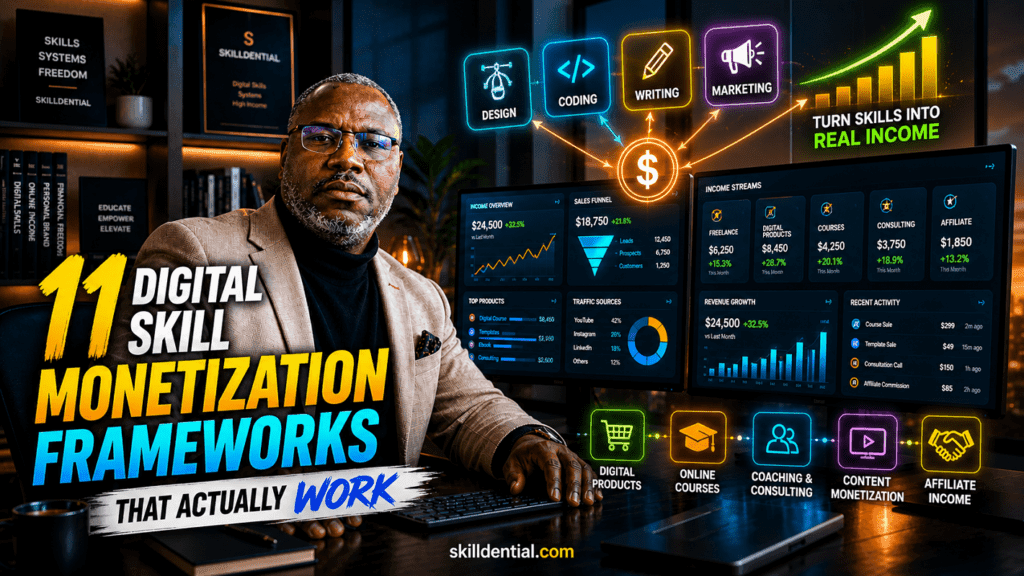
- Input (Skill): The raw technical expertise or specialized knowledge.
- Process (Offer): The transformation of that skill into a structured, market-ready solution.
- Output (Revenue Model): The specific vehicle for capturing value (e.g., recurring subscriptions, high-ticket fees, or unit sales).
By applying first principles, these frameworks move beyond “ad-hoc hustling” to create a repeatable business engine. Instead of seeking “jobs,” you identify the fundamental problem your skill solves, package it into a high-leverage format, and deploy it through optimized distribution channels.
The Value Logic: High-Leverage vs. Linear Gigs
The core objective of a Digital Skill Monetization Framework is to prioritize scalability. While traditional freelancing relies on linear input (1 hour worked = 1 hour billed), a structured framework favors productization.
- Linear Income (Low Leverage): One-off gigs, hourly consulting, and custom projects with high administrative overhead.
- Framework Income (High Leverage): Systems that allow you to build an asset once and sell it indefinitely, or standardize a service to maximize the margin between cost and price.
The 3-Step First Principles Application
| Phase | Action | Objective |
| 1. Identify Value | Isolate the core problem solved by the skill. | Determine the ROI for the end-user. |
| 2. Package the Offer | Choose the format (Course, SaaS, Productized Service). | Structure the delivery for maximum efficiency. |
| 3. Distribute | Select high-signal channels (LinkedIn, SEO, Newsletters). | Ensure predictable reach and lead generation. |
Adopting a Digital Skill Monetization Framework shifts the professional focus from “trading time” to “building systems.” It ensures that every technical skill acquired serves as a component in a larger, scalable revenue engine, providing predictable financial outcomes and industry authority.
The Freelance Pipeline Framework: A Systematic Approach to Scale
The Freelance Pipeline Framework functions by establishing a consistent acquisition engine, then standardizing delivery to transition from sporadic gigs to a predictable business model.
In Skilldential career audits, early earners utilizing these structured pipelines doubled their secured gigs within 90 days compared to those relying on sporadic outreach.
Phase 1: High-Signal Acquisition
The objective is to move away from “waiting for work” and toward a proactive, high-leverage outreach system.
- Step 1: Skill Audit: Identify 1–2 high-demand technical skills (e.g., Figma design or technical writing). Isolate the specific problem these skills solve for the market.
- Step 2: Portfolio Synthesis: Construct exactly 3 case studies. Focus on the “Before vs. After” results rather than just the aesthetic or technical output. This provides the necessary proof of ROI for potential clients.
- Step 3: High-Volume Pitching: Deploy a disciplined outreach strategy via platforms like Upwork or LinkedIn. Target a minimum of 10 pitches per day. Consistency here ensures a healthy lead flow to offset the natural churn of the sales funnel.
Phase 2: From Gigs to Productization
Once the pipeline generates consistent leads, the framework shifts toward Step 4: Productization. This is where you decouple your time from your income to reach higher revenue ceilings (e.g., scaling to $5k/month).
| Feature | Custom Freelancing | Productized Pipeline |
| Pricing | Variable/Hourly | Fixed-price packages (e.g., $500/logo set) |
| Scoping | Infinite/Custom | Strictly defined deliverables |
| Efficiency | Low (New process each time) | High (Repeatable workflows) |
| Revenue Potential | Limited by hours | Scalable via standardized delivery |
Execution Logic
By treating your freelance service as a product, you eliminate the friction of constant negotiation. This Digital Skill Monetization Framework ensures that as your pipeline grows, your operational complexity remains flat, allowing for increased profit margins and sustainable career growth.
11 Digital Skill Monetization Frameworks That Actually Work
To scale beyond linear income, you must transition from “selling services” to “deploying systems.” These 11 Digital Skill Monetization Frameworks represent the highest-leverage strategies for technical professionals to package expertise into predictable, scalable revenue engines. Applying the 80/20 rule, these models prioritize the 20% of activities that drive 80% of long-term wealth, moving you from active
The Productized Service Model
The Productized Service Model is a high-leverage Digital Skill Monetization Framework that treats service delivery like a physical product. By standardizing your technical output into a fixed-price “menu,” you eliminate the friction of custom proposals, scope creep, and unpredictable billing.
Core Mechanics
- Standardized Deliverables: Instead of “custom consulting,” you sell specific outcomes (e.g., “A 5-page SEO-optimized Website” or “A Cloud Architecture Audit”).
- Fixed Pricing: Prices are set upfront based on value and average effort, removing the need for hourly tracking or negotiation.
- Systematized Workflow: Because the output is the same every time, you can build SOPs (Standard Operating Procedures) and use automation tools like n8n or Zapier to handle the 80% of repetitive tasks.
Strategic Advantages
This model is the bridge between freelancing and passive income. It allows for operational automation, where you can eventually hire others to execute the standardized steps, effectively decoupling your personal time from company revenue. In the Skilldential framework, this is the primary method for scaling a technical skill to a six-figure income without increasing your working hours.
High-Ticket Consulting
High-Ticket Consulting is a specialized Digital Skill Monetization Framework that prioritizes depth over breadth. Instead of seeking volume, you leverage deep domain expertise to solve complex, high-stakes problems for clients who value speed, certainty, and specific outcomes.
The ROI-Based Pricing Shift
The fundamental shift in this model is moving away from time-based input (hourly rates) toward ROI-based pricing. You are not being paid for the hours you work, but for the financial or strategic impact of the problem you solve.
- Traditional Billing: $150/hour for “IT Support.”
- High-Ticket Consulting: $15,000 for a “Security Infrastructure Overhaul” that prevents a potential $1M data breach.
Strategic Implementation
- Identify the High-Stakes Problem: Focus on “bleeding neck” issues—problems that are expensive, urgent, or strategically critical for an organization.
- Position as the Authority: Utilize your technical background to provide “diagnostic” value. Much like a surgeon, the value is in the diagnosis and the specialized execution, not the manual labor.
- The “Expert-Advisor” Delivery: Engagement is typically structured as a fixed-term project or a high-value retainer. This allows you to maintain high margins by applying the 80/20 Rule: focusing your efforts on the 20% of strategic interventions that yield 80% of the client’s results.
Scalability through Authority
While this model is less automated than productized services, it offers the highest revenue per hour of input. By solving larger problems, you can achieve significant income targets with only 2–3 active clients, providing the financial runway to build other high-leverage systems within the Skilldential ecosystem.
Paid Newsletter & Insight Feeds
The Paid Newsletter & Insight Feeds framework transforms the “consumption” phase of your professional workflow into a primary revenue driver. By converting your ongoing research, technical experiments, and industry analysis into a structured subscription, you monetize the “high-signal” information that others are too busy to find themselves.
The Information Arbitrage Model
This is a recurring revenue Digital Skill Monetization Framework built on the value of curation and synthesis. Your subscribers pay for the time you save them and the competitive advantage your insights provide.
- Synthesis: Distilling 40 hours of technical documentation or market shifts into a 10-minute briefing.
- Analysis: Moving beyond “what happened” to “why it matters” and “how to profit from it.”
- Consistency: Providing a predictable pulse of intelligence that becomes an essential part of the subscriber’s professional stack.
Strategic Execution
Low Overhead, High Leverage: Unlike services, newsletters scale infinitely with zero marginal cost per new subscriber. Using the 80/20 Rule, your primary input is the research you are likely already doing to stay at the top of your field, making this one of the most efficient ways to build a “scale forever” income stream.
- Identify the Signal: Focus on a niche where information density is high but clarity is low (e.g., Edge AI Orchestration or No-Code Automation for Fintech).
- Tiered Access: Offer a “Freemium” layer to build authority and a “Pro” layer for deep-dive technical breakdowns, templates, or proprietary data.
The “Build in Public” Course
The “Build in Public” Course is a high-leverage Digital Skill Monetization Framework that monetizes the process of creation alongside the result. Instead of developing a product in isolation, you document the architecture, challenges, and technical decisions of a live project, then package that journey into a structured educational asset.
The Validation-First Engine
The core of this framework is the elimination of market risk. By sharing your progress openly (via LinkedIn, X, or a newsletter), you secure audience validation before committing to full-scale production. This ensures the final course has immediate product-market fit.
- Documentation as Content: Your daily technical hurdles and solutions become the marketing material.
- The Beta Feedback Loop: Early interest from your “build” phase provides a pool of beta testers who help refine the curriculum.
- Proof of Competence: Seeing the project come to life in real-time acts as an undeniable testimonial of your technical authority.
Strategic Implementation
- Select a High-Signal Project: Choose a build that solves a specific problem or utilizes a trending stack (e.g., Deploying an AI Agent on Vercel).
- Capture the “Messy Middle”: Do not just show the finished code. The value lies in the “how-to”—the debugging, the pivots, and the architectural trade-offs.
- Package for Scale: Once the project is complete, reorganize the documentation into a MECE (Mutually Exclusive, Collectively Exhaustive) curriculum.
Economic Impact
This model exemplifies the “Build Once, Scale Forever” philosophy of Skilldential. Once the course is recorded and hosted, the marginal cost of a new student is near zero, while the 40–70% margins typical of digital products provide the capital needed to fund further technical innovation.
Micro-SaaS Development
Micro-SaaS Development is a “build once, scale forever” Digital Skill Monetization Framework focused on solving a single, hyper-specific problem within a niche workflow. Unlike venture-backed startups, Micro-SaaS aims for lean operations, high margins, and recurring revenue with minimal churn.
The Niche-Pain Protocol
The success of this model relies on finding a “boring” but recurring technical friction point. Instead of building a general project management tool, you build a “Markdown-to-Shopify formatter” or a “Specific API Connector for Real Estate Agents.”
- Identify the Friction: Look for manual tasks that take 30+ minutes daily for a specific professional group.
- Build the “Lean” Solution: Develop the Minimum Viable Product (MVP) using a focused tech stack (e.g., Python, Node.js, or No-Code tools) to solve that one problem perfectly.
- Recurring Revenue: Implement a subscription-based model. Even a $20/month tool with 100 users creates a $2,000/month stable income stream with near-zero marginal costs.
Strategic Advantages
Exit Potential: These assets are highly liquid. A stable Micro-SaaS with proven recurring revenue can often be sold on marketplaces like Acquire.com for 3x–5x its annual profit, providing a significant capital injection for your next high-leverage project.
- Low Maintenance: By limiting the feature set, you reduce the technical debt and support tickets typical of complex software.
- Platform Arbitrage: Many successful Micro-SaaS products are built as plugins or extensions for existing ecosystems (e.g., Chrome Store, Shopify App Store, or Slack), leveraging their built-in distribution.
Tiered Membership Communities
The Tiered Membership Communities framework is a high-leverage Digital Skill Monetization Framework that shifts the value proposition from “individual output” to “collective intelligence.” By creating a structured environment where members access your expertise, exclusive assets, and each other, you build a scalable revenue stream that decouples your income from your personal billable hours.
The Community-as-a-Service (CaaS) Model
In this model, your primary role transitions from a service provider to a curator and facilitator. The community becomes an asset that grows in value as more members join, creating a “network effect” where the members themselves contribute to the retention and satisfaction of others.
- Tier 1: Access & Content (The Base): Provides entry-level access to a library of technical resources, pre-recorded workshops, or a community forum.
- Tier 2: Tools & Templates (The Value-Add): Includes everything in Tier 1 plus exclusive technical assets—such as n8n automation workflows, Figma templates, or proprietary code snippets—that save members time.
- Tier 3: Direct Access & Mastermind (The Premium): Features high-touch interaction, such as monthly group coaching, live technical audits, or exclusive networking opportunities with industry peers.
Strategic Implementation
- Identify the Shared Goal: A community thrives on a specific outcome (e.g., “Mastering Edge AI for Career Growth” or “Scaling a Freelance Design Agency”).
- Select the Tech Stack: Use platforms that support gated content and community interaction (e.g., Circle, Skool, or a custom Discord/Slack integration).
- Prioritize High-Leverage Engagement: Use the 80/20 Rule to manage your time. Instead of answering every question individually, host a single weekly “Office Hours” session that provides value to the entire group at once.
Scalability and Retention
Unlike one-off products, tiered memberships generate recurring revenue, providing the predictable cash flow necessary to scale a professional ecosystem. In the Skilldential philosophy, this is the ultimate “Build Once, Scale Forever” model because the infrastructure remains the same whether you have 100 or 1,000 members, while the profit margins increase as the community matures.
Technical Content Licensing
Technical Content Licensing is a high-margin Digital Skill Monetization Framework that treats your expertise as intellectual property (IP). Instead of selling your time to build a solution for one client, you build a high-value technical asset once and sell the right to use it to multiple organizations or creators.
The IP Arbitrage Model
This framework focuses on creating “plug-and-play” value. You identify a common technical hurdle and build a comprehensive solution that an organization can buy for a fraction of the cost of developing it in-house.
- Code Snippets & Libraries: Developing specialized, well-documented scripts (e.g., custom n8n nodes or advanced React components) that developers can integrate into their own projects.
- Infrastructure Templates: Creating “Architecture as Code” (Terraform, CloudFormation) or advanced workflow templates that provide an instant technical foundation.
- White Papers & Proprietary Research: Licensing deep-dive technical reports or market analyses to companies for use in their own marketing or strategic planning.
Strategic Implementation
- Develop the “Gold Standard”: Your asset must be significantly better, faster, or more compliant than what a mid-level engineer could produce quickly.
- Define the License Terms: Structure your offers based on usage—e.g., a “Single-Site License” versus an “Enterprise/White-Label License.”
- Target High-Leverage Buyers: Focus on agencies, startups, or content creators who have the distribution but lack the deep technical “Lego blocks” to complete their offerings.
Scalability and Leverage
Licensing represents the ultimate 80/20 win: 80% of the effort goes into the initial creation, while 100% of the subsequent sales are pure profit with zero marginal cost. In the Skilldential ecosystem, this allows a technical professional to act as an “arms dealer” for an entire industry, providing the tools others need to succeed while maintaining full ownership of the underlying IP.
Outcome-Based Coaching
Outcome-Based Coaching is a high-signal Digital Skill Monetization Framework that replaces the “pay-for-time” model with a “pay-for-results” architecture. Instead of selling hourly sessions, you sell a specific, measurable transformation—such as transitioning from a Junior to a Senior Developer or mastering a specific technical stack to land a high-paying role.
The Value-Transformation Logic
In this model, the pricing is decoupled from the hours spent coaching and is instead pegged to the “Before vs. After” value provided to the client. This aligns your incentives with the client’s success and allows for significantly higher margins than traditional tutoring.
- Linear Coaching: “I charge $50 per hour to teach you Python.” (Low leverage, price-sensitive).
- Outcome-Based Coaching: “I will help you build a production-ready AI portfolio and land a $100k+ role in 12 weeks.” (High leverage, value-driven).
Strategic Implementation
- Define the “Point B”: Be hyper-specific about the transformation. Broad coaching fails; specific outcomes (e.g., “Passing the AWS Solutions Architect Exam”) command premium prices.
- Productize the Curriculum: Use a MECE (Mutually Exclusive, Collectively Exhaustive) framework to create a roadmap that clients follow. This reduces the need for custom prep for every session.
- The 80/20 Engagement Rule: Focus 80% of your live interaction on the 20% of psychological or technical “bottlenecks” that stop progress. Use pre-recorded technical drills to handle the foundational teaching.
Scalability through Results
While coaching requires more active input than a digital product, the high price point (often $2,000–$10,000 per program) provides massive leverage. By documenting these successes, you build the technical authority and case studies necessary to eventually transition into lower-touch models like Tiered Membership Communities or the “Build in Public” Course.
Affiliate & Tool Orchestration
Affiliate & Tool Orchestration is a high-leverage Digital Skill Monetization Framework that monetizes the infrastructure of your expertise. Instead of charging for your time or a specific deliverable, you monetize the recommendation and implementation of the tools required to execute a high-value workflow.
The Ecosystem Logic
This model thrives on the complexity of modern tech stacks. Professionals and businesses are often overwhelmed by the sheer volume of available tools (e.g., No-Code AI, Cloud Infrastructure, or CRM automation). You provide value by “orchestrating” these tools into a functional system.
- Build the Blueprint: Create a high-performance workflow using a specific stack (e.g., n8n + Pinecone + OpenAI for automated customer support).
- Monetize the Stack: When users adopt your blueprint, they sign up for the underlying tools via your affiliate links, creating a recurring, passive commission stream.
- The Multiplier Effect: One successful workflow can generate income from 3–5 different SaaS tools simultaneously.
Strategic Implementation
- Select a High-Signal Toolstack: Focus on tools with recurring affiliate programs and high “stickiness” (tools that users are unlikely to cancel once integrated into their business).
- Publish Implementation Guides: Create “how-to” content, templates, or technical teardowns that demonstrate exactly how to replicate your success using the specific stack.
- Combine with Productization: Offer the workflow template for free or at a low cost to drive high-volume adoption of the affiliate links.
Leverage and Passive Growth
This framework exemplifies the Skilldential “Build Once, Scale Forever” philosophy. Once the technical documentation and workflows are live, they act as 24/7 sales engines. As the tools in your stack grow in popularity, your income scales automatically without any additional technical input or client management.
The Workshop Sprint
The Workshop Sprint is a high-velocity Digital Skill Monetization Framework designed to maximize revenue density by solving a single, acute technical problem in a compressed timeframe (typically 2–4 hours). This model transitions you from 1-on-1 consulting to a “one-to-many” delivery system, significantly increasing your hourly rate.
The “Single-Problem” Logic
The success of a sprint depends on hyper-specificity. While a course covers a broad domain, a workshop delivers a specific “win.”
- Broad Focus (Low Conversion): “How to use AI for business.”
- Sprint Focus (High Conversion): “Building a Custom AI Chatbot for Customer Support in 180 Minutes.”
Strategic Implementation
- Isolate the Bottleneck: Identify a technical task that is high-value but creates friction for your target audience (e.g., setting up a CI/CD Pipeline or Configuring Advanced Schema for WordPress).
- The “Done-With-You” Format: Structure the session so participants follow along in real-time. The value is not just the information, but the completion of the task by the end of the sprint.
- High-Leverage Pricing: Price the sprint as a premium event ($100–$500 per seat). With 20 participants, a single 3-hour session can generate $2,000–$10,000.
Synergy with the Skilldential Ecosystem
The Workshop Sprint serves as a powerful “lead magnet” for higher-ticket offers. It provides immediate proof of your technical authority and allows you to identify participants who may need more intensive solutions, such as Outcome-Based Coaching or High-Ticket Consulting.
By recording the session, you also create a technical asset that can be repurposed into the “Build in Public” Course or a Tiered Membership resource.
White-Label Implementation
White-Label Implementation is an “invisible” Digital Skill Monetization Framework that positions you as the technical engine for other businesses. You develop a specialized, high-performance workflow and sell it to agencies or consultancies, who then rebrand the service and sell it to their own client base as their own.
The “Scale through Others” Logic
This model allows you to focus exclusively on technical excellence while outsourcing the high-overhead activities of sales, account management, and client support to your partners. You are essentially the “manufacturer” of a technical service.
- The Workflow: You build a high-leverage system (e.g., A 24-hour Technical SEO Audit or an Automated n8n Lead-Scoring Engine).
- The Partnership: Agencies buy this system from you at a wholesale rate (e.g., $500 per audit).
- The Arbitrage: The agency sells it to their client at a retail rate (e.g., $1,500), keeping the margin for managing the relationship.
Strategic Implementation
- Identify Agency Bottlenecks: Target services that agencies struggle to fulfill profitably or lack the specialized technical talent to execute in-house.
- Standardize the “Black Box”: Create a predictable, repeatable process where the agency sends you inputs and you return a polished, “ready-to-present” output.
- Prioritize Efficiency: Use the 80/20 Rule to automate as much of the fulfillment as possible. The more you automate, the higher your profit margin on each wholesale unit sold.
Leverage and Stability
In the Skilldential ecosystem, White-Label Implementation provides significant stability through volume. While individual clients may come and go, a partnership with a single agency can provide a consistent stream of 10–20 projects per month.
This allows you to scale your revenue to high levels with zero public-facing marketing or personal brand overhead, focusing entirely on “building once and scaling forever” through existing distribution networks.
Execution Strategy: Implementing Your Digital Skill Monetization Framework
To transition from active labor to a scalable income engine, implementation must be disciplined and analytical. Use the following high-leverage steps to deploy your framework with maximum efficiency.
The 80/20 Skill Audit
Identify the 20% of your technical skills that generate 80% of your market value.
- Deconstruct: List your core competencies (e.g., Python, technical writing, API orchestration).
- Value Mapping: Cross-reference these skills against market demand and “pain point” intensity.
- Focus: Eliminate low-margin activities and double down on the skill that solves high-stakes problems.
Build Once, Scale Indefinitely
Prioritize frameworks that allow for asset decoupling. Every hour of input should generate a compounding return on your technical authority.
- Productize Early: Even if you start with the Freelance Pipeline, move toward fixed-price packages immediately to standardize your operations.
- Capture Intellectual Property: Document your workflows to create templates, code snippets, or SOPs that can be sold via Technical Content Licensing or White-Label Implementation.
- Automate Delivery: Use technical orchestration (n8n, Python scripts, or specialized SaaS) to handle the execution, leaving you to focus on strategy and architecture.
The Skilldential Success Roadmap
A systematic approach ensures predictable results rather than ad-hoc success.
| Phase | Action | Framework Alignment |
| Validation | Pitching and Portfolio Building | Freelance Pipeline |
| Standardization | Creating fixed-price menus | Productized Service Model |
| Leverage | Creating one-to-many assets | “Build in Public” Course / Micro-SaaS |
| Authority | High-level strategic solving | High-Ticket Consulting / Paid Newsletters |
Continuous Optimization
Your framework is a living system. Regularly audit your conversion rates and client feedback to refine your “Process” (Offer). By ensuring your Digital Skill Monetization Framework remains lean and focused on high-leverage outputs, you ensure long-term industry success and career growth that scales forever.
How the Productized Service Framework Monetizes Skills
The Productized Service Framework functions by converting abstract expertise into tangible, fixed-scope packages. This structural shift eliminates “scope creep”—the primary profit-killer in traditional services—by defining exactly what is delivered and exactly what it costs before the engagement begins.
The Mechanics of Productization
Instead of selling “consulting hours,” you sell a specific outcome with standardized deliverables.
- Example: A generalist SEO consultant might charge $100/hour for “SEO work.” A productized professional sells an “SEO Audit Kit” for $997, consisting of exactly 5 specific deliverables (e.g., Keyword Gap Analysis, Technical Site Audit, and a 3-month Content Roadmap).
- Pricing Structure: Implement 3 tiers (Basic / Pro / Enterprise) to anchor value. This allows clients to self-select their level of investment based on their needs rather than negotiating your hourly rate.
- Delivery Model: Efficiency is achieved by using templates and SOPs (Standard Operating Procedures) for 90% of the work, followed by a single high-leverage strategy call.
Economic Impact and Scaling
The financial leverage of this model is significant. By standardizing the “process” phase of the Digital Skill Monetization Framework, you increase your effective hourly rate through speed and repetition.
- Revenue Multiplier: Data suggests this model can yield 4x the income of traditional hourly rates [Source: ConvertKit Creator Economy Report].
- Breaking the Plateau: In the Skilldential ecosystem, we frequently see technical freelancers who were previously plateaued at $2k/month reach $8k/month by shifting to this model.
Core Benefits
| Feature | Impact on Monetization |
| No Scope Creep | Fixed deliverables ensure profit margins remain protected. |
| Operational Automation | Standardized tasks can be outsourced or automated with code. |
| Client Clarity | Predictable costs and outcomes lead to higher conversion and faster closing. |
By treating your skill as a product, you ensure that every engagement is a repeatable high-margin transaction, allowing you to build once and scale your income indefinitely.
What Makes the Content-to-Consulting Framework Scalable?
The Content-to-Consulting Framework is a high-leverage model that utilizes “educational proof” to bypass traditional sales friction. By creating free, high-signal content that demonstrates your technical competence, you transform passive viewers into high-ticket leads without active prospecting.
The Content-to-Commerce Flow
This framework functions as an automated marketing funnel. Instead of cold pitching, you use “skill demos” to provide immediate value, which builds the trust necessary for high-ticket transactions.
- Distribution (Top of Funnel): Post technical tutorials or project walkthroughs on platforms like YouTube or TikTok.
- Capture (Middle of Funnel): Direct viewers to a specialized email list or a “lead magnet” (e.g., a free automation template).
- Monetization (Bottom of Funnel): Convert the warmest leads into $2,000/month consulting retainers.
Conversion Logic and Revenue Impact
The scalability of this model lies in the “one-to-many” nature of digital content. While your consulting time is limited, your lead generation is infinite.
- Predictable Conversion: Even with a modest 5% booking rate from high-intent viewers, a single viral technical video can fill a consulting roster for months.
- Passive Lead Generation: Aspiring solopreneurs within the Skilldential ecosystem often secure $3,000/month in passive leads simply by letting their content act as a 24/7 sales representative.
The MECE Efficiency Split
To maintain this framework without burnout, apply a disciplined allocation of resources:
| Category | Allocation | Primary Objective |
| Content Production | 80% | Building technical authority and “compound” visibility. |
| Sales/Closing | 20% | Finalizing high-ticket agreements and scoping transformations. |
Strategic Advantage
The primary benefit of Content-to-Consulting is pre-qualification. By the time a lead reaches a discovery call, they have already validated your expertise through your content. This reduces the sales cycle and allows you to maintain high margins by solving the 20% of complex problems that your audience cannot solve with the free content alone.
How Digital Product Ladders Generate Passive Income
The Digital Product Ladder is a high-leverage architecture that monetizes a single technical skill across multiple price points. This allows you to capture value from a broad audience by offering various levels of depth, support, and implementation speed.
The Stacking Logic
Instead of building isolated products, you “stack” assets that lead into one another. This creates a natural upsell path through automated email sequences, maximizing the Lifetime Value (LTV) of every lead.
- Entry Level (The Template – $27): A low-friction tool that solves a single technical micro-problem (e.g., a specific Python script or an n8n workflow template).
- Intermediate Level (The Course – $197): A self-paced curriculum that teaches the “how” and “why” behind the skill (e.g., Mastering Automation Logic).
- Premium Level (The Cohort – $997): A high-touch, structured program that provides community and direct expert feedback to ensure the transformation is achieved.
Economic Performance
The efficiency of the ladder model stems from near-zero marginal costs. Once the assets are built, margins often hit 90% [Source: Gumroad Metrics]. For technical professionals, this represents the fastest path to testing an MVP (Minimum Viable Product), with many beginners launching a Tier 1 template in 7 days to validate market interest before building higher tiers.
Freelance Pipeline vs. Productized Services: Decision Matrix
To optimize your career growth, you must choose the model that aligns with your current resources and long-term leverage goals.
| Criterion | Freelance Pipeline | Productized Services |
| Setup Time | 1 week | 2–4 weeks |
| Income Predictability | Medium (client-dependent) | High (fixed pricing) |
| Scalability | 1:1 time trade | 1:many via templates |
| Revenue Potential | $3k–$10k/month | $10k–$50k/month |
| Best For | Early earners | Plateaued freelancers |
Strategic Selection
- Choose the Freelance Pipeline if you have immediate time availability and need to generate cash flow quickly through active labor and 1-on-1 relationships.
- Choose Productized Services if you have established expertise and want to move toward leverage, allowing you to decouple your income from the hours worked.
Summary of Strategic Intent
By integrating these frameworks into the Skilldential ecosystem, you ensure every hour of input generates a compounding return. Whether through a Product Ladder or a Productized Service, the goal remains constant: build the technical system once and scale the financial results indefinitely.
How the Affiliate Skill Stacking Framework Works
The Affiliate Skill Stacking Framework is a low-barrier Digital Skill Monetization Framework that combines educational value with tool orchestration. Instead of charging only for your knowledge, you monetize the “stack” required to execute that knowledge. This allows you to generate both immediate front-end revenue and long-term, recurring back-end commissions.
The Synergy Model
This framework operates on the principle that technical skills are useless without the tools to implement them. By teaching a specific workflow and recommending the best-in-class tools to power it, you become the trusted curator of a member’s professional infrastructure.
- The Skill: Teach a high-demand, focused outcome (e.g., “No-Code Marketing Automation”).
- The Stack: Bundle the teaching with specific tool recommendations like Carrd for landing pages or Airtable for databases.
- The Revenue Engine: Earn $1,000 from the course or workshop sales while simultaneously building a $500/month recurring stream via 30% affiliate commissions.
Implementation for Career Growth
This model is particularly high-leverage for career switchers or those entering the Nigerian tech market, as it allows for income generation before securing a traditional full-time role.
- Low Barrier to Entry: You only need mastery of one skill and proficiency in one tool to launch.
- The Newsletter Catalyst: Use a niche newsletter to share technical teardowns and “How-I-Built-This” guides. Every tool mentioned becomes a potential affiliate touchpoint.
- Compounding Returns: Unlike a one-time service fee, affiliate commissions scale as your audience grows, providing the “build once, scale forever” stability central to the Skilldential philosophy.
Comparison: Skill Stacking vs. Pure Consulting
| Feature | Pure Consulting | Affiliate Skill Stacking |
| Primary Revenue | Hourly Rate / Project Fee | Course Fee + Recurring Commissions |
| Scalability | Linear (Limited by hours) | Exponential (Tools scale with users) |
| Passive Potential | Low | High (Commissions continue post-teaching) |
| Market Barrier | High (Requires a deep portfolio) | Low (Requires one effective workflow) |
Strategic Execution
- Select “Sticky” Tools: Prioritize tools that users are unlikely to cancel (e.g., email service providers, CRMs, or hosting).
- Transparent Integration: Always disclose affiliate relationships to maintain high-signal trust with your audience.
- Create “Plug-and-Play” Templates: Increase the affiliate conversion rate by providing pre-built templates that only work within the recommended toolstack.
What Is the Micro-Course Framework for Creators?
The Micro-Course Framework is a high-velocity Digital Skill Monetization Framework that prioritizes speed-to-market and hyper-specific problem-solving. Unlike comprehensive masterclasses that take months to produce, a micro-course targets a single “micro-win” that can be consumed and implemented in under an hour.
The Architecture of a Micro-Win
The goal is to eliminate fluff and deliver the “80/20” of a technical skill. This creates a low-friction entry point for your audience and a high-margin asset for your portfolio.
- The Deliverable: A concentrated 30-minute video (focused on execution, not theory) paired with a practical workbook or technical cheat sheet.
- Price Point: Positioned at $47—a “no-brainer” price that bypasses the need for high-pressure sales calls or long email sequences.
- Infrastructure: Host the assets on streamlined platforms like Gumroad or Teachable to minimize technical overhead and automate delivery.
The Validation and Launch Loop
To ensure product-market fit, this framework utilizes “Social Validation” before a single minute of video is recorded.
- Poll for Demand: Use X or TikTok polls to let your audience choose between two specific technical problems (e.g., “Automating LinkedIn Leads” vs. “Building a Personal Portfolio in 30 Minutes”).
- Build the Solution: Once a winner is identified, record the session in one take to maintain high-energy, high-signal delivery.
- Iterative Revenue: Successful solopreneurs within the Skilldential ecosystem can generate $2,000/month from a single micro-course. Because the production cost is so low, this process is repeatable weekly, allowing you to build a library of assets that cover an entire technical niche.
Efficiency Metrics: Micro-Course vs. Full Masterclass
| Metric | Micro-Course | Full Masterclass |
| Production Time | 4–8 Hours | 40–100+ Hours |
| Market Risk | Low (Validated via Polls) | High (Months of silent build) |
| Sales Friction | Low ($47 impulse buy) | High ($500+ investment) |
| Scalability | High (Stackable weekly) | Medium (High maintenance) |
Strategic Execution
The Micro-Course is the ultimate “First Principles” monetization tool. It allows you to build technical authority in real-time while generating the cash flow necessary to fund more complex projects like Micro-SaaS Development or Outcome-Based Coaching.
How Does the Agency Handover Framework Scale Freelancers?
The Agency Handover Framework is a transition-focused Digital Skill Monetization Framework that converts a soloist’s workflow into a managed production line. This model allows you to break the “time-for-money” ceiling by training junior talent to execute your high-signal processes while you shift focus to sales, strategy, and quality assurance.
The “Middleman” Arbitrage Logic
In this model, you act as the bridge between “Retail” client pricing and “Wholesale” fulfillment costs. By systemizing your expertise into repeatable steps, you can delegate 80% of the labor while retaining a significant portion of the margin.
- Systemize (The SOP Engine): Before hiring, you must deconstruct your service into Standard Operating Procedures (SOPs). If a process cannot be explained in a 5-minute Loom video or a checklist, it cannot be handed over.
- The 50% Cut: You charge the client your premium rate (e.g., $100/hr) and pay a junior contractor a fair but lower rate (e.g., $10/hr–$25/hr via platforms like Upwork or locally in Nigeria).
- The Scalability Shift: Plateaued freelancers who hit a ceiling at $2,000/month often triple their output and reach $20,000/month by managing three or four juniors simultaneously.
Strategic Implementation Steps
- Isolate the High-Value Action: Identify the 20% of the project that requires your expert eye (strategy, final review) and delegate the rest.
- The “Checklist” Defense: Mitigate the risk of quality drop-off by implementing mandatory Quality Control (QC) checklists. The junior cannot submit work to the client until every box is ticked.
- The Seamless Handover: Present the junior as your “Project Manager” or “Technical Associate.” The client still pays for the Skilldential standard of excellence, but you are no longer the one doing the manual typing.
Efficiency Comparison: Solo vs. Agency Handover
| Metric | Solo Freelancer | Agency Handover |
| Primary Activity | Execution (Writing/Coding) | Orchestration & Sales |
| Income Ceiling | Limited by personal hours | Scalable by headcount |
| Output Quality | Inconsistent (Burnout risk) | Consistent (System-driven) |
| Risk Factor | Health/Burnout = $0 Income | Management/Quality Control |
Strategic Leverage
The Agency Handover Framework is the ultimate fulfillment of the “Build Once, Scale Forever” philosophy. Once your SOPs are robust and your hiring pipeline is active, the agency becomes a self-sustaining asset. You move from being a “worker” in the business to being the “architect” of a technical engine that generates high-leverage income with minimal active input.
What Makes the Template Marketplace Framework Beginner-Friendly?
The Template Marketplace Framework is the most accessible entry point for the Digital Skill Monetization Framework because it requires zero upfront capital and minimal technical complexity. It focuses on packaging “recurring utility”—tools that others use daily—into a downloadable format that generates revenue every time it is purchased.
The Low-Barrier Architecture
This model succeeds because it leverages existing user bases on established platforms. You do not need to build an audience from scratch; you simply “insert” your product where people are already searching for solutions.
- The Assets: Package design skills into Canva templates (social media kits, brand boards) or organizational skills into Notion templates (project trackers, second brains).
- The Price Point: Positioned as a “micro-investment” ($10–$50). This low price point triggers impulse buys and reduces the need for complex sales funnels.
- The Distribution: Utilize high-intent search engines like Etsy or visual discovery engines like Pinterest to drive consistent volume. 100 sales a month at $20 creates a reliable $2,000/month baseline.
The “MVP in 24 Hours” Protocol
For beginners, the primary hurdle is often “analysis paralysis.” This framework enforces speed through its simplicity.
- Select One Niche: Identify a specific user group (e.g., “Real Estate Agents” or “Freelance Copywriters”).
- Create One MVP: Build a single, high-utility template that solves one problem (e.g., a “Client Onboarding Portal in Notion”).
- Launch Free-to-Paid: Offer a basic version for free to gather reviews and “social proof,” then upsell to a premium version.
Efficiency Metrics: Template Marketplace vs. Custom Services
| Metric | Template Marketplace | Custom Freelance Services |
| Setup Cost | $0 (Start Free) | High (Software/Marketing) |
| Fulfillment | 100% Automated | 100% Manual Labor |
| Sales Volume | High (100+ units/mo) | Low (1–5 clients/mo) |
| Technical Barrier | Low (Basic tool mastery) | High (Expert-level execution) |
Scaling to Passive Income
Once a template is live on Gumroad or Etsy, it becomes a permanent digital asset. In the Skilldential philosophy, this is the “Level 1” of building once and scaling forever. While one template provides a small stream, a “Template Suite” of 10–20 assets creates a compounding income engine that operates entirely in the background, allowing you to focus on higher-leverage projects like Technical Content Licensing or Micro-SaaS.
How Cohort-Based Consulting Frameworks Command Premiums
The Cohort-Based Consulting (CBC) Framework represents the high-water mark of educational leverage. It combines the scalability of a digital course with the high-intent results of 1-on-1 consulting. By grouping 5–10 clients into a synchronized, 8-week bootcamp, you create a high-pressure, high-support environment that justifies a premium price point (typically $1,500+ per seat).
The Psychology of the Premium
CBCs command higher fees than self-paced courses because they solve the primary failure point of online learning: completion rates.
- Peer Accountability: The group dynamic creates “social friction” against quitting. Participants are paying for the community and the expert’s direct attention, not just the information.
- Synchronous Delivery: Weekly live sessions on platforms like Discord or Zoom allow for real-time troubleshooting, which is high-signal value that static videos cannot replicate.
- Scarcity and Urgency: By running cohorts only 2–3 times a year, you leverage natural market scarcity to drive 20% conversion rates among warm audiences [Source: Maven Analytics].
The “Lifetime Value” (LTV) Multiplier
The CBC is rarely the end of the customer journey. In the Skilldential ecosystem, it serves as a massive qualifier for future high-ticket engagements.
- Alumni Upsells: Graduates of a bootcamp often hit new technical ceilings. You can offer a “Phase 2” advanced cohort or move them into Outcome-Based Coaching at a 3x price multiplier.
- The Referral Engine: Because cohorts produce measurable “Before vs. After” transformations, alumni become your highest-converting sales force through word-of-mouth.
Efficiency Comparison: Self-Paced vs. Cohort-Based
| Metric | Self-Paced Course | Cohort-Based Consulting |
| Average Price | $50–$200 | $1,500–$5,000 |
| Completion Rate | 5%–10% | 70%–90% |
| Fulfillment Style | Passive (Record once) | Active (Live sessions) |
| Profit Margin | 95% (Post-marketing) | 80% (Higher ops/support) |
Strategic Execution for Solopreneurs
To launch a CBC without operational burnout, follow this MECE structure:
- Curriculum (20%): Standardize your “core” technical drills into pre-recorded videos to save live time.
- Implementation (60%): Spend the bulk of the 8 weeks on “Live Audits,” where you review the clients’ work in front of the group.
- Community (20%): Facilitate peer-to-peer support in Discord to reduce your personal support load.
This framework allows you to generate $7,500–$15,000 in a single 8-week window while building deep technical authority. It turns your consulting practice into a repeatable, high-leverage event that compounds in value with every successful graduate.
What Is the Newsletter-to-Offers Framework?
The Newsletter-to-Offers Framework is a high-leverage Digital Skill Monetization Framework that centralizes your technical authority in a platform you own. Unlike social media algorithms, a newsletter provides a direct, uninterrupted line to your audience, allowing you to build deep trust through consistent “technical compounding.”
The Authority-Building Cadence
This framework operates on a “Value-First” rhythm. You provide free, high-signal education that solves small problems, which naturally segments your audience for paid solutions that solve larger problems.
- The Content (Weekly Tips): Deliver high-leverage technical insights, industry teardowns, or “80/20” skill guides. This establishes you as an expert in your niche (e.g., “The Python Automation Weekly”).
- The Monetization (Monthly Offers): Every 4 weeks, introduce a specialized, $97 digital product or workshop that provides a deeper dive into a topic covered in the free tips.
- Infrastructure: Utilize specialized platforms like Beehiiv or Substack to handle distribution, subscriptions, and analytics with minimal technical friction.
The 80/20 Revenue Logic
In the Skilldential ecosystem, we observe a consistent power-law distribution in newsletter monetization: 20% of your most engaged subscribers will generate 80% of your total revenue.
- Recurring Baseline: Early earners often hit a $1,000/month recurring baseline by maintaining a small but high-intent list of 500–1,000 subscribers.
- High-Leverage Scaling: As the list grows, the cost of sending an email remains zero, but the revenue potential scales exponentially. A single email sent to 10,000 people can generate $10k+ in a weekend.
Efficiency Metrics: Newsletter vs. Social Media Monetization
| Metric | Newsletter (Owned) | Social Media (Rented) |
| Reach Predictability | High (Direct Inbox) | Low (Algorithm-dependent) |
| Relationship Depth | High (Long-form) | Low (Short-form/Transient) |
| Conversion Rate | 2%–5% (High intent) | <1% (Passive browsing) |
| Asset Value | High (Exportable list) | Low (Platform-locked) |
Strategic Implementation for Technical Experts
To maintain the “Build Once, Scale Forever” philosophy, use the following execution protocol:
- Lead Magnet: Create a one-page technical “Cheat Sheet” or “SOP” that visitors get in exchange for their email. This ensures you only attract high-signal subscribers.
- Automated Welcome Sequence: Set up a 5-email sequence that delivers your best “evergreen” content automatically to every new subscriber. This builds authority while you sleep.
- Low-Friction Offers: Focus on “digital assets” (templates, micro-courses, or checklists) that require zero manual fulfillment once purchased.
This framework transforms your technical knowledge into a Liquid Asset. By owning the distribution, you ensure that your career and income are no longer dependent on third-party platforms, providing the ultimate stability for long-term industry success.
How the Open-Source Sponsorship Framework Works for Coders
The Open-Source Sponsorship Framework is a high-leverage Digital Skill Monetization Framework that converts public technical contributions into recurring financial support. Instead of selling a closed product, you release valuable code to the community and monetize the “gratitude and utility” of the users who rely on it.
The Public Validation Logic
For coders, especially those in the Nigerian tech market or career switchers, this model serves as a dual-purpose engine: it builds a verifiable technical portfolio while simultaneously generating income.
- The Asset: Release specialized tools or libraries on platforms like GitHub (e.g., Python scripts for automated marketing or custom CSS frameworks).
- The Monetization: Integrate frictionless donation layers such as GitHub Sponsors, BuyMeACoffee, or Patreon.
- The Income Stream: Successful maintainers typically see $500 to $5,000/month in donations. While not a “sale,” this recurring support acts as a “Social Salary” for maintaining the tool.
The “Low-Effort” Post-Build Scaling
This framework aligns with the Skilldential “Build Once, Scale Forever” philosophy by utilizing the global developer community for distribution.
- Solve a Personal Friction Point: Build a script that solves a common problem (e.g., a tool that cleans messy CSV data for non-technical marketers).
- Document for Adoption: Write high-signal README files that make it easy for others to use and contribute.
- Passive Maintenance: Once the code is stable, the primary “work” is reviewing community pull requests. The tool continues to solve problems for new users 24/7, driving continuous sponsorship traffic.
Efficiency Comparison: Proprietary Software vs. Open-Source Sponsorship
| Metric | Proprietary (SaaS/Paid) | Open-Source Sponsorship |
| Sales Friction | High (Paywalls/Invoicing) | Low (Voluntary/Gratitude) |
| Marketing | Active (Ads/Outreach) | Organic (GitHub Discovery/Stars) |
| Skill Validation | Private/Hidden | Public/Verifiable |
| Income Type | Transactional | Recurring Donation |
Strategic Advantage for Career Switchers
The Open-Source Sponsorship model is the ultimate “Proof of Work.”
- Zero-Cost MVP: You do not need a business license or a complex payment gateway to start.
- Network Effects: Every “Star” or “Fork” on GitHub increases your technical authority, often leading to High-Ticket Consulting or job offers from companies that use your tools.
- MECE Split: Focus 90% of your effort on solving a high-value technical problem and 10% on setting up the sponsorship “call-to-action” within your repository.
By making your code “public infrastructure,” you ensure that your technical output generates compounding returns in both reputation and revenue.
Digital Skill Monetization Framework FAQs
The following FAQ addresses the core logic and performance benchmarks of high-leverage monetization systems. These insights are designed for technical professionals prioritizing Industry Standard Rigor and Actionable Depth.
What defines a successful Digital Skill Monetization Framework?
A successful framework delivers repeatable revenue from technical skills via validated offers and scalable delivery systems. Success is measured by the ability to decouple income from active labor.
KPIs: It must achieve a positive ROI within 90 days.
Benchmarks: Target 30%+ profit margins and 2x growth quarterly
Can beginners use Digital Skill Monetization Frameworks?
Yes, provided they apply the 80/20 Rule to validation.
Validate: Prove the demand for one specific skill via free, high-signal content or a small project.
Sequencing: Start with the Freelance Pipeline to generate immediate cash flow.
Constraint: Avoid overcomplicating infrastructure (e.g., complex automation or multi-tier funnels) until you consistently generate $1,000/month.
What is the ROI timeline for these frameworks?
The timeline varies based on the “Time-to-Market” of the chosen model:
Freelance/Consulting: Typically yields first income in 2–4 weeks.
Digital Products/Micro-Courses: Typically yield first income in 4–8 weeks.
Scaling: Full system optimization and compounding growth require a minimum of 3 months of iteration based on market feedback
How do Digital Skill Monetization Frameworks differ from gigs?
The distinction lies in Systemization versus Transaction.
Gigs: One-off, manual tasks (e.g., “Fix this bug”). They require constant active labor and provide no long-term leverage.
Frameworks: Systematize expertise for recurrence (e.g., “Monthly Security Maintenance Package”). Frameworks emphasize Productization, Automation, and Asset Creation, ensuring the work done today pays dividends indefinitely.
Which framework suits low-time commitments?
For professionals with limited bandwidth, the focus should be on Low-Maintenance Assets:
Template Marketplaces: Requires a 10–20 hour setup to build the initial library; generates passive income via search traffic on platforms like Etsy or Notion.
Affiliate Skill Stacking: Once the “Skill + Tool” workflow is documented and published, the recurring commissions require minimal monthly maintenance.
In Conclusion
To maximize technical career growth, move beyond one-off transactions and transition into a Digital Skill Monetization Framework that prioritizes leverage over labor.
Strategic Summary
- Prioritize Productized Services: Shift from hourly billing to fixed-scope packages to achieve 3x revenue leverage and eliminate scope creep.
- Diversify Output: Deploy Freelance Pipelines for immediate cash flow and Digital Product Ladders for long-term passive scaling.
- Validation First: Apply the 80/20 rule—validate market demand through high-signal content before investing resources into full-scale builds.
- Systematic Selection: Use the Decision Matrix to align your chosen model with your current time availability and income targets.
Action Protocol: The 7-Day Sprint
Test the Freelance Pipeline framework this week to secure immediate technical validation:
- Audit: Identify one high-leverage skill (e.g., Python automation, technical SEO, or specific tool orchestration).
- Target: Curate a list of 10 high-intent prospects or organizations that face the friction your skill solves.
- Pitch: Execute 10 direct, low-friction outreach messages offering a specific, high-value solution.