Franchise Digital Marketing: A Guide for Business Owners
Franchise digital marketing requires a delicate balance between national brand equity and local lead generation. When executed correctly, a robust franchise digital marketing strategy empowers corporate headquarters to maintain strict brand governance while giving individual franchise owners the flexibility to dominate their local markets.
Mastering franchise digital marketing means solving the core tension of multi-location scaling: how to run centralized brand campaigns that build enterprise value while deploying localized tactics—like geo-targeted paid ads and localized SEO—that fill the calendar for specific franchise units.
Who this guide is for
- Current franchise owners looking to increase local foot traffic and customer acquisition through targeted franchise digital marketing campaigns.
- New franchisees preparing to launch their territory and establish an immediate local digital footprint.
- Franchisors scaling a multi-unit brand and seeking scalable systems to streamline marketing compliance across dozens or hundreds of branches.
- Small-business owners evaluating franchise models who want to understand the digital support and marketing obligations required by franchisors.
- Franchise marketing managers and in-house teams designing cooperative advertising funds, brand asset libraries, and localized execution playbooks.
- Digital marketers and agencies building specialized client acquisition funnels and reputation management frameworks tailored to franchise systems.
What is franchise digital marketing?
Franchise digital marketing is the dual-layered framework of online channels and strategies used to build national brand equity while driving localized customer acquisition for individual units. Operating across a multi-location model requires solving two distinct structural challenges simultaneously:
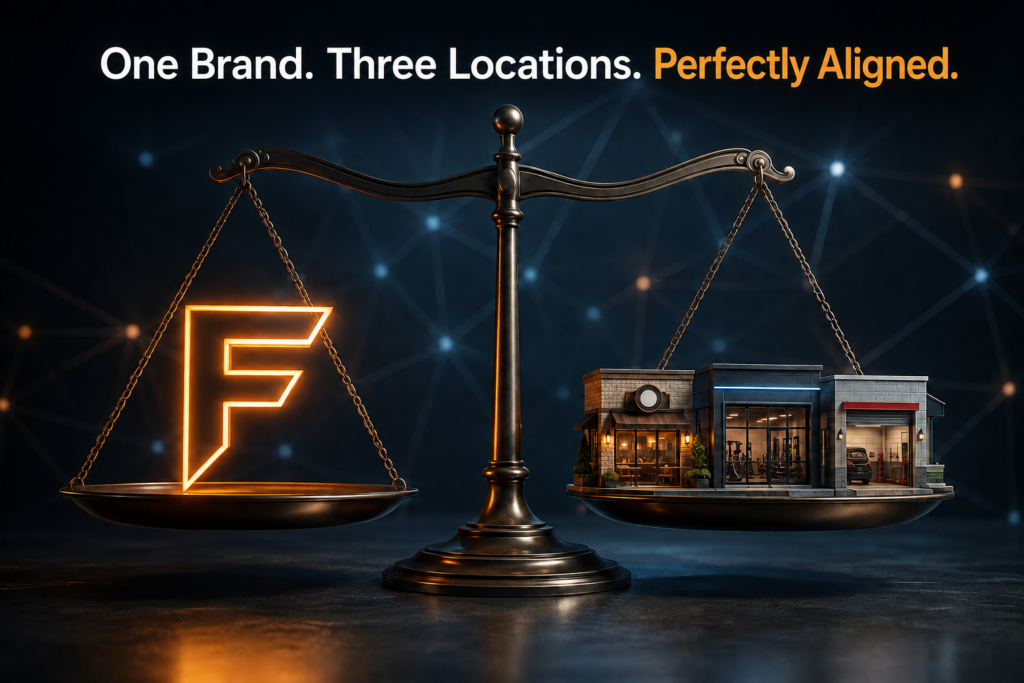
- Centralized Brand Equity and Compliance: The franchisor manages high-level brand identity, corporate website architecture, national paid campaigns, and core digital assets to protect brand reputation and build enterprise value.
- Localized Execution and Lead Generation: Individual franchisees or local operators execute geo-targeted tactics—such as local SEO, localized social media, and neighborhood-specific promotions—to capture high-intent demand in their specific service areas.
A high-performing franchise digital marketing ecosystem relies on clear brand guardrails. These operational boundaries allow corporate teams to maintain strict visual and messaging consistency while giving local operators the agility needed to compete against independent businesses in their regional markets.
Franchisor vs franchisee: who does what?
A successful franchise network depends on a clear division of labor between corporate headquarters and local operators. Franchise digital marketing breaks down responsibilities into two distinct domains: national infrastructure managed by the franchisor and localized execution managed by the franchisee.
Franchisor digital responsibilities
The franchisor builds and maintains the digital ecosystem, ensuring that brand equity scales efficiently across every market. Core duties include:
- Central Website Architecture & SEO: Managing the primary corporate domain, parent brand positioning, and enterprise-level technical SEO.
- MarTech Stack & Asset Libraries: Providing centralized digital tools, asset management systems, pre-approved ad templates, and creative collateral.
- National Paid Media & Campaigns: Running large-scale programmatic advertising, national search campaigns, and brand awareness initiatives that lift all locations.
- Brand Governance & Compliance: Enforcing strict guidelines to protect trademarks, visual identity, tone of voice, and messaging across all digital touchpoints.
- Central Analytics & Tracking: Monitoring network-wide performance metrics, conversion rates, and cooperative advertising fund (ad fund) allocations.
Franchisee digital responsibilities
The individual franchisee acts as the local market operator, leveraging national brand authority to capture hyper-local demand. Core duties include:
- Local SEO & Google Business Profiles: Optimizing and maintaining accurate Google Business Profile listings, local NAP (Name, Address, Phone) data, and location-specific landing pages.
- Localized Social Media & Community Engagement: Managing active social channels or neighborhood-specific pages to build local trust and community presence.
- Local Paid Advertising: Executing geo-fenced PPC or social media ad campaigns within franchisor-approved geographic boundaries and budget limits.
- Reputation & Review Management: Actively generating customer reviews and responding to feedback to maintain high local ratings.
- Local Promotions: Adapting national campaigns to fit neighborhood-specific events, local partnerships, and regional customer preferences.
Core goals of a franchise digital marketing strategy
A high-performing franchise digital marketing strategy aligns corporate brand power with local execution to drive predictable growth across every unit in the network. Strategic planning focuses on specific operational objectives:
- Defining Multi-Location Frameworks: Clarifying the distinct mechanics of franchise digital marketing and how it diverges from traditional single-unit marketing models.
- Optimizing Division of Labor: Establishing clear operational boundaries between franchisor-level brand stewardship and franchisee-level tactical execution.
- Enforcing Brand Consistency: Protecting enterprise equity by maintaining uniform messaging, visual standards, and brand voice across all digital touchpoints.
- Building a Scalable Strategy: Designing a repeatable, multi-tier marketing playbook that can be deployed efficiently as the franchise network expands.
- Maximizing Local SEO Visibility: Dominating localized search results and Google Business Profile rankings to capture high-intent buyers in every specific geographic territory.
- Driving Multi-Channel Lead Generation: Scaling inbound acquisition through structured content marketing, social media, email automation, and paid advertising funnels.
- Protecting Brand Reputation: Managing customer feedback, sentiment analysis, and online review acquisition across every location to build local trust.
- Tracking Network-Wide Performance: Implementing centralized attribution models and multi-location dashboards to measure ROI and ad fund utilization accurately.
- Preventing Strategic Pitfalls: Avoiding common compliance failures, channel conflicts, and localized marketing missteps that dilute brand value.
- Scaling Execution Resources: Evaluating whether to build an in-house digital marketing team or partner with specialized franchise marketing agencies to support growth.
Building a coordinated franchise digital marketing strategy
A coordinated franchise digital marketing strategy aligns the franchisor and individual locations around shared branding, clear responsibilities, local customer needs, consistent campaigns, and measurable business goals.
Start with a clear operating model
Before deploying ad dollars or selecting software, define how your organization divides marketing control. Choosing the right structural framework prevents channel conflicts and wasted spend:
- Centralized: The franchisor controls all digital activities, content creation, ad spend, and brand touchpoints. Franchisees act purely as local operators with minimal marketing autonomy. This maximizes brand compliance but often sacrifices local market agility and community connection.
- Decentralized: Individual franchisees run their own independent marketing campaigns, social channels, and local ads with little to no corporate oversight. While this provides maximum local speed, it frequently leads to brand dilution, fragmented messaging, and compliance liabilities.
- Hybrid (Industry Standard): The franchisor dictates core strategy, brand guardrails, master web architecture, and tracking infrastructure, while franchisees execute hyper-local tactics like neighborhood-specific social media, review management, and targeted local SEO within strict compliance parameters.
A hybrid model consistently delivers optimal results for franchise digital marketing, balancing enterprise-level brand equity with the speed and nuance required to win in local markets.
Define brand and marketing guardrails
Brand dilution in a franchise network rarely happens overnight; it creeps in through unapproved flyers, rogue social media accounts, and off-brand messaging created by well-meaning local operators. Establishing rigid operational boundaries protects enterprise value without stifling local responsiveness:
- Publish Comprehensive Brand Guidelines: Codify exact visual identities, color hex codes, typography rules, brand voice attributes, and approved core messaging into an easily accessible digital brand portal.
- Deploy Pre-Approved Asset Libraries: Provide franchisees with customizable, digital-ready templates for social posts, paid ads, email sequences, and local landing pages via a Digital Asset Management (DAM) platform.
- Establish Social Media Workflows: Define precise channel architecture—specifying whether locations maintain dedicated sub-brands on platforms like Facebook and Instagram—and outline clear escalation paths for content review and approval.
- Automate Compliance and Distribution: Utilize enterprise marketing automation tools to lock core brand assets and streamline approvals, ensuring local operators can only publish pre-vetted variations.
- Implement Continuous Monitoring: Set up routine audits and automated tracking to catch visual drift, unauthorized claims, or off-brand messaging early, correcting issues before they impact enterprise reputation.
Local SEO for franchise locations
Local SEO is the engine of multi-unit growth; each physical branch must capture high-intent search traffic within its specific territory without competing against sister locations in adjacent markets.
Key components of multi-location local SEO
- Individual Google Business Profiles (GBPs): Establish a distinct, fully verified GBP for every physical location rather than relying on a single, brand-wide profile. This ensures each unit appears in the local Map Pack for geo-targeted queries.
- Unique Location-Specific Landing Pages: Build dedicated pages for every branch featuring locally relevant content, staff introductions, local photos, regional service details, and driving directions rather than deploying thin, auto-generated pages with swapped city names.
- Consistent NAP Data Maintenance: Audit and synchronize Name, Address, and Phone data meticulously across major citation directories, including Google, Bing Places, Apple Maps, Yelp, and industry-specific aggregators.
- Store-Level Review Management: Decentralize daily review responses while maintaining centralized oversight to ensure prompt engagement, sentiment tracking, and resolution of local customer service issues.
- Geographic Cannibalization Prevention: Structure URL hierarchies, service area definitions, and localized schema markup carefully to ensure corporate domain authority supports local pages without triggering internal ranking conflicts between nearby franchises.
Practical checklist for each location page
Every unit within a franchise digital marketing framework requires an optimized, high-converting destination on the primary web domain. Build each location page with these essential technical and content elements:
- Unique Local Content: Incorporate localized copy referencing nearby landmarks, specific neighborhoods served, regional service variations, and store-specific announcements rather than recycling thin templates.
- Embedded Google Map: Integrate a responsive Google Map iframe centered directly on that exact physical address to enhance local relevance and user experience.
- Direct Local Contact Details: Feature a direct local phone number and location-specific email address to minimize friction for high-intent buyers looking to connect with their nearest branch.
- Tailored Operational Metadata: Publish exact store hours, holiday schedules, manager introductions, and branch-specific amenities if they deviate from standard corporate hours.
- Localized Schema Markup: Embed structured data using the
LocalBusinessschema on every individual page, ensuring search engines accurately map addresses, phone numbers, geo-coordinates, and operating hours. - Uniform Category Mapping: Maintain consistent primary business categories across all local listings and metadata unless specific regional services legally or operationally require divergence.
Common local SEO mistakes to avoid
- Deploying a Single Master GBP: Using one brand-wide Google Business Profile instead of individual, verified profiles for every physical branch, which eliminates the local map pack presence for regional units.
- Publishing Thin, Duplicated Landing Pages: Reusing identical page copy across dozens of URLs and merely swapping out city names, triggering search engine duplicate content penalties and poor local rankings.
- Allowing NAP Inconsistencies: Permitting conflicting business names, phone numbers, or street address formats across major directories and aggregators, which destroys local citation trust.
- Neglecting Local Review Management: Failing to monitor and respond to store-level feedback, allowing unaddressed negative experiences to sour the brand’s local reputation and hurt click-through rates.
Content, social media, and email for franchises
Content, social media, and email marketing help franchises attract local customers, maintain consistent brand messaging, build relationships, and encourage repeat business across multiple locations.
Content marketing
Scaling content across a multi-unit network requires dividing labor between macro-level education and micro-level relevance. A balanced franchise digital marketing content engine operates on a two-tier model:
- Enterprise Content Production: The franchisor generates pillar assets, including authority-building blog posts, industry guides, whitepapers, and brand videos that establish overarching market leadership and feed the primary domain’s SEO authority.
- Local Content Adaptation: Franchisees localize these core assets by incorporating regional case studies, neighborhood event sponsorships, local staff spotlights, and hyper-local calls to action to drive conversions.
This hub-and-spoke model eliminates duplicate effort across the network while ensuring messaging remains anchored to brand standards.
Social media governance
Social channels represent one of the highest-risk areas for visual drift and message dilution. Managing multi-location social presence requires strict structural boundaries:
- Channel Architecture Definition: Establish whether individual branches maintain dedicated local profiles (e.g., specific Facebook neighborhood pages or Instagram location tags) or if all publishing routes through a centralized corporate feed.
- Template and Asset Distribution: Equip local operators with pre-approved Canva templates, graphic assets, and caption frameworks via a centralized digital library.
- Platform Specialization: Match channels to specific audience behaviors—deploying Instagram and TikTok for consumer-facing visual engagement, Facebook for local community groups and events, and LinkedIn for B2B franchise networks.
- Community-First Execution: Prioritize active engagement, prompt comment responses, and direct messaging over passive broadcasting to build genuine local trust.
Email marketing and automation
Automated email sequences bridge the gap between corporate marketing campaigns and localized conversion. Franchise-friendly marketing automation platforms allow corporate teams to deploy centralized templates while enabling local units to execute targeted lifecycle messaging:
- Welcome Sequences: Automated onboarding flows triggered immediately when a customer interacts with a specific location.
- Lead Nurturing Workflows: Drip campaigns designed to educate prospects who inquire about services but require multiple touchpoints before converting.
- Post-Purchase Review Requests: Automated follow-up emails sent post-service to capture customer feedback and drive reviews directly to local profiles.
- Re-Engagement Campaigns: Targeted reactivation offers sent to lapsed customers based on historical visit or purchase dates.
Paid advertising for franchise networks
Paid advertising in a multi-unit network requires balancing centralized buying power with geo-targeted execution. Uncoordinated spending leads to internal bidding wars, inflated cost-per-click (CPC) rates, and fragmented messaging. A scalable franchise digital marketing paid media program relies on structural governance and cooperative funding:
- Cooperative (Co-Op) Advertising Models: Leverage co-op ad funds where the franchisor subsidizes a percentage of local paid media spend, provided franchisees adhere to strict creative compliance and platform guidelines.
- Geo-Fenced Paid Search Campaigns: Deploy hyper-local Google Ads campaigns targeting specific zip codes or radius boundaries around each physical branch, preventing nearby sister locations from competing for the same search keywords.
- Dynamic Local Ad Customization: Utilize programmatic ad templates that automatically populate local store variables—such as neighborhood-specific phone numbers, local addresses, regional pricing, and store-specific promos—while locking core brand elements.
High-ROI channel mix for franchise networks
Maximizing customer acquisition across distributed locations requires integrating paid media with organic search and reputation systems:
| Channel | Primary Objective | Execution Level |
| Paid Search (Google Ads) | Capture high-intent, immediate-purchase demand | Hybrid (Corporate framework with local geo-targeting) |
| Local Listings & GBP | Dominate map packs and capture local mobile searches | Decentralized operation, centralized audit |
| Paid Social (Meta, TikTok) | Build local awareness and retarget website visitors | Decentralized execution via approved templates |
| Reputation & Review Management | Protect local sentiment and increase conversion rates | Store-level execution with corporate oversight |
| Email & SMS Marketing | Drive repeat business and customer retention | Centralized automation templates, local deployment |
Managing online reviews and local reputation
Reputation management in a multi-unit network carries unique enterprise risk. Because modern consumers view reviews as a proxy for brand-wide quality, a single neglected location with a sub-three-star rating on Google Maps can inflict severe reputational damage on the entire franchise system. Protecting brand equity requires a dual-tier framework combining centralized software monitoring with local engagement discipline.
Key practices for franchise reputation management
- Centralized Review Monitoring: Implement enterprise reputation management platforms (such as Chatmeter, Yext, or Birdeye) to aggregate and track feedback across Google Business Profiles, Yelp, Facebook, and industry-specific directories for every single location in real time.
- Standardized Response Protocols: Issue comprehensive response playbooks to local operators. Define clear rules of engagement, including approved tone of voice, legal boundaries for customer privacy, escalation paths for hostile feedback, and pre-approved response templates.
- Proactive Review Generation Systems: Automate review requests by embedding post-purchase email and SMS triggers, placing physical QR codes at checkout counters, and training local staff to ask satisfied customers for reviews at the point of peak satisfaction.
- Hyper-Localized Review Responses: Mandate that reviews be answered at the store level by local managers using personalized replies that reference specific staff members, services, or interactions rather than deploying generic corporate copy.
- Systemic Crisis Escalation: Establish a rapid-response protocol that flags severe customer complaints (such as health, safety, or legal issues) and escalates them immediately from local managers to corporate risk teams before localized friction spirals into a public relations crisis.
Tracking performance across locations
Without multi-tier attribution, franchise digital marketing becomes an expensive guessing game. Enterprise success requires measuring performance simultaneously at the macro level (national brand health and aggregate campaign ROI) and the micro level (individual storefront lead volume and local conversion rates).
Core KPIs for franchise marketing
- Cost Per Lead (CPL): Track acquisition costs across different geographic territories to identify inefficient local ad spend or poorly optimized campaigns.
- Channel Conversion Rates: Measure how effectively traffic converts into inbound inquiries across organic search, local landing pages, paid search, and social media.
- Store Visit Attribution (Local Pack & Maps): Monitor metrics like Google Business Profile direction requests, “click-to-call” volume, and store locator interactions.
- Marketing-Attributed Revenue: Connect CRM data and Point of Sale (POS) systems back to specific digital campaigns to calculate true revenue contribution per location.
- Return on Ad Spend (ROAS): Evaluate campaign-level profitability across centralized brand campaigns and co-op localized advertising efforts.
- Promo Code and Booking Tracking: Utilize unique tracking numbers, location-specific promo codes, and integrated booking tools (such as Mindbody, Calendly, or custom booking software) to attribute online actions to offline sales.
Building a practical dashboard
- Consolidated BI Dashboards: Utilize business intelligence tools like Looker Studio, Tableau, or Power BI to aggregate data streams from Google Analytics 4, CRM platforms, ad managers, and call-tracking software into unified multi-location views.
- Tiered Access Permissions: Configure dashboards so corporate executives view aggregate network performance while individual franchisees see only their specific location’s metrics, eliminating data clutter and confusion.
- Mobile-Accessible Reporting: Ensure performance dashboards are optimized for mobile devices so busy local operators can check lead volume, review ratings, and campaign spend on the go.
- Decoupled Vendor Architecture: Separate your website development agency from your paid advertising provider where possible. Maintaining independent vendors prevents data siloing, eliminates attribution bias, and keeps performance reporting entirely transparent.
Common franchise digital marketing mistakes to avoid
Avoiding strategic missteps and execution errors protects enterprise capital, preserves brand equity, and accelerates time-to-profitability across every unit in your network.
Strategic mistakes
- Assuming Corporate Handles Everything: Franchisees frequently rely entirely on national brand campaigns, ignoring the reality that hyper-local visibility, review management, and neighborhood engagement are core local responsibilities.
- Chasing Raw Lead Volume Over Quality: Optimizing campaigns solely for cheap, unverified inquiries instead of high-intent leads that actually convert into lifetime customers and recurring revenue.
- Deploying Uniform Messaging Across Markets: Forcing a one-size-fits-all narrative across diverse geographic territories without tailoring value propositions to regional cultural nuances, local demographics, and neighborhood-specific needs.
- Optimizing for Vanity Metrics (Impressions over ROI): Measuring success through superficial metrics like ad impressions or reach rather than tracking actual cost-per-lead, conversion rates, and bottom-line revenue.
Brand and execution mistakes
- Permitting Brand Inconsistency: Allowing erratic tone of voice, outdated logos, or fractured visual identities across digital touchpoints, which dilutes brand recall and professional trust.
- Operating Without Marketing Guardrails: Empowering local operators to launch unvetted flyers, rogue social accounts, and off-brand promotional assets that erode core brand value.
- Publishing Thin, Duplicate Location Pages: Deploying copy-and-paste web pages where only the city name changes, which triggers search engine penalties and fails to convert local traffic.
- Flying Blind Without Data Attribution: Relying on gut instinct and historical assumptions rather than implementing robust, multi-tier tracking across Google Analytics, CRM, and POS systems.
Eliminating these pitfalls requires defining rigid brand guardrails, choosing appropriate multi-channel distribution models, allocating realistic co-op budgets, and auditing performance metrics on a monthly cadence.
In-house team vs agency: which is right for your franchise?
Scaling a multi-unit network requires choosing the right resource model to execute your franchise digital marketing strategy. Franchisors and multi-unit operators typically evaluate three primary structures: building an internal team, outsourcing to specialized partners, or deploying a hybrid framework.
In-house marketing
An internal marketing department provides unmatched institutional knowledge and total control over daily execution.
- Advantages: Deep alignment with brand culture, immediate responsiveness to internal stakeholders, and complete ownership of brand messaging. Lean internal teams can maximize output when paired with robust enterprise marketing automation and digital asset management tools.
- Limitations: Building a full in-house team with specialized competencies across advanced technical SEO, programmatic paid media, data engineering, and graphic design can be cost-prohibitive. Internal teams also risk developing insular perspectives over time.
Agency model
Outsourcing execution to specialized marketing agencies provides immediate access to elite technical talent and scalable infrastructure without the overhead of full-time employment and benefits.
- Advantages: Lower fixed costs, rapid deployment of specialized campaigns, and the ability to scale resources up or down based on network growth.
- Evaluation Criteria for Franchise Agencies: A qualified franchise marketing partner must demonstrate specific operational traits:
- Exemplary Digital Presence: They practice what they preach through their own organic visibility and inbound acquisition funnels.
- Cultural and Strategic Alignment: Their operational philosophy aligns with your brand’s long-term vision and mission.
- Deep Franchise Acumen: They understand the complex multi-location dynamics of balancing national brand equity with localized compliance and reporting.
Hybrid model (recommended for most franchises)
A hybrid structure combines internal brand governance with external technical horsepower, making it the most resilient framework for expanding franchise systems.
- Agency Responsibilities: Focus external partners on high-impact, technical initiatives requiring specialized expertise, such as enterprise technical SEO, multi-location paid search architecture, custom dashboard development, and large-scale creative production.
- Internal Responsibilities: Keep routine brand management, internal stakeholder communications, local franchisee support, and day-to-day community engagement in-house.
- Governance and Oversight: Enforce strict brand guidelines, maintain final sign-off authority through an internal brand manager, and establish precise scopes of work with regular performance audits to eliminate budget creep.
A simple implementation roadmap
Executing a successful franchise digital marketing program requires dividing responsibilities into distinct phases for both corporate leadership and local operators. Adapt this implementation framework to fit your network size, resource capacity, and growth stage.
For franchisors
- Define the Operating Model: Establish whether your network will operate under a centralized, decentralized, or hybrid structure, ensuring clear boundaries for brand control and local execution.
- Publish Brand and Marketing Guidelines: Codify visual identity, voice, tone, and messaging standards into an accessible portal complete with pre-approved creative templates.
- Audit and Build Local SEO Infrastructure: Finalize standardized location page templates and establish a scalable framework for individual Google Business Profile management.
- Deploy Enterprise Marketing Technology: Implement core software stacks—including your CMS, multi-location analytics, reputation management tools, and ad-tracking platforms.
- Establish Centralized Dashboards: Build unified BI reporting views to track location-level KPIs, campaign ROAS, and ad fund utilization.
- Onboard and Train Franchisees: Conduct structured training programs to educate local operators on their responsibilities, compliance rules, and approved software tools.
For franchisees
- Claim and Optimize Local Listings: Claim, verify, and fully optimize your Google Business Profile and core local directories with accurate NAP data.
- Launch Localized Web Pages: Partner with corporate to deploy your designated location page, ensuring it includes unique local content and embedded maps.
- Establish Review Workflows: Implement a proactive review generation system using post-purchase triggers, QR codes, and disciplined response protocols.
- Utilize Brand-Approved Assets: Execute social media campaigns and email marketing sequences exclusively using corporate-vetted templates.
- Monitor Local Performance: Track core metrics—including local leads, conversion rates, and channel-attributed revenue—and review data monthly.
- Maintain Open Communication: Share local market insights, customer feedback, and campaign wins regularly with franchisor leadership to improve network-wide strategies.
What is franchise digital marketing?
Franchise digital marketing is a dual-layered system of online activities designed to build national brand equity for the franchisor while driving localized customer acquisition for individual branch locations. It balances centralized brand governance with geo-targeted execution like local SEO, paid ads, and reputation management.
How do franchisors and franchisees split digital marketing responsibilities?
Franchisors typically manage enterprise-level assets, core website architecture, national paid campaigns, brand guidelines, and central analytics. Franchisees handle hyper-local execution, including individual Google Business Profiles, local social media, neighborhood-specific paid ads, and store-level review management within approved brand guardrails.
Why is local SEO important for multi-location franchises?
Local SEO ensures that every physical branch captures high-intent search traffic in its specific geographic territory without competing against sister locations. This requires individual Google Business Profiles, unique location-specific landing pages, consistent NAP data, and structured LocalBusiness schema markup for every unit.
What is the best operating model for franchise marketing?
A hybrid model is generally the most effective approach for franchise networks. The franchisor sets the overarching strategy, brand guardrails, master web infrastructure, and measurement frameworks, while individual franchisees execute localized SEO, content adaptation, and community engagement within those defined parameters.
How should franchises manage online reviews across multiple locations?
Franchises should utilize centralized review-monitoring software to track feedback across Google, Yelp, and Facebook in real time. Responsibilities are then decentralized to the store level, where local managers respond personally using approved templates, backed by automated post-purchase review generation systems and strict crisis escalation protocols.
In Conclusion
Franchise digital marketing thrives on structural clarity: corporate headquarters establishes the scalable systems and brand guardrails, while local operators execute geo-targeted tactics within those boundaries.
Achieving sustainable multi-location growth requires prioritizing individual Google Business Profiles, unique location pages, disciplined review management, and transparent, multi-tier performance attribution while eliminating common pitfalls like brand drift and unmeasured ad spend.
Begin your execution by auditing these three core areas immediately:
- Verify that every physical branch maintains an individual, optimized Google Business Profile and a unique, content-rich location page.
- Confirm your brand guidelines and pre-approved asset libraries are actively utilized across all franchise units.
- Implement centralized dashboards to track location-level KPIs and monthly conversion data.