What Is Information Technology Outsourcing? A Complete Guide
Information technology outsourcing has evolved from a simple cost-cutting tactic into a core strategic lever for modern enterprises. By partnering with external specialists for functions ranging from software engineering and cloud infrastructure to cybersecurity and data operations, organizations can scale technical capacity rapidly without the overhead of internal hiring.
However, navigating the vendor landscape requires a structured approach. Information technology outsourcing (ITO) introduces complex governance, security, and operational variables that dictate project success.
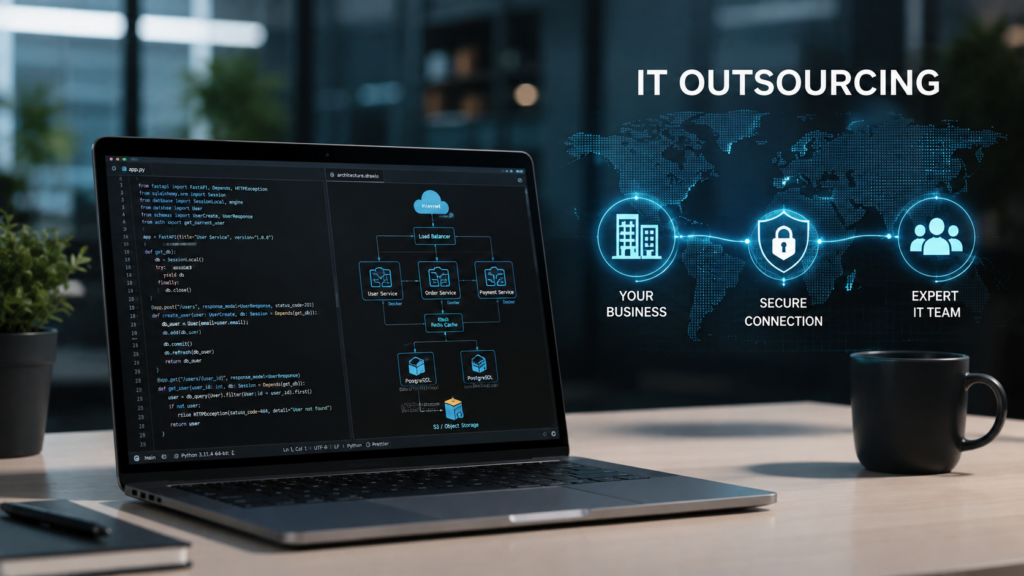
This comprehensive guide breaks down how information technology outsourcing functions in practice, analyzes the primary engagement models, weighs the strategic benefits against inherent risks, and provides a decision framework to determine if an external IT provider aligns with your business goals.
Types of Information Technology Outsourcing Vendors
To operationalize information technology outsourcing effectively, organizations must understand the different provider archetypes available in the market:
- Managed Service Providers (MSPs): Handle ongoing, day-to-day infrastructure management, monitoring, and helpdesk support under a subscription model.
- Software Development Agencies: Deliver custom engineering, application modernization, and product development on a project or dedicated-team basis.
- Specialized Consultancies: Provide high-leverage advisory and implementation services for complex, niche domains like cloud migration, enterprise architecture, or cybersecurity.
- Freelance Specialists & Independent Contractors: Execute targeted, short-term technical tasks or fill immediate skill gaps for specific projects.
- BPO (Business Process Outsourcing) Providers: Manage large-scale operational workloads that include integrated IT back-office support.
Strategic Advantages and Inherent Risks
When evaluating information technology outsourcing, leaders must weigh immediate operational gains against potential long-term friction points.
| Strategic Advantages | Inherent Risks |
| Access to Global Talent: Bypass local labor shortages to deploy certified engineers and architects instantly. | Vendor Lock-In: High switching costs if proprietary workflows or deep code dependencies bind you to a single provider. |
| Cost Optimization: Convert fixed internal capital expenditures (CapEx) into variable operational expenditures (OpEx). | Communication & Culture Friction: Time-zone disparities, language barriers, and misaligned organizational priorities. |
| Accelerated Time-to-Market: Scale engineering capacity up or down rapidly to meet product roadmaps and peak demand. | Security & Compliance Exposure: Expanded attack surface and potential vulnerabilities if third-party governance fails. |
Decision Framework: When to Outsource vs. Keep In-House
Deciding whether to pursue information technology outsourcing requires a clear evaluation of core competencies versus operational execution.
Core Rule
Outsource non-core, highly specialized, or capacity-constrained operations to free up internal bandwidth, but retain direct architectural control over your core intellectual property and strategic tech stack.
- Assess Strategic Value: If a technology function directly drives your primary competitive advantage, keep it internal. If it is foundational plumbing (e.g., standard infrastructure management, basic helpdesk), consider outsourcing.
- Audit Internal Bandwidth: If your existing team is bottlenecked by routine maintenance and cannot focus on high-leverage initiatives, delegate execution to an external provider.
- Calculate Total Cost of Ownership (TCO): Compare the true cost of recruiting, onboarding, tooling, and retaining full-time internal specialists against predictable vendor service-level agreements (SLAs).
How Information Technology Outsourcing Works
Information technology outsourcing typically begins when an organization identifies an IT need, challenge, or function that could be handled more effectively by an external provider.
The organization then defines its requirements, evaluates and selects a suitable outsourcing partner, establishes the scope and expectations through a formal agreement, and continuously monitors the provider’s performance throughout the relationship.
Identify the IT Requirement
Before evaluating vendors, an organization must define precisely what it intends to delegate. Vagueness breeds scope creep and operational failure. A precise problem statement is infinitely more actionable than a broad directive like “manage our IT.”
Common requirements suited for information technology outsourcing include:
- Custom Software Engineering: Building native mobile applications, web platforms, or modernizing legacy codebases.
- Cloud Transformation: Migrating infrastructure, data lakes, and core systems to AWS, Azure, or Google Cloud.
- Managed Infrastructure: Maintaining servers, networks, and endpoints to ensure maximum uptime.
- Cybersecurity Operations: Deploying 24/7 security event monitoring, threat detection, and incident response.
- Technical Support: Providing tiered helpdesk operations for internal employees or external customers.
- Data Protection & Disaster Recovery: Designing, automating, and verifying backup and recovery pipelines.
Defining these needs upfront ensures that subsequent scoping, vendor evaluation, and contracting efforts target the exact operational gaps you need to solve.
Define Scope, Responsibilities, and SLAs
Once the technical requirement is clear, both the organization and the provider must codify the exact parameters of the engagement. Ambiguity at this stage is the primary root cause of budget overruns, missed deadlines, and operational friction in information technology outsourcing.
A comprehensive scope and responsibility matrix must explicitly document:
- In-Scope vs. Out-of-Scope Services: Clear boundaries defining what the provider owns versus what remains internal.
- Service-Level Agreements (SLAs): Quantifiable performance benchmarks, including support coverage windows, first-response targets, and mean time to resolution (MTTR).
- Security & Access Parameters: Strict protocols governing data classification, permission levels, credential management, and compliance mandates.
- Reporting & Governance Cadence: Required operational dashboards, status updates, and periodic review frequencies.
- Commercial Terms: Transparent pricing structures (fixed-price vs. time-and-materials) and payment milestones.
- Offboarding & Exit Protocols: Documented procedures for data repatriation, code handover, and knowledge transfer when the contract concludes.
Explicitly mapping these parameters prevents dangerous assumptions regarding system ownership, incident liability, financial accountability, and operational decision-making.
Evaluate and Select Providers
Choosing the right partner requires moving beyond surface-level sales pitches and conducting rigorous due diligence. Successful information technology outsourcing depends on evaluating a vendor’s technical capability against your organization’s unique risk profile and operational cadence.
Key evaluation criteria include:
- Technical Competence & Industry Track Record: Examine past case studies, portfolio projects, and domain expertise within your specific tech stack.
- Security Posture & Compliance: Review independent audit reports, certifications (e.g., SOC 2, ISO 27001), and data protection protocols.
- Operational Readiness: Verify support coverage hours, service-level delivery models, and structural ability to scale resources as your business grows.
- Financial Stability: Assess the vendor’s financial health to ensure long-term viability and risk mitigation against sudden provider insolvency.
- Cultural & Communication Fit: Evaluate language proficiency, time-zone overlap, collaboration tools, and transparency in pricing and reporting processes.
Ultimately, a vendor should be vetted not just for what they can build, but for how seamlessly they integrate into your risk framework and working culture.
Sign Comprehensive Legal Agreements
Once you have selected a qualified partner, you must formalize the relationship through a structured legal framework. Relying on informal understandings or vague terms invites operational risk. A robust information technology outsourcing contract uses a modular document suite to protect intellectual property, define liabilities, and establish clear operational boundaries.
The contracting package typically includes:
- Master Services Agreement (MSA): Establishes the overarching legal, financial, and commercial foundation governing the entire vendor relationship (e.g., liability caps, dispute resolution, and intellectual property rights).
- Statement of Work (SOW): Details project-specific deliverables, milestones, resource allocations, and timelines for individual initiatives.
- Service-Level Agreement (SLAs): Codifies quantitative performance targets, system uptime guarantees, and response times.
- Data-Processing Agreement (DPA): Governs how sensitive, personal, or proprietary data is handled, stored, and protected in compliance with applicable regulations.
- Security Addendum: Outlines mandatory technical controls, access permissions, auditing rights, and formal incident-reporting obligations.
Structuring the contract across these specific instruments ensures absolute clarity on accountability, safeguarding your organization from unexpected liabilities and operational disputes.
Execute a Controlled Transition and Onboarding
Once contracts are executed, the partnership enters its most vulnerable phase: operational handoff. A rushed transition introduces critical friction points, including downtime, security blind spots, and blurred lines of ownership.
A disciplined information technology outsourcing transition requires a structured playbook:
- Asset Inventory & Process Mapping: Catalog all hardware, software licenses, data repositories, and document existing standard operating procedures (SOPs).
- Secure Credential Handover: Transfer administrative rights and access tokens using enterprise-grade password managers and least-privilege principles.
- Environment Configuration: Deploy and test monitoring dashboards, ticketing systems, and secure communication channels between internal teams and the external provider.
- Knowledge Transfer & Shadowing: Conduct technical walkthroughs, run parallel operations, and execute a short pilot phase to validate the provider’s capabilities before full deployment.
- Escalation & Recovery Testing: Validate communication workflows, emergency escalation paths, and data backup/recovery procedures under simulated failure conditions.
A measured, methodical onboarding process ensures operational continuity, protecting your infrastructure from the disruptions that typically plague poorly managed handoffs.
Monitor, Measure, and Optimize Performance
Signing the contract and completing onboarding does not mean an organization can adopt a “set-and-forget” mindset. Successful information technology outsourcing requires continuous oversight, objective metric tracking, and proactive vendor management to maintain long-term value.
To prevent service degradation and align the provider with evolving business objectives, organizations should track a balanced scorecard of quantitative metrics:
- Operational Efficiency: Measure first-response time, mean time to resolution (MTTR), and system availability (uptime percentages).
- Reliability & Security: Monitor recurring incident counts, patch-compliance rates, backup-success rates, and security-event response times.
- Delivery & Financial Governance: Track project milestones against agreed timelines, measure end-user satisfaction scores, and audit total expenditures against budgeted forecasts.
Regular performance reviews—such as monthly or quarterly business reviews (MBRs/QBRs)—allow leadership to address friction points early, optimize workflows, and dynamically adjust agreements as technical requirements scale.
Main Types of Information Technology Outsourcing
Geographic distribution and delivery structure dictate how an external partnership operates. Understanding these delivery models helps organizations align cost parameters with operational oversight requirements.
| Outsourcing Type | Meaning | Main Advantages | Common Challenges |
| Onshore Outsourcing | Provider operates in the same country as the client. | Shared language, identical legal jurisdiction, and synchronized working hours. | Typically commands higher labor rates. |
| Nearshore Outsourcing | Provider operates in a nearby country or adjacent time zone. | Strong time-zone overlap and competitive cost structures. | Potential friction across cross-border regulations or cultural nuances. |
| Offshore Outsourcing | Provider operates in a distant country or region. | Access to massive global talent pools and optimized cost efficiency. | Disparate time zones, communication barriers, and complex legal oversight. |
| Domestic Freelancing | Individual specialists or contractors execute targeted work locally. | High flexibility for specialized, short-term project needs. | Limited scaling capacity and single-point-of-failure risks. |
| Hybrid Outsourcing | Internal staff and external providers share technical responsibilities. | Balances internal control with scalable external execution power. | Requires strict boundary management to prevent ownership confusion. |
Strategic Note
Geography is merely a logistical variable, not a proxy for quality. A domestic vendor can suffer from weak security posture, while an offshore team may maintain world-class compliance and engineering maturity. Always audit the actual controls, technical expertise, and operating model rather than relying solely on location.
Common Information Technology Outsourcing Services
Organizations can outsource a wide range of IT functions, from routine technical support to highly specialized services such as software development, cloud management, and cybersecurity. The right services to outsource depend on factors such as business priorities, internal expertise and resources, regulatory and compliance requirements, cost considerations, and the organization’s tolerance for operational and security risks.
Software Development and Engineering Services
Custom engineering is one of the most common applications of information technology outsourcing. External teams are frequently deployed to accelerate product roadmaps or modernize legacy systems across a wide range of digital touchpoints:
- Digital Products & Interfaces: Building responsive websites, complex web applications, and native or cross-platform mobile apps.
- Enterprise Infrastructure: Developing internal business systems, automation utilities, application programming interfaces (APIs), and legacy-system integrations.
- Modern Workloads: Launching e-commerce platforms alongside modern data pipelines and artificial intelligence applications.
Critical IP Protection
Because software assets represent core corporate value, the outsourcing contract must explicitly assign full ownership of source code, technical documentation, development environments, third-party libraries, administrative credentials, and resulting intellectual property directly to the client organization from day one.
Cloud Infrastructure and Managed Services
Migrating and managing modern infrastructure requires specialized expertise that many internal teams lack. Information technology outsourcing in the cloud domain allows organizations to tap into elite engineering capabilities without maintaining a full-time, in-house cloud architecture division.
External providers frequently manage critical cloud functions, including:
- Cloud Migration & Architecture: Executing zero-downtime migrations and designing scalable infrastructure from the ground up.
- Identity & Access Management (IAM): Provisioning secure user access, multi-factor authentication (MFA), and role-based access control (RBAC).
- Containers & Deployment: Orchestrating workloads using Kubernetes, Docker, and CI/CD deployment automation pipelines.
- Observability & Optimization: Setting up 24/7 monitoring, log aggregation, and continuous cloud cost optimization (FinOps).
- Resilience: Architecting robust backup and disaster recovery protocols.
The Shared Responsibility Reality
As defined by NIST standards, cloud computing delivers on-demand access to shared computing resources, but outsourcing infrastructure does not outsource accountability.
Cloud providers secure the cloud (hardware, underlying virtualization), while the organization and its outsourcing partner remain responsible for security in the cloud (data classification, access configurations, patching, and application security).
The outsourcing contract must explicitly delineate these operational boundaries to eliminate dangerous security gaps.
IT Infrastructure Management and Operations
Managing underlying hardware, networks, and virtual environments requires continuous, round-the-clock vigilance. Many organizations utilize information technology outsourcing to handle foundational infrastructure operations, eliminating the need to recruit and retain large, specialized internal systems-administration teams.
External managed service providers typically oversee:
- Core Hardware & Datacenters: Maintaining physical servers, enterprise storage arrays, and datacenter equipment.
- Network & Connectivity: Administering corporate networks, routers, switches, firewalls, and virtual private networks (VPNs).
- Virtualization & Compute: Managing virtual machines, hypervisors, and container host environments.
- End-User Computing: Managing provisioning, patching, and endpoint security for employee devices.
- Operational Tooling: Maintaining configuration management databases (CMDBs), proactive monitoring platforms, and disaster recovery hot sites.
This operational model ensures high availability and enterprise-grade reliability while allowing internal technology teams to focus on revenue-generating business initiatives rather than routine infrastructure maintenance.
Technical Support and Help Desk Operations
Providing consistent, high-quality technical support—whether for internal employees or external customers—is a common use case for information technology outsourcing. It ensures rapid issue resolution and uninterrupted productivity without pulling high-level engineers away from strategic projects.
Outsourced help desk services typically manage the following day-to-day operations:
- Identity & Access Requests: Handling password resets, multi-factor authentication (MFA) issues, and account lockouts.
- Device & Application Management: Configuring corporate endpoints, installing sanctioned software, and managing licenses.
- Connectivity & Productivity: Troubleshooting network latency, VPN access, email platforms, and unified collaboration tools.
- Lifecycle Management: Automating standardized technical onboarding and secure offboarding procedures for employees.
- Incident Triage: Providing initial remote troubleshooting and comprehensive ticket logging for all support requests.
Crucial Requirement
A robust technical support partner must operate with a rigidly documented escalation matrix. Any incidents requiring specialized intervention, architectural changes, or sensitive data access must seamlessly route back to the appropriate internal stakeholders to ensure control over high-risk decisions.
Cybersecurity Outsourcing and Managed Defense
As digital threats grow more sophisticated, maintaining an elite, round-the-clock security team in-house is cost-prohibitive for many businesses. Information technology outsourcing in the security domain allows organizations to deploy enterprise-grade defense mechanisms by partnering with specialized Managed Security Service Providers (MSSPs).
Outsourced cybersecurity operations commonly encompass:
- Threat Monitoring & Detection: Deploying 24/7 Security Operations Center (SOC) oversight and Managed Detection and Response (MDR) platforms.
- Vulnerability & Risk Assessment: Conducting routine vulnerability scanning, automated patch validation, and external penetration testing.
- Endpoint & Identity Protection: Securing user workstations, mobile devices, servers, and enforcing robust Identity and Access Management (IAM) controls.
- Incident Response & Recovery: Providing rapid containment, forensic investigation, and remediation protocols when security breaches occur.
- Governance & Training: Designing corporate security policies, regulatory compliance frameworks, and employee security awareness programs.
Industry Guidance & Best Practices
Because outsourcing IT infrastructure often expands your organization’s attack surface, federal agencies and cybersecurity authorities—including CISA—recommend rigorous risk mitigation controls.
This includes enforcing strict multi-factor authentication (MFA) across all managed service provider accounts, strictly auditing privileged access credentials, and baking immutable cybersecurity requirements directly into the core service contract.
Data Services and Analytics Outsourcing
Organizations generate vast quantities of information, but turning raw data into strategic assets requires specialized technical skills. Information technology outsourcing in the data domain enables companies to scale their analytical capabilities, modernize data pipelines, and maintain database performance without building massive internal data science teams.
External data service providers commonly manage:
- Database Administration (DBA): Maintaining database health, optimizing query performance, scaling storage, and ensuring high availability.
- Data Engineering & Migration: Architecting modern data warehouses, building ELT/ETL pipelines, and safely migrating legacy data to cloud environments.
- Analytics & Business Intelligence: Designing automated executive dashboards, custom reporting suites, and advanced business analytics.
- AI & Machine Learning: Developing predictive models, natural language processing tools, and custom machine-learning pipelines.
- Governance & Hygiene: Performing routine data quality management, deduplication, backup, and long-term archival.
Data Privacy & Compliance Imperative
Because data-processing arrangements frequently grant external providers access to personal identifiable information (PII), proprietary financials, or commercially sensitive trade secrets, they require strict legal safeguards.
Organizations must couple their outsourcing contracts with comprehensive Data-Processing Agreements (DPAs) that enforce strict data residency compliance, encryption standards, access logging, and data destruction protocols upon contract termination.
Business Application Management and Maintenance
Core enterprise software underpins daily business operations, but keeping these systems stable, integrated, and updated requires specialized technical bandwidth. Information technology outsourcing is frequently leveraged to manage mission-critical business platforms, freeing internal teams from routine system administration.
External application management providers typically oversee:
- Enterprise Platforms: Administering and optimizing enterprise resource planning (ERP) systems, customer relationship management (CRM) platforms, and human resources information systems (HRIS).
- Operational Software: Managing specialized accounting software, learning management systems (LMS), and industry-specific vertical applications.
- Lifecycle & Health Operations: Handling major software upgrades, continuous patch management, third-party system integrations, and proactive performance monitoring.
- Support & Incident Management: Providing dedicated end-user troubleshooting and rapid-response incident resolution for application-level bottlenecks.
Delegating business application management ensures high system uptime and smooth user adoption, allowing your internal workforce to focus on core business strategy rather than troubleshooting software configurations.
IT Outsourcing Delivery Models and Commercial Structures
Choosing the right engagement model is just as important as selecting the vendor. The delivery structure defines how an organization engages, manages, and pays its information technology outsourcing partner.
Organizations typically select from four primary commercial and operational models:
- Project-Based Outsourcing: The provider delivers a specific, bounded deliverable—such as building an e-commerce platform, migrating a database, or conducting a security audit. This model succeeds only when requirements, timelines, and acceptance criteria are locked down upfront.
- Staff Augmentation: External specialists integrate directly into your internal teams to fill immediate skill gaps or expand engineering capacity. While the external talent executes the work, your organization retains direct control over architecture, priorities, and daily direction.
- Managed Services (MSP Model): An external provider takes ongoing, continuous ownership of specific operational IT functions—such as network monitoring, cloud infrastructure, endpoint management, or 24/7 help-desk support—governed by predictable recurring fees and strict SLAs.
- Dedicated Development Team: The vendor supplies a full, dedicated cross-functional pod (including software engineers, QA testers, UI/UX designers, and DevOps specialists) that functions as an extension of your company over a long-term product lifecycle.
What aspect of information technology outsourcing would you like to build out next for this guide (e.g., Cost Models, Vendor Risk Management, or Best Practices)?
Business-Process Outsourcing (BPO) with Integrated IT Components
Beyond pure technology functions, organizations frequently combine digital operations with workforce outsourcing. Business-Process Outsourcing with IT components (often referred to as IT-enabled services or ITES) involves delegating an entire operational workflow that relies heavily on integrated technology platforms, specialized personnel, and structured processes.
Common applications of integrated BPO include:
- Customer Support Operations: Outsourcing contact-center workflows while the provider simultaneously manages the underlying ticketing platform, omnichannel communications routing, reporting analytics, and telephony infrastructure.
- Back-Office Finance & Accounting: Delegating financial processing operations backed by specialized enterprise billing systems, automated ledger integration, and secure data pipelines.
- Supply Chain & Logistics Management: Outsourcing inventory tracking and fulfillment workflows via integrated warehouse management software (WMS) and enterprise resource planning (ERP) interfaces.
Strategic Distinction
Unlike traditional information technology outsourcing where the primary focus is managing code, infrastructure, or hardware, BPO arrangements blend human labor with software tooling.
Organizations must establish clear governance to ensure both the operational service levels (e.g., customer satisfaction scores, processing speeds) and the underlying technology performance meet enterprise standards.
Strategic Benefits of Information Technology Outsourcing
While information technology outsourcing offers powerful levers for business growth, value is never automatic. Realizing these advantages requires a well-defined scope, rigorous partner selection, and disciplined ongoing management.
Organizations leverage external providers to capture several core strategic advantages:
- Access to Specialized Expertise: External partners service multiple clients and industries, accumulating deep technical exposure that internal teams rarely encounter. This unlocks elite skills in complex domains such as cloud architecture, advanced cybersecurity, DevOps, data engineering, and automated software testing.
- Rapid Scalability: Providers can scale technical headcount up or down far faster than an organization can recruit, onboard, and train permanent staff. For instance, a startup can deploy an external engineering pod for a major product launch and right-size capacity post-release.
- True Cost Efficiency: Outsourcing mitigates capital expenditures tied to recruitment, onboarding, hardware provisioning, and software licensing. However, nominal hourly rates are misleading; a true financial evaluation must account for total cost of ownership (TCO).
- Speed to Market: When facing tight deadlines or sudden strategic shifts, external teams provide instant technical capacity, bypassing the months-long hiring cycle required to build an equivalent internal division.
- Operational Focus: Offloading foundational technology maintenance allows internal teams to concentrate on core business drivers and revenue-generating products (e.g., keeping core medical decisions in-house while outsourcing infrastructure monitoring).
- Expanded Support Coverage: Partnering with providers across different geographical regions enables true 24/7/365 operational coverage and seamless support for global workforces or customer bases.
- Enhanced Process Maturity: Elite providers bring battle-tested operational frameworks for incident management, change control, documentation, and security auditing, elevating the maturity of your entire digital ecosystem.
The Cost Equation Reality
Lower vendor billing rates do not automatically equal lower total costs. A comprehensive financial comparison must factor in provider fees, internal management overhead, legal transition expenses, communication costs, change-request add-ons, potential downtime liabilities, and ultimate exit/migration costs.
Risks and Disadvantages of IT Outsourcing
While IT outsourcing can provide substantial benefits, it can also introduce operational, security, compliance, financial, and vendor-management risks. Outsourcing a function does not eliminate an organization’s responsibility for overseeing it, so businesses must carefully assess potential risks, establish appropriate controls, and continuously monitor their outsourcing providers.
Security and Privacy Exposure in Information Technology Outsourcing
Delegating technical functions inherently expands your corporate attack surface. Because external providers often require privileged access to core systems, databases, and sensitive assets, a security compromise on the vendor’s end can directly jeopardize your entire operational environment.
To mitigate third-party supply-chain risks—which align closely with federal guidance from organizations like NIST—organizations must enforce rigid, non-negotiable security controls:
- Least-Privilege Access: Restrict vendor permissions strictly to the specific systems, files, and tools required to execute their contracted duties.
- Mandatory Multi-Factor Authentication (MFA): Enforce robust, phishing-resistant MFA across all administrator and service accounts used by the external provider.
- Individualized Accounts: Prohibit shared credentials or generic administrator logins; every provider technician must use a uniquely auditable account.
- Rigorous Credential Management: Implement enterprise password managers, enforce strict rotation policies, and immediately revoke access when staff departs or project responsibilities change.
- Continuous Access Reviews & Monitoring: Audit user permissions quarterly, maintain immutable access logs, and monitor remote connections for suspicious activity.
- Encryption Standards: Ensure all data is encrypted both in transit across remote networks and at rest within storage repositories.
Supply-Chain Accountability
Following NIST supply-chain risk management frameworks, outsourcing infrastructure or data processing does not transfer ultimate security liability. Your organization remains legally and operationally responsible for safeguarding its assets, making proactive vendor security auditing and airtight contract addendums mandatory components of any information technology outsourcing initiative.
Managing Vendor Dependence and Lock-In
When an external partner deeply embeds into your core architecture, proprietary codebases, or critical workflows, breaking away can become dangerously difficult and expensive. This phenomenon—commonly known as vendor lock-in—occurs when switching costs or the loss of institutional knowledge trap an organization with a single provider, stifling competition and future flexibility.
To protect your business from paralyzing vendor dependence, your information technology outsourcing strategy must bake protective clauses directly into the contracting phase:
- Transparent Documentation Standards: Require the provider to maintain up-to-date, comprehensive technical documentation for all configurations, architectures, and standard operating procedures.
- Absolute Intellectual Property Ownership: Ensure all custom source code, design assets, and proprietary developments remain legally owned by your organization from day one.
- Data Portability & Open Standards: Mandate data-export capabilities using standard, non-proprietary formats so you can easily extract your information at any time.
- Enforceable Knowledge-Transfer Obligations: Write explicit handover duties into the contract, compelling the vendor to actively train your internal teams or an incoming successor.
- Structured Transition Assistance: Define mandatory support timelines, pricing caps, and cooperation parameters for when the contract terminates.
- Clear Termination Terms & Tested Exit Plans: Establish precise offboarding triggers, notice periods, and periodically test your exit plan to ensure you can repatriate operations without catastrophic downtime.
The Strategic Safeguard
True operational independence means you control the keys to your kingdom. A reliable partner welcomes transparent governance and clear exit terms, recognizing that long-term relationships should be sustained by mutual value, not contractual traps.
Communication and Cultural Friction in Distributed Teams
When managing information technology outsourcing partnerships across distributed geographies, operational friction is a frequent hazard. Disparate teams often encounter cultural, linguistic, and logistical barriers that can derail project velocity if left unmanaged:
- Time-Zone Disparities: Gaps in working hours can delay critical bug fixes or halt real-time collaboration.
- Language & Terminology Barriers: Nuances in dialect or varying technical lexicons can lead to severe misinterpretations of system requirements.
- Communication Styles & Decision Speed: Misaligned expectations regarding directness, hierarchy, and approval velocity can stall momentum.
- Calendar Mismanagement: Differing regional public holidays and weekend structures can disrupt continuous sprint cycles.
Mitigation Framework
Combat distributed friction by establishing rigorous operational guardrails. Define primary communication channels (e.g., Slack, Jira), mandate a minimum number of daily overlapping working hours, enforce written documentation for all major architectural decisions, set clear escalation pathways, and designate single points of contact (SPOCs) on both sides.
Navigating Reduced Operational Control
When an organization delegates execution to an external entity, a natural consequence is reduced direct supervision over day-to-day operations. You no longer dictate how internal engineers spend their morning hours, which specific productivity tools they open, or the microscopic implementation details of every code commit.
However, relinquishing micro-management does not mean forfeiting oversight. Successful information technology outsourcing bridges the gap between autonomy and accountability by substituting direct supervision with structured governance frameworks:
- Regular Service Reviews: Establish recurring monthly or quarterly business reviews (MBRs/QBRs) to measure performance against agreed SLAs and budget baselines.
- Rigorous Access Policies: Maintain strict control over system boundaries using least-privilege permissions, ensuring the provider operates within safe, predefined guardrails.
- Transparent Reporting Dashboards: Require real-time visibility into project backlogs, ticket resolution rates, and system performance metrics via shared operational tools.
- Defined Approval Workflows: Implement mandatory gatekeeping for high-risk actions, major architectural shifts, or unexpected budget expenditures.
- Clear Accountability Matrices: Use RACI charts (Responsible, Accountable, Consulted, Informed) to ensure every technical task and strategic decision has an explicit owner.
The Governance Balance
Autonomy empowers external specialists to move fast and apply their technical ingenuity, while structured governance ensures their momentum remains perfectly aligned with your enterprise risk profile and strategic goals.
Mitigating Inconsistent Service Quality
One of the most persistent hazards in information technology outsourcing is the “bait-and-switch” or gradual degradation of output. A vendor may pitch using elite, senior-level engineers during the sales cycle, only to staff your project with inexperienced junior personnel.
Left unchecked, this manifests as missed deadlines, brittle code, frequent regressions, and a focus on checking off short-term tasks rather than building for long-term system reliability.
Protecting your organization from inconsistent delivery requires embedding hard accountability mechanisms directly into the vendor relationship:
- Measurable SLAs & Performance Benchmarks: Tie vendor performance to concrete, quantifiable metrics such as first-response times, mean time to resolution (MTTR), and system uptime guarantees.
- Strict Acceptance Criteria: Define rigorous, objective testing and review standards that a deliverable must pass before it is officially accepted or invoiced.
- Key Personnel Approval Rights: Retain the contractual right to interview, vet, and approve key technical personnel (e.g., lead architects, security leads, project managers) assigned to critical work, with prohibitions on unannounced staff swapping.
- Routine Quality & Code Reviews: Mandate periodic code audits, architecture reviews, and quality-assurance sign-offs to catch sub-standard engineering before it hits production environments.
- Defined Escalation Procedures: Establish a rapid, multi-tiered escalation pathway to flag performance bottlenecks directly to account leadership before they snowball into critical failures.
- Contractual Remedies & Service Credits: Incorporate financial protections—such as service credits for missed SLAs or fee-withholding rights for repeated project delays—to ensure underperformance carries a commercial penalty.
The Accountability Standard
Quality is not a hope; it is a contractually enforced standard. A reliable outsourcing partner will readily accept performance-based accountability, viewing transparent metrics and quality controls as a baseline for a healthy, long-term partnership.
Compliance, Regulatory Governance, and Legal Obligations
Outsourcing infrastructure, data, or operations to a third party changes how work gets done, but it never transfers ultimate legal or regulatory liability. If a data breach occurs, a compliance deadline is missed, or a privacy mandate is violated, regulatory authorities hold the enterprise organization—not the external vendor—strictly accountable.
Navigating compliance in an information technology outsourcing arrangement requires absolute transparency and rigid governance around four critical pillars:
- Data Residency & Storage Governance: You must maintain a precise map of where physical servers, cloud databases, and backup repositories are located to comply with cross-border data transfer laws.
- Access Control & Privileged Auditing: Verify exactly which individuals (both internal and external) hold administrative clearance, ensuring compliance with strict need-to-know access policies.
- Incident Reporting Protocols: Codify rapid, mandatory breach-notification timelines within the contract to ensure your legal and technical teams are alerted instantly if security is compromised.
- Record Retention & Archival Standards: Ensure the provider complies with industry-specific mandates regarding how long operational logs, financial records, and user data must be retained or permanently destroyed.
Local Regulatory Context (Nigeria)
For organizations operating in Nigeria, regulatory compliance must align with the Nigeria Data Protection Act (NDPA), 2023. The Nigeria Data Protection Commission (NDPC) publishes specific compliance frameworks, particularly for data controllers and processors of major importance.
Because generic international templates rarely satisfy local statutory requirements, organizations should always secure specialized legal and privacy counsel tailored to their exact operational footprint rather than relying blindly on standard outsourcing contracts.
Uncovering Hidden Costs in Information Technology Outsourcing
Evaluating an outsourcing proposal based solely on headline rates or base monthly retainers is a recipe for budget overruns. Initial vendor quotes frequently exclude critical operational expenses that accumulate rapidly once execution begins. True financial governance requires looking past the surface to account for the total cost of ownership (TCO).
Commonly concealed financial drivers include:
- Onboarding & Knowledge Transfer: The internal engineering hours, training overhead, and initial productivity dips required to bring an external team up to speed.
- Custom Integrations & Tooling: Expenses tied to connecting vendor systems with your internal architecture, alongside licensing fees for specialized development, CI/CD, or monitoring tools.
- Support Premiums: Surcharges for after-hours support, weekend maintenance windows, and emergency incident response.
- Scope Creep & Change Requests: Premium billing rates applied to architectural pivots, custom feature adjustments, or iterative requirement changes outside the base agreement.
- Infrastructure & Storage Scaling: Incremental cloud consumption costs driven by prolonged testing cycles, log retention, and expanding data storage volumes.
- Offboarding, Extraction, & Termination: Expenses associated with data repatriation, final code audits, and transition assistance when switching vendors or bringing operations back in-house.
Mitigation Strategy
Never accept a generic pricing schedule. Before executing any contract, require potential providers to explicitly document all underlying assumptions, service exclusions, hourly rate cards for change requests, and prospective out-of-scope charges.
Would you like to explore Vendor Risk Management frameworks or compile this guide into a comprehensive structural blueprint next?
Mitigating the Loss of Institutional Knowledge
When an external partner manages your core infrastructure, codebases, or operations over an extended period, a silent risk emerges: your internal team gradually loses its technical fluency. If internal employees no longer touch the systems daily, institutional memory evaporates. Over time, the organization becomes entirely dependent on the vendor, making it nearly impossible to independently troubleshoot emergencies, evaluate architectural changes, or transition to a new provider.
To prevent your internal team from becoming “digital tenants” in your own infrastructure, you must retain absolute ownership of high-level strategy and system understanding:
- Architectural Governance: Maintain internal authority over high-level system design, tech stack selection, and scalability frameworks, ensuring external developers build within your long-term blueprint.
- Business Requirements & Product Vision: Own the definition of functional requirements and feature roadmaps. External teams should execute the code, but internal stakeholders must drive what is built and why.
- Security & Data Governance Policies: Retain strict internal control over security postures, compliance mandates, access policies, and data classification frameworks. Never outsource your governance authority.
- Vendor Management & Oversight: Keep accountability for evaluating vendor performance, conducting regular service reviews, and auditing deliverables firmly in-house.
- Technical Documentation & Knowledge Repositories: Enforce a strict standard requiring the provider to maintain up-to-date, transparent documentation stored in your company’s internal repositories—not locked in the vendor’s proprietary systems.
- Recovery & Exit Planning: Periodically run internal tabletop exercises and disaster recovery drills to ensure your team understands how core systems fail and how to execute an emergency repatriation plan.
The Ownership Imperative
Outsourcing execution does not mean outsourcing understanding. While external specialists provide the labor and technical horsepower, your organization must retain the intellectual core, strategic vision, and architectural mastery of its own digital ecosystem.
Strategic Decision Framework: When to Outsource IT
Outsourcing is a tactical lever, not a default operating model. An organization should only outsource information technology functions when an external partner can execute them more effectively, reliably, or economically than an internal team.
Key triggers that signal the right time to outsource include:
- Severe Skill Gaps: The business requires deep technical expertise—such as advanced cloud architecture, cybersecurity defense, or data engineering—that current internal staff does not possess.
- Variable or Fluctuating Demand: Project scopes or workloads are temporary, cyclical, or unpredictable, making permanent hires inefficient.
- 24/7 Operational Requirements: The organization needs round-the-clock monitoring, help-desk support, or security watch that would strain internal shift rotations.
- Defined Project Delivery: A specific initiative features a fixed scope, rigid deadline, and clear acceptance criteria suited for project-based outsourcing.
- Internal Capacity Relief: Internal technical employees are overwhelmed by routine, low-leverage maintenance, preventing them from focusing on core business growth.
- Process Maturity Deficits: An external provider offers battle-tested frameworks for incident management, change control, and compliance that the organization cannot easily build from scratch.
- Non-Core Functions: The technology function is critical to daily operations but does not serve as your primary competitive differentiator.
- Agile Scaling: The company needs to rapidly expand its engineering or operational footprint without the overhead of long-term recruiting, onboarding, and HR management.
Practical Application Scenarios Across Company Stages
How an organization approaches outsourcing depends heavily on its maturity, size, and strategic objectives:
- Small Business Context: A 30-person company might outsource baseline help-desk support, endpoint device management, automated backups, and 24/7 security monitoring. Simultaneously, leadership keeps strategic technology planning, business application decisions, and vendor governance strictly in-house.
- Startup Context: An early-stage startup can utilize an external development team to rapidly build and launch its Minimum Viable Product (MVP). However, to prevent catastrophic lock-in, the startup must retain absolute ownership of the source code repositories, cloud provider accounts, product roadmaps, and technical documentation.
- Established Enterprise Context: A larger organization typically outsources routine infrastructure operations, data center management, or tier-1 support. In exchange, it preserves an internal core of elite enterprise architects, security directors, procurement leads, and vendor managers to maintain complete control over the digital ecosystem.
Strategic Red Lines: When a Business Should Avoid Outsourcing
While information technology outsourcing is a powerful growth lever, treating it as a universal cure-all is a dangerous strategic error. Outsourcing the wrong functions or entering into an agreement under the wrong conditions invites catastrophic project failure, security breaches, and ballooning costs.
An organization should immediately halt plans to outsource when encountering these critical red lines:
- Core Competitive Differentiator: The function or technology directly drives your unique value proposition, proprietary intellectual property, or competitive advantage in the market. (Never outsource your core product engine).
- Volatile, Muddy Requirements: Project requirements are completely undefined, highly ambiguous, and subject to constant, erratic pivoting. (Outsourcing structured tasks works; outsourcing discovery usually fails).
- Uncompromising Compliance & Data Privacy Barriers: Statutory regulations, client contracts, or data sovereignty mandates legally prohibit sharing sensitive data or PII with external third-party providers.
- Absence of Vendor Management Capacity: Your internal team lacks the technical bandwidth or management maturity to supervise the supplier, review code quality, or track deliverables.
- Substandard Security or Uptime Posture: The vetting process reveals that a prospective provider cannot meet your mandatory security baselines, compliance certifications, or availability standards.
- Low Margins vs. High Transition Risk: The projected financial savings are marginal and easily eclipsed by the friction, operational disruption, and administrative overhead of transitioning the work.
- Non-Existent Exit Plan: You have no realistic, tested mechanism to repatriate operations, extract your data, or switch vendors if the relationship sours.
- Total Depletion of Internal Knowledge: Internal technical competency has already eroded to the point where your team cannot even evaluate whether the provider’s work is correct or secure.
The Cost Trap Warning
Never outsource a critical function merely because the vendor’s headline pricing looks cheap. A low initial hourly rate quickly becomes exorbitant when low-quality code, security vulnerabilities, hidden change fees, and operational downtime hit your bottom line.
How to Choose an IT Outsourcing Provider: A Structured Selection Framework
Selecting an external technology partner requires a rigorous, methodical evaluation process. Choosing a vendor based solely on headline price or surface-level sales pitches invites severe operational risk, project failure, and budget overruns.
To secure the right partner, organizations should execute a structured, seven-stage selection framework:
Define the Business Outcome
Establish precise metrics for what success looks like before evaluating vendors. Vague goals yield vague results. Define exact outcomes such as:
- Reducing unresolved support ticket backlogs by a specific percentage.
- Improving application availability or uptime to a designated threshold (e.g., 99.99%).
- Launching a digital product or feature by a hard deadline.
- Meeting rigorous recovery time and point objectives (RTO/RPO).
- Enhancing round-the-clock security monitoring and threat detection.
- Optimizing cloud infrastructure expenditure without degrading system performance.
Classify the Service’s Criticality
Evaluate the operational weight of the function being outsourced by asking fundamental risk questions:
- What happens to business operations if this service abruptly stops?
- Does the function process personal, financial, or heavily regulated data?
- Can the business execute core operations manually as a temporary fallback?
- How rapidly must the system recover from a critical failure?
- What level of administrative access will the provider require?
- Is this technical capability strategically important to our competitive edge?
The Rule of Proportional Rigor
The higher the operational criticality and data sensitivity of the service, the more exhaustive your provider assessment, security auditing, and contract protections must be.
Request Comparable Proposals (RFPs)
Issue a standardized Request for Proposal (RFP) to multiple qualified vendors, ensuring every participant responds to identical requirements. Mandate that proposals comprehensively detail:
- The proposed technical solution and engineering architecture.
- Underlying operational and financial assumptions.
- Proposed team composition, seniority, and geographic location.
- Delivery methodology (e.g., Agile sprints, milestone-based execution).
- Proposed Service-Level Agreements (SLAs) and performance metrics.
- Security controls, data protection policies, and compliance frameworks.
- Transparent pricing models, rate cards, and out-of-scope cost add-ons.
- Explicit service exclusions and technical limitations.
- Implementation timelines, milestones, and critical path dependencies.
- Identified project risks and mitigation strategies.
Verify Technical and Operational Capability
Look past marketing claims by conducting deep-dive due diligence on the vendor’s actual track record:
- Client References & Case Studies: Interview past or current clients with similar technical requirements.
- Staff Qualifications: Verify the actual certifications, engineering backgrounds, and tenure of the team members slated for your project.
- Security & Compliance Audits: Review independent third-party audit reports (e.g., SOC 2 Type II, ISO/IEC 27001). Note: Certifications are valuable baseline evidence, but they must be supplemented with direct questioning regarding how the vendor will secure your specific systems.
- Business Continuity & Subcontractors: Examine disaster recovery plans, operational stability metrics, and policies governing third-party subcontractor usage.
Review Security and Privacy Controls
Interrogate the vendor’s security posture to ensure they will not expand your organization’s attack surface. Essential lines of inquiry include:
- Are phishing-resistant multi-factor authentication (MFA) and granular role-based access enforced across all systems?
- How are privileged administrator accounts managed, rotated, and audited?
- Are all administrator actions and database queries immutably logged?
- What is the cadence for routine vulnerability scanning, patch management, and user access reviews?
- Where is data physically stored, processed, and transmitted, and how is it encrypted both at rest and in transit?
- What are the mandatory breach-notification timelines and incident reporting procedures?
- How are backups protected, isolated, and periodically tested for restoration integrity?
Negotiate Measurable Service Levels (SLAs)
Codify performance expectations into a binding Service-Level Agreement that defines realistic, actionable operational parameters:
- System uptime availability targets.
- First-response times and update frequencies categorized by incident severity.
- Hard resolution targets or escalation triggers.
- Standard support windows and scheduled maintenance governance.
- Multitiered escalation pathways mapping directly to named points of contact.
- Reporting cadences (e.g., monthly business reviews).
- Commercial remedies, such as service credits or fee-withholding rights, for repeated SLA breaches.
Protect Ownership and Exit Rights
Ensure the contract explicitly assigns full intellectual property ownership and operational control to your organization from day one. Clear clauses must mandate absolute access to:
- Raw data, databases, and secure export capabilities.
- Custom source code repositories, version control histories, and design files.
- System configurations, infrastructure-as-code scripts, and technical documentation.
- Administrative credentials, API keys, and access tokens.
- Comprehensive audit logs and monitoring telemetry.
- Explicit, step-by-step transition and knowledge-transfer obligations detailing how the vendor must assist during offboarding or contract termination.
Cost Considerations and Commercial Pricing Models
There is no universal price point for information technology outsourcing. Total expenditure varies wildly based on project scope, technical complexity, geographic location, support coverage hours, required engineering expertise, risk profiles, and chosen commercial structures.
Organizations can select from six primary pricing models depending on their operational objectives:
| Pricing Model | How It Works | Suitable For |
| Fixed Price | A defined deliverable is executed for an agreed-upon total sum. | Clearly scoped projects with immutable requirements and strict deadlines. |
| Time and Materials (T&M) | Payment is calculated based on actual hours or effort expended by the team. | Exploratory work, software prototyping, or evolving requirements. |
| Per-User / Per-Device | A recurring fee is charged based on active user counts or managed endpoints. | Help-desk support, endpoint management, and IT administration. |
| Monthly Managed Service | A flat recurring fee covers an agreed continuous service scope. | Ongoing infrastructure management, monitoring, and routine maintenance. |
| Consumption-Based | Pricing scales dynamically according to actual infrastructure utilization. | Cloud computing, data storage, and high-volume data processing workloads. |
| Dedicated Team | A fixed monthly retainer reserves a full cross-functional engineering pod. | Long-term product development, iterative scaling, and core roadmaps. |
Total Cost of Ownership (TCO) Reality
Never evaluate an outsourcing partner based solely on their quoted hourly rate or headline retainer. A cheaper vendor frequently introduces hidden expenses through excessive defect rates, increased internal management overhead, costly change requests, and expensive offboarding friction. Always calculate the full lifecycle cost of the engagement.
Practical Implementation Checklist
Before executing any information technology outsourcing contract, leadership must verify that internal governance, technical baselines, and legal protections are fully established. Rushing into an agreement without this foundation invites severe operational risk.
Use this final pre-signature checklist to confirm your organization is fully prepared:
- Strategic Alignment:
- [ ] A formal written business case validating why outsourcing is superior to internal execution.
- [ ] A strictly defined scope of work with an explicit list of service exclusions.
- Asset & Risk Governance:
- [ ] A comprehensive inventory of all systems, assets, data repositories, and dependencies.
- [ ] A completed risk and impact assessment evaluating operational and data security exposures.
- [ ] Clear internal ownership assigned for architecture, product vision, and vendor oversight.
- Vendor Due Diligence & Security:
- [ ] Verified background checks, references, financial stability, and audit credentials for the provider.
- [ ] Airtight security and privacy requirements (including multi-factor authentication and encryption standards).
- [ ] Granular access-control procedures and least-privilege permission models.
- [ ] Explicit rules governing subcontractor utilization and third-party risk.
- Performance & Operations:
- [ ] Realistic, measurable service-level targets (SLAs) and incident-notification requirements.
- [ ] Structured reporting cadences and operational review mechanisms (e.g., MBRs/QBRs).
- [ ] Clear business continuity and disaster-recovery expectations.
- Legal Protection & Exit Strategy:
- [ ] Absolute ownership terms assigned to the client for data, source code, designs, and technical documentation.
- [ ] A fully tested or testable exit plan ensuring seamless data repatriation and transition assistance.
Final Verification
If any item on this checklist is unchecked or ambiguous, pause negotiations. Securing these guardrails beforehand is the only reliable way to capture the strategic benefits of outsourcing while protecting your organization from lock-in, security breaches, and ballooning costs.
Common Mistakes to Avoid in IT Outsourcing
Even with a structured framework, organizations frequently stumble into recurring operational, financial, and strategic traps. Avoiding these seven critical mistakes will safeguard your business against project failure, security vulnerabilities, and vendor lock-in:
- Choosing Solely on Price: Selecting a vendor based purely on the lowest hourly rate or headline retainer is a false economy. Over the lifecycle of a contract, poor code quality, frequent defects, high transition friction, and excessive management overhead will rapidly outweigh any initial savings.
- Outsourcing Without Internal Ownership: Delegating execution does not mean abdicating accountability. Even lean organizations must retain a designated internal owner who understands the technical scope, reviews performance metrics, approves system changes, and manages ongoing risk.
- Using Vague Service Descriptions: Broad catchphrases like “IT support” or “system maintenance” invite scope creep, misaligned expectations, and bitter disputes. Every contract must explicitly define exact tasks, operating hours, target systems, and measurable service levels.
- Granting Excessive Access: Handing over blanket administrative permissions creates an unnecessary enterprise attack surface. Providers must strictly adhere to the principle of least privilege, with every credential logged, actively audited, and immediately revoked post-engagement.
- Ignoring Subcontractor Risks: A primary vendor may quietly outsource hosting, specialized development, or customer support to third-party sub-processors. Contracts must explicitly govern whether subcontracting is permitted and enforce the same compliance standards down the supply chain.
- Failing to Plan the Exit: Neglecting to draft an exit strategy out of misplaced loyalty or poor planning strips your organization of leverage and guarantees operational chaos if you need to switch vendors or repatriate systems.
- Treating Outsourcing as a Total Security Panacea: Hiring an elite managed security service provider (MSSP) bolsters your defenses, but it cannot substitute for sound internal governance, secure default configurations, active employee training, and informed executive leadership.
What is the difference between IT outsourcing and managed IT services?
IT outsourcing is the broad umbrella term for delegating any technology work to an external vendor. Managed IT services are a specific operational model where a provider takes continuous, ongoing ownership of defined IT functions under rigid service-level commitments and recurring fee structures.
Is cloud computing the same as IT outsourcing?
No. Cloud computing refers to on-demand computing resources and infrastructure delivered over the internet. IT outsourcing involves hiring an external partner to perform or manage technical work. A business can utilize cloud infrastructure independently, hire an external vendor to manage its cloud environment, or combine both approaches.
What is the difference between outsourcing and offshoring?
Outsourcing simply means using an external entity rather than internal staff. Offshoring means sourcing those services from a provider located in another country or distant geographic region. Offshoring is a subset of outsourcing, not a synonym.
Is IT outsourcing suitable for small businesses?
Yes, particularly for functions like help-desk support, automated backups, endpoint security monitoring, and discrete software projects. Small businesses should maintain a tightly constrained scope and strictly control administrative access.
Does outsourcing reduce IT costs?
It can generate efficiencies, but cost savings are never guaranteed. True financial outcomes depend on service scope, vendor quality, internal management overhead, transition expenses, and potential costs associated with operational downtime or poor delivery.
Who owns software created by an outsourced developer?
Ownership is determined strictly by the contract and local law. Agreements must explicitly grant the client full ownership of all custom source code, intellectual property, documentation, design assets, and administrative credentials.
Is it safe to give an outsourcing provider access to company systems?
It can be managed securely, but third-party access inherently expands your attack surface. Risk is mitigated using least-privilege permissions, multi-factor authentication, individualized accounts, strict logging, regular access audits, and clear incident-response protocols.
How long does IT outsourcing take to implement?
While a simple project can launch rapidly, migrating a complex environment involving legacy infrastructure, regulated data, or 24/7 operations requires extensive planning. Timelines must account for technical discovery, documentation, access configuration, testing, and training.
What should be included in an IT outsourcing contract?
Essential contract clauses include clear scope definitions, service-level agreements (SLAs), transparent pricing, security and data privacy mandates, access controls, intellectual property ownership, subcontractor limitations, incident notification protocols, audit rights, and a tested exit plan.
In Conclusion
Information technology outsourcing is a powerful strategic engine. When deployed correctly, it allows organizations to bypass internal talent constraints, scale operations rapidly, and access elite technical expertise. However, as this guide demonstrates, delegating execution never means abdicating accountability.
Unlocking the full value of external partnerships requires balancing operational flexibility with strict governance. Success hinges on a few core non-negotiables:
- Relentless Ownership: Retain absolute control over your core intellectual property, high-level architecture, data governance, and strategic vision.
- Rigorous Risk Control: Enforce least-privilege access, multi-factor authentication, measurable SLAs, and airtight compliance protocols.
- Total Cost Transparency: Look far beyond headline rates to evaluate the true total cost of ownership (TCO), including transition, management, and exit expenses.
- Proactive Exit Planning: Maintain operational independence by securing open data formats, comprehensive documentation, and tested offboarding pathways.
Your Practical Next Step
Do not attempt to outsource your entire digital ecosystem at once. Begin by creating a one-page outsourcing assessment for a single, well-defined function. Your assessment document should explicitly outline:
- The specific IT function to be outsourced.
- The targeted business objective and success metrics.
- The nature and sensitivity of the data involved.
- Required service levels (SLAs) and availability targets.
- The designated internal owner and governance lead.
- Estimated total cost of ownership (including hidden expenses).
- Key operational and security risks.
- A clear, tested exit and repatriation plan.