9 Best AI Search Optimization Tools for AI Search Visibility
AI search optimization tools are specialized software platforms designed to help businesses track, measure, and improve their visibility inside AI-generated answers across engines like ChatGPT, Google AI Overviews, Perplexity, and Gemini. These AI search optimization tools monitor brand mentions, citations, and prompt-level performance to reveal exactly where your content appears—or doesn’t—in AI responses.
While basic tracking platforms excel at measuring raw visibility, fewer AI search optimization tools effectively connect that data directly to business revenue or offer concrete, actionable recommendations. Features and pricing models vary significantly, meaning the right AI search optimization tools for your stack depend heavily on your organization’s size, goals, and whether you require product-level or broad brand-level tracking.
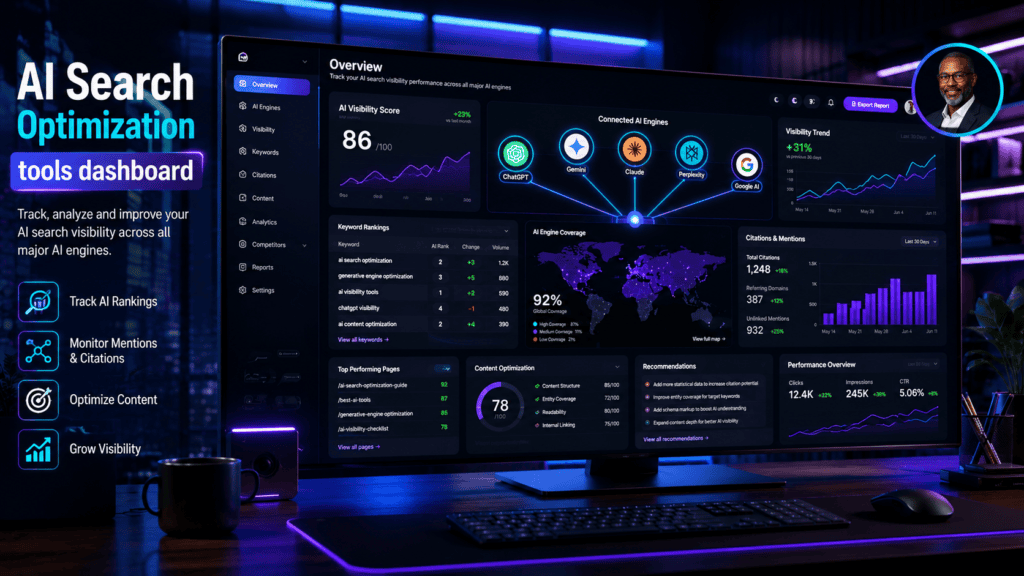
Search behavior has fundamentally shifted. Buyers increasingly start their journey by asking ChatGPT, Perplexity, or Google AI Overviews directly—instead of clicking through traditional search results. If your brand isn’t appearing in those AI-generated answers, you’re missing a rapidly growing share of the modern customer journey.
This guide is built for SEO professionals, digital marketers, content teams, business owners, and agency leaders looking to discover which AI search optimization tools deliver real, measurable results in 2026—and which platforms are actually worth your budget.
What You’ll Learn
- What AI Search Optimization Means: How Generative Engine Optimization (GEO) and Answer Engine Optimization (AEO) operate in practice.
- Why AI Visibility Matters: How to capture high-intent traffic as AI assistants become primary search tools.
- Detailed Tool Comparisons: How the 9 leading AI search optimization tools rank across pricing, key features, and engine coverage.
- Tailored Recommendations: Which specific AI search optimization tools fit your operational scale—from lean small businesses to multi-client agencies and enterprises.
- Strategic Playbooks: How to build a sustainable, long-term AI visibility strategy alongside traditional SEO.
Article Breakdown
To give you a clear roadmap, this guide is structured to help you make an informed decision efficiently:
- Foundational Concepts: A quick primer on AI search indexing, prompt tracking, and GEO mechanics.
- Product Reviews: In-depth analysis of the 9 best AI search optimization tools, complete with core features, pros, cons, and pricing tiers.
- Side-by-Side Comparison: A structured matrix evaluating engine coverage, tracking depth, and value for money.
- Decision Framework & FAQs: Practical guidelines to help you evaluate and choose the right AI search optimization tools with total confidence.
What Is AI Search Optimization?
AI search optimization—frequently referred to as Generative Engine Optimization (GEO) or Answer Engine Optimization (AEO)—is the strategic process of improving how often, how accurately, and how prominently your brand, products, or key insights are cited within AI-generated responses.
Instead of optimizing web pages to rank among traditional search engine “blue links,” AI search optimization targets the synthesized, conversational outputs generated by platforms like ChatGPT, Google AI Overviews, Perplexity, and Gemini.
Traditional Search (SEO)             AI Search (GEO / AEO)
┌───────────────────────┐           ┌───────────────────────┐
│     User Query        │           │     User Query        │
└───────────┬───────────┘           └───────────┬───────────┘
            │                                   │
            ▼                                   ▼
┌───────────────────────┐           ┌───────────────────────┐
│ Keyword Indexing      │           │ Retrieval-Augmented   │
│ & Backlink Graph      │           │ Generation (RAG)      │
└───────────┬───────────┘           └───────────┬───────────┘
            │                                   │
            ▼                                   ▼
┌───────────────────────┐           ┌───────────────────────┐
│ Ranked List of        │           │ Synthesized Answer    │
│ 10 Blue Links         │           │ + Primary Citations   │
└───────────────────────┘           └───────────────────────┘Code language: PHP (php)
The Architectural Shift: How AI Search Works
To optimize for AI engines, it helps to understand their underlying architecture:
- Retrieval-Augmented Generation (RAG): Modern AI search engines do not rely solely on their initial training data. When a user enters a query, the system retrieves relevant live content from vector databases or web indexes, then injects that context directly into the Large Language Model (LLM) to generate an answer.
- Citation Selection: The model evaluates retrieved sources for semantic match, entity authority, extractable facts, and brand consensus. It then synthesizes the response and attaches inline citations to the top sources used.
- Zero-Click Direct Answers: Because users receive immediate answers, the primary goal shifts from winning clicks to securing “answer real estate” and establishing brand presence in the generated synthesis.
What AI Search Optimization Tools Do
Dedicated AI search optimization tools bridge the gap between static web analytics and dynamic AI outputs by focusing on two core functional pillars:
| Capability Pillar | Core Functions & Deliverables | Strategic Impact |
| 1. Intelligence & Monitoring | • Tracking share of voice across ChatGPT, Perplexity, Gemini, and Google AIO. • Auditing prompt-level triggers (e.g., “What is the best CRM for startups?”). • Identifying which competitors are cited in place of your brand. | Maps your brand’s footprint in generative model outputs and establishes visibility baselines. |
| 2. Optimization & Actionability | • Generating structural recommendations (e.g., schema markup, factual density updates). • Highlighting unindexed knowledge gaps and citation vulnerabilities. • Guiding earned media and entity consensus building. | Informs content updates to maximize the probability of LLM citation retrieval. |
The Maturity Gap: While most AI search optimization tools currently excel at visibility monitoring, fewer platforms effectively link tracking data to direct attribution, revenue impact, or programmatic content optimization. Selecting a platform that moves beyond passive tracking into actionable optimization is critical for building a sustainable strategy.
Why Does AI Search Visibility Matter?
Three core structural shifts make securing AI search optimization tools and building generative visibility a top strategic priority:
The Exponential Growth of Zero-Click Discovery
Search behavior has fundamentally decoupled from traditional website clicking. Over 60% of traditional Google queries—and up to 80–83% of queries containing AI Overviews—now end as zero-click searches.
Buyers rely on ChatGPT, Perplexity, and Google AI Overviews to summarize options directly on the screen. If your brand isn’t embedded directly into that synthesized response, your business remains practically invisible—regardless of how well your site ranks in classic search engine results.
Traditional Funnel                    AI Search Synthesis
┌───────────────────────┐            ┌───────────────────────┐
│     Google Query      │            │       AI Prompt       │
└───────────┬───────────┘            └───────────┬───────────┘
            │                                    │
            ▼                                    ▼
┌───────────────────────┐            ┌───────────────────────┐
│ 10 Organic Links      │            │ Direct Synthesis      │
│ (User Clicks Around)  │            │ + Pre-Vetted Brands   │
└───────────┬───────────┘            └───────────┬───────────┘
            │                                    │
            ▼                                    ▼
┌───────────────────────┐            ┌───────────────────────┐
│ Evaluation On-Site    │            │ High-Intent Buyer     │
│ (Low Initial Intent)  │            │ (Arrives Pre-Convinced)│
└───────────────────────┘            └───────────────────────┘
High-Intent Traffic with Superior Conversion Rates
While total traffic volume from AI engines is smaller than traditional search, the traffic that does click through converts at dramatically higher rates.
┌─────────────────────────────────────────────────────────────┐
│ Channel Conversion Benchmarks                              │
├────────────────────────────────┬────────────────────────────┤
│ Traditional Organic Search     │ █ 1.8% - 2.8%              │
│ Social Media Referrals         │ █ 1.5% - 2.0%              │
│ AI Engine Referrals (Avg.)     │ ████████ 14.2% - 18.0%      │
└────────────────────────────────┴────────────────────────────┘Code language: CSS (css)- Pre-Qualified Decision Making: Visitors from AI platforms arrive having already consumed a tailored summary, compared options, and evaluated recommendations. They visit your site to complete an action, driving conversion rates upwards of 4.4x to 5x higher than standard search.
- Massive Commercial Impact: Real-world implementations show that even when AI referral traffic represents roughly 1 in 50 (2%) total site visitors, that hyper-focused segment can drive 20x revenue growth in AI-attributed sales.
Early Entity Advantage and Compounding Authority
LLMs and vector-based answer engines rely on entity recognition and consensus building.
When a brand consistently gets cited across web indexes, authoritative directories, and expert databases, generative models classify it as a trusted entity for specific topic clusters. Brands that deploy dedicated AI search optimization tools early build a strong “entity authority” foundation that competitors will find increasingly difficult to displace as model memory and index weights solidify over time.
How AI Search Optimization Tools Work
Modern AI search optimization tools operate using programmatic workflows to track, score, and optimize content for large language models and Retrieval-Augmented Generation (RAG) engines.
                        AI TRACKING WORKFLOW

  ┌─────────────────┐       ┌─────────────────┐       ┌─────────────────┐
  │  1. PROMPT SET  │  ───► │  2. MULTI-ENGINE│  ───► │ 3. CITATION &   │
  │   GENERATION    │       │     QUERYING    │       │ SENTIMENT ANALYSIS│
  └─────────────────┘       └─────────────────┘       └─────────────────┘
                                                               │
                                                               ▼
                            ┌─────────────────┐       ┌─────────────────┐
                            │  5. ACTIONABLE  │  ◄─── │  4. COMPETITOR  │
                            │ RECOMMENDATIONS │       │  BENCHMARKING   │
└─────────────────┘ └─────────────────┘- Prompt-Level Tracking: Defining Target Conversational Queries – You define your brand, domain, and primary products, or let the platform auto-generate buyer-journey prompt sets (covering awareness, consideration, and comparison queries). The tool schedules and executes these prompts across engines like ChatGPT, Perplexity, Gemini, Claude, and Google AI Overviews repeatedly.
- Visibility & Sentiment Measurement: Extracting Core Response Metrics – The engine captures full conversational outputs and calculates core visibility performance metrics:
- Visibility Score: The overall composite index representing your brand’s presence across target prompt sets.
- Mention Rate: The total percentage of responses that explicitly mention your brand name or product lines.
- Owned vs. Earned Citations: Distinguishing between direct links to your domain (owned) versus indirect citations in third-party publications, review sites, or Reddit threads (earned).
- Sentiment & Context: Evaluating whether the model presents your brand as a top recommendation, a neutral mention, or a conditional warning.
- 3Competitor Benchmarking: Mapping Share of Voice & Gap Analysis – The platform runs identical prompt sets against competitors. This reveals which third-party media outlets, directories, or industry databases AI engines cite when recommending rival products instead of yours.
- Actionable Optimization Recommendations: Generating GEO & Technical Audit Tasks – Advanced AI search optimization tools translate visibility gaps into prioritized tasks. They generate structured schema recommendations, content depth updates, and entity consensus briefs designed to improve your retrieval probabilities in upcoming model runs.
Critical Technical Consideration: UI Scraping vs. API Querying
When evaluating AI search optimization tools, pay close attention to how they retrieve response data:
| Retrieval Method | Mechanics | Accuracy & Realism |
| Browser Automation (UI Scraping) | Tools run headless browser sessions mimicking real user interactions directly inside web UIs. | High Realism. Reflects the exact web search integrations, real-time RAG web browsing, and system prompts that end-users see. |
| Direct API Requests | Tools query official provider endpoints (e.g., OpenAI API, Anthropic API). | Lower UI Parity. API responses often bypass real-time web search layers or run on different system instructions, causing up to a 25% divergence in output compared to public UIs. |
Takeaway: For consumer-facing platforms like ChatGPT Web, Perplexity, or Google AI Overviews, select AI search optimization tools that incorporate headless UI sampling or hybrid data retrieval to ensure your visibility data mirrors real consumer experiences.
9 Best AI Search Optimization Tools Compared
The following AI search optimization tools were evaluated based on AI engine coverage, features, pricing, ease of use, integrations, and the types of users they are best suited for.
Surfer AI Tracker
Surfer AI Tracker blends traditional on-page SEO intelligence with real-time generative visibility tracking. By bridging keyword optimization with AI engine analytics inside a single workflow, it stands as one of the most comprehensive platforms for content teams, digital agencies, and SEO specialists seeking to own both traditional search and AI-generated answer engines.
Core Specifications & AI Capabilities
- Platform Type: Web-based SaaS platform.
- Engine Coverage: Tracks visibility across ChatGPT, Perplexity, Gemini, Google AI Overviews, and Claude.
- Tracking Method: Uses headless browser UI scraping (capturing real user-facing web responses) rather than relying exclusively on API endpoints.
- Data Refresh Cadence: Daily updates on Pro+ plans (weekly on entry-level tiers).
- Integrations: Direct publishing and live content editing via WordPress, Webflow, Google Docs, and Jasper.
- Target Audience: Content marketers, SEO agencies, and growth teams scaling search and AI visibility simultaneously.
Standout AI Features
┌─────────────────────────────────────────────────────────────┐
│                 SURFER AI TRACKER WORKFLOW                 │
├───────────────────────┬─────────────────────────────────────┤
│ 1. REAL UI SCRAPING   │ Headless browsing captures real     │
│                       │ user-facing ChatGPT & AIO answers   │
├───────────────────────┼─────────────────────────────────────┤
│ 2. METRIC COMPOSITES  │ Aggregates Visibility Score,        │
│                       │ Mention Rates, and Position Data    │
├───────────────────────┼─────────────────────────────────────┤
│ 3. PROMPT FAN-OUTS    │ Maps buyer-intent queries to topic  │
│                       │ gaps & competitor citations         │
├───────────────────────┼─────────────────────────────────────┤
│ 4. DIRECT ACTION      │ Pushes optimization briefs directly │
│                       │ into the Surfer Content Editor      │
└───────────────────────┴─────────────────────────────────────┘- Real-User Interface Scraping: Unlike tools that rely strictly on standard API calls, Surfer captures actual web UI outputs. This eliminates up to 25% of response discrepancies caused by API vs. UI search integrations.
- Composite Metric Dashboards: Tracks holistic Visibility Scores, Mention Rates, and Average Recommendation Positions across all major engines simultaneously.
- Prompt Fan-Outs & Content Gap Discovery: Auto-generates high-intent query variations and identifies which third-party domain citations competitors are using to steal share-of-voice.
- Seamless Actionability: Moves directly from visibility insights into content execution via Surfer’s core Content Editor and Topical Map tools, allowing you to optimize directly for missing entity consensus.
Pros & Cons
| Strengths (Pros) | Limitations (Cons) |
| • High Accuracy: UI scraping delivers real-world fidelity for live user chats. • Unified Workflow: Connects AI visibility tracking with proven on-page SEO audits, keyword research, and content score editors. • Cost Efficiency: Significantly cheaper than subscribing to standalone SEO and GEO tracking platforms separately. • Clear Actionability: Translates raw tracking data into concrete content update recommendations. | • Prompt Costs Scale Quickly: Adding extensive lists of tracked queries across multiple client brands can drive plan costs up. • No Standalone Tier: You must subscribe to Surfer’s core content suites to access the AI Tracker suite. • Overkill for Starter Sites: Too feature-dense and expensive for personal blogs or basic affiliate sites. |
Pricing & Value Breakdown
Surfer AI Tracker is integrated directly into Surfer’s tiered SaaS plans:
- Standard Plan ($99–$119/mo): Includes 25 tracked prompts (refreshed weekly) across basic ChatGPT models.
- Pro Plan ($182–$219/mo): Unlocks 50 tracked prompts with daily refreshes across all 5 engines, plus 5 brand workspaces.
- Peace of Mind Plan ($299–$359/mo): Expands to 100 tracked prompts with daily updates across all models, custom templates, and dedicated support.
Alternatives & Market Positioning
- Semrush AI Toolkit: Best if you need traditional backlink analysis and broader organic keyword databases bundled alongside basic AI monitoring.
- Otterly.AI: A lighter, lower-cost alternative suited for solo operators who only need passive visibility monitoring without content creation tools.
Verdict: Best Overall for Content & SEO Teams. Surfer AI Tracker is the premier choice for organizations that want to monitor AI visibility and immediately turn those insights into rank-ready, optimized content within a single platform.
Amplitude AI Visibility
Amplitude AI Visibility is a product-analytics-driven answer engine optimization (AEO) platform. Originally built for product and conversion analytics, Amplitude’s expansion into AI search optimization allows teams to map how AI mentions in engines like ChatGPT, Gemini, and Google AI Overviews correlate directly with downstream site visits, user signups, and conversion funnels.
Core Specifications & AI Capabilities
- Platform Type: Integrated Analytics & SaaS Module.
- Engine Coverage: ChatGPT and Google AI Overviews on base tiers; expands to Perplexity and Gemini on Advanced tiers.
- Tracking Method: Automated prompt querying across topics, brands, and URLs.
- Data Refresh Cadence: Weekly updates on entry plans; daily refreshes on Growth/Enterprise tiers.
- Integrations: Direct pipeline ingestion into Amplitude Analytics, Session Replay, and Cohort Builder.
- Target Audience: Product managers, growth marketers, and analytics teams seeking to link AI visibility directly to downstream revenue and user behavior.
Standout AI Features
┌─────────────────────────────────────────────────────────────┐
│             AMPLITUDE AI VISIBILITY WORKFLOW               │
├───────────────────────┬─────────────────────────────────────┤
│ 1. ONE-CLICK SCANNING │ Initial instant audit across core   │
│                       │ topics, prompts, and competitors   │
├───────────────────────┼─────────────────────────────────────┤
│ 2. DOWNSTREAM PIPELINE│ Ingests AI visibility events into   │
│                       │ custom conversion funnels & cohorts │
├───────────────────────┼─────────────────────────────────────┤
│ 3. MATRIX BENCHMARKS  │ Multi-brand share-of-voice and      │
│                       │ citation-source breakdown           │
├───────────────────────┼─────────────────────────────────────┤
│ 4. ACTION SIMULATOR   │ Page-level analysis that simulates  │
│                       │ content edits before live publishing│
└───────────────────────┴─────────────────────────────────────┘- Integrated Conversion Attribution: The biggest differentiator of Amplitude AI Visibility is its ability to push visibility snapshots into Amplitude’s broader analytics stack as custom events (
[AI Visibility] Brand Snapshot). This enables product teams to answer critical ROI questions, such as whether users arriving from AI search convert faster than those from traditional organic search. - Page-Level Action Simulator: Includes an “Analyze Page” feature where you can input a URL or raw content block, receive recommended schema or factual adjustments, and run simulated tests against AI prompts to gauge potential rank changes before going live.
- Multi-Dimension Competitor Benchmarks: Maps your brand against competitors across Mentions, Average Position, and Citation Sources, offering matrix and one-to-one comparison views.
- Sentiment & Topic Ingestion: Evaluates how positively AI engines present your brand and flags contextual sentiment issues.
Pros & Cons
| Strengths (Pros) | Limitations (Cons) |
| • Conversion & Revenue Mapping: Uniquely links AEO data directly to downstream product usage, cohorts, and conversion funnels. • No-Barrier Testing: Offers an accessible initial scan to evaluate baseline brand presence across prompts. • Simulated Recommendations: Allows content teams to edit text in a sandbox and test AI responses before publishing live updates. • Enterprise Product UX: Leverages a highly polished interface designed for cross-functional marketing and product analytics teams. | • Static Free Tier: The standalone starter tier provides a single-time snapshot check with no ongoing recurring refreshes. • Tiered Engine Access: Full access to engines like Gemini or Claude requires higher-tier or enterprise plans. • Requires Analytics Stack Alignment: Maximum value comes when paired with Amplitude’s broader event-tracking ecosystem rather than as a standalone SEO tool. |
Pricing & Value Breakdown
- Starter / Free Snapshot: Includes up to 500 prompts for an initial visibility audit. (Note: Free tier provides a single static report without automated recurring refreshes).
- Plus Tier ($49/mo): Expands coverage up to 1,000 tracked prompts with weekly report refreshes across primary engines like ChatGPT and Google AIO.
- Growth & Enterprise Plans (Custom): Unlocks 2,500 to 5,000+ active prompts, daily data refreshes, full multi-engine coverage (Perplexity, Gemini, Claude), and custom workspace event ingestion.
Alternatives & Market Positioning
- MaxAEO: A specialized standalone AEO monitoring platform suited for content teams that do not require enterprise product analytics.
- Rankscale AI: Another lightweight tracking option offering basic entry tiers for quick competitor share-of-voice checks.
Verdict: Best for Product & Data-Driven Growth Teams. Amplitude AI Visibility is the clear winner for companies already using product analytics platforms that need to tie AI search citations directly to downstream conversions, retention curves, and actual user revenue.
Rankscale AI
Rankscale AI is a purpose-built Generative Engine Optimization (GEO) platform that diagnoses content “AI readiness” before tracking begins. Unlike traditional SEO platforms that tacked on AI features, Rankscale was engineered specifically to evaluate how LLMs extract, synthesize, and cite source materials. It provides a low-friction entry point for small businesses, growth teams, and agencies seeking multi-engine visibility insights.
Core Specifications & AI Capabilities
- Platform Type: Web-based SaaS platform.
- Engine Coverage: Supports 17+ AI platforms, including ChatGPT, Perplexity, Gemini, Google AI Overviews, Claude, DeepSeek, Grok, and Copilot.
- Tracking Method: Recreates exact consumer prompts and samples LLM response data, citation sources, and brand sentiments.
- Data Refresh Cadence: Configurable schedules (hourly, daily, or weekly depending on credits).
- Integrations: REST API access, Looker Studio connectors, white-labeled dashboard export capabilities, and partner agency workflows.
- Target Audience: SMBs, SEO consultants, and multi-brand agencies looking for cost-effective GEO tracking without per-engine add-on fees.
Standout AI Features
┌─────────────────────────────────────────────────────────────┐
│                 RANKSCALE AI CORE WORKFLOW                  │
├───────────────────────┬─────────────────────────────────────┤
│ 1. AI READINESS AUDIT │ Evaluates technical crawlability,   │
│                       │ authority, and factual density      │
├───────────────────────┼─────────────────────────────────────┤
│ 2. WIDE MODEL COVERAGE│ Samples outputs across 17+ LLM      │
│                       │ models from a single dashboard      │
├───────────────────────┼─────────────────────────────────────┤
│ 3. SENTIMENT ANALYSIS │ Quantifies whether brand mentions   │
│                       │ are positive, neutral, or critical  │
├───────────────────────┼─────────────────────────────────────┤
│ 4. CITATION MAPPING   │ Pinpoints exact third-party URLs    │
│                       │ AI engines cite instead of you      │
└───────────────────────┴─────────────────────────────────────┘Code language: JavaScript (javascript)- AI Readiness Diagnostic Score: Before spending tracking credits, Rankscale runs a 200+ point page audit that rates content quality, entity authority, technical crawlability, and factual density to spot indexing bottlenecks early.
- Broad Multi-Engine Surface: Evaluates brand presence across 17+ generative platforms—including niche models like DeepSeek and Grok alongside ChatGPT and Gemini—without locking coverage behind add-on fees.
- Citation & Sentiment Analysis: Tracks owned versus earned domain citations and measures sentiment nuance at both the brand level and competitor level.
- Cloud Run Limits & Topic Clustering: Helps teams organize prompts into topical clusters while setting usage limits to manage monthly credit consumption.
Pros & Cons
| Strengths (Pros) | Limitations (Cons) |
| • Pre-Tracking Readiness Score: Diagnoses technical and structural gaps before committing tracking budget. • Broad Engine Range: Covers 17+ AI platforms out of the box, offering wider engine variety than most competitors. • Integrated Sentiment Tracking: Measures sentiment quality alongside raw brand mention counts. • Accessible Entry Pricing: Entry tier (~€20/month) makes it one of the most budget-friendly GEO tools available. | • Output-Only Monitoring: Tracks generated text outputs but does not monitor backend AI crawler user-agent visits to your site. • No In-App Content Editor: Provides actionable audit briefs but lacks native text-editing or publishing capabilities (fixes must be made manually in your CMS). • Credit-Based Scaling: Heavy tracking across dozens of prompts and models can burn monthly credits rapidly. |
Pricing & Value Breakdown
Rankscale AI utilizes a tiered credit system with access to all 17+ models on every level:
- Essentials Tier (€20/mo): 2 Brand Dashboards, 120 credits (~480 AI responses), and basic web audits. Ideal for freelancers and individual sites.
- Pro Tier (€99/mo): 10 Brand Dashboards, 1,200 credits (~4,800 AI responses), 50 web audits, and full prompt research capabilities.
- Growth Tier (€385/mo): 50 Brand Dashboards, 5,500 credits, Looker Studio export, REST API access, and white-labeled links for agency portfolios.
- Enterprise Tier (€780/mo): 100 Brand Dashboards, 12,000 credits (~48,000 AI responses), dedicated support, and custom data workflows.
Alternatives & Market Positioning
- Amplitude AI Visibility: A free alternative for quick, low-barrier snapshot checks when detailed historical tracking isn’t required.
- Otterly.AI: A competing lightweight monitoring platform suited for teams that prefer simpler prompt-based alert systems.
Verdict: Best for Diagnosing Gaps & Budget-Conscious Teams. Rankscale AI is ideal for SMBs and SEO consultants who want to audit content “AI readiness,” monitor sentiment across a broad range of AI engines, and track visibility without paying premium enterprise prices.
SE Ranking
SE Ranking integrates traditional keyword rank tracking with dedicated AI search optimization tools inside a single, unified SEO platform. Known for its robust backlink databases and site audit capabilities, SE Ranking allows marketing teams and digital agencies to monitor organic search performance alongside generative AI citations without managing multiple separate software subscriptions.
Core Specifications & AI Capabilities
- Platform Type: Web-based SaaS platform.
- Engine Coverage: Google AI Overviews, Google AI Mode, ChatGPT, Perplexity, and Gemini.
- Tracking Method: Hybrid prompt-level tracking and SERP-integrated response scraping.
- Data Refresh Cadence: Daily updates on standard tracking; customizable recurring intervals for AI prompt packages.
- Integrations: Direct pipeline integration with Google Analytics 4 (GA4), Google Search Console, Looker Studio, and Zapier.
- Target Audience: SEO professionals, growth marketers, and multi-client agencies expanding their traditional organic search workflows into AI search optimization.
Standout AI Features
┌─────────────────────────────────────────────────────────────┐
│                 SE RANKING UNIFIED WORKFLOW                 │
├───────────────────────┬─────────────────────────────────────┤
│ 1. AI SEARCH MODULE   │ Tracks brand presence & citations   │
│                       │ across Google AIO, ChatGPT & Gemini │
├───────────────────────┼─────────────────────────────────────┤
│ 2. INSIGHTS ENGINE    │ Translates prompt gaps into clear,  │
│                       │ actionable SEO & content updates    │
├───────────────────────┼─────────────────────────────────────┤
│ 3. COMPETITOR BENCH   │ Analyzes competitor AI visibility   │
│                       │ for any domain without project setup│
├───────────────────────┼─────────────────────────────────────┤
│ 4. GA4 TRAFFIC LINK   │ Maps AI search citations to real    │
│                       │ referral traffic and goal leads     │
└───────────────────────┴─────────────────────────────────────┘- Integrated AI Search Tracking: Tracks brand mentions, position data, and citations across 5 major generative platforms directly inside the primary keyword tracking interface.
- Actionable Insights Engine: Moves beyond raw tracking metrics by generating specific, prioritized action items (e.g., content depth updates, schema fixes, and citation gap closures) to improve future AI outputs.
- Domain-Wide AI Competitor Research: Enables teams to run instant competitor audits against any domain to see where rivals appear in AI search answers—without needing to configure a full project baseline first.
- GA4 Traffic & Attribution Mapping: Connects visibility trends from AI search optimization tools to real organic and referral traffic data inside Google Analytics 4, providing tangible revenue context.
Pros & Cons
| Strengths (Pros) | Limitations (Cons) |
| • Unified Ecosystem: Combines AI search optimization tools with full-suite traditional SEO features (backlink checks, site audits, and rank tracking). • GA4 Attribution: Directly connects AI citation data to real website traffic and conversion goals. • Instant Competitor Benchmarking: Evaluates rival domains in AI responses instantly without dedicated setup requirements. • Agency-Ready Scaling: Offers unlimited user seats on standard plans and robust client reporting capabilities. | • Layered Add-On Pricing: Full access to advanced AI Search features requires a separate monthly add-on fee on top of base plan costs. • Steep Learning Curve: Feature-dense dashboard can feel overwhelming for solo freelancers or non-technical users. • No Hallucination Detection: Lacks automated flags to detect when AI platforms generate false or inaccurate statements about your brand. |
Pricing & Value Breakdown
SE Ranking structures its pricing using a core platform subscription paired with an optional AI tracking module:
- Core Plans (Essential / Pro / Business): Base plans range from $52/month to $235+/month, providing standard SEO audits, rank tracking, and basic AI Overview monitoring.
- AI Search Add-On: Available starting at $89/month (or ~$71/month on annual billing), unlocking multi-engine AI prompt tracking across ChatGPT, Perplexity, Gemini, and Google AIO with historical trend data.
- SE Visible Standalone Suite: For teams wanting only generative search tracking without the traditional SEO toolkit, SE Ranking offers standalone packages starting from $189/month.
Alternatives & Market Positioning
- Surfer AI Tracker: Better suited for teams that want an integrated on-page content editor directly tied to their AI search tracking workflow.
- Moz Pro / Semrush: Traditional SEO platform alternatives, though SE Ranking offers a more seamless blend of AI prompt tracking at a competitive total price point.
Verdict: Best for Integrated Traditional & AI Search Workflows. SE Ranking is the premier choice for agencies and SEO teams that want to manage classic rank tracking alongside modern AI search optimization tools within a single centralized platform.
Ahrefs Brand Radar
Ahrefs Brand Radar is an enterprise-grade module built directly into the Ahrefs SEO ecosystem. Operating on a database of over 270 million search-backed prompts, it provides brands and digital agencies with large-scale visibility intelligence without requiring users to manually predefine every prompt. By cross-referencing AI mentions with Ahrefs’ massive domain authority and backlink indexes, it stands out among AI search optimization tools for macro-level competitive research.
Core Specifications & AI Capabilities
- Platform Type: Web-based SaaS (available as a paid add-on module to core Ahrefs plans).
- Engine Coverage: ChatGPT, Perplexity, Gemini, Google AI Overviews, Google AI Mode, and Microsoft Copilot.
- Tracking Method: Runs search-backed prompt queries sampled from Google’s People Also Ask corpus and Ahrefs’ keyword database, combined with custom user prompt tracking.
- Data Refresh Cadence: Daily updates for custom-tracked prompts and monthly refresh cycles for database prompt sets.
- Integrations: Direct ecosystem crossover with Ahrefs Site Explorer, Keywords Explorer, and Content Explorer.
- Target Audience: Enterprise SEO teams, multi-client agencies, and brand marketers already embedded in the Ahrefs platform who require deep competitive intelligence.
Standout AI Features
┌─────────────────────────────────────────────────────────────┐
│              AHREFS BRAND RADAR DATA PIPELINE              │
├───────────────────────┬─────────────────────────────────────┤
│ 1. 270M+ PROMPT INDEX │ Queries real search-backed questions│
│                       │ sampled across major AI engines     │
├───────────────────────┼─────────────────────────────────────┤
│ 2. METRIC SYNTHESIS   │ Models AI Share of Voice (SOV) and  │
│                       │ Estimated AI Impressions            │
├───────────────────────┼─────────────────────────────────────┤
│ 3. CITATION CROSS-REF │ Connects citations directly to      │
│                       │ Ahrefs Domain Rating (DR) & links   │
├───────────────────────┼─────────────────────────────────────┤
│ 4. MULTI-CHANNEL DATA │ Correlates web citations with       │
│                       │ YouTube and Reddit brand mentions   │
└───────────────────────┴─────────────────────────────────────┘Code language: JavaScript (javascript)- Massive Search-Backed Prompt Database: Evaluates your brand across hundreds of millions of real-world queries out of the box, reducing the manual setup time typical of basic AI search optimization tools.
- Backlink & Authority Integration: Cites pulled by AI models open directly into Ahrefs Site Explorer. This allows teams to instantly evaluate the Domain Rating (DR) and backlink strength of the third-party pages driving AI recommendations.
- AI Share of Voice (SOV) & Market Demand: Quantifies your brand’s total presence versus competitors across targeted topics, industries, or prompt clusters.
- Multi-Channel Mention Tracking: Monitors unlinked brand mentions and citations across search engines, YouTube, and Reddit to map full-funnel visibility.
Pros & Cons
| Strengths (Pros) | Limitations (Cons) |
| • Macro-Scale Insights: Uncovers brand mentions across millions of search-backed prompts without tedious manual entry. • Deep SEO Crossover: Links AI citations directly to Ahrefs’ industry-standard backlink and organic search data. • Granular Filtering: Fast filtering by brand, domain, page, topic, or cited URL. • Unified Ecosystem: Eliminates the need for a separate vendor login for teams already using Ahrefs. | • High Investment: Requires an underlying Ahrefs base subscription plus add-on fees, pricing out smaller businesses. • Missing Niche Models: Coverage focuses on top engines but lacks platforms like Claude, Grok, or DeepSeek. • Analysis Over Optimization: Focuses heavily on visibility research and monitoring rather than providing native content-editing tools. |
Pricing & Value Breakdown
Brand Radar requires an active Ahrefs base plan (Lite, Standard, Advanced, or Enterprise):
- Base Ahrefs Subscription: Starts at $129/month (Lite) or $249/month (Standard).
- Brand Radar Module Add-On: Starts at $199/month for a single AI index or $398–$699/month for full access across all 6 engines plus custom prompt check packages.
- Custom Prompt Packages: Additional prompt-tracking checks start at $50/month for 2,500 monthly checks.
Alternatives & Market Positioning
- Semrush AI Visibility Toolkit: The direct competitor for teams that prefer the Semrush suite over Ahrefs for integrated traditional and generative search tracking.
- Profound AI: An enterprise-focused alternative designed specifically for deep conversational analytics and prompt fan-out tracking.
Verdict: Best for Enterprise Teams & Existing Ahrefs Power Users. Ahrefs Brand Radar is the premier choice for established brands that want to leverage massive backlink databases and search-backed data to track AI search optimization across major answer engines.
Otterly.AI
Otterly.AI is an entry-level, self-serve answer engine optimization (AEO) tracking tool. Built to help marketing, content, and agency teams continuously monitor brand visibility, Otterly automates prompt checks across engines like ChatGPT, Google AI Overviews, Perplexity, and Microsoft Copilot. It provides accessible, automated monitoring and citation tracking for brands entering generative search without large software investments.
Core Specifications & AI Capabilities
- Platform Type: Web-based SaaS platform.
- Engine Coverage: 4 core engines included on base tiers (ChatGPT, Google AI Overviews, Perplexity, Microsoft Copilot), with paid add-on options available for Google Gemini, Google AI Mode, and Claude.
- Tracking Method: Automated prompt querying across 50+ country/language markets.
- Data Refresh Cadence: Daily updates on custom-tracked prompts.
- Integrations: Public REST API, Model Context Protocol (MCP) server, and Looker Studio connector available on Standard tiers and above.
- Target Audience: SMBs, content marketers, and digital agencies seeking cost-effective AI search optimization tools with unlimited team user seats.
Standout AI Features
┌─────────────────────────────────────────────────────────────┐
│                 OTTERLY.AI AUTOMATED PIPELINE               │
├───────────────────────┬─────────────────────────────────────┤
│ 1. AI PROMPT RESEARCH │ Converts traditional target seed    │
│                       │ keywords into real consumer prompts │
├───────────────────────┼─────────────────────────────────────┤
│ 2. DAILY AUTOMATION   │ Runs scheduled prompts across major │
│                       │ engines without manual execution    │
├───────────────────────┼─────────────────────────────────────┤
│ 3. LINK CITATIONS     │ Tracks owned vs. competitor URL     │
│                       │ citations and rank movements        │
├───────────────────────┼─────────────────────────────────────┤
│ 4. GEO AUDIT (25+ PT) │ Evaluates on-page factors to fix    │
│                       │ crawlability and citation gaps      │
└───────────────────────┴─────────────────────────────────────┘Code language: CSS (css)- AI Prompt Research & Discovery: Converts standard seed keywords into natural-language consumer prompts that users type directly into AI assistants.
- Automated Search Prompt Monitoring: Runs scheduled prompts daily across base engines, storing historical outputs to track brand visibility shifts over time.
- Citation & Domain Movement Tracking: Monitors every cited URL and domain, logging weekly rank changes to highlight which content assets are earning AI references.
- Generative Engine Optimization (GEO) Audit: Evaluates 25+ on-page criteria (on Standard+ plans) to identify crawlability bottlenecks, entity gaps, and actionable content optimizations.
Pros & Cons
| Strengths (Pros) | Limitations (Cons) |
| • Low Barrier Entry: The $29/month Lite plan makes it one of the most affordable paid options among dedicated AI search optimization tools. • Unlimited Team Seats: Does not charge per-user seat fees on any tier, making client and team access simple. • Global Market Coverage: Supports multi-country tracking across 50+ markets out of the box. • Automated URL Citation Audits: Automatically tracks every cited link without requiring complex manual setups. | • Paid Engine Add-Ons: Engines like Gemini, Google AI Mode, and Claude are charged as add-on fees, which can quickly increase overall monthly costs. • Tight Prompt Caps on Entry: The $29/mo plan includes only 15 prompts, requiring upgrades as query volume scales. • Lacks Native Content Editing: Provides audit diagnostics, but content changes must be published externally in your CMS. |
Pricing & Value Breakdown
Otterly.AI uses a self-serve tiered pricing structure based on tracked prompt volumes:
- Lite Plan ($29/mo): Includes 15 tracked prompts, 4 base engines, 1,000 GEO URL audits, and multi-country support for 1 workspace.
- Standard Plan ($189/mo): Expands to 100 tracked prompts, 5,000 GEO URL audits, unlimited team seats, Looker Studio connectors, REST API, and MCP access.
- Premium Plan ($489/mo): Scales to 400 tracked prompts, 10,000 GEO URL audits, and higher API limits for agencies and larger brand portfolios.
- Engine Add-Ons: Gemini/AI Mode add-ons range from $9 to $149/mo; Claude add-ons range from $29 to $439/mo depending on plan tier. (Annual billing offers a ~15% discount across all tiers).
Alternatives & Market Positioning
- Rankscale AI: Another affordable alternative starting around €20/mo, offering diagnostic readiness scores and wide engine coverage out of the box.
- Profound AI: Built for enterprise teams requiring deeper prompt fan-out tracking, conversion attribution, and advanced brand analytics.
Verdict: Best Affordable Entry Point for Teams. Otterly.AI is an ideal choice for marketers and agencies seeking a straightforward, low-cost platform to start monitoring AI citations and prompt visibility without heavy initial financial commitments.
Profound
Profound is an enterprise-grade platform dedicated to Generative Engine Optimization (GEO) and Answer Engine Optimization (AEO). Engineered specifically for Fortune 500 brands, regulated organizations, and high-volume digital agencies, Profound goes beyond basic prompt monitoring to provide deep AI crawler tracking (Agent Analytics), enterprise data controls (SOC 2 Type II / HIPAA compliance), and revenue attribution models.
Core Specifications & AI Capabilities
- Platform Type: Enterprise Web-Based SaaS Platform.
- Engine Coverage: 10+ AI platforms, including ChatGPT, Gemini, Perplexity, Claude, Google AI Overviews, Google AI Mode, Microsoft Copilot, and DeepSeek.
- Tracking Method: Continuous headless UI sampling and programmatic API monitoring, supplemented by Agent Analytics to monitor backend AI web crawler bot traffic.
- Data Refresh Cadence: Daily refresh on Growth tiers; configurable near-real-time updates on Enterprise plans.
- Integrations: Direct pipeline integrations with Google Analytics 4 (GA4), Salesforce CRM, Looker Studio, REST APIs, and custom enterprise data warehouses.
- Target Audience: Enterprise marketing teams, regulated industries (finance, healthcare, legal), and large agencies needing compliance-grade audit trails.
Standout AI Features
┌─────────────────────────────────────────────────────────────┐
│                 PROFOUND ENTERPRISE WORKFLOW                │
├───────────────────────┬─────────────────────────────────────┤
│ 1. AGENT ANALYTICS    │ Monitors backend AI crawler access  │
│                       │ (GPTBot, ClaudeBot, PerplexityBot)  │
├───────────────────────┼─────────────────────────────────────┤
│ 2. PROMPT VOLUMES     │ Analyzes real conversational trends │
│                       │ and high-intent buyer prompts       │
├───────────────────────┼─────────────────────────────────────┤
│ 3. REVENUE ATTRIBUTION│ Connects AI mentions to GA4 leads,  │
│                       │ sales pipelines, and conversions    │
├───────────────────────┼─────────────────────────────────────┤
│ 4. AI CONTENT AGENTS  │ Generates data-backed AEO templates │
│                       │ and automated site content updates  │
└───────────────────────┴─────────────────────────────────────┘- Agent Analytics (AI Bot Tracking): Tracks backend AI crawler visits (e.g., OpenAI’s GPTBot, Anthropic’s ClaudeBot, PerplexityBot). This reveals whether answer engines are indexing your web pages before responses ever appear in user chats.
- Prompt Volume & Intent Intelligence: Measures real-world search volume across generative engines to reveal how buyers query platforms like ChatGPT or Perplexity for brand recommendations.
- Enterprise Compliance & Security: Built with SOC 2 Type II controls, SAML/SSO single sign-on, and HIPAA compliance protocols, satisfying strict security mandates for financial, legal, and healthcare organizations.
- GA4 Revenue & Conversion Attribution: Maps AI search citations to real website sessions, lead captures, and sales conversions within Google Analytics 4 and enterprise CRMs.
Pros & Cons
| Strengths (Pros) | Limitations (Cons) |
| • Enterprise Security: SOC 2 Type II compliance and SAML/SSO satisfy stringent corporate IT requirements. • Backend Crawler Insights: Agent Analytics tracks live AI web scraper bots alongside frontend user answers. • Deep Revenue Mapping: Ties AI mentions directly to GA4 conversion funnels and pipeline value. • Integrated AI Content Agents: Generates structured AEO templates to help teams update content for higher citation rates. | • High Total Cost: Lower-tier plans restrict engine coverage (e.g., Starter covers ChatGPT only), requiring upgrades to access multi-engine tracking. • Complex Onboarding: Enterprise capabilities require dedicated technical setup and strategic onboarding. • No Public Free Trial: Requires contacting sales or scheduling a product demo to evaluate full platform capabilities. |
Pricing & Value Breakdown
Profound offers tiered subscriptions tailored for corporate brands and digital agencies:
- Profound Starter ($99/mo): Includes 50 tracked prompts (1,500 monthly responses) and 1 user seat, but tracks ChatGPT only.
- Profound Growth ($399/mo): Expands to 100 tracked prompts (9,000 monthly responses), 3 user seats, multi-engine tracking (ChatGPT, Perplexity, Google AIO), and 6 AI-optimized content articles per month.
- Enterprise Tier (Custom / $2,000+/mo): Unlocks 10+ AI engines, unlimited domain workspaces, SAML/SSO, dedicated Slack support, SOC 2 compliance, and custom prompt check volumes.
- Agency Plans ($99/mo base + $399/mo per full client workspace): Features dedicated prospect pitching workspaces and agency management portals.
Alternatives & Market Positioning
- Semrush AI Visibility Toolkit: A strong choice for growth marketing teams that need multi-engine tracking tied to a standard SEO suite rather than an enterprise security platform.
- Ahrefs Brand Radar: An alternative for SEO teams seeking large-scale prompt database analysis backed by traditional backlink data.
Verdict: Best for Enterprise Teams & Regulated Industries. Profound is the top solution for Fortune 500 brands, enterprise organizations, and compliance-driven sectors that require SOC 2-certified security, AI bot crawler tracking, and deep revenue attribution models across AI search optimization tools.
Promptwatch
Promptwatch is a Generative Engine Optimization (GEO) platform focused on prompt-level granularity and backend AI crawler visibility. Designed for SEO specialists, content teams, and digital agencies, Promptwatch tracks brand mentions, cited source URLs, and competitive positioning across 10+ AI engines. Beyond surface-level dashboard metrics, it offers AI crawler logs (Agent Analytics), a Model Context Protocol (MCP) server, and automated AEO content generation to help teams close visibility gaps.
Core Specifications & AI Capabilities
- Platform Type: Web-based SaaS platform.
- Engine Coverage: 10+ AI models including ChatGPT, Perplexity, Google AI Overviews, Google AI Mode, Gemini, Claude, DeepSeek, Grok, and Meta AI.
- Tracking Method: Combines headless UI scraping with direct API querying across country, state, and city-level locations.
- Data Refresh Cadence: Daily updates on paid plans.
- Integrations: Native Model Context Protocol (MCP) server, REST API, Looker Studio / Data Studio connector, and GA4 traffic attribution.
- Target Audience: SEO consultants, content marketers, SaaS companies, and digital marketing agencies seeking prompt-level insights without complex enterprise setups.
Standout AI Features
┌─────────────────────────────────────────────────────────────┐
│                 PROMPTWATCH CORE WORKFLOW                   │
├───────────────────────┬─────────────────────────────────────┤
│ 1. PROMPT DISCOVERY   │ Maps natural-language user queries  │
│                       │ and high-intent buyer prompts       │
├───────────────────────┼─────────────────────────────────────┤
│ 2. CRAWLER LOGS       │ Agent Analytics track when GPTBot   │
│                       │ and ClaudeBot index site content    │
├───────────────────────┼─────────────────────────────────────┤
│ 3. CITATION ANALYSIS  │ Identifies linked web sources vs.   │
│                       │ unlinked brand mentions             │
├───────────────────────┼─────────────────────────────────────┤
│ 4. AEO GENERATION     │ Generates structured articles and   │
│                       │ content briefs to fill topic gaps   │
└───────────────────────┴─────────────────────────────────────┘- Agent Analytics (AI Crawler Logs): Tracks when AI web scrapers (like OpenAI’s GPTBot or Anthropic’s ClaudeBot) crawl and process your site pages, revealing indexing patterns before citations appear in live user answers.
- Geographic Prompt Granularity: Supports prompt execution down to state and city-level targeting, allowing local and regional brands to evaluate regional AI search variations.
- Model Context Protocol (MCP) & API Included: Provides open MCP server access and REST API endpoints across all pricing tiers, enabling developer teams to integrate AI tracking data into custom internal apps.
- Automated AEO Article Briefs: Converts detected topic and citation gaps into AI-optimized content articles designed to earn references in upcoming model retraining cycles.
Pros & Cons
| Strengths (Pros) | Limitations (Cons) |
| • Developer-Friendly Access: Includes MCP server and API endpoints even on entry tiers. • Deep Engine Depth: Tracks 10+ platforms out of the box (including Meta AI and DeepSeek). • Backend Crawler Insights: Agent Analytics show live AI web scraper visits to your site. • Geographic Precision: Supports state and city-level prompt tracking. | • Steep Mid-Tier Price Jumps: Upgrading from $95/mo to $245/mo to unlock crawler analytics is a significant step for small teams. • Project Limits: Base plans limit active project workspaces. • Niche Platform Footprint: Smaller support footprint compared to legacy platforms like Semrush or Ahrefs. |
Pricing & Value Breakdown
Promptwatch offers self-serve SaaS plans with public pricing:
- Explore Plan (Free): Entry tier to test baseline prompts with MCP and API access.
- Essential Plan ($95/mo): 1 project, 4 AI models, 6,000 monthly responses, 5 AEO articles, country-level tracking, and API/MCP access (7-day free trial).
- Professional Plan ($245/mo): 2 projects, 18,000 monthly responses, 15 AEO articles, city/state tracking, and full Agent Analytics (AI crawler logs).
- Business Plan ($579/mo): 5 projects, 42,000 monthly responses, 30 AEO articles, and higher API throughput for agency portfolios.
Alternatives & Market Positioning
- Otterly.AI: A lighter, budget-friendly alternative ($29/mo entry) for teams focused on basic brand mention alerts without crawler log features.
- Peec AI: An alternative for global teams seeking multi-language UI scraping accuracy.
Verdict: Best for Prompt Granularity & Developer Integration. Promptwatch is ideal for marketers, SEO teams, and agencies seeking detailed prompt tracking, local geographic queries, and backend AI crawler logs without paying enterprise sales-gated prices.
xFunnel
xFunnel is an AI search optimization and visibility intelligence platform built to track how brands, products, and buyer personas appear across answer engines. Acquired to power marketing and sales intelligence, xFunnel combines software tracking with specialized strategy assessments, persona-specific conversion analysis, and an internal AI Licensing Deal Database that reveals which publishers hold content partnerships with generative models.
Core Specifications & AI Capabilities
- Platform Type: Web-based SaaS platform.
- Engine Coverage: ChatGPT, Gemini, Claude, Perplexity, Google AI Overviews, Google AI Mode, Microsoft Copilot, and Grok.
- Tracking Method: High-scale headless UI browsing and stream processing that captures exact end-user interface responses.
- Data Refresh Cadence: Daily continuous monitoring on paid tiers; one-time instant audit available on starter plans.
- Integrations: Direct pipeline integration with Google Analytics 4 (GA4) for AI referral traffic, REST APIs, and custom BI dashboard exports.
- Target Audience: Demand generation teams, growth marketers, multi-brand enterprises, and digital agencies requiring hands-on strategic advisory alongside software analytics.
Standout AI Features
┌─────────────────────────────────────────────────────────────┐
│                 XFUNNEL CORE ARCHITECTURE                   │
├───────────────────────┬─────────────────────────────────────┤
│ 1. AI LICENSING DATA  │ Maps media sites with official data │
│                       │ partnerships with OpenAI, Google etc│
├───────────────────────┼─────────────────────────────────────┤
│ 2. JOURNEY MAPPING    │ Tracks brand visibility across      │
│                       │ persona-specific buyer funnels      │
├───────────────────────┼─────────────────────────────────────┤
│ 3. EXPERT ADVISORY    │ Weekly strategy sessions and        │
│                       │ custom playbooks alongside software │
├───────────────────────┼─────────────────────────────────────┤
│ 4. HALLUCINATION DET. │ Flags false or inaccurate brand     │
│                       │ claims made by generative models    │
└───────────────────────┴─────────────────────────────────────┘Code language: JavaScript (javascript)- AI Licensing Deal Database: A proprietary index tracking which third-party media outlets and publishing houses have active data-licensing agreements with AI engines (e.g., OpenAI, Perplexity). This helps teams understand why certain domain citations dominate specific prompts.
- Buyer Persona Journey Mapping: Evaluates how AI search engines respond to distinct customer personas (e.g., enterprise CTO vs. SMB owner) across awareness, consideration, and decision prompts.
- Dedicated Expert Guidance: Blends automated software monitoring with weekly strategic consultation meetings, custom AEO playbooks, and strategic content production services.
- Hallucination & Sentiment Monitoring: Automatically flags inaccurate or outdated product details generated by LLMs to protect brand positioning.
Pros & Cons
| Strengths (Pros) | Limitations (Cons) |
| • Unique Licensing Insights: Uncovers hidden publisher partnerships that influence AI model recommendations. • Strategic Human Support: Combines platform metrics with weekly strategy assessments and analyst meetings. • Full Funnel Persona Tracking: Analyzes how AI outputs change across different buyer personas and intent stages. • Free Audit Entry: Offers a free initial scan for teams evaluating baseline brand presence. | • Opaque Enterprise Pricing: Standard continuous monitoring tiers require contacting sales for customized quote structures. • Service-Heavy Model: Organizations seeking a pure self-serve software tool may find the analyst-guided workflows broader than necessary. • Custom Setup Overhead: Persona taxonomy mapping requires upfront strategic onboarding. |
Pricing & Value Breakdown
- Free Starter Audit ($0): Provides a one-time audit across 50 search queries and 1 language/region to evaluate baseline brand presence.
- Enterprise / Growth Plans (Custom Pricing): Unlocks unlimited search queries, daily prompt monitoring across all major AI platforms, GA4 referral tracking, technical AEO audits, weekly expert strategy meetings, and dedicated Wikipedia and Reddit sentiment management services.
Alternatives & Market Positioning
- Profound: The direct pure-play competitor for enterprise marketing teams needing SOC 2-compliant prompt tracking and backend crawler analytics without agency advisory services.
- BrightEdge: A legacy search platform alternative for enterprise teams looking to manage traditional SEO alongside basic answer engine visibility.
Verdict: Best for Enterprise Teams Wanting Strategic Guidance & Persona Insights. xFunnel is an outstanding choice for demand generation teams and enterprises that want dedicated strategy consulting, buyer persona funnel mapping, and deep publisher licensing insights alongside their AI search optimization tools.
AI Search Optimization Tools Comparison Matrix
To help you compare the top platforms side-by-side, here is how the leading AI search optimization tools stack up across core features, coverage, and target user profiles:
| Tool Name | Core Strengths | Engine Coverage | Starting Price | Best For |
| Surfer AI Tracker | UI scraping + integrated content editor & audits | ChatGPT, Perplexity, Gemini, Google AIO, Claude | $99/mo | Content & SEO teams |
| Amplitude AI Visibility | Conversion funnel mapping & product analytics | ChatGPT, Google AIO, Perplexity, Gemini | Free / $49/mo | Product & growth teams |
| Rankscale AI | Pre-tracking AI readiness score & sentiment | 17+ LLMs (ChatGPT, Gemini, Claude, Grok, etc.) | ~€20/mo | Budget-conscious SMBs |
| SE Ranking | Unified traditional SEO + AI prompt tracking | Google AIO, ChatGPT, Gemini, Perplexity | $129/mo (+$89/mo add-on) | SEO agencies & pros |
| Ahrefs Brand Radar | Macro prompt index (270M+) & DR backlink links | ChatGPT, Perplexity, Gemini, Google AIO, Copilot | $129/mo + $199/mo add-on | Enterprise Ahrefs users |
| Otterly.AI | Automated citation alerts & global tracking | ChatGPT, Perplexity, Google AIO, Copilot | $29/mo | Entry-level tracking |
| Profound | Agent Analytics (crawler bots) & SOC 2 compliance | 10+ engines (ChatGPT, Gemini, Perplexity, etc.) | $99/mo (ChatGPT) / $399/mo | Enterprise & regulated orgs |
| Promptwatch | MCP server, city-level tracking & crawler logs | 10+ engines (ChatGPT, Claude, Meta AI, etc.) | $95/mo | Developers & SEO pros |
| xFunnel | AI publisher licensing data & persona funnels | ChatGPT, Gemini, Claude, Perplexity, Copilot, Grok | Free Audit / Custom | Demand gen & enterprise |
Buying Guide: How to Choose the Right AI Search Optimization Tool
Selecting the right software for AI search optimization tools depends directly on your organizational scale, budget limits, technical resources, and primary growth targets. The evaluation framework below maps strategic fit across business profiles:
Who Should Buy
- Small Businesses & Freelancers: Start with Amplitude AI Visibility (free starter report) or Rankscale AI (~€20/month). These platforms allow you to baseline brand mentions and diagnostic “AI readiness” without locking capital into high minimum commitments.
- Content Marketers & SEO Agencies: Surfer AI Tracker or SE Ranking offer the strongest operational value. Both bridge traditional organic search capabilities with generative prompt tracking, allowing teams to move directly from citation gap insights into rank-ready content edits.
- Enterprises & Regulated Industries: Profound stands out as an enterprise-grade platform with SOC 2 Type II and HIPAA compliance, making it mandatory for healthcare, financial services, legal, and enterprise SaaS sectors requiring strict data residency and security controls.
- Established Ahrefs Power Users: Ahrefs Brand Radar integrates seamlessly into the existing Ahrefs ecosystem, enabling teams to cross-reference AI prompts against Ahrefs’ massive 270M+ prompt database and Domain Rating (DR) backlink graphs without onboarding new external vendors.
- Budget-Conscious Growth Teams: Otterly.AI ($29/month) or Rankscale AI (~€20/month) deliver automated prompt tracking, citation alerts, and multi-engine monitoring at accessible starting price points.
Who Should Avoid
Businesses Without Software Budgets: While paid tracking tiers start around $20–$30/month, organizations operating with zero software budget should utilize zero-cost diagnostic checkers like Amplitude AI Visibility or HubSpot AEO Grader for initial baseline checks.
Teams Expecting Instant ROI: Generative Engine Optimization (GEO) operates on LLM training runs, web indexing cadences, and RAG retrieval updates. Expect a 3 to 6-month timeline before published on-page updates and citation building reflect consistently across live AI model outputs.
Non-Technical Users Seeking Fully Automated Fixes: AI search optimization tools identify gaps, monitor competitor citations, and generate optimization playbooks. However, implementing schema markup, revising content depth, and building entity consensus still require manual human execution and strategic oversight.
Strategic Budget Framework for AI Search Optimization Tools
Selecting software for AI search visibility requires aligning your software spend with operational scope. Below is a breakdown of pricing tiers alongside essential features to prioritize when building an Answer Engine Optimization (AEO) and Generative Engine Optimization (GEO) stack.
┌─────────────────────────────────────────────────────────────────────────┐
│                     SOFTWARE BUDGET TAXONOMY                            │
├───────────────────┬─────────────────────────────────────────────────────┤
│ TIER              │ RECOMMENDED PLATFORMS                               │
├───────────────────┼─────────────────────────────────────────────────────┤
│ Free / Checkers   │ Amplitude AI Visibility, HubSpot AEO Grader          │
├───────────────────┼─────────────────────────────────────────────────────┤
│ $20 – $50/mo      │ Rankscale AI, Otterly.AI (Lite Plan)                │
├───────────────────┼─────────────────────────────────────────────────────┤
│ $50 – $150/mo     │ Surfer AI Tracker, SE Ranking, Otterly.AI Standard  │
├───────────────────┼─────────────────────────────────────────────────────┤
│ $150 – $500/mo    │ Ahrefs Brand Radar, Profound (Starter/Growth),      │
│                   │ Semrush AI Toolkit, Promptwatch                     │
├───────────────────┼─────────────────────────────────────────────────────┤
│ $500+/mo          │ Profound Enterprise, AthenaHQ, Evertune, xFunnel    │
└───────────────────┴─────────────────────────────────────────────────────┘
Core Selection Criteria: Essential vs. Advanced Features
When evaluating software options across AI search optimization tools, evaluate features using this dual-priority rubric:
┌───────────────────────────────────────┐   ┌───────────────────────────────────────┐
│         ESSENTIAL FEATURES            │   │         NICE-TO-HAVE FEATURES         │
│         (Baseline Standard)           │   │         (Advanced / Agency)           │
├───────────────────────────────────────┤   ├───────────────────────────────────────┤
│ • Multi-Engine Tracking (ChatGPT, AIO)│   │ • GA4 Conversion Attribution          │
│ • Owned vs. Earned Citation Audits    │   │ • White-Label Client Dashboards       │
│ • Competitor Share-of-Voice Mapping   │   │ • Open REST API & MCP Server Access   │
│ • Contextual Sentiment Analysis       │   │ • Real-Time UI Output Verification    │
│ • Actionable Content & Schema Briefs  │   │ • Agent Analytics (AI Crawler Logs)   │
└───────────────────────────────────────┘   └───────────────────────────────────────┘
Essential Features (Non-Negotiable)
- Multi-Engine Coverage: Must track at minimum ChatGPT, Perplexity, Gemini, and Google AI Overviews simultaneously.
- Deep Citation Tracking: Must distinguish between owned domain links and earned third-party media citations.
- Competitor Share of Voice: Must benchmark your brand’s presence against market rivals for identical prompt sets.
- Contextual Sentiment Scoring: Must analyze whether LLMs present your brand as a top recommendation, neutral mention, or conditional alternative.
- Actionable Recommendations: Should provide structured tasks (schema markup, content depth updates, citation building) rather than passive visualization dashboards alone.
Advanced & Enterprise Features (High-Leverage)
- GA4 Revenue Attribution: Connects AI referral traffic and citations directly to lead forms, sales pipelines, and e-commerce conversions.
- White-Label Reporting: Allows multi-client digital agencies to export custom-branded client reports and live portfolio portals.
- REST API & Model Context Protocol (MCP): Enables developers to programmatically extract prompt tracking data into internal BI platforms or custom workflows.
- Real-Time UI Screenshots & Captures: Captures and verifies visual user interface outputs across desktop and mobile models.
- Agent Analytics (AI Bot Scrapers): Tracks backend AI web crawler visits (e.g., OpenAI’s
GPTBot, Anthropic’sClaudeBot) to verify content indexing before user responses populate.
Security, Compliance & Data Handling
For enterprise brands, agencies, and regulated sectors (healthcare, finance, legal), verify the following security parameters before committing to AI search optimization tools:
| Compliance Factor | Requirement Standard | Primary Tool Fit |
| Data Security & Privacy | SOC 2 Type II certification, SAML/SSO single sign-on, and HIPAA compliance protocols for sensitive data handling. | Profound, Evertune |
| Regulatory & Data Residency | GDPR-compliant data processing, strict audit logging, and custom EU/US data residency hosting controls. | Rankscale AI, Profound |
The video provides a detailed look into how enterprise generative engine optimization tools analyze brand visibility, competitive citations, and content gaps across major AI search platforms.
What is the difference between AI search optimization and traditional SEO?
Traditional SEO focuses on ranking web pages within traditional search engine results pages (SERPs) to drive direct web clicks. In contrast, AI search optimization (Generative Engine Optimization or Answer Engine Optimization) targets the synthesized, zero-click responses generated by platforms like ChatGPT, Perplexity, Gemini, and Google AI Overviews. Instead of measuring keyword rankings and backlink counts, AI search optimization tools track brand mentions, link citations, share of model, and prompt-level recommendations.
Which AI search optimization tool is best for small businesses?
For small businesses looking for low-risk testing, Amplitude AI Visibility (free initial report) or Otterly.AI ($29/month) provide accessible entry points. If your business requires deeper technical diagnostic scoring and sentiment tracking without enterprise costs, Rankscale AI (~€20/month) delivers an ideal balance of features and affordability.
Are AI search optimization tools worth paying for?
Yes—if your prospective buyers are using AI assistants to research vendor lists, software options, or service providers. Industry data reveals that traffic coming from AI referrals converts at upwards of 14% to 18%—significantly higher than standard organic or paid search channels. However, because Retrieval-Augmented Generation (RAG) caches data and model retraining occurs periodically, expect a 3-to-6-month timeline to see consistent movement in citations and brand mentions.
How are AI search optimization tools different from traditional SEO platforms?
Traditional SEO software focuses on page speed, backlink profiles, technical site crawls, and keyword density. AI search optimization tools evaluate how Large Language Models (LLMs) extract, synthesize, and cite information across both owned domains and third-party media outlets. Modern unified platforms (such as Surfer AI Tracker and SE Ranking) now bridge both disciplines by linking prompt tracking directly to traditional on-page SEO workflows.
Which tool is best for digital agencies managing multiple clients?
For agencies seeking accessible multi-brand management and flexible reporting, Otterly.AI (unlimited user seats) and Rankscale AI Pro offer multi-client dashboards and white-label exports. For agencies managing enterprise, healthcare, or financial accounts, Profound and xFunnel stand out by providing SOC 2 Type II compliance, GA4 revenue attribution, and dedicated strategy support.
In Conclusion
As AI search engines redefine how users discover products, services, and content, tracking your presence in generative answers is no longer optional. Securing a permanent foothold in AI-generated answers requires transitioning from traditional rank tracking to proactive, prompt-level monitoring and Generative Engine Optimization (GEO).
Strategic Takeaways
- Focus on Synthesis & Citations: AI search optimization tools monitor brand citations, sentiment, and prompt mentions—not just traditional organic keyword rankings.
- Align Software with Operational Scale: The right platform depends directly on your team size, budget, and compliance mandates (such as SOC 2 Type II or HIPAA controls).
- Prioritize Actionability Over Passive Data: Monitoring highlights visibility gaps, but top-tier platforms bridge tracking with concrete on-page updates, schema fixes, and entity consensus building.
Practical Implementation Roadmap
Rule of Thumb: Start with a zero-cost option like Amplitude AI Visibility to audit your current brand baseline. Once you confirm that AI assistants drive high-intent discovery in your space, invest in a specialized paid platform to systematically expand your share of voice.