How to Write a Freelance Proposal That Gets Clients to Reply
A high-converting freelance proposal does not start with your biography; it starts with the client’s bottleneck. Mastering how to write a Freelance Proposal means shifting the focus away from what you do and onto the exact business outcome the client needs. If your opening lines fail to capture attention, your pricing and portfolio will never get evaluated.
This guide is built for beginner and intermediate freelancers, remote workers, and independent professionals sending pitches via Upwork, Fiverr, LinkedIn, cold email, or direct outreach. Whether you are landing your first client or trying to scale your response rates past the single digits, learning how to write a Freelance Proposal transforms your outreach from a guessing game into a predictable pipeline.
What You Will Learn
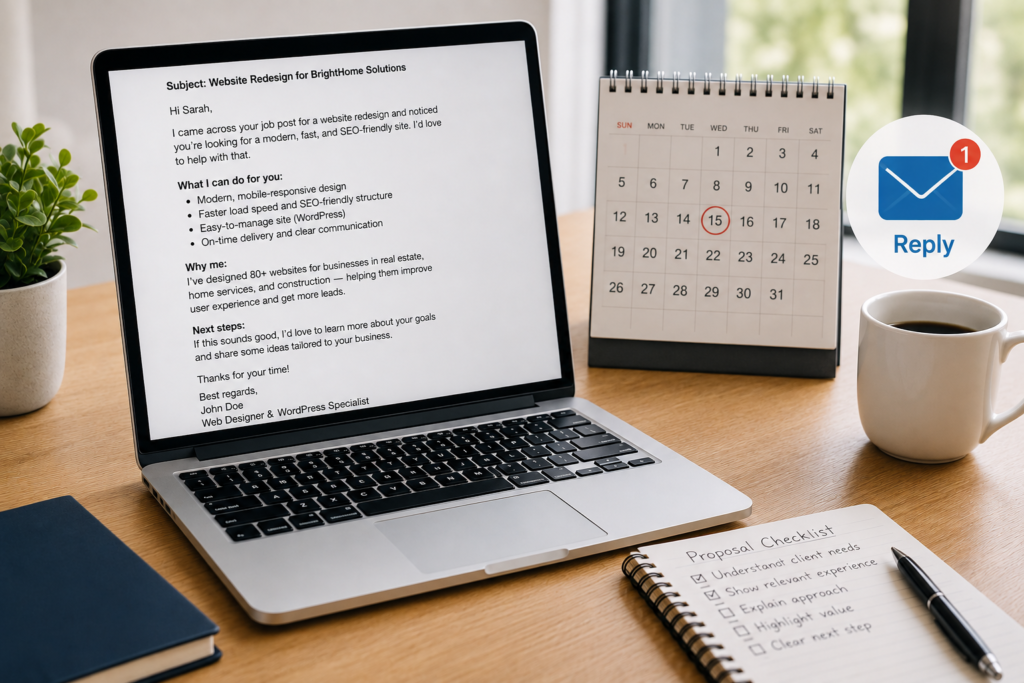
- The Psychology of the Reply: Why busy clients read, ignore, or instantly delete pitches.
- The Core Framework: A step-by-step system for structuring client-focused proposals that command attention.
- The Hook: How to bypass generic pleasantries and immediately diagnose the client’s real problem.
- Value Communication: How to articulate your expertise, scope, and timeline without writing a 1,000-word essay.
- Templates & Comparisons: Real-world bad vs. good proposal examples you can adapt immediately.
- Pitfalls to Avoid: The most common mistakes that tank response rates on freelance platforms and cold channels.
- The Follow-Up Playbook: Exactly how and when to re-engage when prospects go silent without sounding desperate.
Why Most Proposals Get Ignored (And What Gets Replies)
Clients running active projects are overwhelmed by bids and operate as ruthless filters. When you master How to Write a Freelance Proposal, you stop writing pitches from your own perspective and start designing them for how clients actually read: scanning for competence, relevance, and low risk.
Understanding the mechanics of why proposals fail—and what instantly triggers a reply—is the foundation of every high-converting How to Write a Freelance Proposal strategy.
Clients Tend to Read Proposals That:
- Mirror their exact words and diagnose the problem immediately: The opening lines prove you read the brief by rearticulating their specific pain point before talking about yourself.
- Show a tactical mini-plan or projected outcome: Instead of listing software proficiencies or historical credentials, you outline a concise path from their current bottleneck to the desired result.
- Are ruthlessly short, scannable, and low-friction: You respect their time with clean formatting, short paragraphs, and a single, low-pressure call to action at the end.
Clients Tend to Ignore Proposals That:
- Open with self-centered introductions (“I am…”, “My name is…”): Wasting the most valuable real estate at the top of the message on a bio guarantees a scroll past.
- Are bloated, vague, or obviously copy-pasted: Generic templates lacking context signal low effort and immediate disqualification.
- Bury essential variables: Hiding pricing, project scope, or next steps forces the client to work too hard to figure out if you are a fit.
The 7-Step Proposal Framework (Client-First)
Executing How to Write a Freelance Proposal requires a predictable, repeatable structure. Whether you are submitting an Upwork bid, sending a LinkedIn direct message, or pitching via cold email, use this 7-step client-first sequence. Adapt the overall length to fit the channel, but keep the core architecture intact.
Read and Mirror
Read the project brief twice before writing a single word, highlighting the client’s actual goal rather than just the listed tasks. In your opening lines, mirror their exact terminology back to them to prove instant comprehension. This core pillar of How to Write a Freelance Proposal instantly separates tailored pitches from automated spam.
Open with the Outcome
Lead with the specific result or business outcome you will deliver, not a greeting or your resume. The client cares about their problem being solved, so place the destination front and center in the first two lines to earn a full read.
Scope It Tightly
Define the operational boundaries of the project to eliminate ambiguity and scope creep. Clearly list what deliverables, milestones, and phases are included—and just as importantly, explicitly state what is excluded.
Price with Context
Anchor your fee directly to the business value you are creating rather than an hourly commodity rate. Where it fits the platform or project scope, offer structured pricing tiers (e.g., Lean, Standard, Comprehensive) so the client feels in control of their investment.
State Payment Terms
Remove financial friction by transparently outlining your commercial terms. Name the exact currency, milestone advance split (such as 50% upfront and 50% upon completion), and preferred payment method to prevent awkward negotiations later.
Add Precision Proof
Link directly to one or two hyper-relevant case studies, portfolio pieces, or metrics that match their exact industry or problem. Never dump your entire portfolio or a generic link; curated proof is a non-negotiable asset in How to Write a Freelance Proposal.
Close with One Clear Action
End your pitch with a single, frictionless next step. Instead of a vague “Let me know what you think,” tell them precisely how to begin—such as asking if they are available for a quick 10-minute async chat or if they want to review a finalized contract.
How to Open a Proposal (Without Generic Intros)
When mastering How to Write a Freelance Proposal, the opening sentence is your highest-leverage real estate. Opening with “Hi, my name is…” or “I am an experienced designer with 5 years of…” immediately marks your pitch as self-focused template spam.
Replace generic introductions with an opening line that proves you read their brief, understand their core business problem, and know how to achieve their target outcome.
The Hook Formula
[Client Name], you need [their specific goal in their exact words]. Here is how I will deliver it:
By opening with this structure, you bypass pleasantries, validate their pain point, and anchor yourself as a strategic peer rather than an eager job applicant.
Examples in Action
- Example 1 (SaaS Landing Page): “Tunde, you need a mobile-optimized landing page that consistently converts cold visitors into booked demo requests. Here is my plan to drop your load time under two seconds and lift your overall conversion rate.”
- Example 2 (E-Commerce Checkout): “Amina, your Shopify store needs a streamlined checkout flow and stronger trust signals to stop leaking revenue. I can cut your cart abandonment rate by simplifying purchase steps and embedding strategic social proof at key decision points.”
A critical element of learning how to write a Freelance Proposal that commands immediate responses is shifting your opening from identity (“Who I am”) to outcome (“What I will solve for you”).
Addressing the Client’s Actual Problem
A high-converting response within any masterclass on How to Write a Freelance Proposal hinges on diagnostic precision. Once you move past the opening hook, you must immediately validate their pain points by referencing the exact data, metrics, deadlines, and constraints extracted from their project brief or initial discovery call.
Clients do not care how many years you have spent in your industry; they care if you understand the friction blocking their revenue, traffic, or operational efficiency today.
What to Include (Diagnostic Specifics)
- Use hard numbers and metrics: Restate their exact performance bottlenecks, slow loading speeds, broken conversion funnels, or outdated design years.
- Reference specific operational constraints: Acknowledge tight launch deadlines, strict tech stack requirements, or specific user-experience complaints noted in their brief.
Contrast: Good vs. Bad Problem Framing
- Do: “Your site currently loads in 6.2 seconds and hasn’t been visually updated since 2021, which is why your mobile traffic is bouncing before seeing your portfolio.”
- Do: “You mentioned during our chat that your inbound pipeline is leaking leads because the current intake form requires seven distinct clicks and lacks error handling.”
- Avoid: “I am a full-stack web designer with 8 years of agency experience building responsive WordPress sites.” (This shifts the spotlight entirely back onto your resume instead of their broken system.)
Grounding your proposal in their reality proves competence instantly and forms the operational bedrock of How to Write a Freelance Proposal.
Communicating Value Without Writing a Novel
Freelancers often make the fatal mistake of confusing length with thoroughness. When executing How to Write a Freelance Proposal, writing a 1,000-word essay signals that you lack clarity and respect for the client’s time. Busy decision-makers do not want to read your life story; they want proof that you can execute without hand-holding.
Keep platform bids tight at 150 to 200 words, and reserve more detailed breakdowns (2 to 5 pages) exclusively for high-ticket direct client proposals or formal discovery follow-ups. Every single sentence must earn its place by advancing the sale.
The Lean Proposal Anatomy
- The Outcome Opener: One sharp sentence naming their goal and your plan to hit it.
- The Three-Step Mini Plan: A concise, sequential breakdown showing how you will move them from problem to solution.
- The Precision Proof Link: Exactly one hyper-relevant case study or portfolio piece matching their niche.
- The Action Close: One low-friction question or direct call to action to initiate the conversation.
Mastering How to Write a Freelance Proposal means realizing that brevity is a weapon: a shorter, highly targeted pitch always outperforms a long, unfocused copy-paste template.
Good vs. Bad Proposal Examples
The difference between an ignored pitch and a booked project often comes down to a single paragraph. Reviewing actual text side-by-side demonstrates why mastering How to Write a Freelance Proposal changes your entire pipeline.
Bad (Generic, Self-Focused)
“Hi, I am a graphic designer with 5 years of experience. I have worked with many clients and can do logos, banners, and social media posts. I am very hardworking and can meet deadlines. Please check my portfolio. Let me know if you are interested.”
Why it fails: This opens with self-introductory fluff (“I am a…”), lists vague capabilities instead of specific outcomes, relies on tired clichés (“hardworking, meet deadlines”), and ends with a weak, high-friction call to action (“Let me know if you are interested”).
Good (Client-Focused, Specific)
“Chioma, you need a brand refresh that makes your Instagram feed look premium and consistent. I will deliver a color palette, 3 logo variants, and 12 post templates aligned to your style. Timeline: 10 business days. Price: $450 (50% advance). Recent work: [link]. If this fits, reply ‘go’ and I will send the advance invoice today.”
Why it works: This hits every requirement of How to Write a Freelance Proposal: it opens with the client’s name and goal, outlines a clear scope and timeline, prices transparently with terms, anchors with a single hyper-relevant link, and ends with a micro-commitment closing line that makes replying effortless.
Adaptable freelance proposal templates
Use these customizable freelance proposal templates as a starting point for different clients, projects, and situations. Each template can be adapted to highlight the client’s specific needs, your most relevant skills, and the value you can provide—without making your proposal sound generic or copied.
Upwork Bid Template
Plaintext
[Client name], you need [their goal]—here's exactly how I'd deliver it.

I've done this for [similar client/result], for example [one-line proof].

My plan:
1. [Step 1]
2. [Step 2]
3. [Step 3]

Timeline: [X days]. Price: [amount], [advance split].

I invoice in [USD/GBP/EUR] and receive to a local account, so there's no delay or heavy conversion loss.

A quick question: [one smart question about the project]?

Shall I get started?
Code language: PHP (php)
This high-converting Upwork template applies the core mechanics of How to Write a Freelance Proposal. It keeps the word count between 150 and 200 words, cuts out unnecessary self-introductions, and hits every critical decision-making factor a client looks for in the first 30 seconds of reading.
By inserting local settlement details for your currency, you instantly remove friction around international payment processing, proving you understand cross-border operational realities as well as technical execution.
LinkedIn DM Template
Plaintext
Subject: Helping you with [Project name]

Hi [Name],

I saw your post about [topic] and wanted to connect. I specialize in [skill] and have helped [similar company/client achieve specific benefit].

Curious—are you currently looking for help with [specific service] to solve this?

Would love to explore how I can help. Are you open to a quick 10-minute chat this week?
Code language: CSS (css)
Adapting How to Write a Freelance Proposal for LinkedIn requires a conversational approach that fits an inbox rather than a formal proposal portal. This direct message template works because it connects your outreach to an immediate trigger (their post or recent update), establishes instant niche authority, and closes with a low-friction invitation to talk rather than a wall of text.
Email Proposal Template (Direct Clients)
Plaintext
Subject: [Result] for [Client/Company]—proposal

Hi [Client name],

You mentioned you need [restate their problem/goal in one line].

I help [who you help] achieve [outcome], and I can do the same here.

What I will do:
- [Deliverable 1]
- [Deliverable 2]
- [Deliverable 3]

Out of scope: [what is not included]

Timeline: [duration], with [milestone] by [date].

Investment: [amount], structured as [e.g. 50% advance, 50% on delivery].

Payment terms: invoices in [currency], received to a local account and settled in [your currency]. Advance due before work begins.

Recent work: [1–2 relevant links].

If this looks right, reply 'go' and I'll send the advance invoice today.

Best,
[Your name]
Code language: PHP (php)
When sending outbound pitches to direct clients, your proposal functions as an asynchronous contract outline. This template translates the principles of How to Write a Freelance Proposal into a structured, executive-ready email format. By explicitly defining out-of-scope boundaries and upfront payment terms right in the email body, you establish professional authority and eliminate scope creep before a single line of work is started.
Common Mistakes That Reduce Response Rates
Even experienced freelancers tank their conversion rates by falling into lazy habits. When optimizing How to Write a Freelance Proposal, avoiding these five structural errors will instantly separate your pitches from the amateur noise:
- Generic Copy-Paste: Sending the same block of text to fifty different clients reads as lazy and self-absorbed. Always customize your opening lines to reference the specific project brief.
- Burying the Price: Clients evaluate financial risk early. If you hide your rates or leave pricing vague, they will move on to someone transparent. Give figures with context rather than saving them for the bottom.
- Over-Writing: Writing a multi-page essay or padding your bid with irrelevant credentials does not win work. Relevance and ruthless brevity always beat volume.
- Ignoring Payment Terms: Leaving currency, advance splits, and settlement methods vague invites delayed payments, cash flow friction, and unexpected foreign exchange losses.
- No Clear Next Step: Ending with a weak, passive sign-off like “Let me know what you think” forces cognitive load onto the client. Always close with one specific, low-friction action to keep momentum moving forward.
How and When to Follow Up
Silence after sending a pitch does not automatically mean rejection; busy clients simply bury emails and platform messages. Mastering How to Write a Freelance Proposal includes building a systematic follow-up cadence. Following up is an expected part of professional outreach, not an act of desperation.
Use this structured sequence to re-engage silent prospects without burning bridges:
First Follow-Up (3 to 5 Business Days Later)
Send a gentle, low-friction check-in to ensure your proposal didn’t slip through the cracks.
“Hi [name], just checking in on the proposal I sent on Tuesday. Happy to walk through any section or adjust the scope if needed. What questions came up on your end?”
Second Follow-Up (5 to 7 Days Later)
If the first message gets no response, pivot from asking for an update to providing immediate value. Share a relevant case study, a quick teardown, or an industry insight tied directly to their project bottleneck.
Closing the Loop (After 3 Total Touchpoints)
If a prospect remains unresponsive after multiple well-timed follow-ups, professionally close the communication loop. This often triggers a response from clients who felt guilty about ghosting.
“It sounds like the timing might not be right for this project. I will leave the proposal open, and the scope and pricing will remain valid for the next 30 days. Let me know when you are ready to pick this back up.”
Quick Checklist Before You Send
Before you hit submit or send on any outreach channel, run your draft through this final audit. Mastering How to Write a Freelance Proposal comes down to enforcing this exact quality control before your pitch reaches a client’s screen:
- The Mirror Check: Does your opening line restate the client’s actual goal in their exact terminology?
- The Outcome Test: Do the first two lines focus on the business result you will deliver rather than your biography or credentials?
- The Scope Boundary: Are both inclusions and explicit exclusions clearly defined to prevent scope creep?
- The Timeline Check: Does the schedule outline clear phases and specify client feedback or review deadlines?
- The Pricing Anchor: Is your investment figure visible, anchored to value, and structured into clear tiers if applicable?
- The Payment Terms: Do your commercial terms name the exact currency, advance split, and settlement method?
- The Precision Proof: Did you link to one or two hyper-relevant examples instead of dumping an entire portfolio?
- The Frictionless Close: Does the proposal end with a single, highly specific call to action rather than a vague sign-off?
What is the ideal word count for a freelance proposal?
Platform bids on sites like Upwork or Fiverr should stay between 150 and 200 words strictly to respect the client’s scanning habits. Direct client proposals sent via email can range from 2 to 5 pages, provided they contain detailed scopes, wireframes, or phased roadmaps. Across all channels, brevity paired with high diagnostic relevance always outperforms long-winded essays.
How should I price my services in a proposal without scaring the client away?
Anchor your pricing directly to the business value and ROI you are generating rather than calculating an hourly commodity rate. Present a single, clear investment figure or structured tiers (such as Lean, Standard, and Comprehensive) so the client feels in control of their spending.
Always pair your pricing immediately with commercial terms, such as a milestone advance split, to establish professional financial boundaries early.
What is the biggest mistake freelancers make in the opening lines?
The most common error is starting with self-centered filler like “Hi, my name is [Name] and I have X years of experience.” Clients do not care about your biography initially; they care about their own problems. Replacing this with a tailored hook that mirrors their exact goal in their own words captures attention within the first two seconds.
How many times should I follow up if a client ghosts my proposal?
Follow a structured three-touch cadence over two weeks. Send a gentle status check after 3 to 5 business days, follow up with a value-add insight or case study 5 to 7 days later, and professionally close the loop after your third touchpoint by letting them know your quote remains valid for 30 days. This systematic approach frequently revives dormant conversations without appearing desperate.
Should I link my entire portfolio in every proposal?
Never dump a generic portfolio link or an exhaustive archive of past projects into a pitch. Curate your proof down to exactly one or two hyper-relevant case studies or metrics that directly match the client’s specific industry, tech stack, or bottleneck. Precision proof proves you can solve their exact problem today.
In Conclusion
Mastering How to Write a Freelance Proposal transforms your outreach from a low-probability lottery into a predictable client-acquisition system. By abandoning self-centered bios, leading with diagnostic precision, structuring tight scopes, and closing with frictionless calls to action, you position yourself as a strategic partner rather than an interchangeable vendor.
Stop treating proposals as administrative chores and start treating them as your primary conversion engine. Audit your next pitch against the 7-step framework, send it with confidence, and let your clarity win the contract.