Why Brandable Domain Names Outperform Keyword Domains
Choosing a domain name is one of the most critical decisions in your digital launch strategy. It serves as your primary online identity, influencing brand recall and long-term asset scalability. For years, the SEO industry was dominated by the pursuit of exact-match domains; however, the shift toward entity-based search and AI-driven discovery has fundamentally changed the landscape.
Brandable domain names—unique identifiers designed to build proprietary brand value—now offer a superior strategic advantage over rigid, keyword-stuffed alternatives. While keyword domains may provide immediate contextual signals, modern search engines prioritize content quality, topical authority, and user experience far above the literal words in a URL. For founders building a scalable business, brandable domain names provide the necessary flexibility to pivot, expand, and establish the trust required to outlast algorithm updates.
This guide moves beyond outdated SEO myths, offering an analytical framework to help you choose the right digital real estate for long-term growth.
Target Audience
- Entrepreneurs & Startup Founders: Building assets meant for acquisition or long-term market leadership.
- SEO Professionals & Content Strategists: Looking to optimize for modern “Brand + Entity” search signals.
- Digital Marketers & Affiliate Marketers: Transitioning from short-term traffic plays to building lasting brand equity.
Core Objectives
By the end of this analysis, you will understand:
- The Anatomy of Brandable Domain Names: Why abstraction and memorability beat literal descriptions.
- The Modern SEO Calculus: How Google treats domains within the context of E-E-A-T (Experience, Expertise, Authoritativeness, and Trustworthiness).
- The Scalability Gap: Why keyword-constrained domains often hit a “growth ceiling” during business expansion.
- Decision Matrix: A high-level assessment of when to leverage a brandable asset versus a hybrid keyword approach.
By synthesizing Google’s guidance with first-principles branding, this guide provides the clarity needed to select a domain that functions as a high-leverage business asset rather than a technical bottleneck.
What Are Brandable Domain Names?
Brandable domain names are unique, abstract, or evocative identifiers engineered to function as the foundational asset of a business identity rather than a blunt instrument for search engine optimization.
Unlike keyword domains—which rely on literal, descriptive terms to communicate function—brandable domain names derive their authority and value from brand equity. They do not describe what a business does at the moment of inception; instead, they serve as a “blank canvas” that the business defines, fills, and scales over time through consistent marketing, product excellence, and customer recognition.
High-Leverage Examples
The most successful modern platforms are built on brandable domain names that intentionally decouple themselves from specific keyword constraints:
- Google.com: Abstract, memorable, and infinitely scalable.
- Spotify.com: Evocative of sound, yet distinct enough to permit expansion into video, podcasts, and social features.
- Shopify.com: Provides a distinct brand identity that encompasses e-commerce, POS, and financial services.
- Notion.So: A single-word brandable that defines a category rather than describing a set of features.
- Canva.com: A short, punchy name that allows for endless pivot potential in the design space.
The Strategic Distinction
The power of these names lies in their semantic independence. Because they do not rely on inherent keyword relevance, they are not “trapped” by a specific niche.
When you choose a brandable domain, you are not buying a search shortcut; you are registering an entity. In an era where AI-powered search engines and recommendation algorithms prioritize Brand Authority and Entity Recognition, a brandable name acts as a persistent identifier that remains relevant even as your business model, products, or service offerings evolve.
Characteristics of Brandable Domain Names
To function as a high-leverage business asset, brandable domain names must satisfy specific criteria that prioritize cognitive ease and legal defensibility over literal description. A successful brandable domain serves as the anchor for your entire digital ecosystem; it is not merely an address, but a mnemonic device.
The Core Framework of High-Value Brandables
A high-quality brandable domain name typically adheres to the following characteristics:
- Cognitive Ease (Memorability & Pronunciation): If a user cannot easily spell it after hearing it once, it fails the “radio test.” Simplicity reduces friction, ensuring your brand stays top-of-mind.
- Concise: Shorter is objectively better for retention, design utility (e.g., logo placement, social media handles), and user input speed.
- Distinctiveness: It must stand out in a crowded market. Abstract or evocative names avoid the “commodity trap” that keyword-heavy domains fall into, where the brand is indistinguishable from its competitors.
- Strategic Flexibility: Unlike keyword-stuffed domains that tether a business to a single product or service (e.g., BestSEOtools.com), a brandable domain name provides the horizontal and vertical room to pivot your business model as you grow.
- Trademark Defensibility: A distinct, non-descriptive name is significantly easier to legally protect than a generic phrase. Descriptive domains often face barriers in trademark registration because they consist of common, dictionary-defined terms.
- Verbal Shareability: The name should sound professional and clear when spoken aloud in podcasts, meetings, or interviews.
The “Scalability Advantage”
The primary strategic benefit of these characteristics is the removal of the “Niche Ceiling.”
When your domain name is not tied to a specific keyword or industry niche, you maintain total ownership of your brand identity regardless of how your product offering evolves. You aren’t “just the company that does X”—you become the entity that defines the space. By prioritizing these traits, you ensure that as your business expands into new markets, your domain remains an asset rather than a liability you eventually have to rebrand away from.
What Are Keyword Domains?
Keyword domains—often categorized as Exact-Match Domains (EMD) or Partial-Match Domains (PMD)—are URLs engineered to mirror the precise language users input into search bars. They are tactical, utility-first assets designed to capture immediate traffic by banking on the perceived correlation between a domain name and search intent.
The Mechanics of Keyword Domains
These domains are built on a “descriptive-first” philosophy:
- BestRunningShoes.com
- CheapCarInsurance.com
- FloridaPlumber.com
Historically, these served as a “shortcut” for SEO. In earlier iterations of search algorithms, a domain containing the user’s search query often signaled high relevance, frequently resulting in top-tier rankings regardless of the depth or quality of the underlying content.
The Shift in Search Reality
While words in a domain name remain one of many signals used by Google, the “EMD advantage” has been heavily mitigated by modern ranking systems. Google’s algorithms are now sophisticated enough to recognize that a domain name is not a proxy for topical authority or content quality.
Today, a domain like CheapCarInsurance.com receives no inherent ranking “bonus” simply because it matches a query. In fact, relying on this strategy often introduces significant risks:
- Low Brand Equity: These names are rarely memorable or distinct. They lack the character required to build long-term trust, often feeling like commodity sites rather than established authorities.
- Trust Deficits: Users and search engines alike increasingly associate hyper-descriptive, keyword-heavy domains with low-quality content, spam, or thin affiliate sites.
- The “Relevance Trap”: By limiting your identity to a specific string of keywords, you are effectively pigeonholing your business. If the market shifts or you decide to expand your services, a domain like FloridaPlumber.com becomes a strategic anchor, forcing you to choose between branding inconsistency or the high cost of a full domain migration.
Types of Keyword Domains
To understand the tactical limitations of keyword-based assets, it is essential to distinguish between the two primary formats: Exact Match Domains (EMD) and Partial Match Domains (PMD). While both attempt to leverage search volume through URL structure, they function as different tiers of the same “relevance-focused” strategy.
Exact Match Domain (EMD)
An EMD consists of a domain name that is a 1:1 match for a high-volume search query.
- Structure:
[Keyword].com(or other TLDs). - Example:
bestlaptops.com - The Intent: The goal is to signal immediate topical relevance to both the user and the search algorithm, effectively “buying” perceived authority via the URL string.
- The Reality: In modern search, an EMD is a neutral signal. It does not provide an algorithmic boost; instead, it is often scrutinized more heavily for content quality and site-wide E-E-A-T. If the content is thin, the EMD serves as a red flag rather than a ranking advantage.
Partial Match Domain (PMD)
A PMD incorporates core keywords within a broader brand or descriptive structure.
- Structure:
[Brand/Modifier] + [Keyword].com - Example:
smartlaptophub.com - The Intent: These aim to balance the “relevance” of an EMD with a slightly broader, more “branded” feel. They allow for more flexibility than an EMD but still rely on the keyword to explain what the site offers.
- The Reality: PMDs are generally considered safer and more flexible than EMDs because they allow for some degree of brand identity. However, they still suffer from the same limitation: they are tied to a specific search term that may lose volume or relevance as technology and user habits evolve.
The Strategic Takeaway
Whether you are considering an EMD or a PMD, it is critical to recognize that both are subservient to content quality and authority.
In the current SEO ecosystem, neither an EMD nor a PMD can serve as a substitute for a comprehensive SEO strategy. They provide contextual signals, but they do not guarantee rankings. Without deep, expert-level content and a cohesive brand strategy, these domains remain mere addresses, unable to compete with established brandable domain names that have built genuine user trust and domain-wide authority.
How Does Google Treat Domain Names Today?
Google considers domain names as only one of many ranking signals, and their influence is much smaller than it was in the past.
Google’s ranking systems evaluate factors such as:
- Relevance
- Helpful content
- User experience
- Expertise
- Authority
- Trustworthiness
- Page usability
- Search intent
rather than relying heavily on keywords contained in a domain name.
Google also states that its exact-match domain system exists to ensure that keyword-stuffed domains do not receive disproportionate ranking advantages simply because they closely resemble search queries.
This means that:
- A brandable domain can rank extremely well with strong content.
- A keyword domain can also rank well—but only when supported by high-quality, authoritative content.
- Neither domain type guarantees SEO success on its own.
The quality of your website matters far more than whether your domain contains a target keyword.
Why Brandable Domain Names Often Outperform Keyword Domains
The debate between domain strategies is often reduced to “SEO vs. Branding.” However, in a mature digital economy, this is a false dichotomy. Brandable domain names consistently outperform keyword-driven domains because they function as proprietary business assets, whereas keyword domains function merely as SEO tactical signals.
As algorithms transition from literal string matching to entity-based understanding, the value has shifted decisively toward Brand Authority. Here is the analytical breakdown of why brandables offer a higher ROI for long-term growth.
Brand Recognition Outlasts Algorithm Volatility
Search algorithms are inherently unstable; they are designed to change. Brands, conversely, are built on user preference. When you rank for a keyword, you are at the mercy of the next update. When you build a brand, you create a “direct-traffic moat.” Users don’t search for “online collaboration software” when they need to get work done—they search for Notion, Figma, or Slack. By becoming your own search term, you decouple your business growth from the fluctuating volatility of search engine rankings.
Cognitive Efficiency and Retention
Memory is a high-leverage metric. Consider the friction difference:
- Keyword Domain: BestLaptopReviewsOnline.com (High cognitive load; prone to typos; feels like a commodity).
- Brandable Domain: Laptoply.com (Low cognitive load; distinctive; feels like a destination).
Short, distinctive names significantly improve direct traffic and word-of-mouth referrals. If a user can recall your domain after hearing it once during a podcast or a social video, you have significantly reduced your customer acquisition cost.
The Psychology of Trust
User perception of “Professionalism” is tied to naming conventions. A descriptive URL like CheapLaptopDeals247.com signals a transactional, low-trust environment—often associated with “thin” affiliate sites. Conversely, a brandable name like TechNova.com implies an established business entity. While this is a psychological observation, it is a critical one: users are exponentially more likely to engage with, link to, and purchase from a brand that presents itself as an authority rather than a directory.
The Scalability Advantage
The most dangerous trap in domain selection is Niche Trapping. If your domain name is locked to a specific keyword, you are effectively limited to that search intent.
- Example: A site built on SEOTutorials.com will struggle to pivot into AI Productivity or Career Development without causing massive branding confusion.
- Brandable Flexibility: A brandable domain acts as an empty vessel. As your business evolves, your domain remains consistent, allowing you to expand your product suite, pivot your service model, and enter new markets without the massive cost and equity loss of a rebrand.
Marketing Channel Friction
Your domain is the centerpiece of your omnichannel presence—appearing on TikTok, LinkedIn, podcasts, and email newsletters. Short, phonetic, and clear names are significantly easier to share verbally. In audio-heavy media (podcasts, live streams), a brandable name is the difference between a listener visiting your site or forgetting it instantly because the domain was too long or confusing to hear.
Compounding Brand Equity
Every piece of content, social engagement, and backlink is a deposit into your “Brand Bank.” Over the years, a keyword domain only reinforces your relevance to that one specific search term. A brandable domain, however, aggregates Authority, Reputation, and Trust into a single, cohesive entity. That value compounds, creating an asset that grows in worth independent of your current SEO rankings.
When Do Keyword Domains Still Make Sense?
While the strategic ceiling for keyword domains is lower in a global, brand-driven market, they are not universally obsolete. There are specific, high-leverage scenarios where a keyword-centric domain provides immediate tactical utility by reducing the time required for a user to understand the site’s function.
These are primarily geographically constrained or utility-fixed models where the search intent is binary: the user needs a specific service, in a specific place, at a specific time.
The “High-Utility” Use Cases
Keyword domains excel when the objective is not to build a “lifestyle brand,” but to serve as a reliable lead-generation node for:
- Local Service Businesses: Plumbers, roofers, law firms, and dental clinics. When a user in Denver searches for an electrician, DenverElectrician.com provides immediate trust and relevance.
- Hyper-Niche Affiliate Sites: For specific, narrow topics where the search volume is driven by a singular functional query (e.g., BestLaptopCoolingPads.com), a descriptive domain can act as a “lean” entry point.
- Temporary Campaign Assets: For short-term marketing initiatives, landing pages, or product launches where long-term brand equity is less critical than immediate clarity.
The Reality: Utility ≠ Immunity
Even in these scenarios, a keyword domain is not a license to skip SEO best practices. The days of “ranking by URL” are over. To compete effectively, these domains must still satisfy the modern requirements of the search engine:
- Local SEO Signals: For location-based domains like MiamiRoofRepair.com, you must still optimize your Google Business Profile, manage local citations, and cultivate genuine client reviews.
- Conversion-Optimized UX: A keyword domain may get a user to click, but your user experience, pricing, and service clarity are what actually close the sale.
- Content Depth: Search engines now analyze the intent of your pages. If a keyword-heavy site contains thin, auto-generated, or low-quality content, it will be outperformed by a professional brand that provides comprehensive answers to user problems.
The Strategic Pivot
If you are building a scalable business—one that you plan to grow beyond a local radius or a single product line—a keyword domain is often a tactical debt you will have to pay off later. However, if your business model is geographically fixed (e.g., a brick-and-mortar local service), the literal clarity of a keyword domain can be a highly efficient way to capture “top-of-funnel” local search volume.
Strategic Summary: The Domain Selection Matrix
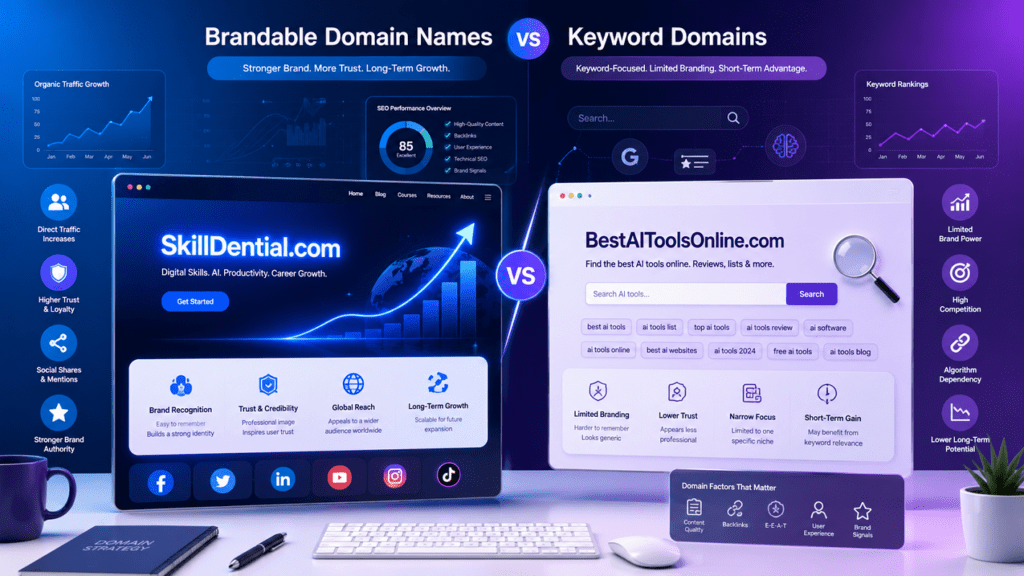
To help your audience make an informed, data-driven decision, here is the synthesis of our analysis. This matrix evaluates Brandable Domain Names versus Keyword Domains across the core dimensions of high-leverage business growth.
| Feature | Brandable Domain Names | Keyword Domains |
| Memorability | Excellent | Moderate |
| Branding Potential | Excellent | Limited |
| Long-Term Scalability | Excellent | Moderate |
| Flexibility | High | Lower |
| User Trust | High (builds over time) | Varies (often transactional) |
| Word-of-Mouth | Excellent | Moderate |
| Local SEO | Good | Often advantageous (localized) |
| Modern SEO | Strong (with quality content) | Strong (with quality content) |
| Future Expansion | Excellent | Can be restrictive |
Final Decision Framework: How to Choose
When selecting your domain, apply this first-principles analysis to ensure your choice aligns with your long-term business trajectory:
Choose a Brandable Domain Name if:
- You are building a business, not just a website. You intend to expand your product line, services, or content topics over the next 3–5 years.
- You prioritize long-term asset value. You want a name that you can trademark, protect, and eventually build into a high-authority “entity” that search engines recognize by name.
- You operate in a crowded digital space. A distinctive, brandable name provides the competitive differentiation required to stand out in social feeds, podcasts, and search results.
Choose a Keyword Domain if:
- Your business is geographically locked. You are a local service provider (e.g., HVAC, legal, dental) where your customers search for a “service + city” combination.
- Your model is purely transactional. You are building a one-off project or a hyper-niche affiliate site with no intention of creating a broad, multi-category brand.
- Immediate clarity is the primary hurdle. You operate in a legacy industry where customers may not understand what you do without a descriptive URL.
In the modern search landscape, Brandable Domain Names are an investment in your company’s future, whereas Keyword Domains are a tactical play for immediate, narrow visibility. For founders at Skilldential and beyond, the goal should be to build a brand that is large enough to encompass your future ambitions, not one that is trapped by your initial keyword strategy.
Decision Checklist for Brandable Domain Names and Keyword Domains
Use this framework to align your domain choice with your long-term business strategy.
Choose a Brandable Domain Name if you:
- ✅ Prioritize long-term asset value: You are building an entity intended to last, scale, and potentially exit.
- ✅ Plan for horizontal expansion: You anticipate moving into multiple topics, products, or service lines as you grow.
- ✅ Value memorability: You need an identity that survives the “radio test”—easy to say, spell, and share across podcasts, social media, and live events.
- ✅ Are building a productized business: You want a name that anchors your proprietary IP, software, or service offering.
- ✅ Target global/scale-neutral markets: You want to avoid geographical or linguistic constraints that might limit your growth.
Choose a Keyword Domain if you:
- ✅ Operate a strictly local service business: Your revenue is fundamentally tied to a service-plus-location search intent (e.g., CityNameService.com).
- ✅ Are locked into a singular niche: You have zero intention of pivoting, expanding, or broadening your scope beyond a specific product or service category.
- ✅ Operate a transactional, low-complexity model: You are building a one-off affiliate site or a landing page where immediate functional clarity is the only conversion driver.
- ✅ Want to minimize “time-to-understanding”: You are operating in a traditional industry where your customer base relies on literal, descriptive cues to understand what you offer.
The “High-Leverage” Final Thought
The ultimate risk in domain selection is strategic debt. A keyword domain may save you time at the launch phase by providing instant relevance, but it often creates a “growth ceiling” that you will have to break through later at the cost of your hard-earned SEO authority and brand recognition.
If you are playing a long-term game, always favor the asset that provides the most room for you to define your own success.
Real-World Comparative Analysis: Domain Evolution
To illustrate the strategic difference in practice, consider the choice between a keyword-dependent domain and a brandable entity. This is not just a theoretical comparison; it is a preview of your future growth trajectory.
The Comparative Framework
| Factor | SkillBizTech.com (Keyword-Focused) | SkillDential.com (Brandable Entity) |
| Memorability | Good | Excellent |
| Branding Potential | Moderate | Excellent |
| Scalability | Limited | Excellent |
| Professional Appearance | Generic | Authoritative |
| Future Expansion | Constrained | High Flexibility |
The Strategic Breakdown
- SkillBizTech.com: This domain tells the user exactly what to expect—a combination of skills, business, and technology. While functionally clear, it suffers from the “commodity effect.” It positions the site as a directory or a generic service provider. If you decide to pivot toward high-level leadership coaching, AI strategy, or financial advisory, the name begins to feel like a “technical debt”—a descriptor that no longer captures the breadth of your expertise.
- SkillDential.com: This name is a proprietary construction—a “blank canvas.” It is inherently distinctive, signaling a synthesis of “Skill” and “Credential.” Because it is not tethered to a specific niche, it carries no implicit limits. It allows you to build a comprehensive ecosystem covering AI, career growth, and digital mastery without ever needing to justify why a “Tech” site is writing about “Finance.”
The “First-Principles” Principle
This example highlights a broader truth: Keyword domains are descriptive; Brandable domains are generative.
When you choose a name like SkillDential, you are not just selecting a URL—you are establishing a brand that you can imbue with authority over time. You don’t have to explain your name; you simply have to perform at a high level, and the name becomes synonymous with that quality.
In the modern, entity-driven search environment, the brand is the signal. By choosing a name that evolves with you, you ensure that your digital footprint remains an asset that appreciates rather than a bottleneck that you will eventually need to outgrow.
Common Misconceptions
When navigating domain strategy, much of the prevailing “SEO wisdom” is based on outdated tactics rather than current algorithmic realities. To build a future-proof foundation, you must first clear away these three common myths.
“Keyword domains automatically rank higher.”
The Reality: This is a legacy belief from the early 2000s. While search engines recognize the terms within a domain name as a potential relevance signal, it is only one of hundreds of factors. Google’s modern ranking systems are designed to prioritize topical authority, content quality, user experience, and E-E-A-T (Experience, Expertise, Authoritativeness, and Trustworthiness). A keyword-rich domain with thin, unhelpful content will consistently be outranked by an authoritative brand that answers user intent more comprehensively.
“Brandable domains hurt SEO.”
The Reality: This is fundamentally false. If you look at the most visible and high-ranking websites in the world—Notion, Canva, Slack, Spotify—the vast majority operate on brandable domains. They rank not because their names contain keywords, but because they have engineered their sites to be the authoritative entities in their respective categories. A brandable domain does not “hurt” your SEO; it simply forces you to rely on actual merit—content, reputation, and user satisfaction—rather than a domain-level shortcut.
“You must choose one or the other.”
The Reality: In practice, successful strategies often exist at the intersection of branding and tactical optimization. You can choose a Brandable Domain Name as your identity while still leveraging descriptive page titles, semantic keyword research in your content, and optimized URL slugs for individual pages.
- The Identity: Your domain is your brand anchor (SkillDential).
- The Utility: Your sub-pages use descriptive slugs (Skilldential.com/career-paths/ai-tools) to communicate relevance.
By separating your Brand Identity from your Content Strategy, you gain the benefits of both: the scalability and trust of a brand, combined with the precision of keyword-focused content optimization.
Are brandable domain names better for SEO?
Not inherently. A brandable domain provides no algorithmic ranking “bonus.” However, it is superior for building brand authority—a critical metric in modern search. By fostering higher click-through rates (CTR) from search results, increased direct traffic, and a stronger backlink profile, brandable domains create the long-term equity that helps a site outlast algorithmic volatility.
Do keyword domains still work?
Yes, but as a tactical tool rather than a foundational strategy. They can perform well if paired with world-class content and authoritative site architecture. However, they are effectively “tactical debt”—you gain short-term relevance at the cost of long-term branding flexibility and memorability.
What is an Exact-Match Domain (EMD)?
An EMD is a URL that mirrors a high-volume search query (e.g., bestlaptops.com). While these were once powerful shortcuts, they no longer receive an intrinsic ranking advantage. Today, they are evaluated by Google with the same rigorous standards as any other site, often facing higher scrutiny regarding thin content and spam signals.
Can I rank without keywords in my domain?
Absolutely. Modern search engines are increasingly entity-aware. They rank sites based on topical depth, expertise, and user signals, not just literal word matching. Some of the most highly ranked entities in the world possess names with zero inherent keyword relevance (e.g., Google, Canva, Notion).
Which is better for a startup?
In almost every scenario, a brandable domain is the better choice for a startup. Startups must be prepared to pivot, iterate, and expand. A brandable domain acts as an “empty vessel,” allowing your business to scale its product suite or shift its market positioning without being tethered to a restrictive, keyword-defined name.
Should I change my existing keyword domain?
Proceed with caution. Migrating an established site is a significant technical undertaking that carries the risk of temporary search visibility loss. You should only consider a domain migration if your current name is a genuine bottleneck to your long-term business goals and you have the technical resources to execute a professional 301-redirect strategy to preserve your existing equity.
In Conclusion
Choosing a domain name is a foundational strategic decision that extends far beyond the reach of search engine rankings. A high-leverage domain should not only serve your current requirements but remain a versatile, credible asset as your business evolves over the next decade.
The core takeaways are:
- Prioritize Brand Identity: Brandable domain names are the primary driver for building memorable, recognizable entities that foster trust and direct loyalty.
- Evaluate Tactical Utility: Keyword domains remain functional tools for hyper-local services or narrow, transactional niche projects, but they often carry the “strategic debt” of a growth ceiling.
- Trust the Modern Algorithm: Search engines have matured. Today, they prioritize topical authority, E-E-A-T, and user experience over the literal string matching of decades past.
- Think Long-Term: Your domain is a permanent business identity. Your branding strategy should consistently outweigh short-term, keyword-based SEO myths.
If you are building a scalable business, brandable domain names are almost always the superior investment. They provide the “empty vessel” needed to pivot into new markets, products, and services without the friction of a total rebrand. If your model is strictly local or singular in focus, a keyword domain remains a practical entry point.
Ultimately, do not choose a domain simply to satisfy a search algorithm for today. Choose the domain that your future customers will remember, trust, and recommend.