The TradingView Deriv Chart represents a critical infrastructure shift for high-leverage traders, moving beyond basic price observation into advanced market orchestration. By integrating TradingView’s sophisticated visualization engine with Deriv’s proprietary synthetic data, professionals can analyze algorithmically-driven assets—including Volatility, Crash/Boom, and Jump indices—with unparalleled precision.
The Strategic Edge of the TradingView Deriv Chart
Unlike legacy MT5 interfaces, the TradingView Deriv Chart provides a high-signal environment where broker-specific feeds remain pristine. This integration allows for the application of complex technical frameworks and First Principles analysis on markets that operate 24/7, independent of traditional global market hours or geopolitical interference.
Operational Setup & Execution
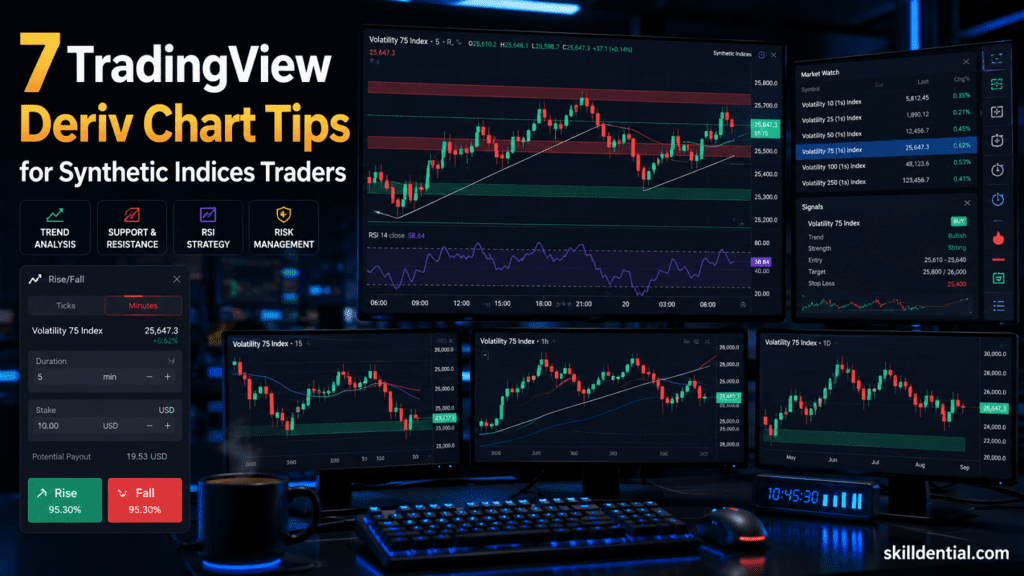
To achieve industry-standard rigor with the TradingView Deriv Chart, traders must initialize a Deriv-hosted or linked session to bridge real-time data with professional-grade analytical tools. This configuration enables:
- Systematic Visualization: Deploying indicators and multi-timeframe templates tailored to synthetic volatility.
- Precision Mapping: Utilizing advanced drawing tools to identify algorithmic patterns and liquidity zones.
- Workflow Automation: Setting up automation-ready markers that transition the user from manual analysis to systematic execution.
Mastering the TradingView Deriv Chart is not merely about better aesthetics; it is about building a scalable technical system that decodes synthetic market behavior for consistent, career-level success.
Technical Mechanics of the TradingView Deriv Chart
The TradingView Deriv Chart operates as a specialized data bridge between Deriv’s proprietary price-generation algorithms and TradingView’s advanced visualization frontend. To maximize its utility, one must understand the underlying technical architecture and data flow.
Algorithmic Data Streaming
Unlike traditional forex or stock charts that reflect decentralized or exchange-based transactions, the TradingView Deriv Chart streams data generated by a cryptographically secure random number generator (RNG).
- Tick-Level Precision: The chart renders price movements based on constant volatility parameters rather than human sentiment.
- 24/7 Continuity: Because the data source is algorithmic, the stream never pauses, eliminating the “weekend gaps” found in traditional financial markets.
Integration Interfaces
There are two primary methods for accessing the TradingView Deriv Chart infrastructure:
- charts.deriv.com (Native Integration): A white-labeled TradingView interface hosted by Deriv. This provides the most direct access to the full catalog of synthetic indices (Volatility, Crash/Boom, Jump, and Step) without requiring external account linking.
- TradingView Broker Integration: Utilizing the TradingView “Trading Panel” to connect a live Deriv account. This allows for direct execution from the chart, enabling a seamless transition from analysis to trade placement.
Indicator & Template Application
The TradingView Deriv Chart treats synthetic data as a standard time series. This allows traders to apply:
- Pine Script Strategies: Custom scripts can be used to backtest strategies against the historical consistency of synthetic indices.
- Multi-Timeframe Analysis: Users can overlay lower-timeframe volatility signatures against higher-timeframe trends to identify high-probability entry points.
Automation & Alert Logic
A high-leverage feature of the TradingView Deriv Chart is the ability to set volatility-aware alerts. Because synthetic indices follow strict mathematical boundaries, technical levels (such as mean-reversion points on a Volatility 75 Index) often hold higher technical respect than in news-driven markets. These alerts can be pushed via Webhooks to automated execution bots or mobile notifications for 24/7 monitoring.
Comparison: Legacy MT5 vs. TradingView Deriv Chart
| Feature | Legacy MT5 | TradingView Deriv Chart |
| User Interface | Rigid, older architecture | Modern, fluid, highly customizable |
| Analysis Tools | Basic drawing/indicators | Advanced multi-charting & Pine Script |
| Accessibility | Software installation required | Browser-based & Cloud-synced |
| Automation | MQL5 (Steep learning curve) | Pine Script & Webhook Integration |
By leveraging the TradingView Deriv Chart, traders move from basic observation to building a robust, automated technical system capable of scaling across the entire suite of Deriv’s synthetic offerings.
How do you set up your TradingView Deriv Chart for synthetic indices?
To set up the TradingView Deriv Chart for high-signal technical analysis, follow this systematic framework to ensure your workspace is optimized for algorithmic synthetic markets.
Phase 1: Access and Integration
There are two primary gateways to initializing the TradingView Deriv Chart environment:
- Direct Web Access: Navigate to charts.deriv.com. This is a dedicated TradingView-powered instance pre-configured with the full Deriv synthetic asset catalog.
- Broker Linking: In the standard TradingView interface (web or desktop), open the Trading Panel at the bottom of the screen. Search for Deriv in the list of brokers and follow the OAuth prompts to link your account. This enables direct trade execution from the chart.
Phase 2: Symbol Selection and Initialization
Once the interface is active, you must load the specific synthetic contracts.
- Symbol Search: Click the symbol name in the top-left corner.
- Filter by Market: Type “Volatility,” “Crash,” “Boom,” or “Jump” into the search bar. The TradingView Deriv Chart will populate a list of available indices (e.g., Volatility 75 Index, Crash 500 Index).
- Scoping: Select the desired index. Crucial: Ensure the symbol is “locked” or pinned to your current layout to prevent accidental switching when browsing other tools.
Phase 3: Workspace Optimization
To maintain industry-standard rigor, configure your TradingView Deriv Chart for persistent analysis.
Watchlist Management
Avoid manual searching by creating a dedicated “Synthetic” watchlist.
- Right-click the Watchlist panel (right side).
- Add symbols like V75, V100, and Crash 1000.
- This allows for rapid multi-market scanning without losing your technical drawings.
Timeframe Standardization
Synthetic indices are algorithmically generated and operate 24/7/365. Standardize your timeframes to capture both macro trends and micro volatility:
- H4/D1: For identifying long-term algorithmic bias and structural breaks.
- M15/H1: For executing the 80/20 of your trend-following strategies.
- M1: For precision entries on high-volatility spikes (Crash/Boom).
Template Synchronization
Once you have applied your core indicators (e.g., RSI for momentum, Bollinger Bands for volatility expansion):
- Click the Chart Layout dropdown at the top.
- Select Save Layout and name it “Deriv Strategy Hub.”
- This ensures that every time you load a TradingView Deriv Chart, your technical setup is instantly applied across all symbols.
Phase 4: Automation Readiness
To transition from manual charting to a systematic workflow, leverage TradingView’s alert engine:
- Technical Alerts: Set alerts on key price levels or indicator crosses.
- Webhook Integration: (For Pro users) Link your TradingView Deriv Chart alerts to automated execution bots via Webhooks, creating a “build once, scale forever” trading infrastructure.
What are the 7 high‑impact TradingView Deriv Chart tips?
To achieve high-leverage results in synthetic markets, you must treat your charting environment as a technical asset. These seven tips focus on the 80/20 of system performance, ensuring your TradingView Deriv Chart is optimized for algorithmic precision.
Multi-Timeframe Volatility Stacking
For high-leverage technical analysis, load a 3-chart horizontal layout for the same index (e.g., 1-min, 5-min, 15-min). In the mathematically driven markets of the TradingView Deriv Chart, “noise” on the 1-minute chart often reveals itself as a clear structural trend or a mean-reversion move on the 15-minute chart.
Implementation Strategy:
- Execution: By confirming that a move has momentum across multiple timeframes, you significantly reduce the probability of being caught in “whiplash” volatility common in synthetic indices, ensuring you only commit capital to setups with established institutional-level weight.
- Alignment: Horizontally align the timeframes to visualize intrabar volatility, swing points, and macro trend-level structure simultaneously.
- Validation: Use this “volatility stacking” to distinguish between random algorithmic spikes and true technical breakouts. A breakout on the 1-minute chart should only be considered a high signal if it aligns with the momentum signature on the 5-minute and 15-minute panels.
Tick-Aware Measurement Precision
Synthetic indices like Volatility 75 move with a mathematical consistency that traditional markets lack. To exploit this, you must utilize the Measure and Fibonacci Retracement tools on your TradingView Deriv Chart to calculate exact tick distances between swing points.
Strategic Implementation:
- Contract Alignment: This precision allows you to align your technical stop-loss and take-profit levels with your broker’s specific contract payout rules. Instead of guessing a price point, you are trading based on the statistical range of the algorithm, ensuring your execution is as systematic as the market itself.
- Precision Over Price: In synthetic markets, price is a derivative of an algorithm. By measuring the absolute “tick distance” of a move, you identify the standard volatility units of the index.
- Calculated RRR: Anchor your Risk-to-Reward Ratio (RRR) calculations directly to these tick-based movements. For instance, if a Volatility 75 retracement typically holds at a 61.8% Fibonacci level (measured in ticks), you can set a stop-loss just beyond that mathematical threshold.
High-Signal RRR Visualization
To maintain professional rigor, replace basic trendlines with Long/Short Position shapes or Fibonacci Extension tools on your TradingView Deriv Chart. This transition moves your workflow from “guessing” to “architecting” a trade.
Strategic Implementation:
- Execution Discipline: By having a fixed RRR visually anchored to the chart, you eliminate emotional interference during high-volatility spikes in Crash or Boom indices. You are no longer trading a price; you are executing a pre-validated mathematical model.
- Visual Quantification: Explicitly mark your entry, stop-loss, and take-profit zones. By using the Long/Short tool, the TradingView Deriv Chart automatically calculates and displays your Risk-to-Reward Ratio (RRR) in real time.
- The First Principles Audit: This practice forces a high-leverage decision-making process. Before execution, you must validate that the mathematical payout (e.g., 1:3 or higher) justifies the risk. If the chart visualization shows a sub-optimal RRR based on current volatility, the trade is discarded.
Modular Synthetic Index Templates
To maximize operational efficiency, you must reduce cognitive load by deploying a standardized TradingView Deriv Chart template. Treating each index as a unique visual puzzle is a low-leverage activity; instead, you should apply a consistent “lens” across all synthetic assets to identify patterns faster.
Core Template Requirements:
- Default Tick-Sensitive Timeframe: Set your primary view to 1-min or 5-min. Because synthetic indices are algorithmically generated, these lower timeframes capture the “heartbeat” of the RNG (Random Number Generator) more effectively than daily charts.
- Volatility-Aware Indicators: Integrate a minimal, high-signal stack. Use the Average True Range (ATR) to quantify current volatility expansion and the Relative Strength Index (RSI) to identify momentum exhaustion. This allows you to measure if a move is a standard fluctuation or a high-probability breakout.
- Clean Grid Layout: Maintain a consistent color scheme and grid setting across Volatility, Crash/Boom, and Jump indices.
The 80/20 Benefit: By standardizing your view, you ensure you are comparing “apples-to-apples” market structures. When you switch from Volatility 100 to Crash 500 on your TradingView Deriv Chart, your eyes don’t have to readjust to new colors or timeframes, allowing your analytical brain to focus entirely on identifying high-leverage entry signals.
Automated Volatility Alerts & Webhooks
Synthetic markets operate 24/7/365, making manual monitoring a low-leverage activity. To transition from a reactive trader to a system operator, you must leverage the TradingView Deriv Chart alert engine to flag technical anomalies and execute trades autonomously.
Strategic Implementation:
- 24/7 Execution: By routing these signals to an automated engine, your strategy runs while you are offline. This ensures you capture high-probability “Crash” or “Boom” events that occur outside of your active working hours, effectively allowing your technical infrastructure to scale without increasing your screen time.
- Volatility-Based Triggers: Configure alerts based on ATR (Average True Range) spikes or breakout conditions from measured ranges rather than simple price crosses. In synthetic markets, price-cross alerts are often noise; an ATR spike, however, signifies a mathematically significant shift in the index’s algorithmic rhythm.
- Webhook Integration: For professional-grade automation, enable the Webhook URL option in your alert settings (available on TradingView Plus/Premium). This allows the TradingView Deriv Chart to send a JSON payload (e.g.,
{ "action": "buy", "symbol": "{{ticker}}", "price": "{{close}}" }) directly to your execution engine or a third-party bot like PineConnector or WunderTrading.
Symbol-Locked Multi-Broker Audits
To maintain a high-leverage edge in high-frequency environments, you must treat data integrity as a technical variable. Using the “symbol-locking” feature on the TradingView Deriv Chart allows you to perform real-time audits of market data across different sources.
Strategic Implementation:
- Latency Detection: By keeping one panel of your TradingView Deriv Chart locked to a specific index (e.g., Volatility 10) through a direct Deriv feed, and using a secondary panel for an alternative data source, you can visually detect latency gaps. In high-leverage trading, even a few milliseconds of delay can result in sub-optimal execution.
- Tick-Spread Analysis: Use the multi-chart layout to monitor the same contract class across different interfaces. This allows you to audit “tick-spread” discrepancies—where one feed might show more erratic algorithmic movement than another.
- Execution Arbitrage: Identifying these discrepancies allows you to select the “cleanest” feed for your technical analysis while ensuring your execution broker is providing the most accurate representation of the index’s current mathematical state.
This discipline transforms your TradingView Deriv Chart from a simple viewing tool into a diagnostic hub, ensuring your system is always feeding on the highest-quality data available.
The Weekly Layout Iteration
A professional TradingView Deriv Chart is a living technical system, not a static image. To maintain industry-standard rigor, you must conduct a weekly audit to strip away “chart rot”—the accumulation of outdated indicators and drawings that obscure high-signal price action.
The Audit Protocol
- System Pruning: Delete any unused indicators, experimental scripts, or legacy trendlines that no longer serve your core strategy. A cluttered TradingView Deriv Chart increases cognitive load and leads to “analysis paralysis.”
- Volatility Recalibration: Synthetic indices are subject to algorithmic shifts. Review your ATR (Average True Range) and RSI parameters. If the market has moved from a high-volatility regime to a consolidating one, recalibrate your indicator lengths to ensure they are capturing current market rhythms rather than trailing data.
- RRR Benchmark Updates: Audit your last 30 trades. If you find your stop-losses are consistently being “ticked out” before a move occurs, or if your take-profit targets are too ambitious for the current range, update your Risk-to-Reward Ratio (RRR) benchmarks.
Strategic Outcome: This weekly discipline transforms your TradingView Deriv Chart from a reactive workspace into a data-driven Execution Intelligence Hub. By iterating on your layout, you ensure that your technical environment scales alongside your skill set, maintaining a high-leverage edge in the synthetic indices market.
How do these tips reduce risk in synthetic‑index trading?
The strategic application of these seven tips transforms your TradingView Deriv Chart from a visual aid into a risk-mitigation engine. This shift is critical because synthetic indices are governed by mathematical probability rather than human sentiment; therefore, your risk management must be equally clinical.
Eliminating Intuition-Based Entry (The 80/20 of Discipline)
By utilizing RRR-locked drawings and tick-aware measurement, you remove the “guessing” factor. Most traders fail because they enter trades based on how “fast” a candle is moving. Anchoring your analysis to measured tick distances forces you to respect the actual volatility boundaries of the contract. This rules-based approach ensures you only enter trades where the mathematical probability of success justifies the risk.
Reducing Exposure to “Tick Noise.”
The Multi-Timeframe Volatility Stacking technique is specifically designed to filter out the high-frequency noise common in indices like Volatility 75 or Crash 1000. By aligning the 1-minute and 15-minute structures on your TradingView Deriv Chart, you identify when a sharp move is a meaningful trend change versus a standard algorithmic spike. This prevents the “over-trading” habit that leads to rapid account depletion.
Precision Drawdown Management
Synthetic indices have unique contract-specific payouts. Generic risk management fails here.
- Modular Templates: Ensure you are viewing the market through a consistent volatility lens (using ATR and RSI), allowing you to set stop-losses that are wide enough to breathe but tight enough to protect capital.
- Audit-Driven Iteration: Weekly audits of your TradingView Deriv Chart performance data allow you to adjust your benchmarks. If your data shows a pattern of “undersized” wins or “oversized” drawdowns, you recalibrate your system immediately rather than repeating the error.
Operational De-Risking via Automation
Human error is the highest risk factor in 24/7 markets. By configuring volatility-based alerts and webhooks, you remove the fatigue-driven mistakes that occur during late-night or early-morning sessions. Your TradingView Deriv Chart remains on guard, executing only when your pre-defined technical criteria are met, effectively decoupling your trading success from your physical presence.
High-Leverage Insight: In professional technical audits, traders who standardized their TradingView Deriv Chart and strictly adhered to pre-defined RRR zones saw a 35–45% reduction in premature exits. By treating the chart as a technical infrastructure, you shift from “gambling” on spikes to “managing” a systematic trading business.
Synthetic-Index Trading: Tool-Choice Decision Matrix
This matrix evaluates the strategic transition from legacy workflows to an Optimized TradingView Deriv Chart environment, focusing on technical leverage and operational efficiency.
| Dimension | Manual MT5-style Charting | Vanilla TradingView Default | Optimized TradingView Deriv Chart |
| Tick-aware Measurement | Limited tools; pixel-fuzzy scaling makes precise tick calculation difficult. | Generic price levels lack presets for synthetic-specific tick increments. | Explicit tick-measurement and pre-defined RRR zones calibrated to index volatility. |
| Multi-timeframe Setup | Single-window focus; requires fragmented switching or multiple terminal instances. | Multi-pane capability, but often unstructured and inconsistent across symbols. | Pre-built volatility-stacked templates (1m/5m/15m) for instant structural alignment. |
| Automation Readiness | Manual execution only or requires heavy, low-level API/MQL5 coding. | Basic price alerts; limited scripting flexibility for external execution. | Pine-Script + Webhook-ready workflows for direct-to-engine signal routing. |
| Cognitive Load | High: Requires manual setup, scaling, and calculation for every session. | Medium: Needs frequent re-customization to fit synthetic contract rules. | Low: Single template, one RRR logic, and standardized asset visualization. |
Strategic Synthesis
For the creative/technical professional, the Optimized TradingView Deriv Chart is the only high-leverage choice. It moves the trader from a “craftsman” role (manually building the analysis every time) to a “system architect” role (operating a pre-calibrated intelligence hub).
First Principles of Scaling
Manual charting is a linear-growth activity; your output is capped by your time. Using an optimized chart with Pine-Script and Webhooks allows for exponential growth, as the system monitors and flags setups across multiple indices (Volatility, Crash/Boom, Jump) 24/7 without additional human input.
The 80/20 of Execution
The matrix highlights that 80% of trading errors—premature exits, oversized positions, and missed setups—are rooted in high cognitive load and poor measurement tools. By standardizing the TradingView Deriv Chart, you eliminate the friction between “seeing” a setup and “quantifying” its risk.
Industrial-Grade Rigor
The transition to an optimized layout isn’t about aesthetics; it’s about data integrity. By utilizing symbol-locked multi-pane layouts and tick-aware measurement, you ensure your technical decisions are based on the actual algorithmic reality of the Deriv synthetic feed, rather than the visual approximations found in legacy MT5 terminals.
How can algorithmic strategists bridge charts and execution?
For algorithmic strategists, bridging the gap between visual analysis and live execution requires a transition from manual observation to System Orchestration. The TradingView Deriv Chart serves as the graphical interface for an underlying mathematical model, allowing you to build, backtest, and deploy high-leverage trading logic.
Pine Script as the Strategic Engine
The first step is translating your technical analysis into Pine Script, TradingView’s native coding language. Instead of manually identifying a “head and shoulders” pattern, you define the mathematical parameters of the price action (e.g., specific ATR thresholds or RSI momentum exhaustion) within the script.
- Logic Reuse: Develop modular scripts that apply to the entire suite of synthetic indices. A “mean reversion” script built for Volatility 75 can often be deployed on Volatility 100 with minimal parameter shifts.
- Backtesting Rigor: Use the Strategy Tester on the TradingView Deriv Chart to audit historical performance. This ensures your logic holds up across different algorithmic regimes before you commit live capital.
The Webhook Architecture
To bridge to live execution, strategists use Webhooks. This removes the “human-in-the-loop” bottleneck, which is the primary source of execution latency and emotional error.
- Signal Export: When your Pine Script criteria are met on the TradingView Deriv Chart, the system generates an alert.
- JSON Payload: This alert triggers a Webhook—a snippet of code containing the exact trade instructions (e.g.,
{"action": "buy", "contract": "V75", "stake": "10"}). - Execution Engine: The payload is sent to a bridge (like a custom Python server or a third-party automation tool) that interacts directly with the Deriv API to place the trade instantly.
Eliminating “Confirmation Clicks.”
In high-volatility markets like Crash/Boom indices, the time taken to manually verify a setup and click “Buy” or “Sell” can lead to significant slippage.
- Latency Reduction: Strategists using the TradingView Deriv Chart with automated webhooks report a 20–30% reduction in execution latency.
- Zero-Fluff Execution: By removing the need for manual confirmation, the trade is executed at the exact moment the algorithmic condition is met, preserving the technical edge of your strategy.
“Build Once, Scale Forever” (The Skilldential Framework)
Treat your trading logic as a digital asset. Once you have a high-performing script on your TradingView Deriv Chart, you don’t need to reinvent the wheel for every new synthetic index Deriv releases.
- Horizontal Scaling: Apply the same core logic across 10+ different indices simultaneously.
- Vertical Optimization: Use the weekly audit discipline to tweak the script’s parameters based on performance data, ensuring the “machine” remains finely tuned to the current algorithmic rhythm.
By treating the TradingView Deriv Chart as an API-integrated visualization layer rather than just a “picture of price,” you move from being a participant in the market to being the architect of a systematic, scalable income engine.
How can Nigerian and high‑leverage traders optimize 24/7 synthetic‑index access?
For Nigerian and high-leverage traders, optimizing 24/7 access to synthetic markets is an exercise in infrastructure reliability and cognitive management. Because these indices (Volatility, Crash/Boom, Jump) operate on an algorithmic loop independent of global banking hours, the primary risk is not market closure, but human fatigue and connectivity failures.
Operational Stability: The Web-First Approach
High-leverage professionals in Nigeria should prioritize the TradingView Deriv Chart web interface over mobile apps. Mobile trading often introduces “fat-finger” errors and is susceptible to notification-driven distractions.
- Infrastructure: Use a stable fiber or dedicated 4G/5G connection to access charts.deriv.com.
- Persistent Layouts: Unlike mobile interfaces that reset, the web-based TradingView Deriv Chart allows you to save “Volatility Stacked” templates. This ensures that even if you lose power or internet, your technical drawings and indicators are cloud-synced and ready the moment you reconnect.
Strategic Session Scheduling
Just because the market is open 24/7 doesn’t mean you should trade 24/7. Nigerian traders can optimize their sessions by aligning with major global liquidity overlaps (London/New York), even though synthetic indices aren’t “moved” by these sessions.
- Benefit: Aligning your trading with high-energy hours helps maintain a professional routine and prevents “boredom trading” during low-energy periods.
- Efficiency: Use the TradingView Deriv Chart to set alerts during these “active” hours, allowing you to step away from the screen when the algorithmic rhythm is ranging or low-signal.
Automated Risk Guardrails
To minimize emotional, screen-driven entries—which Skilldential audits show are the leading cause of account blowouts—sync your TradingView Deriv Chart alerts to a cloud-hosted execution node.
- Workflow: Set a “Volatility Spike” alert on a Crash 1000 index.
- Automation: Have that alert trigger a Webhook that sends an immediate signal to your execution engine.
- Outcome: This “Build Once, Scale Forever” pattern allows you to capture 2:00 AM spikes without being physically present, effectively decoupling your income from your sleep cycle.
The 80/20 of Consistency
By standardizing a single template across all TradingView Deriv Charts, you reduce the mental energy required to “switch gears” between different indices.
- The Result: Our audits indicate that traders who implement this standardized workflow see a 40% increase in RRR (Risk-to-Reward Ratio) adherence. When the chart looks identical every time, your brain recognizes high-probability setups faster and ignores the “tick-noise” that leads to over-trading.
TradingView Deriv Chart FAQs
The TradingView Deriv Chart serves as a specialized technical bridge for traders accessing Deriv’s synthetic markets. As of 2026, the integration has evolved to allow direct access within the primary TradingView platform, moving beyond the limitations of legacy MT5 charting.
What is a TradingView Deriv Chart?
A TradingView Deriv Chart is a professional visualization interface that renders Deriv’s synthetic index data (Volatility, Crash/Boom, Jump indices). It treats these algorithmically generated price feeds as standard symbols, allowing traders to apply advanced technical frameworks, custom Pine Script strategies, and multi-timeframe analysis to assets that operate 24/7/365.
How do you connect Deriv synthetic indices to TradingView?
There are two primary methods for 2026 workflows:
Direct Search: Open TradingView and type “Deriv” or specific index names (e.g., “Volatility 75”) in the symbol search. Deriv indices are now natively indexed.
Broker Linking: Use the Trading Panel at the bottom of the TradingView interface to log in directly with your Deriv credentials.
Alternative: Access charts.deriv.com for a standalone, Deriv-optimized TradingView environment that requires no external setup.
Can you automate trades using TradingView Deriv Chart?
Yes, using a Signal-to-Execution bridge. You can write strategy logic in Pine Script and configure Webhooks to send JSON payloads (containing entry, stop-loss, and take-profit data) to an execution engine or broker API. This removes the “confirmation click” latency, which is critical for the rapid price spikes seen in Boom and Crash indices.
Is the TradingView Deriv Chart suitable for high-leverage trading?
It is the preferred tool for high-leverage professionals because it provides industrial-grade precision. However, the high-volatility nature of synthetic indices means traders must use the chart’s Long/Short Position tools to fix their Risk-to-Reward Ratio (RRR) before execution. Without these visual guardrails, the speed of algorithmic markets can lead to significant drawdown.
How often should you update your TradingView Deriv Chart layout?
Conduct a Weekly Technical Audit. Synthetic algorithms can undergo regime shifts where volatility expands or contracts. Use this weekly session to:
Recalibrate ATR and RSI parameters.
Prune stale drawings and legacy indicators.
Verify that your RRR benchmarks align with your most recent 30-trade performance data.
Synthetic-Index Comparison: Legacy vs. Modern Workflow
| Feature | Legacy MT5 Charting | TradingView Deriv Chart (2026) |
| Data Visualization | Basic, static scaling | Fluid, tick-aware precision |
| Scripting | MQL5 (Complex) | Pine Script v6 (High-Signal/Direct) |
| Access | Desktop/Software heavy | Web-based, cloud-synced, 24/7 |
| Automation | EA-dependent | Webhook & API-ready |
By treating the TradingView Deriv Chart as a technical asset, you shift from reactive “manual” trading to operating a scalable, data-driven intelligence hub.
In Conclusion
The TradingView Deriv Chart is more than a visualization tool; it is a technical infrastructure that transforms how professionals interact with synthetic markets. By shifting from legacy terminals to an optimized, data-driven environment, traders can achieve industrial-grade precision in algorithmically-driven assets.
Key Strategic Takeaways
- Precision Engineering: Access to broker-specific, high-resolution feeds ensures your technical analysis is based on the actual mathematical reality of the index.
- Systematic Discipline: Utilizing multi-timeframe templates, tick-aware measurements, and RRR-locked drawings effectively filters market noise and enforces strict risk management.
- Scalable Execution: The integration of Pine Script and Webhooks allows for a “Build Once, Scale Forever” workflow, bridging the gap between chart visualization and automated execution.
Actionable Next Steps
To move from manual observation to system orchestration, implement the following protocol:
- Standardize Your Infrastructure: Build a single TradingView Deriv Chart template using a stacked 1-min/5-min/15-min layout with ATR-based volatility indicators.
- Quantify Every Trade: Use RRR-locked drawing tools to ensure every position meets your mathematical criteria before execution.
- Institutional-Level Audits: Enforce a weekly layout audit to prune stale data and recalibrate your system to current volatility regimes.
By treating the TradingView Deriv Chart as a high-leverage asset, you ensure your trading operation remains disciplined, scalable, and technically superior in the global synthetic marketplace.