Best 5G Phone Under $300 for AI Content Creators
Creating content with AI tools doesn’t require a $1,000 flagship device. Modern sub-$300 5G smartphones deliver vibrant AMOLED displays, versatile multi-lens cameras, multi-year software updates, and robust on-device AI processing capabilities that easily rival premium hardware. If you need the best 5G phone under $300 to manage your creative workflow, this guide evaluates the top options built specifically for creators producing content on TikTok, YouTube, Instagram, and Facebook.
This resource is tailored for digital creators and solo founders who demand a high-performing device without breaking a $300 budget. You leverage AI tools for automated transcription, generative design, photo enhancement, and swift video editing. You require stable connectivity for livestreaming and cloud syncing, but prioritize maximum utility and financial efficiency per dollar spent.
Executive Summary
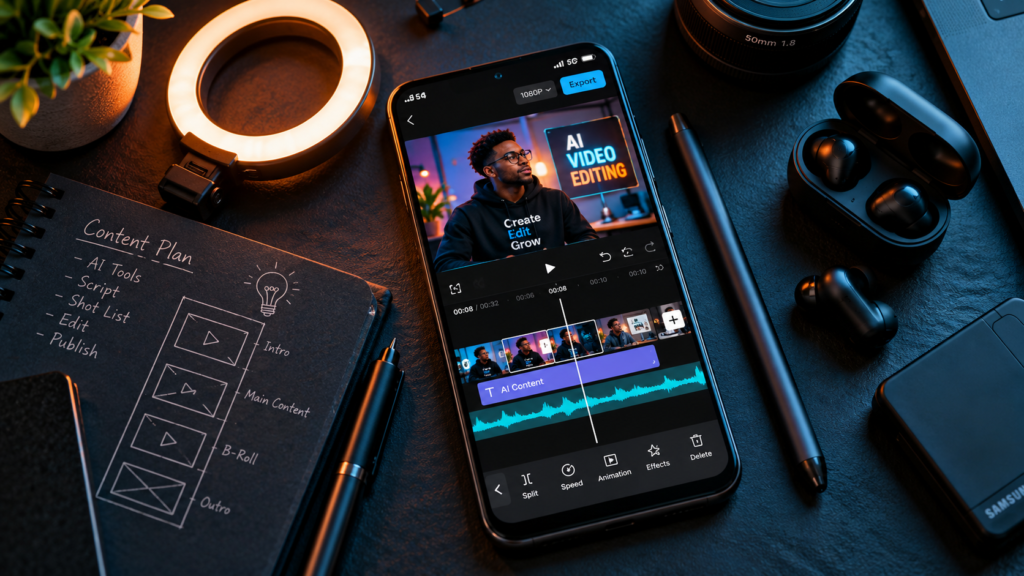
- Samsung Galaxy A17 5G ($199): The best 5G phone under $300 for overall value, featuring a 6.7-inch Super AMOLED display, a 50MP camera with OIS, and industry-leading software longevity through 2031.
- Google Pixel 8a (Renewed) (~$285): The top pick for computational photography and on-device AI features like Magic Editor, though it comes with shorter battery endurance.
- Moto G Power (2025) ($299.99):The performance-forward choice, packing 8GB RAM, a fluid 120Hz display, and rare-for-the-price wireless charging capabilities.
What You’ll Learn
- The top-tier budget devices qualifying as the best 5G phone under $300 for mobile content creation.
- Essential hardware specs that directly impact creator workflows: processor architecture, RAM allocation, camera optics, battery longevity, and panel refresh rates.
- Evaluation of on-device AI capabilities, including automated captioning, object removal, and smart photo enhancement.
- Strategic use cases matched to each phone type—whether your primary focus is rapid social publishing, long-form video, or live engagement.
- Critical hardware limitations and trade-offs to look out for before making a purchasing decision.
- Frameworks for prioritizing phone specifications based on your specific content output model.
Quick Comparison: Top 5 Budget 5G Phones for Creators
| Phone | Price | Display | RAM/Storage | Main Camera | Battery | AI Features | Best For |
| Samsung Galaxy A17 5G | $249.99 | 6.7″ Super AMOLED 90Hz | 4GB/128GB | 50MP + OIS | 5000mAh, 25W | Object Eraser, Filters, Circle to Search, Galaxy AI | Long-term support, AMOLED display, Samsung ecosystem |
| Moto G Power (2025) | $199.99 | 6.8″ FHD+ 120Hz LCD | 8GB/128GB | 50MP + OIS | 5000mAh, 30W + 15W wireless | AI camera optimisation, Face Retouch, Google Photos Auto Enhance | Performance, multitasking, wireless charging |
| Samsung Galaxy A26 5G | ~$275 | 6.7″ Super AMOLED 120Hz | 8GB/256GB | 50MP + OIS | 5000mAh, 25W | Circle to Search, Object Eraser, Galaxy AI, 6 years updates | Best AMOLED display, premium specs under $300 |
| Google Pixel 8a (Renewed) | ~$285 | 6.1″ OLED 120Hz | 8GB/128GB | 64MP + 13MP ultrawide | 4492mAh, 18W | Magic Editor, Best Take, Photo Unblur, Night Sight, Tensor AI | Camera quality, AI editing features, Pixel software |
| Moto G Stylus 5G (2024) | $169.99 | 6.7″ pOLED 120Hz | 8GB/128GB | 50MP + OIS | 5000mAh, 30W + 15W wireless | AI camera features, built-in stylus for annotations | Note-taking, sketching, annotations, wireless charging |
Prices verified September 2026. All phones support 5G on major US carriers.
Samsung Galaxy A17 5G – Best Overall for AI Content Creators
- Price: $249.99 (US unlocked)
- Best for: Long-term software support, AMOLED display quality, Samsung ecosystem integration, and creators who keep devices for 4+ years.
Key Specifications
- Display: 6.7-inch FHD+ Super AMOLED, 90Hz refresh rate
- Processor: Exynos 1330
- RAM/Storage: 4GB RAM, 128GB storage (expandable via microSD to 1TB)
- Camera System: 50MP main (OIS) + 5MP ultrawide + 2MP macro; 13MP front-facing selfie camera
- Battery & Charging: 5000mAh with 25W Super Fast Charging
- Software Longevity: 6 years of OS and security updates through 2031
- Durability: IP54 splash resistance, Gorilla Glass Victus
- Connectivity: 5G, NFC, eSIM, Samsung Wallet
Why It’s the Top Pick for the Best 5G Phone Under $300
The Samsung Galaxy A17 5G secures the top spot as the best 5G phone under $300 because Samsung guarantees 6 years of OS upgrades and security patches through 2031—an unprecedented level of longevity in this price bracket. For creators prioritizing a tool that remains secure and functional for 4+ years, this changes the long-term value calculation entirely.
The 6.7-inch Super AMOLED panel produces deep blacks, accurate colors, and striking contrast, making it an ideal portable monitor for reviewing footage and tweaking photo edits on the move. Furthermore, integrated Galaxy AI features like Object Eraser for eliminating distractions, dynamic filters, and Circle to Search with Google streamline research and editing workflows straight from the native gallery app.
Coupled with a 50MP main shooter featuring Optical Image Stabilization (OIS) for stable hand-held recording and a 5000mAh battery providing over 7 hours of screen-on time, this device stands out as a dependable daily driver.
Trade-offs to Consider
- Performance Bottlenecks: The Exynos 1330 paired with 4GB of RAM easily manages social apps and browsing, but demanding workloads like 4K video rendering or heavy multitasking will cause stutter.
- 90Hz Refresh Rate: While fluid, it trails the 120Hz panels found on competing devices in this tier.
- Low-Light Photography: Daylight performance is sharp, but nighttime captures lack the advanced computational depth of the Pixel 8a.
Best Use Cases
- TikTok & Instagram Reels: Enjoy a color-accurate preview on the AMOLED screen while utilizing OIS for stable walk-and-talk video.
- YouTube Shorts & Long-Term Projects: Leverage multi-year software updates to keep your device secure through 2031.
- Social Media Management: Utilize Samsung Wallet NFC for quick contactless checkouts and eSIM support when traveling.
- Rapid Mobile Editing: Apply AI-driven touch-ups with Object Eraser to publish content instantly without desktop software.
Who Should Skip This
- Power users and heavy mobile gamers requiring sustained high-framerate performance.
- Creators who switch rapidly between 10+ background apps simultaneously.
- Low-light mobile photographers who should look at the Pixel 8a instead.
Moto G Power (2025) – Best Performance and Multitasking
- Price: $199.99 (US unlocked)
- Best for: Performance-focused creators, heavy multitasking, wireless charging, rugged durability, and maximum specs per dollar.
Key Specifications
- Display: 6.8-inch FHD+ LCD, 120Hz refresh rate
- Processor: MediaTek Dimensity 6300
- RAM/Storage: 8GB RAM, 128GB storage (expandable via microSD)
- Camera System: 50MP main (OIS) + 8MP ultrawide; 16MP front-facing selfie camera
- Battery & Charging: 5000mAh with 30W wired charging + 15W wireless charging
- Software Longevity: 3 years of security updates (~2028)
- Durability: IP67/IP68 water resistance, MIL-STD-810H military-grade certification
- Connectivity: 5G, NFC, Google Pay, 3.5mm headphone jack
Why It’s the Performance Pick for the Best 5G Phone Under $300
At $199.99, the Moto G Power (2025) punches well above its weight class, delivering 8GB of RAM and a fluid 120Hz display—specifications that were reserved for mid-tier devices just a short time ago. Powered by the MediaTek Dimensity 6300 chipset, it outperforms the Galaxy A17 in raw multi-app workflows and gaming, effortlessly maintaining 10+ active apps in memory without frustrating reloads.
The butter-smooth 120Hz refresh rate transforms daily creator habits, making scrolling through dense editing timelines, scrubbing video clips, and managing social media feeds exceptionally fluid. Furthermore, the inclusion of 15W wireless charging is a massive anomaly under $200, allowing you to drop the phone onto a Qi pad between recording sessions without messing with cables.
Built for the field, its IP67/IP68 water resistance and MIL-STD-810H ruggedized build protect against accidental drops, heavy rain, and dusty outdoor shoots—making it an ideal companion for creators on the move.
AI and Camera Features
Motorola integrates practical intelligence directly into the hardware, including AI-powered shot optimization, Face Retouch for quick appearance touch-ups, and native Google Photos Auto Enhance integration for one-tap fixes. The 50MP main sensor paired with Optical Image Stabilization (OIS) captures crisp daylight footage, while deep Google Lens integration enables instant visual searches and text extraction straight from the viewfinder for quick content ideation.
Trade-offs to Consider
- Limited Software Support: Motorola commits to 3 years of security patches, falling short of Samsung’s 6-year window. Creators wanting a device that lasts past 2028 should look at the Galaxy series.
- LCD Panel Limitations: While the 120Hz refresh rate is fast, the LCD technology cannot match the deep blacks and punchy contrast of an AMOLED display for accurate color grading.
- No Telephoto Lens: Like most budget devices, zoom relies entirely on digital cropping, which degrades fine details at higher magnifications.
Best Use Cases
- Heavy Multitasking: Running video editing software, background music streams, and social platforms concurrently without lag.
- Mobile Livestreaming: Utilizing the 8GB RAM buffer to prevent unexpected app crashes or reloads during extended live broadcasts.
- Outdoor & Action Filming: Leveraging IP67/IP68 water resistance and military-grade durability for adventurous on-location shoots.
- Budget-Conscious Starters: Securing top-tier hardware specs and wireless charging features at a sub-$200 price point.
Who Should Skip This
- Creators who want long-term software updates spanning 4 to 6 years.
- Videographers and photographers requiring strict AMOLED color accuracy for grading content.
- Low-light purists who would benefit more from the Pixel 8a’s computational camera engine.
Samsung Galaxy A26 5G – Best AMOLED Display Under $300
- Price: ~$275 (international unlocked model)
- Best for: Uncompromised display quality, premium memory specs, long-term software support, T-Mobile/MVNO network users, and creators seeking a near-flagship experience on a budget.
Key Specifications
- Display: 6.7-inch FHD+ Super AMOLED, 120Hz refresh rate
- Processor: Exynos 1280 (5nm)
- RAM/Storage: 8GB RAM, 256GB storage (expandable via microSD up to 2TB)
- Camera System: 50MP main (OIS) + 5MP ultrawide + 2MP macro; 13MP front-facing selfie camera
- Battery & Charging: 5000mAh with 25W Super Fast Charging
- Software Longevity: 6 years of OS and security updates through ~2031
- Durability: IP67 water and dust resistance
- Connectivity: 5G, NFC, Samsung Wallet
Why It’s the Display Champion for the Best 5G Phone Under $300
The Samsung Galaxy A26 5G stands as the best 5G phone under $300 for pure panel quality, pairing a 6.7-inch FHD+ Super AMOLED screen with a fluid 120Hz refresh rate. Getting deep blacks, vibrant contrast, and a butter-smooth refresh rate alongside a massive 8GB of RAM and 256GB of baseline storage under $300 is an exceptional find.
For mobile creators, the AMOLED panel acts as a reliable color-accurate monitor when grading clips, scrubbing timelines, and polishing social posts on the go. Furthermore, the bump to 8GB RAM prevents app crashes when switching between high-overhead editing apps and messaging platforms, while the 256GB storage allows you to store substantial amounts of local 4K footage before needing to offload to the cloud.
Integrated Galaxy AI toolsets—including Circle to Search with Google and Object Eraser—further enhance day-to-day productivity by letting you clean up photo backgrounds instantly from the native gallery.
Critical Caveats
- International Model Status: The variant featured here is the international factory-unlocked model. While fully operational on T-Mobile and its associated MVNOs (such as Mint Mobile, Tello, and US Mobile), new activations on AT&T or Verizon can sometimes hit hurdles because the variant lacks native US carrier certification.
- No Domestic Warranty: Because it is an international release, it does not ship with an official US manufacturer warranty, leaving you reliant on retailer return windows or third-party repair hubs if hardware issues arise.
Trade-offs to Consider
- Carrier Limitations: Best deployed on GSM networks like T-Mobile. CDMA-based network users need to verify active-SIM requirements before committing.
- Processor Class: The Exynos 1280 handles standard creator workloads reliably, but graphic-heavy 3D gaming will demand dialed-down visual settings.
- Ceiling Pricing: At ~$275, you are pressing right against the budget ceiling, meaning more price-sensitive creators might prefer the lower cost of the Galaxy A17.
Best Use Cases
- Mobile Video Editing: Leveraging the 8GB RAM and expansive 256GB storage array to cut, render, and save 4K video projects locally.
- Color-Critical Work: Utilizing the high-contrast AMOLED panel for exact color representation during on-site photo selection.
- T-Mobile / MVNO Ecosystems: Maximizing full 5G tower connectivity on GSM networks without compatibility friction.
- Future-Proof Production: Enjoy a secure workspace backed by 6 years of consistent Samsung software support.
Who Should Skip This
- AT&T or Verizon subscribers looking for effortless, direct-from-carrier new line activations.
- Creators who strictly require a regional US manufacturer warranty.
- Budget-focused minimalists who can achieve 90% of the workflow value with a lower-cost option like the Galaxy A17.
Google Pixel 8a (Renewed) – Best Camera and AI Editing Features
- Price: ~$285 (renewed, Amazon)
- Best For: Studio-grade mobile photography, advanced AI photo manipulation, Google’s clean software ecosystem, long-term support, and a pocket-friendly compact form factor.
Key Specifications
- Display: 6.1-inch OLED, 120Hz refresh rate, HDR10+
- Processor: Google Tensor G3 (custom AI co-processor)
- RAM/Storage: 8GB RAM, 128GB storage
- Camera System: 64MP main + 13MP ultrawide; 13MP front-facing selfie camera
- Battery & Charging: 4492mAh with 18W wired charging
- Software Longevity: 7 years of full OS updates through May 2031
- Connectivity: 5G, eSIM, NFC, Google Pay
Why It’s the Camera King for the Best 5G Phone Under $300
No sub-$300 smartphone matches the image processing power of the Google Pixel 8a. Combining a 64MP main sensor with Google’s proprietary computational photography algorithms, it captures shots that routinely rival devices twice its price. For content creators relying on high-impact visual assets, the Pixel’s exclusive suite of AI editing tools fundamentally changes post-production workflows.
- Magic Editor: Reposition subjects, erase unwanted background distractions, or generate realistic filler elements to fix composition errors without setting up a reshoot.
- Best Take: Seamlessly stitch together consecutive group shots to guarantee everyone looks their best with open eyes and natural expressions—essential for collaborative media.
- Photo Unblur: Salvage fast-moving or motion-blurred action shots using machine learning to pull details back into focus.
- Night Sight: Deliver pristine, low-light photography without a flash, making it the undisputed winner for evening events, concerts, and dim studio settings.
Powered by the Google Tensor G3 chip, the device also drives deep on-device AI capabilities like Circle to Search and Live Translate, streamlining daily background research and content ideation.
Trade-offs to Consider
- Renewed Hardware Status: This option is a refurbished unit backed by a 90-day Amazon Renewed guarantee. Cosmetic wear varies, and initial battery health is variable, meaning a replacement cell may be necessary after a couple of years of heavy use.
- Smaller Battery Capacity: At 4492mAh, it is the most compact power cell on this list. While it easily handles moderate daily workflows, power creators should expect to top up mid-day.
- Slower Wired Charging: The 18W charging ceiling lags behind Samsung’s 25W and Motorola’s 30W charging speeds, requiring roughly 90 minutes for a complete cycle.
- Compact Footprint: The 6.1-inch form factor is ideal for one-handed handling, but it provides less digital real estate for complex mobile video editing timelines than its 6.7-inch competitors.
Best Use Cases
- Stills-First Content Creators: Producing sharp, professional-grade photography for Instagram feeds and blog headers.
- Advanced AI Editing: Utilizing Magic Editor and Photo Unblur to fix mistakes directly on-device instead of transferring files to a desktop.
- Low-Light & Event Coverage: Capturing crisp details in challenging dark environments using Night Sight.
- Future-Proof Software: Enjoy Google’s industry-leading 7-year update schedule that keeps the device secure through May 2031.
Who Should Skip This
- Buyers who refuse refurbished items and strictly require a brand-new device with a full manufacturer warranty.
- High-volume video creators who demand multi-hour recording sessions without battery anxiety.
- Content producers who prefer expansive screens and need larger 6.7-inch displays for timeline scrubbing.
Moto G Stylus 5G (2024) – Best for Note-Taking and Annotations
- Price: $169.99 (US unlocked)
- Best For: Creators who rely on precision handwriting, tutorial annotations, rapid sketching, document markup, and budget-friendly wireless charging.
Key Specifications
- Display: 6.7-inch pOLED, 120Hz refresh rate, FHD+
- Processor: Qualcomm Snapdragon 6 Gen 1
- RAM/Storage: 8GB RAM, 128GB storage (expandable via microSD)
- Camera System: 50MP main (OIS); 16MP front-facing selfie camera
- Battery & Charging: 5000mAh with 30W wired charging + 15W wireless charging
- Software Longevity: 3 years of security updates (support through ~2027)
- Special Hardware Feature: Built-in active stylus
- Connectivity: 5G, NFC, 3.5mm headphone jack, Google Pay
Why the Stylus Matters for Creators
The Moto G Stylus 5G (2024) is the only device under $300 featuring an integrated physical stylus. For content creators who map out video workflows, annotate user interface screenshots for tutorials, or sketch thumbnail concepts on the go, this precision input changes the mobile content creation process entirely.
Extracting the stylus from its housing automatically surfaces quick-note options, supporting pressure-sensitive tracking for smooth handwriting and rough drafts. Practical creator applications include:
- Annotating Screenshots: Circling UI elements and highlighting key features for step-by-step tutorial content.
- Thumbnail Prototyping: Sketching visual layouts and composition structures for upcoming video releases.
- Mobile Scripting: Jotting down talking points or capturing quick interview notes by hand.
- Creative Markup: Reviewing client revisions or sketching digital assets directly onto mobile art boards.
Beyond the pen, the 6.7-inch pOLED 120Hz display delivers rich contrast and deep blacks that outshine typical budget LCD panels, while the Snapdragon 6 Gen 1 processor keeps stylus latency low. At $169.99, it is also the most affordable entry on this list to incorporate both an OLED-class panel and wireless charging capability.
Trade-offs to Consider
- Stylus Security: The mechanical release click means the stylus can eject during heavy drops if unshielded. A protective wrap-around case is strongly recommended.
- Limited Support Lifecycle: Security patching runs through roughly 2027, making its support window noticeably shorter than Samsung’s extended updates.
- Averaged Camera Hardware: While the OIS-stabilized main sensor handles casual social sharing well, it lacks the advanced computational depth of the Pixel ecosystem.
Best Use Cases
- Educational & Tutorial Creators: Marking up application screens and capturing detailed instructional graphics.
- Digital Artists & Designers: Drafting initial concepts, typography layouts, and hand-drawn accents for social posts.
- Interactive Business Workflows: Signing forms, editing contracts, and organizing feedback on the move.
- Value-First Wireless Charging: Acquiring high RAM allocation, pOLED visuals, and wireless Qi power at a sub-$170 price tier.
Who Should Skip This
- Creators who have no use for a stylus and would prefer a traditional phone chassis.
- Buyers demanding multi-year software longevity past 2027.
- Photography purists who will find greater value in the Pixel 8a’s imaging software.
AI Features That Matter for Content Creators
Not all “AI features” are equally useful for mobile content creation. Manufacturers love throwing marketing jargon around, but only a handful of specific capabilities directly speed up production, fix errors, or enhance your creative output.
High-Value AI Features
- Object Eraser / Magic Eraser: Effortlessly clean up photo backgrounds by eliminating stray tourists, poles, or distracting elements without needing a desktop reshoot. Available natively across Samsung Galaxy A-series and Google Pixel devices.
- Best Take: Automatically stitch together multiple sequence shots to ensure every person in a group frame has their eyes open and is smiling. This is essential for collaborative media and team content.
- Photo Unblur: Utilize machine learning to sharpen soft focus and eliminate motion blur, salvaging otherwise unusable handheld captures.
- Circle to Search: Long-press the home button or navigation bar and circle any on-screen text, product, or visual element to trigger an instant search. This dramatically accelerates background research and real-time content ideation without app-switching.
- AI Night Mode / Night Sight: Process low-light images computationally to capture clean details without deploying harsh flashes. This is critical for evening events, dimly lit venues, and nightlife content.
- Face Retouch & Auto Enhance: Rapidly apply blemish corrections, skin smoothing, and one-touch exposure optimizations, shaving valuable minutes off your daily social media publishing pipeline.
Lower-Value AI Features
- AI Scene Detection: Automatically modulates exposure parameters depending on whether the camera flags a landscape, meal, or portrait. While helpful, most modern sensors manage dynamic range well enough on their own.
- AI Grip Control: Minimizes accidental touch registrations along curved or slim bezels. Highly convenient for day-to-day usability, but it holds no direct bearing on actual content production.
AI Features to Ignore
- Vague Marketing Buzzwords: Terms like “AI-optimized battery management,” “AI performance boost,” or “AI network acceleration” are frequently overhyped and rarely deliver measurable, real-world improvements to your workflow. Always evaluate hardware specifications and concrete toolsets over generic software claims.
Specifications That Matter for AI Content Creation
Evaluating a sub-$300 budget phone requires looking past flashy marketing to focus on the hardware components that directly impact your creation workflow, export times, and mobile post-production.
Processor and RAM
- Minimum Threshold: 4GB of RAM handles basic social media posting, messaging, and light single-app usage, but bottlenecks quickly under pressure.
- Recommended Standard: 8GB of RAM provides the breathing room needed for serious creators running video editing apps, background music, and communication suites simultaneously.
- Chipset Hierarchy (Best to Adequate): Snapdragon 6 Gen 1 > Dimensity 6300 > Exynos 1280 > Exynos 1330. Qualcomm’s Snapdragon alternatives offer superior thermal management and faster handling for CPU-intensive tasks and multi-app switching.
Display
- AMOLED vs. LCD: AMOLED panels (featured on the Samsung A-series and Pixel 8a) deliver true blacks, vivid contrast, and precise color grading—making them vital for checking photo and video assets before publishing. LCD panels offer decent outdoor brightness but fall short on color depth.
- Refresh Rate: A 120Hz refresh rate makes scrolling through complex editing timelines and navigating social feeds buttery smooth compared to 60Hz or 90Hz screens.
- Resolution: 1080p (FHD+) is the non-negotiable baseline. Avoid 720p (HD+) budget options, which lack the crispness required for precision media editing.
Camera
- Main Sensor: A 50MP or 64MP primary shooter equipped with Optical Image Stabilization (OIS) is the budget sweet spot. OIS is critical for stabilizing hand-held walkthrough videos and cutting down low-light motion blur.
- Ultrawide Lens: An 8MP or higher ultrawide sensor gives you the flexibility needed for expansive landscape shots, tight studio spaces, and large group framing.
- Selfie Camera: Aim for 13MP or higher to ensure clear front-facing vlogs and crisp video calls.
- Video Capability: Standard 1080p at 30fps/60fps is reliable. True 4K recording is rare under $300 and frequently lacks proper stabilization.
Battery and Charging
- Capacity: A 5000mAh cell is the gold standard for all-day use. Remember that continuous 5G usage drains power roughly 15% to 25% faster than standard 4G connections.
- Charging Speeds: Look for 25W wired charging or higher to minimize downtime. The inclusion of 15W wireless charging (found on select Motorola models) adds a layer of seamless, cable-free convenience at your desk.
Software Support
- The Longevity Gap: Premium budget options like the Samsung Galaxy A-series and Pixel 8a offer 6 to 7 years of software and security updates, whereas Motorola models max out at 3 years. If you intend to use your device as a primary content tool for 4 or more years, long-term software commitment is essential for app compatibility and security.
Common Mistakes to Avoid
Avoiding costly purchasing errors keeps your workflow efficient and your investment secure. Here are the five most common pitfalls creators make when shopping for budget devices:
- Prioritizing Megapixels Over OIS: A massive 108MP sensor without optical stabilization produces shaky, blurry video compared to a modest 50MP sensor backed by OIS. Optical image stabilization is non-negotiable for hand-held walkthroughs and stable social clips.
- Ignoring Software Support: A phone that stops receiving security patches within a couple of years becomes a digital vulnerability. Prioritizing long-term support windows, such as Samsung’s 6-year commitment through 2031, safeguards your creator tools.
- Buying Out-of-Date Refurbished Flagships: Snagging an older refurbished flagship (like a 2020 or 2021 Galaxy S-series device) sounds tempting, but they are often at or near the end of their official software updates. Only purchase renewed units if they remain well within active support windows (like the Pixel 8a through mid-2031).
- Overlooking Carrier Compatibility: International imports (such as the Galaxy A26 SM-A266M/DS variant) thrive on T-Mobile and its MVNO network ecosystem, but AT&T and Verizon customers often hit activation roadblocks. Always verify model strings against your carrier before checking out.
- Assuming All 5G Is Equal: Sub-$300 phones completely omit high-speed mmWave 5G support, meaning your real-world performance depends heavily on carrier mid-band coverage. T-Mobile users typically average 150 to 350 Mbps, while Verizon users frequently pull lower speeds on 5G Nationwide bands.
Decision Framework: Which Phone Should You Buy?
Choosing the right 5G phone under $300 depends on more than just price or specifications. In this section, we’ll compare the key factors that matter to AI content creators—including processing power, RAM, camera quality, battery life, display, storage, 5G connectivity, and AI-powered features—to help you identify the phone that best matches your content creation needs and budget.
Choose the Samsung Galaxy A17 5G if:
- You want a reliable device you can keep for 4+ years without losing security updates.
- You rely on the Samsung ecosystem (Samsung Wallet, Knox Security).
- You prioritize Super AMOLED display quality and NFC contactless payments.
- You need a strict budget option that still offers long-term software backing.
Choose the Moto G Power (2025) if:
- You want a fluid 120Hz display experience under the $200 threshold.
- You value 8GB of RAM for seamless multitasking and heavy app switching.
- You need rugged durability to survive drops, dust, and water splashes (IP67/IP68 + MIL-STD-810H).
- You upgrade your hardware every 2 to 3 years and prefer immediate performance over multi-year software longevity.
Choose the Samsung Galaxy A26 5G if:
- You use T-Mobile or a compatible GSM MVNO (Mint, Tello, US Mobile).
- You want the absolute highest-tier 120Hz AMOLED display under $300.
- You intend to keep your phone for 4+ years.
- You require 8GB of RAM and 256GB of local storage for heavy 4K video editing workflows.
Choose the Google Pixel 8a (Renewed) if:
- Camera quality and computational photography are your top priorities.
- You need advanced AI editing tools like Magic Editor, Best Take, and Photo Unblur.
- You want clean Pixel software with support extending through May 2031.
- You are comfortable with a renewed hardware condition and a slightly smaller battery.
Choose the Moto G Stylus 5G (2024) if:
- You frequently take handwritten notes, sketch concepts, or annotate documents.
- You design tutorials that require direct on-screen markings and annotations.
- You want a vibrant pOLED display paired with wireless charging at the lowest possible price point.
- You actively use a physical stylus as an extension of your content creation toolkit.
Which budget 5G phone is best for TikTok and Instagram Reels?
The Samsung Galaxy A17 5G is the best overall choice for short-form video creators. Its Super AMOLED display provides color-accurate framing, Optical Image Stabilization (OIS) steadies hand-held walkthroughs, and a 6-year software support window safeguards your device through 2031. For creators who value raw multitasking headroom, the Moto G Power (2025) steps up with 8GB of RAM and a smooth 120Hz display at $199.99.
Can I edit 4K video on a sub-$300 phone?
Yes, but within sensible limits. Models equipped with 8GB of RAM—such as the Samsung Galaxy A26 5G and the Moto G Power (2025)—handle standard 1080p timelines smoothly and manage light 4K projects. Expect slower export times and occasional frame drops on complex timelines. Creators dealing heavily in 4K multi-layer production should look toward mid-range devices ($400–$500).
Do budget 5G phones support AI photo editing apps like Lightroom and Canva?
Yes. Every device on this list runs modern versions of Android with at least 4GB of RAM, easily meeting the operational requirements for Lightroom Mobile, Canva, CapCut, and other AI-driven creative platforms. Devices with 8GB RAM, like the Pixel 8a and Galaxy A26, deliver the most responsive performance for high-load workloads.
How important is 5G for content creators?
5G is valuable for quickly uploading large video files, broadcasting high-bitrate livestreams, and pulling cloud assets on the go. Keep in mind that active 5G connections drain batteries roughly 15% to 25% faster than 4G. If your pipeline operates primarily on studio Wi-Fi, 5G is less critical, but it remains a smart feature for future-proofing your workflow.
Should I buy a renewed phone to save money?
Only if the device remains well within its active manufacturer support lifecycle. The Google Pixel 8a (Renewed) is supported through May 2031, making it a safe choice. Avoid older refurbished flagships from 2020 or 2021 (such as the Galaxy S21 or S20 FE), as they have reached the end of their official security update windows and pose security liabilities.
How much storage do I need for content creation?
Minimum: 128GB suits casual creators shooting standard 1080p video and handling light asset storage.
Recommended: 256GB is ideal for creators shooting frequent 4K clips or maintaining massive local photo archives. Fortunately, almost all phones on this list feature microSD card expansion (supporting up to 1TB or 2TB), allowing you to expand local capacity over time.
In Conclusion
The best 5G phone under $300 depends on your priorities, whether that’s long-term software support, multitasking performance, AI-powered photography, or display quality. Compare your needs, confirm network compatibility, and check current pricing before making your final choice.
- Samsung Galaxy A17 5G ($249.99): The best 5G phone under $300 overall for content creators, combining 6-year software support through 2031, a vibrant Super AMOLED display, and integrated Galaxy AI features.
- Moto G Power (2025) ($199.99): Delivers unmatched performance per dollar with 8GB of RAM, a fluid 120Hz display, and rare wireless charging—making it ideal for heavy multitasking.
- Google Pixel 8a (Renewed) (~$285): Unmatched for computational photography and advanced AI editing tools like Magic Editor and Best Take, though it features a smaller battery.
- Core Takeaways: Always prioritize Optical Image Stabilization (OIS) over raw megapixel counts, AMOLED over LCD, and 6-year software lifecycles over 3-year windows to maximize long-term value.
- What to Avoid: Steer clear of out-of-date refurbished flagships from 2020–2021 that lack active security patching. Only buy renewed if the device remains firmly inside its official manufacturer update window.
Next Step
Identify your primary constraint or feature priority: long-term support (Galaxy A17), multitasking performance (Moto G Power), camera processing (Pixel 8a), or display quality (Galaxy A26). Once selected, verify your specific network carrier compatibility and check current live pricing on Amazon or the manufacturer’s official portal before making your final purchase.