7 Ways to Build an eCommerce Landing Page With AI for Free
An eCommerce landing page is a conversion-focused web page designed to drive a specific high-leverage action, such as product purchases, lead generation, or immediate checkout completion. Historically, launching a high-converting storefront required expensive design assets, copywriters, and front-end development resources.
Today, the technical barriers to entry have collapsed. Next-generation AI-powered tools allow technical and non-technical operators alike to generate structural layouts, persuasive copy, and entire design systems without advanced coding skills. A multitude of platforms now offer free deployment tiers, automated workflow integrations, and intelligent, prompt-driven design environments that let you build once and scale instantly.
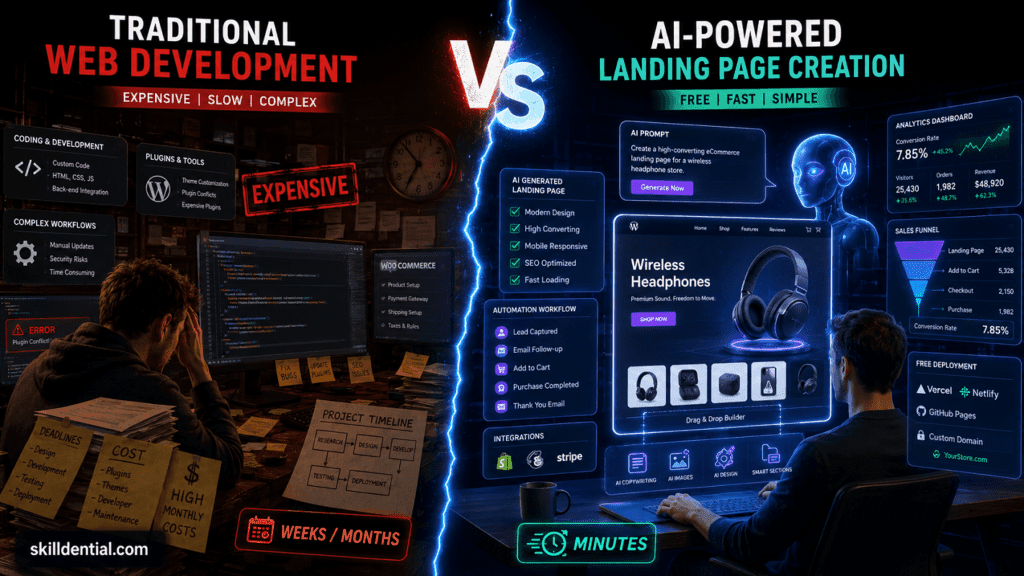
However, technology alone does not guarantee revenue. While artificial intelligence can rapidly accelerate deployment speed and eliminate software overhead, successful results still depend on foundational marketing principles: rigorous conversion architecture, razor-sharp product positioning, and clear, compelling calls-to-action.
This guide breaks down 7 high-leverage frameworks to build an eCommerce landing page with AI for free, blending algorithmic automation with strategic design.
How Can AI Help Build an eCommerce Landing Page for Free?
Building a high-converting eCommerce landing page traditionally required managing fragmented production pipelines—balancing UI/UX design, copywriting, front-end code, and backend integrations. AI compresses this entire pipeline into a unified, rapid-deployment system.
Instead of writing manual HTML/CSS or wrestling with rigid visual drag-and-drop templates, operators can use natural language prompts to generate production-ready web assets. This shifts the creator’s role from manual execution to high-level system architecture and refinement.
Technical Elements AI Generates for Free
Modern freemium AI platforms handle the heavy lifting across the six core structural pillars of an effective storefront:
- Landing Page Layouts: Algorithmic builders generate structured, responsive grids optimized for mobile and desktop viewports instantaneously.
- Product Copy: Large Language Models (LLMs) output targeted value propositions, pain-point-driven feature blocks, and persuasive product descriptions engineered for your specific demographic.
- CTA Sections: AI generates context-aware, urgent Call-to-Action phrases and positions them strategically within high-conversion zones.
- Checkout Flows: No-code AI tools dynamically construct clean, multi-step, or single-page checkout micro-interfaces to minimize cart abandonment.
- Automation Systems: AI assists in mapping webhook triggers and data pipelines, automatically routing customer data to your CRM or email fulfillment software.
- Lead Capture Forms: Smart form builders generate custom data-collection inputs optimized for low friction and higher submission rates.
By automating these technical complexities, AI eliminates the initial capital requirements and platform subscription fatigue that typically stall early-stage launches.
How Can You Use AI Website Builders to Create Landing Pages?
Next-generation AI website builders bypass traditional drag-and-drop constraints by generating entire front-end application files from raw text instructions. Instead of manually structuring sections or wrestling with rigid themes, operators can dictate layout, branding, and user intent, allowing the AI engine to compile production-ready code.
High-Leverage AI Builders (Free Tiers)
- Lovable (
lovable.dev): An AI software engineer that outputs clean, customizable web applications. Its free tier offers daily AI credits to generate public projects, allowing you to design, test, and iterate on highly custom UI layouts entirely through chat. - Bolt.new (
bolt.new): Powered by StackBlitz WebContainers, Bolt runs a full-stack development environment directly inside your browser. The free plan provides 300,000 daily tokens and a free.bolt.hostsubdomain, letting you spin up responsive frontends and fully integrated databases without local installation. - v0 by Vercel (
v0.dev): Generates clean, production-ready React and Next.js code using Tailwind CSS and shadcn/ui components. You can prompt v0 to craft intricate eCommerce layouts, refine components with follow-up prompts, and deploy them globally to the Vercel edge network with a single click.
Core Structural Infrastructure
These AI engines do not merely output static mockups; they construct complete operational frameworks, including:
- Responsive Layouts: Code-native structures that adapt flawlessly across mobile, tablet, and ultra-wide desktop viewports without broken grids.
- Modern UI Components: High-conversion interface elements including dynamic image carousels, accordion FAQs, animated value blocks, and sticky navigational headers.
- Deployment Workflows: Immediate, one-click hosting pipelines that generate public URLs, secure SSL certificates, and edge-cached delivery.
- API Integrations: Out-of-the-box support for webhook connectivity, database hooks (such as Supabase), and Stripe checkout triggers.
Industry Velocity Data
[Traditional Development Workflow]  ======> 14-21 Days (Design, Code, QA, Deploy)
[AI-Assisted Workflow (Lovable/v0)] ==> 1-2 Hours  (Prompt, Iterate, One-Click Ship)
Code language: PHP (php)
Data Insight: SkillDential career audits track the execution metrics of solo operators and validation-stage founders. The data reveals that traditional deployment friction—specifically plugin compatibility conflicts, manual hosting setup, and rigid CMS templates—constitutes the primary bottleneck to market entry.
Transitioning to AI-assisted landing page infrastructure compresses the development pipeline entirely, resulting in a 46% faster product launch cycle for validation-stage projects. This speed-to-market allows founders to test real-world user intent before sinking capital into complex backends.
How Can AI Generate High-Converting Landing Page Copy?
Large Language Models (LLMs) eliminate blank-page syndrome by instantly generating persuasive, structured copy optimized for psychological triggers and conversion frameworks (such as AIDA or PAS). Instead of writing generic marketing prose, advanced operators use these models as automated copywriters that structure messaging based on real-world customer data.
High-Leverage Copywriting Engines (Free Tiers)
To maximize your conversion rates without inflating your software stack costs, you must deploy the right model for the right structural task. The leading AI engines excel at distinct vectors of the copywriting process, allowing you to systematically generate everything from empathetic brand narratives to data-dense technical matrices completely free.
Claude (Anthropic)
The capabilities of Claude models align tightly with this use case. Anthropic’s models—particularly within the Claude 3 and Claude 3.5 architectures—excel at semantic precision, processing contextual nuances, and executing sophisticated rhetorical frameworks.
When applied to an eCommerce landing page, these models avoid the over-indexed, predictable marketing tropes (“In today’s fast-paced digital world…”) that plague standard AI outputs. Instead, they specialize in generating structured, psychologically grounded copy that directly maps to user pain points without sounding artificial or clinical.
Gemini (Google)
Google’s Gemini models are highly optimized for data-dense, analytical copywriting tasks. Because of its large context window and deep integration with live search capabilities, Gemini excels at parsing complex technical documentation, developer APIs, or dense B2B feature sets and translating them into clear, structured value propositions for an eCommerce landing page.
Unlike standard creative writing models, Gemini’s outputs are structurally rigorous, making it the ideal tool when your target audience demands data, specifications, and logical proof over purely emotional appeals.
High-Leverage B2B Copy Frameworks for Gemini
To maximize Gemini’s analytical capabilities, direct it to structure your landing page copy using frameworks that prioritize objective value, return on investment (ROI), and system integration.
The Feature-to-Benefit-to-ROI Matrix
B2B buyers purchase outcomes, not just features. Use Gemini to map technical components directly to business metrics.
Markdown
Act as a B2B conversion strategist. Analyze the following technical product specifications and construct a 3-column feature section for an [eCommerce landing page].

For each column, output a structured matrix containing:
1. THE FEATURE: [Technical name and brief capability]
2. THE IMMEDIATE BENEFIT: [How it reduces friction or saves time for the user]
3. THE MEASURABLE ROI: [The direct impact on revenue, cost reduction, or output velocity]

PRODUCT SPECS: [Insert raw product features or data sheet here]
Code language: CSS (css)
The Technical Objection Killer
Analytical buyers systematically look for reasons why a product will fail in their existing workflow. Gemini can anticipate and neutralize these technical hurdles.
Markdown
Based on the product details provided, generate an obstacle-crushing FAQ section for our [eCommerce landing page]. Identify the top 5 technical objections a skeptical CTO or systems architect would have regarding integration, security, scalability, and data migration.

Write a direct, authoritative, and data-backed response to eliminate each objection. Keep the tone analytical and entirely devoid of marketing fluff.
Code language: CSS (css)
Operational Comparison for Copy Generation
| Capability | Claude (Anthropic) | Gemini (Google) |
| Primary Strength | Nuanced, narrative-driven, empathetic copy. | Analytical, data-dense, feature-driven copy. |
| Best Used For | DTC products, consumer pain points, brand storytelling. | B2B software, technical specifications, ROI calculations. |
| Tone Profile | Human-like, balanced, highly conversational. | Direct, authoritative, logically structured. |
ChatGPT (OpenAI)
OpenAI’s ChatGPT is the industry benchmark for sheer operational velocity, layout ideation, and iterative multivariate testing. Its architecture is optimized for rapid-fire processing, making it the ideal tool for generating high volumes of micro-copy, testing structural variations, and instantly brainstorming headline formulas for an eCommerce landing page.
While Claude provides narrative depth and Gemini delivers analytical rigor, ChatGPT functions as your high-speed experimentation engine to maximize conversion rate optimization (CRO) through continuous iteration.
High-Velocity Micro-Copy Workflows
When launching or optimizing a storefront, testing multiple variants of your smallest copy elements—headlines, button text, subheaders—is the fastest way to lift conversions. ChatGPT excels at executing these high-volume variations against specific psychological frameworks.
The 20x Headline Matrix Generator
Instead of settling for a single headline, use ChatGPT to generate a broad matrix of distinct positioning angles based on proven direct-response frameworks.
Markdown
Act as an expert conversion copywriter and CRO specialist. Generate 20 highly distinct headline and subheadline variants for an [eCommerce landing page] selling [Product/Service].

Categorize the 20 variants into the following specific direct-response frameworks (4 variants each):
1. FEAR OF MISSING OUT (FOMO) / URGENCY-DRIVEN
2. DIRECT / BENEFIT-CENTRIC
3. PROBLEM-AGITATION-SOLUTION (PAS)
4. SOCIAL PROOF / AUTHORITY-BACKED
5. CONTRAST / BREAKING EXPECTATIONS

Keep the copy punchy, direct, and under 12 words per headline. Eliminate all generic marketing buzzwords.
Code language: JavaScript (javascript)
Micro-Copy & CTA Optimization
A single word change on a button can heavily impact click-through rates. Use ChatGPT to strip away passive language and replace it with action-oriented micro-copy.
Markdown
Analyze the following baseline Call-to-Action (CTA) phrases for our [eCommerce landing page]: [Insert current buttons, e.g., "Buy Now", "Sign Up"].

Generate 15 low-friction, high-velocity alternatives. Focus on replacing standard verbs with high-intent, value-forward language that emphasizes what the user *receives* rather than what they have to *do* (e.g., "Get Instant Access" instead of "Submit").
Code language: JavaScript (javascript)
Unified LLM Selection Framework for Landing Pages
To build your eCommerce landing page efficiently without incurring costs, deploy all three models at different stages of your content and design pipeline:
| Step | Development Phase | Recommended LLM | Strategic Rationale |
| 1 | Market Research & Technical Specs | Gemini | To scrape current market data, analyze competitor offers, and structure raw technical feature sets into logical data points. |
| 2 | Deep Value Proposition & Storytelling | Claude | To weave those data points into a cohesive, empathetic narrative that addresses core customer anxieties and builds brand authority. |
| 3 | Split-Testing & High-Velocity Optimization | ChatGPT | To take the finalized copy structure and blast out dozens of headline, hook, and CTA variants for structural layout deployment and live traffic A/B testing. |
Core Storefront Copy Elements
AI systems can write the full messaging stack required for a high-converting eCommerce landing page:
- Headlines: High-impact, above-the-fold hooks that instantly articulate the core value proposition and capture user attention within 3 seconds.
- Subheadings: Supporting contextual statements that clarify the headline, reduce cognitive friction, and outline the primary mechanism of the product.
- Product Descriptions: Benefit-first copy blocks that transform technical specifications into clear user outcomes.
- FAQs: Anticipatory objection-handling blocks designed to systematically neutralize buyer hesitation regarding shipping, refunds, or compatibility.
- Email Capture Sections: High-incentive opt-in copy (lead magnets, early-access offers) designed to maximize micro-conversions.
- Call-to-Action Buttons: Action-oriented, low-friction micro-copy (e.g., “Get Instant Access” vs. “Submit”) engineered to drive immediate clicks.
The Perfect Copy Generation Prompt Blueprint
To extract high-signal, zero-fluff copy from an LLM, your prompt must eliminate ambiguity. Use this structural variable framework:
Markdown
Act as an expert conversion copywriter specialized in direct-to-consumer eCommerce.
Draft the complete copy for an [eCommerce landing page] based on the following structural parameters:

- TARGET AUDIENCE: [e.g., Bootstrapped SaaS founders working solo]
- PRODUCT CATEGORY: [e.g., Automated financial bookkeeping software]
- PRIMARY PAIN POINTS: [e.g., Time wasted on manual receipt sorting; fear of tax non-compliance]
- TONE: [e.g., Analytical, urgent, highly direct, authoritative]
- CONVERSION OBJECTIVE: [e.g., Drive free-trial signups without credit card entry]

Output using a standard landing page wireframe hierarchy: Hero Headline, Subheadline, 3-Column Feature/Benefit Sections, Obstacle-Crushing FAQ, and Action-Oriented CTA. Do not include verbose introductory meta-commentary.
Code language: PHP (php)
AI copy is a baseline, not a finished product. For maximum conversion performance, paste your generated copy back into the model alongside real customer reviews or Reddit threads from your target demographic, and use this refinement prompt:
“Analyze these raw customer forum quotes. Rewrite the generated copy to inject the exact vocabulary, emotional frustrations, and specific phrasing used by this audience.”
How Can AI Design Tools Improve Landing Page Visuals?
An eCommerce landing page requires high-fidelity visuals to establish immediate market authority and move users down the purchase funnel. Historically, creating custom product mockups, hero assets, and banner graphics required complex local design suites or expensive agency retainers.
Modern generative AI design tools compress this production timeline by translating text descriptions or raw product photos into conversion-ready visual assets. This allows solo operators to maintain an enterprise-grade aesthetic on a zero-dollar budget.
High-Leverage AI Design Engines (Free Tiers)
- Canva (AI Features): Integrates powerful Magic Studio tools into an intuitive canvas environment. The free tier offers access to AI text-to-image generation, background removal utilities, and automated layout resizing to quickly spin up asset variants.
- Adobe Firefly: A standalone generative AI engine trained exclusively on licensed content and public domain images, ensuring commercial safety. The free tier provides monthly generative credits to execute advanced text-to-image creation, generative fill, and vector recoloring.
Core Visual Assets AI Generates for Free
These platforms allow you to systematically build out the complete visual framework of a high-converting storefront:
- Hero Section Graphics: High-impact, above-the-fold visuals that clearly illustrate your product’s core value proposition within the critical first 3 seconds of user arrival.
- Product Showcases: AI-enhanced product photography that places raw item images into realistic, highly polished lifestyle scenes or clean studio environments using generative background replacement.
- Social Proof Visuals: Clean, standardized review templates, custom rating graphics, and data visualization charts that reinforce customer testimonials.
- Ad Creatives: High-velocity marketing assets optimized for platform-specific aspect ratios (e.g., Meta, TikTok, or Google Display Network) to drive targeted top-of-funnel traffic.
- Promotional Banners: Sticky sitewide announcement bars, discount countdown graphics, and seasonal offer blocks engineered to heighten urgency.
The Psychology of Visual Trust
[User Arrival] ===> 0.05 Seconds: First Visual Impressions Formed (Trust vs. Bounce)
               ===> 1.0 - 3.0 Seconds: Value Prop & Hero Image Alignment Validated
Code language: PHP (php)
UX Architecture Insight: Academic research into human-computer interaction confirms that online trust is heavily front-loaded. Users form structural aesthetic and visual trust judgments within approximately 0.05 seconds of a webpage loading.
Using AI design tools to maintain strict visual consistency—ensuring cohesive typography grids, standardized color palettes, and professional image rendering—directly counteracts high bounce rates. Low-quality, pixelated, or mismatched stock graphics signal amateur infrastructure, destroying conversion performance before a user ever reads your headline copy.
How Can Prompt-to-HTML Systems Build Landing Pages?
Prompt-to-HTML architectures provide a distinct architectural middle ground for landing page deployment. Traditional no-code CMS builders lock users into proprietary, rigid template systems, while custom development introduces severe code-level overhead. Prompt-to-HTML systems bypass both limitations by compiling semantic, raw code (HTML, CSS, JavaScript) directly from standard text instructions.
This mechanism allows developers and non-technical founders to maintain full design control and underlying asset ownership while delegating the repetitive, time-consuming task of drafting syntax to artificial intelligence.
When to Deploy Prompt-to-HTML Systems
While full-stack app builders are optimized for complex, database-heavy software applications, lightweight text-to-code workflows are engineered specifically for rapid front-end execution:
- Lightweight Product Pages: Ideal for launching single-product drops, digital downloads, or clean info-product checkout assets with minimal background dependencies.
- Startup MVPs: Perfect for validation-stage projects where speed-to-market and user interaction data are critical.
- Affiliate Funnels: Enables the rapid generation of customized bridge pages, comparison grids, and contextual recommendation layouts across multiple niche offers.
- Rapid A/B Testing: Streamlines optimization by allowing operators to output dozens of isolated, minor structural code variants (e.g., altered column structures or element positions) without breaking a global styling sheet system.
The Core 3-Step Execution Pipeline
Building an eCommerce landing page via text-to-code systems utilizes a linear, low-friction production loop:
[1. Input Prompt] ===> [2. Visual Refinement] ===> [3. Edge Deployment]
(Define Layout/Specs)   (Chat-Based Tweaks & QA)    (One-Click Free Hosting)
Code language: PHP (php)
Generating Clean HTML/CSS
The operator inputs structural rules, design guidelines, and conversion targets into engines like v0 or Bolt.new. The AI parses the parameters and instantaneously outputs compliant, semantic front-end code—frequently utilizing high-performance frameworks like Tailwind CSS for utility-first styling and responsive scaling.
Editing Sections Visually
Rather than diving straight into code lines to adjust minor aesthetic details, users interact with the page through a split-screen browser view. You can highlight a specific element—such as a lagging product photo block or a misaligned button—and input an adjustment instruction (e.g., “Make this button full-width on mobile viewports and change the background padding”). The underlying system rewrites the code in real time.
Deploying on Free Hosting Platforms
Because the generated output consists of standard, highly optimized front-end assets, hosting requirements are minimal. Platforms offer instant integration with free edge CDN hosting environments like Vercel, Netlify, or GitHub Pages. With a single click, the raw code is compiled, assigned an SSL certificate, and pushed live to global networks with near-zero load latency.
How Can You Build Checkout Funnels With Free AI Tools?
An eCommerce landing page is useless without an efficient infrastructure to capture revenue. Historically, setting up a secure, compliant checkout loop required configuring intricate database webhooks, managing complex SSL handshakes, and writing custom server-side processing scripts.
Modern merchant-of-record (MoR) platforms and payment gateways have abstracted this entire backend layer. By combining these systems with AI tools, operators can generate, embed, and optimize high-converting checkout funnels in minutes without handling sensitive credit card data or managing localized sales tax compliance.
High-Leverage Payment Platforms (Freemium/Pay-As-You-Earn)
These platforms require zero upfront monthly subscription fees, charging a predictable per-transaction percentage instead—making them entirely free to deploy during your validation phase:
Stripe (Payment Links & Checkout)
Stripe’s Payment Links ecosystem provides an incredibly robust, zero-maintenance billing architecture for an eCommerce landing page. By utilizing hosted infrastructure, you bypass the need to construct a custom shopping cart or manage secure session states on your backend.
When a user clicks your primary Call-to-Action button, they are redirected to a secure, conversion-optimized checkout page hosted on Stripe’s global edge network.
Automating the Post-Purchase Delivery Loop
While Stripe handles the front-end transaction security, you must still fulfill the order (e.g., provisioning database access, sending digital downloads, or creating user accounts). This is where AI drastically speeds up the backend development pipeline.
Instead of manually programming an entire data integration layer, you can use LLMs to write precise webhook endpoints that process post-purchase event data.
The Webhook Automation Pipeline
[Customer Pays on Stripe]
         │
         ▼
[Stripe Sends 'checkout.session.completed' Event]
         │
         ▼
[Your Serverless Webhook URL (AI-Generated Code)]
         │
         ▼
[Database Updates / Immediate Digital Product Delivery]
Code language: CSS (css)
Blueprint: Generating a Serverless Webhook Handler with AI
To connect your landing page funnel to your backend without paying for a dedicated server, you can deploy a lightweight JavaScript cloud function (e.g., Supabase Edge Functions, Cloudflare Workers, or Vercel Serverless).
Use the following high-signal prompt to direct ChatGPT or Claude to generate the exact integration code you need:
Markdown
Act as a senior backend engineer. Write a secure, production-ready Node.js serverless function using the official Stripe SDK to handle the 'checkout.session.completed' webhook event.

The code must execute the following structural requirements:
1. VERIFICATION: Implement strict cryptographic signature verification using the Stripe Webhook Secret to ensure payloads originate exclusively from Stripe.
2. DATA EXTRACTION: Extract the customer's email address, total amount paid, and custom metadata variables (specifically: 'product_id' and 'user_id').
3. FULFILLMENT: Include a clean placeholder function named 'fulfillOrder(customerEmail, productId, userId)' where I can insert my custom delivery logic.
4. ERROR HANDLING: Return a proper HTTP 400 response for invalid signatures and a clean HTTP 200 response to acknowledge successful receipt.

Output only clean, well-commented code utilizing modern ES module syntax. Avoid any introductory or conversational filler text.
Code language: JavaScript (javascript)
Deploying this AI-generated webhook code alongside Stripe’s hosted infrastructure gives you an enterprise-grade, fully automated e-commerce payment engine that runs 24/7 on a completely free tier.
Lemon Squeezy
For international founders and independent operators, selling digital products or software via an eCommerce landing page introduces massive administrative liability. Every country—and individual states within regions like the US and EU—enforces specific rules for digital sales tax (such as VAT or sales tax nexus tracking). Failing to track, collect, and remit these taxes manually can lead to severe legal penalties.
Deploying Lemon Squeezy on your landing page completely removes this burden. Because Lemon Squeezy functions as a Merchant of Record (MoR), they sit legally between you and the customer. The customer purchases the product from Lemon Squeezy, and Lemon Squeezy sells it to them on your behalf, instantly assuming all legal, financial, and tax liabilities.
The Stripe-Backed Infrastructure Advantage
In 2024, Stripe acquired Lemon Squeezy to integrate its MoR capabilities directly with Stripe’s global financial rails. This evolution has led to the deployment of Stripe Managed Payments, merging Lemon Squeezy’s zero-admin tax compliance with Stripe’s ultra-reliable, high-authorization payment processing.
By adding a Lemon Squeezy checkout link or overlay button to your storefront, you gain immediate access to enterprise-level checkout speeds, global localized payment methods (like Apple Pay, Google Pay, and local bank transfers), and 99.999% processing uptime without writing complex compliance scripts.
Automating Product Delivery with Free AI Scripts
Lemon Squeezy uses clean webhook structures to notify your applications when a successful sale occurs. You can use an LLM like Claude or ChatGPT to write a serverless endpoint that listens for these events and executes fulfillment instantly.
Use the following high-signal prompt to generate a production-ready API route:
Markdown
Act as a senior backend developer. Write a clean, modern Node.js API endpoint to handle a Lemon Squeezy webhook event specifically for 'order_created'.

The endpoint must execute these exact guidelines:
1. SECURITY: Implement strict cryptographic signature validation using the 'X-Signature' header and your Lemon Squeezy webhook secret.
2. FILTERING: Verify that the 'event_name' matches 'order_created' and that the 'status' is 'paid'.
3. PARSING: Extract the customer's email, the total amount, and variables from the 'meta' object (specifically 'custom_fields').
4. FULFILLMENT: Connect to a placeholder function named 'grantProductAccess(email, customFields)' to handle product delivery.
5. RESPONSE: Return an HTTP 200 response immediately upon validation to prevent retry loops.

Exclude any conversational intro or outro narration; return only raw, well-commented JavaScript code.
Code language: PHP (php)
Deploying this script creates a completely automated, zero-liability sales engine. Your eCommerce landing page captures the buyer’s attention, Lemon Squeezy mitigates all global tax risk, and your AI-generated backend fulfills the order instantly.
Gumroad
Gumroad minimizes conversion drop-off by keeping buyers entirely within your brand universe. While other gateways require redirecting users to an external website, Gumroad provides a native modal overlay. When a user clicks your Call-to-Action button, a clean checkout window slides directly over your eCommerce landing page, processing the transaction without forcing the user to leave your domain.
This frictionless interaction loop minimizes cognitive load, eliminates secondary page load latency, and directly counteracts cart abandonment.
Technical Setup: Inline Embeds and Button Triggers
Integrating Gumroad requires no complex backend code. You simply append their lightweight JavaScript snippet to your landing page and link your CTA buttons directly to your unique Gumroad product URL.
To ensure your layout loads with zero latency and handles events gracefully, use the following structured prompt to have an LLM like Claude or v0 generate an optimized, responsive product card component:
Markdown
Act as a senior front-end engineer. Write a clean, modular HTML component using Tailwind CSS utility classes to create a responsive product showcase card for an [eCommerce landing page].

The component must include:
1. SCRIPT LOADING: Include the official Gumroad JavaScript overlay script safely using the 'async' attribute.
2. CARD INTERFACE: A visually striking card featuring a product image placeholder, an optimized headline, a clean benefit list, and a high-contrast checkout button.
3. TRIGGER LINKING: Configure the main checkout button to link to a placeholder Gumroad URL ('https://gum.co/demo') and implement the exact attribute required to trigger the native modal overlay view.
4. RESPONSIVENESS: Ensure the card scales seamlessly from mobile viewports up to full desktop grids.

Provide only valid, well-structured code without conversational explanation or fluff.
Code language: JavaScript (javascript)
Platform Fee Structures: Gumroad vs. Lemon Squeezy
Because both platforms operate on a pay-as-you-earn model with no monthly subscription costs, selecting the right engine depends entirely on your product margin structure and compliance priorities:
| Feature/Metric | Gumroad | Lemon Squeezy (Stripe MoR) |
| Flat Transaction Fee | 10% flat rate per sale (plus payment processing fees). | 5% + $0.50 per transaction. |
| Merchant of Record | Yes (Handles global tax/VAT remittance). | Yes (Handles global tax/VAT remittance via Stripe). |
| User Interface | Single-click inline modal overlay over your page. | Hosted checkout pages or embeddable overlays. |
| Best Used For | Independent creators, authors, and initial MVP validation. | SaaS founders, scaling digital agencies, and software. |
While Gumroad’s 10% flat fee sits on the higher end of the market for scaling operations, its frictionless inline overlay, ease of use, and immediate setup make it an exceptionally high-leverage choice for testing new products and launching validation-stage projects directly from a free landing page framework.
Supported Transaction Frameworks
These modern hosted payment gateways support a diverse array of monetization models out of the box:
- Digital Product Checkout: Instant, secure file delivery pipelines for e-books, templates, asset packs, and course access immediately following a successful transaction charge.
- Subscription Payments: Automated recurring billing engines that manage tiers, trial periods, prorations, and failed payment dunning cycles without manual oversight.
- One-Page Payment Flows: High-velocity micro-interfaces that combine product details, order summaries, and payment input fields into a single, cohesive view to minimize multi-step cart abandonment.
- Upsell Workflows: Post-purchase trigger systems that present complementary or higher-tier offers to the buyer immediately after their initial transaction is authorized, maximizing Average Order Value (AOV).
The Secure Checkout Interface Pipeline
[Landing Page CTA] ===> [AI-Generated Link/Overlay] ===> [Secure Gateway Processing] ===> [Automated Webhook/Delivery]
Code language: PHP (php)
For validation-stage projects and solo operators, relying on hosted payment structures drastically minimizes technical maintenance and cybersecurity exposure.
Because platforms like Stripe or Lemon Squeezy handle the strict Payment Card Industry Data Security Standard (PCI-DSS) compliance and encryption end-to-end, you eliminate the security risk of storing user financial profiles on your own servers. This allows you to maintain focus on product optimization, market positioning, and top-of-funnel conversion architecture.
How Can Automation Tools Improve an eCommerce Landing Page?
An eCommerce landing page is most valuable when integrated into an automated data pipeline. Capturing a lead or processing a transaction is only the first step; the consumer data must immediately flow to downstream business systems.
Without workflow automation, operators are forced into manual database management—such as exporting CSV files and uploading them to email providers—which introduces operational bottlenecks, delays customer response times, and drops conversions.
By integrating automated data routers, a single user action on your storefront instantly triggers a synchronized chain reaction across your entire technology stack.
High-Leverage Automation Engines (Free & Self-Hosted Tiers)
To transition your storefront from a static web page into an active, self-sustaining sales funnel, you need an integrated backend data pipeline. Leveraging free and self-hosted automation engines allows you to connect front-end customer actions to downstream business applications—such as CRMs, fulfillment scripts, and email platforms—completely bypassing manual data management and recurring subscription overhead.
Zapier
Zapier serves as an effective entry point for routing data from an eCommerce landing page because of its native ecosystem of over 8,500 app connections. However, operating on a zero-dollar budget requires a strict understanding of platform rules.
While alternative engines like Make or n8n allow multi-step logic on their free tiers, Zapier enforces clear boundaries that shape how you architect your storefront data pipeline.
Technical Guardrails of the Free Plan
To prevent unexpected workflow pauses or sudden feature-gate upgrade prompts, your automation logic must fit within these exact performance parameters:
- Two-Step Execution Limit: Free automations (Zaps) are strictly capped at a 1:1 ratio—meaning you can have exactly one trigger and one action. You cannot chain multiple events together (such as adding a lead to a database and sending a Slack notification simultaneously within the same Zap).
- 100 Tasks Per Month: A task is counted every time an action step executes successfully. If your landing page form captures 101 leads in a month, the 101st lead will be held in a paused queue until your billing cycle resets or you upgrade.
- 15-Minute Polling Intervals: Unlike real-time instant webhooks, Zapier’s free tier uses a polling mechanism for non-instant triggers, checking external apps for new data updates once every 15 minutes.
- Premium App Exclusions: Access to enterprise-grade connections and advanced developer tools (including Webhooks by Zapier) is locked behind paid tiers.
Designing High-Leverage Two-Step Zaps
Because you are restricted to a single trigger and a single action, your data architecture must be incredibly efficient. Instead of trying to make Zapier handle your entire backend, use it purely as a direct bridge to complete one critical business goal per landing page:
Case A: The Direct Lead-Capture Loop
Optimized to feed your top-of-funnel email sequences instantly from a visual landing page form component.
[TRIGGER: New Submission in Typeform/Google Forms]
                    │
                    ▼ (Moves data under 3 seconds)
[ACTION: Add/Update Subscriber in ConvertKit or MailerLite]
Code language: CSS (css)
Case B: The Instant Fulfillment Pipeline
Optimized to process external digital product sales and deliver access links without manual coordination.
[TRIGGER: New Successful Sale in Gumroad]
                    │
                    ▼ (Triggers automated welcome sequence)
[ACTION: Send Transactional Email via Gmail or HubSpot]
Code language: CSS (css)
Maximize Efficiency via Multi-Receiver Destination Apps
To bypass the single-action restriction without upgrading to a paid Zapier plan, select a destination app that can natively distribute data to other platforms.
For example, set your Zapier action step to route landing page data directly into a Google Sheet or an Airtable Base. Once the row is populated, you can use the destination platform’s internal, built-in automation features to fire off emails or Slack alerts completely free, allowing you to scale a multi-step execution pipeline on a zero-dollar framework.
Make (formerly Integromat)
Make is an exceptionally high-leverage automation platform for an eCommerce landing page because it eliminates the structural constraints found in other basic tools. While competitors limit free accounts to simple, linear automation paths, Make’s visual canvas allows you to build multi-step, multi-branch data pipelines that can parse, transform, and route information based on complex conditional logic.
This visual flow environment functions like an automated motherboard for your storefront, tracking every customer action and executing distinct backend responses simultaneously.
Architectural Advantages of Make’s Free Tier
Make’s free tier provides advanced capabilities that allow you to construct an enterprise-grade backend infrastructure at zero cost:
- 1,000 Free Monthly Operations: An operation is counted each time an individual module in your scenario executes an action or checks for data. If a scenario uses 4 modules to process a single purchase, you can execute approximately 250 complete customer transactions per month for free.
- Unlimited Active Scenarios: You can build and run as many independent automation workflows as needed across different landing pages or lead magnets without being capped on active processes.
- Multi-Step & Multi-App Routing: You can chain dozens of distinct apps together inside a single workflow, allowing a single trigger to update your CRM, ping your team channels, and issue an invoice simultaneously.
- Advanced Internal Tools: Free access to built-in developer features like Routers (conditional branching), Iterators (splitting data arrays), and Aggregators (combining separate data pieces into a single payload).
The Post-Purchase Advanced Branching System
When a user buys a product from your landing page, a standard linear workflow is insufficient if you offer different tiers or bundles. Make use of conditional routers to filter data and send customers down custom paths based on their exact transaction details.
Technical Execution Blueprint
The visual canvas maps out an automated branching pipeline instantly:
                          ┌─── [Filter: Product = Basic] ───> MailerLite: Tag as "Basic User"
                          │
[TRIGGER: Stripe Sale] ──>┤─── [Filter: Product = Premium] ──> Teachable: Enroll in Course + Slack Alert
                          │
                          └─── [Filter: Product = VIP Bundle] ──> Notion: Create Client Onboarding Board
Code language: CSS (css)- The Trigger Module: A webhook module listens for a successful transaction event (e.g., from Stripe or Lemon Squeezy).
- The Central Router: A built-in Make Router intercepts the payload and duplicates the data across multiple divergent paths.
- The Conditional Filters: You set precise execution rules on each path. For instance, Path A only allows data to pass if
total_amount = $49. Path B only fires ifitem_nameit contains the wordVIP. - The Custom Destination Modules: Based on which filter criteria are met, Make routes the data to specific platforms—seamlessly separating basic email signups from high-touch VIP client onboarding sequences without any code overlapping.
Optimizing for Operation Conservation
To prevent your 1,000 monthly operations from running out mid-month, you must design your workflows to be highly data-efficient.
Instead of setting up your scenarios to actively poll external apps for updates every few minutes—which rapidly consumes your operation quota even when no new data exists—always utilize Instant (Webhook) triggers. Webhook modules remain completely dormant and consume zero operations until your landing page explicitly pushes a live submission or transaction payload to them, ensuring your free quota is spent exclusively on actual customer conversions.
n8n: A fair-code, node-based workflow automation tool. While they offer a paid cloud version, n8n provides an entirely free, self-hostable community edition. This allows technical operators and founders to run unlimited, complex workflows with no data volume caps or execution limits directly on a micro-server.
Core Operations Automated for Free
Deploying these engines allows you to run five critical customer engagement pipelines completely hands-off:
- Lead Capture Routing: Instantly extracts raw input data from landing page forms and injects it directly into email marketing suites (e.g., MailerLite or ConvertKit) under targeted segmentation tags.
- Email Follow-Ups: Automatically trigger personalized onboarding sequences, download delivery links, or digital product access coordinates within seconds of a user micro-conversion.
- Abandoned Cart Workflows: Listens for initialized checkout actions that fail to complete within a specified timeframe, triggering automated, high-incentive recovery emails to recapture lost revenue.
- CRM Synchronization: Continuously pipes customer demographic details, lifetime value metrics, and transaction history into central sales hubs to maintain a single source of truth.
- Notification Systems: Dispatches instant transactional updates, system logs, or internal sales alerts to team communication channels like Slack or Discord the moment an event occurs.
Operational Efficiency Data
[Manual Data Entry] ======> High Error Rates | 12-24 Hour Delays | Severe Scaling Friction
[Automated Pipelines] ====> 0% Error Margin  | < 3 Second Syncs   | Build Once, Scale Forever
Code language: JavaScript (javascript)
Systems Architecture Insight: Industry reports from independent technology research groups focus heavily on structural agility. The data demonstrates that workflow automation directly eliminates operational bottlenecks, allowing lean digital businesses to maintain complete response consistency.
By standardizing API connections through tools like n8n or Make, small infrastructure teams can handle transaction volumes that traditionally required dedicated administrative personnel. This operational leverage ensures your storefront remains agile, responsive, and ready to scale infinitely from day one.
How Can You Deploy an eCommerce Landing Page for Free?
An eCommerce landing page requires fast, secure, and resilient hosting to prevent users from bouncing due to slow page loads. Historically, web hosting meant paying upfront monthly fees for server space, managing server patches, and manually configuring security certificates.
Modern edge deployment platforms have fundamentally altered this infrastructure layout. By utilizing global Content Delivery Networks (CDNs), these platforms host your static frontend assets (HTML, CSS, JavaScript) directly on edge servers worldwide.
When a user visits your storefront, the assets are served from the geographically closest server, resulting in sub-second load times. Best of all, their free tiers are robust enough to handle enterprise-level traffic velocities without requiring a credit card.
High-Leverage Deployment Engines (Free Tiers)
- Vercel: The premier platform for frontend developers, optimized for framework architectures like Next.js and Tailwind environments. Vercel’s free Hobby tier includes global edge network distribution, automated SSL, and instant rollbacks, making it the ideal choice for deploying code generated by v0 or Lovable.
- Netlify: A highly developer-friendly platform built specifically for static sites and modern Jamstack workflows. The free tier offers generous monthly bandwidth allocations (typically 100 GB), built-in form handling, and serverless function routing, allowing you to run micro-backends alongside your frontend code.
- GitHub Pages: A completely free public hosting service provided directly by GitHub. By pushing your landing page code repository to a GitHub public repository, GitHub Pages compiles and publishes the static site automatically, offering an incredibly stable, zero-fluff option for minimalist code structures.
Technical Infrastructure Included for Free
These edge services provide enterprise-grade web infrastructure completely out of the box:
- Static Site Hosting: Your landing page files are pre-compiled and distributed globally, bypassing the processing delays of traditional database-driven web servers.
- Custom Domains: You can map your own unique branding domain name (e.g.,
yourbrand.com) to the deployment environment completely free, entirely removing platform-specific subdomains. - SSL Security: Platforms generate, deploy, and automatically renew cryptographic Let’s Encrypt SSL certificates for your custom domains, instantly establishing secure HTTPS encryption to maintain user transaction trust.
- Continuous Deployment Workflows (GitOps): Integrates natively with Git code repositories. The moment you update your landing page code or save a new design iteration via an AI builder, the deployment engine detects the change, builds a preview version, and pushes the update live in seconds.
Ideal Use Cases for Edge Environments
[Traditional Server Architecture] =====> Server Processing Delay -> High Latency -> User Bounce Risk
[Global Edge CDN Deployment] ====> Pre-Compiled Code -> Distributed Globally -> Sub-Second Load Speed
Code language: PHP (php)
For lean builders, utilizing edge deployment environments eliminates the platform lock-in fees and configuration overhead that slow down early-stage execution. These zero-cost environments provide the exact performance profile required to scale initial business initiatives:
- Validation-Stage Businesses: Test product market fit, capture early buyer interest, and run real-world transaction mechanics before committing operational budget to backend servers.
- MVP Launches: Ship functional, high-fidelity minimum viable products to live users immediately to begin collecting interaction data and iterative feedback loops.
- Portfolio Funnels: Deploy highly polished single-page showcases, digital resume assets, or technical skill systems to demonstrate capability to prospective enterprise clients.
- Early Traffic Testing: Drive heavy targeted traffic loads from paid social advertising or content marketing loops into an isolated, high-performance page optimized purely to convert clicks to revenue.
What Makes an AI-Generated eCommerce Landing Page Convert Better?
An eCommerce landing page generated by artificial intelligence will fail to generate revenue if it relies solely on aesthetic appeal. While AI tools accelerate production velocity and minimize software overhead, conversion performance is dictated by direct-response fundamentals: how effectively your layout, messaging, and user experience minimize friction and guide a user toward a single action.
The algorithmic output must be guided by a human strategy to transform raw web traffic into transactional conversions.
The 6 Pillars of Conversion Architecture
To maximize the financial return on your free AI deployment stack, ensure your generated interface strictly enforces these six structural elements:
- Strong Hero Sections: The critical above-the-fold real estate that must capture user attention within 3 seconds. It requires a high-contrast visual asset aligned perfectly with your primary value statement.
- Clear Value Propositions: A zero-fluff articulation of exactly what your product is, who it is engineered for, and the core mechanism of how it solves their primary frustration.
- Social Proof: Strategic placement of verified customer reviews, data-backed case studies, or contextual results that neutralize buyer skepticism.
- Trust Indicators: Clear integration of security badges, explicit guarantee blocks (e.g., “30-Day Money-Back Guarantee”), and crisp partner logos to establish immediate market authority.
- Simple CTAs: Action-oriented, high-contrast buttons positioned prominently throughout the layout. Eliminate secondary choices; give the user exactly one path forward.
- Mobile Responsiveness: Strict optimization for mobile viewports. Over 50% of global e-commerce traffic originates on mobile devices; text size, button hit boxes, and media files must scale flawlessly without layout shifting.
The Core Optimization Principles
When refining your AI-generated wireframes and copy blocks, prioritize these five operational vectors over complex design flourishes:
[Clarity over Cleverness] ──> [Edge-Cached Speed] ──> [Visual Trust Markers] ──> [Friction Elimination]
Code language: CSS (css)
Clarity Over Cleverness
Avoid ambiguous or poetic language. Users do not convert if they have to guess what you are selling. Ensure your headlines explicitly state the immediate benefit of your offer.
Sub-Second Load Speed
A one-second delay in page load speeds can tank conversion performance significantly. Leverage static edge deployment environments (like Vercel or Netlify) to ensure your pre-compiled HTML and compressed images load instantly.
Established Trust Architecture
Buyers are inherently defensive when arriving at an unfamiliar digital storefront. Use AI design tools to maintain a highly professional, consistent typography grid and color scheme. Mismatched styles signal an insecure, amateur infrastructure.
Hyper-Targeted Offer Relevance
Ensure the copy generated by your LLMs matches the exact intent and specific vocabulary of the traffic source driving users to the page (e.g., matching the specific hook used in a social media ad or email campaign).
Absolute Friction Reduction
Minimize the physical and cognitive effort required to complete a purchase. Use single-page checkout flows, hosted modal overlays (like Gumroad), autofill form fields, and digital wallet integrations (Apple Pay/Google Pay) to capture revenue with the fewest clicks possible.
Usability and Engagement Optimization
Accessibility & Compliance Insight: Government and international digital accessibility guidelines (such as the W3C WCAG frameworks) highlight that structural simplification directly correlates with increased user engagement.
Implementing highly scannable typographic hierarchies, maximizing background-to-text color contrasts, removing multi-layered navigational menus, and deploying aria-labeled interactive components does not just aid compliance. It systematically removes cognitive load for all visitors, resulting in lower bounce rates, longer session times, and superior overall conversion metrics.
AI Landing Page Builder Comparison Table
The complete AI-assisted storefront development pipeline can be broken down into eight core technical execution methods. This comparative matrix outlines how to leverage each framework on a zero-dollar budget during your initial product validation phase.
| Production Method | Best For | Technical Skill Level | Cost Framework | Deployment Speed |
| AI Website Builders (Lovable, Bolt.new) | Rapid functional MVP funnels, complex components, and integrated databases. | Low (Natural language text prompting) | Free tiers with daily generation credits. | Very Fast (Complete interface generation in under 2 minutes) |
| Prompt-to-HTML (v0 by Vercel) | Highly flexible layouts, modular custom components, and lightweight code files. | Medium (Basic code familiarity helps for minor edits) | Completely free options available. | Fast (Instant front-end component generation) |
| AI Copywriting (Claude, Gemini, ChatGPT) | Conversion-centric messaging, direct-response hooks, and structured FAQs. | Low (Requires clean variable prompting parameters) | Free access to top-tier LLM foundational models. | Very Fast (Full storefront wireframe copy blocks in seconds) |
| AI Design Tools (Canva AI, Adobe Firefly) | High-fidelity visual assets, hero graphics, and context-aware product mockups. | Low (Visual asset generation and templates) | Free tiers with monthly generative credits. | Fast (Replaces hours of traditional software editing) |
| Hosted Checkout Tools (Stripe, Lemon Squeezy) | Secure global payment workflows, automated tax compliance, and one-click billing. | Low (Dashboard setup and checkout link routing) | Freemium (Pay-as-you-earn; $0 upfront, standard transaction %) | Fast (Ready-to-use checkout infrastructure out of the box) |
| Automation Platforms (n8n, Make, Zapier) | End-to-end data pipelines, instant CRM sync, and post-purchase email workflows. | Medium (Requires baseline knowledge of API webhook structures) | Freemium tiers or entirely free self-hosted options (n8n). | Moderate (Requires connecting app triggers and testing variables) |
| Free Hosting Platforms (Vercel, Netlify, GitHub) | Global edge CDN deployment, custom domain mapping, and continuous integration. | Medium (Basic Git workflows or single-click zip deployment) | Completely free for hobby and validation tiers. | Fast (Global live URL generation via automated build pipelines) |
Strategic Architectural Takeaway
For maximum speed-to-market and operational efficiency, do not rely on a single, monolithic platform. Combine these modular, high-leverage tools into a unified production pipeline:
[Claude/Gemini] ──> Generates structural direct-response copy.
      │
      ▼
[v0 / Lovable]  ──> Compiles copy into clean HTML/Tailwind CSS code components.
      │
      ▼
[Stripe/Lemon]  ──> Injects an overlay checkout button to securely handle revenue.
      │
      ▼
[Vercel/n8n]    ──> Pushes the raw page live to global CDNs and automates user delivery.
Code language: PHP (php)
This composable framework lets you build once, eliminate initial software subscription overhead entirely, and scale your storefront infrastructure indefinitely.
What is an eCommerce landing page?
An eCommerce landing page is a standalone, conversion-focused webpage engineered specifically to drive a single, high-leverage action—such as completing a product purchase, joining a waitlist, or capturing qualified leads.
Unlike a standard online storefront or homepage, which encourages broad exploration, a landing page eliminates external navigation links and distracting elements to focus the user entirely on a single value proposition and call-to-action (CTA).
Can AI build a landing page without coding?
Yes. Next-generation AI website builders (such as Lovable and Bolt.new) and prompt-to-HTML engines (such as v0 by Vercel) interpret natural language descriptions to compile semantic frontend code instantly.
Operators simply input text instructions outlining the product features, audience demographics, and layout preferences, and the AI constructs the visual interface, responsive layouts, and interactive components automatically.
Are free AI landing page tools good for beginners?
Free AI tools are highly effective for beginners because they eliminate blank-page syndrome and compress the traditional development cycle. By handling repetitive technical tasks—like styling grids with Tailwind CSS or drafting marketing copy—these tools allow non-technical founders to focus entirely on product strategy, positioning, and offer alignment.
Can AI-generated landing pages rank on Google?
AI-generated landing pages rank on Google exactly like traditionally coded pages, provided they fulfill search engine optimization (SEO) best practices. Google’s indexing algorithms prioritize user intent satisfaction, mobile responsiveness, fast page loading speeds, and high-quality structured content. Using lightweight, edge-hosted static code alongside a clean copy ensures the page meets enterprise-level performance baselines.
Which AI tools are commonly used for eCommerce landing pages?
The modern composable AI production stack is segmented by deployment phase:
Interface Generation: Lovable, Bolt.new, and v0 by Vercel.
Conversion Copywriting: Claude, Gemini, and ChatGPT.
Visual Asset Production: Canva AI and Adobe Firefly.
Backend & Data Automation: n8n, Make, and Zapier.
Global Edge Hosting: Vercel, Netlify, and GitHub Pages.
In Conclusion
Artificial intelligence has systematically dismantled the technical and financial barriers to launching an enterprise-grade digital storefront. By automating front-end layout design, copywriting, visual production, secure payment routing, and multi-app data workflows, AI tools eliminate the need for expensive monolithic software suites and lengthy development pipelines.
The highest-leverage strategy for solo operators and bootstrapped founders is to deploy a lean, composable production loop:
[AI Builders / Prompt-to-HTML] ──> Rapidly compiles high-performance interfaces.
               │
               ▼
[LLMs / Creative Engines]      ──> Generates targeted direct-response copy and visuals.
               │
               ▼
[Edge CDNs / Payment Links]    ──> Ships the storefront globally on zero-dollar tiers.
Code language: CSS (css)
For validation-stage projects, speed-to-market is the primary competitive advantage. The most practical approach is to build once, launch a lean AI-driven MVP immediately, collect real-world user data, and solidify your conversion metrics before committing capital to scaling infrastructure investments.