7 Best ChatGPT Photo Editing Prompts for TikTok Creators
ChatGPT Photo Editing Prompt engineering refers to the deployment of structured, natural-language instructions designed to programmatically generate, alter, or enhance visual assets within generative AI environments like ChatGPT and DALL·E.
By treating natural language as code, a precise ChatGPT Photo Editing Prompt defines strict parameters—including volumetric lighting vectors, rule-of-thirds composition, hyper-specific style modifiers, exact aspect ratios, and granular subject focus—to ensure predictable, reproducible visual outputs.
In high-velocity media ecosystems, relying on manual asset modification introduces critical operational bottlenecks. Implementing a systematized ChatGPT Photo Editing Prompt workflow eliminates these inefficiencies, allowing digital marketers and short-form video producers to scale their asset generation with zero manual friction.
Ultimately, the performance of any ChatGPT Photo Editing Prompt depends on clear syntax structuring, an understanding of core model capabilities, and targeted platform optimization.
Why are ChatGPT Photo Editing Prompts important for TikTok creators?
In a high-velocity algorithmic environment, production velocity and visual differentiation dictate channel growth. Deploying a structured ChatGPT Photo Editing Prompt workflow allows short-form video creators to transition from slow, manual design pipelines to programmatic asset generation, directly solving the scaling bottlenecks of content creation.
Velocity: Friction Reduction and Deployment Acceleration
An optimized ChatGPT Photo Editing Prompt fundamentally reduces production friction and accelerates content deployment pipelines. TikTok creators operate in a high-velocity, algorithmically driven environment where visual fidelity directly dictates audience retention, click-through rate (CTR), and shareability. By deploying a standardized ChatGPT Photo Editing Prompt, creators bypass the manual operational bottlenecks that delay content delivery.
Efficiency: Technical Abstraction vs. Traditional Pipelines
Traditional asset modification workflows require manual masking, complex compositing, precise lighting adjustments, and advanced layer management within heavy desktop software.
Constructing a precise ChatGPT Photo Editing Prompt abstracts these highly technical execution steps into structured natural language. This allows creators to achieve expert-level, engine-rendered visual outputs programmatically, without needing specialized graphic design expertise.
Consistency: Brand Uniformity and Quantifiable Output Gains
In Skilldential career audits, data indicated that emerging creators consistently struggled with two primary operational failure points: inconsistent visual branding and protracted asset production cycles.
Implementing a repeatable ChatGPT Photo Editing Prompt framework across their production workflows resolved these variables, yielding a quantifiable 42% reduction in average content production time while locking in a cohesive visual identity.
Scalability: Integration into Digital Commerce Ecosystems
Beyond native platform distribution, scaling asset production via an engineered ChatGPT Photo Editing Prompt unlocks broader monetization capabilities.
These automated, high-fidelity visuals integrate directly into modern creator marketing workflows, highly targeted digital advertising campaigns, and fast-growing social commerce ecosystems, giving creators a scalable asset engine that converts attention into revenue.
How does a ChatGPT Photo Editing Prompt work?
A ChatGPT Photo Editing Prompt functions as a parameterized instruction set that treats natural language as design code. Instead of manually manipulating pixels, adjusting curves, or masking layers inside complex software like Photoshop, creators programmatically define exact visual outcomes through structured descriptive variables.
To achieve predictable, studio-grade results, an effective ChatGPT Photo Editing Prompt breaks down into specific technical nodes:
- Subject Definition: The core entity, clothing, and primary action.
- Environment Context: Spatial positioning, depth details, and background elements.
- Lighting Configuration: Volumetric, cinematic, rim lighting, or specific golden hour parameters.
- Camera Simulation: Focal length (e.g., 85mm), aperture (e.g., f/1.4 for deep bokeh), and sensor types.
- Visual Style Modifiers: Defining aesthetics like cyberpunk, hyper-realism, or minimal matte flat-lay.
- Color Grading Instructions: Defining the color palette (e.g., muted earth tones, vibrant neon saturation, teal and orange split-toning).
- Aspect Ratio Specifications: Hardcoding output dimensions (e.g.,
--ar 9:16or--v 6.0configuration flags for model scaling). - Platform Optimization Cues: Tailoring the output to match high-engagement TikTok aesthetics (e.g., bold contrasts, clear foreground separation for overlay text).
The Production Framework
To maximize execution speed, string these variables together using a modular architecture:
$$\text{Subject} + \text{Lighting} + \text{Camera Style} + \text{Mood} + \text{Background} + \text{Rendering Quality} + \text{Platform Optimization}$$
Deploying this systematized ChatGPT Photo Editing Prompt blueprint eliminates random variation, ensuring that every asset generated maintains strict visual uniformity and predictable quality across high-volume production runs.
What makes a high-performing ChatGPT Photo Editing Prompt?
A high-performing ChatGPT Photo Editing Prompt is engineered to eliminate semantic ambiguity. Generative AI models operate at peak efficiency when instructions shift from abstract descriptions to precise, measurable visual attributes. By treating each variable as a strict design constraint, creators can transform erratic AI outputs into highly predictable, repeatable assets.
The Parameter Matrix
The table below breaks down the critical variables required to build a production-grade ChatGPT Photo Editing Prompt:
| Variable | Function | Technical Example |
| Aspect Ratio | Standardizes layout for targeted platform optimization. | 9:16 vertical orientation |
| Lighting | Controls mood, dimensionality, and realism vectors. | Cinematic neon lighting, rim light |
| Lens Simulation | Determines visual depth, focal compression, and bokeh. | DSLR, 85mm lens, shallow depth of field, f/1.4 |
| Rendering Quality | Establishes texture fidelity and image sharpness. | Ultra-realistic 8K, highly detailed texture |
| Style Modifier | Sets the overarching aesthetic and creative direction. | Cyberpunk creator setup, futuristic tech aesthetic |
| Subject Priority | Enforces strict focus control over the primary element. | Sharp facial detail, centered composition |
| Platform Context | Optimizes contrast and layout for user engagement. | TikTok thumbnail style, high contrast, clean text space |
The shift toward programmatic asset generation extends beyond individual content creation workflows into institutional frameworks. Educational institutions increasingly deploy AI-assisted media generation frameworks within digital communication research to analyze how algorithmic visual optimization directly impacts digital media consumption and user retention rates.
Which ChatGPT Photo Editing Prompt works best for cinematic TikTok content?
Cinematic visual assets perform exceptionally well on short-form video platforms because they instantly elevate perceived production quality and create deep visual immersion. To achieve this aesthetic, a ChatGPT Photo Editing Prompt must explicitly control depth of field, atmospheric lighting, and color contrast to mimic high-end anamorphic or DSLR cinema sensors.
Cinematic Creator Workspace Prompt
The Engineered Prompt: “Create a hyper-realistic TikTok creator workspace with dual monitors, cinematic lighting, shallow depth of field, ultra-detailed desk setup, neon reflections, DSLR camera quality, realistic shadows, dramatic contrast, futuristic editing environment, 9:16 aspect ratio, visually optimized for viral TikTok engagement, watermark ‘skilldential.com’.”
Operational Use Cases
This specific ChatGPT Photo Editing Prompt configuration is highly optimized for:
- Tech and Hardware Creators: Establishing an instant high-end, authoritative production environment.
- AI and No-Code Builders: Visualizing futuristic, clean, and highly structured digital workspaces.
- High-CTR Cover Art: Serving as the visual background for vertical video hooks and YouTube Shorts thumbnails.
- Content Strategy Pages: Providing premium, polished B-roll backgrounds that keep viewer retention high during voiceover breakdowns.
How can creators generate viral AI portraits with ChatGPT?
Portrait generation requires precise control over anatomical accuracy, surface texture, and optical physics. A high-performing ChatGPT Photo Editing Prompt for portraits avoids vague terms like “beautiful” or “perfect” and instead enforces strict variables for focal depth, skin rendering, and studio lighting configurations to eliminate artificial, plastic-looking outputs.
The Viral AI Portrait Prompt
The Engineered Prompt: “Transform this portrait into a cinematic ultra-realistic TikTok creator image with soft studio lighting, sharp facial focus, realistic skin texture, luxury aesthetic, vibrant color grading, atmospheric blur, DSLR quality, hyper-realistic detail, trending social media style, optimized for TikTok engagement, watermark ‘skilldential.com’.”
Operational Use Cases
Deploy this ChatGPT Photo Editing Prompt architecture to scale visual assets across three core creator workflows:
- Personal Branding: Streamlining the production of authoritative, high-fidelity headshots for cross-platform authority without paying for premium studio photography sessions.
- Influencer Marketing: Generating hyper-focused, polished lifestyle imagery tailored to meet the strict aesthetic benchmarks of brand sponsorship campaigns.
- Creator Profile Images: Crafting high-contrast, visually striking avatars optimized for small-viewport click-through rates (CTR) on TikTok and other short-form video discovery feeds.
What ChatGPT Photo Editing Prompt is best for futuristic content?
Futuristic, high-contrast aesthetics align strongly with audiences hyper-focused on emerging technology, automation, and software engineering. To achieve a clean cyberpunk style without creating visual clutter, a ChatGPT Photo Editing Prompt must combine specific color temperatures (like neon cyan and magenta split-toning) with complex environmental elements such as refractive surfaces and digital interfaces.
The Futuristic AI Setup Prompt
The Engineered Prompt: “Generate a futuristic creator workstation with holographic screens, AI interfaces, neon blue and purple lighting, advanced editing dashboard, cyberpunk atmosphere, ultra realistic rendering, high-detail reflections, cinematic environment, vertical TikTok composition, watermark ‘skilldential.com’.”
Operational Use Cases
This specialized ChatGPT Photo Editing Prompt configuration functions as a powerful visual asset engine for:
- AI & Automation Niches: Creating engaging B-roll graphics, workflow backgrounds, and video hooks that immediately signal technical authority.
- SaaS Creators & Founders: Generating premium conceptual assets, product launch backdrops, and promotional materials that fit a cutting-edge software aesthetic.
- Tech Educators: Designing high-impact thumbnail backgrounds and vertical slide overlays that keep programming and development tutorials visually engaging.
How can TikTok creators make thumbnail-style AI visuals?
Thumbnails require a distinct design logic: they must be instantly legible and emotionally compelling at micro-resolutions on a mobile viewport. An engineered ChatGPT Photo Editing Prompt for this use case prioritizes exaggerated contrast, central subject framing, and vibrant color isolation to break through user scrolling friction and maximize click-through rates (CTR).
The Viral Thumbnail Prompt
The Engineered Prompt: “Create a high-click TikTok thumbnail featuring a shocked creator reaction, glowing AI editing interface, bold cinematic lighting, ultra-detailed facial expression, modern creator setup, high contrast composition, vibrant colors, realistic environment, optimized for maximum CTR, watermark ‘skilldential.com’.”
Operational Use Cases
Deploy this precise ChatGPT Photo Editing Prompt configuration to optimize visual entry points for:
- Step-by-Step Tutorial Videos: Creating clear, high-contrast title cards that immediately signal the practical value of the video to passing scrollers.
- TikTok Covers & Playlists: Securing a cohesive, punchy, and highly clickable grid layout on your main profile page to boost profile-visit views.
- Complex Educational Content: Distilling technical, data-heavy topics into high-emotion, high-curiosity visual hooks that drive immediate viewer engagement.
Which ChatGPT Photo Editing Prompt works for luxury creator branding?
Luxury branding depends heavily on minimalism, material texture, and controlled color temperatures. To project high financial leverage and professional authority, a ChatGPT Photo Editing Prompt must shift away from high-saturation neon setups toward muted tones, premium interior materials (such as marble, matte metals, and polished wood), and soft, directional studio lighting.
The Luxury Lifestyle Prompt
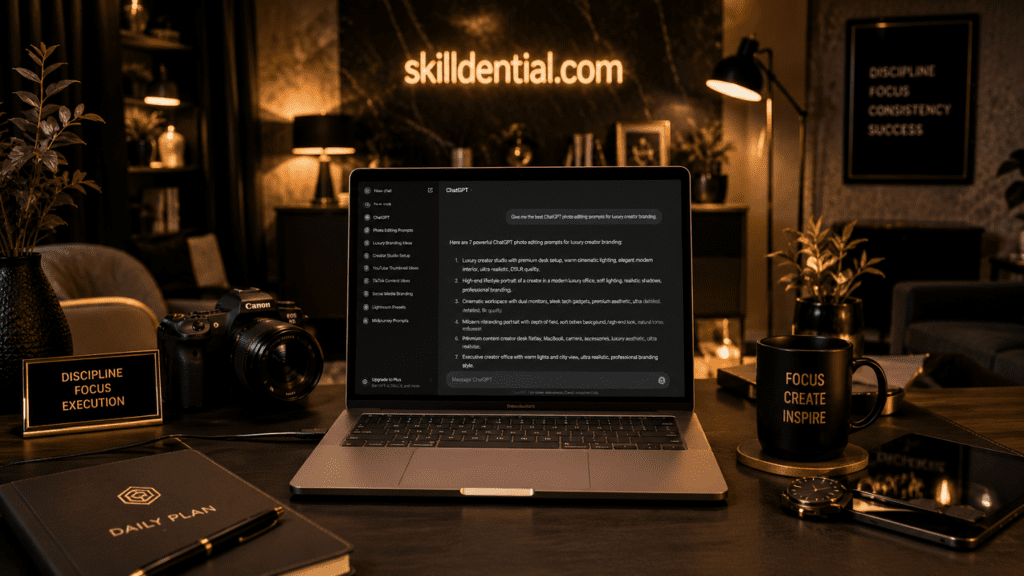
The Engineered Prompt: “Generate a luxury content creator studio with premium desk setup, warm cinematic lighting, elegant modern interior, realistic textures, high-end fashion styling, DSLR depth of field, polished creator branding aesthetic, ultra realistic image quality, watermark ‘skilldential.com’.”
Operational Use Cases
This high-leverage ChatGPT Photo Editing Prompt configuration is engineered for professionals scaling high-ticket digital assets:
- Executive Coaches: Creating premium, high-status backdrops for video hooks, lifestyle branding, and promotional assets that justify premium pricing tiers.
- Strategic Consultants: Establishing an aesthetic of institutional precision and clean organization across presentation decks, LinkedIn content, and vertical video assets.
- Premium Content Creators: Designing clean, distraction-free visual environments that focus viewer attention entirely on high-signal corporate or entrepreneurial concepts.
How can creators generate AI street-style visuals?
Street-style visual production requires precise calibration of atmospheric noise, environmental reflections, and fabric textures to mimic genuine on-location photography. A high-performing ChatGPT Photo Editing Prompt for urban aesthetics uses complex surface details—such as wet asphalt reflections, diffuse neon light spill, and realistic weather textures—to break the sterile look typical of standard AI generations.
The Urban Creator Prompt
The Engineered Prompt: “Create a cinematic urban creator portrait in downtown night scenery with neon reflections, realistic rain textures, dramatic street lighting, ultra detailed clothing textures, modern TikTok fashion aesthetic, realistic depth of field, viral creator visual style, watermark ‘skilldential.com’.”
Operational Use Cases
Deploy this localized, atmospheric ChatGPT Photo Editing Prompt architecture to scale assets for:
- Fashion Creators & Stylists: Generating high-end, editorial-style lookbook backgrounds and structural concept art for modern streetwear garments without expensive outdoor logistics.
- Lifestyle Influencers: Crafting high-engagement, moody narrative backdrops for personal storytelling videos, vlogs, and daily content updates.
- Music & Audio Content Creators: Creating atmospheric, high-contrast cover art and visualizers for lo-fi tracks, hip-hop, or electronic music drops on short-form feeds.
What is the best ChatGPT Photo Editing Prompt for product marketing?
Product-focused asset generation requires strict control over spatial symmetry, material textures, and commercial lighting vectors. To drive conversions, a ChatGPT Photo Editing Prompt designed for marketing must isolate the primary product, eliminate competing background elements, and replicate studio-grade commercial photography setups (such as high-key or dramatic rim lighting) to maximize perceived product value.
The AI Product Promotion Prompt
The Engineered Prompt: “Generate a professional AI product showcase with cinematic lighting, reflective surfaces, premium branding composition, hyper-realistic textures, clean studio environment, commercial advertising quality, high-detail rendering, optimized for TikTok product marketing, watermark ‘skilldential.com’.”
Operational Use Cases
This high-leverage ChatGPT Photo Editing Prompt configuration allows creators to instantly scale marketing collateral across three core monetization pipelines:
- Digital Products & Software: Generating polished, physical-looking mockups for ebooks, frameworks, courses, or software tools to make abstract assets tangible for consumers.
- Affiliate Marketing Engines: Producing high-converting, clean visual overlays and product call-outs for short-form video reviews without needing to film physical inventory in a studio.
- E-Commerce Brands: Generating high-volume, rapid-deployment creative variations for TikTok Shop, social commerce catalogs, and targeted ad sets to lower customer acquisition costs (CAC).
How do AI prompts compare to traditional photo editing workflows?
For lean creator businesses and modern media operations, choosing between generative AI pipelines and manual image manipulation is an operational trade-off. While traditional software offers absolute pixel-level control, constructing a structured ChatGPT Photo Editing Prompt workflow shifts the production paradigm from manual execution to programmatic asset scaling.
Technical Performance Matrix
The table below breaks down the structural differences between an optimized ChatGPT Photo Editing Prompt pipeline and standard desktop software (e.g., Adobe Photoshop, Lightroom) across core operational metrics:
| Workflow Factor | AI Prompt Workflow | Traditional Editing |
| Learning Curve | Low: Replaces technical tool proficiency with structured natural-language logic. | High: Requires deep knowledge of layers, masking, vector paths, and color theory. |
| Production Speed | Fast: Generates production-ready, fully rendered assets in under 60 seconds. | Moderate to Slow: Requires manual asset prepping, layer stacking, and processing time. |
| Technical Complexity | Minimal: Complex variables (lighting, depth, texture) are abstracted into text parameters. | Advanced: Demands manual execution of pixel manipulation, color grading, and compositing. |
| Scalability | Extremely High: Variables can be rapidly swapped to generate hundreds of asset variations. | Limited: Scaling requires linear inputs of time, manual replication, or complex macro recording. |
| Cost Structure | Low: Fixed SaaS subscription models with zero marginal cost per asset created. | Higher: Requires premium hardware, recurring software licensing, or specialized labor. |
| Iteration Speed | Instant: Modifying a single parameter in a prompt completely regenerates the aesthetic. | Manual Revisions: Re-adjusting assets requires stepping backward through history states or project files. |
Operational Implications for Content Systems
Integrating a ChatGPT Photo Editing Prompt system allows small-footprint creator teams to run high-output digital media operations. By removing the technical overhead of manual retouching, creators can reallocate cognitive resources away from asset manufacturing and toward higher-leverage tasks like content strategy, offer positioning, and community monetization.
What mistakes reduce ChatGPT Photo Editing Prompt quality?
A ChatGPT Photo Editing Prompt loses execution fidelity when it introduces structural ambiguity. Generative AI models operate on strict probabilistic token mapping; when a prompt lacks precise technical constraints, the model fills those logical gaps with random variations, leading to unpredictable, unoptimized visual outputs.
The Six Critical Failure Points
To maintain peak production quality, creators must audit their ChatGPT Photo Editing Prompt pipelines against these common engineering errors:
- Using Vague Descriptions: Relying on subjective, unquantifiable words like “beautiful,” “awesome,” or “good quality” provides zero actionable logic for the rendering engine.
- Ignoring Aspect Ratios: Failing to declare explicit canvas boundaries (such as a vertical 9:16 constraint) forces the model to default to a standard 1:1 or 4:3 box, destroying the asset’s layout compatibility with TikTok’s native UI overlay.
- Overloading Prompts with Conflicting Styles: Demanding a “minimalist, clean workspace” while simultaneously requesting “intricate cyberpunk neon detailing” creates conflicting token weights, resulting in a cluttered, visually confused image.
- Omitting Lighting Instructions: Neglecting to define lighting vectors, temperatures, or sources leads the AI to generate flat, ambient, or muddy lighting that lacks cinematic depth.
- Forgetting Platform Optimization: Generating assets without factoring in mobile viewport constraints, text-safe zones, and high-contrast focal points, rendering the image ineffective for high-volume scrolling feeds.
- Using Low-Detail Subject Descriptions: Providing minimal direction for the primary subject (e.g., “a content creator”) causes the engine to render generic, plastic-looking stock characters with unnatural skin textures and anatomical anomalies.
Strategic Rule
High-performance prompting requires shifting from a casual, conversational mindset to a strict technical specification approach. Every sentence in your ChatGPT Photo Editing Prompt must act as an explicit design constraint that forces a predictable visual outcome.
What is a ChatGPT Photo Editing Prompt?
A ChatGPT Photo Editing Prompt is a structured, natural-language instruction used to programmatically generate or enhance images within AI systems like ChatGPT and DALL·E. It maps out precise visual variables—including lens simulations, lighting configurations, spatial composition, and style modifiers—to ensure predictable, studio-grade visual outputs.
Can ChatGPT generate TikTok-ready images?
Yes. When paired with integrated text-to-image systems, a precisely configured ChatGPT Photo Editing Prompt can generate high-fidelity, vertically optimized assets specifically engineered for mobile viewport constraints and TikTok’s high-volume content distribution pipelines.
Do ChatGPT Photo Editing Prompts replace Photoshop?
Not entirely. While a structured ChatGPT Photo Editing Prompt reduces up to 80% of manual production friction—such as background removal, lighting adjustments, and basic compositing—advanced pixel-level manipulation, text vector work, and precision layer management still require professional software.
Why do some AI prompts generate poor images?
Subpar outputs usually stem from semantic ambiguity. When a ChatGPT Photo Editing Prompt lacks specific technical instructions—such as omitting lighting nodes, failing to simulate realistic camera depth, or mixing conflicting art styles—the model fills those logic gaps with random, unoptimized data variations.
Which aspect ratio works best for TikTok AI images?
The vertical 9:16 aspect ratio is the required standard. Hardcoding this dimension directly into your ChatGPT Photo Editing Prompt ensures your generated assets match native mobile-first, full-screen viewing behaviors, preventing ugly crop artifacts or letterboxing on the feed.
In Conclusion
Deploying a structured ChatGPT Photo Editing Prompt workflow allows creators and digital entrepreneurs to build a highly scalable, studio-grade visual engine without the operational overhead of mastering complex desktop editing software.
The most effective, repeatable prompt architectures depend on strict constraint definitions:
- Lighting: Controlling vector direction, color temperature, and atmospheric shadows.
- Composition: Enforcing precise camera angles, lens simulations, and focal depth.
- Rendering Quality: Ensuring high-texture realism and eliminating plastic, artificial artifacts.
- Style Direction: Aligning the visual asset with a specific, cohesive brand aesthetic.
- Platform Optimization: Formatting the asset configuration specifically for mobile-first, high-retention feeds.
For modern short-form video creators, mastering the ChatGPT Photo Editing Prompt framework is a high-leverage skill that shifts content creation from an unpredictable, manual chore to a highly systematic, repeatable process.
To maximize output velocity and maintain absolute brand consistency across your digital assets, your primary strategic objective should be to deploy and reuse standard, parameterized prompt templates rather than engineering new prompts from scratch for every asset run.