Google Ads vs ChatGPT Ads Manager: A Complete Comparison
ChatGPT Ads Manager is OpenAI’s self-serve platform for creating and managing ads that appear within ChatGPT conversations, whereas Google Ads is the established industry standard for search, display, and video advertising. ChatGPT Ads Manager currently supports CPC and CPM buying models, offering a specialized interface designed for conversational, intent-rich placements.
In contrast, Google Ads utilizes an auction-based pricing system across an expansive global network, bolstered by decades of mature targeting, automation, and analytics infrastructure. ChatGPT Ads Manager is most effective when your target audience actively engages with AI, and you require high-intent, native interaction, while Google Ads remains the essential default for broad reach and proven, scalable performance.
Understanding ChatGPT Ads Manager
ChatGPT Ads Manager functions as the centralized infrastructure for executing advertising within the OpenAI ecosystem. It transitions OpenAI from a closed-loop platform to an open, performance-based ad marketplace.
Operational Mechanics
The platform operates on a contextual delivery model, differentiating it from traditional keyword-indexed ad servers. Here is the operational breakdown:
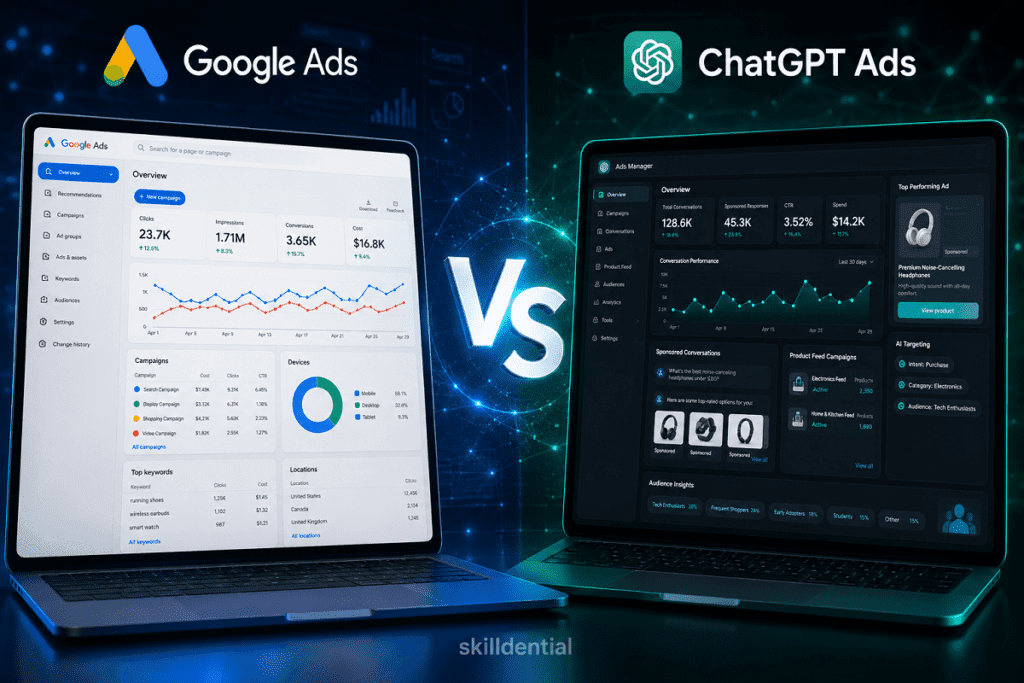
- Campaign Architecture: Similar to other enterprise platforms, ChatGPT Ads Manager utilizes a hierarchical structure: Campaign $\rightarrow$ Ad Group $\rightarrow$ Ads. This allows for granular control over budgets, bidding strategies (CPC/CPM), and audience targeting.
- Conversational Placement Logic: Unlike search ads that trigger on exact-match queries, advertisements managed through ChatGPT Ads Manager are served based on conversational context and semantic relevance. The system analyzes the user’s intent within the chat turn and serves a sponsored element that feels native to the ongoing discourse.
- Workflow Integration:
- Creative Assets: Advertisers input copy and creative assets directly into the ChatGPT Ads Manager interface.
- Management: The dashboard provides real-time telemetry on impressions, click-through rates (CTR), and spend.
- Data Export: Support for CSV exports and table-based performance views enables integration with external business intelligence (BI) tools for deeper ROI analysis.
- The Guardrail Layer: OpenAI enforces strict privacy protocols. Advertisements within ChatGPT Ads Manager are computationally separated from the LLM’s reasoning process to ensure that ad serving does not compromise the neutrality or safety of the generated responses.
Critical Constraints & Scope
- Audience Restriction: As of the current deployment, ad inventory is limited to Free and Go tier users. Professionals using ChatGPT Team, Enterprise, or Plus accounts do not see these sponsored placements, which fundamentally shifts the platform’s utility toward B2C and mass-market B2B acquisition.
- Bidding Evolution: The move from an initial CPM-only pilot to a dual CPC/CPM model within ChatGPT Ads Manager indicates a transition toward performance-based accountability, allowing advertisers to pay for direct traffic rather than just brand awareness.
Strategic Note: Because ChatGPT Ads Manager relies on semantic context rather than keyword density, your creative strategy must pivot from “what the user searches” to “what the user is discussing.” Focus on crafting assets that solve specific problems that arise naturally during a user’s interaction with the AI.
Understanding Google Ads
Google Ads serves as the foundational infrastructure for performance marketing, enabling advertisers to capture demand across the world’s largest search engine, display network, and video ecosystem. It acts as an automated, high-speed marketplace that resolves billions of auctions every day.
Operational Mechanics
The platform functions through a real-time, auction-based model that balances advertiser bid price with user experience.
- The Auction Engine: Every time a user executes a search query or visits a page within the Google Display Network, an auction occurs in roughly 200 milliseconds. The system evaluates three primary factors to determine ad rank and positioning:
- Bid Amount: The maximum price you are willing to pay for a click (CPC) or impression (CPM).
- Ad Rank: A dynamic score based on your bid, the quality and relevance of your ad/landing page (Quality Score), and the expected impact of ad assets or extensions.
- Auction-Time Context: Real-time signals such as the user’s location, device, time of day, and historical search intent.
- The Pricing Mechanism (Modified Second-Price Auction): You generally do not pay your maximum bid. Instead, you pay the minimum amount necessary to clear the Ad Rank threshold of the advertiser immediately below you, divided by your own Quality Score, plus a $0.01 increment. This incentivizes high-quality, relevant advertising by effectively rewarding top-tier ads with lower costs.
- Campaign Ecosystem:
- Search Ads: Triggered by specific keywords. These represent high-intent traffic and are the most common entry point for performance marketers.
- Display & Video: Contextual and audience-based targeting that expands reach to users who may not be actively searching but fit your demographic or behavioral profile.
- Performance Max: A more modern, AI-driven campaign type where you provide creative assets, and Google’s machine learning models automatically optimize placement and bidding across all its properties (Search, YouTube, Gmail, Maps, etc.) to achieve your specific conversion goals.
Strategic Differentiators
- Scale and Maturity: Unlike the newer ChatGPT Ads Manager, Google Ads has a massive, multi-decade data advantage. Its bidding strategies—from manual CPC to AI-driven “Target ROAS”—allow for hyper-fine-tuned control over acquisition costs.
- Intent Versatility: Google captures both “active intent” (searching for a specific solution) and “passive awareness” (display ads while browsing).
- Optimization Levers: Success in Google Ads is driven by a repeatable feedback loop: refining match types, improving landing page Core Web Vitals, and leveraging account-wide historical performance to improve the expected Click-Through Rate (CTR).
Strategic Note: While ChatGPT Ads Manager is currently emerging as a niche for conversational, AI-native engagement, Google Ads remains the primary engine for high-volume, multi-channel growth. The “perfect” strategy often involves using Google to capture the broader “solution-seeking” market, while using the more focused ChatGPT placements to intercept users during their “decision-making” or “comparative analysis” phase.
Feature and Targeting Comparison: Google Ads vs. ChatGPT Ads Manager
The following table delineates the architectural and strategic differences between these two platforms, framed for high-leverage decision-making.
| Feature/Metric | Google Ads | ChatGPT Ads Manager |
| Primary Intent | Explicit (Search) & Implicit (Display) | Contextual (Conversational) |
| Targeting Stack | Keywords, Audiences, Demographics, Geo-fencing | Semantic/Contextual relevance |
| Placement Reach | Global (Search, YT, Maps, Play, GDN) | Native (Inside ChatGPT chat threads) |
| Automation | Mature (Smart Bidding, Performance Max) | Nascent (Optimized for conversational flow) |
| Data Privacy | Extensive historical/cross-site tracking | Guarded, session-based personalization |
| Ad Format | Text, Image, Video, Responsive | Text-based Sponsored Cards |
Strategic Analysis of Targeting Dynamics
Google Ads: The Precision Auction
Google remains the gold standard for deterministic targeting. By leveraging decades of search history and intent data, it allows for granular control over the funnel.
- The Advantage: The capability to use “Exact Match” keywords ensures you are only paying for traffic that demonstrates high-intent alignment with your service offerings.
- The Trade-off: Increasing market saturation in competitive verticals leads to higher CPCs, often necessitating a shift toward broader, AI-assisted campaign types like Performance Max, which reduces manual control in exchange for scale.
ChatGPT Ads Manager: The Contextual Intercept
ChatGPT Ads Manager represents a fundamental shift in how ads are surfaced, moving away from user-provided queries and toward system-inferred intent.
- The Advantage: By serving ads mid-conversation, you are intercepting the user during the “information synthesis” phase—where they are actively building their knowledge base or comparing solutions. This is often earlier in the journey than a Google search.
- The Trade-off: The lack of traditional keyword targeting requires a content-first advertising strategy. Success is contingent on the AI’s ability to correctly correlate your ad copy with the conversational nuance of the user’s prompt.
Implementation Protocol: The 80/20 Leverage Rule
As noted in your internal audits, the most effective approach to deploying ChatGPT Ads Manager is to treat it as a high-intent experimental channel rather than a core infrastructure replacement.
- The 80/20 Allocation: Maintain 80–90% of your budget in Google Ads to ensure stability and reliable conversion volumes. Allocate 10–20% to ChatGPT Ads Manager.
- Learning Velocity: Use the 10% budget allocation to run rigorous A/B tests on your “Conversational Cards.” Because these ads are served in a more intimate environment, focus on problem-solving copy rather than traditional brand-awareness messaging.
- Success Metric: Measure the Incremental Conversion Lift (ICL). If the 10–20% allocation to ChatGPT Ads Manager results in an 8–15% improvement in your total campaign conversion rate, the platform has reached “Proven Channel” status and warrants increased funding.
Feature and Targeting Comparison
While Google Ads relies on deterministic data and historical search intent to scale your message, ChatGPT Ads Manager introduces a new paradigm: contextual interception. Understanding the divergence between these two platforms is critical for allocating your budget effectively; the following table outlines the technical and strategic distinctions between Google’s mature, multi-channel auction system and OpenAI’s emerging, conversation-native interface.
| Dimension | Google Ads | ChatGPT Ads Manager |
| Core Placement | Search, Display Network, YouTube, Shopping, Discovery. | Native sponsored cards inside ChatGPT conversations for Free/Go tier users. |
| Targeting Model | Deterministic: Keywords, audiences, demographics, exact location, remarketing. | Semantic: Intent-driven conversational context; strict privacy walls block advertisers from viewing user prompts. |
| Buying Options | Mature marketplace: CPC, CPM, CPA, and algorithmic smart bidding (Target ROAS). | Emerging beta: CPC and CPM primarily; baseline conversion tracking expanding toward CPA functionality. |
| Budget Controls | Granular daily and monthly pacing; hard caps to prevent overspend. | Campaign-level allocations managed via the dashboard; pacing controls are functional but structurally basic. |
| Analytics | Comprehensive reporting, data-driven attribution models, direct GA4 integration. | Functional table views, charts, and CSV exports; relies on a standard pixel for session-based conversion tracking. |
| Automation | Highly autonomous: Performance Max, responsive asset generation, predictive bidding. | Early stage: Guided workflow setup and basic delivery optimization; lacks predictive multi-channel bidding. |
| Audience Scale | Unmatched global volume across ubiquitous web and video properties. | High-intent but segmented; constrained entirely by Free/Go tier volume and OpenAI safety guardrails. |
Strategic Synthesis
The architectural differences dictate distinct operational strategies. Google Ads is built for scale, utilizing massive historical data pools and deterministic targeting to capture active demand across a multi-channel ecosystem. It remains the mandatory infrastructure for baseline acquisition.
Conversely, ChatGPT Ads Manager operates entirely on contextual semantic matching. It functions as a discovery layer, intercepting users who are actively synthesizing information, comparing tools, or solving specific technical problems.
Because it currently lacks mature retargeting and demographic filters, success relies entirely on mapping ad creative to the specific conversational scenarios (context hints) your target buyer initiates. For technical professionals and founders, this platform should be utilized as a high-signal, experimental channel designed to capture decision-makers at the exact moment of software or strategy evaluation.
Pricing Structure: A Comparative Overview
Understanding the underlying economic model of each platform is essential for forecasting your acquisition costs and managing campaign ROI.
Google Ads: The Competitive Auction
Google Ads operates on a demand-driven, real-time auction model. Your final cost is not merely a reflection of your bid, but a function of the auction’s intensity in that specific microsecond.
- Pricing Mechanics: Costs are typically calculated as Cost-Per-Click (CPC) or Cost-Per-Thousand-Impressions (CPM). For most standard setups, you only incur costs when a measurable action (a click or a call) occurs.
- Economic Drivers: Pricing is heavily influenced by your Quality Score. Because the system prioritizes ad relevance and landing page experience, high-quality ads can effectively “outbid” competitors with higher budgets but lower relevance scores.
- Predictability: Due to the maturity of the platform, pricing is highly predictable for stable industries, though it remains prone to seasonal spikes based on competitor auction participation.
ChatGPT Ads Manager: The Emerging Marketplace
ChatGPT Ads Manager is currently in an evolutionary phase, moving away from its initial CPM-only roots toward a more balanced, performance-based model.
- Pricing Mechanics: The platform supports both CPC and CPM buying models. Unlike Google’s broad auction, pricing here is tied to the contextual relevance of your ad to the ongoing AI-generated conversation.
- Economic Drivers: Since the marketplace is in beta, pricing is currently less transparent and lacks the historical benchmarks found in Google’s ecosystem. OpenAI prioritizes the user experience; therefore, your ability to place ads—and the resulting cost—is governed by “usefulness” and strict guardrails. If your ad content does not align with the conversational context, you may face restricted reach regardless of your bid.
- Predictability: Expect high volatility. As more advertisers enter the ChatGPT Ads Manager ecosystem and the user base evolves, pricing benchmarks will shift. Currently, the “early-adopter premium” applies; you are paying to capture high-intent users in an untapped, non-distracted environment.
Strategic Summary for Budgeting
| Metric | Google Ads | ChatGPT Ads Manager |
| Model | Real-time, competitive auction | Contextual/semantic bidding |
| Bidding Focus | Bid + Quality Score | Bid + Contextual Relevance |
| Cost Basis | CPC / CPM / CPA | CPC / CPM |
| Market Maturity | High (Stabilized benchmarks) | Low (Fluctuating/Emerging) |
Strategic Advice: When allocating budget to ChatGPT Ads Manager, treat it as an R&D investment. While Google Ads provides the reliable, predictable baseline for your acquisition costs, the pricing in the ChatGPT ecosystem represents the “cost of discovery” for a new, high-intent channel.
Monitor your CPC closely against your Google benchmarks; if ChatGPT costs exceed your Google ROAS targets by more than 20% during this beta phase, pivot your focus back to optimizing your creative resonance within the chat threads rather than simply increasing your bid.
Strategic Verdict: When to Choose Which Platform
The determination of whether one platform is “better” than the other is a false dichotomy. For high-leverage marketing, the question is one of utility and funnel placement, not superiority.
Google Ads: The “Proven Engine”
Google Ads is the default infrastructure for any serious business because it covers the full spectrum of demand:
- Best for: Core revenue goals, massive scalability, and established product-market fit.
- Strategic Role: The reliable “base” of your acquisition strategy. Its historical data and mature automation tools allow you to forecast ROI with high precision. If your priority is volume and predictable performance, Google Ads remains the superior platform.
ChatGPT Ads Manager: The “High-Intent Discovery Layer”
ChatGPT Ads Manager is not a competitor for broad reach; it is a specialized tool for intercepting the “consideration phase” of the customer journey.
- Best for: Complex B2B solutions, high-consideration purchases, and technical products where users require conversational guidance before committing.
- Strategic Role: An upper-mid-funnel experimental channel. It excels when the user is not just looking for a service (the search moment) but is actively building a mental model or comparing options (the synthesis moment).
The Integration Framework
| Scenario | Recommended Strategy |
| High-Volume, Commodity Needs | Prioritize Google Ads (Search/Shopping). |
| Complex/Technical Solution | Hybrid: Google Ads for capture, ChatGPT Ads Manager for consideration/education. |
| Budget Constraints | Allocate 80–90% to Google Ads for stability; 10–20% to ChatGPT Ads for experimentation. |
- Google Ads is superior for foundational growth. It provides the deterministic data and broad inventory necessary to sustain a business.
- ChatGPT Ads Manager is “better” for market penetration in high-consideration niches. It provides a unique opportunity to engage users who have moved beyond simple search queries and are now deep in the decision-making process.
The most effective marketers do not choose between them; they use the Skilldential approach of leveraging Google’s massive intent capture to build the revenue floor, while utilizing the conversational, high-signal environment of ChatGPT Ads Manager to shorten the sales cycle for complex, high-value offerings.
Should You Reallocate Your Ad Budget?
Moving a portion of your budget to ChatGPT Ads Manager is a strategic decision that should be driven by experimental rigor rather than market pressure. For the majority of professional marketers, this is not an “either-or” transition but a tactical expansion of your existing funnel.
The 5–20% “Learning Budget” Framework
Adopting ChatGPT Ads Manager effectively requires an isolated experimental budget. We recommend the following allocation strategy to maximize signal without jeopardizing core revenue:
- The Baseline (80–95%): Maintain your primary spend on Google Ads. This ensures your baseline conversion volume remains stable and predictable.
- The Test (5–20%): Allocate a dedicated “innovation budget” to ChatGPT Ads Manager.
- Low Maturity (5%): Use for exploratory campaigns to test messaging resonance and baseline CTR.
- High Maturity (20%): Use once you have identified specific conversational “trigger topics” that consistently drive high-quality site traffic.
Why This Approach Works
- Risk Mitigation: By capping spend at 20% in an evolving beta environment, you insulate your business from the volatility of unproven automation and shifting ad-serving rules.
- Cross-Platform Synergy: Insights gained from ChatGPT Ads Manager are not siloed. The messaging angles that convert in a conversational interface can often be repurposed to optimize your Google Ads responsive search ads or landing page copy.
- Advanced Attribution: As identified in Skilldential audits, the primary value of this reallocation is often not the direct conversion, but the learning velocity. The data points gathered from these AI-native placements provide a deeper understanding of user friction points that traditional search queries often mask.
Ideal Candidates for Reallocation
If your business falls into one of the following categories, the argument for testing ChatGPT Ads Manager is significantly stronger:
- Complex SaaS/Tech: Where your customer journey involves long-form research or technical comparison.
- High-End Education/Professional Development: Where the sale depends on establishing authority through educational content (e.g., your “Solar Energy Master Guide”).
- Niche Services: Where user intent is better surfaced through broad, problem-solving discussions than specific keyword matches.
Strategic Assessment: The goal of this budget shift is to capture “conversational equity.” You are not just buying traffic; you are buying early access to the decision-making process of your future customers. As the tooling within ChatGPT Ads Manager matures, this early-stage investment will provide a competitive moat that late-moving advertisers will struggle to replicate.
What specific metrics are you planning to track to determine if this 5–20% allocation is providing a positive return on learning?
The Synergy Strategy: Integrating Google Ads & ChatGPT Ads Manager
Rather than viewing these platforms as competing auction environments, treat them as two distinct stages of the decision-making funnel. Integrating them allows you to leverage the breadth of search intent alongside the depth of conversational context.
The Integrated Funnel Framework
| Strategy Phase | Platform Primary | Strategic Role |
| Demand Capture | Google Ads | Captures “solution-aware” traffic via high-intent keywords. |
| Consideration/Synthesis | ChatGPT Ads Manager | Intercepts “problem-solving” discourse; builds trust via native placement. |
| Retargeting/Conversion | Google Ads | Re-engages site visitors across the GDN and YouTube. |
Execution Tactics for Skilldential
To maximize the efficiency of both platforms, apply these three integration levers:
The “Conversational Keyword” Feedback Loop
Use ChatGPT Ads Manager as your R&D lab for messaging. The specific questions and technical pain points users discuss in ChatGPT threads are often more granular than what they type into a Google search bar.
- Action: Analyze the high-performing ad copy from your ChatGPT Ads Manager campaigns. Identify the specific “problem-solution” phrasing that yields the highest CTR.
- Synergy: Translate these high-performing conversational hooks into Google Ads Responsive Search Ads (RSAs) to improve your Google ad relevance and Quality Score.
Synchronized Funnel Mapping
Use Google Ads to drive broad traffic to your core landing pages, then use the data from these sessions to refine your “context hints” in ChatGPT Ads Manager.
- Action: If your Google Analytics 4 (GA4) data shows that your “Solar Energy Master Guide” page has a high bounce rate but high engagement, it suggests that users need more “pre-education.”
- Synergy: Deploy ChatGPT Ads Manager to target users asking questions related to the solar problem (e.g., “how to evaluate solar ROI”), effectively educating them before they even hit your Google-driven landing page.
Cross-Platform Attribution Modeling
Do not treat your platforms as isolated data silos. Integrate your reporting to track the path to conversion.
- Action: Use a unified tracking pixel or UTM parameter strategy to identify when a user discovers your brand via a ChatGPT Ads Manager interaction but ultimately converts via a brand-search click on Google.
- Synergy: This “Assisted Conversion” data allows you to prove the value of your ChatGPT investment to your overall ROAS, justifying your 5–20% experimental budget allocation.
Strategic Bottom Line:
Your goal is to build a unified acquisition ecosystem. Google Ads provides the scale and visibility to bring users to your doorstep; ChatGPT Ads Manager acts as the specialized guide that convinces them to walk through the door. By sharing insights between these platforms, you create a self-optimizing system where one platform’s findings act as the strategic fuel for the other’s growth.
The Impact of AI-Native Advertising on Audience Acquisition
AI-native advertising represents a fundamental shift from broad-spectrum demographic targeting to in-the-moment intent interception. Unlike traditional search engines, where the user intent is captured via a static keyword query, ChatGPT allows advertisers to participate in the user’s decision-making reasoning process.
Shift from Keyword Triggers to Contextual Relevance
In a standard search environment, you compete for “keywords.” In an AI-native environment, you compete for relevance to the ongoing problem.
- The Change: Advertising moves from being a reaction to a specific word to an extension of the conversational flow.
- The Consequence: Advertisers must move away from generic slogans and toward “solution-oriented” copy that naturally integrates into the user’s research.
Enhanced Precision via Semantic Context
Because OpenAI’s system uses “context hints” rather than exact-match keywords, the platform can interpret the nuance of a request (e.g., distinguishing between a user researching solar panels for an academic paper versus a user looking to purchase a system for their home).
- Monetization Impact: This enables higher-quality lead generation. Advertisers pay for exposure to users who are currently deep in the “evaluation” or “comparison” phase, which historically yields higher conversion rates than top-of-funnel awareness traffic.
Privacy-First Monetization Guardrails
OpenAI’s approach enforces a strict separation between the AI’s reasoning and the ad-serving layer.
- The Constraint: Advertisers do not gain access to the actual contents of the user’s conversation. This protects user privacy but limits the granularity of retargeting compared to platforms like Google or Meta, which rely on cross-site tracking.
- The Opportunity: Brands that build trust through “useful” rather than “intrusive” ads stand to gain significant brand equity. Since ads are visually separated and clearly labeled, the “click” is a more deliberate and higher-intent signal than a standard display ad click.
Implications for Creators & B2B Brands
For platforms like Skilldential, AI-native advertising offers a distinct advantage:
- Problem-Solution Alignment: Since your audience is likely using ChatGPT to learn and solve problems, your ads can act as a natural next step in their learning journey (e.g., suggesting a “Solar Energy Master Guide” when a user asks about solar panel efficiency).
- Mid-Funnel Capture: AI-native placements effectively bridge the gap between initial discovery (YouTube/TikTok) and the final transaction. They provide the “nudge” required to move a user from general information-seeking to selecting your specific professional service or course.
Summary of Strategic Shift
| Feature | Traditional Advertising | AI-Native (ChatGPT) |
| Trigger | Static Keyword Search | Conversational Intent/Context |
| Strategy | Broad Audience Reach | Decision-Moment Interception |
| Value Basis | Impulse & Awareness | Problem-Solving & Utility |
| Success Metric | Click Volume (CTR) | Assisted Conversions & Influence |
Strategic Note: Because the system is in beta, the most successful marketers in 2026 are those using agentic media buying—where they express their goals and standards once, and the AI evaluates conversational intent in real-time to activate the ad. If you treat this as a high-intent discovery layer rather than a replacement for Google Ads, you can effectively shorten the sales cycle for complex, high-consideration offerings
Google Ads vs ChatGPT Ads Manager FAQs
As of June 2026, the advertising landscape within ChatGPT has matured significantly. Use these updated responses to ensure your guide reflects the current technical and operational realities.
What is ChatGPT Ads Manager?
ChatGPT Ads Manager is OpenAI’s self-serve platform for creating, launching, and managing ad campaigns that appear within ChatGPT conversations. Since May 5, 2026, it is open to all U.S. businesses with no minimum spend. It now supports sophisticated features including Product Feed Ads (launched June 11, 2026), conversion tracking via Pixel/Conversions API, and conversion-optimized bidding strategies.
Who sees ChatGPT ads?
Ads are served to Free and Go tier users in the United States, United Kingdom, Canada, Australia, New Zealand, Japan, and South Korea. Subscribers on Plus, Pro, Business, and Enterprise plans remain ad-free. OpenAI maintains strict guardrails to exclude sensitive categories (e.g., health, politics) and ensures ads are visually separated from AI responses.
How do advertisers pay for ChatGPT Ads?
Advertisers can bid using CPC (Cost-Per-Click) or CPM (Cost-Per-Mille) models.
CPC: Recommended starting max bids are typically $3.00–$5.00.
CPM: Default max bids are often set at $60, though real-world clearing prices have been observed as low as $25 as the auction matures.
Budgeting: Advertisers can now set daily budgets and use conversion-optimized campaigns to pay only for specific actions (CPA) rather than just clicks or impressions.
How do Google Ads costs work?
Google Ads utilizes a real-time, auction-based marketplace. Costs are determined by a combination of your bid amount and Quality Score (which evaluates ad relevance and landing page experience). You generally pay the minimum amount necessary to clear the Ad Rank threshold of the advertiser below you, rather than your maximum bid.
Can I run Google Ads and ChatGPT Ads at the same time?
Yes. They are currently viewed as complementary channels. Google Ads provides the “search-intent” baseline for scalable, predictable volume. ChatGPT Ads Manager serves as an experimental, high-intent “discovery layer” that intercepts users during conversational research—a phase often preceding a formal Google search. Tracking “assisted conversions” across both platforms is the recommended method for measuring their combined impact on your ROI.
Since the launch of Product Feed Ads in June 2026, many advertisers are now re-using their Google Merchant Center feeds for ChatGPT campaigns. If you already maintain a clean product feed for Google Shopping, you can often syndicate this data directly into ChatGPT Ads Manager to auto-generate sponsored placements without the need for manual campaign builds.
In Conclusion
Google Ads remains the industry’s most reliable, scalable infrastructure for multi-channel acquisition, offering the mature bidding, deterministic targeting, and comprehensive analytics required for core revenue growth. ChatGPT Ads Manager introduces a compelling new frontier: AI-native, conversational placements that capture high-intent users during critical decision-making journeys.
While the platform is currently in beta and limited to specific user tiers, its ability to surface your brand within AI discourse offers a unique advantage that traditional search cannot replicate. Moving forward, adopt a bimodal allocation strategy. Dedicate the vast majority of your budget to the proven performance of Google Ads to maintain stability, while carving out a structured experimental slice (5–20%) for ChatGPT Ads Manager.
By establishing clear success metrics and robust attribution tracking, you can effectively capture “conversational equity” in the AI ecosystem without compromising your baseline performance. In the evolving landscape of 2026, the competitive edge goes to the marketers who integrate these two channels—using the reach of Google to build your market presence and the intent-rich context of ChatGPT to accelerate the conversion of complex, high-value leads.