AI Automation Engineer Courses: Skills, Tools, Jobs & Salary
An AI Automation Engineer designs and implements end-to-end workflows that combine AI models with business systems to remove manual work at scale. They translate complex business processes into automated pipelines using tools like n8n, Make, Zapier, Python, and cloud services. In the United States, annual salaries for this role typically range from $85,000 to over $140,000 depending on experience, specialization, and geography.
AI is shifting from simple, “one-off” prompts to persistent, autonomous systems that run 24/7 in the background. AI Automation Engineer courses are essential for professionals who want to move beyond isolated experiments and master the design, connection, and maintenance of these durable, business-critical systems.
This guide is curated for four specific profiles: technical builders, business automators, career pivoters, and AI product strategists. Whether you are looking for AI automation engineer courses to sharpen your technical edge or to transition into this high-growth field, this resource provides the necessary clarity on skills, tool stacks, and earning potential. It prioritizes a build-first roadmap, ensuring you know exactly what to learn, in what order, and what to ship as a public portfolio to prove your value.
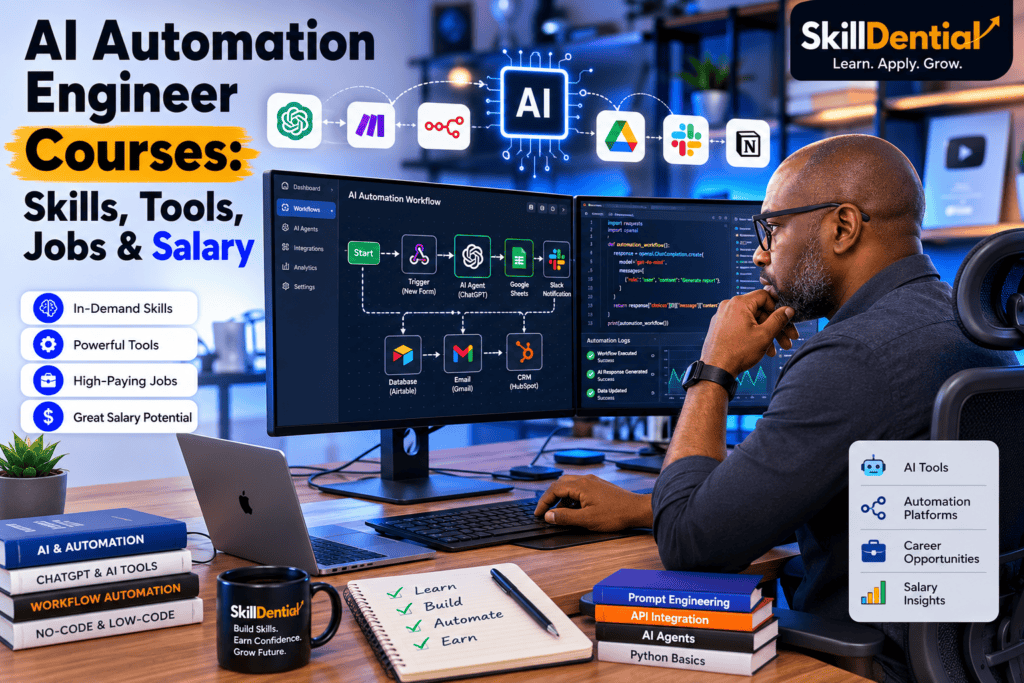
In the following sections, you will learn the critical differences between general AI Engineers and AI Automation Engineers, review a comprehensive competency matrix covering both code and no-code environments, and explore a shortlist of the best AI automation engineer courses mapped to tangible career outcomes. The article is organized around three pillars—workflow architecture, tool orchestration, and production readiness—designed to help you move from “toy” automations to robust, production-grade systems.
What is an AI Automation Engineer?
An AI Automation Engineer is a technical specialist who designs, builds, and maintains intelligent, end-to-end workflows that leverage AI models to process data, make decisions, and execute actions across disparate business systems.
Unlike traditional AI Engineers who focus on training or fine-tuning underlying machine learning models from scratch, the AI Automation Engineer is an application-layer specialist. They act as a “catalyst for innovation,” bridging the gap between an organization’s business needs and the practical application of existing AI capabilities (LLMs, vector databases, and APIs) to solve real-world operational bottlenecks.
Core Responsibilities
- Workflow Architecture: Translating manual business processes—such as lead routing, document processing, or customer support—into efficient, automated pipeline diagrams and specifications.
- Tool Orchestration: Selecting and integrating the “AI stack,” including no-code/low-code platforms (n8n, Make, Zapier), cloud services, and specialized AI infrastructure.
- Intelligent Integration: Embedding LLMs, retrieval-augmented generation (RAG) systems, and voice agents into existing enterprise environments to handle tasks that require reasoning rather than just static rule-following.
- Production Hardening: Implementing critical infrastructure for reliability, including error handling, retry logic, logging, monitoring, and observability to ensure systems “fail loudly” rather than silently.
- Impact Measurement: Quantifying the ROI of automations through metrics such as hours saved, operational cost reductions, and revenue growth.
Why This Role is a “Force Multiplier”
The AI Automation Engineer is increasingly viewed as an internal force multiplier. While other technical roles focus on shipping customer-facing products, this role focuses on internal velocity—optimizing how a business actually functions. By codifying institutional knowledge into automated, self-sustaining systems, they transform “one-off” AI experiments into durable, production-grade operations that scale alongside the company.
How is an AI Automation Engineer different from an AI Engineer?
The distinction between these roles is foundational for anyone building a career in AI. While an AI Engineer focuses on the model (creating the “brain”), the AI Automation Engineer focuses on the workflow (giving that brain a job and a nervous system to interact with business tools).
Role Comparison: AI Engineer vs. AI Automation Engineer
| Aspect | AI Engineer | AI Automation Engineer |
| Primary Focus | Model design, training, fine-tuning, MLOps | Workflow design, integration, orchestration |
| Typical Stack | Python, PyTorch, TensorFlow, MLflow, GPUs | n8n, Make, Zapier, RPA, LLMs, cloud APIs |
| Success Metric | Model accuracy, latency, robustness | Hours saved, error reduction, revenue uplift |
| Stakeholders | Data scientists, ML infra teams | Ops, marketing, sales, product, founders |
| Entry Path | CS/ML background, heavy math | Dev, ops, no-code, or business ops pivot |
Why the Distinction Matters
- Model-Centric vs. Workflow-Centric: AI Engineers build the proprietary engines or core infrastructure that powers AI products (like working at OpenAI or Anthropic). AI Automation Engineers are “application-layer” specialists; they take existing models and make them useful for specific business problems within industries like finance, legal, or retail.
- Technical Breadth: AI Automation engineering is often a more accessible entry point for those without deep machine learning or PhD-level math backgrounds, as it prioritizes system architecture and API connectivity over model training.
- The “Productization” Gap: A company can have a great LLM model (built by an AI Engineer), but it remains a “toy” until an AI Automation Engineer connects it to their CRM, email, and billing systems to trigger actual business outcomes.
For this guide, we define the AI Automation Engineer as a role that transcends legacy RPA. It encompasses the modern “stack”: RPA fundamentals, no-code/low-code platforms, and LLM orchestration (RAG, tool calling, and autonomous agents).
The video above provides a concise overview of the differences between the two career paths and helps clarify which one aligns best with your technical background and long-term goals.
What skills does an AI Automation Engineer need today?
To succeed in the current landscape, an AI Automation Engineer must move beyond basic prompt-writing and toward systems-level thinking. In 2026, the market rewards professionals who can bridge the gap between volatile model outputs and stable, observable business processes.
The 2026 Competency Matrix: An 80/20 View
| Skill Area | Minimum Viable Skill | Advanced Skill (High-Leverage) |
| Workflow Architecture | Mapping processes; identifying manual triggers. | Designing branching, multi-step pipelines with SLAs and fallbacks. |
| AI Literacy | Basic prompting; choosing model providers. | Managing context windows, token optimization, and RAG patterns. |
| Integration & Coding | Using No-Code tools (Make/n8n) + basic APIs. | Python/JS for custom logic, async processing, and SDK orchestration. |
| Data & Security | Handling PII; basic authentication. | Tenant isolation, secret management, and prompt injection defense. |
| Reliability & Monitoring | Basic alerts on failure. | Implementing observability (LangSmith/Langfuse) and structured logging. |
| Communication | Documenting workflow steps. | Arguing for ROI; aligning technical builds with business KPIs. |
Do you need to code?
- The “No-Code” Floor: For business automators and pivoters, mastering tools like n8n and Make is the fastest path to shipping value. You can build sophisticated systems today without writing a single line of production code.
- The “Technical” Ceiling: For technical builders and product strategists, Python is the ultimate leverage multiplier. Once you hit the complexity of custom RAG pipelines or need to handle high-concurrency (async) workflows, “basic scripting” becomes your most critical asset.
Recommendation: Treat “Python for APIs and data cleaning” as your foundational coding requirement. You don’t need to be a software engineer building models from scratch, but you do need to understand how to manipulate data and connect services when pre-built connectors inevitably fail.
The video above provides a brief, high-level overview of how traditional automation roles are evolving to incorporate AI-driven workflows, which serves as a great supplement to your competency matrix.
What tools and platforms do AI Automation Engineers actually use?
To effectively operate as an AI Automation Engineer in 2026, you need to manage a stack that bridges the gap between high-level business logic and low-level system execution. While the tools continue to evolve, the core architecture—trigger, transform, act—remains the universal constant.
Core Orchestration Platforms
- n8n: A powerhouse for technical teams. Its self-hosting capability and “fair-code” model allow for deep security, on-prem deployment, and complex custom logic using JS/Python.
- Make (formerly Integromat): The gold standard for visual, branching workflows. Its ability to handle conditional logic, routers, and data iteration makes it ideal for complex, multi-step business automations.
- Zapier: The most extensive ecosystem. With 9,000+ app integrations and recent “AI Agent” capabilities (via MCP and SDK), it is the fastest way to connect disparate SaaS tools into a single, cohesive workflow.
- Enterprise-Grade Platforms (e.g., Tray, Workato, Boomi): These are the go-to for scale, governed access, and connecting legacy/on-prem systems with modern cloud infrastructure.
The AI & Infrastructure Stack
- AI Services: LLM APIs (OpenAI, Anthropic, Gemini) remain the brain of the operation, while specialized platforms like Gumloop focus on AI-first tasks like document extraction, classification, and RAG-based data enrichment.
- RPA Integration: Platforms like UiPath remain essential when you encounter legacy software or UI-only systems that lack modern APIs, effectively “bridging the gap” to 2026 AI capabilities.
- Business Stack: Most automations ultimately read/write to your existing business stack: CRMs (Salesforce/HubSpot), databases, communication platforms (Slack/Teams), and data warehouses.
Salary Benchmarks (2026 US Data)
While “AI Automation Engineer” is still an emerging title, data indicates strong compensation linked to the ability to deliver scalable, high-leverage workflows:
- 25th Percentile: ~$86,500
- Median: ~$102,600 – $107,000
- 75th Percentile: ~$123,500
- Top Earners (90th percentile): Can reach $142,500+ annually, depending on their ability to integrate AI into enterprise-grade, high-concurrency systems.
The video above provides a fast-paced overview of the leading tools and platforms for 2026, which helps in visualizing the current industry-standard stack for AI automation.
How much do AI Automation Engineers earn (jobs & freelance)?
In 2026, the market for AI automation expertise is bifurcated by depth of skill: generalist automation work commands a solid middle-market rate, while specialized AI integration and systems architecture sit at the top of the pay scale.
Salary Benchmarks: Employee Roles (USA)
AI Automation Engineers are generally compensated at a premium compared to traditional RPA developers because they require a hybrid skill set: systems thinking, API mastery, and AI literacy.
| Experience Level | Annual Salary Range (US) |
| Entry-Level (0–2 years) | $75,000 – $95,000 |
| Mid-Level (3–6 years) | $100,000 – $125,000 |
| Senior/Staff (7+ years) | $130,000 – $175,000+ |
- Average Base: As of July 2026, the national average for roles closely aligned with automation engineering sits between $103,000 and $108,000 annually.
- Variable Factors: Compensation is heavily influenced by geography (e.g., San Francisco, NYC, and DC command higher base pay) and industry (Biotech, Aerospace, and Finance often pay 15–20% above the national average).
Freelance & Consulting Rates
Freelance rates for 2026 reflect the high demand for “results-oriented” builds. Clients are increasingly willing to pay a “scarcity premium” for engineers who can move from model testing to production-grade deployments.
| Specialist Tier | Hourly Rate (USD) | Best For |
| Junior/Task-Based | $40 – $75/hr | Well-scoped workflows, bug fixes, data prep. |
| Mid-Level/Specialist | $80 – $150/hr | Multi-step agent workflows, RAG, custom integrations. |
| Expert/Architect | $150 – $250+/hr | Complex multi-agent ecosystems, strategy, governance. |
Project-Based Pricing Benchmarks
For those moving away from hourly billing, successful consultants are pricing by outcome rather than time:
- Simple Workflow (e.g., Zapier/Make): $500 – $2,500
- Custom AI Agent Implementation: $5,000 – $25,000+
- Enterprise Multi-Agent Architecture: $50,000 – $150,000+
The “High-Leverage” Takeaway
The most successful AI Automation Engineers in 2026 are those who position themselves as business partners rather than just “automation builders.” By linking your work to clear ROI—such as reducing operational overhead or increasing lead conversion speed—you effectively bypass the “commodity” pricing of low-end VA tasks and enter the high-margin “architectural” pricing tier.
What are the best AI Automation Engineer courses right now?
Choosing the right AI Automation Engineer course can help you build practical skills, work on real projects, and prepare for in-demand automation careers.
| Course Name | Focus Area | Best For | Level |
| n8n Official Courses & Docs | Workflow Orchestration | Technical builders needing self-hosted/complex logic | Intermediate |
| The AI Engineer Course 2026 (Udemy) | Full Pipeline/LLM Eng | Developers moving into applied AI/RAG | Advanced |
| Make Academy | Visual Automation | Business automators; rapid prototyping | Beginner |
| DeepLearning.AI: Functions, Tools & Agents | AI Agent Logic | Understanding the “brain” behind the automation | Intermediate |
| AI-102 Azure AI Engineer Associate | Enterprise Deployment | Engineers targeting high-compliance/cloud roles | Advanced |
Strategic Breakdown for Your Content
The “Platform-First” Path (No-Code/Low-Code)
If your goal is to become a Business Automator, prioritize official academies. Platforms like n8n and Make offer some of the best free, structured training, with course content updated regularly to reflect new features and capabilities.
- Actionable Advice: Suggest they start with the official Make Academy for visual logic, then migrate to n8n when they hit the “complexity wall” where custom JavaScript or self-hosting is required.
The “Engineering-First” Path (Technical Builders)
For technical builders, choose courses that cover the entire large language model (LLM) development pipeline. The AI Engineer Course 2026 (Udemy) is a strong option, offering comprehensive training in prompt engineering, vector databases, retrieval-augmented generation (RAG), LangChain, AI agents, and application deployment.
- Key Differentiator: Remind your readers that “calling the API” is common; “building the system” (error handling, logging, observability) is what differentiates an engineer from a hobbyist.
The “Strategy-First” Path (Product Strategists)
For professionals focused on business integration and return on investment (ROI), consider strategy-focused courses like AI for Everyone by DeepLearning.AI. Rather than teaching platform-specific workflows, these courses focus on how to identify AI opportunities, align automation initiatives with business goals, and deliver measurable business value.
Course 1: “Best AI Automation Courses in 2026” (SkillScouter Roundup)
This is a high-signal, curated resource that ranks ten top-tier AI automation engineer courses across the primary orchestration ecosystems (n8n, Zapier, Make, and Power Automate). It serves as a meta-selection tool, allowing you to compare platforms, technical depth, and cost structures before committing to a specific learning track.
Key Specifications
- Scope: Covers a top 10 list spanning the industry-standard automation stack.
- Hybrid Content: Combines official vendor academies with independent, expert-led programs.
- Accessibility: Includes free-to-start options for rapid platform testing.
- Platform Agnostic: The roundup is browser-based and focuses on comparative analysis rather than vendor lock-in.
Best For
- AI Product Strategists & Career Pivoters: Ideal for those who need a high-level landscape view to benchmark options against their career goals quickly.
- High-Leverage Learners: Those who prefer an 80/20 analysis of the training market rather than diving blindly into a single curriculum.
Pros & Cons
- Pros: Single source of truth for comparing tool-specific learning paths; updated for mid-2026 standards; differentiates between beginner and intermediate resource intensity.
- Cons: Not a structured course itself; requires the reader to perform a “second-pass” evaluation of the individual syllabi listed.
Strategic Verdict: Use this roundup as your first-pass filter. Identify 2–3 courses that align with your preferred tool stack (e.g., n8n for technical builds vs. Make for visual logic) and evaluate their project-based requirements against your goal of building a public portfolio.
Course 2: “AI Automation for Business: Zapier, Make & n8n Workflows” (FindSkill)
This course is designed to transition learners from “AI hobbyists” to “workflow engineers.” It focuses on the strategic decision-making required to map business processes, select the appropriate orchestration platform (Zapier, Make, or n8n), and build durable, AI-enhanced pipelines that prioritize reliability over transient “toy” automations.
Key Specifications
- Operational Focus: Teaches the “Value Chain” mapping process to identify and eliminate manual friction points.
- Multi-Platform Literacy: Provides a comparative narrative on when to use low-code/cloud-based tools (Zapier/Make) versus self-hosted, scalable solutions (n8n).
- Resilience Engineering: Specifically targets the problem of “silent failures,” teaching students how to implement error handling, logging, and monitoring to ensure automations remain stable.
Best For
- Business Automators & Operations Managers: Professionals who need to reclaim 5–10 hours per week by automating administrative tasks, lead handling, and reporting.
- Career Pivoters: Individuals looking to build a “robust, outcome-first” portfolio that signals technical competency in AI-enabled operations.
Pros & Cons
- Pros: Shifts focus from “AI theory” to “applied business results”; provides clear frameworks for selecting the right tool for the job; addresses the critical (and often overlooked) aspect of governance and reliability.
- Cons: Content may lean heavily into the specific platforms covered; requires a baseline level of comfort with SaaS environments.
Strategic Verdict
This is an excellent primary choice for operations-focused professionals. Unlike theoretical courses, it forces students to build tangible agents that read, understand, and act on data. It is particularly effective for those who want to move beyond simple “prompting” and start building persistent, 24/7 business infrastructure.
Course 3: “Automation Mastery: Zapier + n8n for AI & Workflow Pros” (Udemy)
This project-driven masterclass is built for those who want to move beyond theory and start shipping client-ready automations immediately. It focuses on bridging the “no-code” convenience of Zapier with the “open-source” flexibility of n8n, providing a dual-platform toolkit that is highly sought after in the freelance and agency markets.
Key Specifications
- Practical Deployment: Moves quickly from concepts to building actual AI-powered assets, such as AI chatbots (Google Search + GPT), automated RSS-to-email digests, and intelligent lead-capture pipelines.
- Monetization Focus: Includes specific modules on launching automation-related gigs and services, making it a “learn-to-earn” path rather than just a technical one.
- Tooling Hybridization: Teaches when to leverage the ease of Zapier for rapid SaaS integrations versus when to utilize n8n for complex, self-hosted, or cost-sensitive agentic workflows.
Best For
- Technical Builders & Freelancers: Professionals who want to build a portfolio of “live” automations to showcase to potential clients.
- “Speed-to-Market” Learners: Individuals who prefer a structured, video-led environment over raw documentation and want to reach a “consultant” level quickly.
Pros & Cons
- Pros: High-ROI content that translates directly into service offerings; provides templates and lab guides that reduce “blank page” syndrome; accessible price point via Udemy’s frequent promotional cycles.
- Cons: Narrower platform focus (Zapier/n8n) compared to broad “all-platform” roundups; quality is dependent on instructor expertise, so verifying recent student feedback is recommended.
Strategic Verdict
This is a high-leverage tactical course. While it may not cover every enterprise-grade nuance, it provides the fastest “time-to-first-gig” for freelancers and small agency owners. It is a perfect follow-up to a broader “meta-selection” resource like the SkillScouter roundup, as it provides the hands-on “reps” required to gain true fluency in AI orchestration.
How do the Three Pillars of AI Automation work in practice?
The “Three Pillars” framework is the technical backbone that distinguishes a durable, enterprise-grade AI automation from a fragile, “toy” experiment. Here is how these pillars function in practice for an AI Automation Engineer.
Workflow Architecture (The “Logic”)
Architecture is the process of mapping the “business reality” before touching a single tool.
- Process Decomposition: You break a manual task (like lead qualification) into discrete, testable units. You identify exactly where the “human-in-the-loop” is required for high-risk decisions.
- Success Metrics: You define what “done” looks like before building. Is it lead conversion rate, document processing time, or zero-error data entry?
- The “Why” vs. “How”: You prioritize mapping the data flow and decision rules over the software itself, ensuring the workflow reflects real business rules rather than just following the limitations of an AI model.
Tool Orchestration (The “Connectivity”)
Orchestration is the middleware—the digital symphony—that coordinates agents, APIs, and databases.
- Integration Layers: You connect your AI assets (LLMs, vector databases) to your systems of record (CRMs, ERPs). This involves selecting platforms like n8n or Make for visual orchestration, or LangGraph/CrewAI for complex, code-based agentic loops.
- State Management: An orchestration layer maintains context across multi-step tasks, ensuring the system “remembers” information from step one when it reaches step five.
- API Management: You define clear interfaces between tools, ensuring that if you swap a model provider (e.g., from GPT-4 to Claude), the entire pipeline doesn’t break.
Production Readiness (The “Resilience”)
This is the stage where most “hobbyist” projects fail. Production readiness transforms a demo into a system that stakeholders trust.
- Observability & Monitoring: You instrument every step with latency tracking, output quality scoring, and cost attribution. You don’t just wait for a crash; you watch for “silent degradations”—where the model slowly becomes less accurate or token costs inflate.
- Error Handling & Fallbacks: You implement “fail-loud” mechanisms. If an API call fails, the system doesn’t just stop; it triggers an alert, retries with exponential backoff, or moves the task to a “Human Review” queue.
- Governance & Security: You apply identity management and secret management (API keys, PII handling) from day one. You ensure the system has permission-aware access, so it only accesses data the user is authorized to see.
Summary Checklist for Production Systems
| Pillar | Focus | Key Indicator of Success |
| Architecture | Process mapping | Clear, documented decision gates. |
| Orchestration | Connectivity & Handoffs | Reliable data lineage between tools. |
| Readiness | Reliability & Observability | Minimal “silent failures” & clear escalation paths. |
By organizing your work around these three pillars, you ensure that your automations are not just “one-off” experiments, but scalable assets that provide long-term business leverage.
Decision Asset: AI Automation Learning Path Matrix
Use this matrix to identify your optimal entry point. In 2026, the market value is no longer in just “connecting apps,” but in systems-level integration—designing for reliability, observability, and business ROI.
| Profile | Primary Focus | Core Tools (Start Here) | Recommended Learning Path |
| Technical Builder | Hybrid (Code + No-Code) | n8n, Python, APIs, RAG Patterns | Automation Mastery (Udemy) + Official n8n Documentation |
| Business Automator | No-Code First | Make, Zapier, CRM Connectors | AI Automation for Business (FindSkill) |
| Career Pivoter | No-Code → Light Code | Zapier/Make, Data Hygiene, Basic Scripting | SkillScouter Roundup (Meta-Selection) |
| Product Strategist | Concept + Architecture | Cross-tool Architecture, ROI, Governance | SkillScouter Roundup + Business-focused AI Strategy courses |
The Skilldential Certification Roadmap: From Zero to Production
This path is designed to take you from a foundational understanding of business process mapping to the deployment of persistent, agentic AI systems.
| Phase | Focus | Objective | Key Deliverable |
| Phase 1: Foundations | Logic & Data Flow | Master Python basics and REST APIs. | Functional script for API data cleaning. |
| Phase 2: Orchestration | Platform Mastery | Learn n8n, Make, or Zapier to design workflows. | 15-node workflow with error handling. |
| Phase 3: Intelligence | LLM Integration | RAG patterns, vector DBs, and prompt chaining. | AI agent with external data context. |
| Phase 4: Resilience | Production Readiness | Logging, monitoring, retries, and fallbacks. | System with 99% uptime/observability. |
| Phase 5: Portfolio | Visibility | Document, demo, and deploy publicly. | GitHub/Portfolio of “live” automations. |
Implementation Strategy: The “Ship-First” Mindset
In 2026, certifications are secondary to demonstrated results. To make your mark:
- Build in Public: Host your automations (e.g., via Docker/FastAPI) and share the architecture on LinkedIn or GitHub.
- Focus on “Fail-Loudly” Engineering: Employers are specifically looking for candidates who can anticipate where models fail and build systems that catch those errors before they hit end-users.
- Prioritize ROI: Don’t just build a “chatbot.” Build a tool that reduces support volume by 20% or automates 10 hours of manual data entry per week.
By following this roadmap, you transform from a passive learner into a high-leverage engineer capable of architecting the AI-driven infrastructure companies are currently scrambling to hire for.
The video above is relevant because it provides a practical perspective on the importance of implementing real-world projects rather than just collecting certificates to advance your career.
Buying guide: How to choose AI automation courses and tools
Before investing in an AI automation course or tool, compare your options carefully. The best choice depends on your experience level, career goals, budget, and the type of workflows you want to automate. Consider the following factors:
Who Should Invest
- The Workflow Owner: Only invest in paid courses if you control processes with high manual friction—lead intake, customer onboarding, reporting, or internal operations.
- The “Project-Ready” Learner: If you lack real-world data or processes, avoid paid courses. Start with free vendor-led academies (n8n, Make, Zapier) to build “sandbox” projects first.
Who Should Avoid
- The Sandbox-Constrained: If your organization forbids external AI APIs or SaaS tools, or if you lack access to proprietary data, buying a generic course will lead to frustration. Prioritize enterprise-approved platforms (e.g., Power Automate) and internal sandboxes.
- The “Curiosity-Only” Learner: Buying courses without a concrete, deployable project usually leads to “tutorial hell” rather than actual skill acquisition.
Strategic Budget Allocation
- The 80/20 Rule: Use free vendor academies for platform proficiency (the “how”) and save your budget for one or two deep-dive courses that teach systems-level architecture (the “why”).
- ROI Justification: An investment of $200–$500 in high-quality training is negligible when positioned against the $85,000–$140,000+ salary bands or $75–$150/hr consulting rates prevalent in 2026.
Essential Evaluation Criteria
When vetting a course, look for these three “High-Signal” indicators:
- Production Readiness: Does the curriculum teach error handling, structured logging, and observability? A demo-ready workflow is a toy; a production-ready system is an asset.
- Agentic Depth: Move past basic triggers. Look for courses that cover RAG (Retrieval-Augmented Generation), vector databases, and multi-step agent orchestration.
- Portfolio-Oriented: Does the course provide a roadmap to ship a “build in public” project? Your portfolio is your true certification in 2026.
Platform Selection: A 2026 Reality Check
- n8n: Best for developers and agencies. Its execution-based pricing is significantly more cost-effective at high volumes (10,000+ tasks/month) compared to Zapier.
- Make: The “Goldilocks” platform for SMBs. It balances visual clarity with complex logic like arrays and iterators at a better price point than Zapier.
- Zapier: The fastest “Time-to-Value” for non-technical users. Use it to validate simple workflows, but monitor task-based costs carefully as your complexity scales.
Is an AI Automation Engineer the same as an RPA developer?
No. While both roles automate business processes, they operate at different levels. RPA developers act as tactical specialists who build software “bots” for specific, rule-based tasks. In contrast, AI Automation Engineers act as strategic architects who combine RPA fundamentals with LLMs, APIs, and modern orchestration tools to handle unstructured data, adapt to changing conditions, and manage end-to-end infrastructure.
Do I need a computer science degree to become an AI Automation Engineer?
No, a formal degree is not required. In 2026, the industry will shift toward a skills-first hiring model. Employers prioritize “proof-of-work”—such as GitHub repositories, architecture diagrams, and deployed systems—over academic credentials. A strong portfolio demonstrating your ability to build production-oriented AI systems is more persuasive to hiring managers than a traditional degree.
Which pays more: AI Engineer or AI Automation Engineer?
Pure AI Engineers (focusing on model training/MLOps at large tech firms) often command higher base salaries, sometimes reaching $130k–$200k+. However, AI Automation Engineers remain highly compensated, with median salaries in the U.S. currently around $107,126 and top earners (90th percentile) reaching $142,500+. Your specific pay depends heavily on your ability to demonstrate business impact, your location, and the complexity of the systems you architect.
Can I start with Zapier and later move to n8n or code-heavy stacks?
Yes. This is a common and recommended progression. Starting with “no-code” platforms like Zapier or Make allows you to master core patterns—triggers, data transformations, and actions—without the overhead of debugging code. As your projects grow in complexity, you can naturally migrate to n8n for its self-hosting and custom logic capabilities, or integrate Python/JavaScript to overcome the limitations of pre-built connectors.
How long does it take to become job-ready?
While timelines vary, a focused “build-first” approach can make you job-ready in a few months. By building 3–6 real-world automations—complete with error handling, logging, and observability—you can assemble a credible portfolio that proves your competency. Real-world expertise, however, compounds over 12–24 months as you manage systems through real-world variability and scale.
In Conclusion
Becoming an effective AI Automation Engineer in 2026 is less about mastering a specific tool and more about mastering a systematic approach to workflow orchestration.
Key Takeaways
- Role Focus: You are an application-layer specialist. Unlike AI Engineers who build models, you build durable business systems by integrating existing AI capabilities into real-world operations.
- Compensation: The market is robust, with average salaries for automation-focused engineering roles reaching approximately $107,126 in the US, with senior or highly specialized roles frequently exceeding $140,000–$160,000.
- The Methodology: Survival beyond the “demo phase” depends on your mastery of the Three Pillars:
- Workflow Architecture: Mapping processes for human-AI collaboration.
- Tool Orchestration: Connecting disparate APIs, databases, and agents into a cohesive pipeline.
- Production Readiness: Implementing observability, logging, and error handling so your systems “fail loudly” and remain trustworthy.
Your Strategic Path Forward
For most professionals, the highest-leverage move is to pick one primary orchestration platform (e.g., n8n, Make, or Zapier), complete a single focused, project-based course, and immediately pivot to building a concrete portfolio of business-relevant automations.
- Technical Builders: Lean into hybrid stacks. Combine no-code orchestration with Python and RAG (Retrieval-Augmented Generation) patterns to solve complex data challenges.
- Business-Side Professionals: Start with no-code to achieve rapid “time-to-value,” then layer in basic scripting to increase your technical ceiling and autonomy.
In 2026, certifications are secondary to demonstrated impact. By documenting how your automations save time, reduce costs, or drive revenue, you move from being a “user of AI tools” to a “strategic asset” for any organization.