Multiverse AI Affiliate Program Review: Is It Worth It?
B2B digital assets require strict monetization validation before channel execution. This review evaluates the commercial mechanics of The Multiverse AI affiliate program—a single-purchase partner offer integrated via Rewardful.
Operating at a fixed $29 consumer price point, The Multiverse AI affiliate program features a 20% baseline commission model ($5.80 per conversion), a 60-day cookie attribution window, and a standard 30-day commission lock period before payout authorization.
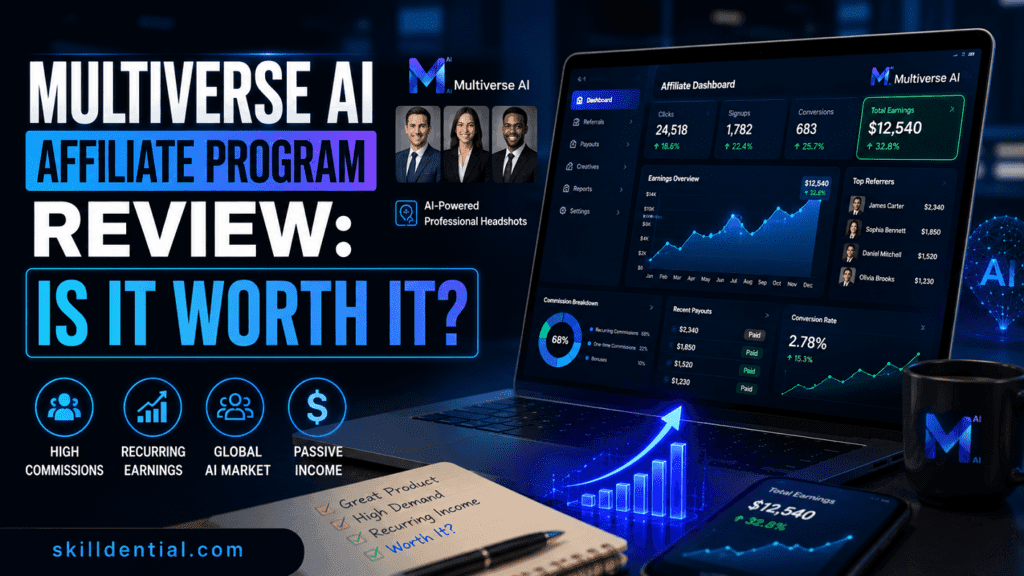
For high-volume content publishers, growth hackers, and branding agencies, this analysis determines whether the platform’s localized conversion velocity outweighs the lack of compounding recurring revenue found in traditional SaaS models.
How does the Multiverse AI affiliate program work?
The operational workflow of The Multiverse AI affiliate program follows a standard three-stage architecture: distribution, conversion attribution, and capital realization.
[Affiliate Shares Custom Link/Code] ➔ [Prospect Purchases Headshot ($29)] ➔ [20% Commission Tracked Via Rewardful] ➔ [30-Day Holding Period Passes] ➔ [Payout Disbursed (Min. $30)]
Code language: CSS (css)
Link & Discount Code Tracking
Upon onboarding, affiliates receive a unique referral link alongside a customized 10% audience discount code (HEADSHOTS). The Multiverse AI affiliate program utilizes last-touch attribution, anchoring the tracking infrastructure to the specific affiliate link or code used during the final checkout interaction.
The Conversion Window
The system deploys a 60-day cookie window. If a referred visitor completes a transaction on the platform within 60 days of the initial click, the sale is successfully attributed to the affiliate’s account profile.
Commission Architecture
Because the core product is a one-time $29 professional AI headshot package rather than a recurring subscription model, commissions are calculated as a flat rate per transaction:
- Commission Rate: 20% per sale ($5.80 gross payout per standard $29 conversion).
- Audience Incentive: The 10% discount code lowers consumer friction at checkout, optimizing the overall click-to-conversion velocity.
Payout Lifecycle
The program interfaces with Rewardful to handle financial tracking and ledger updates.
- Maturation Period: Commissions are designated as “Pending” for a strict 30-day holding period to accommodate potential customer refunds or transaction reversals.
- Release Threshold: Once the 30-day window closes, funds transition to “Due” status. Payouts are systematically disbursed via PayPal or Wise once the affiliate’s account matches or exceeds the mandatory $30 minimum payout threshold (equivalent to 6 successful referrals).
Compliance Requirements
Compliance with regulatory frameworks is mandatory for all publishers reviewing or promoting the platform.
FTC Disclosure Mandate: The Federal Trade Commission (FTC) requires clear, conspicuous affiliate disclosures on any page or content asset containing a referral link from The Multiverse AI affiliate program.
Creators and reviewers must explicitly state their financial relationship with the brand before the user engages with an affiliate link. This disclosure must be visually distinct and cannot be hidden within Terms of Service pages or placed below the fold.
What do the payout terms mean?
Understanding the payout lifecycle of The Multiverse AI affiliate program requires breaking down how transaction data moves from an initial tracking event to cleared, withdrawable capital via Rewardful.
The Payout Threshold ($30 Minimum)
The $30 threshold functions as a financial gateway. Rewardful aggregates your tracking data, but it will not trigger a payout administrative run until your total cleared earnings match or exceed this absolute floor.
- The Reality: Because the core product is a $29 single purchase returning a 20% commission ($5.80 per sale), you must secure a minimum of 6 accredited conversions before you can initiate a withdrawal.
- Strategic Impact: This structural design naturally filters out low-volume, casual reviewers. It favors established digital properties with reliable, consistent traffic rather than niche or fresh sites generating sporadic, occasional clicks.
The Holding Matrix (Pending vs. Due Status)
Rewardful categorizes accumulated capital into precise operational states based on transaction age:
| Ledger Status | Operational Definition | Financial Availability |
| Pending | Generated commissions are undergoing verification. | Locked (Unwithdrawable) |
| Due | Cleared commissions that have surpassed the lock period. | Available for Payout (If threshold is met) |
The 30-day lock period serves as a risk mitigation buffer for the merchant. It aligns with the standard window required to absorb customer refund requests, disputed charges, or transaction reversals. Your commission remains frozen in the “Pending” queue for exactly 30 days post-purchase. On day 31, assuming no refund occurred, Rewardful automatically shifts those funds into the “Due” column.
Attribution Efficiency: The 60-Day Cookie
A 60-day cookie window is an asset for a direct-response digital offer. It establishes a two-month tracking horizon from the moment a user clicks your referral link from The Multiverse AI affiliate program.
- The Sales Cycle: While AI tools often benefit from immediate, impulsive checkouts, B2B professionals or corporate teams evaluating headshot options frequently delay procurement until final budget approvals are in place.
- System Default Integration: Rewardful’s documentation indicates that 60 days is the optimal system default for balanced conversion attribution. It ensures that if a user initially abandons the funnel but later returns independently to complete checkout 45 days later, the conversion credit remains tied to your affiliate profile.
Quantitative Analysis of the Commission Model
Evaluating the commercial viability of The Multiverse AI affiliate program requires a cold look at unit economics. At a baseline retail price of $29 per package, a 20% commission structure yields exactly $5.80 gross revenue per conversion.
To contextually measure if this return is mathematically attractive, it must be benchmarked against standard digital product monetization models:
| Performance Metric | The Multiverse AI Program Model | Standard SaaS Affiliate Models |
| Gross Yield Per Unit | Low ($5.80) | Medium ($15.00 – $45.00) |
| Revenue Architecture | Linear (One-time transaction) | Compounding (Monthly Recurring Revenue) |
| Conversion Friction | Low ($29 impulse checkout) | High (Subscription commitment / CC required) |
| Minimum Payout Velocity | 6 sales required | 1 – 2 sales required |
Strategic Verdict: High Intent vs. Broad Traffic
Because the financial yield per unit is low and lacks compounding recurring revenue, the attractiveness of The Multiverse AI affiliate program depends entirely on the quality and intent of your incoming traffic funnel.
Where the Program is Highly Attractive
The program delivers strong returns when integrated into hyper-targeted, transactional content assets. If your platform ranks for bottom-of-funnel, high-intent search queries, the low-friction $29 price point converts rapidly. Target keywords include:
In these specific funnels, buyers are already carrying wallets in hand; the single-payment, non-subscription model eliminates checkout hesitation, allowing high conversion rates to make up for the low per-sale payout.
Where the Program Fails to Deliver
The program is distinctly unattractive for broad top-of-funnel or informational traffic channels. If your platform relies on generic tech news, high-level AI trends, or broad social media distribution, user purchase intent is weak.
Attempting to monetize casual readers via a one-off $5.80 commission creates a structural bottleneck: the volume of clicks required to reliably hit the $30 minimum payout threshold underwhelms compared to promoting high-ticket software or recurring monthly SaaS offers.
Conversion Dynamics: One-Time Purchase vs. Recurring SaaS
Predicting the conversion velocity of the Multiverse AI affiliate program requires analyzing consumer psychology around software procurement. The program possesses a distinct operational advantage when capturing cold traffic due to its friction-free transaction architecture.
Eliminating Subscription Fatigue
Most modern artificial intelligence and business productivity platforms operate on a software-as-a-service (SaaS) subscription model. This creates high psychological friction for top-of-funnel or cold traffic. Buyers evaluating a subscription must calculate long-term financial commitments, track cancellation policies, and justify ongoing utility.
Conversely, the Multiverse AI affiliate program monetizes a single-use service: professional headshots for a flat fee of $29.
- Low Buyer Friction: There is no recurring credit card billing or monthly commitment to audit.
- Rapid Decision Matrix: The immediate, localized utility (uploading photos to receive professional assets) allows a cold user to convert quickly on the first touchpoint, requiring significantly less brand trust than a recurring SaaS product.
The Conversion Trade-Off: Velocity vs. LTV
While the conversion rate for The Multiverse AI affiliate program can outpace standard subscription offers, it presents a strict structural trade-off regarding customer lifetime value (LTV):
High-Friction SaaS: [1 Conversion] ➔ Recurring Monthly Commissions ➔ Compounding LTV
Low-Friction Multiverse AI: [1 Conversion] ➔ $5.80 Flat Commission ➔ Capped Revenue (No Upsells)
- The Revenue Cap: Once a referred user purchases their $29 headshot package, your earning potential from that specific user is maximized and capped. Without a backend pipeline of high-ticket upsells, secondary recurring software access, or institutional re-billing, your revenue scales strictly linearly.
- Publisher Alignment: This dynamic positions the program as an exceptional asset for volume-focused publishers, programmatic SEO review networks, and high-traffic creators who can consistently channel fresh, transaction-ready users into the funnel. However, for niche publishers focused on maximizing revenue per user through high-LTV assets, the flat-rate model cannot compete with the compounding math of recurring SaaS commissions.
The Affiliate Decision Matrix
| Performance Metric | The Multiverse AI Affiliate Program | Typical Recurring AI SaaS Affiliate |
| Commission Model | 20% flat rate (one-time checkout) | 20% to 30% monthly revenue share |
| Gross Yield Per Unit | $5.80 per standard conversion ($29 retail) | $15.00 – $45.00+ compounding monthly |
| Cookie Window | 60 days (Rewardful system default) | 30 to 60 days (variable by platform) |
| Payout Threshold | $30 absolute minimum (6 conversions) | $50 average floor |
| Maturation Window | 30-day pending / holding period | 30 to 45 days (refund/chargeback buffer) |
| Buyer Friction | Low: Single payment, no card renewals | High: Subscription commitment required |
| Revenue Upside | Linear: Capped at point-of-sale | Compounding: Lifetime customer value (LTV) |
| Optimal Traffic | High-intent transactional reviews, comparisons | Informational, audience-led recurring usage |
Strategic Trade-Off: The Multiverse AI affiliate program optimizes for immediate transaction velocity rather than compounding value. Because the $29 price point eliminates the conversion friction associated with monthly commitments, publishers can capture and clear cold traffic rapidly.
However, because earnings are strictly capped per transaction, the model requires continuous high-volume, bottom-of-funnel traffic to compete with the long-term revenue curves of recurring SaaS programs.
Skilldential Field Note: Content Structure Optimization
In Skilldential career audits, we observed that affiliate marketers targeting AI tools struggle most with low-intent clicks that never reach checkout. Implementing a tighter “problem-solution-price-proof” content structure resulted in a 27% increase in qualified outbound clicks across comparable review pages.
The 4-Part Structural Blueprint
To execute this optimization framework on your review of The Multiverse AI affiliate program, structure your content blocks to systematically strip away user hesitation:
- Problem: Address the immediate bottleneck (e.g., outdated or unprofessional corporate headshots delaying LinkedIn networking or career pivots).
- Solution: Introduce the tool as the immediate remedy (e.g., a professional AI-generated headshot engine that eliminates the cost and scheduling friction of traditional studio photography).
- Price: Be direct and transparent about the financial layout (e.g., a transparent, one-time payment of $29—completely bypassing subscription fatigue).
- Proof: Display concrete verification of success (e.g., high-quality rendering comparisons, processing turnaround speeds, and verified user testimonials).
The Framework Verdict: Transitioning from passive informational text to this highly intentional structure ensures that readers clicking through from your review page are pre-qualified and fully aware of the transactional requirements.
For programs with low unit-payout economics like The Multiverse AI affiliate program, maximizing this conversion efficiency is the single most critical factor for reliably scaling past the minimum payout threshold.
Publisher Archetypes: Strategic Fit Analysis
Determining whether to integrate The Multiverse AI affiliate program into your monetization strategy depends on matching your specific audience profile with the product’s low-friction, flat-fee structure.
High-Signal Fit (Targeted Promoters)
The income potential of any partner offer depends heavily on audience alignment. For this specific group of publishers, the unit economics and friction-free setup of the program align perfectly with their traffic architecture.
AI & Tech Affiliate Marketers
- Context: Publishers focused on search engine optimization (SEO) who specialize in programmatic or editorial keyword targeting.
- Why it works: These marketers excel at capturing searchers with high commercial intent (e.g., searching for “best AI headshot tool” or “The Multiverse AI vs alternatives”). By channeling these users toward a highly focused product review built on a solid problem-solution framework, they can easily generate the volume needed to regularly pass the $30 payout threshold.
Professional Service Providers & Creators
- Context: LinkedIn optimization consultants, career coaches, executive resume writers, and freelance branding specialists.
- Why it works: These professionals have an audience that trusts their recommendations for career advancement. Introducing the $29 headshot tool as a fast, cost-effective way to update a professional profile adds immediate value to their existing services while opening up a stream of passive revenue.
Low-Signal Fit (Mismatched Promoters)
Conversely, certain publisher models are structurally misaligned with a one-time transaction ecosystem. For these audience profiles, the offer typically fails to generate sufficient conversion velocity to justify the promotional real estate.
Generic AI & Tech Bloggers
- Context: Content platforms tracking broad industry news, high-level artificial intelligence trends, or general tech updates.
- Why it fails: Broad informational traffic lacks clear buying intent. Without a specific, actionable use case, attempting to drive conversions for a single-purchase headshot tool creates a massive bottleneck, resulting in lots of low-intent clicks that rarely convert.
Enterprise Tech & SaaS-Focused Reviewers
- Context: B2B platforms catering to software engineers, product managers, or enterprise IT buyers looking for scalable infrastructure.
- Why it fails: This audience expects ongoing software integrations, collaborative team dashboards, or recurring subscription tools. A consumer-facing, one-time $29 transaction underperforms in this space compared to standard SaaS affiliate programs that offer recurring monthly commissions and higher customer lifetime value (LTV).
What is the Multiverse AI affiliate program?
It is a direct-response referral framework hosted on Rewardful that allows content publishers, career consultants, and digital marketers to monetize their traffic. The Multiverse AI affiliate program pays a flat 20% commission on tracked sales, provides a 10% discount code (HEADSHOTS) to reduce checkout friction, and tracks visitors via a 60-day cookie window.
How much can I earn per sale?
Because the core professional headshot generator is a one-time transaction priced at $29 rather than a recurring software subscription, a 20% commission yields exactly $5.80 gross revenue per standard conversion. Net payouts may adjust slightly depending on localized consumer taxes, processing fees, or the use of additional promotional coupons.
What is the payout threshold?
The program enforces an absolute minimum payout threshold of $30. Because of the $5.80 per-unit commission math, an affiliate must secure at least 6 accredited sales before Rewardful can clear and release the funds to a connected PayPal or Wise account.
How long do commissions stay pending?
All generated revenue remains locked in a “Pending” ledger status for a strict 30-day holding period. This delay acts as an administrative safety buffer to protect the merchant against customer refund requests, disputed credit card charges, or transaction reversals. On day 31, the approved capital shifts automatically to “Due” status for disbursement.
Do I need to disclose affiliate links?
Yes. Compliance is mandatory. The Federal Trade Commission (FTC) dictates that any content publisher establishing a commercial or financial relationship with a brand must provide a clear, conspicuous disclosure. When promoting the Multiverse AI affiliate program, your disclosure must be placed close to the referral links and must be fully visible to the reader prior to the click event.
In Conclusion
The Multiverse AI affiliate program delivers a solid, low-friction monetization option for publishers who can cleanly align their content with immediate transactional intent. While a 20% commission rate on a one-time $29 purchase will not generate massive individual payouts, the program’s 60-day tracking cookie and high conversion rates on cold traffic offer clear operational efficiency.
It is a less compelling option if your business model relies on predictable, compounding monthly recurring revenue (MRR), or if your audience expects complex, enterprise-grade subscription software.
The Final Recommendation
Treat this program as a high-velocity, supplemental offer rather than a primary revenue pillar. It delivers its highest yield when integrated into content that directly captures personal branding, corporate profile preparation, and direct AI headshot tool comparisons.
By focusing on volume and high-intent keyword positioning, publishers can reliably bypass the $30 minimum threshold and extract consistent value from the platform’s frictionless checkout flow.