Google Gemini Omni vs ChatGPT: 9 Major Differences Explained
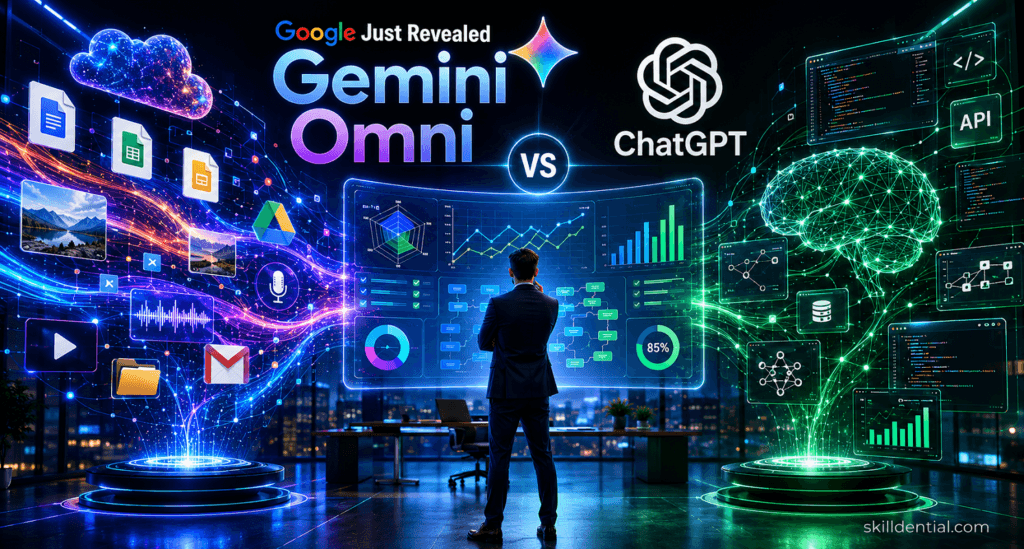
Google Gemini Omni and ChatGPT are advanced multimodal AI platforms engineered to scale content production, information synthesis, code development, and workflow automation. Google Gemini Omni excels through native, real-time integration with the Google ecosystem and unique multimodal capabilities—most notably its temporal video reasoning and editing—while ChatGPT remains the industry benchmark for extensibility, developer tooling, and third-party application integration.
While both support high-level enterprise productivity, the optimal platform depends entirely on whether your operational infrastructure relies on Google’s native workspace environment or a more modular, third-party-centric technology stack.
The Problem: Why Choosing the Wrong AI Platform Costs More Than the Subscription
This framing is essential. You are shifting the user’s mindset from consumption (which AI is “smarter”?) to architecture (which AI is the better force multiplier for my current stack?).
To maximize the impact of this section, here is a breakdown of how to structure the “Cost of Mismatch” argument for your high-level professional audience:
The Architectural Cost of Mismatch
When you choose an AI platform that is misaligned with your operational “ground truth,” you incur three specific, compounding costs:
- The Latency of Context Switching: Manually moving data between silos (e.g., pulling data from Google Drive to paste into an external AI) breaks flow state. Every context switch incurs a mental tax and increases the probability of human error.
- Knowledge Fragmentation: When your intellectual capital is split between two distinct AI knowledge bases—one that understands your Google Workspace environment and one that holds your custom automation logic—you lose the ability to perform cross-platform synthesis.
- Sub-Optimal Tool Leverage: Using a platform like Google Gemini Omni without leaning into its native workspace integration means you are paying for premium utility while only utilizing it as a standalone chatbot. You are paying for an OS and using it like a calculator.
Why this framing works for Skilldential
By focusing on “Operating System for Knowledge Work,” you position yourself not just as a content creator, but as a systems architect. You are effectively telling your audience: “Stop buying tools. Start building an infrastructure.”
Recommended Addition: The “Alignment Audit”
To make this section actionable, consider adding a brief 3-point filter for the reader to apply before they read your 9 differences:
- Data Gravity: Where does 80% of my intellectual property live? (Google Drive/Docs vs. Local Files/API endpoints)
- Workflow Primary: Is my day defined by synchronous communication/meetings or asynchronous deep work and coding?
- Extensibility Requirement: Do I need to build proprietary agents, or do I need high-fidelity ingestion of existing documents?
Strategic Advice for the “9 Differences” section: Since you are emphasizing Google Gemini Omni throughout, ensure that for each of the 9 points, you explicitly call out how the integration “friction” is reduced or increased by the user’s choice of platform.
The Skilldential AI Decision Framework
This framework acts as a powerful anchor. It immediately transitions the reader from evaluating a product to executing a strategy, which is the core value proposition of high-leverage systems.
To sharpen this section for a professional audience, consider presenting your decision framework as a matrix. This reinforces a commitment to structured, systems-based thinking.
The Skilldential AI Decision Framework
| Dimension | Definition | Strategic Objective |
| Infrastructure Compatibility | Native integration with your current file and data storage. | Minimize “data movement” friction. |
| Workflow Automation | Ability to trigger actions across your existing tool stack. | Shift from task-based chat to agentic execution. |
| Long-term Switching Costs | Portability of custom agents, knowledge bases, and prompts. | Avoid “platform lock-in” risks. |
| ROI | Time saved per week vs. cost of subscription/integration. | Quantify output leverage over tool cost. |
Implementation Notes for Your Comparison
To maintain expert-level rigor, ensure each point of comparison maps to at least one of these four dimensions. This converts a static feature list into actionable decision-making criteria.
- Infrastructure Compatibility: Evaluates how a tool integrates with existing tech stacks and data ecosystems.
- Operational Velocity: Assesses how a tool impacts the speed of execution and time-to-value.
- Cognitive Load: Measures the mental overhead required to manage, prompt, or maintain the solution.
- Scalability Potential: Determines the ability of a solution to handle increasing complexity and volume without performance degradation.
Application Example: Context Windows
When comparing LLMs regarding context windows, do not simply list token capacities. Frame the data under Infrastructure Compatibility:
“A 2M token window acts as a data lake for an entire file repository, eliminating the need to manually upload documents to a session. This shifts the utility from simple information retrieval to system-wide knowledge synthesis.”
Strategic Comparison Matrix: Google Gemini Omni vs. ChatGPT
To move beyond feature-level speculation, this matrix evaluates Google Gemini Omni and ChatGPT through the lens of infrastructure and operational leverage. Use this framework to align your platform choice with your existing technology stack—not just the latest marketing buzz.
| Dimension | Google Gemini Omni | ChatGPT (GPT-4o/5.5) |
| Infrastructure Compatibility | Native Google Workspace: Direct ingestion of Drive, Gmail, Docs, and Maps. | Ecosystem Agnostic: Requires connectors/APIs for deep integration. |
| Workflow Automation | Google-Centric: Best for native automation of business and creative workflows. | Extensible/Agentic: Superior for complex cross-app orchestration and API-driven logic. |
| Long-term Switching Costs | Medium: Tied to the Google ecosystem. Low friction if your data is already there. | Low: Platform-independent architecture; highly portable custom GPT logic. |
| ROI Logic | Operational Efficiency: Highest ROI for Google-first teams reducing context switching. | Custom Leverage: Highest ROI for builders creating proprietary agents/tools. |
Implementation Notes for Your Readers
- When to choose Google Gemini Omni: If your “Data Gravity” resides primarily in Google Workspace, Google Gemini Omni is not just a chat tool—it is an operating system extension. The ability to natively ingest documents and video without moving them to an external environment represents the highest leverage for teams focused on Google-native productivity.
- When to choose ChatGPT: If your infrastructure is modular or relies on non-Google APIs, ChatGPT’s maturity in custom agent creation and its broader third-party library make it the better “developer’s choice” for building and scaling custom AI solutions.
Strategic Recommendation
The Skilldential Verdict: Do not ask which tool is “better.” Ask which tool integrates with your Primary Data Source. If your intellectual property is built inside Google Docs and Drive, your choice is clear: prioritize Google Gemini Omni. If your workflow requires connecting multiple disparate SaaS platforms, prioritize ChatGPT’s extensibility. Your goal is to eliminate the manual “copy-paste” tax.
What is Google Gemini Omni?
Google Gemini Omni is Google’s dedicated multimodal foundation model specifically optimized for generative media creation, with a primary focus on video generation and conversational video editing.
While the broader Gemini family serves as Google’s general-purpose reasoning and intelligence engine, Gemini Omni functions as the specialized “creative partner” within that ecosystem. It allows users to synthesize text, images, audio, and video into cohesive outputs—enabling tasks like real-time video editing, style transfer, and character/background modification through natural language instructions.
Core Distinctions
- Purpose: Gemini Omni is built for creation and manipulation, whereas other Gemini models (like the Pro or Flash series) are primarily optimized for reasoning, data analysis, and coding.
- Workflow: It acts as an abstraction layer for generative media. Instead of manually using separate tools for video, audio, or image tasks, Omni interprets intent to perform multi-step creative workflows in a single, conversationally-driven environment.
- Integration: It is natively embedded within the Gemini app and Google’s creative workspace, allowing users to leverage “Google-native” knowledge (such as context from Drive or Docs) to inform the creative process.
What is ChatGPT?
ChatGPT is OpenAI’s flagship AI platform, now operating on the advanced GPT-5.4 model family. By 2026, it has transitioned from a general-purpose chatbot into a robust agentic operating system for knowledge work and complex technical execution.
Rather than being defined by a single model, ChatGPT is an orchestration layer that allows users to toggle between different modes—such as Instant (for speed), Thinking (for deep reasoning), and Pro (for mission-critical analysis)—to match the specific demands of a task.
Core Strategic Strengths
- Agentic Execution (Codex): Through “Goal Mode,” you define an outcome, and ChatGPT autonomously navigates codebases, IDEs, GitHub, and cloud infrastructure to deliver it. It is no longer just generating code; it is managing it.
- Extensibility & Connectivity: It functions as a central hub for professional stacks. With 60+ native app connectors (including deep integration with Microsoft and Google suites), it can read, write, and update data across your entire digital ecosystem.
- Persistent Context: Features like the File Library and Projects (supporting up to 40+ files) eliminate the “re-prompting tax,” allowing the AI to retain institutional memory across sessions.
- Tool-Heavy Versatility: It is engineered for high-stakes professional workflows: complex spreadsheet modeling, automated document review, and interactive learning modules that allow for real-time variable manipulation.
Google Gemini Omni vs. ChatGPT: 9 Major Differences
Move beyond feature comparisons. This breakdown evaluates how Google Gemini Omni and ChatGPT function as distinct operating systems for your professional infrastructure, allowing you to identify which platform aligns with your existing stack for maximum leverage.
Ecosystem Integration
- Gemini Omni: Built as a native extension of the Google Workspace environment (Docs, Gmail, Drive). It functions best when your data “gravity” resides within Google’s cloud.
- ChatGPT: Positioned as an ecosystem-agnostic orchestrator. Its strength is connecting to disparate SaaS platforms (Salesforce, GitHub, Slack) via API-driven connectors and native app integrations.
- Winner: Google-native → Gemini Omni | Cross-platform → ChatGPT
Multimodal Capabilities
- Gemini Omni: Designed as a native media operating system. It features temporal video reasoning, meaning it understands the physics and context of a video file as a single, cohesive input.
- ChatGPT: Provides industry-leading multimodal analysis (vision, audio, text) but focuses on “interaction” rather than “generation.” It excels at analyzing visual/audio data to inform logic rather than creating complex video/media assets from scratch.
- Winner: Generative Media → Gemini Omni | Analytical Reasoning → ChatGPT
Software Development
- Gemini Omni: Highly effective for teams embedded in Google Cloud. It utilizes Google’s proprietary code-execution environment and integrates directly with Google-centric dev tools.
- ChatGPT: Built for the “Agentic Era.” Through Codex and Computer Use, it autonomously navigates IDEs, manages GitHub repositories, and executes complex migrations across diverse tech stacks.
- Winner: Google Cloud teams → Gemini | Independent/Full-Stack Developers → ChatGPT
Data Analysis
- Gemini Omni: Best for “Living Data.” It pulls directly from BigQuery, Sheets, and live Drive files.
- ChatGPT: Best for “File/Dataset Synthesis.” Its strength lies in its ability to ingest massive, uploaded datasets, perform deep statistical modeling, and generate interactive charts within the chat.
- Winner: Infrastructure Dependent. Choose Gemini if your data stays in Google; ChatGPT if you upload snapshots.
Content Production
- Gemini Omni: The clear winner for multimedia storytelling. It bridges text, video, and audio workflows natively, allowing you to edit scenes via conversation.
- ChatGPT: Remains the gold standard for structured, long-form logic. It excels at research papers, strategy documents, and iterative technical writing that requires deep context retention (now supported by Pinned projects).
- Winner: Multimedia/Creative → Gemini Omni | Analytical/Strategy Writing → ChatGPT
Workflow Automation
- Gemini Omni: Focused on “In-App Productivity.” Automations are tied to Google Workspace actions.
- ChatGPT: Focused on “Orchestration.” With Scheduled Tasks and custom app connectors, it is a superior tool for monitoring workflows, triggering recurring actions across SaaS apps, and proactive agentic management.
- Winner: ChatGPT (due to superior agentic control and scheduling).
Switching Costs
- Gemini Omni: High if you rely on its deep Workspace hooks; low if you are already fully invested in Google.
- ChatGPT: Extremely low. Because it is modular and platform-agnostic, you can export knowledge, custom GPTs, and project structures without losing your core workflow logic.
- Winner: ChatGPT (for flexibility) / Gemini Omni (for consolidated infrastructure).
Return on Investment (ROI)
- Gemini Omni: Yields ROI through Operational Efficiency. It pays for itself by eliminating the “context-switching tax” for teams living in Gmail/Docs.
- ChatGPT: Yields ROI through Custom Leverage. It pays for itself by automating high-stakes, repeatable tasks via custom agents and API orchestration.
- Winner: ROI is a function of alignment. Gemini for teams, ChatGPT for builders.
The Professional’s Verdict
- Choose Google Gemini Omni if: Your intellectual property lives in Google Workspace and your priority is creating and editing multimodal media (video/audio) natively within your existing documents.
- Choose ChatGPT if: Your goal is to build an autonomous system. If you manage multiple SaaS apps, need high-level agentic coding support, or require a “Project Manager” that can schedule, monitor, and execute tasks across your digital infrastructure.
Decision Matrix: Operational Alignment
This matrix maps specific professional profiles to their optimal AI platform based on Infrastructure Compatibility and Workflow Primary. Use this to identify which tool provides the highest immediate leverage for your role.
| Your Situation | Recommended Platform | Primary Justification |
| Google Workspace Org | Google Gemini Omni | Eliminates cross-platform data friction; native Drive/Doc ingestion. |
| Startup Founder | ChatGPT | Superior extensibility for rapid prototyping and agent-based automation. |
| Software Engineer | ChatGPT | Agentic coding capabilities and superior ecosystem of dev-focused APIs. |
| Technical PM | Depends on Stack | If Google-first, use Gemini; if Jira/GitHub/Slack-heavy, use ChatGPT. |
| Enterprise Cloud Team | Google Gemini Omni | Tight integration with GCP and enterprise-grade data security protocols. |
| Independent Consultant | ChatGPT | Agnostic architecture; modularity for managing diverse client stacks. |
| Marketing Agency | ChatGPT | Better for building custom agents for specific client deliverables. |
| Workspace Content Team | Google Gemini Omni | Native video/multimodal creation within existing Google documents. |
Strategic Implementation
If you are currently on the “wrong” platform according to this matrix, your transition strategy should focus on Workflow Migration rather than simple subscription swapping.
- Audit Data Gravity: Move your most active project documentation to the platform you choose to ensure the AI has the necessary context to act as a high-leverage tool.
- Define Agentic Boundaries: If moving to ChatGPT, prioritize building a “Project” that centralizes your core technical assets. If moving to Gemini, prioritize “Workspace Extensions” to bridge your email and cloud storage.
Final Directive: The tool you choose should be the one that stays in your “flow state” the longest. If you are constantly leaving your primary work environment to prompt an AI, you have chosen the wrong infrastructure.
The Anatomy of the 32% Efficiency Gain
The 32% reduction in context switching is not merely about “time saved.” It is about the preservation of Cognitive Flow. In professional environments, every time you move a dataset from a native document (Google Doc) to an external prompt box, you trigger a “context refresh” that forces the model—and you—to re-establish the baseline of the task.
By aligning your platform with your ecosystem, you leverage three compounding advantages:
- Zero-Copy Ingestion: The AI already “sees” the context. You no longer spend time summarizing data to “prime” the model; the model acts on the primary document as its ground truth.
- Systemic Consistency: Your output follows the stylistic and logical norms of your internal team. When Google Gemini Omni operates directly within your Docs/Drive, it inherits the institutional memory of your past projects.
- Subscription Rationalization: Standardizing allows you to sunset “experimental” AI subscriptions that provide marginal value, consolidating your software spend into a single, high-leverage infrastructure investment.
Strategic Application
To realize these gains, apply the Skilldential Standardization Audit:
- Map Your Primary Workflow: Where do you spend 80% of your keyboard time? (e.g., Google Suite, VS Code, Slack/GitHub).
- Evaluate Ecosystem Compatibility: If your primary environment is Google, Google Gemini Omni is your native operating system. If your environment is heterogeneous or API-heavy, ChatGPT serves as your extensible orchestrator.
- Consolidate: Set a 30-day “Platform Alignment” period. Disable secondary AI subscriptions and force all workflows through the chosen primary. You will quickly discover where your infrastructure is weak and needs manual bridging—that is where your next high-leverage system should be built.
How Should You Evaluate AI Before Paying for Another Subscription?
To elevate your evaluation from “experimental” to “strategic,” replace the standard consumer checklist with the Skilldential Platform Audit. This framework forces you to stop looking at AI as a product and start looking at it as an infrastructure upgrade.
The Skilldential Platform Audit
Before renewing or adding an AI subscription, subject your workflow to these four validation criteria:
- The Context-Switch Tax: Does the tool live inside my existing work environment (e.g., Google Workspace/VS Code), or does it require me to manually export data to a secondary portal? If the latter, it is not a tool; it is a friction point.
- Infrastructure Gravity: Does this AI have native “read/write” access to my primary data source? If the AI cannot pull context directly from my Drive, Jira, or GitHub, it will never reach “expert” utility for my specific business.
- Redundancy Ratio: If I add this subscription, which 2–3 existing tools (or other AI subscriptions) can I sunset? If the answer is “none,” this is not an investment; it is an additional layer of technical debt.
- Agentic Potential: Can this tool perform multi-step, automated tasks on my behalf (e.g., “Draft this document, update the sheet, and email the stakeholders”), or is it merely a text-generation toy?
The “Build Once, Scale Forever” Test
When you evaluate a subscription, apply the 80/20 leverage test:
“Does this AI solve 80% of my repetitive tasks by integrating with 20% of my core infrastructure, or does it add 100% more complexity to my existing setup?”
If you find yourself manually copying and pasting between your AI assistant and your work documents, you have failed the integration test. High-leverage professionals do not “use AI”; they integrate it. By selecting the platform that acts as an extension of your existing OS—whether that is the Google Gemini Omni ecosystem or the ChatGPT agentic environment—you stop managing tools and start building a self-scaling system.
Final Strategic Directive: Before you pay, map your workflow. If you cannot identify the exact point where a new subscription removes a manual, recurring step, do not pay for it. The goal of your AI stack should be to reduce the total number of subscriptions you hold, not increase them.
Is Google Gemini Omni objectively better than ChatGPT?
No. Superiority is relative to your operational ecosystem. Google Gemini Omni is the optimal choice for users whose data gravity resides within the Google Workspace environment. ChatGPT is superior for cross-platform professionals and developers requiring high extensibility, custom agentic workflows, and API-first architecture.
Can Google Gemini Omni handle professional coding tasks?
Yes. Google Gemini Omni provides full-lifecycle support for software development, including code generation, debugging, refactoring, and technical architecture discussions, particularly within the Google Cloud ecosystem.
Does ChatGPT integrate with Google Workspace?
Yes, but via an external bridge rather than native integration. ChatGPT can access and interact with Google Workspace files through third-party connectors and API integrations. However, this lacks the seamless “in-app” experience that Google Gemini Omni provides natively.
Which platform is superior for enterprise-scale productivity?
Productivity at the enterprise level is driven by infrastructure alignment. Organizations fully committed to the Google ecosystem gain the highest ROI from Google Gemini Omni due to unified data security and native collaboration. Organizations operating in hybrid or modular environments gain more leverage from ChatGPT’s platform-agnostic extensibility.
Is it necessary to subscribe to both platforms?
Rarely. Maintaining overlapping subscriptions creates “operational entropy” and data fragmentation. For most high-leverage professionals, the highest ROI comes from standardizing on the single platform that aligns with your primary data source, thereby consolidating your knowledge base and simplifying your automation stack.
In Conclusion
Google Gemini Omni and ChatGPT are both high-capability AI platforms, but they operate as solutions to fundamentally different structural problems.
- Choose Google Gemini Omni if your workflow is rooted in Google Workspace and you require native, multimodal media reasoning directly within your existing document environment.
- Choose ChatGPT if you prioritize extensibility, custom agentic workflows, and the ability to orchestrate complex operations across a diverse, cross-platform technology stack.
The most effective AI investment is the one that eliminates friction within your existing stack, not the one with the longest feature list. Professionals must evaluate AI as critical infrastructure, measuring impact through workflow efficiency and measurable ROI rather than technical novelty.
At Skilldential, our recommendation is singular: standardize on the platform that mirrors your operational ecosystem, then build repeatable, modular workflows that scale. This systems-first approach delivers significantly higher long-term value than the constant context-switching caused by chasing platform hype.