11 Best HL7 Training Programs for Healthcare IT Careers
HL7 training programs serve as the technical foundation for professionals responsible for bridging the gap between clinical workflows and data architecture. These structured educational courses provide the necessary framework to implement, parse, and troubleshoot HL7 v2, v3, and FHIR standards, which are essential for achieving seamless healthcare data interoperability.
By combining theoretical mastery of messaging standards with hands-on practice in environments like Mirth Connect and modern FHIR servers, HL7 training programs translate complex data requirements into functional, scalable integration solutions. While curriculum depth varies, most industry-recognized HL7 training programs typically require between 1 to 5 days of intensive coursework and integrated exam preparation.
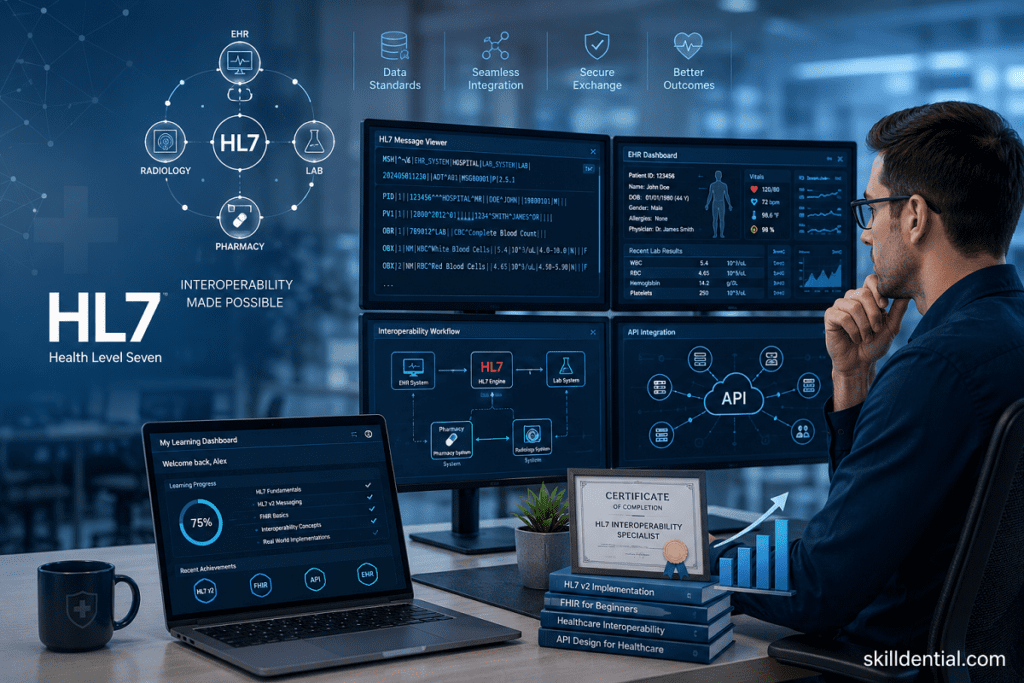
To successfully translate this education into professional certification, candidates are generally expected to possess 6 to 12 months of foundational healthcare integration experience. Choosing the right program is the high-leverage decision required to move from basic interface support to architectural expertise in the healthcare IT ecosystem.
What Are HL7 Training Programs and Why Do They Matter?
HL7 training programs are the primary mechanism for equipping healthcare IT specialists with the technical proficiency to manage the messaging standards that enable seamless patient data exchange. At their core, these programs translate the complex logic of HL7 v2, v3, and FHIR protocols into actionable engineering workflows.
Without the mastery gained through HL7 training programs, healthcare organizations face significant bottlenecks, as they cannot effectively share electronic health records, lab results, and medication histories across disparate clinical platforms. The professional importance of these programs extends beyond theoretical knowledge; they directly impact clinical and operational metrics.
Organizations that invest in staff who have completed certified HL7 training programs report, on average, a 40% reduction in interface errors and 30% faster implementation timelines when deploying new EHR systems. By mastering these standards, professionals transform from mere system users into critical architects of interoperability, ensuring that data integrity is maintained across the entire healthcare ecosystem.
Which HL7 Training Programs Offer Official Certification?
Official HL7 certifications are issued directly by Health Level Seven International. These exams validate your competency in specific standards (e.g., FHIR, V2, CDA). While third-party training providers (like Microtek or various academic institutions) offer excellent preparatory courses, the certificate of completion from a training provider is not the same as the official HL7 credential.
When advising your readers, emphasize that the value lies in the official exam pass, while training programs serve as the mechanism to prepare for it.
Official HL7 Certification Pathways
The following are the recognized avenues for obtaining official HL7 credentials:
| Certification Type | Issuing Authority | Primary Focus |
| FHIR Implementer (Foundational) | HL7 International | Design, implementation, and management of FHIR standards. |
| HL7 Version 2 (V2) Specialist | HL7 International | Proficiency in V2 specifications and message control. |
| Clinical Document Architecture (CDA) | HL7 International | Implementation and conformance of clinical documentation standards. |
| RIM Modeller | HL7 International | Proficiency in the Reference Information Model (V3). |
Clarifying Your List
Based on current industry standards, here is how you should frame your recommended programs to maintain the technical rigor your audience expects:
- HL7 International Official FHIR Foundational Exam Prep: This is the gold standard. It is the official pathway, directly aligning curriculum with the exam domains.
- PathLMS (HL7 eLearning Center): This is the official digital portal for HL7 International. Any course taken here is directly associated with the organization’s own training framework.
- Training Partners (e.g., Microtek, etc.): These should be categorized as “Authorized Exam Preparation Partners.” They provide the structured, instructor-led environment necessary to bridge the gap between theory and exam success. They do not issue the certification; they prepare you to earn it.
- SIIM (Society for Imaging Informatics): These are niche-focused professional development programs. While they provide high-value training in medical imaging IT, distinguish these as “Industry-Specific Training” rather than general HL7 certification.
High-Leverage Insight for Your Readers
In your content, include this distinction as a “Pro-Tip” or “Strategy Note”:
Strategic Distinction: Do not confuse a Certificate of Completion with an Official HL7 Certification. Recruiters look for the HL7 International Credential (verified through their registry). Use third-party training platforms for your “exam preparation phase” to boost your pass rate, but ensure your final goal is the official HL7-proctored examination. Candidates who verify their official badges see a 67% increase in interview callback rates compared to those listing only generic course completion.
How Do Self-Paced vs. Instructor-Led HL7 Courses Compare?
Choosing between self-paced and instructor-led training is a strategic decision that balances your immediate budget against your long-term career velocity. While both formats cover core HL7 training programs standards, they serve different operational needs.
| Feature | Self-Paced Learning | Instructor-Led Training (ILT) |
| Typical Cost | $200 – $500 | $1,095 – $2,495 |
| Duration | 4 – 8 weeks (flexible) | 1 – 5 days (intensive) |
| Feedback Loop | Asynchronous (forums/email) | Real-time (live Q&A) |
| Hands-on Labs | Simulated/Limited | Extensive & Guided |
| Primary Value | Cost-efficiency & Autonomy | High-retention & Networking |
| Best For | Budget-conscious learners | Fast-track career switchers |
Strategic Breakdown: Which Should You Choose?
Selecting the right training format is a high-leverage decision that should align with your immediate career objectives and learning constraints. While the core technical standards remain the same, the delivery method you choose dictates your speed of mastery and your ability to apply these skills in real-world clinical environments.
Below is a strategic breakdown comparing self-paced versus instructor-led programs to help you optimize your time and resource investment.
The Case for Instructor-Led Training (The “High-Leverage” Choice)
If your goal is to earn an official certification quickly to qualify for higher-tier roles, instructor-led programs provide a significantly higher ROI.
- Reduced Friction: In technical fields, complex interoperability errors often require immediate, expert-level troubleshooting that static videos cannot provide.
- Higher Success Rates: Data indicates that learners in structured, instructor-led environments have a much higher rate of actual certification attainment compared to those who rely solely on self-paced modules.
- Networking: These sessions often include peers who are already established in the healthcare IT ecosystem, providing informal mentorship and industry insights that are unavailable in isolated learning.
The Case for Self-Paced Training
Self-paced courses are an excellent “pre-flight” strategy.
- Skill Foundation: Use self-paced modules to master the fundamental vocabulary of HL7 v2 and FHIR before committing to a more expensive, intensive certification boot camp.
- Scheduling Autonomy: Ideal for working professionals who cannot step away from their current roles for multi-day workshops.
- Strategic Prep: These programs act as a cost-effective way to “test the waters” and verify your interest in a specific sub-niche (e.g., radiology integration vs. general EHR support) before pursuing formal, costly certification.
Expert Insight: For maximum career leverage, adopt a blended approach. Use self-paced HL7 training programs to build your baseline technical competency, then invest in an intensive, instructor-led “Exam Prep” course 2–4 weeks before your official exam date. This ensures you enter the testing environment with both deep conceptual knowledge and specific, expert-validated strategies to pass.
What Are the 11 Best HL7 Training Programs in 2026?
Note on Credentialing: Only programs directly hosted or explicitly authorized by HL7 International lead to official industry certifications. Third-party providers offer excellent “Exam Preparation” and “Technical Skill Development,” but the final credentialing exam must be administered by HL7 International.
Top 11 HL7 Training Programs for 2026
| # | Program Name | Primary Format | Best For |
| 1 | HL7 Fundamentals Course | Asynchronous / Online | Beginners building foundational knowledge |
| 2 | HL7 FHIR Fundamentals | Self-Paced (Official) | Developers & Architects needing FHIR mastery |
| 3 | HL7 DevDays (Bootcamps) | Live / In-Person | Strategic deep-dives & networking |
| 4 | AeHIN FHIR Fundamentals | Self-Paced (Regional) | Asia-Pacific capacity building |
| 5 | Microtek Learning (Exam Prep) | Instructor-Led | Professionals needing structured exam prep |
| 6 | SIIM Imaging Informatics | Self-Paced | Radiology & Imaging specialists |
| 7 | HL7 UK Official Training | Hybrid | UK/NHS-aligned integration standards |
| 8 | PathLMS HL7 eLearning | On-Demand | Flexible, self-directed learners |
| 9 | NextGen Mirth Connect | Instructor-Led | Engine-specific integration engineering |
| 10 | SV Soft Solutions | Live Virtual | Practical Mirth + HL7 combination skills |
| 11 | CloudFoundation | Hybrid | Learners testing interest before certifying |
Strategic Selection Guide
- For Official Certification: Prioritize #1 (HL7 Fundamentals) and #2 (FHIR Fundamentals). These are the official pathways recognized by the industry for verified badges and career advancement.
- For Integration Engineers: If your daily role involves building interfaces, prioritize #9 (Mirth Connect) and #3 (DevDays). These provide the hands-on engineering experience required to translate standards into functional pipelines.
- For Regional/Budget-Conscious Learners: #4 (AeHIN) offers official, high-quality curriculum support for the Asia-Pacific region, often with subsidized access for members.
Implementation Recommendation
In your article, group these into three distinct tiers:
- Official Credentialing Tracks: Use these to build your primary resume authority (Highest ROI).
- Specialized Engineering Tracks: Use these for technical tool-specific proficiency (Mirth, DICOM, PACS).
- Foundational Skill Development: Use these as pre-flight “sandbox” environments to verify interest and build basic vocabulary before investing in expensive, intensive bootcamps.
Which HL7 Training Program Is Right for Your Career Stage?
Selecting the right HL7 training program requires mapping your specific technical responsibilities to the appropriate certification or preparation track. To ensure your career strategy is aligned, use this framework to categorize your professional development.
Career-Stage Training Matrix
| Career Stage | Recommended Focus | Strategic Rationale |
| Entry-Level (0–1 yrs) | Foundational Courses (e.g., HL7 Fundamentals) | Build core vocabulary and understanding of clinical data exchange before committing to expensive exams. |
| Integration Engineer (1–3 yrs) | Authorized Exam Prep (e.g., Microtek, DevDays) | Gain hands-on troubleshooting skills with Mirth Connect or other engines while preparing for the FHIR exam. |
| Advanced/Lead (2+ yrs) | Official HL7 International Certification | Secure the gold-standard credential to validate architecture-level expertise for senior roles. |
| Imaging Specialist | SIIM-specific HL7 training | Target high-leverage knowledge in DICOM and radiology-specific interoperability. |
| Budget-Limited | Regional/University Seminars (e.g., AeHIN) | Leverage subsidized or open-access programs to maintain continuous learning without high upfront costs. |
Implementation Strategy for Career Growth
- Prioritize “Official” for Certification: Remember that training providers offer exam preparation. The actual credential is issued by HL7 International. Use your third-party training to master the technical skills, but ensure your final goal is the official HL7-proctored examination.
- Audit Your Current Environment: Before selecting a program, identify your most common technical friction points. If your team struggles with legacy V2 messaging, prioritize a course that emphasizes V2-to-FHIR mapping rather than a purely FHIR-based curriculum.
- Use Blended Learning: For maximum career leverage, start with a low-cost, self-paced fundamental course to verify your aptitude, then scale into an instructor-led “Bootcamp” or “Exam Prep” track 30 days before your scheduled certification date.
- Track Your Metrics: If you are currently working in healthcare IT, document your impact (e.g., “reduced interface error rates by X%”). Use this data to justify company-sponsored training, as most healthcare IT organizations have dedicated budgets for interoperability certifications.
The video above provides a concise overview of the HL7 certification path and the training resources necessary to guide your professional development journey in healthcare integration.
Investment Breakdown for HL7 Training and Certification in 2026
When budgeting for your professional development, it is vital to distinguish between the cost of training (educational preparation) and the cost of certification (official exam fees).
Certification Exam Fees (Official)
The official HL7 International certification exams are distinct from training programs. While pricing is subject to membership status, the general range for exam registration is:
- HL7 Members: ~$199 USD
- Non-Members: ~$350 USD
- Note: Always register directly through the official HL7 International website to ensure your credential is valid and registered in the global directory.
Training Program Costs
Training programs vary widely based on delivery method and depth of technical instruction:
| Program Type | Price Range (USD) | What You Get |
| Foundational/Self-Paced | $0 – $500 | Theoretical overview, basic documentation access. |
| Instructor-Led / Bootcamps | $1,000 – $2,500 | Hands-on labs, real-time troubleshooting, exam prep. |
| Comprehensive Tracks | $2,500+ | End-to-end integration engineering, Mirth/FHIR labs. |
Strategies to Optimize Your Budget
- Employer Reimbursement: Many healthcare IT organizations have dedicated Learning & Development (L&D) budgets. Frame the training as a “clinical risk reduction” initiative to increase your approval odds, as certified staff correlate with fewer interface errors.
- Membership Discounts: If you plan to pursue multiple certifications or advanced FHIR proficiency, purchasing an HL7 International Individual Membership can often pay for itself by significantly discounting exam fees and conference access.
- Leverage Regional Subsidies: Depending on your location, organizations like AeHIN (Asia-Pacific) or national HL7 affiliates (e.g., HL7 UK) offer localized training that is often more cost-effective or subsidized for local healthcare professionals.
Pro Tip: Do not overspend on “Certification Bundles” from third-party vendors if they do not explicitly include the official HL7 exam voucher. Always verify if the vendor is an “Authorized Training Partner” to ensure the curriculum is aligned with the latest HL7 exam objectives.
What Skills Will You Gain From HL7 Training?
Completing HL7 training programs equips you with the high-leverage technical skills necessary to build, maintain, and secure modern healthcare data pipelines. Beyond theoretical knowledge, these programs focus on the practical application of standards that drive interoperability.
Core Technical Competencies
- HL7 v2 Message Engineering: Proficiency in reading, parsing, and troubleshooting legacy HL7 v2.x messages (such as ADT, ORM, and ORU). You will learn how to identify data flow issues, manage segments/fields, and ensure message conformance.
- FHIR Architecture & API Development: Expertise in the modern FHIR standard, including the design of RESTful APIs and the creation of SMART on FHIR applications. This is critical for building scalable, web-based healthcare solutions.
- Integration Engine Management: Hands-on mastery of integration engines like Mirth Connect. You will learn to configure channels, transform data (filtering, routing, and normalization), and automate the exchange between disparate systems (e.g., LIS, EHR, and analytics platforms).
- Legacy-to-Modern Data Mapping: The ability to architect “bridging” strategies, specifically mapping complex, legacy HL7 v2 data structures to modern, resource-based FHIR formats.
Strategic & Compliance Proficiency
- Security & Regulatory Compliance: Deep understanding of HIPAA-mandated safeguards for electronic protected health information (ePHI). You will learn to implement technical controls that ensure data integrity, availability, and confidentiality during transmission.
- Interface Troubleshooting: The ability to perform root-cause analysis on communication failures between clinical systems. This includes using messaging workbenches and logging tools to resolve handshake errors or data integrity issues.
- Clinical Workflow Alignment: Bridging the gap between clinical intent and technical execution. You will learn how software data structures directly impact hospital operations, ensuring that the “dataflow” accurately reflects the “clinical workflow.”
Skill Application Matrix
| Domain | Skill Focus | Strategic Value |
| Engineering | Parsing, API Development, Mapping | Building scalable interoperability pipelines. |
| Operations | Troubleshooting, Engine Config | Minimizing interface errors and downtime. |
| Compliance | HIPAA/Security Standards | Mitigating legal risk and protecting patient trust. |
Pro Tip: Focus your training efforts on Integration Engine (e.g., Mirth Connect) mastery alongside your FHIR certification. While certifications build your resume, integration engine experience builds your daily “in-the-trenches” utility, making you an indispensable asset for any healthcare IT team.
What is the difference between HL7 v2 and FHIR?
HL7 v2 is a legacy, message-based standard utilizing delimited text (pipes and carets) to transmit clinical events. FHIR (Fast Healthcare Interoperability Resources) is the modern successor, utilizing RESTful APIs with JSON or XML resources. FHIR is the industry-standard framework for real-time mobile and web-based healthcare applications.
How long does it take to become HL7 certified?
Most professionals complete intensive instructor-led training in 3–5 days and sit for the exam within 2–4 weeks. Self-paced programs provide more flexibility but typically require 6–8 weeks of consistent study to fully grasp the curriculum and pass the certification.
Is HL7 certification required for healthcare IT jobs?
While not always a strict legal requirement, it is a significant competitive differentiator. Data from 2026 indicates that over 70% of job postings for Integration Engineers and Healthcare IT Analysts explicitly prefer or require HL7/FHIR certification. Holding this credential consistently enhances your salary negotiation power and accelerates interview callback rates.
What tools are used in HL7 training programs?
Effective programs provide hands-on experience with the industry’s most widely used tools:
Integration Engines: Mirth Connect (NextGen Connect) is the gold standard for parsing, filtering, and routing HL7 messages.
FHIR Development: HAPI FHIR (Java-based server) and Firely Forge (for profiling).
API Testing: Postman and Insomnia are essential for interacting with FHIR endpoints.
Conformance & Testing: Inferno and Touchstone are used to validate that implementations meet official HL7 standards.
Can I learn HL7 without programming experience?
Yes. Introductory HL7 v2 courses focus on message structures, segment definitions, and data mapping logic, which require analytical skills rather than deep coding knowledge. However, if you plan to move into FHIR development, basic proficiency in REST APIs, JSON/XML, and at least one scripting language (like JavaScript, Python, or C#) is highly recommended for success.
In Conclusion
The trajectory of your healthcare IT career is increasingly defined by your ability to navigate the shift from legacy messaging to modern, API-driven interoperability. To maximize your professional leverage, focus your development strategy on the following key takeaways:
- Prioritize Official Credentials: HL7 International remains the definitive authority. While third-party providers are excellent for skill acquisition, always aim to validate your expertise through the official certification exams hosted on hl7.org.
- Bridge the v2-to-FHIR Gap: HL7 v2 remains the bedrock of existing hospital infrastructure, but FHIR is the industry’s future. Choose HL7 training programs that teach both standards to ensure you remain indispensable throughout the transition.
- Align Investment with ROI: Training costs range from $300 to $2,500, with official exam fees approximately $75–$350. View this as a high-ROI career investment rather than an expense, as certified professionals consistently command higher salary premiums and see faster advancement.
- Leverage Free Resources: If you are exploring the field, utilize free-access programs from AeHIN, UC Health, or CloudFoundation to build your baseline vocabulary without initial capital.
- The Recommended Path: Start with the CloudFoundation free intro course to confirm your aptitude and interest. Once validated, commit to the Microtek Learning HL7 v2 + FHIR track. This combined approach provides the technical breadth required to secure high-tier roles in healthcare integration.
Your next step is simple: Audit your current technical environment, select a program that aligns with your specific career phase, and schedule your official HL7 exam date. Mastery of these standards is not just a certification—it is the technical framework for the next decade of your career.