Top Cisco Networking Academy Free Courses with Certificates
If you are looking to build foundational IT skills without upfront costs, Cisco Networking Academy free courses with certificates offer a direct path to learning networking, cybersecurity, Python programming, Linux, and IoT at your own pace.
While these completion certificates and digital badges are distinct from professional certifications like the CCNA, Cisco Networking Academy free courses with certificates provide verifiable credentials that validate your practical skill set. Whether you are a student, career switcher, or self-taught learner, these programs build the technical foundation needed to land entry-level IT roles or prepare for advanced certifications.
What is Cisco Networking Academy?
It is Cisco’s flagship global education initiative, delivering self-paced online courses alongside instructor-led technical training. The platform’s expansive course catalog covers critical domains, including networking, cybersecurity, Python programming, Linux, data science, and IoT.
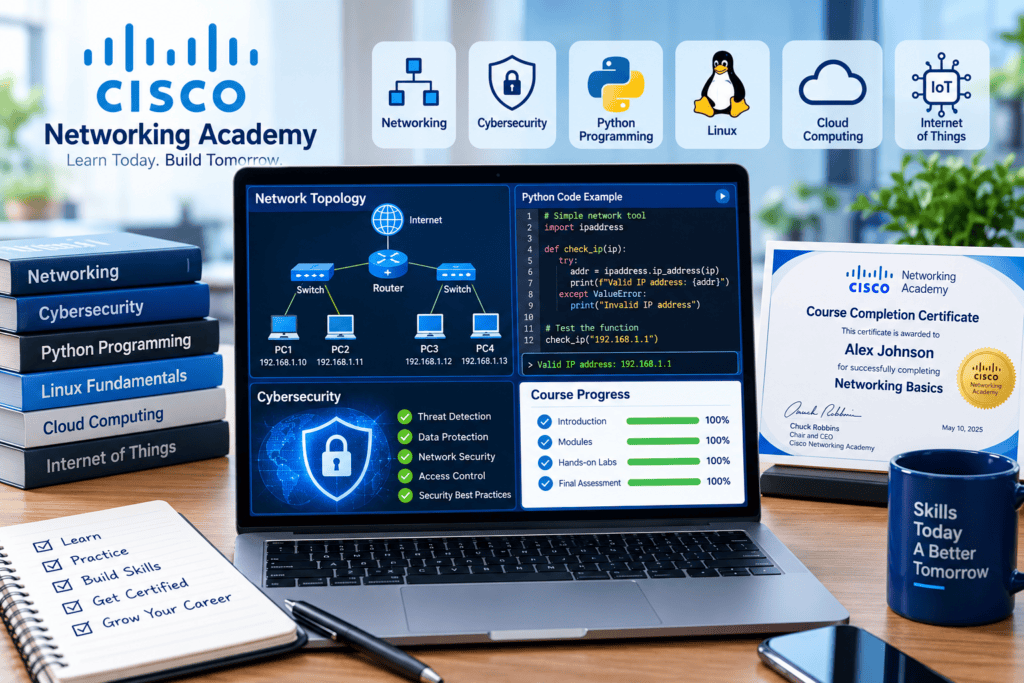
If you are exploring a career in tech without wanting to commit to upfront tuition, Cisco Networking Academy free courses with certificates offer an ideal entry point. While these self-paced programs award completion badges and certificates to validate your skill set, these credentials differ from formal, exam-based professional certifications like the CCNA.
Whether you are a student, recent graduate, career switcher, or self-taught learner, completing Cisco Networking Academy free courses with certificates allows you to build verifiable technical fundamentals before stepping into an entry-level IT role or pursuing advanced qualifications.
Best Free Cisco Networking Academy Courses at a Glance
To help you choose the right starting point, the summary table below highlights top-rated Cisco Networking Academy free courses with certificates selected for their beginner accessibility, practical value, and direct alignment with key IT career paths.
(Note: Estimated completion times reflect Cisco’s official duration guidelines; actual completion time will depend on your background and study pace.)
| Course Name | Estimated Duration | Level | Target Career / Best Suited For |
| Networking Basics | 22 Hours | Beginner | Networking Fundamentals & Help Desk Support |
| Introduction to Cybersecurity | 6 Hours | Beginner | Cybersecurity Exploration & Threat Basics |
| Python Essentials 1 | 30 Hours | Beginner | Scripting, Automation & Entry-Level Programming |
| Linux Unhatched | 8 Hours | Beginner | System Administration & Linux CLI Fundamentals |
| Introduction to IoT and Digital Transformation | 6 Hours | Beginner | Connected Devices, Smart Tech & IoT Strategy |
| Getting Started with Cisco Packet Tracer | 2 Hours | Beginner | Virtual Network Simulation & Hands-On Lab Work |
| Introduction to Data Science | 6 Hours | Beginner | Data Analytics, AI Exploration & Business Intelligence |
Catalog Note
The programs listed above are offered at zero cost in the official catalog. Because course delivery formats, regional availability, and badge distribution rules can update periodically, always verify current details on the official platform before enrolling.
Networking Basics
- Duration: ~22 Hours
- Level: Beginner
- Cost: Free
- Credential: Digital Completion Badge (Issued via Credly)
For anyone looking to understand how modern digital communication functions, Networking Basics is one of the most practical starting points among Cisco Networking Academy free courses with certificates.
This self-paced module introduces foundational internet architecture, local area network (LAN) operations, essential network hardware, and core protocols. Through interactive simulations and self-assessments, you build practical knowledge around IP addressing, wireless routing, and network traffic flows with zero prior technical experience required.
Core Learning Outcomes
- Network Infrastructure: Understand network topologies, physical media, client-server models, and communication methods.
- Protocols & Wireless: Master Ethernet standards, Wi-Fi connectivity, TCP/UDP, and OSI model layers.
- IP Addressing: Learn IPv4 structuring, subnetting concepts, static vs. dynamic addressing (DHCP), and introductory IPv6.
- Routing & Gateways: Grasp how routers connect distinct networks via Network Address Translation (NAT) and routing tables.
- Diagnostic Utilities: Execute entry-level network testing, ping tests, and CLI troubleshooting commands.
Career Alignment & Credentials
Completing this course earns you a verifiable digital badge. It serves as a direct ramp-up for roles like Help Desk Technician, Entry-Level IT Support, or Junior Network Technician.
Recommended Pathway
Pair this course with Getting Started with Cisco Packet Tracer for hands-on visual simulation, then progress toward the Cisco Certified Support Technician (CCST) Networking pathway.
Introduction to Cybersecurity
- Duration: ~6 Hours
- Level: Beginner
- Cost: Free
- Credential: Digital Completion Badge (Issued via Credly)
If you want to understand how modern organizations safeguard critical infrastructure, Introduction to Cybersecurity is one of the most accessible entry points among Cisco Networking Academy free courses with certificates.
This self-paced module introduces the core fundamentals of threat landscape analysis, personal privacy, data confidentiality, and enterprise security frameworks. Designed for absolute beginners, it breaks down complex security principles into actionable concepts while outlining clear career tracks within the cybersecurity ecosystem.
Core Learning Outcomes
- Threat Intelligence & Attack Vectors: Understand how malicious actors exploit vulnerabilities using malware, phishing, social engineering, and ransomware.
- Privacy & Data Protection: Master best practices for securing personal assets, managing digital footprints, and maintaining data confidentiality.
- Organizational Defense: Learn defensive strategies, basic encryption concepts, network defense architecture, and threat mitigation models.
- Ethics & Industry Frameworks: Explore legal boundaries, ethical hacking principles, and compliance guidelines governing corporate security.
- Cybersecurity Career Paths: Identify specialization areas, from Security Operations Center (SOC) analysis to incident response.
Career Alignment & Credentials
Completing the course awards a verifiable digital completion badge to validate your baseline knowledge. It provides foundational context for Tier-1 IT Support, Junior Security Analysts, and Systems Administrators.
Recommended Pathway
Transition directly into Cybersecurity Essentials or the Cisco Certified Support Technician (CCST) Cybersecurity pathway to gain hands-on technical skills.
Python Essentials 1
- Duration: ~30 Hours
- Level: Beginner
- Cost: Free
- Credential: Digital Completion Badge & PCEP Exam Discount Eligibility
As software development, data analytics, and network automation increasingly rely on scripting, Python Essentials 1 stands out as one of the most high-value options among Cisco Networking Academy free courses with certificates.
Developed in alignment with the OpenEDG Python Institute, this foundational course requires zero prior coding experience. It teaches algorithmic thinking—how to decompose complex problems into logical, executable steps—while mastering core Python 3 syntax, control structures, and modular function design.
Core Learning Outcomes
- Syntax & Fundamental Data Types: Work with variables, integers, floats, booleans, strings, and fundamental I/O operations.
- Control Flow Logic: Implement conditional branching (
if,elif,else) and iteration loops (while,for) to execute structured logic. - Data Structures: Store, manage, and slice collections using dynamic lists, tuples, and fundamental data structures.
- Modular Code & Functions: Design custom reusable functions, manage variable scoping, and utilize built-in Python modules.
- Debugging & Problem Solving: Identify syntax vs. runtime errors, implement basic exception handling, and systematically debug scripts.
Career Alignment & Credentials
Completing this module earns a verifiable Cisco completion badge and serves as direct preparation for the PCEP™ – Certified Entry-Level Python Programmer certification exam. It provides immediate value for Junior Developers, IT Support Engineers, Systems Administrators, and Network Automation Specialists.
Recommended Pathway
Build 2–3 entry-level projects (e.g., an automated file organizer or a log parser), then progress directly to Python Essentials 2 to master object-oriented programming (OOP) and module architecture.
Linux Unhatched
- Duration: ~8 Hours
- Level: Beginner
- Cost: Free
- Credential: Digital Completion Badge (Co-issued with NDG via Credly)
Because Linux powers the majority of global cloud infrastructure, web servers, and cybersecurity toolkits, Linux Unhatched provides a critical entry point among Cisco Networking Academy free courses with certificates.
Developed in partnership with Network Development Group (NDG), this lightweight, self-paced module introduces the Linux command-line interface (CLI). Through hands-on, terminal-based virtual machine exercises, learners master directory navigation, file manipulation, and fundamental command execution without complex local installation.
Core Learning Outcomes
- CLI Syntax & Navigation: Understand absolute paths, directory structures (
cd,pwd,ls), and terminal command syntax. - File & Directory Management: Create, copy, move, rename, and delete files or folders within user home environments.
- Permissions & User Environment: Gain introductory exposure to Linux file attributes, user privileges, and environment variables.
- Basic Scripting Concepts: Understand how terminal commands transition into simple administrative shell scripts.
- Virtual Machine Interactivity: Practice real-time command input within an embedded Linux virtual environment.
Career Alignment & Credentials
Completing the final assessment unlocks a verifiable digital badge. It serves as a core foundation for Junior Linux Administrators, Help Desk Engineers, Cloud Support Associates, and Entry-Level Cybersecurity Analysts.
Recommended Pathway
Transition directly into NDG Linux Essentials or Linux I to build deep system administration skills and prepare for LPIC-1 or CompTIA Linux+ certifications.
Introduction to IoT and Digital Transformation
- Duration: ~6 Hours
- Level: Beginner
- Cost: Free
- Credential: Digital Completion Badge (Issued via Credly)
As smart sensors, automated systems, and connected devices continue to redefine modern industries, Introduction to IoT and Digital Transformation offers an essential foundational overview within Cisco Networking Academy’s free courses with certificates.
This self-paced, introductory module breaks down how physical objects interact across IP networks, generate massive data flows, and drive business automation. Designed for non-technical beginners, it explores core concepts across IoT architecture, basic visual/Python programming logic, big data storage, and the vital role of cybersecurity in connected ecosystems.
Core Learning Outcomes
- Connected Ecosystems: Understand how smart sensors, actuators, edge devices, and IP networks exchange data continuously.
- Programming Logic & Prototyping: Gain hands-on exposure to basic programming concepts using Blockly visual blocks and Python for automation.
- Big Data & Analytics: Discover how billions of connected endpoints generate data streams to power artificial intelligence (AI) and machine learning (ML) models.
- Security & Device Privacy: Analyze critical vulnerabilities in consumer smart home gear, industrial control systems, and corporate IoT setups.
- Digital Transformation Pathways: Explore career trajectories across IoT solution architecture, smart infrastructure, and embedded systems.
Career Alignment & Credentials
Completing the final module assessment earns a verifiable Cisco digital badge to demonstrate baseline tech literacy. It serves as a strong stepping stone toward IoT Support Technicians, Smart Systems Associates, and Entry-Level Network Technicians.
Recommended Pathway
Pair this conceptual course with Networking Basics to understand the routing infrastructure behind IoT networks, then simulate smart environments visually in Cisco Packet Tracer.
Getting Started with Cisco Packet Tracer
- Duration: ~2 Hours
- Level: Beginner
- Cost: Free
- Credential: Digital Completion Badge (Issued via Credly)
For anyone entering the networking domain, gaining hands-on hardware experience without expensive physical lab gear can be a challenge. Getting Started with Cisco Packet Tracer serves as the practical Gateway module across Cisco Networking Academy free courses with certificates, teaching you how to build, configure, and troubleshoot virtual network environments in real time.
This fast-paced, interactive module walks you through downloading, installing, and navigating Cisco Packet Tracer—a powerful visual simulation software. You will construct simulated home and office topologies, connect virtual routers, switches, and endpoint devices, and observe real-time packet transmission across IP networks.
Core Learning Outcomes
- Software Environment & Navigation: Install Cisco Packet Tracer and master the Logical and Physical workspace interfaces.
- Network Topology Construction: Drag, drop, cable, and configure virtual hardware (routers, switches, wireless access points, PCs, and IoT devices).
- Simulation Mode & Packet Inspection: Switch to simulation view to inspect ICMP packets, PDU headers, and data flow behavior step-by-step.
- Basic IP & Connectivity Setup: Assign static IP addresses, configure gateway settings, and verify basic ping/traceroute connectivity.
- Guided Lab Execution: Complete embedded
.pka(Packet Tracer Activity) files to solve diagnostic and network design challenges.
Career Alignment & Credentials
Completing the quick assessment unlocks a verifiable Cisco digital badge. Mastery of Packet Tracer is an essential prerequisite tool for Junior Network Engineers, Tier-1 Help Desk Technicians, and Systems Administrators.
Recommended Pathway
Use Packet Tracer alongside Networking Basics and Python Essentials 1 to simulate network automation scripts, then advance toward the CCST Networking or CCNA learning paths.
Introduction to Data Science
- Duration: ~6 Hours
- Level: Beginner
- Cost: Free
- Credential: Digital Completion Badge (Issued via Credly)
As organizations increasingly depend on data-driven decision-making, artificial intelligence, and predictive modeling, Introduction to Data Science provides an essential entry point among Cisco Networking Academy free courses with certificates.
This self-paced module introduces the foundational lifecycle of data—from collection and cleaning to visualization and model training. Designed for beginners, it demystifies the distinct disciplines within the ecosystem (data analytics, data engineering, and data science) while exploring practical applications across business intelligence, healthcare, and finance.
Core Learning Outcomes
- Data Ecosystem Foundations: Differentiate between data analytics, data science, and data engineering roles, skill sets, and tooling.
- Data-Driven Decision Making: Understand how structured and unstructured data inform executive strategy and automated business processes.
- AI & Machine Learning Intersect: Explore how raw datasets feed, train, and validate modern artificial intelligence algorithms.
- Data Literacy & Visualization: Learn how qualitative and quantitative metrics are transformed into actionable visual reporting.
- Career Path Exploration: Identify entry pathways, skill requirements, and certification tracks across the broader data domain.
Career Alignment & Credentials
Completing this course awards a verifiable Cisco digital completion badge. It provides strong conceptual grounding for Junior Data Analysts, Business Intelligence Trainees, and Systems Support Specialists.
Recommended Pathway
Pair this course with Python Essentials 1 to learn basic scripting for data processing, then advance into Data Analytics Essentials or Data Science Essentials.
What Credentials Do You Receive After Completing a Cisco Course?
Before enrolling in Cisco Networking Academy free courses with certificates, it is crucial to understand the distinct types of recognition offered. Cisco differentiates between simple course completion documents, verifiable digital badges, and formal professional certifications.
Course-Completion Certificate
A downloadable PDF document that confirms you have completed a specific curriculum or module. For instance, programs like Networking Basics and Introduction to Cybersecurity issue official completion certificates upon passing the end-of-course assessment.
Verified Digital Badge
Issued through Credly, a digital badge is a metadata-backed credential that verifies specific practical skills, exam scores, and learning outcomes. Unlike static PDF certificates, digital badges can be shared directly on LinkedIn, embedded in digital resumes, and instantly verified in real-time by hiring managers and recruiters.
Professional Certification
An industry-standard qualification awarded only after passing a formal, proctored exam (typically administered via Pearson VUE or Certiport). Examples include the Cisco Certified Support Technician (CCST) and Cisco Certified Network Associate (CCNA).
Does Completing a Free Cisco Course Grant a CCNA Certification?
No. Completing Cisco Networking Academy free courses with certificates does not automatically grant you a CCNA or CCST certification.
While free introductory courses provide essential foundational knowledge, formal professional certifications require passing a separate, paid exam at an authorized testing center. The same standard applies to external partner tracks—such as the OpenEDG PCEP™ (Python) or LPIC-1 (Linux)—where Cisco’s course prepares you for the syllabus, but the official certification requires a separate exam.
Pro Tip
Always review the Achievements, Recognition, or Certification tab on the official course landing page before enrolling to verify which specific digital credential is included upon completion.
Which Free Cisco Course Aligns With Your Career Goals?
Selecting the right entry point among Cisco Networking Academy free courses with certificates depends on your target role, technical interest, and immediate upskilling priorities. The matrix below maps primary career objectives to recommended starting courses and immediate follow-up actions:
| Target Career / Goal | Recommended Starting Course | Strategic Next Step |
| Explore IT Support & Help Desk | Networking Basics | Practice command-line diagnostics and learn computer hardware fundamentals. |
| Explore Cybersecurity | Introduction to Cybersecurity | Move to Cybersecurity Essentials and execute hands-on threat defense labs. |
| Learn Programming & Scripting | Python Essentials 1 | Build small automation scripts (parsers, file managers) and progress to Python Essentials 2. |
| Explore Cloud & Systems Administration | Linux Unhatched | Practice Linux CLI commands in virtual machines and advance to NDG Linux Essentials. |
| Explore Networking Engineering | Networking Basics | Install Cisco Packet Tracer to visually build and configure virtual networks. |
| Understand Smart Systems & IoT | Introduction to IoT and Digital Transformation | Build simulated IoT networks using Packet Tracer and learn basic Python device automation. |
| Explore Data Analytics & AI | Introduction to Data Science | Learn Python data libraries (Pandas, NumPy) or enroll in Data Analytics Essentials. |
Career Reality Check
These initial recommendations serve as foundational starting points rather than immediate guarantees of employment. IT hiring managers value multi-disciplinary capability; combining foundational coursework with hands-on lab projects and industry-recognized certifications (e.g., CCST, CCNA, or Security+) will significantly accelerate your job readiness.
How to Enrol in Cisco Networking Academy Free Courses
Starting your learning journey with Cisco Networking Academy free courses with certificates is straightforward, fully digital, and requires zero upfront financial commitment. Follow this 6-step process to set up your account and begin learning immediately:
- Access the Official Portal: Navigate directly to netacad.com.
- Select Your Target Subject: Browse the course catalog by filtering for free, self-paced tracks in your area of focus—such as Networking, Cybersecurity, Python, Linux, or Data Science.
- Verify Course Details & Prerequisites: Review the course overview page to confirm the estimated completion time, target skill level, self-paced format, and digital badge eligibility via Credly.
- Create Your Free Account: Click Get Started or Sign Up. You can register instantly using a Google, Apple, or Cisco account, or complete a standard email registration form.
- Complete Modules & Lab Exercises: Work through interactive reading modules, embedded quizzes, and visual hands-on simulation labs (using tools like Cisco Packet Tracer).
- Claim Your Digital Credential: Upon passing the end-of-course assessment, navigate to your account dashboard under My Learning / Achievements to collect your course completion certificate and claim your verified digital badge.
A Practical Learning Path for Beginners
If you are new to technology, avoid trying to enroll in every module at once. The most effective strategy when leveraging Cisco Networking Academy free courses with certificates is to pick one specialized track and build your skill set systematically through a structured, multi-stage roadmap.
[ Stage 1: Core Foundation ] ──> [ Stage 2: Specialized Track ] ──> [ Stage 3: Applied Lab Practice ] ──> [ Stage 4: Exam & Portfolio Prep ]
Code language: CSS (css)
The 4-Stage Upskilling Framework
- Stage 1: Establish Your Core Foundation. Start with Networking Basics to master how data moves across IP networks, or begin with basic digital literacy modules if you are entirely new to technical operating environments.
- Stage 2: Select a Focused Specialization. Choose a primary technical domain—Cybersecurity, Python Programming, Linux System Administration, IoT, or Data Science—that aligns directly with your long-term career target.
- Stage 3: Execute Applied Lab Practice. Theory without practice creates fragile skills. Complete all embedded module quizzes and use simulation engines like Cisco Packet Tracer or terminal-based virtual machines to build hands-on competency without buying physical hardware.
- Stage 4: Advance Toward Industry Credentials. Analyze target job postings to identify required competencies. Decide whether your next step is a proctored professional certification (e.g., CCST, CCNA, PCEP), a GitHub project portfolio, or advanced hands-on coursework.
Tactical Career Roadmap Examples
- Network Support Track:
Networking Basics$\rightarrow$Getting Started with Cisco Packet Tracer$\rightarrow$ Virtual Network Topology Labs $\rightarrow$ CCST Networking / CCNA Preparation - Cybersecurity Analyst Track:
Introduction to Cybersecurity$\rightarrow$Cybersecurity Essentials$\rightarrow$ Terminal & Packet Inspection Labs $\rightarrow$ CCST Cybersecurity Preparation - Network Automation & Scripting Track:
Networking Basics$\rightarrow$Python Essentials 1$\rightarrow$ Automation Script Projects $\rightarrow$ OpenEDG PCEP Certification Exam
Are Cisco Networking Academy Courses Worth Taking?
Yes—for beginners, career switchers, and self-taught learners, Cisco Networking Academy free courses with certificates represent one of the highest-ROI entry points into the tech industry. They provide enterprise-grade curriculum, access to industry-standard tools like Cisco Packet Tracer, and verifiable digital badges without requiring upfront tuition.
However, the real-world value of these courses depends entirely on how strategically you leverage them. A free completion badge proves baseline literacy, but securing an entry-level role requires transforming theoretical concepts into demonstrable technical capability.
[ Free Cisco Course ] ──> [ Applied Lab Projects ] ──> [ Verified Badges ] ──> [ Proctored Exam / Portfolio ] ──> [ Entry-Level Job ]
Code language: CSS (css)
How to Extract Maximum Career Value:
- Target Role-Specific Tracks: Align your course selection directly with market demand (e.g., Networking Basics for IT Support or Python Essentials 1 for Automation).
- Commit to Practical Assessments: Complete all end-of-module quizzes and labs rather than passively skimming video content.
- Build a Practical Portfolio: Save your
.pkaPacket Tracer network topologies, Python scripts, and Linux lab setups to showcase in interviews. - Bridge to Industry Certifications: Use free coursework as the foundation to prepare for proctored exams like the CCST, CCNA, or OpenEDG PCEP.
Global Perspective
For learners operating in emerging tech hubs—such as Nigeria, India, or Latin America—where formal training budgets may be limited, Cisco Networking Academy free courses with certificates offer a risk-free environment to audit multiple tech domains before committing financial resources to paid proctored exams.
Are Cisco Networking Academy courses free?
Yes, many introductory and self-paced courses in the online catalog are 100% free. However, advanced instructor-led bootcamps, localized academy programs, and official proctored certification exams (such as the CCNA or CCST) require separate payment or exam vouchers.
Can I study Cisco courses online at my own pace?
Yes. Most introductory offerings—such as Networking Basics, Introduction to Cybersecurity, and Python Essentials 1—are self-paced, allowing you to complete modules, labs, and quizzes on your own schedule. Certain specialized pathways may also be offered as instructor-led programs through partner institutions.
Do Cisco Networking Academy courses provide certificates?
Yes. Upon passing the end-of-course assessment, eligible students earn downloadable course completion certificates and verifiable digital badges (hosted via Credly). The exact credential varies by course, so always verify the achievement details on the course overview page before enrolling.
Can I get a job after completing a free Cisco course?
A free course demonstrates initiative and provides essential foundational knowledge, but an introductory badge alone rarely guarantees employment. To secure entry-level IT roles, pair your Cisco learning with practical lab projects (using tools like Cisco Packet Tracer), a GitHub portfolio, and formal industry credentials.
Which Cisco course is best for absolute beginners?
For Computer Networks & IT Support: Start with Networking Basics.
For Digital Safety & Defense: Start with Introduction to Cybersecurity.
For Software & Scripting: Start with Python Essentials 1.
Do I need a computer to take these courses?
While reading materials and simple quizzes can be accessed via mobile browsers or tablets, a desktop or laptop computer (Windows, macOS, or Linux) is strongly recommended. A computer is required to run Cisco Packet Tracer, execute terminal commands in Linux virtual machines, and write Python code effectively.
Is a Cisco course completion certificate the same as a CCNA certification?
No. A course completion certificate or digital badge validates that you completed training for a specific module. The CCNA (Cisco Certified Network Associate) is an industry-recognized professional qualification earned only after passing a separate, proctored, high-stakes exam administered through Pearson VUE.
In Conclusion
Cisco Networking Academy free courses with certificates provide one of the most accessible, high-ROI launchpads for anyone entering IT, networking, cybersecurity, software automation, or data analytics. By removing financial barriers, these self-paced programs allow beginners, career switchers, and self-taught professionals to gain enterprise-grade technical literacy risk-free.
To maximize your results, avoid collecting badges passively. Pick a single foundational track that directly aligns with your career target, execute all practical assessments, build visual network topologies in Cisco Packet Tracer, and document your projects. Once you establish core competency, leverage your momentum to prepare for proctored, industry-standard credentials like the CCST, CCNA, or PCEP.
Your Next Strategic Move
Visit the official Cisco Networking Academy catalog, select the introductory course that matches your primary target role, verify its current digital badge requirements, and start building your technical foundation today.