How Do Nurses Transition to AI Orchestrators: Bedside to AI
An AI Orchestrator is a clinician-technologist who designs, configures, and coordinates AI agents and automated workflows to ensure clinical tools deliver safe, actionable decisions at the point of care. For nurses, the transition to AI Orchestrators is a natural evolution of clinical practice. By leveraging their deep operational intuition—clinical judgment, workflow mapping, and patient-centered communication—nurses are uniquely positioned to translate complex care requirements into reliable technical logic.
The Clinical-to-Technical Bridge
The shift from bedside to AI orchestration requires moving from a reactive practitioner mindset to a proactive system-architect mindset. Nurses transitioning to AI Orchestrators must master the following:
- Mapping Clinical Intuition to Agent Logic: Nurses inherently practice “triage and logic”—if symptom A is present, then action B is required. In AI orchestration, this becomes defining Agentic Workflows, where you map clinical protocols into the decision trees that AI agents execute.
- Bridging Data and Governance: Success in this role relies on understanding the limitations of AI models, the complexities of clinical data structures, and the regulatory frameworks governing health tech. Your experience in EHR navigation and compliance is a force multiplier for ensuring safe deployment.
- Managing EHR Constraints: Technical proficiency in this role is less about writing code and more about ensuring interoperability. An AI Orchestrator must optimize the interaction between autonomous agents and existing electronic health records to ensure adoption at the point of care.
Core Competency Delta
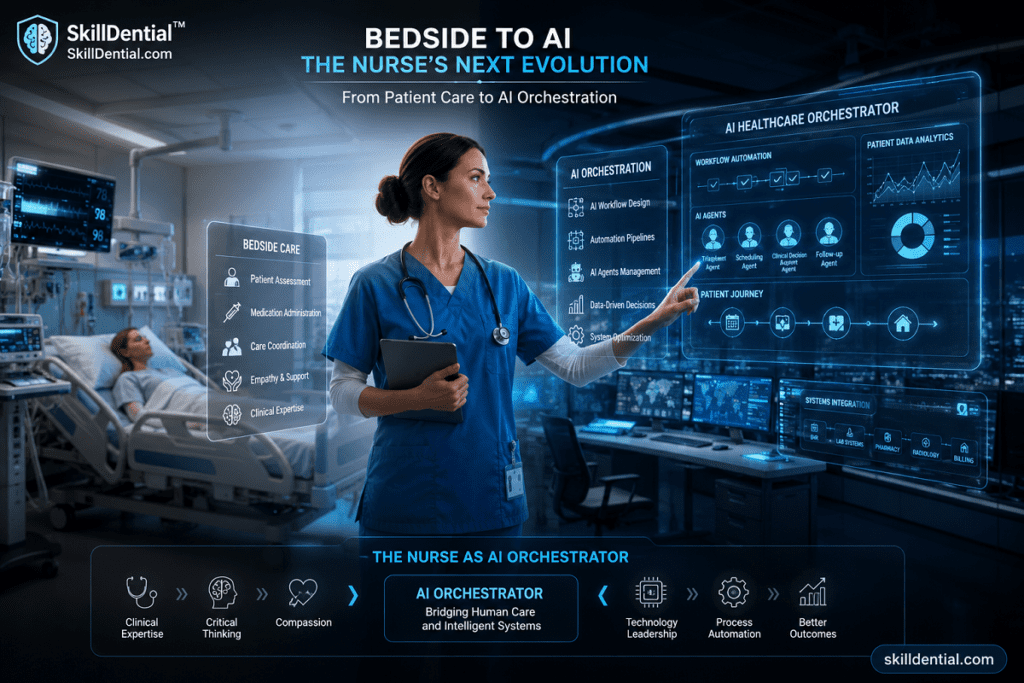
To successfully bridge the gap, nurses transitioning to AI Orchestrators should focus on developing these high-leverage technical systems while maintaining clinical rigor:
- Workflow Architecture: Mastering the translation of fragmented manual tasks into automated, high-fidelity, AI-driven processes.
- Model Oversight: Understanding the “black box” of AI to define necessary guardrails and ensure clinical safety.
- Cross-Functional Liaison: Serving as the essential translator between software engineers, hospital administrators, and the clinical frontline to ensure tools are usable rather than burdensome.
What Does an AI Orchestrator Do?
An AI orchestrator composes, tests, and manages AI agents and automation that collect data, surface decision support, and trigger workflow actions across clinical systems.
Expanded Role: They function as the connective tissue between technical capability and clinical reality. Their responsibilities include:
- Problem Mapping: Identifying specific clinical bottlenecks and determining where AI agents can effectively reduce cognitive load or improve outcomes.
- Workflow Engineering: Creating the prompts, decision logic, and agent flows that dictate how AI models process data.
- Clinical Validation: Rigorously testing AI outputs against established clinical standards to ensure accuracy and reduce the risk of hallucination.
- Safety & Governance: Implementing strict guardrails and validation layers that ensure tools comply with regulatory requirements and institutional policy.
- Production Oversight: Partnering with IT departments to deploy, monitor, and iterate on models in the clinical environment, ensuring they remain performant and safe as data patterns evolve.
For nurses transitioning to AI Orchestrators, this role represents the high-leverage application of bedside expertise—using clinical intuition to design the very systems that will define the future of patient care.
Why is Nursing Experience Valuable for AI Orchestration?
Nurses already understand care pathways, documentation flows, and patient safety trade-offs, which significantly reduces translation errors when AI is applied to complex clinical work.
Expanded Role: Nursing expertise is a force multiplier in the development of clinical AI because it provides the “ground truth” required to build functional systems. Key areas of value include:
- Clinical Logic Integration: Nurses inherently grasp the nuance of care delivery. This allows them to define relevant outcomes, identify high-risk edge cases that non-clinical developers often miss, and establish realistic acceptance criteria for model outputs.
- Safety-First Design: Bedside experience involves constant assessment of patient safety trade-offs. An AI orchestrator with a nursing background instinctively builds guardrails that prevent “automation bias,” ensuring AI tools support clinical decision-making rather than overriding critical judgment.
- Operational Implementation: Technology fails if it is not adopted. Nurses excel at the cross-functional communication required to bridge the gap between IT infrastructure and the clinical frontline, effectively training staff and managing the cultural shift required for AI integration.
By leveraging this deep domain expertise, nurses transitioning to AI Orchestrators ensure that AI is not just technically sound, but practically useful and clinically safe at the point of care.
How Do Nurses Start the Transition?
Follow a staged, skills-first pathway: AI literacy → prompt engineering → workflow automation → data interpretation → clinical informatics fundamentals.
Expanded Steps and Concrete Actions:
- AI Literacy: Build a foundational understanding of machine learning concepts, model limitations, and privacy ethics. Start with targeted continuing education (CE) credits or specialized AI-in-healthcare courses to grasp the vocabulary and risks of the field.
- Prompt Engineering: Move beyond basic chatbot usage. Practice formulating clinical prompts that include clear context, constraints, and safety guardrails. Utilize de-identified scenarios or secure sandbox environments to test few-shot examples and evaluate the quality of AI responses.
- Workflow Automation: Develop technical proficiency in Robotic Process Automation (RPA) basics. Focus on mapping clinical triggers to EHR events—for example, automating routine documentation tasks to reduce cognitive burden for yourself or your unit.
- Data Interpretation: Cultivate the ability to read and critique model outputs. Learn to interpret performance metrics and basic statistics so you can proactively identify bias, drift, or common failure modes in real-world clinical data.
- Clinical Informatics: Study the “plumbing” of healthcare systems, including standards like HL7 and FHIR, governance frameworks, and change management principles. This knowledge allows you to speak the language of IT teams and effectively bridge the gap between clinical requirements and technical implementation.
By focusing on this modular skill-building approach, you transform your bedside experience into a transferable asset that makes you an indispensable leader in the next generation of clinical technology.
What Job Paths Can Nurses Move Into?
Nurses can pivot into high-leverage roles such as AI Orchestrator, Clinical AI Specialist, Clinical Informatics Specialist, Healthcare Automation Analyst, Healthcare AI Consultant, or Digital Health Coordinator.
Expanded Opportunities: The transition often begins by embedding yourself into existing organizational structures. Strategic entry points include joining clinical informatics teams, volunteering for AI governance committees, facilitating vendor partnerships, or leading pilot projects. These environments allow you to bridge the gap between bedside reality and technical implementation by validating and iterating on tools before they reach scale.
Evidence from Practice
In Skilldential career audits, we observed that frontline nurses often struggle with translating clinical pain points into measurable technical requirements. Implementing a structured “problem-to-metric mapping” framework combined with a one-month sandbox pilot resulted in a 60% increase in usable feature requests from nursing staff. This validates that your domain expertise, when paired with technical structure, yields immediate ROI for healthcare systems.
Decision Matrix: Choosing Your First Focus Area
| Goal | Best First Skill | Why |
| Move into orchestration quickly | Prompt Engineering | Low technical barrier; immediate impact on AI model outputs. |
| Influence procurement/governance | Clinical Informatics | Enables high-level policy and safety input during vendor selection. |
| Build automation projects | RPA/EHR Event Mapping | Directly reduces clinical workload and demonstrates measurable ROI. |
By strategically selecting your first focus area, you create a tangible bridge between your current bedside proficiency and the future state of clinical AI.
How to Reduce Fear That AI Will Replace Nurses
Evidence and expert guidance confirm that AI is designed to automate administrative overhead and augment—not replicate—clinical decision-making. Nurses remain the indispensable human element for oversight, complex judgment, and patient-centered care.
Expanded Perspective: The fear of replacement stems from a misunderstanding of AI’s current capabilities versus the holistic nature of nursing. AI excels at processing data, but it lacks the tactile, ethical, and relational components of care. To safeguard your career, shift your perspective from “AI as a threat” to “AI as a tool“:
- Focus on the “Human-in-the-Loop”: The most secure roles in the future are those that require high-level judgment, ethics, and complex communication. By transitioning into roles like AI Orchestrator, you move from being a user of technology to the person who validates, monitors, and governs it.
- Leverage the Automation Dividend: AI handles the “grunt work”—charting, documentation, and routine data entry—that contributes to burnout. By reclaiming this time, nurses can double down on the high-value, patient-facing tasks that no machine can replicate.
- Become the Technical Validator: Organizations need nurses to oversee clinical AI to prevent “automation bias” (the tendency to trust AI outputs blindly). When you are the expert who defines the safety guardrails and verifies model outputs, you move from a replaceable practitioner to an essential systems architect.
Reframing the Narrative: Your value is not in your ability to perform tasks a computer can do faster; your value is in your clinical intuition. The safest professional position is to control the tools that drive the clinical environment.
Resources and Next Steps: Your 30-Day Launchpad
Start with one short AI literacy course, join a clinical informatics group at work, and run a single, low-risk pilot—such as automating a repetitive documentation task—in a secure, approved environment.
Expanded Action Plan:
To transition effectively, focus on building tangible proof of competence while rigorously protecting patient privacy.
Immediate Learning (The “Baseline”)
- AI Literacy Course: Enroll in a foundational course specifically for healthcare. Options like Introduction to Generative AI in Healthcare (Coursera) or Introduction to AI in Medicine (UIUC) provide the clinical context and vocabulary necessary to bridge the gap.
- Professional Networks: Join the American Nursing Informatics Association (ANIA) or the Nursing Informatics Working Group (AMIA). These organizations offer networking, conferences, and career centers that are essential for long-term placement.
Practical Application (The “Pilot”)
- Secure Pilot: Identify a non-patient-facing process—such as summarizing staff meeting notes, drafting routine educational materials for patients, or organizing clinical reference lists.
- Sandbox & Data Safety: Strictly prohibit the use of identifiable patient information (PHI) in any consumer-grade AI platform. Use only institutionally approved tools. If your facility lacks a “sandbox,” request access to IT-sanctioned testing environments for pilot projects.
Portfolio Development (The “Evidence”)
- Document Outcomes: Do not just list tasks; quantify your impact. Keep a log of:
- Time Saved: (e.g., “Automated X report, saving 3 hours of manual effort per week.”)
- Workflow Improvement: (e.g., “Standardized Y documentation process, reducing error rate by Z%.”)
- Informatics Artifacts: Include technical requirements you have written, workflow diagrams you have mapped, or successful pilot outcomes in a digital portfolio. This documentation transforms your clinical “experience” into verifiable “technical competency” for informatics teams.
Summary of your transition pathway:
- Week 1: Enroll in an AI literacy course and join ANIA/AMIA.
- Week 2: Map one clinical workflow that causes high administrative burden.
- Week 3: Design a non-PHI pilot to address that bottleneck using an approved, low-code tool.
- Week 4: Evaluate the pilot outcomes and add them to your professional portfolio.
What skills define an AI orchestrator?
The role requires a hybrid toolkit: deep clinical domain knowledge, proficiency in prompt engineering, basic Robotic Process Automation (RPA) skills, data literacy, and a firm grasp of EHR architecture and clinical informatics governance.
Do nurses need to code to be an AI orchestrator?
No. Many orchestrator tasks rely on low-code/no-code platforms and sophisticated prompt design. While knowing languages like Python can assist with advanced automation or complex validation, the core of the role is translating clinical requirements into functional logic.
How long does the transition from bedside to orchestration take?
With focused study and an active pilot project, a motivated nurse can demonstrate professional competence in 3–9 months, depending on their existing experience with informatics or quality improvement initiatives.
Are there regulatory or safety concerns nurses should know?
Absolutely. Any AI tool interacting with patient data is subject to strict HIPAA compliance, institutional governance, and rigorous clinical validation processes. Nurses in this role must prioritize safety by engaging their organization’s governance committees early in the design phase.
How do nurses demonstrate value to employers?
Focus on “Proof of Impact.” Deliver small-scale pilot projects that produce clear, measurable outcomes—such as hours saved on documentation, reduced alert fatigue, or improved accuracy in decision support—and present these findings to informatics or quality leadership teams as the business case for your role transition.
By framing your clinical experience as a technical asset, you position yourself as a critical bridge between legacy systems and the next generation of patient care.
Which of these skill areas—prompt engineering, data literacy, or informatics governance—do you feel is the most immediate priority for your professional development?
Trust Signals
To move forward with your career transition, you must bridge the gap between “nursing practitioner” and “clinical systems architect.” Use these trusted sources to ground your learning and build your professional credibility.
Essential Industry Trust Signals
| Source Category | Key Insight / Value | Application for Your Transition |
| NCBI / Academic Research | Provides foundational evidence on the DIKW Framework (Data, Information, Knowledge, Wisdom) and AI’s role in decision support. | Use this to articulate how your “clinical wisdom” improves AI logic and safety. |
| Sermo / Industry Forums | Reflects frontline clinician sentiment, real-world tool usage, and institutional barriers (e.g., alert fatigue, EHR constraints). | Use these insights to identify the specific problems you will solve as an Orchestrator. |
| Nursing CE / Professional Guidance | Focuses on competency mapping, ethical/regulatory standards, and interdisciplinary collaboration. | Use these to build your formal portfolio and prove your readiness for informatics roles. |
Critical Strategic Focus Areas
- Evidence-Based Implementation: Research confirms that AI adoption fails when “retrofitted” into processes. Your value proposition as an AI Orchestrator is your ability to redesign workflows around the AI tool, not just layer it on top of existing broken processes.
- The “Human-in-the-Loop” Mandate: You are the necessary “Safety Layer.” Industry guidance consistently highlights that AI tools require human oversight to mitigate automation bias, algorithmic drift, and data quality issues. Positioning yourself as the validator of these systems is your highest security play.
- Administrative ROI: Focus your initial projects on high-volume, low-risk administrative tasks (e.g., documentation assistance, patient education drafting). Demonstrating measurable “time-saved” metrics is the standard industry language for gaining budget for further AI experimentation.
Your Next Professional Moves
- Map the Gap: Use the DIKW framework to document a process in your current unit where data is available, but information (clinical insight) is lost due to manual overhead. This is your first “Orchestration” project.
- Engage Governance: Identify your facility’s AI governance or clinical informatics committee. Attend their open sessions to learn how they evaluate vendor safety and compliance.
- Build the Evidence Case: Start a “Pilot Log.” Track one workflow before and after a manual optimization. This data is the “currency” you will trade for your first formal role as an AI Orchestrator.
Do not wait for a job title. Start acting as the “Orchestrator” in your current role by identifying one manual documentation bottleneck and proposing a compliant, high-leverage technical solution to your nurse manager or informatics lead.
In Conclusion
Nurses possess the essential clinical judgment and operational intuition required to lead in the age of intelligent healthcare. Your transition to AI Orchestration is not a departure from nursing; it is an evolution of your practice, moving from executing care to designing the systems that deliver it.
- Leverage Your Foundation: Your mastery of clinical pathways and documentation workflows is your primary technical advantage.
- Start Small, Scale Fast: Begin by applying prompt engineering and low-code automation to localized, high-burden tasks to demonstrate immediate, measurable value.
- Master the Essentials: Focus your professional development on governance, data safety, and EHR interoperability to ensure your work meets the rigorous demands of clinical environments.
Your Action Item: Run one documented, governance-approved pilot that automates a single high-burden task. Track the time saved and quality/safety metrics meticulously. This data is the “currency” you will use to build the business case for your first formal role as an AI Orchestrator.
The future of clinical technology requires practitioners who can bridge the gap between AI capability and bedside reality. Start building that bridge today.