AWS MLA-C02 Certification: Exam Guide and How to Prepare
The AWS MLA-C02 Certification (AWS Certified Machine Learning Engineer – Associate) is an essential credential for professionals who build, deploy, operate, and secure machine learning and generative AI workloads on AWS.
Designed to replace the legacy MLA-C01 exam, the AWS MLA-C02 Certification places an updated, heavy emphasis on modern cloud architectures. It evaluates practical capabilities across traditional ML models, foundation models, Amazon Bedrock, Amazon SageMaker AI, retrieval-augmented generation (RAG), agentic workflows, MLOps, system monitoring, cost optimization, and enterprise security.
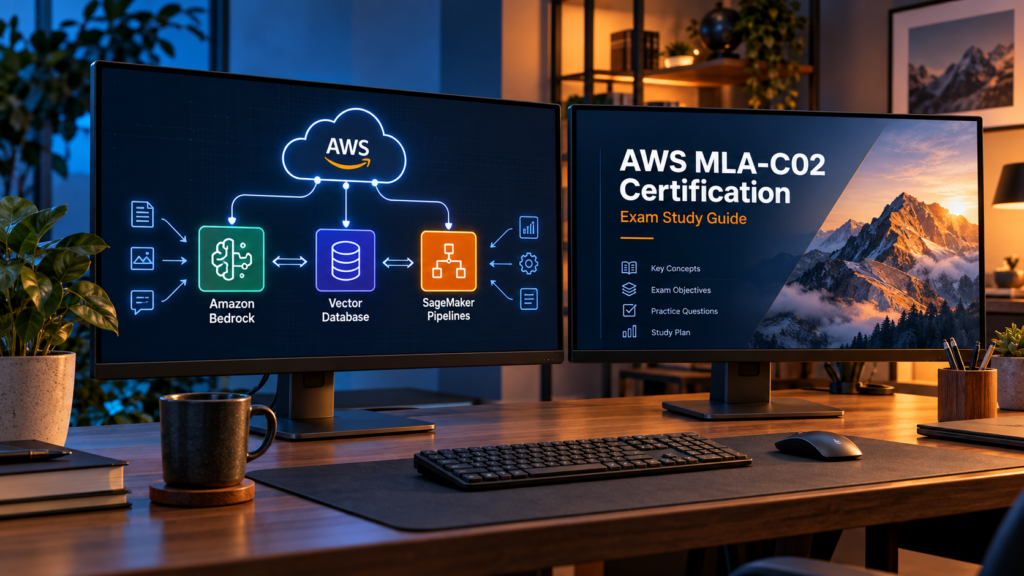
Because of its comprehensive technical scope, the AWS MLA-C02 Certification is best suited for candidates with practical, hands-on experience in AWS and machine learning rather than complete beginners.
What is AWS MLA-C02?
The AWS MLA-C02 Certification is the updated AWS Certified Machine Learning Engineer – Associate examination, designed to validate hands-on technical proficiency in implementing and operationalizing AI and ML pipelines using AWS Cloud services. Unlike higher-level professional or specialty tracks, the AWS MLA-C02 Certification focuses heavily on tactical implementation rather than high-level enterprise architecture.
Core Competency Requirements
AWS targets the AWS MLA-C02 Certification at practitioners with at least one year of direct experience utilizing core AWS ML services. Ideal candidates typically hold professional backgrounds in:
- Machine Learning Engineering & MLOps
- Data Engineering & Backend Development
- DevOps & Cloud Infrastructure
- Data Science
Technical Domain Scope
The AWS MLA-C02 Certification bridges legacy and modern paradigms by dividing its scope into two critical pillars:
- Traditional Machine Learning: Data preparation, feature engineering, model training, tuning, deployment, and performance monitoring.
- Generative AI Workloads: Foundation model implementation via Amazon Bedrock and Amazon SageMaker AI, Retrieval-Augmented Generation (RAG) architectures, vector embeddings, and agentic workflows.
Passing the AWS MLA-C02 Certification requires balanced mastery of both domains, along with rigorous standards in cloud security, MLOps automation, and cost optimization.
AWS MLA-C02 Exam Blueprint & Logistics
The AWS MLA-C02 exam blueprint shows which skills and topics you need to study, while the exam logistics cover practical details such as question format, timing, cost, and registration. This section breaks down both so you can plan your preparation and know what to expect on exam day.
| Exam Characteristic | Specification (MLA-C02 Beta & Standard) |
| Certification Level | Associate |
| Exam Code | ME1-C02 |
| Delivery Method | Pearson VUE Test Centre or Online Proctored |
| Duration | 170 Minutes |
| Total Questions | 85 (Multiple-choice and Multiple-response) |
| Scored Questions | 50 |
| Unscored Questions | 15 (Used for statistical evaluation) |
| Language | English (Expanded for standard release) |
| Pricing | $75 USD (Beta pricing; standard pricing applies post-beta) |
| Passing Score | Scaled score of 720 minimum (Standard) |
| Certification Validity | 3 Years |
Key Exam Mechanics & Rules
- Question Format: The exam features standard multiple-choice (one correct option) and multiple-response (two or more correct options out of five or more alternatives) items.
- Guessing Policy: Unanswered questions are marked incorrect, but there is no penalty for guessing. It is strategically vital to answer every single question before time expires.
- Scoring Model: The exam utilizes a compensatory scoring model, meaning you do not need to pass every individual section, provided your cumulative scaled score meets the 720 threshold.
AWS MLA-C02 Exam Domains & Weighting
The AWS MLA-C02 Certification is structured around four technical domains. The percentage weights below apply directly to the scored content on the exam.
| Domain & Weight | Core Focus Areas |
| Domain 1: Data Preparation for ML and AI (28%) | • Data ingestion, storage, and transformation pipelines • Feature engineering and vector embeddings generation • Data quality, data privacy, and mitigating bias |
| Domain 2: ML Model and Foundation Model Development (24%) | • Selecting traditional ML algorithms vs. foundation models • Model training, fine-tuning, and hyperparameter optimization • Prompt customization, evaluation metrics, and performance analysis |
| Domain 3: Deployment and Orchestration of ML and AI Workflows (24%) | • Managing inference endpoints and scalable infrastructure • Building RAG systems and autonomous agentic workflows • CI/CD pipelines and automated MLOps workflow orchestration |
| Domain 4: Operating, Monitoring, and Securing ML and AI Solutions (24%) | • System observability and model drift monitoring • Cost optimization and resource efficiency • Cloud security, access control, and responsible AI governance |
Strategic Breakdown for the AWS MLA-C02 Certification
- Data Preparation (28%): Carrying the heaviest weight on the exam, this domain tests your ability to ingest, clean, and transform raw data into high-quality features and embeddings required for both predictive models and modern generative AI workloads.
- Core Development & Operations (72% Combined): Domains 2, 3, and 4 evenly distribute the remaining focus across building, deploying, scaling, and maintaining production-grade architectures on AWS.
Domain 1 Breakdown: Data Preparation for ML and AI (28%)
As the highest-weighted domain on the AWS MLA-C02 Certification, Domain 1 requires mastering the complete data lifecycle—from ingestion to downstream model consumption. To succeed, you must move beyond memorizing AWS service names and focus heavily on architecture selection based on data volume, format, privacy constraints, latency requirements, and downstream model compatibility.
Core Competency Checklist
- Ingestion & Storage: Collect and store diverse data modalities—structured, unstructured, text, images, and audio—using the most appropriate AWS storage and processing tiers.
- Transformation & Engineering: Execute feature engineering, tokenization, text preprocessing, and vector embedding generation for both text and image data.
- Generative AI Readiness: Prepare and chunk documents specifically for Retrieval-Augmented Generation (RAG) applications, and format datasets for fine-tuning, continued pre-training, and model distillation.
- Governance & Hygiene: Validate data quality, detect bias, and execute data masking, redaction, anonymization, deduplication, and cleaning.
The Data Pipeline Mental Model
When tackling scenario-based questions for the AWS MLA-C02 Certification, use the following sequential framework to evaluate data flow:
$$\text{Raw data} \rightarrow \text{Validated data} \rightarrow \text{Features or embeddings} \rightarrow \text{Training or retrieval}$$
Domain 2 Breakdown: ML Model and Foundation Model Development (24%)
Domain 2 bridges conventional machine learning with modern generative AI development. For the AWS MLA-C02 Certification, exam questions will heavily test your ability to weigh technical trade-offs rather than simply picking the most powerful model available.
Core Competency Checklist
- Traditional Machine Learning:
- Selecting optimal algorithms for classification, regression, and clustering.
- Managing training, hyperparameter tuning, model versioning, and performance evaluation.
- Diagnosing underfitting, overfitting, and underlying data-quality issues.
- Generative AI & Foundation Models:
- Selecting appropriate foundation models via Amazon Bedrock (comparing managed, custom, and pre-trained options).
- Evaluating and scoring generated responses using metrics like BLEU, ROUGE, BERTScore, and semantic similarity.
- Assessing retrieval accuracy in Retrieval-Augmented Generation (RAG) architectures.
Customization Strategy Framework
When answering scenario-based questions on the AWS MLA-C02 Certification, map the business problem to the correct customization or design pattern:
| Requirement / Constraint | Recommended Approach | Primary Rationale |
| Dynamic / Private Data | RAG | Incorporates frequently changing or private organizational information without retraining. |
| Consistent Task Behavior / Style | Fine-Tuning | Teaches the model specific domain formats or specialized behavioral patterns. |
| Instruction Design | Prompt Engineering | Ideal when the base model already possesses the required core capabilities. |
| Strict Latency & Cost Budgets | Smaller Base Models | Prioritizes operational efficiency over maximum possible capability. |
Domain 3 Breakdown: Deployment and Orchestration of ML and AI Workflows (24%)
Domain 3 shifts the focus from model building to production operations. For the AWS MLA-C02 Certification, you must understand how to transition models and generative AI applications out of experimental notebooks and into scalable, secure, and production-ready environments.
Core Competency Checklist
- Endpoint & Infrastructure Configuration:
- Configuring Amazon SageMaker AI endpoints, managing resource allocation, and scaling GPU workloads.
- Deploying models created outside of AWS.
- Implementing Amazon Bedrock model and agent deployment options.
- Advanced Generative AI Architectures:
- Building RAG pipelines, configuring retrieval and reranking, and managing Bedrock knowledge bases with vector databases.
- Managing agent states across multi-step execution flows.
- CI/CD & Operational Automation:
- Building continuous integration and continuous deployment (CI/CD) pipelines for models, prompts, agents, and knowledge bases.
- Setting up model versioning, automated testing, and scheduled data/knowledge-base refresh processes.
Recommended Hands-On Mini-Project Blueprint
To cement your understanding for the AWS MLA-C02 Certification, avoid relying solely on Jupyter notebooks. Build an end-to-end pipeline that incorporates the following implementation steps:
- Storage & Ingestion: Store a small document collection in Amazon S3, then ingest and validate the data.
- Retrieval Pipeline: Create embeddings, set up a vector database or Bedrock knowledge base, and build a retrieval and reranking workflow.
- Application Exposure: Expose the application via a controlled API or application interface using SageMaker AI or Bedrock agents.
- Operational Controls: Attach logging, access control, evaluation mechanisms, and cost monitoring. Automate at least one deployment or knowledge-refresh step.
Cost Warning
Services like Amazon Bedrock, SageMaker AI, vector databases, and GPU instances incur ongoing charges based on usage and configuration. Always configure AWS Budgets, monitor service limits, and clean up resources immediately after testing.
Domain 4 Breakdown: Operating, Monitoring, and Securing ML and AI Solutions (24%)
The final domain of the AWS MLA-C02 Certification covers the operational lifecycle of production systems. Because machine learning and generative AI workloads degrade differently than traditional software, Domain 4 tests your ability to look beyond basic application uptime and monitor the health of data, models, infrastructure, and multi-step AI workflows.
Core Competency Checklist
- Observability & Drift Detection:
- Monitoring inference performance, model behavior, and foundation-model evaluations.
- Detecting data drift, concept drift, feature quality degradation, and prediction anomalies.
- Debugging agentic workflows to catch tool failures, coordination breakdowns, and truncated responses.
- Cost Management & FinOps:
- Tracking token consumption, embedding generation costs, vector database storage fees, and overall inference expenditure.
- Cloud Security & Governance:
- Securing endpoints, pipelines, model artifacts, and credentials using AWS IAM (enforcing least privilege), encryption (at rest and in transit), and data-protection controls.
- Hardening CI/CD pipelines against code and container image vulnerabilities.
- Applying guardrails and sensitive-data filters for generative AI applications (e.g., preventing PII leakage or toxic outputs).
Security Best-Practice Mandate
For the AWS MLA-C02 Certification, security is treated as an architectural foundation rather than an afterthought. When designing solutions across all domains:
- Integrate IAM roles and least-privilege policies from the start.
- Apply proper encryption keys (AWS KMS) to model artifacts, vector databases, and S3 buckets.
- Manage secrets securely using AWS Secrets Manager or Parameter Store rather than hardcoding credentials for Amazon Bedrock or SageMaker integrations.
Structural & Domain Comparison: MLA-C01 vs. MLA-C02
While the high-level domain structure remains identical, the transition from MLA-C01 to MLA-C02 represents a critical shift toward modern cloud architectures. The exam weightings have been adjusted to reflect the heavy integration of Generative AI and Large Language Model (LLM) workflows into the standard Machine Learning Engineer role.
| Content Domain | MLA-C01 Weight | MLA-C02 Weight | Strategic Shift & Focus Change |
| Domain 1: Data Preparation | 28% | 28% | Expanded Scope: Retains the same weight, but significantly broadens its focus to include multimodal data (text, image, audio), vector database storage setup (e.g., OpenSearch, pgvector), chunking strategies for RAG, and dataset preparation for fine-tuning and model distillation. |
| Domain 2: Model Development | 26% | 24% | Broadened Integration: Decreases slightly in percentage weight, but expands heavily in technical scope—shifting from purely traditional algorithms to include Amazon Bedrock foundation models, prompt customization, semantic similarity metrics, and retrieval evaluation. |
| Domain 3: Deployment & Orchestration | 22% | 24% | Increased Priority: Rises by 2% to account for complex production pipelines, including RAG retrieval/reranking systems, Bedrock knowledge bases, multi-step agentic workflow states, and GPU resource scaling. |
| Domain 4: Operations, Monitoring & Security | 24% | 24% | Modernized Guardrails: Maintains its 24% weight while shifting focus to cover foundation-model evaluations, agentic failure detection (tool or coordination failures), token/embedding cost tracking, and GenAI-specific safety guardrails. |
Key Takeaway for Candidates
Preparing for the AWS MLA-C02 Certification requires more than a simple refresher of legacy MLOps concepts. Candidates must master both traditional predictive pipelines and modern generative AI components—specifically managing Amazon Bedrock, vector databases, retrieval-augmented generation (RAG), and agentic workflows alongside standard SageMaker operations.
Strategic Implications of MLA-C02 Enhancements
The evolution from MLA-C01 to AWS MLA-C02 Certification marks a critical realignment of cloud engineering standards. By formally embedding generative AI, foundation models, and multi-step agentic execution into the blueprint, AWS has transformed the associate-level exam into a rigorous test of modern MLOps and LLMOps proficiency.
Key Architectural Shifts & What They Test
- Generative AI & Amazon Bedrock Integration: Candidates must navigate decisions between managed inference (Amazon Bedrock) and self-managed custom containers (Amazon SageMaker AI), understanding the cost, latency, and operational trade-offs of each.
- Retrieval-Augmented Generation (RAG) & Vector Operations: Mastery is required across document chunking, vector embedding generation, vector database selection (e.g., Amazon OpenSearch Serverless, pgvector), and hybrid retrieval/reranking mechanisms.
- Agentic Workflows & State Orchestration: The inclusion of autonomous AI agents means candidates must understand how agents interact with external tools, preserve state across multi-step cycles, and handle coordination failures.
- Responsible AI & FinOps Governance: Security extends beyond IAM and encryption to encompass Bedrock Guardrails, PII and toxic content filtering, automated model evaluation metrics (BLEU, ROUGE, BERTScore), and granular tracking of token and vector storage consumption.
Streamlined Exam Focus
The removal or reduction of legacy topics in the AWS MLA-C02 Certification blueprint reflects a purposeful modernization of the exam. AWS has trimmed niche or low-frequency engineering tasks to make room for high-demand cloud native and generative AI responsibilities.
What Was Scaled Back or Removed?
- SageMaker Neo Edge-Device Optimization: Edge device compilation and hardware-specific runtime packaging are no longer emphasized, as modern associate-level workloads lean heavily toward cloud-hosted inference and managed foundation models.
- SageMaker Bring-Your-Own-Container (BYOC): Custom Docker container construction for training and hosting has been reduced, shifting focus toward managed SageMaker built-in algorithms, pre-built frameworks, and serverless Amazon Bedrock endpoints.
- Storage Resource Loading (EFS/FSx): Complex mounting configurations of Amazon EFS and Amazon FSx for high-throughput model training data loading have been trimmed from the core tasks.
- Infrastructure & Capacity Troubleshooting: Deep, low-level infrastructure debugging and manual capacity planning have been streamlined in favor of automated scaling and managed service orchestration.
Strategic Takeaway for Your Preparation
Do not waste precious study hours deep-diving into retired legacy edge-optimization workflows or custom container deployment scripts. Direct 100% of your technical bandwidth toward mastering Amazon Bedrock, SageMaker AI managed instances, vector databases, RAG architecture, and agentic workflows.
Strategic Decision Rule for Test Takers
- Target the MLA-C02 Exam: Because the English version of the legacy MLA-C01 exam was retired on September 28, 2026, all candidates testing in English must prepare for and take the MLA-C02 exam.
- Existing MLA-C01 Holders: If you previously passed the MLA-C01 exam, your certification remains completely valid and active through its standard three-year expiration window.
- In-Progress Candidates: If you were previously studying for MLA-C01 but have not yet booked your test, pivot immediately to the AWS MLA-C02 Certification blueprint. Ensure your study plan prioritizes modern workloads, including Amazon Bedrock, RAG pipelines, foundation models, multi-step agentic workflows, model evaluation metrics, and AI security guardrails.
- Resource Filtering: Avoid using unvetted legacy practice question banks unless you actively map them against the new domain requirements. While historical questions remain useful for foundational cloud and traditional ML mechanics, they completely omit the critical Generative AI and LLMOps expansions introduced in MLA-C02.
Who should take MLA-C02?
The AWS MLA-C02 Certification is explicitly designed for technical practitioners who want to validate their ability to build, deploy, operationalize, and maintain machine learning and generative AI workloads on the AWS cloud.
Core Experience Requirements
According to AWS guidelines, the ideal candidate should possess:
- At least 1 year of hands-on experience using Amazon SageMaker AI, Amazon Bedrock, and other core AWS machine learning services.
- At least 1 year of practical experience in a related technical capacity, such as a machine learning engineer, MLOps/LLMOps engineer, data engineer, backend developer, DevOps engineer, or data scientist.
- Fundamental IT proficiency spanning software engineering best practices (modular code, debugging), data engineering pipelines, CI/CD automation, infrastructure as code (IaC), cloud monitoring, and security/IAM compliance.
Who Benefits Most from This Certification?
- Machine Learning & MLOps Engineers: Validates end-to-end pipeline creation, model training, monitoring, and automated deployment architectures.
- Backend & Cloud Engineers: Perfect for developers transitioning into AI integration, managing scalable endpoints, or handling cloud-hosted model infrastructure.
- Data Engineers: Suited for professionals expanding their scope from raw data pipelines into feature engineering, vector embeddings, and RAG data preparation.
- Data Scientists: Ideal for those who want to prove their capability to move models out of notebooks and into secure, production-grade cloud environments.
Note
This is an associate-level technical certification focused heavily on practical implementation. It is not recommended as a starting point for absolute beginners without prior cloud and coding background.
Prerequisites & Readiness Checklist for the AWS MLA-C02 Certification
Before committing time and money to the AWS MLA-C02 Certification, use this foundational checklist. Because the exam is scenario-based and implementation-focused, absolute beginners should pause and build core competencies if they cannot yet fulfill these baseline requirements:
- Machine Learning Fundamentals: Confidently explain the distinct roles of training, validation, and test datasets, and map basic ML approaches to real-world business problems.
- Programming Literacy: Read, understand, and modify basic Python code, script data transformations, and work with common data formats.
- Data & SQL Competency: Perform common data manipulation tasks using SQL-like transformations and data hygiene protocols.
- AWS Cloud & IAM Mastery: Interpret IAM policies, configure least-privilege security controls, and manage basic AWS resource permissions.
- Infrastructure & Deployment: Deploy, manage, or troubleshoot a fundamental AWS workload while balancing model quality, execution latency, and cost implications.
- Engineering Practices: Articulate the core concepts of CI/CD pipelines and infrastructure as code (IaC).
Realistic Expectations for Candidates
You do not need to be an advanced AI researcher or hold a PhD to pass. The AWS MLA-C02 Certification is strictly an associate-level, hands-on implementation exam. However, bridging the gap successfully requires a balanced baseline across software engineering, cloud architecture, data processing, and machine learning fundamentals to navigate complex, multi-step scenario questions.
Execution Roadmap for the AWS MLA-C02 Certification
Executing a structured preparation plan is essential for mastering both traditional machine learning pipelines and modern generative AI architectures on AWS. Follow this four-phase framework to bridge technical gaps systematically and prepare efficiently.
Phase 1: Analyze the Official Exam Guide
- Action: Download and review the official AWS MLA-C02 Certification exam guide from AWS Skill Builder.
- Mapping Strategy: For every task statement listed across all four domains, document:
- The core concept definition.
- The primary AWS services or features involved (e.g., Amazon Bedrock, SageMaker AI, OpenSearch Serverless).
- The exact business problem or architectural requirement it solves.
- The underlying technical trade-offs (cost vs. latency vs. accuracy).
- Your method for hands-on verification and closing knowledge gaps.
Phase 2: Close Technical Gaps Sequentially
Organize your study path based on architectural dependencies rather than random module consumption:
- Cloud & Infrastructure Foundation: AWS IAM least-privilege policies, KMS encryption, VPC configuration, CloudWatch logging, and AWS Budgets/cost management.
- Data Engineering & Python Literacy: Data formats (JSON, Parquet, CSV), data manipulation, tokenization, text/image preprocessing, and vector embedding creation.
- Traditional ML & Evaluation: Supervised/unsupervised algorithms, hyperparameter tuning, metrics (AUC-ROC, RMSE, F1-score), and overfitting detection.
- SageMaker AI Workflows: Training jobs, endpoint configuration, batch transform, and automated pipelines.
- Generative AI & LLMOps: Amazon Bedrock foundation model selection, fine-tuning, RAG architectures, document chunking, vector databases, and multi-step agentic workflows.
- Production Operations: CI/CD automation (CodePipeline), infrastructure drift detection, model monitoring, token/storage cost tracking, and Bedrock Guardrails.
Phase 3: Build an End-to-End Implementation Project
Avoid getting trapped in passive video loops by building a single, cohesive project that mimics a production environment:
- Project Scope: A document question-answering application for an enterprise workspace.
- Implementation Steps:
- Ingest and store source files in Amazon S3, securing buckets with KMS encryption and IAM policies.
- Clean, validate, and chunk documents, generating vector embeddings.
- Store embeddings in a vector database or Amazon Bedrock Knowledge Bases.
- Configure a RAG pipeline utilizing an Amazon Bedrock foundation model and evaluate response quality.
- Deploy an agentic workflow to manage multi-step interactions or tool execution.
- Attach Amazon CloudWatch logging, configure cost budgets, and set up an automated refresh mechanism.
- Note: Ensure you include a small traditional ML classification or regression component on SageMaker AI to keep your preparation balanced across the entire exam blueprint.
Phase 4: Diagnostic Practice & Readiness Testing
- Diagnostic Review: Use official AWS practice question sets and pretests as diagnostic tools rather than score targets.
- Root-Cause Analysis: For every incorrect practice question, categorize the failure:
- Knowledge gap vs. misread requirement.
- Service confusion (e.g., choosing SageMaker when Bedrock is managed).
- Training vs. inference mismatch.
- Keyword guessing instead of evaluating the complete scenario.
- Readiness Milestone: Do not sit the exam until you can articulately defend why the correct option satisfies the architectural constraints and why every distractor fails.
Final Readiness Checklist for the AWS MLA-C02 Certification
Before scheduling your exam, use this self-assessment checklist to verify your operational readiness. You should be able to answer yes to every item below without hesitation:
- [ ] Workflow Mapping: I can map each exam task statement directly to a concrete, production-grade AWS architecture.
- [ ] Service Boundary Clarity: I can clearly explain the distinct purpose, scaling behavior, and operational limitations of both Amazon SageMaker AI and Amazon Bedrock.
- [ ] Customization Strategy: I can accurately choose between prompt engineering, Retrieval-Augmented Generation (RAG), and fine-tuning based on strict business constraints (latency, cost, data privacy, and task complexity).
- [ ] Vector & Retrieval Mastery: I understand the end-to-end mechanics of embeddings, vector similarity search, document chunking strategies, and retrieval evaluation.
- [ ] Pipeline Automation: I can describe automated CI/CD workflows tailored specifically for machine learning models, prompt templates, autonomous agents, and knowledge bases.
- [ ] Comprehensive Observability: I can identify critical monitoring signals across data drift, model performance degradation, agentic tool failures, and token expenditure.
- [ ] Security & Governance: I can apply the principle of least privilege via IAM, configure data-protection controls (KMS encryption, PII masking), and implement Bedrock Guardrails.
- [ ] Analytical Resilience: I can complete timed practice sets successfully by evaluating architectural constraints rather than relying on memorized answer patterns or keyword matching.
Final Takeaway
Passing the AWS MLA-C02 Certification requires treating machine learning and generative AI not just as data science experiments, but as secure, scalable, and cost-controlled cloud systems. By following this study framework, focusing heavily on hands-on integration (Bedrock, SageMaker AI, RAG, and MLOps), and rigorously testing your diagnostic reasoning, you are fully equipped to conquer the exam.
The video above provides an extensive full-length walkthrough covering all four exam domains for the updated certification.
Common Preparation Mistakes to Avoid for the AWS MLA-C02 Certification
When preparing for the AWS MLA-C02 Certification, avoiding these strategic pitfalls is just as important as studying the right technical topics:
- Studying Only Service Definitions: The exam is strictly scenario-oriented. Knowing what a service does is secondary to understanding when to deploy it, how it integrates into a multi-step workflow, and what operational constraints apply.
- Ignoring Traditional Machine Learning: While generative AI is a major addition, the exam retains a heavy emphasis on conventional ML. Do not neglect model training, hyperparameter tuning, evaluation metrics, versioning, and endpoint monitoring.
- Treating RAG as Merely a Prompt Technique: RAG is an end-to-end architecture. You must master document preparation, chunking strategies, metadata filtering, vector embedding generation, vector database storage, hybrid retrieval, reranking, and automated index refreshes.
- Memorizing Static Model Names: Foundation model availability, regional support, and pricing shift rapidly. Focus instead on structural selection criteria, capability trade-offs, and architectural constraints.
- Neglecting Cloud Costs & FinOps: A technically sound design can still fail exam criteria if it ignores cost efficiency. Always weigh operational performance and accuracy against token expenditure, inference costs, vector storage fees, and GPU utilization.
- Using Unsafe AWS Labs: Never upload sensitive, production, personal, or company data into test environments. Use public domain or synthetic datasets, enforce strict IAM least-privilege boundaries, and immediately purge resources to prevent runaway billing.
- Relying Unchanged on MLA-C01 Materials: Legacy resources lack critical coverage of Amazon Bedrock, agentic workflows, LLMOps, and GenAI guardrails. Always cross-reference your study materials against the current official AWS MLA-C02 Certification exam guide.
Is the AWS MLA-C02 Certification Worth Pursuing?
The AWS MLA-C02 Certification is a high-value credential if your career trajectory involves building, deploying, and operationalizing machine learning and generative AI workloads on the AWS cloud. It provides a rigorous, structured benchmark to prove your technical competence across data preparation, model development, workflow deployment, and production security.
However, a certification badge alone is rarely sufficient to stand out in a competitive job market. To maximize its career impact, you must pair the AWS MLA-C02 Certification with verifiable proof of execution.
How to Maximize the Value of Your Certification
To prove your skills to prospective employers or clients, combine the AWS MLA-C02 Certification with a concrete professional portfolio featuring:
- Documented End-to-End Projects: Build and publish working pipelines rather than relying solely on static code.
- GitHub Repositories: Provide clean, well-documented code with clear, reproducible setup instructions.
- Architecture Diagrams: Visually map out your data flows, RAG indexes, Bedrock integrations, and security boundaries.
- Infrastructure-as-Code (IaC): Include Terraform or AWS CloudFormation templates to demonstrate professional deployment practices.
- Operational Artifacts: Document your monitoring dashboards, evaluation metrics, and explicit cost-benefit design decisions.
Role-Specific Strategic Advantage
- For DevOps & Cloud Professionals: The AWS MLA-C02 Certification acts as a powerful differentiator by proving your ability to bridge traditional infrastructure management with MLOps and LLMOps reliability.
- For Data Scientists: This credential bridges your most common blind spot—proving that you possess the production, CI/CD, security, and monitoring skills required to move models out of notebooks and into scalable environments.
- For Career Changers: Ensure you follow the correct sequence by establishing robust cloud fundamentals and Python proficiency before attempting this specialist certification.
Is MLA-C02 harder than MLA-C01?
While direct difficulty comparisons depend on individual experience, the AWS MLA-C02 Certification covers a substantially wider technical scope. By incorporating generative AI, foundation models, Retrieval-Augmented Generation (RAG), multi-step agentic workflows, and modern AI operations, candidates face an expanded preparation surface rather than a simple rebadge of the legacy exam.
Does MLA-C02 replace MLA-C01?
Yes. MLA-C02 is the current, updated version of the associate-level exam. The English version of MLA-C01 was available through September 28, 2026, while MLA-C02 delivery launched on September 29, 2026. If you already hold an active MLA-C01 certification, it remains fully valid through its standard three-year expiration period.
Do I need to know advanced mathematics?
No. The exam is strictly implementation-focused. You need a practical understanding of common machine learning algorithms, model evaluation metrics, data preprocessing trade-offs, and architecture decisions. Complex mathematical proofs and academic derivations are outside the scope of the target candidate profile.
Do I need to learn Amazon Bedrock?
Yes. Amazon Bedrock is heavily integrated into the AWS MLA-C02 Certification blueprint. You must master its capabilities for foundation model selection, RAG implementation, knowledge bases, agent orchestration, evaluation, security controls, and operational guardrails.
Do I need to know Amazon SageMaker AI?
Yes. Hands-on experience with Amazon SageMaker AI is a core requirement of the target candidate profile. You are expected to understand how SageMaker supports traditional model development, custom training jobs, endpoint deployment, pipeline automation, and operational monitoring.
How long is the certification valid?
Like standard AWS certifications, the AWS MLA-C02 Certification is valid for three years from the date you pass the exam, after which it must be renewed through recertification or continuing education policies.
In Conclusion
The AWS MLA-C02 Certification is the definitive associate-level credential for modern practitioners building, deploying, and operating both traditional machine learning and generative AI workloads on AWS. While Domain 1: Data Preparation (28%) carries the heaviest individual weight, passing requires comprehensive, hands-on fluency across Amazon SageMaker AI, Amazon Bedrock, RAG pipelines, foundation models, autonomous agents, CI/CD automation, system monitoring, cost management, and rigorous cloud security.
Your Immediate Next Steps
- Download the Official Guide: Access the official AWS MLA-C02 Certification exam guide from AWS Skill Builder to review the exact task statements.
- Build Your Skills Checklist: Convert each task objective into a technical checklist detailing relevant AWS services, architectural constraints, and cost trade-offs.
- Execute an End-to-End Project: Move beyond passive video courses by building a single, cohesive project that integrates both a traditional ML classification/regression workflow (via SageMaker) and a generative AI workflow (via Bedrock, vector databases, and RAG).