Graduate Trainee Jobs in Nigerian Banks: How to Apply
Graduate trainee jobs in Nigerian banks offer one of the most structured and lucrative entry points into the corporate sector for young professionals. Designed to groom the next generation of banking leaders, these intensive entry-level programmes transition fresh talent into core operational roles—including risk management, corporate sales, fintech, compliance, and retail branch management.
To successfully secure graduate trainee jobs in Nigerian banks, candidates must navigate a rigorous, multi-stage selection process that includes online aptitude tests, panel interviews, and intensive training academy assessments.
This comprehensive guide breaks down everything you need to know about securing graduate trainee jobs in Nigerian banks:
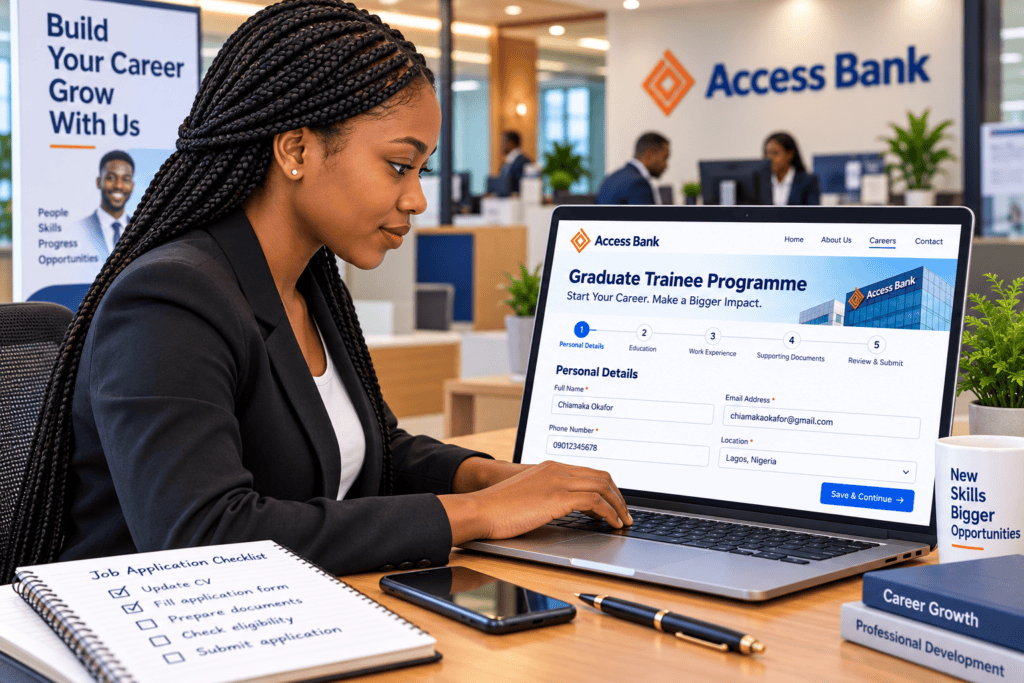
- Eligibility Criteria: Key age limits, class of degree requirements, and NYSC discharge status.
- The Application Process: How to monitor official bank career portals and submit competitive applications.
- Assessment & Interview Prep: Proven strategies for passing Computer-Based Tests (CBT) and assessment centers.
- Recruitment Fraud Prevention: How to identify legitimate bank calls and avoid fake job offers.
Whether you are a recent university graduate, an HND distinction holder, or currently completing your NYSC service, this roadmap will help you strategically apply for and land graduate trainee jobs in Nigerian banks.
What a Graduate Trainee Programme Is
A graduate trainee programme is a structured onboarding and leadership pipeline designed by financial institutions to transition entry-level talent into full-time banking professionals. For candidates seeking graduate trainee jobs in Nigerian banks, these programmes serve as an intensive bridge between academia and the corporate sector through a blend of classroom instruction, digital modules, executive mentorship, and rotational assignments across critical business units.
While the core objectives remain consistent, naming conventions vary across financial institutions:
- United Bank for Africa (UBA): Offers the Graduate Management Acceleration Programme (GMAP), an intensive framework combining specialized training, hands-on mentorship, and strategic project exposure.
- Guaranty Trust Bank (GTBank): Conducts dedicated entry-level recruitment drives and talent development initiatives accessible through its official career platforms.
- Access Bank, Zenith Bank, & First Bank: Frequently run similar specialized graduate academies tailored to retail banking, technology, and corporate finance tracks.
Due to competitive starting salaries, rapid career progression, and structured professional development, securing graduate trainee jobs in Nigerian banks is highly competitive. However, admission into a trainee pipeline does not guarantee automatic permanent deployment—final absorption depends on individual academy performance, assessment scores, and the bank’s operational headcount requirements.
Who Can Apply for Graduate Trainee Jobs in Nigerian Banks?
While exact requirements vary by financial institution and specific recruitment cycle, eligibility criteria across top-tier commercial banks are highly structured. Because individual job listings serve as the final authority, candidates applying for graduate trainee jobs in Nigerian banks should evaluate their profile against the following standard baseline criteria:
Core Educational & Academic Qualifications
- Bachelor’s Degree / Higher National Diploma (HND): Most Tier-1 and Tier-2 banks accept degrees across all academic disciplines—including STEM, Humanities, Social Sciences, and Business Administration.
- Minimum Degree Class: Major banks (such as GTBank, Zenith Bank, and Access Bank) typically mandate a minimum of Second Class Upper (2:1). However, programs like UBA’s Graduate Management Acceleration Programme (GMAP) and select operational pathways accept Second Class Lower (2:2) degrees.
- O’Level Requirements: A minimum of five (5) credit passes in WAEC, NECO, or NABTEB—strictly obtained in no more than two sittings—with mandatory credits in English Language and Mathematics.
Age and NYSC Status
- Age Cap: To maintain a young leadership pipeline, most banks enforce a strict age limit—typically 26 years or under at the time of application (though select programs extend up to 27 or 30 years depending on target tracks or advanced degree requirements).
- NYSC Discharge Status: Candidates must have completed the mandatory National Youth Service Corps (NYSC) scheme and possess an official NYSC Discharge Certificate or a valid Exemption Certificate.
- Alternative Pathways: Select institutions offer specialized entry tracks; for example, GTBank provides targeted internship and career placement programs for recent graduates or active corps members awaiting formal post-NYSC recruitment.
Essential Competencies & Soft Skills
- Analytical & Digital Literacy: Proficiency with basic office productivity tools, data interpretation, and high adaptability to digital banking systems.
- Communication & Interpersonal Skills: Strong written, verbal, and presentation capabilities.
- Behavioral Traits: Demonstrated integrity, emotional intelligence, customer-first orientation, and problem-solving aptitude.
- Mobility: Absolute flexibility and willingness to be deployed across any regional branch or head office department based on institutional needs.
Key Takeaway
You do not need a finance or accounting background to secure graduate trainee jobs in Nigerian banks. Banks explicitly seek diverse talent pools—from software engineering and English to microbiology—focusing instead on cognitive capacity, trainability, and alignment with corporate values.
Typical Eligibility Checklist for Graduate Trainee Jobs in Nigerian Banks
Before submitting your application for graduate trainee jobs in Nigerian banks, ensure you have all mandatory credentials verified, scanned, and formatted according to standard recruitment guidelines.
| Requirement | What to Prepare | Important Note |
| Degree Qualification | Degree Certificate or official Statement of Result. | Most Tier-1 and Tier-2 banks mandate a Second Class Upper (2:1), though select institutions (e.g., UBA, Sterling, First Bank) accept a Second Class Lower (2:2) or HND Upper Credit for specific operational tracks. |
| O’Level Results | WAEC, NECO, or equivalent Senior Secondary Certificate (SSCE). | A minimum of 5 credit passes—strictly including Mathematics and English Language—obtained in no more than two sittings is a standard baseline across all banks. |
| NYSC Status | Official NYSC Discharge Certificate or Exemption Letter. | Must be fully completed at the time of application. Pre-NYSC candidates or active corps members are generally restricted to short-term graduate internships. |
| Identification Documents | Government-issued ID: NIN Slip, International Passport, Voter’s Card, or Driver’s Licence. | Ensure your date of birth, surname, and given names match perfectly across all submitted documents and your recruitment portal profile to avoid disqualification during verification. |
| Curriculum Vitae (CV) | A 1-to-2 page ATS-optimized Graduate CV tailored specifically to banking. | Highlight quantitative aptitude, leadership roles, digital proficiencies, project management, and customer-facing experience. Avoid generic duty descriptions; focus on measurable impact. |
| Application Account & Contact Details | Dedicated professional email address and active mobile phone number. | Use identical contact information across all job portals, CBT platforms, and document verification stages to ensure seamless tracking by bank HR teams. |
Key Document Preparation Tips
- Digital Copies: Scan all original certificates (O’Level, Degree, NYSC Discharge) into high-resolution PDF formats under 500KB for rapid portal uploads.
- Age Compliance: Confirm that your birth date on your NIN matches your WAEC/Degree records, as Nigerian banks enforce strict age caps (typically 26 or 27 years).
How to Find Genuine Openings for Graduate Trainee Jobs in Nigerian Banks
To protect yourself from recruitment scams and ensure your application is processed, apply strictly through official banking channels. Major commercial banks—such as UBA (via its Graduate Management Acceleration Programme portal), GTBank, Zenith Bank, Access Bank, and First Bank—publish verified vacancies exclusively on their official career portals.
Step-by-Step Search & Application Strategy
Follow this structured workflow to track and apply for graduate trainee jobs in Nigerian banks:
- Target List & Bookmarking: Compile a list of major commercial financial institutions (e.g., GTBank, UBA, Zenith Bank, Access Bank, First Bank, Stanbic IBTC, Sterling Bank, Fidelity Bank). Bookmark their official
/careersor/jobspages directly in your browser. - Timing Strategy: Conduct weekly portal reviews—with heightened monitoring following NYSC batch passing-out parades (POP) and during Q1/Q3 corporate recruitment drives.
- Verified Social Channel Monitoring: Follow only verified (blue-checkmarked) LinkedIn, X (formerly Twitter), Instagram, and Facebook handles of target financial institutions for real-time announcements.
- Job Board Validation: While aggregate job sites or email alerts are useful discovery tools, always cross-check and complete your application directly on the bank’s primary domain.
- Application Tracking: Maintain an organized application log containing the exact job advert, role title, closing date, application ID number, and submission confirmation emails.
Red Flags: Identifying Recruitment Fraud
Because graduate trainee jobs in Nigerian banks are highly sought-after, fraudulent actors frequently create fake recruitment portals. Keep these strict guidelines in mind:
- Zero Fees: Legitimate Nigerian banks never request payments for application forms, CBT processing, medical checks, or job placement.
- Domain Verification: Ensure emails originate from official corporate email domains (e.g.,
@ubagroup.com,@gtbank.com,@zenithbank.com) rather than generic addresses (@gmail.comor@yahoo.com). - Third-Party Agents: Banks do not hire external individuals or paid intermediaries to “guarantee” shortlisting or recruitment pass marks.
How to Apply Step-by-Step for Graduate Trainee Jobs in Nigerian Banks
Securing graduate trainee jobs in Nigerian banks requires an error-free, methodical application approach. Because major financial institutions receive tens of thousands of submissions per cycle, following a structured workflow ensures your profile clears initial Applicant Tracking System (ATS) screens and reaches HR recruiters.
Step-by-Step Application Roadmap
[1. Vacancy Audit] ➔ [2. Doc Prep] ➔ [3. ATS CV Optimization] ➔ [4. Portal Submission] ➔ [5. Post-Apply Tracking]
Code language: CSS (css)
Step 1: Conduct a Thorough Job Advert Audit
Before initiating an application for graduate trainee jobs in Nigerian banks, carefully verify that you meet every hard constraint:
- Degree & Class: Confirm whether the advert accepts HND/2:2 degrees or strictly mandates a minimum of Second Class Upper (2:1).
- Age Limit: Verify your age relative to the bank’s cutoff (commonly 26 or 27 years).
- NYSC Status: Confirm whether a completed NYSC Discharge/Exemption Certificate is required immediately or if active corps members are eligible.
Step 2: Prepare & Standardize Digital Documents
Gather and convert all mandatory credentials into clear, high-resolution PDFs or standard image formats (JPEG) under 500KB:
- First Degree Certificate or Official Statement of Result.
- O’Level Result Certificate (WAEC/NECO/NABTEB).
- Official NYSC Discharge Certificate or Exemption Letter.
- Valid Government ID (NIN Slip, International Passport, or Driver’s Licence).
- Professional passport photograph with a clean background.
Step 3: Optimize Your Graduate CV for Banking
Structure a 1-to-2 page ATS-optimized CV in reverse-chronological order:
- Header: Include your full legal name, professional email address, phone number, location, and LinkedIn URL.
- Core Sections: Highlight Education, NYSC Experience, Key Skills (data analysis, customer service, financial literacy), Technical Competencies, and Leadership Roles.
- Impact Metrics: Quantify your achievements (e.g., “Managed project budgets,” “Led a team of 5 during NYSC service,” “Automated reporting workflows”).
Step 4: Access the Official Bank Portal & Create an Account
Navigate directly to the official bank careers portal (e.g., UBA Careers, GTBank Career Placement Portal, Access Bank Careers). Create an applicant profile using a permanent, professional email address that you check daily.
Step 5: Fill Out Personal & Academic Fields Accurately
Ensure all personal data—full name, date of birth, degree classification, CGPA, and O’Level subject breakdown—matches your physical documents word-for-word. Discrepancies between portal entries and uploaded documents will cause automatic disqualification during background checks.
Step 6: Upload Documents & Verify File Compliance
Upload files strictly in the requested format (PDF/JPEG). Avoid uploading password-protected, unreadable, or corrupted files.
Step 7: Review, Submit, and Retain Proof
Before hitting final submission, perform a final review of spelling, email addresses, and phone numbers. Once submitted, take a screenshot of the submission confirmation page and save your Application Reference ID for future correspondence.
Step 8: Monitor Email & Prepare for Assessment Stage
Recruitment for graduate trainee jobs in Nigerian banks progresses quickly once shortlisting begins. Check your main inbox, spam, and junk folders daily for Computer-Based Test (CBT) invitations, which often carry tight 24-to-48-hour response windows.
Pro Tip
Leading financial institutions like UBA, GTBank, and Zenith Bank treat the recruitment cycle as one continuous evaluation. Every stage—from portal submission to online cognitive tests and panel interviews—builds your final candidate evaluation score.
How to Prepare a Strong CV for Graduate Trainee Jobs in Nigerian Banks
Because financial institutions process tens of thousands of submissions per recruitment cycle, bank recruiters and Applicant Tracking Systems (ATS) typically spend less than 10 seconds reviewing a CV. To secure graduate trainee jobs in Nigerian banks, your CV must immediately highlight your academic performance, cognitive ability, leadership potential, and digital literacy.
Key Sections to Include on Your Graduate CV
Header & Contact Information
- Full Legal Name: Must match your NIN, degree certificate, and bank application portal profile.
- Professional Email Address: Use a clean, simple format (e.g.,
first.last@email.com). - Contact Number & Location: Include your active mobile phone number, WhatsApp contact, and current city/state (e.g., Lagos, Nigeria).
- LinkedIn Profile: Link to a fully completed, professional LinkedIn profile.
Professional Summary
Keep this section to 2–3 concise sentences. Focus on analytical capabilities, problem-solving skills, leadership aptitude, and readiness to contribute to core banking operations.
Example
“Analytical and performance-driven First-Class Business Administration graduate with hands-on experience in financial modeling, customer relations, and data analysis. Demonstrated leadership during NYSC service with strong adaptability, digital proficiency, and a commitment to driving operational excellence in modern banking.”
Academic Credentials & NYSC Status
- Degree & Institution: Degree title, university/polytechnic, graduation year, and class of degree (especially if First Class or Second Class Upper).
- O’Level Summary: List your SSCE institution, completion year, and key subject credits (specifically Mathematics and English).
- NYSC Details: State your NYSC status clearly (e.g., Completed: Batch A Stream 1, 2025 – Discharge Certificate Available).
Professional Experience, Internships & SIWES
Detail your work experience, industrial training (SIWES), NYSC primary assignment (PPA), or part-time customer-facing roles in reverse-chronological order. Use active bullet points and quantify your achievements where possible.
- Avoid: “Handled customer complaints during NYSC.”
- Use: “Resolved over 30 daily customer enquiries at the service desk, maintaining a 95% satisfaction rate and accurately logging client records in alignment with service standards.”
Digital Competencies & Technical Skills
Modern graduate trainee jobs in Nigerian banks increasingly prioritize candidates with strong digital skills. Highlight:
- Productivity Tools: Advanced Microsoft Excel (VLOOKUP, Pivot Tables), PowerPoint, Microsoft Word.
- Data & Tech Skills: Basic SQL, Power BI, Python, data visualization, or digital marketing tools (if applicable).
- Soft Skills: Problem-solving, quantitative reasoning, financial literacy, conflict resolution, and teamwork.
Leadership, Campus Involvement & Projects
Include academic final-year projects, debate clubs, student union executive roles, hackathons, or volunteer initiatives. Banks actively seek candidates with a proven track record of initiative and collaborative leadership.
What to Avoid on Your CV
- Unprofessional Emails: Avoid handles like
coolguy2024@email.comorprecious_baby@email.com. - Generic Career Objectives: Omit outdated lines like “Seeking a challenging position in a reputable firm to utilize my skills.”
- Dense Walls of Text: Use bullet points, bold section headers, and standard fonts (Calibri, Arial, or Helvetica, size 10–12).
- Unverified Information: Never inflate grades, alter graduation years, or fake NYSC certificates; Nigerian banks conduct rigorous third-party background checks before final offer letters.
- Unrequested Headshots: Omit photos unless explicitly requested by the portal to ensure smooth ATS parsing.
Preparing for Aptitude Tests and Interviews for Graduate Trainee Jobs in Nigerian Banks
Shortlisting for graduate trainee jobs in Nigerian banks transitions candidates into a multi-stage assessment pipeline designed to test cognitive capacity, problem-solving speed, behavioral fit, and situational intelligence.
Stage 1: Passing the Computer-Based Test (CBT)
Most financial institutions—including Access Bank, GTBank, Zenith Bank, and UBA—use specialized assessment vendors (such as SHL, Dragnet, or Workforce Group) to administer timed Computer-Based Tests.
Key Assessment Modules
- Numerical Reasoning: Focuses on percentages, ratios, data interpretation (charts and tables), compound interest, currency conversions, and basic financial math.
- Verbal Reasoning: Tests reading comprehension, critical analysis, logical deductions, and grammar under tight time constraints.
- Abstract & Logical Reasoning: Evaluates pattern recognition, sequence identification, and spatial intelligence.
- Situational Judgement Tests (SJT): Assess workplace ethics, conflict resolution, prioritization, and alignment with corporate banking values.
- Attention to Detail & Speed Tests: Measure your ability to spot numerical/textual errors rapidly without compromising accuracy.
CBT Execution Best Practices
- Pacing & Time Management: Practice full-length timed tests daily. Most bank CBTs allow under 60 seconds per question; learn when to make an educated guess and move forward.
- Technical Readiness: Ensure a stable internet connection, a fully charged laptop with functional webcams (for proctored exams), a quiet environment, and valid government ID ready for verification.
- Avoid Unethical “Exam Leaks”: Never engage third-party paid answer services or exam proxy takers. Banks employ AI proctoring tools, IP tracking, and secondary face-to-face verification tests before final employment offers.
Stage 2: Excelling in Bank Recruitment Interviews
Candidates who clear the CBT stage are invited to panel interviews, assessment centers, or executive chats. To articulate your experience effectively, structure your behavioral responses using the STAR Method (Situation, Task, Action, Result).
[Situation: Context] ➔ [Task: Challenge] ➔ [Action: Your Specific Role] ➔ [Result: Quantifiable Outcome]
Code language: CSS (css)
Core Interview Questions & Strategic Framing
| Interview Question | What Recruiter Evaluates | How to Frame Your Answer |
| “Why do you want to start your career in banking?” | Commercial awareness and long-term career intent. | Connect your academic background and analytical skills to the evolving financial services industry and digital banking growth. |
| “What do you know about our bank?” | Research effort and genuine interest in the institution. | Highlight the bank’s core pillars, recent financial performance, landmark digital products, leadership, and sustainability/CSR initiatives. |
| “How would you handle an irate or demanding customer?” | Emotional intelligence, empathy, and service orientation. | Explain active listening, remaining calm under pressure, demonstrating empathy, following institutional resolution protocols, and escalating appropriately. |
| “Describe a time you solved a complex problem under pressure.” | Resilience, cognitive flexibility, and problem-solving skills. | Use the STAR method to describe a challenging university project, SIWES experience, or NYSC leadership scenario where you delivered measurable results under a tight deadline. |
| “Are you open to branch deployment anywhere in Nigeria?” | Flexibility and commitment to corporate needs. | Reaffirm your mobility and readiness to serve in any branch or department where your skills create the highest impact for the bank. |
What Bank Recruiters Value Most
During interviews for graduate trainee jobs in Nigerian banks, panel members evaluate four core attributes beyond academic transcripts:
- Integrity & Professionalism: Demonstrating honesty, accountability, and ethical judgment.
- Coachability & Adaptability: Showing eagerness to learn complex financial products and adapt to changing banking technologies.
- Communication & Presentation: Expressing ideas clearly, confidently, and concisely.
- Customer-Centric Mindset: Showing a genuine focus on client satisfaction and value creation.
Common Mistakes to Avoid When Applying for Graduate Trainee Jobs in Nigerian Banks
Securing graduate trainee jobs in Nigerian banks requires meticulous attention to detail and strict adherence to official recruitment guidelines. Candidates frequently miss out on shortlisting or face automatic disqualification by making preventable errors during the application process.
Here are the most critical pitfalls to avoid:
Falling for Recruitment Fraud and Paying Fees
- The Mistake: Applying via WhatsApp broadcast messages, unverified blogs, or third-party agents promising “guaranteed placement” in exchange for cash.
- The Reality: Legitimate Nigerian financial institutions—such as UBA, GTBank, Zenith Bank, and Access Bank—never charge candidates fees for application forms, CBT assessments, medical checks, or job offer letters.
- Rule of Thumb: If payment is requested at any stage, it is an automatic scam.
Discrepancies in Personal Identification & Records
- The Mistake: Presenting inconsistent names, dates of birth, or educational details across your CV, NIN, WAEC certificate, and degree transcript.
- The Reality: Nigerian banks conduct rigorous, multi-tiered background checks and document verifications prior to final employment. Any mismatch between your portal entries and official records can trigger immediate disqualification or offer revocation.
Ignoring Advert Eligibility Criteria
- The Mistake: Applying when you exceed the advertised age limit (e.g., applying at 28 when the cap is strictly 26) or when you do not possess the minimum degree class (e.g., submitting a 2:2 degree for a 2:1 restricted role).
- The Reality: Applicant Tracking Systems (ATS) automatically filter out applications that fail hard numerical or categorical requirements before an HR recruiter ever views them.
Submitting a Generic, Non-ATS-Optimized CV
- The Mistake: Using the same unformatted or overly generalized CV for every corporate application without tailoring it to financial services or digital banking skills.
- The Reality: To stand out for competitive graduate trainee jobs in Nigerian banks, your CV must explicitly showcase analytical problem-solving, quantitative proficiency, leadership experience, and digital tools (e.g., Excel, SQL, data analytics).
Poor Communication Channel Management
- The Mistake: Failing to regularly monitor your primary email inbox, SMS messages, and spam/junk folders after submitting an application.
- The Reality: Invitations for Computer-Based Tests (CBT) or assessment centers often have strict response windows (frequently 24 to 48 hours). Missing a test link due to a full inbox or an ignored spam folder means forfeiting your slot.
Submitting Unverified or Exaggerated Claims
- The Mistake: Inflating your CGPA, claiming unearned technical skills, or submitting unverified NYSC status details.
- The Reality: Integrity is the foundational pillar of the banking sector. Misrepresentation discovered during interviews or background screening permanently blacklists candidates from future recruitment cycles across the industry.
Key Takeaway
Treat the entire recruitment process for graduate trainee jobs in Nigerian banks with professional rigor. Staying vigilant, submitting accurate documentation, and using only official bank channels will give you a decisive advantage in securing your position.
How to Avoid Recruitment Scams When Applying for Graduate Trainee Jobs in Nigerian Banks
Due to high demand for entry-level banking roles, job seekers are frequently targeted by fake recruitment drives, spoofed websites, and phishing schemes. Protecting your personal and financial information requires strict adherence to verification protocols throughout the application process.
Essential Rules to Avoid Recruitment Fraud
[1. Verify Domain] ➔ [2. Reject All Fee Requests] ➔ [3. Protect Sensitive Data] ➔ [4. Cross-Check Channels]
Code language: CSS (css)
Apply Exclusively Through Official Bank Domains
Always check the exact URL in your browser address bar. Scammers often register lookalike domain names (e.g., using gtbank-careers-ng.com or ubagroup-jobs.online instead of official corporate domains like gtbank.com or ubagroup.com).
- Action: Type official domain names directly into your browser or navigate to career pages via verified blue-checkmarked social media profiles.
Absolute Zero-Fee Policy
No legitimate commercial bank in Nigeria—including UBA, GTBank, Access Bank, First Bank, or Zenith Bank—requires candidates to pay at any stage of recruitment.
- Red Flags: Demands for “application fees,” “document processing charges,” “computer-based test (CBT) seat reservation fees,” “medical screening deposits,” or “training portal activation fees.” Any request for money is an immediate indicator of fraud.
Protect Your Confidential Banking & Identification Data
Standard recruitment forms collect your basic contact details, academic credentials, and work history. Legitimate job portals will never ask for sensitive financial authenticators.
- Never Share:
- Bank Verification Number (BVN)
- Debit Card Numbers, CVVs, or Card PINs
- One-Time Passwords (OTPs)
- Online Banking Passwords or Transaction Tokens
Be Wary of Unsolicited Job Offers
Be extremely cautious of direct email or SMS invitations claiming you have been “shortlisted” or “selected” for a graduate trainee role if you never submitted an application on the bank’s official portal. Legitimate recruitment flows always follow a verifiable sequence: Portal Application $\rightarrow$ Proctored Assessment $\rightarrow$ Formal Interview $\rightarrow$ Official Offer Letter.
Verify via Official Security and Customer Service Channels
If you receive a suspicious call, email, or WhatsApp message regarding an assessment or interview slot, do not click embedded links.
- Verification Route: Cross-check announcements on the bank’s main website or reach out directly to official fraud/support desks (e.g., UBA’s official fraud helpdesk or customer fulfillment center).
Summary Checklist: Real Bank vs. Fake Recruitment Scheme
| Checkpoint | Official Bank Recruitment | Fraudulent Scam Attempt |
| Application Portal | Direct corporate website (.com or .com.ng primary domains). | Unverified links, Google Forms, WhatsApp numbers, or generic blogs. |
| Application Fees | ₦0 (100% Free). | Requests money for screening, forms, or training kits. |
| Email Source | Official corporate email domains (e.g., @ubagroup.com). | Free webmail accounts (@gmail.com, @yahoo.com, or @outlook.com). |
| Data Requested | CV, degree certificate, WAEC result, NIN slip, standard bio-data. | ATM Card PINs, OTPs, BVN numbers, or online banking passwords. |
| Communication Style | Professional tone, clear schedules, and formal portal updates. | High-pressure urgency, typos, poor grammar, and threats of “forfeiting your slot”. |
Final Note
Following these security measures ensures that your journey toward securing graduate trainee jobs in Nigerian banks remains safe, professional, and successful.
What Happens After Selection for Graduate Trainee Jobs in Nigerian Banks?
Receiving a selection notification for graduate trainee jobs in Nigerian banks marks the transition from applicant to employee. However, the onboarding workflow is rigorous and conditional upon passing pre-employment verifications and completing formal training.
Phase 1: Pre-Employment Screening & Conditional Offer Letters
Before officially stepping into the training academy, candidates receive a Conditional Offer Letter. Final confirmation hinges on clearing multi-tiered background checks:
- Document Verification: Independent background checks confirm the authenticity of your degree certificate, O-Level statements, and NYSC discharge status directly with universities and exam bodies.
- Medical Fitness Screening: Candidates must complete comprehensive medical evaluations (including drug screening, chest X-rays, blood profiles, and general physical fitness tests) at designated bank panel hospitals.
- Guarantor & Reference Verification: Most banks mandate 2 to 3 credible guarantors (e.g., senior civil servants, corporate executives, or clergy) to execute indemnity forms on your behalf.
Phase 2: The Bank Training Academy Experience
Once cleared, trainees enter the bank’s internal learning institute—such as UBA’s Graduate Management Acceleration Programme (GMAP), Sterling Bank’s Foundation School, or dedicated academies at Access, GTBank, and Zenith Bank.
[Classroom Instruction] ➔ [Digital Simulations] ➔ [Branch Attachments] ➔ [Final Assessment / Confirmation]
Code language: CSS (css)
What to Expect During Training:
- Curriculum & Duration: Programs typically run between 3 and 6 months. Trainees cover core financial modules: credit analysis, accounting, risk management, compliance (AML/CFT), customer service, and digital banking architectures.
- Interactive Assessment: Learning involves case study presentations, simulated trading/banking software practice, and continuous weekly exams.
- Executive Mentorship: Trainees are assigned senior leaders who provide career guidance, strategic orientation, and performance feedback.
Phase 3: Final Deployment and Career Trajectory
Pass marks at the academy are strictly enforced (often requiring an aggregate score of 65% to 70%+ on continuous assessments).
- Final Absorption & Deployment: Graduates are deployed into business divisions—such as Retail Banking, Corporate Finance, Risk Management, Digital Transformation/IT, or Operational Support.
- Geographic Mobility: Final placement depends heavily on the bank’s operational headcount requirements and business expansion needs. Demonstrating willingness to deploy across different branch networks or regional offices increases career progression opportunities.
What is the age limit for graduate trainee jobs in Nigerian banks?
Most Nigerian banks enforce a strict age limit of 26 years or under at the time of application. However, select institutions and specialized technical tracks (such as IT or risk management) may extend eligibility up to 27 or 30 years, particularly for candidates holding master’s degrees or relevant professional qualifications. Always verify the specific cutoff in the official job posting.
Can I apply for graduate trainee jobs in Nigerian banks with a Second Class Lower (2:2) or HND?
Yes. While Tier-1 banks like GTBank and Zenith Bank often require a minimum of Second Class Upper (2:1), several leading institutions—such as United Bank for Africa (UBA), Sterling Bank, First Bank, and Fidelity Bank—regularly accept Second Class Lower (2:2) or HND Upper Credit for specific graduate trainee tracks and operational roles.
Do I need a degree in finance, accounting, or economics to work in a bank?
No. Nigerian banks recruit candidates from all academic disciplines, including STEM fields, humanities, social sciences, agricultural studies, and law. Banks value cognitive ability, problem-solving skills, and trainability over your specific undergraduate major, providing full financial and operational training during their academy programs.
Can active NYSC members or pre-NYSC graduates apply for graduate trainee roles?
Graduate trainee roles strictly require candidates to have completed their service and possess a valid NYSC Discharge Certificate or Exemption Letter. If you are currently serving or awaiting NYSC mobilization, you are eligible for short-term banking internships, graduate intern programs (such as GTBank’s internship pathway), or talent pool registries.
How long does the recruitment process take for Nigerian bank graduate trainee programs?
The full cycle—from initial online portal submission to final academy resumption—typically takes between 2 to 5 months. This timeline covers ATS CV screening, online Computer-Based Tests (CBT), panel interviews, assessment centers, background checks, medical clearances, and final offer issuance.
Do Nigerian banks charge application, test, or processing fees?
No. Legitimate Nigerian banks never charge fees at any stage of their recruitment process. Any request for money—whether for application forms, aptitude test seat reservations, medical screenings, or employment letters—is a scam. Always apply directly through the bank’s verified corporate domain (e.g., ubagroup.com, gtbank.com).
How should I prepare for a bank CBT aptitude test in Nigeria?
Focus your prep on four key areas: Numerical Reasoning (percentages, ratios, data interpretation), Verbal Reasoning (reading comprehension, logical deductions), Abstract Reasoning (pattern identification), and Situational Judgement (workplace ethics). Practice timed sample tests using standard prep materials from providers like SHL, Dragnet, or Workforce Group to improve speed and accuracy.
In Conclusion
Securing graduate trainee jobs in Nigerian banks requires deliberate preparation, strict compliance with eligibility criteria, and absolute vigilance against recruitment fraud.
Core Takeaways
- Structured Entry Point: Graduate trainee jobs in Nigerian banks serve as intensive leadership pipelines rather than automatic job placements. Final absorption depends on academy performance, assessments, and operational needs.
- Advert Authority: Official recruitment adverts are the final authority for class of degree (2:1 vs. 2:2/HND), O’Level sittings, NYSC discharge status, and age cutoffs.
- Official Application Channels: Apply exclusively through verified bank career portals (such as UBA Careers, GTBank Career Opportunities, or Zenith Bank Careers) and retain your application reference details.
- Rigorous Preparation: Optimize your CV for Applicant Tracking Systems (ATS), complete timed cognitive practice tests (numerical, verbal, logical reasoning), and structure interview answers using the STAR method.
- Zero-Fee Policy: Legitimate Nigerian financial institutions never charge candidates money for applications, CBT seats, medical screenings, or offer letters. Never disclose confidential credentials such as card PINs, OTPs, or BVNs.
Next Steps: Build Your Application Vault
To ensure rapid response times when vacancies open for graduate trainee jobs in Nigerian banks, execute these action items today:
- Create an Application Vault: Set up a secure cloud folder (e.g., Google Drive or OneDrive) containing high-resolution PDFs (under 500KB) of your:
- Updated ATS-optimized CV
- Degree Certificate / Official Statement of Result
- O’Level Certificate (WAEC/NECO/NABTEB)
- Official NYSC Discharge Certificate or Exemption Letter
- Valid Government-Issued ID (NIN Slip, Passport, or Driver’s Licence)
- Professional Passport Photograph (white background)
- Bookmark Primary Career Portals: Save the official
/careerspages of major financial institutions directly in your web browser:- GTBank Careers (
[gtbank.com/about/careers](https://gtbank.com/about/careers)) - UBA Careers (
[ubagroup.com/careers](https://ubagroup.com/careers)) - Access Bank Careers (
[accessbankplc.com/careers](https://accessbankplc.com/careers)) - Zenith Bank Careers (
[zenithbank.com/careers](https://zenithbank.com/careers)) - First Bank Careers (
[firstbanknigeria.com/careers](https://firstbanknigeria.com/careers))
- GTBank Careers (
- Set Up a Monitoring Schedule: Review these portals weekly—especially following NYSC batch passing-out parades—and check your primary email and spam folders daily to avoid missing short-notice CBT assessment invitations.