15 Free AI Certificate Programs for Beginners
You can start learning artificial intelligence today without paying for a course. Many top options come from industry leaders like IBM, Microsoft, Google, NVIDIA, and MIT, but they vary significantly: some award a verified digital credential, others provide free learning materials only, and several charge for the completion certificate even when access to the course content is free.
To help you navigate these options, this guide breaks down the best free AI certificate programs for complete beginners, students, job seekers, career changers, freelancers, and professionals seeking practical AI skills without upfront costs. We clearly separate free courses, 100% free certificates, and freemium paid-certificate models so you can quickly choose a program aligned with your specific career goals.
What a “Free AI Certificate” Really Means
A free AI course grants access to learning materials without a price tag. A free AI certificate program provides a verifiable, shareable digital credential upon completion without requiring payment. These two models are frequently confused.
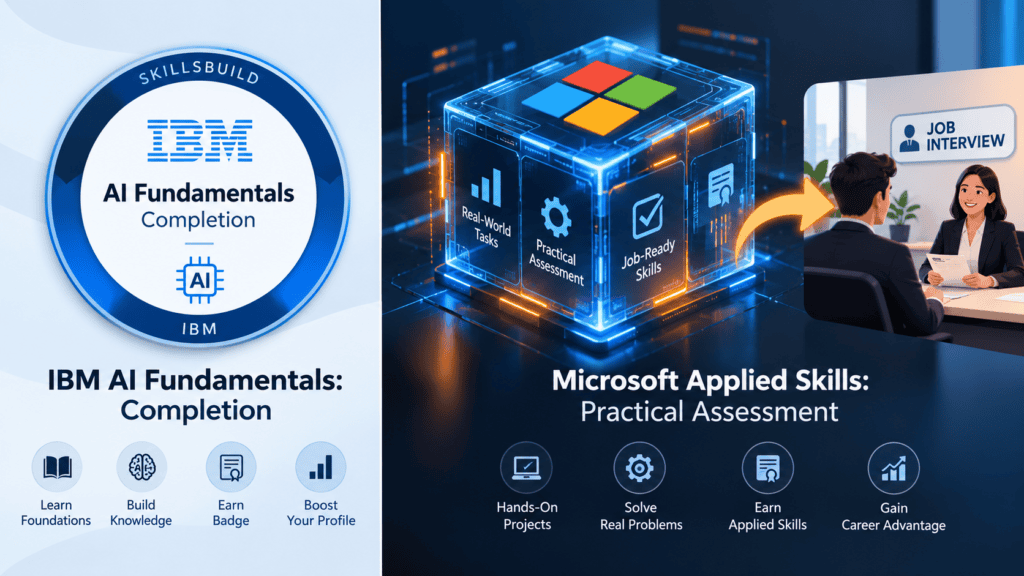
Many major platforms allow you to audit video lectures and readings at zero cost, but put the actual certificate, graded assignments, or lab environments behind a paywall. For instance, while Google AI Essentials offers preview options, obtaining the official Google certificate costs $49 per month after a 7-day free trial in the United States and Canada (pricing varies globally).
4-Point Pre-Enrollment Checklist
Before enrolling in any free AI certificate programs, evaluate these four factors to avoid hidden fees or unexpected paywalls:
- Course Access Scope: Is the entire syllabus accessible, or are key modules locked behind a subscription?
- Credential Issuance: Is a digital badge or verifiable certificate included for free, or is it a paid add-on?
- Assessment Requirements: Are graded exams, practical labs, or active platform subscriptions required to unlock the final certificate?
- Validity & Terms: Is the credential permanently free, or is it tied to a limited-time trial, promotional waiver, or recurring fee?
Comparison of Free AI Certificate Programs & Learning Paths
| Program Name | Provider | Best For | Free Course? | Free Certificate / Credential? |
| Artificial Intelligence Fundamentals | IBM SkillsBuild | Complete beginners needing foundational AI literacy | Yes | Yes (Digital Badge / Credential) |
| Getting Started with Generative AI | IBM SkillsBuild | Learners focusing on generative models & applications | Yes | Yes (Digital Badge / Credential) |
| Explore Emerging Tech | IBM SkillsBuild | Broad awareness of AI, Cloud, and IoT tech | Yes | Yes (Digital Badge / Credential) |
| Beginner: Intro to Generative AI | Google Cloud / Skills | AI concepts, capabilities, and responsible usage | Yes | Varies (Free preview; cert paths require sub/credits) |
| Microsoft Applied Skills AI Credentials | Microsoft Learn | Practical, scenario-based skills validation | Yes | Yes (Free lab-based assessment credential) |
| Azure AI Fundamentals (AI-900) | Microsoft Learn | Cloud-based AI foundations and services | Yes | No (Training is free; official exam is paid) |
| AI Skills Navigator Credentials | Microsoft | Guided, role-based AI learning pathways | Yes | Varies (Credential availability depends on path) |
| Microsoft Credentials AI Challenge | Microsoft Learn | Gamified learning with free exam vouchers | Yes | Yes (Time-limited promotional challenge window) |
| Generative AI Explained | NVIDIA DLI | Non-technical intro to generative AI concepts | Yes | Select Courses (Certificate included for select paths) |
| AI for All: Basics to GenAI Practice | NVIDIA DLI | Comprehensive beginner-level AI overview | Yes | Select Courses (Certificate included for select paths) |
| Building RAG Agents with LLMs | NVIDIA DLI | Hands-on exploration of LLM architecture | Yes | Select Courses (Certificate included for select paths) |
| AI 101 | MIT Open Learning | Non-technical foundational understanding of AI | Yes | No (Course materials only) |
| Artificial Intelligence | MIT OpenCourseWare | Deep technical & classical AI concepts | Yes | No (Free open courseware; no credential) |
| How to AI (Almost) Anything | MIT Open Learning | Practical, creative AI exploration and tools | Yes | No (Course materials only) |
| Google Grow Free AI Workshops | Grow with Google | Practical workplace & daily productivity AI | Yes | No (Certificate not provided for standard workshops) |
Key Takeaways for Readers
- 100% Free Credentials: IBM SkillsBuild and Microsoft Applied Skills offer the most reliable, year-round, zero-cost digital badges and credentials.
- Free Training, Paid Exam: Programs like Microsoft Azure AI Fundamentals (AI-900) allow you to learn for free, but you must pay for the official proctored exam unless you earn a voucher through a Microsoft Challenge.
- No-Certificate Learning: MIT OpenCourseWare and Grow with Google are excellent for acquiring high-grade skills, but they do not issue completion certificates.
15 free AI programs worth considering
Explore 15 free AI certificate programs for beginners that help you build practical artificial intelligence skills, earn valuable certificates, and boost your CV. Compare course content, learning requirements, and certificate availability to find the right program for your career goals.
IBM SkillsBuild: Artificial Intelligence Fundamentals
The IBM SkillsBuild Artificial Intelligence Fundamentals course is one of the most reliable starting points for an authentic, 100% free AI credential. Issued through Credly, the verifiable digital badge carries strong brand recognition without requiring a credit card or subscription.
- Key Topics Covered: Natural language processing (NLP), computer vision, machine learning, deep learning, chatbots, neural networks, AI ethics, and hands-on exposure to running models on IBM Watson Studio.
- Estimated Time: ~10 hours (self-paced).
- Cost: 100% Free (includes all learning modules, quizzes, and digital badge).
- Best For: Complete beginners and non-technical professionals who want a recognized digital badge without paying an upfront fee.
- Prerequisites: None.
- Certificate Status: Free, shareable Credly digital badge upon passing the end-of-module knowledge checks.
Verdict
Start here if you want a structured, credible foundational credential to test your interest before deciding whether to dive deeper into Python programming, prompt engineering, or data science.
IBM SkillsBuild: Getting Started with Generative AI
The IBM SkillsBuild Getting Started with Generative AI course provides an accessible introduction to text, code, and image generation. Issued as a verifiable Credly digital badge, it focuses on real-world applications—such as large language models (LLMs) and prompt guiding—without getting bogged down in complex code.
- Key Topics Covered: Generative AI foundations, practical LLM applications (including IBM Granite models), ethical considerations and risk frameworks (like the IBM Risk Atlas), and prompt creation basics.
- Estimated Time: ~3 hours (self-paced).
- Cost: 100% Free.
- Best For: Non-technical beginners, workplace professionals, and creators who want to understand ChatGPT-style tools, image generators, and enterprise GenAI use cases.
- Prerequisites: None.
- Certificate Status: Free digital credential (issued via Credly upon passing the required assessments).
Verdict
Start here if you want a clear understanding of generative AI mechanics and ethical guardrails before deploying these tools in your daily workplace workflow.
IBM SkillsBuild: Explore Emerging Tech
The IBM SkillsBuild Explore Emerging Tech course provides a wide-angle view of the modern tech stack, covering artificial intelligence alongside four other critical domains. Rather than drilling deep into code, it establishes the strategic context needed to understand how these technologies interconnect in enterprise environments.
- Key Topics Covered: Artificial intelligence, data science, cloud computing, cybersecurity, and an introductory look at quantum computing.
- Estimated Time: ~4–5 hours (self-paced).
- Cost: 100% Free.
- Best For: Career changers and students who want context across multiple high-demand technologies before deciding where to specialize.
- Prerequisites: None.
- Certificate Status: Free digital credential (verified via Credly upon completion).
Verdict
Start here if you are uncertain whether AI, data, or cybersecurity is the right long-term career direction and want a foundational overview backed by an official tech badge.
Google Skills: Beginner – Introduction to Generative AI
The Beginner: Introduction to Generative AI learning path on Google Skills offers a fast-paced, high-level entry point into Google’s ecosystem. Managed by Google Cloud, this path introduces foundational models and ethical considerations through micro-learning courses.
- Key Topics Covered: Fundamentals of generative AI vs. traditional machine learning, large language models (LLMs), prompt engineering basics using Google tools, and responsible AI principles.
- Estimated Time: ~4–5 hours across 4 activities.
- Cost: Free (includes access to course materials and introductory modules).
- Best For: Beginners looking for a structured, non-technical overview directly from Google without enrolling in a subscription-based platform like Coursera.
- Prerequisites: None.
- Certificate Status: Digital Google Cloud Skill Badges are available upon completing specific badge-eligible activities (such as hands-on labs/assessments within the path).
Verdict
Start here if you want a quick, Google-backed introduction to Generative AI concepts without committing to paid certificate paths on external learning portals.
Microsoft Applied Skills: AI Credentials
Microsoft Applied Skills credentials validate practical, hands-on capabilities through free, interactive, lab-based assessments rather than multiple-choice exams. Microsoft’s official programs and challenge windows allow learners to earn a verifiable AI-focused credential at no cost.
- Key Topics Covered: Building and deploying AI solutions using Azure AI Services, implementing generative AI models, building conversational agents, and configuring document intelligence tools.
- Estimated Time: Varies by credential (typically 2 to 6 hours of hands-on lab preparation).
- Cost: 100% Free for the lab-based assessment and credential issuance.
- Best For: Professionals, developers, and students who want verifiable proof of practical ability rather than just a certificate of course completion.
- Prerequisites: Varies by specific credential; foundational cloud knowledge is recommended.
- Certificate Status: Free digital Applied Skills credential issued by Microsoft Learn upon successfully passing the interactive lab assessment.
Verdict
Start here if you want to feature free AI certificate programs that prove you can actually build and execute AI workflows in a cloud environment rather than just watching lectures.
Microsoft Learn: Azure AI Fundamentals Learning Path
The Microsoft Learn Azure AI Fundamentals learning path provides a structured, self-paced introduction to enterprise cloud artificial intelligence. Designed to teach foundational machine learning and computer vision concepts in Azure, it serves as the official preparation route for the AI-900 certification.
- Key Topics Covered: Core machine learning concepts, computer vision workloads, Natural Language Processing (NLP), generative AI fundamentals, and responsible AI principles within the Azure ecosystem.
- Estimated Time: ~8–12 hours (self-paced).
- Cost: 100% Free for all digital training modules, documentation, and sandbox practice.
- Best For: Beginners looking to understand enterprise AI workflows and cloud-based architecture in Microsoft Azure.
- Prerequisites: None for the training path (basic computer literacy and general tech awareness are helpful).
- Certificate Status: Freemium model. While the learning modules and digital badges/modules on Microsoft Learn are entirely free, the official AI-900 certification exam is a paid, proctored test. However, learners can frequently secure free exam vouchers by participating in limited-time promotional programs like the Microsoft Cloud Skills Challenge.
Verdict
Start here if you want to master enterprise cloud AI infrastructure, keeping in mind that while you can study for free, securing the formal proctored exam credential requires monitoring for promotional free AI certificate programs or challenge vouchers.
Microsoft AI Skills Navigator
Microsoft’s AI Skills Navigator functions as an interactive discovery portal that maps out curated learning pathways, events, and free AI certificate programs based on specific job roles (e.g., developers, data scientists, security professionals, and business leaders). Rather than forcing learners through a single, static course, it aggregates playlists, interactive modules, and credential tracks tailored to current industry demand.
- Key Topics Covered: Role-based AI applications (ranging from executive strategic planning to GitHub Copilot integration, Microsoft Copilot Studio, and custom AI agent development).
- Estimated Time: Flexible; individual playlists range from 1 to 5+ hours.
- Cost: 100% Free access to all discovery pathways, video tutorials, and interactive training playlists.
- Best For: Professionals, career switchers, and organizations seeking clear, role-specific guidance on which technical or business AI skills to prioritize.
- Prerequisites: Varies based on the chosen job track (foundational routes require no prior experience).
- Certificate Status: Varies by selected track. The platform guides users toward two main credential types: free lab-based Applied Skills badges and formal Microsoft Certifications (which require proctored exams unless earned via promotional challenges).
Verdict
Use this portal if you want a structured, role-guided roadmap to discover the exact free AI certificate programs and skills required for your specific career path rather than guessing which course to take next.
Microsoft Credentials AI Challenge
The Microsoft Credentials AI Challenge is a promotional, time-bound initiative designed to accelerate skill acquisition by pairing structured learning paths with free, proctored lab assessments. For instance, recent iterations—such as the early 2026 challenge—offered eligible participants the chance to earn a verifiable Applied Skills credential at zero cost.
- Key Topics Covered: Hands-on cloud AI deployment, building custom copilot solutions, configuring Azure AI Document Intelligence, and implementing generative AI models in enterprise environments.
- Estimated Time: Varies by challenge track (typically 5 to 10 hours of hands-on lab work during the active event window).
- Cost: 100% Free during the official challenge timeframe (normally includes access to the required training modules and a free assessment voucher).
- Best For: Self-directed learners and professionals who want to secure formal free AI certificate programs without paying for proctored exam or lab fees.
- Prerequisites: Varies by specific credential track; basic familiarity with cloud concepts or Microsoft Learn is recommended.
- Certificate Status: Free Applied Skills credential—provided you complete the required labs and pass the practical assessment within the official event window.
Verdict
Monitor the Microsoft Learn blog and developer announcements for active event windows. If a challenge is running, this is one of the fastest ways to secure a high-value cloud credential without spending money.
NVIDIA DLI: Generative AI Explained
The NVIDIA Deep Learning Institute (DLI) Generative AI Explained course provides a rapid, high-impact orientation to modern AI models. Designed specifically for non-technical learners, it breaks down complex machine learning concepts into intuitive principles backed by industry-standard hardware leader NVIDIA.
- Key Topics Covered: What generative AI is, how foundation models generate text, images, and video, underlying neural network concepts, and real-world enterprise use cases.
- Estimated Time: ~2 hours (self-paced).
- Cost: 100% Free for course access and learning materials.
- Best For: Beginners, business leaders, and creatives who want a quick, vendor-backed introduction to generative AI without writing a single line of code.
- Prerequisites: None.
- Certificate Status: Varies by path. While the course content is entirely free, NVIDIA issues an official DLI certificate of competency for select foundational and hands-on courses upon passing the final assessment. Always verify the certificate badge indicator on the specific NVIDIA DLI course landing page before enrolling in any free AI certificate program track.
Verdict
Start here if you want a fast, credible, hardware-industry perspective on generative AI mechanics without code prerequisites.
NVIDIA DLI: AI for All
The NVIDIA Deep Learning Institute (DLI) AI for All course introduces artificial intelligence’s transformative impact across modern industries. Bridging the gap between foundational machine learning principles and practical generative AI applications, it delivers a high-level conceptual framework without requiring advanced programming experience.
- Key Topics Covered: Fundamentals of machine learning vs. deep learning, practical generative AI applications, and sector-specific transformations across healthcare, robotics, creative industries, and autonomous systems.
- Estimated Time: ~1.5–2 hours (self-paced).
- Cost: 100% Free for all core learning materials and modules.
- Best For: Non-technical professionals, business leaders, and students seeking a broad overview of industrial AI implementation.
- Prerequisites: None.
- Certificate Status: Varies by path. Access to the course curriculum is free; however, official NVIDIA DLI certificates of competency are issued only for select courses upon passing required assessments. Be sure to check the specific course landing page when reviewing candidate free AI certificate programs.
Verdict
Start here if you want to understand how enterprise AI transforms sectors like healthcare, finance, and autonomous technology without diving into code.
NVIDIA DLI: Building RAG Agents with LLMs
The NVIDIA Deep Learning Institute (DLI) Building RAG Agents with LLMs course explores Retrieval-Augmented Generation (RAG)—a core architectural pattern used to connect large language models to external databases, enterprise documents, and live APIs. It bridges theoretical language modeling with practical, data-grounded AI deployment.
- Key Topics Covered: Fundamentals of RAG systems, vector databases, embedding models, document chunking strategies, and designing autonomous AI agents that retrieve external knowledge to reduce hallucinations.
- Estimated Time: ~8 hours (self-paced).
- Cost: Course access models vary across NVIDIA learning catalogs—select introductory modules and open-source materials are free, while full hands-on cloud GPU lab access with certificate tracking typically carries a fee.
- Best For: Curious beginners, developers, and data practitioners who want a practical, technical introduction to modern LLM application stack architecture.
- Prerequisites: Basic comfort with tech workflows and introductory Python concepts is recommended.
- Certificate Status: Select courses only. NVIDIA issues an official DLI certificate of competency upon passing required practical assessments for specific paid or promotional paths. Always verify the current certificate badge indicator on the course page when reviewing free AI certificate programs.
Verdict
Start here if you want to transition from basic prompt engineering toward building applied, data-connected LLM workflows.
MIT Open Learning: AI 101
The MIT Open Learning AI 101 course (offered through MIT OpenCourseWare) provides a high-signal academic introduction to artificial intelligence. Taught by MIT researcher Brandon Leshchinskiy, this workshop demystifies technical terms and breaks down machine learning concepts without requiring a math or coding background.
- Key Topics Covered: Core terminology (machine vision, data wrangling, reinforcement learning), machine learning task capabilities, interactive algorithm training exercises, and real-world AI limitations.
- Estimated Time: ~1 hour (workshop format).
- Cost: 100% Free.
- Best For: Absolute beginners and students who prefer clear, university-level conceptual explanations over commercial tool overviews.
- Prerequisites: None.
- Certificate Status: No certificate provided. While it offers top-tier academic instruction at zero cost, MIT Open Learning does not issue a completion badge or digital credential for this workshop.
Verdict
Start here if you value deep foundational clarity from a world-class institution before pursuing formal free AI certificate programs for resume building.
MIT OpenCourseWare: Artificial Intelligence
The MIT OpenCourseWare (OCW) Artificial Intelligence course (Course 6.034) provides free, open access to full syllabus materials from MIT’s undergraduate curriculum. Taught by the late Professor Patrick Henry Winston, it explores foundational machine learning concepts, heuristic searches, constraint propagation, and knowledge representation methods.
- Key Topics Covered: Rule-based expert systems, goal trees, depth-first/hill-climbing search algorithms, neural networks, support vector machines (SVMs), and natural language understanding.
- Estimated Time: Self-paced (~40–50 hours of total lecture videos, recitations, and assignments).
- Cost: 100% Free open-access publication of course materials.
- Best For: Self-directed learners, computer science students, and engineers looking for a deep, classical computer science foundation rather than high-level surface tutorials.
- Prerequisites: Intermediate programming knowledge (Python or functional programming logic) and linear algebra/calculus concepts.
- Certificate Status: No certificate provided. MIT OpenCourseWare publishes lecture materials, exams, and syllabus guides for self-study but does not award digital credentials, badges, or course credit.
Verdict
Use this resource to build durable, underlying computer science fundamentals before enrolling in formal free AI certificate programs for resume building.
MIT Open Learning: How to AI (Almost) Anything
The MIT Open Learning How to AI (Almost) Anything course (MAS.S60) explores practical applications of modern artificial intelligence across diverse real-world domains. Taught by Professor Paul Liang, the curriculum moves beyond abstract definitions to focus on modern deep learning, foundation models, multimodal AI, and research workflows.
- Key Topics Covered: Modern deep learning, foundation models, multimodal AI (combining vision, audio, text, and sensor data), AI research methodology, and real-world deployment across non-traditional data modalities.
- Estimated Time: Self-paced (~20–30 hours of lecture materials, readings, and research frameworks).
- Cost: 100% free, open-access publication.
- Best For: Creative professionals, entrepreneurs, researchers, and students looking to apply AI concepts to practical, real-world problems and unique data sources.
- Prerequisites: None required; basic comfort with tech and research concepts is beneficial.
- Certificate Status: No certificate provided. While MIT provides access to open learning materials, it does not issue a completion badge or digital credential for this course.
Verdict
Start here if you want practical context, creative inspiration, and an understanding of modern multimodal AI before selecting formal free AI certificate programs for your resume.
Google Grow: Free AI Workshops
Google offers practical, no-cost workshops through Grow with Google, including Generative AI for Educators with Gemini, Make AI Work for You (for small business owners), and tailored AI productivity resources for students. These self-paced sessions focus on immediate application—helping users integrate tools like Gemini and Gemini Notebook into daily lesson planning, workflow automation, and administrative tasks.
- Key Topics Covered: Practical prompt creation, workplace productivity hacks, personalized learning strategies, business task automation, and ethical AI usage.
- Estimated Time: ~2 hours per course/workshop.
- Cost: 100% Free.
- Best For: Teachers, small-business owners, students, and non-technical professionals seeking actionable AI utility rather than complex software engineering.
- Prerequisites: None.
- Certificate Status: Varies by workshop. Specific offerings (such as Generative AI for Educators) issue a free completion certificate upon passing an optional final assessment, which educators can submit for Professional Development (PD) credit. However, general productivity workshops are uncredentialed.
Verdict
Start here if your main priority is immediately applying productivity tools to your work or teaching environment, but confirm individual workshop terms if you are specifically hunting for free AI certificate programs.
How to Choose the Right Free AI Certificate Program
Choosing the right course comes down to your immediate goal rather than brand recognition alone. Evaluating free AI certificate programs based on learning structure and credentialing models prevents wasted effort on paywalled exams or uncredentialed content.
| Your Primary Goal | Best Starting Point | Expected Outcome |
| Earn a free, verifiable credential quickly | IBM SkillsBuild: AI Fundamentals or Getting Started with Generative AI | Earn a shareable Credly digital badge at zero cost. |
| Prove practical, scenario-based AI skills | Microsoft Applied Skills: AI Credentials | Pass a free, interactive lab-based evaluation. |
| Understand Generative AI without coding | NVIDIA’s Generative AI Explained or Google’s Intro to Generative AI path | Acquire foundational, non-technical concepts without prerequisites. |
| Build deep academic foundations | MIT Open Learning AI 101 or MIT OpenCourseWare Artificial Intelligence | Master computer science concepts (courseware only; no certificate). |
| Apply AI directly to daily work or business | Grow with Google Workshops or Microsoft AI Skills Navigator | Gain immediate, actionable productivity workflows for business or teaching. |
| Prepare for formal cloud AI careers | Microsoft Learn: Azure AI Fundamentals (AI-900) learning path | Build enterprise cloud skills (training is free; proctored exam is paid). |
A Recommended 5-Step Beginner Learning Path
To maximize early momentum while building a solid resume portfolio, follow this structured, five-step progression through free AI certificate programs:
- Build General Literacy: Complete one foundational, non-technical overview (e.g., IBM SkillsBuild AI Fundamentals) to master core terms like machine learning, neural networks, and ethics.
- Master Generative Frameworks: Complete a practical generative AI path (e.g., Google’s Intro to Generative AI or NVIDIA Generative AI Explained) to understand prompt structures and model capabilities.
- Execute a Real Task: Apply what you have learned to a hands-on project—such as using an LLM to automate a business workflow, organize data, or generate a custom script.
- Validate with an Applied Credential: Pass a lab-based assessment (e.g., a Microsoft Applied Skills credential) or build a public repository to demonstrate practical skill execution.
- Publish Your Proof: Share your verifiable digital badge (via Credly or Microsoft Learn) and project repository on LinkedIn, your personal site, or your resume to validate your training.
How to Add AI Certificates to Your CV and LinkedIn
A certificate provides the most value when it supports a specific, verifiable skill claim. Rather than listing every introductory course you take, focus on featuring free AI certificate programs that offer third-party verification or practical assessment.
Formatting on Your Resume/CV
Keep your credentials section concise, professional, and clear. Avoid listing uncredentialed workshops or simple video courses under formal qualification headings.
Markdown
Certifications & Credentials
- Artificial Intelligence Fundamentals | IBM SkillsBuild (Credly Verified), 2026
- Microsoft Applied Skills: Developing Generative AI Solutions | Microsoft, 2026
Optimization for LinkedIn
When adding credentials to your Licenses & Certifications section on LinkedIn, maximize trust by providing full verification details:
- Name: Exact title of the credential earned (e.g., IBM SkillsBuild AI Fundamentals).
- Issuing Organization: Search and tag the official page (e.g., IBM or Microsoft).
- Issue Date: Month and Year earned.
- Credential ID: Include the unique badge ID if provided by the platform (e.g., via Credly or Microsoft Learn).
- Credential URL: Provide the direct public verification link (e.g.,
[credly.com/badges/](https://credly.com/badges/)...or your public Microsoft Learn transcript link).
Pro Tip
Ensure your Microsoft Learn profile or Credly privacy settings are set to Public so recruiters and hiring managers can verify your credential with one click.
Pairing Credentials with Portfolio Proof
To transform course completions into proof of practical capability, link your certificates directly to real-world execution in your experience or project sections.
| Standard Course Mention | Applied Capability Claim |
| “Completed a course on generative AI and prompt engineering.” | “Used generative AI workflows to draft customer-support FAQ documentation, lowering initial response prep time by 30% while manually auditing model outputs for accuracy.” |
| “Learned Retrieval-Augmented Generation (RAG) models.” | “Built a prototype RAG agent using Python and a vector index to query internal company PDFs, documenting prompt optimizations and hallucination limits.” |
By combining official free AI certificate programs with verifiable project outputs, you establish a clear, credible signal of AI competency for prospective employers.
Common Mistakes to Avoid When Pursuing Free AI Credentials
Navigating non-paid educational paths requires a critical eye. Avoiding these five frequent missteps will save you time and keep your portfolio high-signal:
- Assuming Every Free Course Includes a Free Certificate: Many major learning portals use a “freemium” model where course access is free, but identity verification, graded assignments, and final certificate issuance carry a paywall. Always verify whether a path grants a digital credential or badge before enrolling if formal proof is your primary objective.
- Collecting Badges Without Demonstrating Practical Skill: Completing dozens of introductory video modules creates a padded CV without real substance. Hiring managers value one well-documented, public GitHub repository or workflow sample over multiple basic certificates of completion.
- Overlooking Time Sensitivity and Promotional Windows: Certain high-value credentials—such as specific Microsoft Credentials AI Challenges or limited-time NVIDIA Deep Learning Institute promotions—are date-bound. Always double-check assessment deadlines and voucher expiration dates to avoid missing free credential windows.
- Jumping into Technical Machine Learning Too Early: Beginners often make the mistake of enrolling directly in complex calculus- and Python-heavy machine learning frameworks. Establishing foundational literacy—focusing on practical prompting, ethical principles, and workplace tool integration—creates a far more effective trajectory before tackling custom model deployment.
- Overstating Foundational Achievements: An introductory badge demonstrates initiative, foundational vocabulary, and digital agility—not senior engineering capability. Frame your credentials honestly on your resume to reflect conceptual awareness and applied capability rather than production-level AI architecture expertise.
Are these AI certificate programs truly 100% free?
Yes, every program featured in this guide allows you to access core learning materials without paying a subscription fee. However, the exact credential status varies by platform:
Fully Free Credentials: Platforms like IBM SkillsBuild and Microsoft Applied Skills issue free, verifiable digital badges or credentials upon course or lab completion.
Freemium & Exam-Based Models: Providers like Microsoft Learn offer free access to all self-paced learning paths, but charge for proctored certification exams (e.g., Azure AI Fundamentals AI-900) unless earned through time-bound challenge vouchers.
Academic Courseware: Institutions like MIT OpenCourseWare provide open access to university-level lectures and materials for self-study but do not issue digital completion certificates.
What is the difference between a course completion certificate and an Applied Skills credential?
A standard course completion certificate confirms that you watched video lectures or completed modules (e.g., IBM SkillsBuild or Google Skills).
An Applied Skills credential (such as those offered by Microsoft) requires passing an interactive, lab-based assessment that evaluates your ability to perform tasks in an active cloud environment. Employers often view applied credentials as higher-signal proof of technical capability.
Do free AI certificates expire?
Most introductory digital badges (like IBM SkillsBuild badges) do not formally expire, though their relevance may decline as underlying technologies evolve.
For vendor-specific or cloud credentials, validity periods depend on the issuer:
Microsoft Applied Skills: These credentials remain active as long as the underlying technology stack is maintained on Microsoft Learn.
Promotional Challenges: Vouchers earned through events like the Microsoft Credentials AI Challenge have strict activation and test-window expiration dates.
Can I list these free AI certificates on my resume and LinkedIn?
Yes. To maximize their impact on your CV and LinkedIn profile:
List them under “Certifications”: Include the official program title, issuing institution, and completion year.
Include Verification Links: For platforms that issue digital credentials (like Credly or Microsoft Learn), add the direct public verification URL to your LinkedIn profile.
Pair with Applied Proof: Highlight how you used the concepts in a practical scenario (e.g., “Applied prompt engineering principles learned via IBM SkillsBuild to automate customer support documentation”).
Do I need programming experience to start these programs?
No prior coding experience is required for most beginner programs featured here. Non-technical paths—such as NVIDIA’s Generative AI Explained, Google’s Intro to Generative AI, and IBM SkillsBuild Explore Emerging Tech—focus on conceptual understanding, business application, and prompt engineering without writing code.
Technical paths (such as NVIDIA’s RAG agent courses or MIT OpenCourseWare computer science curricula) recommend basic familiarity with Python or data structures.
In Conclusion
The landscape of free AI certificate programs requires distinguishing between genuine credentials and paywalled courseware. For beginners seeking verifiable recognition, the most reliable options remain IBM SkillsBuild and Microsoft Applied Skills:
- IBM SkillsBuild: Delivers zero-cost digital badges (verifiable via Credly) across foundational AI, ethics, and prompt engineering without hidden fees.
- Microsoft Applied Skills: Provides free, interactive, lab-based assessments that validate real-world capability rather than passive video completion.
If your primary goal is gaining technical clarity rather than collecting a credential, MIT OpenCourseWare and NVIDIA Deep Learning Institute offer elite learning paths, though formal certificates are not guaranteed for every free module.
Recommended Next Step
To build momentum immediately:
- Enroll: Complete the IBM SkillsBuild Artificial Intelligence Fundamentals learning path to secure your first verifiable digital credential.
- Apply: Within two weeks of completion, execute a small, hands-on project using a generative AI tool (e.g., structuring a custom prompt workflow, building a basic prototype, or automating a document synthesis task).
- Publish: Link your new credential and project documentation directly to your resume and LinkedIn profile to demonstrate clear, practical value.