An AI skills stack is a layered set of abilities required to use artificial intelligence effectively, safely, and productively in the modern workforce. The World Economic Forum ranks AI and big data among the fastest-growing workplace skills, while OECD analysis finds that most AI-exposed workers need general AI literacy rather than specialist capabilities.
However, the optimal sequence for building your AI skills stack varies according to your role, risk exposure, and intended outcome. Learning AI today can feel like trying to board a moving vehicle. New models, agent platforms, courses, certificates, and job titles appear faster than most people can evaluate them.

This rapid expansion often leads to a costly mistake: learners build an unbalanced AI skills stack by starting with the most visible tool instead of the most transferable skill. They collect random prompts without learning verification, study Python without a defined business use case, or attempt advanced automation before they can run the underlying process manually.
This guide provides a structured blueprint for constructing an effective AI skills stack, designed specifically for students, recent graduates, career switchers, non-technical professionals, freelancers, creators, and early-stage practitioners. It is intentionally NOT an advanced machine-learning engineering curriculum.
Instead, you will learn how the modern AI skills stack operates layer-by-layer: which foundational capabilities to build first, which technical skills can safely wait, and how to customize your personal AI skills stack for your specific career trajectory. This framework progresses systematically from baseline AI literacy to high-leverage workflows, role-specific execution, and optional technical specialization.
What Is an AI Skills Stack?
An AI skills stack is an ordered combination of foundational knowledge, practical operating skills, human judgment, and role-specific capabilities. Rather than treating artificial intelligence as a single subject, an AI skills stack defines how different competencies layer together—explaining not only what to learn, but which baseline abilities must support higher-level execution.
The concept of a “stack” is essential because AI fluency cannot exist in a vacuum. Prompting without verification produces persuasive errors. Automation without underlying process knowledge merely scales an inefficient workflow. Coding without precise problem definition creates functional software that solves the wrong problem.
The 4 Core Layers of a Practical AI Skills Stack
To build a high-leverage capability set, a modern AI skills stack connects four distinct layers:
- Foundational Understanding: Grasping what AI systems actually do, recognizing failure modes (hallucination, bias, context limits), and evaluating systemic impact.
- Applied Operating Skills: Masterclass task definition, context engineering, prompt architecture, output verification, and data security protocol.
- Workflow Capability: Mapping processes to determine where AI accelerates output, where human-in-the-loop judgment is non-negotiable, and how quality control is enforced.
- Role-Specific or Technical Depth: Integrating specialized capabilities—such as growth marketing, data analysis, API integration, retrieval-augmented generation (RAG), or agentic automation—once the foundational layers are secure.
+-------------------------------------------------------+
|  Layer 4: Role-Specific / Technical Depth            |
|  (APIs, Agents, Domain Expertise, RAG, Python)        |
+-------------------------------------------------------+
|  Layer 3: Workflow Capability                         |
|  (Process Mapping, Quality Assurance, Human-in-Loop)  |
+-------------------------------------------------------+
|  Layer 2: Applied Operating Skills                    |
|  (Context Engineering, Prompting, Output Verification)|
+-------------------------------------------------------+
|  Layer 1: Foundational Understanding                  |
|  (Model Capabilities, Limitations, Ethics, Privacy)   |
+-------------------------------------------------------+
Alignment with Global Competency Frameworks
This layered approach to the AI skills stack aligns directly with international educational standards without locking you into a single corporate syllabus:
- UNESCO AI Competency Framework: Categorizes 12 core competencies across a human-centered mindset, AI ethics, technical application, and system design, using a progression from understanding to applying and creating.
- OECD & European Commission Frameworks: Define AI literacy as a composite of knowledge, practical execution, and critical attitude—helping professionals understand AI mechanisms, interrogate outputs, and apply tools responsibly.
These frameworks reinforce a core thesis: a robust AI skills stack prioritizes human judgment, systems thinking, and operational responsibility over simple tool fluency.
How Is an AI Skills Stack Different From a List of AI Tools?
The critical distinction between software acquisition and capability building comes down to durability: a tool list tells you what software exists today, while an AI skills stack defines the transferable capabilities required to execute work regardless of the software underlying it.
Tools Are Replaceable; Skills Transfer
Model names, pricing tiers, interface designs, and feature sets shift constantly. Software updates often render hyper-specific tool tutorials obsolete in months. In contrast, an AI skills stack focuses on core cognitive and operational mechanisms—such as problem framing, context engineering, source evaluation, and workflow design—that remain valid across any platform or model version.
| Feature / Dimension | AI Tool List (Product-Centric) | AI Skills Stack (Capability-Centric) |
| Primary Focus | Specific applications (e.g., ChatGPT, Midjourney, Claude) | Transferable operating mechanisms & human judgment |
| Lifespan / Shelf-Life | Short-term (vulnerable to feature changes, deprecation, pricing) | Evergreen (transfers across new models, interfaces, and platforms) |
| Execution Depth | Superficial (“Push button X to get result Y”) | Architectural (“Structure input context, verify accuracy, control quality”) |
| Adaptability | Low (breaks when the UI changes or a product shuts down) | High (enables seamless switching between model paradigms) |
The Functional Difference in Practice
Consider how two different professionals approach document analysis:
- The Tool-Centric Learner: Relies on a specific PDF-summarizer app button. When the app changes its pricing model, updates its UI, or goes out of business, their workflow breaks entirely.
- The Stack-Centric Practitioner: Uses their AI skills stack to define the specific target audience, select validated source materials, enforce context parameters, and systematically check the model’s output for missing edge cases.
The stack-centric practitioner achieves superior results whether using a raw API, a general-purpose LLM, or an enterprise workspace. Developing a structured AI skills stack ensures your professional value scales alongside artificial intelligence rather than remaining tied to the lifecycle of specific software applications.
What Are General, Applied, and Specialist AI Skills?
Understanding how capabilities build upon one another requires categorizing your AI skills stack into three clear tiers of depth: General, Applied, and Specialist.
Rather than viewing these categories as rigid career silos, consider them as levels of technical and operational leverage. A marketer may need applied skills alongside light automation, while an AI engineer still requires baseline general literacy and ethical data verification. The matrix below breaks down how these layers function across your AI skills stack.
| Skill Category | Typical Capabilities | Who Needs It | Example Evidence of Competence |
| General AI Literacy | Understanding model limitations, common use cases, AI ethics, data privacy, and basic critical evaluation. | Almost every modern knowledge worker, student, and professional. | Explaining when AI is appropriate for a task and accurately identifying hallucinations or privacy risks in an output. |
| Applied AI Skills | Problem framing, context engineering, prompt architecture, output verification, workflow design, and data handling. | Professionals using AI to augment daily execution in work or study. | Completing a fully documented, repeatable workflow with built-in human-in-the-loop review and clear quality criteria. |
| Automation & Integration | Setting up event triggers, mapping data flow, utilizing no-code automation platforms, configuring APIs, and basic failure monitoring. | Practitioners managing stable, recurring, or high-volume processes. | Successfully automating a bounded multi-step process with error-handling logic and failure alerts. |
| Specialist Technical Skills | Advanced Python, machine learning fundamentals, Retrieval-Augmented Generation (RAG), model evaluation datasets, red-teaming/security, and agentic system design. | Software developers, data scientists, systems analysts, and dedicated AI engineers. | Building, benchmarking, and deploying a functional AI application against strict technical requirements. |
Strategic Takeaway for Your AI Skills Stack
When planning your learning progression, the goal is not to master every single category sequentially. Instead, use this breakdown to anchor your core AI skills stack in General Literacy and Applied Skills first. Only expand into Automation or Specialist Technical Skills when a clear business case, high-volume operational bottleneck, or specific career objective demands it.
Why Does the Order of AI Skills Matter?
The sequence in which you construct your AI skills stack determines whether artificial intelligence becomes a force multiplier or an operational liability. Advanced tools do not fix broken reasoning—they merely accelerate and scale the thinking, data quality, and processes beneath them. A weak foundation makes downstream automation harder to debug, trust, maintain, and explain.
The Amplification Principle of the AI Skills Stack
Learning out of order creates compounding errors across your workflow:
[ Weak Process Framing ] ──> [ Flawed Prompt Engineering ] ──> [ Scaled Error via Automation ]
Code language: CSS (css)- Automating an Unverified Process: Setting up a multi-step no-code automation script without mastering manual output verification scales bad data at enterprise speed.
- Coding Without Domain Context: Building a Retrieval-Augmented Generation (RAG) pipeline before understanding the underlying business logic produces a technically functional system that solves the wrong operational problem.
The Labor-Market Case: Augmentation Over Replacement
The economic rationale for a structured AI skills stack is clear, but frequently misinterpreted. According to the World Economic Forum, while AI and big data rank among the fastest-growing technical priorities, cognitive and human capabilities—such as analytical thinking, creative thinking, systems thinking, and technological literacy—are growing at comparable rates.
Employers do not demand isolated tool operation; they require a balanced AI skills stack that pairs technical fluency with high-level human judgment. The World Economic Forum emphasizes that AI’s primary economic impact lies in augmenting human capability through collaboration, rather than direct workforce replacement.
+-----------------------------------------------------------------------+
|                       THE BALANCED AI SKILLS STACK                     |
+-----------------------------------------------------------------------+
|  HUMAN CORE                                   TECHNICAL AUGMENTATION  |
|  • Analytical & Systems Thinking       +      • Context Engineering   |
|  • Deep Domain Expertise                      • Prompt Architecture   |
|  • Quality Assurance & Judgment               • Targeted Automation   |
+-----------------------------------------------------------------------+
Empirical Validation: General Literacy First
Policy research from the OECD reinforces why foundational capabilities must precede technical specialization:
The vast majority of workers exposed to AI will not require specialized developer skills; most need a general understanding that helps them interact with AI, recognize operational risks, and evaluate outputs critically.
Advanced training remains valuable, but it should be added to your AI skills stack only when dictated by specific role requirements. Building core literacy and applied evaluation skills first ensures that every technical skill you acquire later yields maximum career leverage.
What Happens When Learners Start Too High in the Stack?
Skipping the foundational layers of your AI skills stack creates false competence—a state where you generate high volumes of activity without delivering actual operational value. Learners who jump straight to high-tier tools often complete complex tutorials, yet remain unable to identify valid use cases, judge output quality, or justify why a system should exist in the first place.
Common Failure Modes of an Inverted Stack
When you build an AI skills stack from the top down, technical execution detaches from practical utility:
- Premature Agent Building: Deploying autonomous AI agents without first defining security permissions, human-in-the-loop review points, or error-handling protocols.
- Framework Over-Engineering: Learning complex Python frameworks or API architectures before identifying a specific, high-leverage problem that requires custom software.
- Prompt Hoarding: Collecting massive libraries of rigid prompt templates without mastering context engineering, output iteration, or systematic evaluation.
- Automating Chaos: Building no-code automation workflows for processes that are poorly defined, inconsistent, or rarely executed.
- Certificate Collection: Accumulating badges and course completion certificates without building a portfolio of verified, real-world case studies.
INVERTED STACK (High Risk of Failure)       BALANCED STACK (High Leverage)
+------------------------------------+     +------------------------------------+
| High-Level Agents & Automation     |     | Role-Specific & Specialist Depth   |
| (No verification, fragile logic)   |     +------------------------------------+
+------------------------------------+     | Workflow & Process Capability      |
|  [ MISSING FOUNDATIONAL LAYERS ]   |     +------------------------------------+
|  (Weak process, poor evaluation)   |     | Applied Operating & Verification   |
+------------------------------------+     +------------------------------------+
                                           | Foundational Understanding & Ethics|
                                           +------------------------------------+
The Tactical Principle
These high-level activities are not inherently useless; their ROI depends entirely on timing and strategic placement within your AI skills stack.
Advanced tools scale whatever lies beneath them. If you place advanced technical layers on top of a weak foundation of process mapping and output verification, you simply scale operational noise. If you secure your core analytical layers first, every advanced tool you add becomes a compounding career asset.
What Is the SkillDential Bottleneck-First Rule?
The SkillDential Bottleneck-First Rule is a pragmatic editorial and execution framework designed to eliminate learning friction and prevent premature optimization: only learn the next skill that removes an immediate, observed limitation in a high-value workflow.
Never add technical complexity to your AI skills stack simply because a tool, framework, or technique is currently trending.
+---------------------------------------------------------------------------------+
|                         THE BOTTLENECK-FIRST FRAMEWORK                          |
+---------------------------------------------------------------------------------+
|                                                                                 |
|   Identify Friction ──> Is Output Flawed?  ──> Focus on Layer 2: Verification   |
|         │                                                                       |
|         └───> Is Delivery Slow? ──> Focus on Layer 3: Workflow Automation|
|                                                                                 |
+---------------------------------------------------------------------------------+
Dynamic Execution vs. Rigid Syllabi
Instead of following a rigid, static curriculum, the Bottleneck-First Rule keeps your learning progression entirely conditional. Consider how two professionals address workflow limitations using this framework:
- Scenario A (Quality Bottleneck): A freelancer uses AI to draft client research reports quickly, but the output frequently includes unverified statistics. Adding automation tools at this stage would only speed up the delivery of inaccurate work. The Bottleneck-First solution: Prioritize Layer 2 capabilities—specifically source evaluation, context engineering, and systematic verification protocols.
- Scenario B (Operational Bottleneck): A strategist produces high-accuracy content briefs, but manually copying data between client workspaces and project management dashboards consumes hours each week. The Bottleneck-First solution: Move up to Layer 3 capabilities—implementing targeted no-code automation to remove the manual data-transfer constraint.
Key Advantages of the Rule
- Prevents Skill Hoarding: Eliminates the trap of collecting certificates, prompts, or tools without a clear operational trigger.
- Generates Immediate Proof of Competence: Every new capability added to your AI skills stack directly solves a documented operational problem, producing measurable portfolio evidence.
- Maximizes Learning ROI: Ensures 100% of your time is spent acquiring skills that yield immediate productivity improvements.
Which AI Skills Should Beginners Learn First?
To establish a low-risk, high-leverage entry into artificial intelligence, beginners must prioritize fundamental judgment and problem definition over advanced technical tools. Skipping straight to full automation or complex agent development without mastering output verification simply scales errors.
The framework below outlines the SkillDential Minimum Viable AI Stack—a 9-stage progression model synthesized from global workforce and risk-management benchmarks (including UNESCO and OECD guidance). It serves as a clear decision engine to help non-technical practitioners identify what to master, how to demonstrate readiness, and what to postpone.
The Beginner Progression Framework for Your AI Skills Stack
| Order | AI Skill Layer | What to Learn | Proof You Are Ready to Progress | What to Postpone |
| 1 | AI Literacy & Human Judgment | Model capabilities, limitations, hallucination risks, uncertainty, bias, and suitable use cases. | You can explain precisely why a specific task is—or is not—suitable for AI delegation. | Tool hoarding, collecting prompt databases, and studying advanced model theory. |
| 2 | Problem Framing | Defining clear operational goals, target audiences, required inputs, constraints, risks, and success criteria. | You can write a complete, structured task brief before opening any AI interface. | Engineering complex prompts for an undefined or ambiguous problem. |
| 3 | Prompt & Context Design | Context engineering, providing relevant examples (few-shotting), specifying output formats, and iterative refinement. | You can systematically diagnose missing context in a poor output and fix it in one iteration. | Downloading massive, static prompt libraries containing generic templates. |
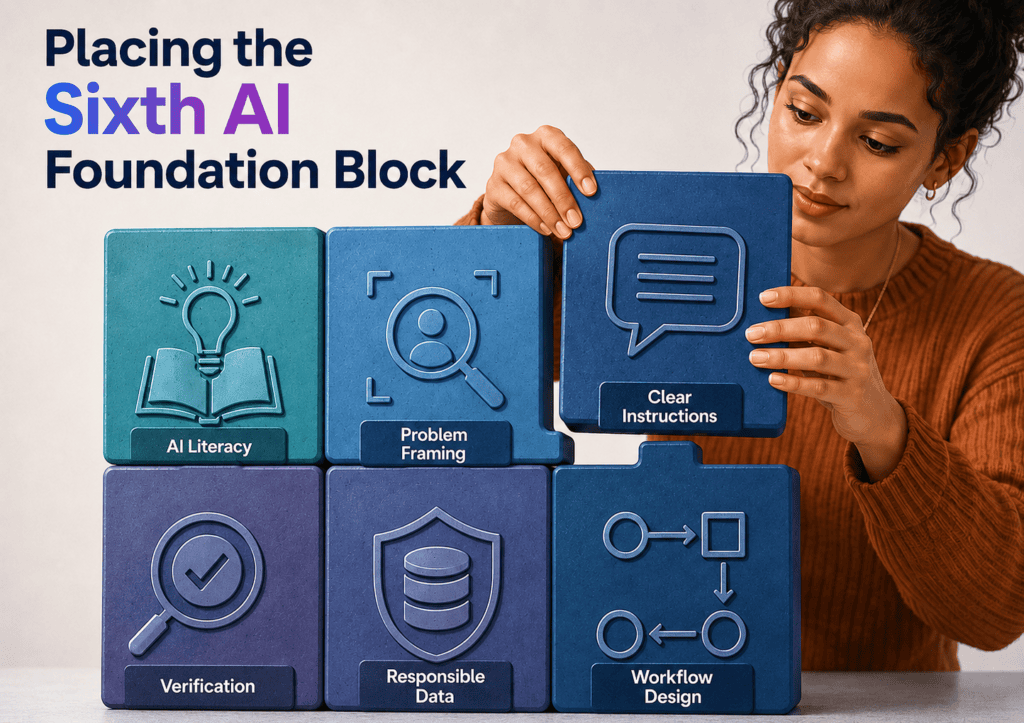
| 4 | Output Verification | Source validation, cross-checking calculations, auditing citations, testing assumptions, and identifying omissions. | You can confidently defend every material claim in an AI output or justify rejecting it entirely. | Autonomous publishing, unreviewed deployment, or hands-off decision-making. |
| 5 | Responsible Data Use | Data privacy protocols, tool permissions, applying the “minimum necessary data” rule, and checking IP policies. | You know exactly what sensitive, proprietary, or personal data must never enter unapproved tools. | Connecting sensitive, internal enterprise datasets directly to public AI tools. |
| 6 | Workflow Design | Mapping human vs. AI steps, setting up human-in-the-loop review gates, defining failure conditions, and tracking quality metrics. | You can execute and document a multi-step human-AI process reliably and repeatably. | Attempting end-to-end, fully autonomous no-code or code-based process automation. |
| 7 | Automation & Integration | Setting up event triggers, mapping data flow, configuring simple APIs or no-code integrations, and error monitoring. | Your underlying manual workflow is stable, repeated frequently, and demonstrably worth automating. | Complex multi-agent architectures or fragile, unmonitored integration loops. |
| 8 | Role-Specific Depth | Domain-tailored execution across growth marketing, user research, data analysis, instruction, operations, or basic scripting. | You have completed a portfolio project that addresses a real-world requirement in your target role. | Enrolling in broad, non-specific AI certificates unrelated to your immediate domain goals. |
| 9 | Specialist Technical Depth | Python programming, machine learning engineering, Retrieval-Augmented Generation (RAG), model evals, and agent design. | You encounter a project requirement that explicitly demands custom software control, data integration, or massive scale. | Fine-tuning proprietary open-source models or training custom LLMs without a research mandate. |
Key Operational Rule
Always treat this sequence as a conditional roadmap. Stages 1 through 5 constitute the mandatory “minimum viable stack” for every professional. Beyond Stage 5, apply the SkillDential Bottleneck-First Rule: only advance to the next layer when a specific, observed friction point in your active workflow requires it.
Why Should AI Literacy Come Before Prompting?
Building prompt engineering capabilities before acquiring baseline AI literacy is one of the most common—and dangerous—mistakes in constructing an AI skills stack.
Prompting is an execution technique. It optimizes how you ask a model to process information, but it cannot fix a fundamental misunderstanding of what the underlying architecture can and cannot do. Without AI literacy, prompt engineering merely accelerates the creation of persuasive errors.
The Operational Boundary Between Literacy and Prompting
Understanding the operational limits of a language model provides the safety boundary within which effective prompting occurs.
+-------------------------------------------------------------------------+
|                          AI LITERACY FOUNDATION                         |
|  Understand limits: Plausible errors, context windows, risk profiles     |
+-------------------------------------------------------------------------+
                                    │
                                    ▼
+-------------------------------------------------------------------------+
|                     APPLIED PROMPT & CONTEXT DESIGN                     |
|  Structure instructions: System prompts, zero/few-shot, constraints    |
+-------------------------------------------------------------------------+
While advanced prompt structures improve output relevance, coherence, and tone, they cannot inherently guarantee:
- Factuality & Truth: A well-structured prompt can still cause a model to confidently hallucinate fake legal citations, flawed code logic, or inaccurate financial calculations.
- Data Freshness: Prompting cannot force a model to know real-time data unless supplied via external context or retrieval tools.
- Risk Suitability: A prompt does not understand the real-world consequences of its output; human judgment must determine whether a task is suitable for AI delegation.
Task Risk Profiles Require Different Literacy Standards
A core element of Layer 1 AI literacy in your AI skills stack is evaluating task exposure. The level of human oversight required scales directly with the real-world risk of the output.
| Dimension | Low-Risk Task (e.g., Social Media Caption) | High-Risk Task (e.g., Medical/Financial Analysis) |
| Primary Risk | Minor brand misalignment, flat messaging | Regulatory breach, physical harm, legal liability |
| Verification Level | Casual review for tone and typos | Line-by-line audit against primary source material |
| Human-in-the-Loop | Single reviewer, high delegation | Multi-stage expert validation, zero autonomous output |
| AI Role | Ideation & drafting accelerator | Context aggregator requiring rigorous human evaluation |
Key Takeaway for Your AI Skills Stack
If you master prompting before literacy, you become skilled at generating text but remain blind to its failure modes. Mastering AI literacy first ensures you know when a model is failing, when to supply external context, and when to bypass AI entirely in favor of human domain expertise.
Why Should Problem Framing Come Before Tool Selection?
Selecting an AI tool before framing the underlying problem is like buying a power tool without knowing whether you are building a bookshelf or fixing a pipe. Problem framing establishes whether artificial intelligence is even the correct solution—and, if so, what success looks like.
Without upfront problem framing, practitioners waste cycles optimizing prompts, tweaking settings, or comparing software platforms without a benchmark for what constitutes a high-quality output.
+---------------------------------------------------------------------------------+
|                            THE PROBLEM-FIRST SEQUENCE                          |
+---------------------------------------------------------------------------------+
|                                                                                 |
|  [ Write Task Brief ] ──> [ Evaluate Impact vs. Effort ] ──> [ Select Tool ]   |
|  • Inputs & Constraints    • Friction & Repeatability       • Simple/Complex    |
|  • Acceptance Criteria     • Risk Profile                   • Model Selection   |
|                                                                                 |
+---------------------------------------------------------------------------------+
The 6-Point Task Brief
Before opening any AI interface, structure your task by drafting a concise brief. Defining these six elements up front prevents wasted generation cycles and anchors your AI skills stack in real-world utility:
- Desired Result: The exact deliverable required (e.g., an executive briefing summary, clean CSV dataset, or code refactor).
- Target Audience: Who will consume or evaluate the final output.
- Available Inputs: Primary source documents, raw data, brand guidelines, or context files provided to the model.
- Constraints: Non-negotiable limits such as word count, formatting rules, style requirements, or banned terms.
- Risks: Failure modes to avoid, such as hallucinated statistics, exposed confidential data, or compliance breaches.
- Acceptance Criteria: Objective metrics that define whether the output is acceptable (e.g., zero factual errors, 100% test pass rate).
Once the brief is complete, your tool choice becomes obvious: always select the simplest tool or model capable of satisfying the acceptance criteria.
Implementation Alignment: Industry Best Practices
This problem-first methodology directly matches practical implementation frameworks recommended by frontier AI developers. For instance, OpenAI’s official deployment guidance advises organizations to avoid jumping straight into software procurement. Instead, they recommend:
- Identifying Concrete Bottlenecks: Focusing on high-friction areas such as repetitive low-value tasks, skill deficits, or time-consuming analysis of ambiguous unstructured data.
- Prioritizing by Impact and Effort: Mapping identified opportunities onto an impact-versus-complexity matrix before selecting model architectures.
Note: While vendor implementation frameworks offer valuable operational advice for system design, treat them as practical execution guides rather than objective, independent labor-market statistics.
By establishing problem framing as a non-negotiable step in your AI skills stack, you ensure that technology choice always serves a clear operational goal—rather than letting shiny tool availability dictate your workflow.
What Does Good Prompting Actually Require?
Effective prompt design is not about discovering secret keywords or collecting static prompt templates; it is about context engineering and precise operational specification. Constructing an effective prompt is far closer to writing a professional brief for a human colleague than programming a traditional computer algorithm.
While specific prompt syntax and technical capabilities vary across model releases, foundational prompting principles transfer across virtually every conversational and multi-modal AI system.
Official Implementation Guidance
Prompt engineering practices recommended by major model builders prioritize clarity and iteration over complexity:
- Be Explicit and Specific: State the core task clearly without assuming implicit knowledge.
- Supply Rich Context: Provide relevant background information, target audience profiles, and primary source documents to anchor the model’s output space.
- Define Output Formats: Specify exact structural requirements (such as tables, markdown, or JSON schemas).
- Audit and Iterate: Systematically evaluate the initial response, identify missing context, and refine instructions iteratively rather than starting over.
The 5-Part Reusable Prompt Architecture
To ensure your AI skills stack delivers consistent, verifiable outputs across different models and interfaces, structure complex prompts using this 5-part architecture:
| Component | Operational Objective | Example Implementation |
| 1. Task | State the precise action to be performed. | “Analyze the attached quarterly customer feedback dataset and summarize key churn drivers.” |
| 2. Context | Supply relevant background, domain rules, or primary source text. | “Our company operates a B2B SaaS platform. Churn has increased 12% among mid-market accounts over the last quarter.” |
| 3. Constraints | Set strict boundaries on what must be included, excluded, or protected. | “Rely strictly on the provided text. Do not invent external benchmarks. Exclude enterprise account data.” |
| 4. Output | Dictate structure, length, tone, and level of detail. | “Provide a Markdown table categorized by ‘Feature Deficit’, ‘Pricing’, and ‘Support’. Limit to 5 key rows.” |
| 5. Quality Test | Specify explicit self-audit or evaluation criteria before final response generation. | “Verify that every cited metric maps directly to a row in the provided CSV file.” |
Key Operational Takeaway
Relying on massive, generic prompt databases creates a fragile AI skills stack. When model architectures or system prompts update, static templates frequently break. Mastering the underlying principles of context delivery, boundary setting, and iterative review ensures your prompting capabilities remain evergreen across any platform or paradigm shift.
Why Is Verification a Core AI Skill?
Verification is a foundational pillar of any professional AI skills stack because large language models are optimized for linguistic plausibility, not guaranteed factual truth. A well-constructed, highly articulate response can easily conceal subtle omissions, hallucinated citations, outdated premises, or flawed logic.
Without systematic verification, using AI in professional environments shifts from an efficiency gain to a compounding risk.
The Anatomy of AI Output Verification
Checking an output goes beyond catching obvious typos or stylistic errors. Professional output verification requires systematically interrogating the response across six operational vectors:
                  +-----------------------------------+
                  |   SIX VECTORS OF AI VERIFICATION   |
                  +-----------------------------------+
                                    |
     +------------------+-----------+-----------+------------------+
     |                  |                       |                  |
     ▼                  ▼                       ▼                  ▼
[ Source Audit ]   [ Calculations ]     [ Documentation ]   [ Freshness ]
Verify primary     Reproduce math       Compare against     Check dates &
citations          & logic steps        official standards  context limits
     |                  |                       |                  |
     +------------------+-----------+-----------+------------------+
                                    |
                        +-----------+-----------+
                        |                       |
                        ▼                       ▼
              [ Explicit Assumptions ]   [ Missing Data ]
Identify unstated premises Audit for critical omissions- Source Auditing: Opening and reading linked or cited primary sources directly to confirm they support the claimed statements.
- Calculation Reproduction: Manually verifying or running scripts to test any mathematical, statistical, or financial data generated by the model.
- Documentation Alignment: Cross-checking technical or policy claims against verified official standards, regulatory guidelines, or enterprise documentation.
- Temporal Freshness: Confirming dates, version numbers, and real-time validity, particularly for fast-moving domains like software development, law, or financial markets.
- Premise & Assumption Auditing: Uncovering unstated premises or underlying biases the model assumed when formulating its response.
- Omission Detection: Explicitly asking: “What critical evidence, counter-arguments, or edge cases were excluded from this summary?”
Proportional Risk: Audit Depth vs. Impact
The depth of your verification process must scale directly with the potential harm caused by an uncorrected error.
| Risk Tier | Task Example | Verification Depth | Human-in-the-Loop Requirement |
| Low Risk | Internal brainstorming, initial draft outlines, social post copy | Spot-check for general coherence, tone, and brand alignment | Single-pass human review before publishing |
| Medium Risk | Competitive research briefs, internal process docs, basic code scripts | Secondary source verification, unit testing, key fact checking | Domain owner sign-off and functional testing |
| High Risk | Medical advice, legal analysis, public financial reporting, security rules | Line-by-line audit against sources, independent math checks | Mandatory multi-stage expert audit; zero autonomous execution |
Institutional Alignment: The NIST AI Risk Framework
The necessity of continuous verification aligns directly with global standards. The NIST AI Risk Management Framework (AI RMF 1.0) structures enterprise AI risk management across four core functions: Govern, Map, Measure, and Manage.
NIST emphasizes that risk evaluation must be continuous across the system lifecycle, rather than a static, one-time checkbox exercise.
+---------------------------------------------------------------------------------+
|              TRANSLATING NIST AI RMF TO INDIVIDUAL WORKFLOWS                   |
+---------------------------------------------------------------------------------+
|                                                                                 |
|  1. GOVERN  ──> Take personal ownership of every published output.               |
|  2. MAP     ──> Understand the specific risk profile of the task context.      |
|  3. MEASURE ──> Systematically test, audit, and verify critical claims.         |
|  4. MANAGE  ──> Intervene immediately when model outputs fail quality standards.|
|                                                                                 |
+---------------------------------------------------------------------------------+
For individual professionals building an AI skills stack, the practical translation of NIST guidance is straightforward: define clear personal responsibility, analyze your operational context, test high-impact outputs rigorously, and establish clear manual interventions when an AI system fails.
Why Must Responsible Data Use Be Part of the Foundation?
Responsible data use must sit at the baseline of your AI skills stack because high productivity never outweighs a compliance breach, leaked trade secret, or privacy violation. A fast, well-prompted output is an operational liability if generated using unauthorized, proprietary, or regulated data.
Core Principles of Baseline Data Governance
Before uploading internal documents or customer inputs to any AI workspace, master these core operational rules:
- 1. Tool Policy Verification: Understand model training opt-outs, enterprise data retention policies, and workspace permissions. Never assume standard consumer tiers protect data confidentiality.
- 2. Data Minimization: Input only the minimum necessary information required to complete the task. Strip out personally identifiable information (PII), proprietary metrics, and customer names before prompting.
- 3. System Authorization: Use only officially vetted and corporate-approved AI applications for workplace tasks.
- 4. Contextual Escalation: Instantly flag and escalate workflows involving sensitive domains—such as health records, hiring assessments, financial evaluations, or legal contracts.
Data Handling Matrix
| Data Classification | Examples | Allowed AI Usage | Action Protocol |
| Public / Non-Sensitive | Marketing blogs, open documentation, industry standards | Standard consumer & enterprise tools | Direct processing with standard output verification |
| Internal Operational | Process guidelines, meeting notes, draft outlines | Approved enterprise workspace tools only | Sanitize internal names; confirm data is excluded from model training |
| Confidential / PII | Source code, financial reports, customer PII, HR records | Dedicated zero-retention / API infrastructure | Apply strict anonymization; require explicit compliance sign-off |
| Highly Regulated | Health records, legal filings, hiring data | Banned on general-purpose AI interfaces | Use specialized, certified local models or human manual execution |
Operational Note: This framework provides general risk-management principles, not legal counsel. Regulatory requirements vary across jurisdictions, industries, data types, and specific enterprise configurations.
Which AI Skills Can Most Beginners Skip for Now?
“Skip for now” is not synonymous with “never learn”—it is a strategic sequencing decision. Adding complex technical capabilities to your AI skills stack before securing core operating fundamentals introduces unnecessary learning friction and creates a fragile, high-maintenance workflow.
A capability belongs in your active stack only when it removes a clear, observed friction point in a real-world workflow or enables a project you could not otherwise execute.
The 5 High-Distraction Traps to Postpone
To optimize your learning ROI, place these five common distractions on hold until your baseline literacy, problem framing, and output verification systems are fully operational.
+---------------------------------------------------------------------------------+
|                       THE ACCELERATED VS. DELAYED STACK                         |
+---------------------------------------------------------------------------------+
|                                                                                 |
|  PRIORITIZE NOW (High Leverage)               POSTPONE FOR LATER (High Overhead) |
|  • Context Engineering & Framing      vs.     • Static Prompt Libraries          |
|  • Systematic Output Verification     vs.     • Premature No-Code Automation     |
|  • Stable Manual Workflow Design      vs.     • Fragile Autonomous Agents        |
|  • Domain-Specific Project Evidence   vs.     • Generic Certificate Collecting   |
|                                                                                 |
+---------------------------------------------------------------------------------+
Code language: PHP (php)
Advanced Model Fine-Tuning & Custom Architecture
- The Distraction: Studying model weights, custom PyTorch/TensorFlow pipelines, or fine-tuning open-source LLMs before mastering basic API utilization or prompt framing.
- Why Skip for Now: Frontier foundation models and retrieval techniques (like basic RAG or context injection) handle 95% of business use cases out of the box without the massive compute, data, and maintenance overhead of custom model training.
- When to Add It: When building specialized proprietary AI products, working in dedicated machine learning engineering roles, or addressing extreme data-sovereignty constraints.
Fragile Multi-Agent System Architectures
- The Distraction: Attempting to build complex, fully autonomous multi-agent loops (e.g., agents assigning tasks to other agents) for routine operational work.
- Why Skip for Now: Autonomous agent loops without human-in-the-loop validation, strict permission boundaries, and deterministic fallback routines frequently loop endlessly, hallucinate at scale, and burn API credits rapidly.
- When to Add It: When you have a stable, highly repeatable manual process with clear error-handling protocols and explicit human review gates already in place.
Collecting Massive, Static Prompt Libraries
- The Distraction: Buying or downloading databases containing thousands of “secret” pre-written prompt templates.
- Why Skip for Now: Static prompts break as underlying model architectures and system instructions evolve. Relying on fixed templates prevents you from mastering true context engineering, task framing, and real-time output iteration.
- When to Add It: Never. Instead, build a small, internal library of personal, field-tested prompt structures tailored specifically to your exact domain workflows.
Premature End-to-End Workflow Automation
- The Distraction: Connecting no-code automation platforms (like Make or Zapier) to AI models before the manual process is fully stable, tested, and documented.
- Why Skip for Now: Automating an unverified process simply accelerates the distribution of low-quality outputs or undetected errors throughout your tech stack.
- When to Add It: Apply the SkillDential Bottleneck-First Rule: only automate when a manual, multi-step process is stable, frequently repeated, error-checked, and consuming significant operational time.
Certificate Collecting Without Project Proof
- The Distraction: Enrolling in multiple broad, introductory AI courses to accumulate digital badges and certificates for your resume.
- Why Skip for Now: Hiring managers and clients increasingly treat generic AI badges as low-signal metrics. Demonstrable proof of capability—such as a case study showing how you solved a bottleneck or improved output quality—carries far more weight.
- When to Add It: Use formal courses selectively to bridge a specific technical gap, but prioritize building public portfolio artifacts over accumulating completion credentials.
The Sequencing Decision Matrix
| Capability / Focus | Immediate Action (Current Stack) | Postponed Action (Future Stack) |
| Prompting Strategy | Master 5-part context framing and iterative refinement. | Downloading mega-prompts or memorizing “magic” phrases. |
| Process Execution | Run human-in-the-loop workflows with line-by-line verification. | Building unmonitored, fully autonomous agent chains. |
| Technical Skills | Learn basic data structures, API keys, and structured output formatting. | Fine-tuning base models or studying deep learning math. |
| Career Proof | Document a real-world project that solved a concrete bottleneck. | Collecting generic introductory AI certificates. |
Should You Stop Chasing Every New AI Tool?
Constant tool switching is one of the highest-overhead distractions in digital skill development. Tool discovery often feels like productive work, but continuously migrating between platforms prevents you from mastering the foundational layers of your AI skills stack: task framing, context design, output verification, and workflow measurement.
For beginners, the optimal strategy is to commit to one main general-purpose model (such as Claude, ChatGPT, or Gemini) and push its operational limits before introducing software complexity.
The 7-Point Tool Switch Checklist
Switching software is justified only when you can state a concrete operational constraint that your current setup cannot meet. Evaluate potential tools using these testable criteria:
- Data Governance & Privacy: The new tool provides required enterprise data-retention opt-outs, local hosting, or compliance certifications (e.g., SOC2, HIPAA) missing from your current option.
- Task-Specific Performance: Benchmark testing shows a measurable increase in output accuracy or reasoning depth on a specific, high-value task.
- Modality & Input Support: The workflow requires native handling of specific file formats, audio/video parsing, or multimodal inputs that your current model cannot process.
- Ecosystem Integration: The application connects natively via API or direct integration into software your team already relies on (e.g., GitHub, Notion, workspace suites).
- Language & Accessibility: The tool offers significantly superior localized language nuance, regional availability, or screen-reader accessibility.
- Unit Economics & Scale: High-volume execution makes alternative models or APIs substantially cheaper per execution unit.
- Documented Failure Rates: Your current platform exhibits persistent, unresolvable reliability or latency issues for an established workflow.
Popularity Is Not an Operational Requirement
“This tool is currently viral” or “This product has a slick interface” are non-technical metrics.
By grounding your tool choices in explicit operational needs, you protect your AI skills stack from shiny-object syndrome—ensuring every new platform added to your workflow serves a clear, measurable purpose.
Are Large Prompt Libraries Worth Learning?
Large prompt libraries are useful reference archives, but memorizing or blindly collecting them is a low-ROI activity for building an AI skills stack.
A pre-written prompt is static, whereas real-world operating environments are dynamic. When model architectures update, target audiences shift, source material changes, or context limits expand, a copied prompt often breaks or generates generic, off-target outputs.
Learning how to diagnose, structure, and adapt instructions yields far greater long-term value than hoarding static templates.
Why Static Prompt Libraries Fail in Practice
Relying heavily on prompt databases creates a fragile capability set due to three primary limitations:
- Context Insufficiency: A static prompt contains instructions (“how to ask”), but it lacks your specific enterprise data, source material, and operational context (“what to know”). Modern AI execution prioritizes context engineering—supplying precise data and constraints—over clever phrasing.
- Model Sensitivity & Version Drift: System updates, model fine-tuning, and platform changes frequently render hyper-specific “magic words” ineffective across different interfaces.
- Lack of Diagnostic Depth: When a copied 500-word prompt yields a flawed output, a user who does not understand context design cannot pinpoint whether the issue stems from ambiguous goals, missing constraints, or bad source inputs.
Dynamic Context Design vs. Static Prompt Hoarding
| Dimension | Static Prompt Libraries | Dynamic Context Design (Skill-First) |
| Primary Method | Copying fixed, pre-written templates | Structuring dynamic instructions based on specific task brief |
| Adaptability | Low (fails when inputs, models, or goals shift) | High (transfers seamlessly across models, APIs, and interfaces) |
| Skill Focus | Memorizing phrasing and rigid structures | Framing tasks, setting boundaries, and auditing outputs |
| Operational Risk | High (produces persuasive errors when context is missing) | Low (anchors output directly to verified source material) |
The SOP Framework: How to Store High-Value Prompts
Prompt collecting is only justified when it supports a frequently repeated, stable workflow. Rather than building a massive database of generic prompts, document a small internal library of field-tested Standard Operating Procedures (SOPs).
Beside every saved prompt, record the operational metadata required to execute it reliably:
+---------------------------------------------------------------------------------+
|                         REUSABLE PROMPT SOP MATRIX                              |
+---------------------------------------------------------------------------------+
|                                                                                 |
|  1. INPUT REQUIREMENTS  ──> What exact documents, data, or context must be fed  |
|                             into the model alongside the prompt?                |
|                                                                                 |
|  2. PROMPT CORE         ──> The 5-part structure (Task, Context, Constraints,   |
|                             Output, Quality Test).                              |
|                                                                                 |
|  3. KNOWN FAILURE MODES ──> What common hallucinations, missing edge cases, or  |
|                             formatting errors usually occur?                    |
|                                                                                 |
|  4. REVIEW PROCEDURE    ──> How must a human verify the output before deployment?|
|                                                                                 |
+---------------------------------------------------------------------------------+
The Bottom Line
A short, adaptable prompt structure that you can diagnose, iterate on, and verify line-by-line is vastly more valuable than a repository of thousands of unverified templates. Focus your AI skills stack on problem framing and context design—and save prompts only when backed by clear human review procedures.
Should You Learn to Train an AI Model From Scratch?
Training a foundation model from scratch is one of the highest-overhead, lowest-ROI activities a beginner can pursue when building an AI skills stack.
Designing, training, and deploying a base model requires deep expertise across advanced calculus, linear algebra, distributed computing infrastructure, massive dataset curation, model evaluations, and complex security protocols. Unless you are entering core machine-learning research or building low-level model architecture, training from scratch is an unnecessary detour.
The Reality of Modern AI Value Creation
The term “working in AI” is often misunderstood as synonymous with building foundation models. In reality, the overwhelming majority of economic and career value is generated at the application, evaluation, and operational layers—not the base model layer.
+---------------------------------------------------------------------------------+
|                       WHERE ECONOMIC VALUE IS CREATED                           |
+---------------------------------------------------------------------------------+
|                                                                                 |
|  [ BASE MODEL LEVEL ]      --> Heavy compute, massive capital, specialized math |
|                                (OpenAI, Anthropic, Google Meta)                 |
|                                                                                 |
|  [ VALUE & ADOPTION LAYER ] --> Context engineering, RAG, domain integration,   |
|                                workflow design, risk management, product design|
|                                (Where 95%+ of professionals operate)            |
|                                                                                 |
+---------------------------------------------------------------------------------+
Most professionals create immediate, high-leverage impact by learning to:
- Evaluate Models: Auditing outputs for hallucinations, logic gaps, and domain accuracy.
- Ground Models: Connecting general-purpose LLMs to proprietary datasets via Retrieval-Augmented Generation (RAG) or structured context injection.
- Integrate Workflows: Connecting model APIs to existing software environments and automated processes.
- Apply Domain Expertise: Combining deep industry knowledge (law, medicine, marketing, finance) with AI augmentation.
Machine-Learning Engineer vs. AI Augmented Professional
| Career Path | Primary Focus | Required AI Skills Stack Depth |
| Machine-Learning Engineer / Researcher | Designing algorithms, model training, pre-training datasets, architecture optimization. | Level 9 (Specialist Technical): Advanced Python, PyTorch, C++, linear algebra, distributed GPU systems. |
| AI Systems / Product Specialist | Designing user experiences, API integrations, evaluation benchmarks, product features. | Level 7–8: API configuration, structured outputs, basic scripting, evals, user research. |
| AI-Augmented Professional / Operations Lead | Streamlining workflows, quality assurance, context design, responsible data governance. | Level 1–6: Literacy, problem framing, context engineering, output verification, process mapping. |
When Is Model Training Worth It?
Training or fine-tuning a model becomes relevant only when you encounter a clear technical constraint that existing foundation models cannot solve:
- Extreme Privacy / Data Sovereignty: Complete network isolation where external API calls are legally prohibited.
- Proprietary Domain Dialects: Highly specialized technical vocabularies or data formats where base models fail even with retrieval grounding.
- Specialized Academic / ML Research: Pursuing novel AI architectures, mechanistic interpretability, or foundational computer science research.
For everyone else, focus your AI skills stack on mastering task framing, context design, system evaluation, and domain execution—the capabilities that turn existing AI models into immediate real-world outcomes.
Is Fine-Tuning a Beginner Priority?
Fine-tuning is rarely a beginner priority. It introduces significant data engineering, evaluation, and infrastructure overhead that can easily trap learners in complex maintenance cycles without delivering a proportional increase in performance.
For the overwhelming majority of business use cases and early-stage projects, starting with structured context, better task framing, and retrieval architectures yields far higher returns with a fraction of the complexity.
The Optimization Staircase: What to Try Before Fine-Tuning
Before considering fine-tuning, systematically progress through lower-overhead methods within your AI skills stack:
+---------------------------------------------------------------------------------+
|                       THE CONTEXT-TO-FINE-TUNING PROGRESSION                    |
+---------------------------------------------------------------------------------+
|                                                                                 |
|  1. Context Engineering  ──> Precise task briefs, constraints, & output schemas |
|  2. Few-Shot In-Context  ──> Providing 3-5 high-quality reference examples      |
|  3. Retrieval (RAG)      ──> Dynamically injecting current or private documents |
|  4. Fine-Tuning          ──> Training weights on static, highly specialized data |
|                                                                                 |
+---------------------------------------------------------------------------------+
Code language: PHP (php)- Context & Instruction Refinement: Optimize task framing, specify explicit constraints, and define strict output schemas.
- Few-Shot Prompting: Provide 3 to 5 clear, high-quality gold-standard examples directly within the context window.
- Retrieval-Augmented Generation (RAG): Connect your model dynamically to external vector databases or internal document repositories.
Architecture Decision: RAG vs. Fine-Tuning
A frequent architectural mistake is using fine-tuning to teach a model new facts or update static knowledge. Fine-tuning modifies behavior, tone, and formatting style, whereas Retrieval (RAG) supplies knowledge, facts, and freshness.
| Architectural Vector | Retrieval-Augmented Generation (RAG) | Model Fine-Tuning |
| Primary Use Case | Accessing current facts, private data, or vast document libraries. | Enforcing strict custom syntax, specialized tone, or complex output structures. |
| Data Freshness | High (instant updates by updating the underlying document store). | Low (requires retraining data pipelines when information changes). |
| Source Provenance | Excellent (enables exact citations and line-by-line source checks). | Poor (model weights obscure explicit source citations). |
| Maintenance Overhead | Moderate (managing vector storage and chunking strategy). | High (managing dataset formatting, overfitting risks, evals, and compute). |
When Does Fine-Tuning Become Relevant?
Only advance to fine-tuning when you meet four specific criteria:
- Stable Behavioral Target: The operational behavior, output format, or domain style is fixed and will not change frequently.
- High-Quality Dataset: You possess a curated, benchmarked dataset of hundreds or thousands of audited input-output pairs.
- Comprehensive Evals: You have built a robust evaluation system to quantify model accuracy and detect regression.
- In-Context Limitations: Simpler methods—like multi-shot prompting or RAG—consistently fail to achieve the required structural adherence or latency targets.
By mastering task definition, context engineering, and retrieval first, you keep your AI skills stack lean, adaptable, and free of unnecessary technical debt.
Should You Build an AI Agent as Your First Project?
No. A bounded assistant or a deterministic, human-directed workflow is a vastly superior first project when building your AI skills stack.
Autonomous agents are designed to make independent decisions, dynamically select tools, and execute multi-step paths with minimal oversight. However, every added permission, conditional branch, API integration, and handoff creates a compounding failure point that is difficult to test, explain, and control.
Starting your applied learning with a fully autonomous agent is equivalent to learning to drive in a Formula 1 car—it introduces massive operational risk before you have mastered baseline navigation.
Deterministic Workflows vs. Autonomous Agents
| Dimension | Deterministic Workflow (Start Here) | Autonomous Agent (Postpone) |
| Execution Path | Linear, predictable, human-directed | Looped, non-linear, independent routing |
| Failure Points | Low (isolated to model output quality) | High (tool selection, infinite loops, logic breaks) |
| Testability | High (clear 1:1 input-to-output mapping) | Low (ambiguous, non-deterministic decision trees) |
| Best Used For | Drafting, summarization, stable data extraction | Open-ended goal seeking, complex tool orchestration |
The Complexity Test (Vendor Guidance)
To determine when an agent actually belongs in your AI skills stack, apply the complexity test. OpenAI’s official deployment guidance explicitly warns against premature agent development. They recommend reserving autonomous systems exclusively for workflows that have actively resisted traditional automation:
- Complex Decision-Making: Processes requiring nuanced, context-sensitive judgment (e.g., qualitative fraud analysis).
- Brittle Rulesets: Systems that have become too difficult to maintain via traditional coding logic.
- Unstructured Data Heavy: Scenarios demanding heavy interpretation of natural language documents.
If your workflow does not meet these specific criteria, OpenAI—the vendor selling the models—states that a traditional, deterministic solution is sufficient.
The Execution Rule
Start with one tightly controlled, linear workflow. Add an autonomous agent to your AI skills stack only when rigorous testing proves that simpler automation and human-in-the-loop validation physically cannot handle the required ambiguity or scale.
Should You Collect AI Certificates Before Building Projects?
No. A certificate can structure your learning and add polish to a resume, but accumulating digital badges without real-world application creates false signal.
Hiring managers, clients, and technical leads prioritize verified proof of capability over course completion badges. A portfolio artifact demonstrates how you think, how you handle failure modes, and whether you can be trusted with operational data; a certificate merely proves you watched videos and passed a multiple-choice quiz.
The Artifact Framework: Proof Over Badges
For every major course or learning module you complete, build one documented project artifact that proves you applied the concept. A high-signal portfolio entry does not need to be a commercially successful product—it simply must demonstrate analytical rigor, process design, and honest evaluation.
+---------------------------------------------------------------------------------+
|                       THE 6-POINT PROJECT ARTIFACT FRAMEWORK                    |
+---------------------------------------------------------------------------------+
|                                                                                 |
|  1. PROBLEM DEFINITION   ──> Who is the user, and what exact constraint exists? |
|  2. WORKFLOW MAP         ──> What was the process before vs. after AI adoption?  |
|  3. TOOL & DATA MATRIX   ──> What inputs, models, and interfaces were used?    |
|  4. VERIFICATION METHOD  ──> How were output accuracy and hallucination checked?|
|  5. RISKS & LIMITATIONS  ──> Where does the system fail or leak context?        |
|  6. MEASURABLE LESSON    ──> What were the quantitative or qualitative results? |
|                                                                                 |
+---------------------------------------------------------------------------------+
The 6 Elements of a High-Signal AI Case Study
- Problem & Target User: Clearly articulate the specific bottleneck or operational pain point and state who benefits from its resolution.
- Before-and-After Workflow: Show the manual process alongside your redesigned, AI-augmented process (highlighting human-in-the-loop review points).
- Data & Tool Stack: Detail the exact datasets, prompt structures, context parameters, and models used.
- Verification Protocol: Explain the line-by-line verification rules, source auditing, or unit testing used to validate outputs.
- Limitations & Failure Modes: Transparently document where the system struggled, what hallucinations occurred, and what security/privacy precautions were implemented.
- Results & Operational Lessons: Share the final output metrics (e.g., time saved, error rate reduction, or quality improvements) and what you would refine in version 2.0.
Certificates vs. Projects: The Hiring Signal Gap
| Dimension | Course Certificate | Documented Project Artifact |
| Primary Proof | Proves you consumed content and completed lessons. | Proves you can frame problems and execute solutions. |
| Risk Management | Silent on output verification and risk handling. | Demonstrates explicit verification and error checking. |
| Market Value | Low (treatable as passive resume filler). | High (serves as direct proof of professional capability). |
| Adaptability | Reflects static course material. | Reflects real-world problem-solving under constraints. |
The Operational Strategy
Use formal courses selectively to structure new learning topics or map out an unfamiliar capability layer. However, never consider a skill added to your AI skills stack until you have published a documented project artifact detailing its execution.
How Should Different Career Paths Modify the AI Skills Stack?
While foundational literacy, context engineering, output verification, and responsible data governance are non-negotiable for everyone, higher levels of your AI skills stack must adapt to your role. The objective is role relevance and risk management—not accumulating maximum technical complexity.
The decision matrix below outlines how key career paths should modify their learning progression, indicating what to add next, what to postpone, and what serves as definitive proof of work.
Career-Specific AI Skills Stack Matrix
| Career Direction | Add After Baseline Foundation | Useful Later | Usually Skip at First | Suitable Proof-of-Work Project |
| Student / Recent Graduate | Research planning, source evaluation, spreadsheet basics, presentation design, responsible academic use. | Python or data analysis (if required by target role). | Multi-agent systems, complex model fine-tuning. | A cited research brief with an audit trail showing AI assistance and human verification. |
| Non-Technical Professional | Meeting workflows, document analysis, process mapping, data privacy, quality review. | Employer-supported no-code automation and APIs. | Advanced machine learning engineering. | A recurring report or administrative workflow with documented review checkpoints. |
| Creator / Marketer | Audience research, content briefs, editorial workflows, brand constraints, performance analytics. | Image/video workflows, automation, lightweight APIs. | RAG architecture or custom agents without business repositories. | A campaign workflow showing source materials, prompt logic, human edits, and outcomes. |
| Freelancer / Consultant | Requirements gathering, client-data governance, repeatable delivery templates, SOP documentation. | Automation, secure client integrations. | Connecting directly to client infrastructure before clearing permissions. | A documented before-and-after case study covering one bounded client workflow. |
| Analyst / Operations | Advanced spreadsheets, SQL, data cleaning, data visualization, process measurement. | Python, API integrations, interactive dashboards, controlled automation. | Generative interfaces that cannot reproduce underlying calculations. | A data pipeline report detailing sources, explicit calculation checks, and exception handling. |
| Educator / Trainer | Instructional design, assessment framing, accessibility standards, academic integrity, safeguarding. | Learning analytics, approved education integrations. | Autonomous grading or unmonitored decision systems affecting learners. | A lesson and assessment workflow featuring clear objectives, differentiation, and teacher review. |
| Developer / AI Builder | Python (or primary production language), Git, API configuration, unit testing, security, evals. | RAG architectures, fine-tuning, agent deployment, observability stacks. | Complex multi-agent architectures before a single linear workflow functions. | A small application featuring comprehensive test cases, failure handling, permissions, and docs. |
Strategic Rule for Career Progression
Always specialize outward from your core domain expertise, not away from it. AI tools should amplify your existing professional skills rather than replace your functional domain knowledge.
By grounding your AI skills stack in role-relevant tasks and backed by verified proof-of-work projects, you build a defensible, high-signal career profile.
What Should Students and Career Switchers Prioritize?
Students and career switchers frequently fall into the trap of over-engineering their learning path—attempting to master deep machine learning theory when their target jobs simply require high-level operational execution.
Unless your explicit goal is to become an AI engineer, you do not need to reproduce a computer science curriculum. Instead, focus on building transferable AI literacy, context engineering, rigorous output verification, and one role-aligned portfolio project.
The Reverse-Engineered Career Progression
To build a high-leverage AI skills stack that hiring managers actually value, follow a 4-step reverse-engineering framework:
+---------------------------------------------------------------------------------+
|                    REVERSE-ENGINEERED LEARNING FRAMEWORK                       |
+---------------------------------------------------------------------------------+
|                                                                                 |
|  1. TARGET ROLE      ──> Select one explicit job title (e.g., Ops Analyst).     |
|  2. JOB DESCRIPTION  ──> Audit 10–15 job postings; extract repeated core tasks. |
|     AUDIT                                                                       |
|  3. MINIMUM STACK    ──> Map AI augmentation to those specific core tasks.      |
|  4. PROOF-OF-WORK    ──> Build one documented case study demonstrating execution. |
|                                                                                 |
+---------------------------------------------------------------------------------+
Code language: JavaScript (javascript)
Step 1: Analyze Real Market Demand
Select a specific target role and analyze 10 to 15 active job listings. Ignore generic buzzwords and pull out the recurring daily responsibilities, required data inputs, and operational software.
Step 2: Build the Minimum Viable Stack
Construct the smallest possible capability set that allows you to execute one of those core job responsibilities at a high standard:
- Aspiring Operations Analyst: Prioritize advanced spreadsheet modeling, SQL data extraction, process mapping, and AI-assisted report generation over neural network theory.
- Aspiring Growth Marketer: Prioritize audience research framing, copy editing workflows, brand context injection, and performance analytics over custom API development.
- Aspiring AI Systems Engineer: Prioritize Python, Git, API architecture, vector database integration, and model evaluations.
Step 3: Produce Credible Evidence
Build a single, documented proof-of-work project that showcases your problem framing, input data, human-in-the-loop review checkpoints, and final output metrics.
Key Takeaway for Career Switchers
Employers hire people who can solve immediate operational problems, not people who hold long lists of unapplied certifications. By focusing your AI skills stack strictly on the tasks required by your target role, you turn artificial intelligence into a direct career multiplier.
What Should Non-Technical Professionals Prioritize?
For non-technical professionals, the objective of building an AI skills stack is not generating higher volumes of raw content. It is designing workflows that systematically eliminate low-value operational drag without compromising accuracy, data confidentiality, accountability, or professional judgment.
The Operational Target: High-Friction Administrative Drag
Non-technical practitioners derive the highest leverage by targeting recurring, structured, administrative tasks. Focus your AI skills stack on six core operational use cases:
- Summarization: Digesting long-form, pre-approved internal documents, transcripts, or policy guidelines.
- Structured Data Extraction: Pulling standardized fields (e.g., action items, key dates, risk factors) from unstructured text into clean tables or spreadsheets.
- Drafting from Verified Inputs: Generating initial draft communications, project briefs, or reports strictly anchored to primary source material.
- Document Benchmarking & Comparison: Identifying discrepancies, missing clauses, or structural differences between two text versions.
- Meeting Preparation: Synthesizing attendee background, past project notes, and agenda items into executive prep briefs.
- Action Item Conversion: Transforming unstructured meeting transcripts or brainstorm notes into assigned tasks with explicit deadlines.
The Non-Technical Professional Workflow Guardrails
To ensure AI augmentation enhances performance without creating operational liability, every non-technical workflow must enforce four non-negotiable guardrails:
+---------------------------------------------------------------------------------+
|                       NON-TECHNICAL WORKFLOW GUARDRAILS                         |
+---------------------------------------------------------------------------------+
|                                                                                 |
|  1. CONFIDENTIALITY ──> Never input unapproved, PII, or sensitive company data  |
|                         into public, unvetted AI interfaces.                    |
|                                                                                 |
|  2. ANCHORED INPUTS ──> Restrict generation strictly to provided, verified      |
|                         source documents (Context Engineering).                 |
|                                                                                 |
|  3. MANDATORY AUDIT ──> Line-by-line verification of factual claims, metrics,   |
|                         and dates before distribution.                          |
|                                                                                 |
|  4. OWNERSHIP       ──> Retain 100% personal responsibility for final outcomes;   |
|                         AI assists execution, but humans hold accountability.   |
|                                                                                 |
+---------------------------------------------------------------------------------+
Code language: PHP (php)
Strategic Summary
The value of an AI skills stack for non-technical professionals lies in time reclamation. By automating low-cognition processing while maintaining strict oversight of output quality, you free up bandwidth for high-leverage human work: strategic decision-making, stakeholder management, and creative problem-solving.
What Should Creators, Freelancers, and Marketers Prioritize?
For creators, freelancers, and marketers, the goal of building an AI skills stack is not producing undifferentiated content at scale. Generic, low-effort AI text floods digital channels daily; true competitive advantage comes from pairing artificial intelligence with deep audience empathy, sharp research, brand judgment, and rigorous editorial oversight.
The 6 Core Capabilities for Growth Practitioners
To build a high-leverage AI skills stack in marketing and creative fields, prioritize these six capabilities over raw content generation:
- Audience Insight & Research Synthesis: Using AI to analyze user interview transcripts, survey data, and customer reviews to uncover core pain points and buying triggers.
- Context-Driven Content Briefing: Structuring rich briefs that supply models with target personas, tone guidelines, search intent, and primary source material.
- Brand Voice & Constraint Engineering: Enforcing strict negative constraints (e.g., banned jargon, tone parameters) to protect brand integrity.
- Sharp Editorial & Fact Auditing: Treating initial AI outputs as rough first drafts—editing heavily for human nuance, verifying statistics, and cutting generic filler.
- Performance Analytics Interpretation: Leveraging AI to parse campaign metrics, perform A/B test analysis, and extract actionable optimization steps.
- Compliance & Platform Governance: Adhering to search engine quality guidelines, platform disclosure policies, and copyright rules.
The High-Signal Portfolio Framework: Transparent Proof-of-Work
Client and hiring managers routinely reject marketers who simply generate AI copy. To prove your value, your portfolio must showcase your editorial process and strategic judgment, not just the final asset.
+---------------------------------------------------------------------------------+
|                    THE CREATIVE PROOF-OF-WORK PIPELINE                          |
+---------------------------------------------------------------------------------+
|                                                                                 |
|  [ Original Brief ]  ──>  [ Verified Source Data ] ──>  [ AI Raw Draft ]       |
|                                                                │                |
|  [ Performance Metric ] <── [ Final Asset ] <── [ Editorial Edits & Rejections ]|
|                                                                                 |
+---------------------------------------------------------------------------------+
Code language: PHP (php)
What a High-Signal Creative Artifact Must Include
- Original Brief & Target Persona: Define the objective, target audience, and key performance indicators (KPIs).
- Primary Source Inputs: Document the exact research, customer quotes, or data fed into the model.
- Raw AI Output: Include the initial draft to highlight the starting point.
- Editorial Track-Changes & Rejections: Explicitly show what text was rewritten, what hallucinations or generic claims were rejected, and why.
- Final Published Asset: Present the polished, brand-aligned deliverable.
- Performance Metrics: Share real-world results (e.g., conversion rate, engagement lift, or organic search rankings achieved).
Key Takeaway for Marketers and Creators
AI accelerates execution, but human judgment commands the market premium. By positioning your AI skills stack around research, context engineering, and editorial control, you position yourself as a high-leverage strategist rather than a commodity content operator.
What Should Analysts and Operations Professionals Prioritize?
For analysts and operations leads, an AI skills stack is not about generating automated opinions or skipping baseline data prep. It is about accelerating analytical throughput while preserving total auditability, calculation reproducibility, and data integrity.
AI must never serve as a black box for analytical execution. If another professional cannot inspect your source data, trace your explicit calculation logic, and reproduce your results, the output is an operational liability.
Core Priorities for Analytical & Ops Workflows
To build a high-signal AI skills stack in data-driven roles, structure your capabilities around five core pillars:
- Data Hygiene & Cleaning: Using AI to assist in regex generation, data standardization, and anomaly detection without altering raw source files.
- Process Mapping & Bottleneck Identification: Structuring current-state vs. future-state operational workflows to isolate manual friction points before introducing software.
- Spreadsheet & SQL Acceleration: Leveraging AI for complex formula construction, query optimization, and schema mapping while manually verifying logic steps.
- Reproducible Code Transformations: Moving up to Python, R, or dbt when data transformations are high-volume, recurring, or too complex for standard spreadsheet audit trails.
- Verification & Audit Logging: Documenting explicit business assumptions, checking statistical distributions, and building automated unit tests for data outputs.
The Auditability Requirement: The 4-Part Data Ledger
Every AI-assisted analysis, dashboard, or operational report must be backed by a transparent audit trail. Never present AI-generated metrics without documenting these four elements:
+---------------------------------------------------------------------------------+
|                         THE REPRODUCIBLE DATA LEDGER                            |
+---------------------------------------------------------------------------------+
|                                                                                 |
|  1. RAW SOURCE DATA     ──> Unaltered primary datasets, API exports, or SQL     |
|                             query logs stored in a read-only state.             |
|                                                                                 |
|  2. CALCULATION PATH    ──> The explicit code, formulas, or SQL transformations   |
|                             used to process the data (no black-box AI outputs). |
|                                                                                 |
|  3. EXPLICIT ASSUMPTIONS──> Documented boundary conditions, handling of null    |
|                             values, and statistical assumptions.                |
|                                                                                 |
|  4. EXCEPTION & AUDIT   ──> Manual review notes detailing edge cases, outlier   |
|     LOG                     verifications, and test pass/fail results.          |
|                                                                                 |
+---------------------------------------------------------------------------------+
Code language: PHP (php)
Technical Tool Progression for Operations
| Stage | Capability Layer | Primary Tools | Operational Trigger to Move Up |
| Stage 1 | Baseline Spreadsheets & SQL | Excel, Google Sheets, PostgreSQL, AI Assistants | Manual data manipulation takes under 2 hours per week. |
| Stage 2 | Process Mapping & SOPs | Lucidchart, Notion, Structured Prompts | Workflow spans multiple teams and requires human review gates. |
| Stage 3 | Scripted Data Transformation | Python (Pandas), R, dbt, SQL APIs | Datasets exceed spreadsheet row limits or require repeated cleaning. |
| Stage 4 | Controlled Automation & Evals | Make, Zapier, Python Scripts, Model Evals | Process is 100% deterministic, error-checked, and highly repeatable. |
Key Operational Rule
AI should generate the code or formula to execute an analysis—not perform the math in its own context window. Using generative AI directly to calculate financial totals or statistical aggregations leads to hallucinated figures. Keep calculation engines deterministic, and use your AI skills stack to write, optimize, and document the underlying logic.
What Should Developers and Aspiring AI Builders Prioritize?
For developers and aspiring AI builders, technical expertise does not replace foundational judgment, problem framing, or responsible data use. Building software with artificial intelligence requires integrating model capabilities into production-grade systems—where reliability, security, testability, and cost control govern architecture decisions.
The Engineering Priorities for AI Systems
To construct a defensible technical AI skills stack, software engineers and AI builders must prioritize system-level reliability over architectural complexity:
- Modern Software Foundations: Git version control, modular code architecture, environment management, and secure API key handling.
- API & Structured Output Design: Enforcing strict schema compliance (e.g., Pydantic, JSON schema) to ensure model outputs reliably integrate into downstream application logic.
- Comprehensive Testing & Model Evaluations (Evals): Building automated unit tests, integration tests, and custom benchmarking suites to quantify accuracy, latency, and regression risks across model updates.
- Security & Red-Teaming: Implementing robust input sanitization, prompt-injection defenses, role-based access controls, and strict data-handling boundaries.
- Observability & Cost Monitoring: Tracking token consumption, response latency, call traces, and failure rates across production environments.
Progressive Architecture: From Simple to Complex
The most common engineering failure in AI development is over-architecting early. Always build the simplest deterministic architecture first, advancing to complex patterns only when empirical testing demands it.
+---------------------------------------------------------------------------------+
|                    PROGRESSIVE TECHNICAL ARCHITECTURE STACK                     |
+---------------------------------------------------------------------------------+
|                                                                                 |
|  Stage 1: Linear API Call    ──> System prompt + user input + schema validation |
|                                                                                 |
|  Stage 2: Context Retrieval   ──> Vector database / RAG pipeline for static data |
|                                                                                 |
|  Stage 3: Function Calling   ──> Model triggers deterministic external tools    |
|                                                                                 |
|  Stage 4: Autonomous Agent   ──> Dynamic multi-step loop with strict eval gates |
|                                                                                 |
+---------------------------------------------------------------------------------+
Code language: JavaScript (javascript)
The Technical Architecture Rule
Start with a small, single-call bounded application. Do not introduce Retrieval-Augmented Generation (RAG), autonomous tool execution, or multi-agent orchestration until automated tests prove that a simpler, linear architecture physically cannot meet requirements.
Core Difference: Traditional Software vs. AI Engineering
| Engineering Dimension | Traditional Software Development | AI Application Engineering |
| Logic Model | Deterministic (If X, then Y) | Probabilistic (Outputs carry variance) |
| Testing Paradigm | Unit tests with exact assertions | Statistical evals, output assertions, boundary checks |
| Failure Modes | Code crashes, explicit stack traces | Hallucinations, subtle logic drift, context degradation |
| Primary Metric | Code coverage, pass/fail rate | Precision, recall, latency, cost per 1k tokens |
Key Operational Takeaway
Writing complex Python scripts or stitching together multi-agent frameworks without robust evaluation benchmarks is simply technical debt in disguise. A master AI builder’s AI skills stack relies on clean software engineering principles: measure baseline performance with rigorous evals, secure the application surface, and keep the system architecture as lean as possible for as long as possible.
When Should You Learn Python, APIs, RAG, Automation, or AI Agents?
Learning an advanced technical skill should always be a conditional decision based on system control, scale, integration requirements, data freshness, and reliability—never on prestige or industry hype.
Technical Layer Progression Framework
| Technical Layer | Learn It When | Delay It When | Learn First | Appropriate First Project |
| Python | You need custom data processing, scriptable logic, data analysis, custom APIs, automated testing, or an engineering career track. | Tasks are occasional and existing out-of-the-box software meets the functional requirement. | Basic programming logic, file handling, data structures, functions, and exception handling. | Clean a raw CSV dataset programmatically and output a reproducible summary report. |
| APIs | Disparate software systems must reliably exchange data, or application code must invoke model endpoints programmatically. | Manually copying small amounts of data is faster, safer, and involves low operational friction. | HTTP methods (GET/POST), authentication headers, JSON payloads, rate limiting, and status errors. | Send user-submitted text to a model endpoint and format the returned JSON response into a workspace tracker. |
| No-Code Automation | A stable, recurring process features clear inputs, deterministic outputs, and established human review gates. | The process logic changes frequently, or systemic errors are difficult to detect automatically. | Process mapping, data governance permissions, trigger event logic, and execution logging. | Automatically route approved form submissions into a reviewed tracking workspace. |
| RAG (Retrieval-Augmented Generation) | Model responses must ground themselves in real-time, private, or organization-specific documentation. | The task is a one-off query, the document corpus is tiny, or standard prompt context is sufficient. | Document hygiene, vector retrieval principles, access control, text chunking, and evaluation metrics. | Build a cited Q&A search tool over a small, vetted set of internal company policy PDFs. |
| AI Agents | The workflow requires dynamic contextual decisions, tool selection, or processing complex unstructured data. | A fixed script, rule-based automation, or single linear model call can execute the task. | Workflow architecture, API interfaces, tool permissions, safety guardrails, and escalation paths. | Deploy a single agent with one low-risk external tool and a mandatory human approval gate. |
Core Architectural Principle
To prevent building fragile or unmaintainable systems, apply the Simplicity First rule: move up the technical stack only when empirical testing proves that the lower-tier solution physically cannot handle the required scale, fresh data requirements, or operational complexity.
+---------------------------------------------------------------------------------+
|                       TECHNICAL LAYER SELECTION DECISION                        |
+---------------------------------------------------------------------------------+
|                                                                                 |
|  1. Need to connect software/data?        ──> Master APIs & No-Code Automation  |
|  2. Need live internal facts/documents?   ──> Implement RAG Architecture        |
|  3. Need custom code control & evals?     ──> Learn Python & Scripting          |
|  4. Need dynamic tool selection & paths? ──> Deploy AI Agents (with Human Gate) |
|                                                                                 |
+---------------------------------------------------------------------------------+Code language: JavaScript (javascript)
The video above provides a complete walk-through of the foundational Python concepts, data handling, and API integrations needed before advancing to complex automated architectures.
When Is Python Worth Learning for AI?
Python is worth learning when your operational demands outgrow standard user interfaces and pre-built software. It transitions your AI skills stack from consuming existing platforms to building custom, automated, and scalable workflows.
However, Python is not a prerequisite for every productive AI user. Non-technical professionals, strategists, and creators can achieve immense leverage using context engineering, output verification, and baseline interfaces without ever writing a line of code.
When to Learn Python vs. When to Skip It
| Criteria | Learn Python Now | Postpone Python |
| Primary Goal | Custom data transformations, programmatic API access, automated testing, or software/data engineering careers. | Text drafting, brainstorming, document summarization, or high-level strategic planning. |
| Process Volume | Managing datasets exceeding standard spreadsheet row limits or executing high-frequency API calls. | Running occasional, low-volume tasks directly inside ChatGPT, Claude, or Gemini interfaces. |
| System Control | Requiring custom output validation schemas, error-handling routines, or local script execution. | Out-of-the-box software and native integrations fulfill 100% of your workflow requirements. |
The Role-Based Learning Spectrum
The depth of Python required depends entirely on your target domain:
- Non-Technical & Business Leads: Zero Python required. Focus on problem framing, context design, and manual verification.
- Marketers & Analysts: Light Python (Pandas, basic scripting) to clean raw campaign datasets, automate CSV transformations, or handle simple API calls.
- Developers & AI Builders: Comprehensive Python (data structures, object-oriented design, async execution, testing frameworks, environments, packaging, and security).
Getting Started Responsibly
If a concrete project justifies learning Python, avoid drowning in abstract computer science theory.
- Follow Structured Reference Material: The official Python documentation offers an excellent core reference, though beginners may benefit from a gentler, hands-on introductory course to grasp foundational concepts like variables, loops, and functions.
- Environment Setup: When your workflow calls for local code execution, refer to SkillDential’s guide to installing Python to set up a clean, isolated local development environment (virtual environments, package management, and IDE configuration).
Always anchor your Python journey in a specific operational bottleneck—letting a real project dictate how far down the technical pipeline you need to go.
When Should You Learn to Use APIs?
You should learn to use APIs when a manual copy-paste workflow or chat interface becomes a clear bottleneck to volume, software integration, data structure, or reliability.
API integration shifts your AI skills stack from manual interaction to programmatic execution—allowing software applications, scripts, and databases to communicate directly with AI models without human intervention.
Key Triggers for Moving to APIs
Advance to API integration when your workflow encounters any of these six operational triggers:
- High Volume Processing: Batch-processing hundreds or thousands of text blocks, customer tickets, or documents that are impractical to paste into a chat UI manually.
- Enforced Structured Outputs: Requiring model responses to return strictly valid JSON schemas, Pydantic objects, or database-ready tables.
- Application Integration: Embedding generative capabilities, search grounding, or semantic analysis directly into a custom web app, product, or internal portal.
- Custom Programmatic Logic: Wrapping model execution inside custom Python scripts, data pipelines, or automated unit tests.
- Data Retention Control: Utilizing zero-data-retention API privacy policies that guarantee your input payloads are never stored or used to train public foundation models.
- Automated Failure Handling: Programmatically catching errors, managing model fallbacks, and logging execution traces automatically.
The Pre-Integration Security & Reliability Checklist
A single successful API call in a terminal is not a production integration. Before connecting an API to real operational data or user-facing applications, verify these non-negotiable architectural requirements:
+---------------------------------------------------------------------------------+
|                       THE PRE-INTEGRATION API CHECKLIST                         |
+---------------------------------------------------------------------------------+
|                                                                                 |
|  [ AUTHENTICATION ]   ──> Are API keys secured using environment variables?     |
|                           (Never hardcode credentials in source code).          |
|                                                                                 |
|  [ RATE & COST LIMITS ]──> Have spend caps and rate-limit retry logic (exponential|
|                           backoff) been implemented?                           |
|                                                                                 |
|  [ DATA PRIVACY ]     ──> Is the endpoint configured under enterprise data      |
|                           retention and privacy agreements?                     |
|                                                                                 |
|  [ ERROR HANDLING ]   ──> Does the application gracefully catch timeouts, 5xx   |
|                           server errors, and invalid payload responses?         |
|                                                                                 |
+---------------------------------------------------------------------------------+
Code language: JavaScript (javascript)
When to Stick with Manual Chat Interfaces
If a process occurs only occasionally, involves low document volume, or requires continuous, nuanced human judgment at every step, setting up an API infrastructure adds unnecessary maintenance overhead.
Always apply the core SkillDential rule: use the simplest, lowest-maintenance method that reliably satisfies your operational acceptance criteria.
When Does No-Code Automation Make Sense?
No-code automation makes sense when a process is stable, repeated, rule-based, and easy to monitor. It offers a high-leverage bridge for professionals who require system integration across platforms without the overhead of writing and maintaining custom software code.
However, substituting code for visual building blocks does not remove technical responsibility. Setting up automated pipelines requires strict operational planning around data privacy, account permissions, and failure handling.
The Pre-Automation Stabilization Checklist
Never build a no-code workflow for a process that is still evolving. If any of the following seven operational parameters are ambiguous, continue executing the task manually until the workflow stabilizes:
+---------------------------------------------------------------------------------+
|                    PRE-AUTOMATION WORKFLOW SPECIFICATION                        |
+---------------------------------------------------------------------------------+
|                                                                                 |
|  1. TRIGGER         ──> What explicit, measurable event starts the process?     |
|  2. INPUT DATA      ──> What exact payload, files, or parameters are passed?    |
|  3. TRANSFORMATION  ──> What exact deterministic or AI rules process the data?  |
|  4. OUTPUT DESTINATION──> Where is the final result sent or stored?             |
|  5. WORKFLOW OWNER  ──> Who is personally responsible for auditing execution?   |
|  6. REVIEW STEP     ──> Where does a human verify outputs before distribution?  |
|  7. FAILURE RESPONSE──> What happens programmatically if an API or step errors?|
|                                                                                 |
+---------------------------------------------------------------------------------+
Code language: PHP (php)
Technical & Governance Responsibilities in No-Code
Visual workflows interact directly with enterprise infrastructure. Before turning on any integration, review these non-negotiable governance boundaries:
| Governance Layer | Operational Risk | Required Audit Action |
| Data Privacy & Minimization | Passing sensitive, proprietary, or PII data through third-party automation servers. | Strip unnecessary fields; confirm the automation platform complies with enterprise data retention rules. |
| Permissions & Access Control | Granting broad OAuth permissions (e.g., full Google Drive or Slack workspace access) to a single automation connector. | Apply the principle of least privilege; create dedicated service accounts with restricted read/write access. |
| Connector Limits & Rate Caps | Hitting API call limits, task quotas, or payload size limits during high-volume spikes. | Monitor subscription tiers; set up email/webhook alerts for execution failures or quota warnings. |
| Error Handling & Logging | Uncaught execution errors causing silent failures or runaway loops that burn tasks. | Build explicit error-handling paths (e.g., routing failed runs to a manual review queue or Slack alert). |
When to Automate vs. When to Keep Manual
- Automate Now: High-frequency, low-variance administrative tasks with structured inputs, clear approval checkpoints, and low harm from delayed execution (e.g., routing reviewed form submissions to a CRM tracking board).
- Keep Manual: One-off projects, rapidly changing business processes, high-stakes decision-making workflows (such as hiring, legal reviews, or financial transfers), or tasks where error detection is difficult to monitor automatically.
No-code platforms are powerful operational multipliers when applied to stable systems—but automating an unverified or unstable process simply accelerates the generation of undetected errors.
The video above walks through practical approaches to prompt design, workflow automation using Make and n8n, and building repeatable AI skill systems without needing a coding background.
When Is RAG Worth Learning?
Retrieval-Augmented Generation (RAG) is worth adding to your AI skills stack when an application must ground its responses in specific, external, or private information rather than relying on static model weights.
First conceptualized by Patrick Lewis and colleagues in 2020, RAG pairs a generative model with non-parametric memory retrieved from a searchable index. It bridges the gap between general linguistic fluency and specialized, domain-specific facts.
Core Operational Triggers: When RAG Is Required
Implement a RAG architecture when your workflow encounters any of these four specific operational bounds:
+---------------------------------------------------------------------------------+
|                         FOUR RAG OPERATIONAL TRIGGERS                           |
+---------------------------------------------------------------------------------+
|                                                                                 |
|  1. PRIVATE CONTENT    ──> Data lives behind internal access controls or NDA    |
|                            and cannot be included in base training.            |
|                                                                                 |
|  2. FAST-CHANGING DATA ──> Knowledge updates daily, weekly, or in real time     |
|                            (e.g., policy updates, stock catalogs).             |
|                                                                                 |
|  3. PROVENANCE & AUDIT ──> Answers require exact source citations, line-by-line |
|                            document tracing, or regulatory verification.        |
|                                                                                 |
|  4. CONTEXT OVERFLOW   ──> The knowledge base is too massive to fit inside a    |
|                            standard context window without high cost.           |
|                                                                                 |
+---------------------------------------------------------------------------------+
Code language: JavaScript (javascript)
Key RAG Implementation Vectors & Failure Modes
Simply retrieving text and passing it to a model does not guarantee an accurate output. As Microsoft’s enterprise design guidance emphasizes, building a reliable RAG pipeline requires addressing several systemic vectors:
| Vector | Operational Challenge | Best Practice Solution |
| Retrieval Quality | The retriever fetches irrelevant, noisy, or incomplete chunks. | Use hybrid queries (combining vector similarity with keyword search) and re-ranking models. |
| Document Hygiene & Chunking | Raw text is fragmented awkwardly, severing context or key metadata. | Apply semantic chunking with overlapping text windows and attach metadata tags (dates, IDs, authors). |
| Access Control & Privacy | Users retrieve private content they lack security permissions to view. | Implement security trimming and filter-based access controls at the query layer. |
| Citation & Provenance | The model synthesizes information without citing the sources of the facts. | Require explicit structural citations linked to source chunk IDs in system instructions. |
| Evaluation Metrics | Hallucinations go undetected because outputs sound plausible. | Run automated evaluation frameworks measuring faithfulness, context recall, and answer relevance. |
The Minimal Proof-of-Work Project
When adding RAG to your AI skills stack, avoid starting with complex, multi-repo enterprise search systems.
- Define a Bounded Corpus: Start with a small, curated set of 5 to 10 approved internal policy or technical documents.
- Draft Test Questions: Write 10 explicit test questions with known, verifiable answers hidden within the text.
- Audit Retrieval First: Test whether your vector index accurately fetches the exact right text passage before evaluating the model’s final written answer.
If the retriever fails to locate the correct passage, improving prompt engineering will not fix the response. Master input retrieval precision before tuning generation quality.
When Should You Build an AI Agent?
Building an AI agent makes sense when a workflow genuinely requires an adaptive system that can independently decide which actions to take, dynamically invoke tools, and route around multi-step exceptions.
If a process follows a static step-by-step path, a deterministic script or simple API integration is safer, cheaper, and far easier to maintain. Renaming a standard chatbot or a fixed Zapier pipeline an “agent” introduces unnecessary conceptual clutter.
The 7-Point Agent Candidate Checklist
Before adding an agent to your AI skills stack, ensure the targeted workflow meets all seven of these operational requirements:
+---------------------------------------------------------------------------------+
|                       AGENT QUALIFICATION CHECKLIST                             |
+---------------------------------------------------------------------------------+
|                                                                                 |
|  1. GENUINE AMBIGUITY   ──> Inputs contain unstructured language or branching   |
|                             paths that static logic cannot predict.             |
|                                                                                 |
|  2. BRITTLE RULESETS    ──> Maintaining traditional hard-coded logic has        |
|                             become complex and unsustainable.                  |
|                                                                                 |
|  3. BOUNDED PERMISSIONS ──> Tools assigned to the agent are strictly limited    |
|                             to necessary actions (least privilege).             |
|                                                                                 |
|  4. MEASURABLE EVALS    ──> You have quantifiable benchmarks (evals) to test     |
|                             success rate and catch regressions.                 |
|                                                                                 |
|  5. HUMAN-IN-THE-LOOP   ──> High-risk actions (e.g., executing transactions,    |
|                             deleting records) require explicit human sign-off.  |
|                                                                                 |
|  6. LEAN TOOLSETS       ──> The agent is built with the minimal viable toolset  |
|                             needed to complete the targeted goal.               |
|                                                                                 |
|  7. JUSTIFIED OVERHEAD  ──> The economic ROI outweighs the added monitoring,    |
|                             API token costs, and latency.                       |
|                                                                                 |
+---------------------------------------------------------------------------------+
Code language: JavaScript (javascript)
Architectural Discipline: Single-Agent vs. Multi-Agent Systems
A common anti-pattern in early AI development is jumping directly into complex multi-agent orchestration (e.g., managers delegating tasks to sub-agents).
Official vendor architecture guidance—including OpenAI’s developer frameworks—recommends maximizing the capability of a single agent with focused instructions and clear tools before introducing multiple agents.
| Architecture Pattern | Operational Complexity | When to Deploy |
| Single-Agent System (Start Here) | Low-to-Moderate | Handled via clear system instructions, 2–4 bounded tools, and explicit exception handling. |
| Multi-Agent System (Postpone) | High | Reserved for strict separation of concerns (e.g., isolated security sandboxes, specialized domain sub-tasks) where a single agent loop degrades in reliability. |
Vendor Guidance vs. System Reality
Treat vendor guides as useful implementation reference points—not absolute law. Always evaluate architectural recommendations against your own team’s security requirements, data privacy bounds, latency tolerance, and budget.
Start small: build one single-agent system equipped with one or two low-risk, read-only tools, enforce human approval for output deployment, and scale complexity only when empirical evals demonstrate clear necessity.
What Is the SkillDential Technical Escalation Test?
The SkillDential Technical Escalation Test is a diagnostic, editorial framework designed to prevent premature technical complexity, reduce learning friction, and protect practitioners from shiny-object syndrome.
Before advancing from foundational operational workflows to higher-overhead technical layers—such as Python scripting, API integrations, no-code automation, RAG pipelines, or autonomous AI agents—run your proposed project through this 6-question audit:
The 6-Point Technical Escalation Checklist
+---------------------------------------------------------------------------------+
|                  THE SKILLDENTIAL TECHNICAL ESCALATION TEST                     |
+---------------------------------------------------------------------------------+
|                                                                                 |
|  [ ] 1. CAPABILITY GAP   ──> Does a real task require capability that my       |
|                              current tools physically cannot provide?           |
|                                                                                 |
|  [ ] 2. FREQUENCY & ROI  ──> Will the task occur frequently enough for the      |
|                              learning and maintenance effort to matter?         |
|                                                                                 |
|  [ ] 3. EVALUATION BOUNDS──> Can I explicitly define acceptable output, failure  |
|                              modes, and human review checkpoints?               |
|                                                                                 |
|  [ ] 4. GOVERNANCE & ACCESS─> Do I have clear permission to utilize the required|
|                              data, APIs, and enterprise systems?                |
|                                                                                 |
|  [ ] 5. TESTABILITY      ──> Can I build a smaller version and evaluate it      |
|                              empirically before expanding scope?                |
|                                                                                 |
|  [ ] 6. MAINTENANCE RISK ──> Am I prepared to maintain code, APIs, or schemas  |
|                              when underlying platform updates occur?            |
|                                                                                 |
+---------------------------------------------------------------------------------+
Code language: PHP (php)
How to Interpret the Test Results
- If Most Answers Are “NO”: Remain at your current layer. Continue refining task definitions, context engineering, few-shot examples, or manual human-in-the-loop validation. Introducing new code or automation infrastructure will add unnecessary maintenance debt without delivering a proportional return on investment.
- If Most Answers Are “YES”: The technical escalation is justified. However, do not build the full system at scale immediately. Begin with the smallest testable, single-purpose implementation (a proof-of-concept) and evaluate its reliability before adding features or dependencies.
Decision Rule for Your AI Skills Stack
Complexity is a cost, not a capability. The most effective AI professionals do not build the most complex systems possible—they build the simplest, lowest-maintenance systems that reliably solve a verified bottleneck.
What Proof-of-Work Project Should You Build?
The most effective proof-of-work project is a bounded, inspectable case study of a domain task you already know how to evaluate manually. Hiring managers, clients, and technical leads do not care about generic, unverified AI outputs; they look for problem framing, risk controls, and verifiable verification methods.
Project Selection Matrix by Role Focus
| Primary Role Focus | Recommended Proof-of-Work Project | Primary Skill Stack Demonstrated |
| Student / Researcher | A cited research brief with a verified citation audit log. | Source grounding, context engineering, hallucination auditing. |
| Non-Technical Lead | A recurring administrative report with human verification gates. | Process mapping, document analysis, risk/privacy controls. |
| Creator / Marketer | A campaign workflow detailing inputs, prompts, edits, and KPIs. | Persona framing, editorial track-changes, analytics evaluation. |
| Analyst / Operations | A data pipeline report with reproducible source logic. | Spreadsheet/SQL modeling, explicit calculation checks, audit trails. |
| Developer / AI Builder | A bounded application with test cases and failure handling. | API handling, schema validation, red-teaming, model evals. |
The 4 Mandatory Components of Every Project Artifact
Regardless of your technical depth, every high-signal portfolio artifact must clearly present four components:
+---------------------------------------------------------------------------------+
|                       HIGH-SIGNAL ARTIFACT STRUCTURE                            |
+---------------------------------------------------------------------------------+
|                                                                                 |
|  1. PROBLEM DEFINITION   ──> Who is the user, and what exact operational        |
|                              constraint or bottleneck exists?                   |
|                                                                                 |
|  2. WORKFLOW MAP         ──> What was the process before vs. after AI adoption? |
|                              (Highlight human-in-the-loop audit gates).         |
|                                                                                 |
|  3. VERIFICATION METHOD  ──> How were hallucination checks, source auditing, or |
|                              calculation tests executed line-by-line?           |
|                                                                                 |
|  4. LESSONS & FAILURE    ──> What edge cases failed, what output was rejected,  |
|     MODES                    and how were model limitations mitigated?          |
|                                                                                 |
+---------------------------------------------------------------------------------+
The Minimal Viable Execution Rule
Choose the smallest possible project that allows you to demonstrate several layers of your AI skills stack in a transparent, credible way. An inspectable 1-page report detailing exact sources, prompt logic, rejected outputs, and human edits carries infinitely more professional weight than an unverified multi-agent prototype.
What Is the SkillDential P.R.O.O.F. Project Framework?
The SkillDential P.R.O.O.F. Project Framework is an editorial methodology for converting AI experimentation into inspectable proof of applied skill. Instead of presenting unverified generated outputs or generic badges, the framework provides a structured format to document problem framing, operational controls, execution workflows, output audits, and analytical reflections.
The P.R.O.O.F. Framework Architecture
| Element | What to Document | Core Questions to Answer |
| P — Problem & Purpose | The user, targeted task, pre-AI baseline, and desired operational outcome. | Who experiences the problem? What specific bottleneck needs improvement? What does a successful, usable result look like? |
| R — Rules & Risks | Data permissions, negative constraints, prohibited uses, and mandatory human oversight. | What information is permitted to enter the tool? What failure modes or risks exist? Which decisions must remain strictly human? |
| O — Operating Workflow | Input requirements, system prompt logic, selected tools, execution steps, and review handoffs. | Where does AI assist execution? Where does a human review, edit, or sign off? What is the step-by-step sequence? |
| O — Output & Verification | The final deliverable, source citations, verification tests, error logs, and baseline comparison. | Is the output accurate, complete, and reproducible? How was each critical claim, metric, or line of code explicitly checked? |
| F — Findings & Reflection | Measurable results, system limitations, documented failures, and planned v2.0 iterations. | What performance metrics improved? What failed or hallucinated? What adjustments would you make before scaling this workflow? |
Redaction and Data Governance Protocol
The P.R.O.O.F. framework is designed for safe public portfolio building. It does not require exposing confidential company data, proprietary prompt IP, or private user information:
- Redact Sensitive Data: Replace internal credentials, client details, and PII with clear placeholders (e.g.,
[CLIENT_NAME],[REDACTED_API_KEY]). - Use Synthetic Datasets: Substitute private organizational files with public, open-source, or synthetic sample datasets that mirror the real-world structure.
- State Disclosures Clearly: Include a brief governance note explaining what information was withheld or modified for privacy compliance.
Strategic Impact
By structuring project case studies through the P.R.O.O.F. lens, you demonstrate professional judgment, risk management, and rigorous verification—the exact high-signal qualities required to turn an AI skills stack into verifiable career evidence.
Which Measures Should Your Project Include?
To build a high-signal proof-of-work project, replace vague assertions like “AI made the work better or faster” with empirical, measurable metrics.
A credible project establishes a strict baseline using traditional methods, then evaluates the AI-augmented workflow against identical task criteria.
Quantitative & Qualitative Performance Metrics
Select 2 to 4 metrics that align directly with your project’s primary operational constraints:
- Completion & Review Time: Total time to execute the task, explicitly including human review, fact-checking, and final edits.
- Error Rate & Defect Type: Count and categorization of hallucinations, logical inconsistencies, formatting errors, or broken code paths detected during audit.
- Verification Yield: Percentage of generated claims, citations, or metrics successfully verified against primary source documents.
- Revision Cycles: Number of manual editorial interventions required before the output meets publishing or deployment standards.
- Field Completion & Accuracy: Percentage of required structured fields correctly extracted or populated without human intervention.
- Unit Economics (Cost per Item): Direct financial expenditure per completed task (API token spend, tool subscriptions) compared to manual labor costs.
- Rubric Consistency: Objective evaluation scores graded against a pre-defined quality or brand-compliance matrix.
Reporting Standards: Avoiding Common Measurement Traps
+---------------------------------------------------------------------------------+
|                       MEASUREMENT INTEGRITY GUARDRAILS                          |
+---------------------------------------------------------------------------------+
|                                                                                 |
|  [ ESTIMATED VS. ACTUAL ] ──> NEVER report hypothetical or "estimated" time     |
|                               savings as empirical data. Measure exact clock    |
|                               time from input to final human approval.          |
|                                                                                 |
|  [ SAMPLE SIZE CLAIMS ]   ──> Single-run tests MUST be labeled as "isolated     |
|                               observations," not general performance trends.   |
|                                                                                 |
|  [ ISOLATED REVIEWS ]     ──> Document human review time separately from automated|
|                               generation latency to show true end-to-end impact.|
|                                                                                 |
+---------------------------------------------------------------------------------+
Code language: PHP (php)
Strategic Takeaway
Measuring output quality alongside human revision effort proves that you understand risk management and operational reality. Transparent metrics transform a basic project into an inspectable, executive-ready case study.
What Does a Beginner Proof-of-Work Project Look Like?
A beginner proof-of-work project does not require complex code or autonomous agents to deliver high signal. Instead, it showcases problem framing, context management, rigorous verification, and human judgment—proving that you can safely integrate AI into a real workflow without sacrificing quality or accuracy.
The following hypothetical case study illustrates how a non-technical learner, student, or researcher can package a simple, bounded task into an inspectable portfolio artifact using the SkillDential P.R.O.O.F. Framework.
Exemplar Portfolio Entry: The Verified Research Brief Workflow
Problem & Purpose (P)
- Target User: Academic project teams and non-technical research leads.
- Operational Bottleneck: Manual literature review and synthesis frequently lead to disorganized notes, loose context boundaries, and unverified or hallucinated citations.
- Objective: Build a repeatable, AI-assisted research workflow that reduces drafting friction while achieving 100% citation accuracy across source documents.
Rules & Governance (R)
- Data Guardrails: Only pre-approved, open-access primary source PDFs and public whitepapers are permitted as context inputs. Zero proprietary or confidential data is entered into the tool.
- Non-Negotiable Review Gates: All factual claims, dates, and quantitative figures generated by the AI assistant must be manually audited line-by-line against primary source documents before final publication.
- Deletion Rule: Any citation or statistic that cannot be explicitly traced back to a specific page or paragraph in the source material is immediately flagged and removed.
Operating Workflow (O)
+---------------------------------------------------------------------------------+
|                    VERIFIED RESEARCH BRIEF OPERATING PIPELINE                   |
+---------------------------------------------------------------------------------+
|                                                                                 |
|  [ Step 1: Research Framing ] ──> Define core research questions & boundaries.  |
|                                                                                 |
|  [ Step 2: Context Loading ]   ──> Supply pre-approved primary sources to tool. |
|                                                                                 |
|  [ Step 3: AI Structuring ]   ──> AI classifies notes & drafts a 2-page outline.|
|                                                                                 |
|  [ Step 4: Human Drafting ]   ──> Synthesize draft with active editorial control.|
|                                                                                 |
|  [ Step 5: Citation Audit ]   ──> Line-by-line verification against source PDFs.|
|                                                                                 |
|  [ Step 6: Log & Publish ]    ──> Document corrections, metrics, & final brief. |
|                                                                                 |
+---------------------------------------------------------------------------------+
Code language: JavaScript (javascript)
Output & Verification Audit (O)
To demonstrate complete transparency, the published portfolio artifact includes an inspectable audit table mapping AI assistance directly against human verification:
| Section / Claim | AI-Drafted Assertion | Primary Source Verification Status | Human Correction / Action Taken |
| Section 1: Market Trends | “Global adoption grew by 42% in 2025.” | Verified (Source A, Page 12, Table 3). | Retained claim; added explicit inline citation. |
| Section 2: Policy Bounds | “Framework mandates 30-day reporting.” | Hallucination / Error (Source B states 60 days). | Corrected: Updated timeline to 60 days to match primary source. |
| Section 3: Cost Analysis | “Average deployment takes 14 weeks.” | Unverified (Claim absent from source corpus). | Removed: Deleted assertion due to lack of primary source grounding. |
Findings & Empirical Metrics (F)
Rather than making broad assertions like “AI made drafting faster,” the project compares clock-time and defect rates against a previously completed manual brief of identical scope:
+---------------------------------------------------------------------------------+
|                       EMPIRICAL PERFORMANCE COMPARISON                          |
+---------------------------------------------------------------------------------+
|                                                                                 |
|  Metric                     Manual Baseline      AI-Augmented Workflow          |
|  ─────────────────────────  ──────────────────   ─────────────────────────────  |
|  Total Completion Time      4.5 hours            2.5 hours (-44%)               |
|  Drafting Time              3.0 hours            0.8 hours                      |
|  Audit & Review Time        0.5 hours            1.2 hours                      |
|  Unverified Citations       3 errors             0 errors (100% verified)       |
|                                                                                 |
+---------------------------------------------------------------------------------+
Why This Format Works
This project is far more persuasive to a hiring manager, client, or academic lead than a screenshot of a chat interface response. It proves that you possess domain knowledge, workflow design, risk management, and the discipline to verify AI outputs before publishing.
What Should You Include in the Portfolio Entry?
To make your portfolio entry inspectable and persuasive to hiring managers, clients, or collaborators, include enough structural evidence for an evaluator to assess your problem-solving logic, risk management, and execution rigor.
The 8 Mandatory Portfolio Entry Components
- Problem Statement & Intended User: A concise, one-paragraph summary defining the core operational bottleneck, who experiences it, and the target outcome.
- Before-and-After Workflow Map: A clear description or visual comparison contrasting the manual process with the AI-augmented pipeline.
- Tool Selection Rationale: A breakdown of the software, models, or platforms used, explaining why each was chosen over simpler alternatives.
- Representative Instructions & Prompts: Key system prompts, context parameters, or templates used during execution (with all sensitive IP or credentials sanitized).
- Governance & Human-Review Protocols: Explicit rules defining what data was permitted, what security boundaries were set, and where human-in-the-loop review occurred.
- Deliverable or Safe Demonstration: The final output asset, an embedded demo, or a link to a sanitized version of the project.
- Audit Log, Error Corrections, & Limitations: Transparent documentation of output verification, hallucination checks, corrected errors, and known system limitations.
- Reflection & Future Iterations: Analytical summary of lessons learned, performance metrics achieved, and planned improvements for version 2.0.
Sanitization Protocol for Confidential Work
If your project was built for an employer or client and cannot be published publicly, construct a sanitized case study using this checklist:
+---------------------------------------------------------------------------------+
|                       PORTFOLIO SANITIZATION CHECKLIST                          |
+---------------------------------------------------------------------------------+
|                                                                                 |
|  [ ] REDACT PII & DATA    ──> Replace real names, accounts, dates, and internal |
|                               metrics with synthetic or anonymized variables.   |
|                                                                                 |
|  [ ] REMOVE CREDENTIALS   ──> Strip API keys, tokens, internal URLs, and database|
|                               connection strings from all code snippets.        |
|                                                                                 |
|  [ ] ABSTRACT PROPRIETARY  ──> Generalize proprietary business logic or unique   |
|      IP                       prompts into industry-standard workflow steps.    |
|                                                                                 |
|  [ ] ADD DISCLOSURE NOTE  ──> Include an opening statement: "Data, prompts, and  |
|                               metrics have been sanitized for confidentiality." |
|                                                                                 |
+---------------------------------------------------------------------------------+
Code language: PHP (php)
Key Portfolio Rule
An effective portfolio entry does not simply state that a project was completed. It exposes your judgment, verification methodology, and operational discipline in a way that proves you can safely deliver business value.
What Is a Practical 30-Day AI Learning Roadmap?
A practical 30-day AI learning roadmap transitions your focus from theoretical concepts to a tested, inspectable workflow. It establishes a strong foundational skill set, though it is designed to build applied execution capability rather than turn a beginner into a machine learning specialist overnight.
Plan for 30 to 60 minutes of focused daily effort. Keeping your target project strictly bounded is the key to completing the roadmap within one month.
The 30-Day Implementation Roadmap
| Period | Focus Area | Core Activities | Tangible Deliverable | Readiness Signal |
| Days 1–7 | AI Literacy & Task Selection | Learn fundamental capabilities and boundary constraints. Select one repeated domain task. Map its inputs, outputs, end users, risks, and manual performance baseline. | One-page Task & Risk Brief | You can articulate where AI provides leverage and where human judgment remains mandatory. |
| Days 8–14 | Context Engineering & Verification | Write system instructions. Test few-shot examples and structured schemas. Audit claims against sources. Build a factual evaluation rubric. | Prompt-and-Review Worksheet with Correction Log | You can systematically diagnose weak or hallucinated outputs instead of randomly rerunning requests. |
| Days 15–21 | Workflow Design & Governance | Break the target task into explicit steps. Add data privacy rules, human review gates, exception handling, and process documentation. Run controlled trials. | Version 1.0 Workflow & Safe Demo Output | An external peer can execute the documented process and identify its safety controls. |
| Days 22–30 | Evaluation & Proof-of-Work | Compare results against your manual baseline. Stress-test edge cases. Record error rates, latency, and costs. Publish your portfolio entry. | Completed P.R.O.O.F. Case Study | You can state with empirical evidence what succeeded, what failed, and if the workflow is ready for production. |
Weekly Execution Strategy
+---------------------------------------------------------------------------------+
|                        30-DAY PROGRESSION ARCHITECTURE                          |
+---------------------------------------------------------------------------------+
|                                                                                 |
|  WEEK 1: SCOPE      ──> Pinpoint one specific, repeated operational friction.   |
|  WEEK 2: GROUND     ──> Enforce context control, structured prompts, & audits.  |
|  WEEK 3: ASSEMBLE   ──> Map the end-to-end pipeline with mandatory human gates.   |
|  WEEK 4: EVALUATE   ──> Measure against baseline metrics & package the asset.   |
|                                                                                 |
+---------------------------------------------------------------------------------+
Code language: JavaScript (javascript)
Week 1 (Days 1–7): Scope and Benchmark
Select a task you already know how to perform and judge manually. Document the current time, error rate, and step-by-step procedure required to complete it without AI.
Week 2 (Days 8–14): Context & Audit Discipline
Focus on context engineering. Pass clean reference material to your chosen model, enforce strict negative constraints, and manually verify every output claim against your primary source files.
Week 3 (Days 15–21): Systemize the Process
Connect your steps into a formal workflow. Define explicit data privacy rules (what data is restricted from entry) and establish human sign-off checkpoints for final deliverables.
Week 4 (Days 22–30): Measure & Package
Run your workflow through tough edge cases. Measure total completion time (including human review) against your Week 1 baseline, and format your findings using the SkillDential P.R.O.O.F. Project Framework.
The Core Operational Principle
Focus on completing one high-signal, fully verified workflow rather than skimming dozens of AI tools. Depth of applied execution delivers far greater professional leverage than superficial software breadth.
What Should You Do During Week One?
Week 1 focuses on task selection, risk boundary setting, and baseline measurement. The objective is to establish an empirical benchmark and define operational guardrails before integrating any AI tools into execution.
Key Focus Areas for Week 1
- Understand System Boundaries: Evaluate your chosen AI interface’s core strengths, context window constraints, token limits, and failure modes (such as hallucinations and ungrounded extrapolation).
- Review Data Governance Policies: Inspect workplace policies, data retention terms, and privacy settings to determine what information is permitted to enter the tool.
- Identify Non-Delegable Decisions: Define explicit boundaries for choices that must remain strictly human—including final approval, ethical considerations, strategic direction, and personnel evaluations.
- Select a Low-Risk Target Task: Choose a repeated, bounded task with low downside risk, clear input requirements, and easily verifiable outputs.
- Record Your Baseline: Document the exact metrics of your current manual process (such as time taken, error rates, and step-by-step procedures) to serve as a baseline for later evaluation.
Week 1 Action Plan: Task & Risk Audit Matrix
Complete this audit matrix during your initial 7 days to formalize your project scope:
| Audit Category | Execution Requirements | Verification Status |
| Task Selection | Identify one repeated, bounded task with low harm from delayed or incorrect execution (e.g., document summarization, meeting note cleanup, or initial draft outline). | Defined / Selected |
| Data Governance | Verify zero PII, confidential company IP, or client-identifying data will be entered. Review account privacy toggles and training controls. | Approved / Checked |
| Non-Delegable Boundaries | List all explicit points where human sign-off is mandatory. Confirm AI will assist execution, not make autonomous decisions. | Enforced |
| Manual Baseline | Measure exact clock-time taken to complete the task manually. Record common manual errors and expected quality standards. | Recorded |
Week 1 Deliverable: The One-Page Task & Risk Brief
By Day 7, compile your findings into a concise, single-page reference document structured as follows:
+---------------------------------------------------------------------------------+
|                         WEEK 1 TASK & RISK BRIEF                                |
+---------------------------------------------------------------------------------+
|                                                                                 |
|  1. TARGET TASK     ──> Clear description of the selected operational task.     |
|  2. END USER        ──> Who consumes the final deliverable?                     |
|  3. PERMITTED DATA  ──> Explicit list of allowed input sources (e.g., public text)|
|  4. RESTRICTED DATA ──> Explicit list of banned data types (PII, credentials).  |
|  5. MANUAL BASELINE ──> Total clock-time, error rates, & current step count.    |
|  6. ACCELERATION GOAL─> Expected target metrics for the AI-augmented workflow.  |
|                                                                                 |
+---------------------------------------------------------------------------------+
Code language: PHP (php)
Readiness Signal
You are ready to proceed to Week 2 when you can explain exactly where AI provides execution leverage and where human oversight remains mandatory, backed by a recorded manual baseline.
What Should You Do During Week Two?
Week 2 focuses on context engineering, structured instructions, and rigorous verification. The objective is to move away from casual, conversational prompting and toward systematic instruction design and methodical output auditing.
Core Activities for Week Two
- Construct Structured Prompts: Build prompts using five mandatory components: a clear Role/Purpose, Relevant Context (primary source inputs), explicit Negative Constraints (what to avoid), a defined Output Format (e.g., Markdown tables or JSON), and Quality Criteria.
- Isolate Variable Impact: Test prompts iteratively by adding one element at a time (e.g., adding constraints or few-shot examples) to observe how each change alters the output quality.
- Establish an Evaluation Rubric: Define a scoring matrix before generating responses to grade accuracy, completeness, formatting compliance, and tone.
- Audit Line-by-Line: Check every factual claim, date, and metric against your primary source files. Test calculations independently rather than trusting model math.
- Log Failure Patterns: Document recurring hallucinations, missed constraints, or formatting errors in a correction log to diagnose model weaknesses.
The 5-Part Structured Prompt Architecture
+---------------------------------------------------------------------------------+
|                       STRUCTURED PROMPT ARCHITECTURE                            |
+---------------------------------------------------------------------------------+
|                                                                                 |
|  1. ROLE & PURPOSE   ──> Define the operational persona and primary objective.  |
|  2. CONTEXT INPUTS   ──> Provide pre-approved reference material and source text.|
|  3. NEGATIVE CONSTRAINTS ──> Explicitly list prohibited claims, formats, or filler.|
|  4. OUTPUT FORMAT    ──> Specify exact structural delivery (e.g., tables, lists).|
|  5. QUALITY CRITERIA ──> Define what constitutes a successful, verified output. |
|                                                                                 |
+---------------------------------------------------------------------------------+
Code language: PHP (php)
Week 2 Deliverable: Prompt-and-Review Worksheet with Correction Log
By Day 14, compile your testing notes into an inspectable worksheet that records how instructions evolved and how errors were caught:
| Iteration | Prompt Adjustment Made | Observed Output Change | Verification Result & Corrections |
| Draft 1 | Open-ended prompt with source attached. | Verbose output; included unverified assumptions. | Failed Audit: 3 hallucinated claims removed. |
| Draft 2 | Added strict negative constraints and citation rules. | Tighter summary; accurate source linkage. | Passed Audit: 1 minor formatting error corrected. |
Readiness Signal
You are ready to advance to Week 3 when you can systematically diagnose a weak or hallucinated output and refine your prompt instructions, rather than blindly rerunning the same prompt hoping for a better result.
What Should You Do During Week Three?
Week 3 shifts your focus from isolated prompt experiments to workflow assembly, governance, and system stabilization. The objective is to construct a repeatable, human-directed process with explicit review gates, clear data controls, and documented failure procedures.
Do not introduce no-code automations, scripts, or autonomous agents during this stage. Keep the pipeline manual until the operational sequence is stable and passes the SkillDential Technical Escalation Test.
Core Activities for Week Three
- Deconstruct the Process: Break your target task into discrete sequential steps, isolating exact inputs, model interactions, and human decision points.
- Enforce Governance Boundaries: Set strict data handling rules specifying what source materials are allowed, how sensitive information is redacted, and where access controls apply.
- Establish Human Review Gates: Embed mandatory sign-off checkpoints before any deliverable, communication, or code is published or executed.
- Define Operational Ownership: Assign a single individual accountable for auditing accuracy, monitoring output quality, and maintaining the process.
- Document Exception Paths: Define explicit fallback procedures when models hallucinate, generate invalid schemas, or produce incomplete answers.
The 7-Element Workflow Specification Framework
Every repeatable AI-assisted workflow must explicitly define seven operational parameters before execution:
+---------------------------------------------------------------------------------+
|                       REPEATABLE WORKFLOW SPECIFICATION                         |
+---------------------------------------------------------------------------------+
|                                                                                 |
|  1. TRIGGER         ──> Explicit event or request that initiates the process.   |
|  2. APPROVED INPUTS ──> Verified source documents, templates, or raw datasets.   |
|  3. AI-ASSISTED STEP──> Specific task executed by the model (e.g., summarize).  |
|  4. HUMAN REVIEW    ──> Mandatory audit, line-by-line verification, & edits.     |
|  5. FINAL OUTPUT    ──> Clean, approved deliverable ready for distribution.     |
|  6. PROCESS OWNER   ──> Individual personally accountable for final quality.    |
|  7. FAILURE PATH    ──> Protocol when AI output fails audit (e.g., manual rewrite)|
|                                                                                 |
+---------------------------------------------------------------------------------+
Code language: PHP (php)
Week 3 Deliverable: Version 1.0 Workflow Map & Safe Demo Output
By Day 21, package your process documentation and run several controlled test cases to produce a safe, inspectable demonstration artifact:
| Workflow Phase | Operational Action | Governance Control / Verification Gate |
| Phase 1: Input Prep | Gather primary sources; strip PII and internal credentials. | Data Rule: Zero unapproved PII enters the prompt. |
| Phase 2: Execution | Run structured prompt with verified context attached. | Constraint Check: Verify negative constraints and format. |
| Phase 3: Audit | Line-by-line comparison against primary source data. | Human Gate: Reviewer approves or routes to failure path. |
| Phase 4: Handoff | Log audit corrections and deliver final approved asset. | Ownership: Process owner signs off on deliverable. |
Readiness Signal
You are ready to advance to Week 4 when an external peer or colleague can follow your documented workflow, execute the steps, and locate every safety and review control without needing verbal explanation.
What Should You Do During Week Four?
Week 4 is the final phase of the 30-day roadmap: stress testing, empirical measurement, portfolio packaging, and strategic skill planning. The goal is to move beyond initial success, expose system weaknesses under adverse conditions, and compile your evidence into an inspectable SkillDential P.R.O.O.F. case study.
Core Activities for Week Four
- Execute Stress Testing & Edge Cases: Test your workflow against intentionally difficult inputs—such as ambiguous instructions, incomplete source documents, formatting anomalies, and potential data-leak vectors—to expose hidden failure points.
- Measure Operational Impact Against Baseline: Compare end-to-end execution time (including human audit and revision), error frequency, and verification yield directly against your Week 1 manual benchmark.
- Perform a Single Targeted Refinement: Apply a single round of updates to your system prompts, negative constraints, or human review gates based on test findings to stabilize the process.
- Compile the P.R.O.O.F. Case Study: Document the Problem, Rules, Operating workflow, Output verification, and Findings using the SkillDential framework.
- Determine Your Role-Specific Technical Next Step: Use empirical project evidence—rather than software hype—to decide whether to remain at your current layer or advance to Python, APIs, or no-code automation.
Week 4 Edge Case Stress-Test Protocol
Run your Week 3 workflow through four mandatory stress tests to identify vulnerabilities before finalizing documentation:
+---------------------------------------------------------------------------------+
|                         WEEK 4 STRESS-TEST PROTOCOL                             |
+---------------------------------------------------------------------------------+
|                                                                                 |
|  [ INCOMPLETE CONTEXT ] ──> Pass partial or conflicting primary sources to      |
|                             verify if the model flags missing information or    |
|                             hallucinates facts.                                 |
|                                                                                 |
|  [ AMBIGUOUS PROMPTS ]  ──> Introduce vague user requests to ensure system      |
|                             instructions default to safety and clarity rules.   |
|                                                                                 |
|  [ DATA PRIVACY LEAK ]  ──> Insert mock PII/credentials to verify human input-  |
|                             filtering controls catch restricted data.           |
|                                                                                 |
|  [ FORMAT DEGRADATION ] ──> Request complex output structures under tight token |
|                             limits to test schema durability.                   |
|                                                                                 |
+---------------------------------------------------------------------------------+
Code language: JavaScript (javascript)
Week 4 Deliverable: Completed P.R.O.O.F. Portfolio Artifact
By Day 30, format your project into an inspectable portfolio case study:
| P.R.O.O.F. Section | Documented Evidence Required |
| P — Problem & Purpose | Operational bottleneck description, target user, and baseline metrics from Week 1. |
| R — Rules & Governance | Data privacy rules, negative constraints, and mandatory human review checkpoints. |
| O — Operating Workflow | Step-by-step pipeline map, tool rationales, and sanitized instruction prompts. |
| O — Output & Verification | Final deliverable, line-by-line factual audit log, and error correction history. |
| F — Findings & Reflection | Empirical performance comparisons, documented system limits, and v2.0 roadmap. |
Next-Step Selection: Post-Roadmap Career Pathing
At the end of Day 30, choose your next skill focus by applying the SkillDential Technical Escalation Test:
- Maintain Current Layer: If your workflow runs reliably, error rates are low, and manual updates take under 2 hours per week, master your current stack.
- Escalate to APIs / No-Code: If your stable workflow requires connecting multiple software tools or handling high item volumes without custom code.
- Escalate to Python Scripting: If custom data cleaning, complex data transformations, or automated evals become your primary operational bottleneck.
Readiness Signal
You have completed the 30-day roadmap when you can present a fully audited, inspectable portfolio entry that proves what succeeded, what failed, and whether the workflow should be deployed in production.
How Can You Use the AI Skills Checklist?
The AI Skills Checklist serves as an operational self-audit tool designed to ensure you only add technical complexity when your project demand justifies it.
Step-by-Step Execution Protocol
To turn this readiness guide into measurable career progress without falling into the “tutorial loop,” follow this four-step sequence:
+---------------------------------------------------------------------------------+
|                    CHECKLIST IMPLEMENTATION PROTOCOL                            |
+---------------------------------------------------------------------------------+
|                                                                                 |
|  1. BASELINE AUDIT   ──> Mark only the items you can back with real evidence.   |
|                                                                                 |
|  2. ISOLATE GAPS     ──> Complete the Foundation & Verification tiers first.     |
|                                                                                 |
|  3. PROJECT ALIGNMENT──> Pick ONE unchecked box linked to a bounded task.        |
|                                                                                 |
|  4. PROOF-OF-WORK    ──> Execute a P.R.O.O.F. case study to validate the skill. |
|                                                                                 |
+---------------------------------------------------------------------------------+
Code language: JavaScript (javascript)
Step 1: Perform an Evidence-Based Self-Audit
Be honest in your assessment. Only mark a box as complete if you can point to a concrete artifact—such as an audited document, a correction log, or a versioned workflow map—that proves you possess the skill.
Step 2: Lock the Core Foundations First
Do not jump ahead to Technical Escalation (Python, APIs, RAG, Agents) if your Verification and Judgment or Responsible Data Use tiers remain unchecked. Over 80% of operational failure stems from unverified hallucinated outputs and poor prompt context management, not a lack of advanced code.
Step 3: Apply the “One-Item Focus” Rule
Select exactly one unchecked criterion that directly unblocks a real bottleneck in your immediate project.
- Example: If your brief has unverified citations, select “I check calculations, citations, names, dates, and consequential recommendations independently” from Verification and Judgment.
Step 4: Run the Technical Escalation Filter
Before enrolling in a new course or installing a new framework, apply the SkillDential Technical Escalation Test:
- Does a real task require capability that your current tools physically cannot provide?
- Will the task occur often enough for the maintenance effort to matter?
- Can you define acceptable output, failure, and human review gates?
If the answer to these questions is No, remain at your current layer and master prompt, context, and verification hygiene.
Priority Progression Matrix
| Your Current Target | Next Recommended Focus Tier | Mandatory Artifact to Build |
| Beginner / Non-Technical | Foundation + Prompting & Context | A 1-page Task & Risk Brief with recorded manual baseline metrics. |
| Practitioner / Lead | Verification & Judgment + Workflow Design | A 2-page research/ops brief with line-by-line factual correction logs. |
| Analyst / Developer | Technical Escalation + Proof of Work | A P.R.O.O.F. case study covering a bounded API/Python pipeline with evals. |
Actionable Next Step
Save or print your checklist today, mark your foundational gaps, and select the single unchecked item that directly improves your current proof-of-work project. Do not start a new tool tutorial until you have produced inspectable evidence for that specific box.
What Is the Best Way to Build Your AI Skills Stack?
Building your AI skills stack effectively requires working from judgment outward. Master foundational AI literacy, problem framing, clear instruction, factual verification, responsible data guardrails, and human-in-the-loop workflows before adding technical layers like Python, APIs, RAG, or autonomous agents.
Core Strategic Takeaways
- Transferable Literacy Beats Tool Interfaces: Platform UIs change rapidly; foundational skills in framing, context control, and risk management transfer across every model ecosystem.
- Verification Is Built-In, Not Added On: Line-by-line source auditing, calculation testing, and human oversight are core execution components—never optional post-processing steps.
- Technical Escalation Requires Proof: Advance to Python, APIs, RAG, automation, or AI agents only when empirical testing proves that simpler methods cannot solve your operational bottleneck.
- Inspectable Evidence Beats Badges: A documented P.R.O.O.F. case study with factual correction logs and baseline metrics provides far stronger evidence of ability than course certificates or prompt collections.
Role-Based Stack Progression
+---------------------------------------------------------------------------------+
|                       AI SKILLS STACK PROGRESSION PATHS                         |
+---------------------------------------------------------------------------------+
|                                                                                 |
|  [ GENERAL WORKPLACE ] ──> Core Stack + 1 Human-in-the-Loop Reviewed Workflow   |
|                                                                                 |
|  [ ANALYST / OPS ]    ──> Core Stack + Data Quality + SQL/Pandas + Scripting   |
|                                                                                 |
|  [ DEVELOPER / BUILDER]──> Core Stack + APIs + Evals/Testing + RAG/Agents      |
|                                                                                 |
+---------------------------------------------------------------------------------+
5-Step Implementation Action Plan
- Select One Bounded Task: Pinpoint a single, low-risk, repeated task in your domain with a measurable manual baseline.
- Apply Structured Instructions: Frame the task using clear purpose, primary context, negative constraints, output schemas, and explicit quality rubrics.
- Enforce Verification Protocols: Audit generated outputs line-by-line against primary source documents, correcting hallucinations and recording errors.
- Document via the P.R.O.O.F. Framework: Format your work into an inspectable portfolio entry capturing the Problem, Rules, Operating workflow, Output audits, and Findings.
- Escalate Only When Necessary: Apply the SkillDential Technical Escalation Test to determine if your project empirically justifies learning Python, APIs, no-code automation, or RAG.
Final Actionable Instruction
Choose one low-risk operational task today and document it using the P.R.O.O.F. framework. Let the empirical evidence and bottlenecks of that specific project dictate what technical skill you learn next.
What Is an AI Skills Stack?
An AI skills stack is a layered combination of fundamental AI literacy, problem framing, prompting, verification, responsible data use, workflow design, and role-specific capability.
Advanced technical layers (Python, APIs, RAG, agents) are optional additions introduced only when task scale or career path requires them.
Which Skill Should Beginners Learn First?
Start with AI literacy and problem framing. Understand model capabilities and limitations, then practice mapping task inputs, risks, and success criteria.
Master problem definition and context bounds before attempting complex prompt templates or software integrations.
Do You Need Coding Skills to Work With AI?
No. Non-technical professionals can unlock massive leverage through research, operations, writing, analysis, design, and workflow design without writing code.
Learn programming only when custom data processing, app development, or scriptable integrations become a hard bottleneck.
Is Prompt Engineering Still Worth Learning?
Yes, provided it focuses on structured task communication (context, negative constraints, output schemas, and quality criteria).
Avoid memorizing static prompt “hacks” or collecting generic templates—focus on learning how to systematically diagnose weak outputs.
How Long Does It Take to Build Practical Skills?
A focused 30-day plan (30–60 minutes daily) establishes foundational literacy and yields one verified, inspectable proof-of-work project.
Professional mastery or technical specialization requires continuous application, evaluation testing, and progressively complex projects.
In Conclusion
Mastering AI is not a race to collect every new tool, memorise prompt formulas, or hoard technical certificates. True professional leverage comes from building from judgment outward—grounding your workflow in AI literacy, problem framing, strict context engineering, line-by-line verification, and responsible data governance before introducing advanced code or autonomous infrastructure.
The most effective practitioners do not build the most complex systems possible; they build the simplest, lowest-maintenance workflows that reliably solve a verified bottleneck.
The 4 Core Principles to Remember
- Transferable Fundamentals Beat Interface Trends: Chat UIs and software tools evolve constantly, but first-principles problem framing and risk management transfer across every model ecosystem.
- Verification Is Execution, Not an Afterthought: Line-by-line source auditing, calculation testing, and human oversight are non-negotiable core components of competent AI deployment.
- Earn Your Technical Escalation: Advance to Python, APIs, no-code automation, RAG pipelines, or autonomous agents only when empirical project demands outgrow simple interfaces and manual review gates.
- Inspectable Evidence Outweighs Course Badges: A single, transparent portfolio entry showing problem definition, data controls, error logs, and baseline comparisons provides far higher signal to employers and clients than any generic certificate.
Your 5-Step Actionable Implementation Plan
+---------------------------------------------------------------------------------+
|                       5-STEP SKILL STACK IMPLEMENTATION                         |
+---------------------------------------------------------------------------------+
|                                                                                 |
|  1. SELECT A TASK    ──> Choose one bounded, low-risk, repeated domain task and |
|                          record your current manual execution baseline.         |
|                                                                                 |
|  2. APPLY CONTEXT    ──> Frame the process using clear roles, primary sources,  |
|                          negative constraints, and explicit output schemas.     |
|                                                                                 |
|  3. AUDIT & LOG      ──> Verify claims line-by-line against primary sources and |
|                          document every error or hallucination in a log.        |
|                                                                                 |
|  4. PACKAGE P.R.O.O.F.──> Structure your project into an inspectable case study |
|                          detailing Problem, Rules, Workflow, Output, & Findings.|
|                                                                                 |
|  5. AUDIT ESCALATION ──> Run the Technical Escalation Test to decide if your    |
|                          next step requires Python, APIs, or automation.        |
|                                                                                 |
+---------------------------------------------------------------------------------+
Code language: JavaScript (javascript)
Immediate Next Step
Do not jump into a new software course or framework tutorial today. Pick one low-risk operational bottleneck in your current workflow and document it using the SkillDential P.R.O.O.F. framework. Let the real-world friction and evidence of that project dictate exactly what layer of the AI skills stack you build next.