11 Best HL7 Certification Courses for Healthcare IT Careers
Healthcare interoperability is the backbone of modern clinical infrastructure, and HL7 certification courses are the gold standard for professionals aiming to master the protocols that enable seamless clinical data exchange. Whether you are managing legacy interfaces or architecting modern, API-driven solutions, the right HL7 certification courses provide the essential frameworks for designing, implementing, and maintaining compliant health IT systems.
These structured training programs deliver critical knowledge across key standards—including HL7 v2, CDA, and FHIR—and are often a prerequisite for high-stakes roles in health data architecture. As you evaluate your path to mastery, selecting from the best HL7 certification courses requires balancing your current technical expertise with specific career goals, such as mastering legacy messaging protocols versus modern cloud-based interoperability.
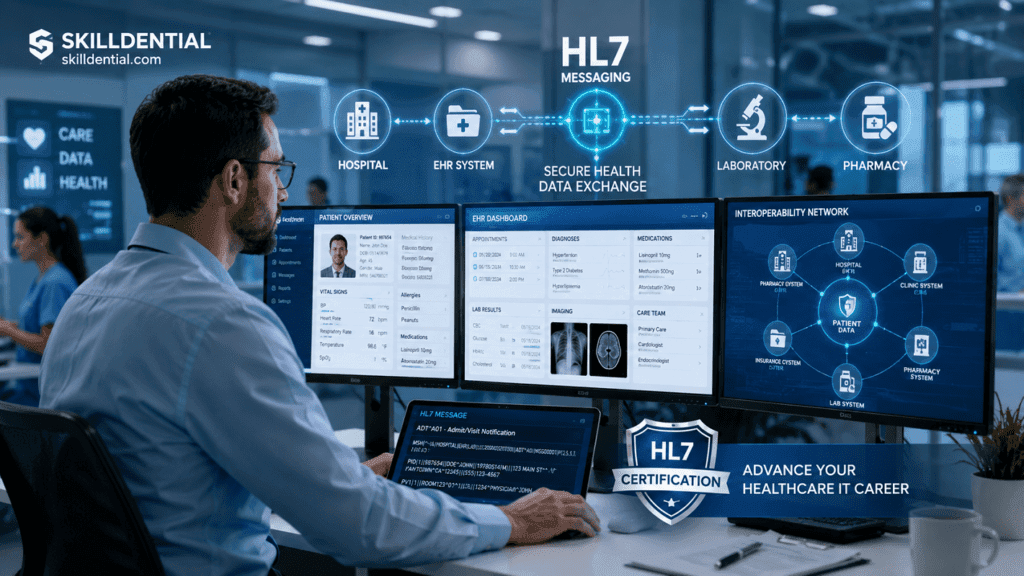
This guide ranks the top HL7 certification courses to help you identify the precise training path—from foundational overviews to specialized credentials—needed to advance your career in healthcare IT.
Which HL7 courses are best for beginners?
For beginners, the focus should be on building a foundational mental model of how healthcare systems “talk” to each other before diving into complex implementation. The following programs are widely considered the gold standard for those starting their careers in health informatics and data exchange.
Top HL7 Certification Courses for Beginners
| Course Name | Best For | Key Focus |
| HL7 Fundamentals | Absolute beginners & broad career builders | Comprehensive introduction to V2, CDA, and FHIR standards. |
| FHIR Fundamentals | Developers & architects | Hands-on workshop focusing specifically on modern API-based exchange. |
| HL7 UK FHIR Overview | System designers & integrators | Practical understanding of FHIR implementation and methodology. |
| HL7 UK Version 2 Online | Legacy system interface analysts | Understanding the world’s most widely implemented messaging protocol. |
Detailed Analysis of Beginner Paths
For those new to the field, navigating the complex landscape of interoperability standards can be overwhelming. The following HL7 certification courses are selected for their ability to distill dense technical documentation into actionable workflows, providing the foundational fluency required for interface analysis and health system architecture.
The “Big Picture” Foundation: HL7 Fundamentals
This is the most highly recommended starting point for anyone who needs to bridge the gap between clinical workflows and technical data.
- Structure: A 12-week, instructor-led workshop that is asynchronous, allowing you to work at your own pace.
- Why it works: It uses “learning by doing.” You aren’t just reading theory; you are engaging in discussions, completing weekly assignments, and participating in projects with a certified tutor.
- Outcome: You will finish with a solid grasp of why interoperability matters and how to navigate the complex specifications of V2, CDA, and FHIR.
The Modern Standard: FHIR Fundamentals
If your goal is to work with modern cloud-based health apps, telehealth platforms, or AI integration, this is your primary path.
- Structure: A focused 4-week online workshop.
- Why it works: It is highly technical but accessible. It covers the move from legacy messaging to RESTful APIs, which is essential for any modern healthcare developer or systems analyst.
- Outcome: Ability to read/write FHIR resources, understand RESTful architecture, and navigate profiling and conformance.
Regional Expertise: HL7 UK Training
While branded under “HL7 UK,” these courses are widely respected and available to an international audience.
- Focus: They offer specific deep dives into HL7 Version 2 (the workhorse of most hospitals) and CDA/ITK (the standard for clinical documentation).
- Why it works: Their courses are designed to be independent of specific national health systems, making them excellent for global professionals. They are particularly strong at “demystifying” the documentation, which is often the biggest hurdle for newcomers.
Strategic Recommendation
If you are completely new to the space, start with the HL7 Fundamentals workshop. It provides the breadth of knowledge required to understand how different standards interact. Once you identify which “flavor” of interoperability (e.g., legacy messaging vs. modern APIs) your role requires, you can layer on more specialized certifications like the FHIR Fundamentals or specific Version 2 Control Specialist tracks.
Which HL7 courses suit advanced specialists?
For advanced specialists, the focus shifts from “what is the standard?” to “how do I architect, implement, and optimize this in high-stakes clinical environments?”
At this level, you are likely looking to validate your expertise for career progression (e.g., Lead Integration Engineer, Health IT Architect) or to master a specific, complex protocol.
Advanced HL7 Certification Tracks
| Track | Target Audience | Primary Focus |
| HL7 V2 Control Specialist | Interface & Integration Engineers | Deep-dive into message control, segment structures, and legacy error handling. |
| HL7 FHIR Proficiency | Software & API Engineers | RESTful architecture, profiling, SMART on FHIR, and security implementation. |
| HL7 CDA Certification | Clinical Informatics Analysts | Structured document architecture, conformance, and clinical data modeling. |
Analysis of Specialist Paths
For experienced health IT professionals, interoperability is no longer a theoretical exercise—it is an architectural challenge. The following HL7 certification courses are designed for specialists who operate at the edge of system integration, providing the rigorous technical depth needed to architect complex data pipelines, secure API-driven ecosystems, and maintain mission-critical clinical interfaces
Mastering the Legacy Workhorse: HL7 V2
With 95% of U.S. healthcare organizations still relying on V2, deep mastery of this standard remains a high-leverage skill.
- The Goal: Move from simply “reading” messages to “mastering” the control chapter. Advanced courses and the V2 Control Specialist exam focus on complex segment groups, Z-segments, and the intricacies of message acknowledgement (ACK) processing that prevent production-level data loss.
- Best For: Professionals who manage interface engines (e.g., Mirth Connect, Rhapsody, Corepoint) and need to troubleshoot high-volume, mission-critical data flows.
Architecting for the Future: FHIR Proficiency
FHIR is the standard for modern healthcare ecosystems. Moving beyond “foundational” knowledge requires understanding how to extend the standard to meet specific business needs.
- The Goal: Learn to build “profiles.” You must understand how to constrain the FHIR base resources to fit unique clinical workflows without breaking interoperability. This includes mastering Implementation Guides (IGs), OAuth 2.0 security, and terminology binding (SNOMED, LOINC).
- Best For: Product managers and software engineers building MedTech applications or cloud-based health APIs.
Enterprise Integration: XDS and DICOM
For specialists working in imaging (radiology/pathology) or massive enterprise-wide health information exchange (HIE), clinical data is only half the battle.
- The Goal: Understand the “Document” side of the house. IHE (Integrating the Healthcare Enterprise) profiles, such as XDS (Cross-Enterprise Document Sharing), and DICOM standards for imaging data are essential for enterprise interoperability.
- Best For: Enterprise architects and system designers responsible for hospital-wide clinical data repositories and PACS integration.
Strategic Recommendation for Exam Readiness
If your goal is formal certification, do not rely on a single course. Use a multi-layered approach:
- Official HL7 “Path to Certification”: Download the official guide from HL7.org to understand the exact scope of each exam.
- Specialized Exam Prep: Look for “Exam Preparation” courses, which are distinct from general training. These typically include practice scenarios, mock exams, and deep dives into the specific testable domains defined by the HL7 certification committee.
- Community & Hands-on: Supplement your study with the HL7 Study Guide (available via resources like SIIM) and engage in technical forums where you can test your knowledge against real-world integration edge cases.
Pro Tip: If you are an experienced developer, skip the “Introduction” tracks and look directly for “Intermediate/Advanced FHIR Implementation” or “V2 Control Specialist” courses. These courses assume you are already familiar with the basics and will save you significant time by focusing on advanced architecture and real-world debugging.
What should you compare before enrolling?
Before enrolling in any training, you must conduct a rigorous “Stack Audit.” Your choice of HL7 certification courses should be dictated by your existing infrastructure and your long-term career trajectory.
The Decision Matrix: Essential Comparison Factors
Before you commit your budget or time, compare your options against these four high-leverage criteria:
| Decision Factor | Why It Matters | The “Skilldential” Insight |
| Protocol Focus | V2 is the “workhorse” of legacy hospital operations; FHIR is the API-driven language of modern digital health. | Don’t choose based on what’s “newest.” Choose based on the primary protocols your target employers (or your current employer) use. |
| Hands-On vs. Theory | Certification exams are theoretical; real-world success requires technical “keyboard-to-server” experience. | Favor courses with lab-based modules over pure lecture-based content. If a course doesn’t include JSON/XML parsing or API testing (Postman), it is likely too theoretical for a career-focused learner. |
| Certification Alignment | Not all training leads to an official, industry-recognized credential. | Ensure the course curriculum maps directly to the HL7 International exam blueprints if you need the formal certification on your resume. |
| Instructor Credibility | Healthcare interoperability is nuanced and often document-heavy. | Look for instructors who are active members of the HL7 working groups or certified tutors. They are the only ones capable of explaining why a standard is implemented in a specific way. |
Strategy: The FHIR-First vs. V2-First Path
In our career audits, the most common pitfall is a lack of path clarity. Define your lane early to maximize your ROI:
- Choose the “V2-First” Path if: You are an Integration Engineer, Interface Analyst, or work primarily in traditional hospital IT. Your day-to-day involves MLLP connections, Z-segments, and legacy interface engines (like Rhapsody or Mirth).
- Choose the “FHIR-First” Path if: You are a Software Developer, Product Manager, or Architect building mobile/cloud-based health apps. Your expertise must lie in RESTful APIs, JSON, OAuth 2.0, and resource-based data modeling.
Actionable Pre-Enrollment Checklist
Before you pay, confirm these three things to ensure the course delivers real-world leverage:
- Request the Syllabus: Does it explicitly mention “Implementation Guides” (IGs) or “Terminology Mapping” (LOINC/SNOMED)? If not, the course is likely an outdated overview.
- Verify Exam Prep: If you want the certification, verify if the course includes mock exam scenarios. The HL7 exams are notoriously dense; without practice with the question style, you will likely fail even if you know the technical material.
- Check for “Active” Content: Does the course provide access to a sandbox or testing tool (e.g., HAPI FHIR, Simplifier.net, or a mock interface engine)? Passive learning is a sunk cost in high-tech; prioritize environments where you can “break” and “fix” code.
Expert Tip: If you are undecided, the HL7 Fundamentals Course remains the most cost-effective “survey” of the landscape. Use it to determine which protocol dominates your target domain, then invest your deeper capital into the FHIR Proficiency or V2 Control Specialist tracks.
Why Does HL7 Matter in Healthcare IT?
HL7 certification courses are mission-critical because they address the primary bottleneck in modern medicine: the inability of fragmented, proprietary systems to communicate. In an industry where lives depend on the accuracy of clinical data, HL7 certification courses provide the standardized framework required to bridge the gap between EHRs, lab systems, radiology, and patient-facing applications.
Without these standards, healthcare data remains trapped in silos, leading to manual re-entry errors, delayed clinical decision-making, and significant operational inefficiencies. By mastering the protocols taught in professional HL7 certification courses, you gain the ability to:
- Architect Seamless Interoperability: Design and troubleshoot the “pipes” that move patient data across diverse vendors, ensuring real-time availability of records.
- Bridge Legacy and Modern Frameworks: Navigate the transition from legacy HL7 v2 messaging—the world’s most widely used integration standard—to the modern, API-first FHIR (Fast Healthcare Interoperability Resources) standard.
- Scale High-Leverage Projects: Enable the integration of AI-enabled health applications and telehealth platforms, which rely entirely on standardized data exchange to function at scale.
- Ensure Regulatory Compliance: Implement secure data transmission protocols that satisfy industry-wide privacy and security mandates.
For the healthcare IT professional, enrolling in HL7 certification courses is not just about learning a protocol; it is about securing the technical fluency required to build, maintain, and innovate within the global digital health infrastructure. Whether you are an interface engineer managing hospital messaging or a developer building the next generation of patient apps, these credentials serve as a high-signal verification of your expertise in the field’s most essential architectural framework.
11 best HL7 Certification Courses
To help you build your guide, here is a consolidated and validated list of the 11 best HL7 certification courses and training paths for 2026. This list focuses on high-leverage, industry-recognized credentials that bridge the gap between technical theory and real-world implementation.
The 11 Best HL7 Certification Courses & Training Paths
| Course / Resource | Provider | Primary Focus |
| HL7 Fundamentals | HL7 International | Foundational interoperability; V2, CDA, and FHIR. |
| FHIR Fundamentals | HL7 International | Modern RESTful API-based exchange. |
| FHIR Overview (Online) | HL7 UK / Firely | Strategic FHIR implementation & methodology. |
| HL7 Version 2 Training | HL7 UK / Ringholm | Legacy interface messaging & troubleshooting. |
| CDA/ITK Overview | HL7 UK | Clinical document architecture for structured data. |
| DICOM/HL7/IHE Overview | HL7 UK | Imaging informatics & enterprise integration. |
| Core Essentials Live: FHIR | SIIM (Society for Imaging Informatics) | Advanced hands-on FHIR resource/API training. |
| FHIR Summary Training | Firely | High-level management overview of FHIR projects. |
| HL7 Certification Prep | HL7 International | Official exam readiness for V2, FHIR, and CDA exams. |
| NIHI HL7 Fundamentals | NIHI / McMaster CE | Practical simulation using integration engines. |
| Role-Specific Vendor Training | Varies (e.g., NextGen, Epic) | Implementation-specific training tied to active systems. |
Strategic Guidance for Your Article
When finalizing your “11 Best” list, use these three high-leverage principles to ensure your content provides maximum utility to your readers:
- Categorize by Career Intent:
- The Architect/Lead: Direct them toward HL7 International’s official certification preparation for FHIR and V2 Control Specialist exams. These are the most widely recognized “gold standard” credentials.
- The Developer/Engineer: Focus on the SIIM “Core Essentials” and Firely courses. These provide the hands-on “keyboard-to-server” experience (REST APIs, JSON, Profiles) that developers need to ship functional code.
- The Systems Analyst: Emphasize the HL7 Fundamentals and HL7 UK overview courses. These offer the best balance of theory and practice for mapping business requirements to technical data specifications.
- Add a “Prerequisite Reality Check”: Many beginners don’t realize that HL7 certification courses (especially official ones) can be dense. Suggest that they have a basic understanding of XML, JSON, and RESTful API concepts before enrolling to ensure a higher ROI on their investment.
- Include an “Implementation Context”: Remind your readers that a course is just a baseline. The best way to leverage these HL7 certification courses is to pair them with active implementation work (e.g., using Mirth Connect or an HAPI FHIR server) to practice the concepts in real-time.
Final Content Strategy Note
For your “11 Best” list, ensure you differentiate between “Training” (learning the skills) and “Certification” (the official, proctored credential). Many professional learners are looking for the credential to advance their careers, so clearly labeling which courses lead to an official HL7 International certification exam versus which are purely educational will build immense trust with your audience.
How should you choose by role?
To select the right training, align your choice with your specific technical “stack” and professional objectives. High-leverage HL7 certification courses are categorized by the functional demands of your daily workflow.
Strategic Selection by Role
| Role | Best Starting Point | Why It’s High-Leverage |
| Interface Engineer | HL7 Version 2 Training | 95% of U.S. hospital infrastructure runs on V2; this is the prerequisite for managing integration engines. |
| Health IT Analyst | HL7 Fundamentals | Provides the cross-standard context (V2, CDA, FHIR) needed to map business requirements to data specifications. |
| Software Developer | FHIR Fundamentals | Focuses on RESTful APIs, JSON, and OAuth 2.0—the building blocks for modern, scalable health apps. |
| Clinical Informaticist | HL7 Fundamentals + CDA | Bridges the gap between clinical documentation (CDA) and data exchange protocols to support evidence-based medicine. |
| CIO / CTO | HL7 Overview / Strategy Courses | Focuses on interoperability roadmaps, legislative compliance, and architecture selection rather than syntax. |
Execution Strategy for Each Path
Acquiring a certification is only the first step. To generate real-world ROI, you must align your training with the specific architecture and interoperability stacks used in your target role. The following execution paths translate technical knowledge into actionable workflows, ensuring your learning investment directly enhances your project impact.
The Integration Specialist (Focus: V2)
If your daily environment involves MLLP connections, integration engines (e.g., Mirth, Rhapsody), or Z-segment mapping, your career value is tied to V2 mastery.
- Action: Enroll in Introduction to Version 2 (via HL7 International). Focus specifically on the “Control” chapter to master message acknowledgement (ACK) logic—the most common point of failure in production interfaces.
The Modern Health Developer (Focus: FHIR)
Your leverage comes from building apps that talk to EHRs securely. Mastery of FHIR is your primary currency.
- Action: Skip the general overviews. Prioritize FHIR Fundamentals and look for courses that include hands-on labs (Postman/HAPI FHIR). Focus your study on Implementation Guides (IGs) and Terminology Binding, as these are the actual “tools of the trade” for production-grade API development.
The Systems Strategist (Focus: Mapping & Strategy)
If you operate at the intersection of business and IT, your goal is to understand which standard solves which problem.
- Action: Leverage the HL7 Fundamentals course to get the “big picture.” Complement this with short-form technical “deep dives” on specific workflows (e.g., Clinical Document Architecture) to ensure you can oversee projects without necessarily being the one coding the interface.
Expert Advice on Avoiding “Certification Bloat”
Don’t collect certificates; build a proof-of-work stack. Before enrolling in any of these HL7 certification courses, ask:
“Will this course require me to build or validate an interface?”
If the answer is no, prioritize a different course that provides a sandbox or simulation environment. The industry values the ability to demonstrate a live, working integration—using the standards you’ve learned—far more than a certificate on a wall.
What is HL7 certification?
HL7 certification is a professional credential that validates an individual’s expertise in healthcare interoperability standards developed by Health Level Seven International. It confirms your ability to understand, design, and implement the frameworks used for the secure exchange, integration, and retrieval of clinical health information.
Is HL7 certification worth it for developers?
Yes. For developers building healthcare applications, integration tools, or clinical APIs, these certifications serve as high-leverage proof of competence. While the FHIR specification is publicly available, certification ensures you grasp the nuances of profiling, implementation guides, and terminology binding—critical elements that prevent errors in production-grade systems.
Do I need HL7 V2 before learning FHIR?
No. FHIR was designed to be a modern, web-friendly standard independent of legacy architectures. However, understanding the “messaging” concepts of V2 is beneficial for interface engineers working in traditional hospital environments, as V2 remains the dominant protocol for existing internal enterprise systems.
Which HL7 course should an interface engineer take first?
Interface engineers should prioritize the HL7 Fundamentals course or specialized HL7 V2 training. These paths focus on the practical “pipes” of healthcare IT, covering message segments, acknowledgment (ACK) patterns, and integration engine workflows, which are the daily bread and butter of hospital systems integration.
Are HL7 courses available online?
Yes. The industry has shifted heavily toward online education. You can access:
Asynchronous, Instructor-Led Courses: Programs like HL7 Fundamentals provide structured, multi-week online workshops with peer discussion and project-based assessments.
On-Demand E-Learning: Providers like Firely and the HL7 Virtual Student Academy offer modular, self-paced content ranging from high-level overviews to deep technical dives into profiling and SDK usage.
Virtual Bootcamps: Live, instructor-led virtual training is available for those who prefer real-time interaction and hands-on coding exercises.
In Conclusion
Mastering healthcare interoperability is a high-leverage move in a field defined by complex, fragmented data. By strategically selecting HL7 certification courses that align with your specific technical stack—whether it be legacy V2 messaging or modern FHIR-based APIs—you transform your career from a generalist role into a specialized, high-demand position in health IT architecture.
For the most effective professional growth, prioritize a “Fundamentals-First” approach:
- Build a Base: Start with HL7 Fundamentals to gain a holistic view of the interoperability landscape.
- Specialize by Role: Once you have a firm grasp of the core concepts, pivot toward the standard that dominates your daily work.
- Interface Engineers should dive deep into HL7 V2 Control to manage mission-critical production environments.
- Developers & Product Teams should master FHIR proficiency to build and scale modern, API-driven clinical applications.
- Validate with Credentials: Use official HL7 certification exams to formally verify your expertise, providing the social proof needed for senior-level roles in healthcare integration and leadership.
The path to mastery is iterative. Technology in digital health evolves rapidly, but the underlying requirement for standardized, secure data exchange remains constant. By investing in these foundational frameworks today, you are not just earning a certificate—you are building the permanent technical infrastructure of your career in healthcare IT.