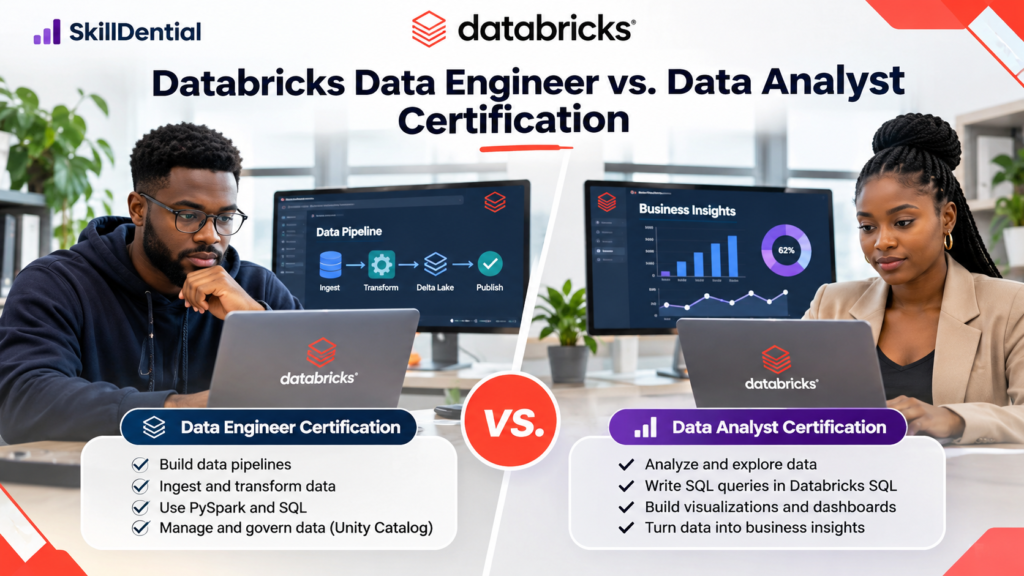
Choosing between the Databricks Data Engineer and Data Analyst Certification comes down to one core distinction: do you want to build the data infrastructure, or extract decisions from it? While both credentials validate foundational proficiency on the Databricks Data Intelligence Platform, they serve distinct technical workflows and career trajectories.
The Databricks Data Engineer Associate credential tests your ability to ingest, transform, and orchestrate reliable production pipelines using Spark, Delta Lake, and Lakeflow. In contrast, the Data Analyst Certification focuses on Databricks SQL, warehouse optimization, interactive dashboards, and AI/BI tools used to turn clean datasets into stakeholder insights.
By breaking down the exam domains, technical prerequisites, and salary ROI of each path, this guide will help you invest your study time in the certification that matches your skills and career goals.
What Is the Databricks Data Engineer Associate Certification?
The Databricks Certified Data Engineer Associate is an entry-level credential that validates your ability to build, automate, and maintain production data pipelines on the Databricks Data Intelligence Platform. Rather than focusing on end-user reporting, this Databricks Data Engineer certification proves you can turn raw, messy data into reliable, analytics-ready datasets at scale.
The exam tests core technical competencies across the data engineering lifecycle:
- Ingestion & Transformation: Loading raw data from external sources and modeling it using Apache Spark SQL, PySpark, and Delta Lake.
- Orchestration & DevOps: Automating production workflows with Lakeflow Jobs and implementing continuous integration and continuous deployment (CI/CD).
- Governance & Optimization: Securing data assets with Unity Catalog while monitoring and tuning pipeline performance.
Who Should Consider This Certification?
This credential is ideal for aspiring data engineers, ETL developers, analytics engineers, and software engineers transitioning into big data infrastructure.
While there are no formal prerequisites to sit for the exam, Databricks recommends at least six months of hands-on experience working with Spark, SQL, and the Databricks workspace before attempting it.
What Is the Databricks Data Analyst Associate Certification?
The Databricks Certified Data Analyst Associate validates your ability to query, visualize, and extract actionable insights from data using Databricks SQL and its integrated analytics tools. While data engineers build and maintain the underlying pipelines, this Data Analyst Certification proves you can analyze prepared datasets, uncover business trends, and communicate findings to stakeholders.
The exam assesses practical analytics competencies across three core areas:
- SQL & Query Performance: Writing ANSI SQL queries, managing Databricks SQL Warehouses, and troubleshooting query performance using Query Profiles and caching.
- BI, Visualization & AI: Building interactive AI/BI dashboards, configuring alerts and parameters, and developing self-service AI/BI Genie spaces for natural-language exploration.
- Data Management & Governance: Importing datasets, applying basic dimensional data modeling, and securing tables and views with Unity Catalog.
Who Should Consider This Certification?
This Data Analyst Certification is built for data analysts, business intelligence (BI) analysts, reporting specialists, and SQL-fluent professionals focused on data-driven decision-making.
Databricks imposes no formal prerequisites, though six or more months of hands-on experience running SQL queries and building dashboards in a Databricks workspace is strongly recommended before taking the exam.
Databricks Data Engineer vs. Data Analyst Certification: Key Differences
While both credentials validate foundational proficiency on the Databricks Data Intelligence Platform, they test completely different layers of the modern data lifecycle.
The Databricks Data Engineer Associate exam focuses on building and automating backend pipelines, whereas the Data Analyst Certification focuses on querying, visualizing, and operationalizing business insights.
| Comparison Factor | Databricks Data Engineer Associate | Databricks Data Analyst Associate |
| Primary Focus | Data infrastructure & pipeline architecture | Business intelligence & data consumption |
| Core Languages & Tools | PySpark, Spark SQL, Delta Lake, Lakeflow Jobs, CI/CD | Databricks SQL, SQL Warehouses, AI/BI Dashboards, Genie |
| Top Exam Domains | Data Transformation (22%), Ingestion (21%), Lakeflow Jobs (16%) | Executing Queries (20%), Analyzing Queries (15%), Platform (11%) |
| Key Day-to-Day Tasks | Ingesting raw files, modeling Medallion tables, orchestrating jobs | Writing complex SQL, optimizing query latency, building dashboards |
| Primary Deliverable | Production-grade, governed data pipelines | Executive reports, KPI dashboards, and ad-hoc insights |
| Exam Format & Cost | 45 questions • 90 mins • $200 USD • 2-year validity | 45 questions • 90 mins • $200 USD • 2-year validity |
| Target Career Path | Data Engineer, Analytics Engineer, ETL Developer | Data Analyst, BI Analyst, Reporting Specialist |
The core distinction comes down to data ownership versus data consumption: a Databricks Data Engineer builds and maintains the reliable systems that make data accessible, while a certified Data Analyst queries that curated data to answer business questions and drive decisions.
Certification Exam Cost and Requirements
Both the Databricks Data Engineer Associate and Data Analyst Certification follow identical examination policies, pricing, and proctoring formats:
| Exam Detail | Databricks Data Engineer Associate | Databricks Data Analyst Associate |
| Format & Delivery | Proctored multiple-choice (Online or test center) | Proctored multiple-choice (Online or test center) |
| Scored Questions | 45 questions (plus unscored pilot items) | 45 questions (plus unscored pilot items) |
| Time Limit | 90 minutes | 90 minutes |
| Registration Fee | $200 USD (excluding local taxes) | $200 USD (excluding local taxes) |
| Retake Policy | 14-day waiting period; full $200 fee per attempt | 14-day waiting period; full $200 fee per attempt |
| Formal Prerequisites | None | None |
| Recommended Experience | 6+ months hands-on Databricks engineering | 6+ months hands-on SQL & BI analysis |
| Credential Validity | 2 years (recertify by passing current exam) | 2 years (recertify by passing current exam) |
Key Exam Policies to Know
- Closed-Book Rules: Neither exam permits outside test aids, notes, or documentation during the proctored session.
- No Free Retakes: Databricks does not include free retake vouchers. If you do not pass on your first attempt, you must wait 14 days and pay the full $200 USD registration fee again.
- International Tax & Billing Note: The published $200 USD fee excludes regional taxes. If you are registering from outside the United States—such as from Nigeria or elsewhere internationally—confirm local VAT/tax additions and international card payment requirements at checkout on the official Databricks Academy portal.
Which Certification Has Better Career Opportunities?
Neither credential is universally superior—the stronger choice depends on whether you want higher technical earning ceilings or faster entry into business-facing analytics roles.
In the US market, Data Engineers command roughly $30,000 to $45,000 more per year than Data Analysts across comparable experience tiers, while Analyst roles typically offer broader entry-level volume and higher remote-work availability.
Databricks Data Engineer Associate Career Path
Earning the Databricks Data Engineer credential positions you for infrastructure and pipeline-building roles, including:
- Data Engineer (Entry US base: ~$80K–$110K; Mid-level: ~$111K–$140K)
- Analytics Engineer (Bridging SQL transformation and pipeline modeling; ~$90K–$130K)
- ETL / Data Platform Engineer
These roles focus on data ingestion, Spark/Delta Lake transformations, CI/CD automation, and production pipeline reliability—making this track ideal if you want deep technical specialization and long-term progression toward Data Architect or Staff Engineering roles.
Databricks Data Analyst Certification Career Path
Earning the Data Analyst Certification aligns with insight-generation and stakeholder-facing roles, including:
- Data Analyst (Entry US base: ~$63K–$80K; Mid-level: ~$73K–$95K)
- Business Intelligence (BI) Analyst
- Product, Operations, or Reporting Analyst
These roles center on querying curated datasets, tracking KPIs, building interactive AI/BI dashboards, and translating metrics into executive decisions—making this path ideal for fast career entry or advancement toward BI Manager and Analytics Director tracks.
What Employers Actually Look For
Passing either exam gets your resume past automated recruiter filters, but a certification alone will not land the job. Hiring managers pair these credentials with real-world proof of execution:
- For Data Engineers: Production Python/PySpark projects, cloud platform fluency (AWS, Azure, or GCP), and end-to-end pipeline portfolios.
- For Data Analysts: Advanced SQL fluency, BI storytelling portfolios, and clear domain communication skills.
Which Databricks Certification Should You Choose?
The right credential depends on your current technical stack and the day-to-day problems you want to solve—not which exam sounds more advanced. Because both exams cost $200 USD and carry identical Associate-level validity, your decision comes down to pipeline engineering versus analytical reporting.
Choose the Databricks Data Engineer Associate If:
- You are comfortable with Python and SQL: You prefer programmatic data processing with PySpark, Spark SQL, and Delta Lake over visual BI tools.
- You want to own data infrastructure: Your goal is building, automating, and troubleshooting production ETL/ELT pipelines using Lakeflow Jobs and CI/CD workflows.
- You are targeting engineering roles: You want the most widely recognized baseline credential for Data Engineer, Platform Engineer, or Analytics Engineer positions.
Choose the Databricks Data Analyst Certification If:
- SQL is your primary strength: You want a credential that validates deep SQL fluency, query optimization, and warehouse management without requiring Python or Spark coding.
- You focus on BI and stakeholder reporting: Your day-to-day involves building interactive dashboards, tracking KPIs, and configuring self-service AI/BI Genie spaces.
- You want a faster, lower-barrier entry point: You are transitioning from Excel, Power BI, or Tableau into modern lakehouse analytics and want immediate career ROI.
Still Unsure Which Path Fits Best?
Start with SQL fundamentals and test both workflows in the free Databricks Community Edition before spending $200 on an exam voucher:
- Test the Analyst workflow: Load a public dataset, run analytical SQL queries, and build a dashboard.
- Test the Engineer workflow: Write a PySpark notebook to ingest raw files, clean the schema, and save a Delta table.
Whichever workflow feels closer to the job you want next is the certification you should pursue first.
Watch the video above to understand which Databricks certification is actually worth it in 2026. It provides a breakdown of the Data Engineer and Data Analyst certification paths to help you decide which credential best aligns with your career goals.
How to Prepare for the Databricks Certifications
Passing either exam requires applied architectural judgment rather than rote memorization—most questions present real-world workspace scenarios where you must choose the optimal configuration. Follow this 5-step preparation roadmap before booking your $200 USD exam slot:
- Audit the Official Exam Guide: Download the current blueprint for your target track—the Databricks Data Engineer Associate (updated May 2026 across 7 domains) or the Data Analyst Certification (updated October 2026 across 9 domains)—and weight your study time around the highest-scoring sections.
- Complete Role-Specific Databricks Academy Training: Work through Databricks’ self-paced learning paths—focusing on Data Engineering with Databricks (Spark, Delta Lake, Lakeflow Jobs, and CI/CD) or Data Analysis with Databricks SQL (SQL Warehouses, Query Profiles, AI/BI Dashboards, and Genie spaces).
- Build Hands-On Labs in Databricks Free Edition: Use a free workspace sandbox to practice real tasks: write PySpark/SQL ingestion pipelines and configure Unity Catalog permissions for engineering, or optimize slow queries and build parameterized dashboards for analytics.
- Take Timed Practice Assessments: Complete full-length 45-question practice exams under 90-minute time constraints to identify weak domains and get used to scenario-based multiple-choice elimination.
- Schedule Your Proctored Exam: Once you consistently score 80% or higher on practice tests, book your online or test-center session through the official certification portal.
Official Databricks Learning Resources
- Databricks Certification Portal: Browse all role-based credentials, exam policies, and registration links.
- Databricks Certified Data Engineer Associate Page: Access the latest exam guide, domain weights, and recommended training path.
- Databricks Certified Data Analyst Associate Page: Download the current exam blueprint, sample questions, and SQL preparation resources.
- Databricks Free Edition & Fundamentals Accreditation: If you are brand new to the lakehouse ecosystem, earn the free Databricks Fundamentals badge and test workflows in Databricks Free Edition before paying for an Associate exam.
Watch the video above for a closer look at what the Databricks Certified Data Analyst Associate exam tests beyond standard SQL. The video provides additional insights into the Databricks Certified Data Analyst Associate Exam Guide (2026).
Is the Databricks Data Engineer certification harder than the Data Analyst certification?
Difficulty depends on your technical background rather than a fixed exam curve. The Databricks Data Engineer Associate exam demands stronger programming and systems skills—such as PySpark, ETL/ELT pipeline design, workflow orchestration, and CI/CD—while the Data Analyst Certification centers on SQL querying, query optimization, dashboards, and BI reporting.
If you write Python and build pipelines, the engineering exam feels more natural; if you live in SQL and BI tools, the analyst exam is usually more accessible.
Can a beginner get Databricks certified?
Yes. Neither Associate credential has a formal prerequisite, so beginners can sit for either exam. However, Databricks recommends at least six months of hands-on practice and relevant coursework first because the 45 multiple-choice questions test real-world workspace scenarios rather than surface-level definitions.
How much does a Databricks certification cost?
Both Associate exams carry a published registration fee of $200 USD per attempt, excluding applicable local taxes. If you do not pass on your first try, you must wait 14 days and pay the full $200 USD fee again—Databricks does not issue free retake vouchers.
How long does a Databricks certification last?
Both Associate certifications remain valid for two years. To maintain your certified status after two years, you must pass the current version of the exam.
Can I earn both Databricks certifications?
Yes. Earning both the Databricks Data Engineer Associate and Data Analyst Certification is a strong move if you want end-to-end fluency across pipeline engineering and lakehouse analytics—particularly for roles like Analytics Engineer or Data Platform Specialist where both skill sets overlap.
Which Databricks certification should I take first?
Start with the credential that matches your immediate job target: choose the Databricks Data Engineer Associate if you want to build and automate data pipelines and infrastructure, or choose the Data Analyst Certification if you want to focus on SQL analytics, dashboards, and business intelligence.
In Conclusion
Choosing between the Databricks Data Engineer Associate and Data Analyst Certification comes down to what you want to own in the modern data stack: building reliable data infrastructure or turning prepared datasets into business decisions.
While either credential validates your ability to work inside the Databricks Data Intelligence Platform, pairing the badge with hands-on portfolio projects in PySpark, SQL, or AI/BI dashboards is what turns a certification into real career leverage.
Your next step:
Download the official exam blueprint for your target track, audit your technical gaps in Databricks Free Edition, and commit to the certification that aligns with your next career milestone.