Become an Influencer Marketing Strategist: 7 Skills You Need
Influencer marketing strategists operate at the intersection of brand positioning and creator economy performance. They design, negotiate, and optimize influencer campaigns that align with specific business objectives across high-velocity platforms like Instagram, TikTok, and YouTube.
Core Strategic Responsibilities
- Campaign Architecture: Define campaign scope, creative direction, and platform-specific KPIs to ensure alignment with brand identity.
- Creator Lifecycle Management: Source, vet, and negotiate partnerships, managing the transition from talent discovery to contract finalization.
- Budget & Resource Optimization: Allocate spend across tiers (nano to celebrity) to maximize reach and engagement efficiency.
- Performance Analytics: Track and attribute conversion data to calculate ROI, using these insights to refine iterative campaign cycles.
Market Trajectory & Requirements
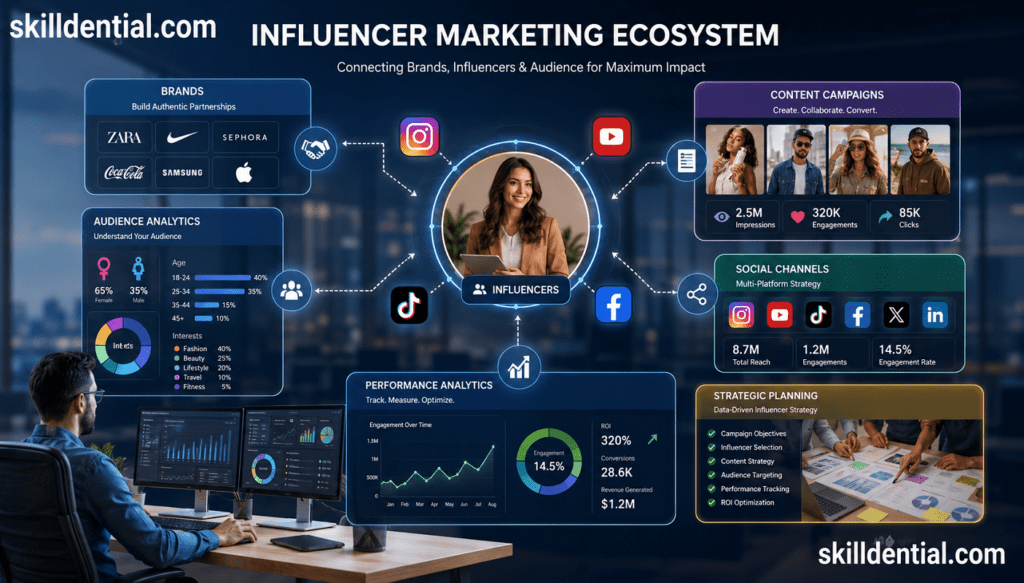
The influence of Influencer Marketing Strategists is accelerating as brands shift budgets toward decentralized, creator-led distribution. While the role is data-intensive, it remains accessible; entry-level success is driven by demonstrable proficiency in:
- Social Media Fluency: Deep understanding of platform algorithms and content trends.
- Analytical Literacy: Ability to interpret engagement data and translate it into an actionable strategy.
- Communication & Negotiation: Mastery of relationship management to secure favorable partnership terms.
Competency Framework
Professional development for this role requires a systematic approach to technical and soft skill acquisition. Below is the foundational 80/20 of the skills necessary to excel:
- Platform Ecosystems: Technical mastery of the backend metrics for Instagram, TikTok, and YouTube.
- Performance Marketing: Understanding the fundamentals of Cost-Per-Click (CPC), Cost-Per-Acquisition (CPA), and conversion tracking.
- Negotiation Tactics: Standardizing creator contracts to protect brand interests while maintaining creative autonomy.
What does an Influencer Marketing Strategist do?
To thrive as an Influencer Marketing Strategist, you must bridge the gap between creative brand storytelling and rigorous performance data. The role is a high-leverage function that transforms subjective creator content into objective business growth.
The most effective Influencer Marketing Strategists manage campaigns through a systematic, repeatable framework that ensures consistency across every project.
Core Functional Pillars
Strategic Planning & Audience Mapping
The Influencer Marketing Strategist begins by defining the “Why” and the “Who.” This involves identifying specific brand objectives—whether it is brand awareness, product education, or direct response sales—and selecting the platform ecosystem that best supports those outcomes.
Talent Acquisition & Commercial Negotiation
Execution requires moving beyond vanity metrics to find “creator-market fit.” This involves:
- Vetting: Auditing audience authenticity, engagement health, and historical content quality.
- Negotiation: Closing contracts that balance creator autonomy with brand guardrails, ensuring clear deliverables (e.g., usage rights, exclusivity, and content formats).
Execution & Creative Governance
Strategists act as the conductor for the campaign. They bridge the gap between internal marketing teams and external creators, ensuring that the final output aligns with the brand’s visual and messaging standards without stifling the creator’s unique voice.
Analytical Optimization
This is where the role shifts from project management to technical strategy. Influencer Marketing Strategists must be proficient in:
- Tracking: Implementing UTM parameters, discount codes, and affiliate links to ensure accurate attribution.
- Reporting: Translating raw performance data into actionable insights for stakeholders.
- Iteration: Using historical campaign data to refine future influencer selection and spend allocation, effectively scaling what works and cutting what does not.
Why this role is scaling
As traditional advertising channels become increasingly saturated and expensive, brands are pivoting toward decentralized, human-centric distribution. Influencer Marketing Strategists are the architects of this shift, providing the professional rigor needed to treat influencer collaborations as a predictable, high-ROI marketing channel rather than a speculative expense.
Why is the Influencer Marketing Strategist role in demand?
The Influencer Marketing Strategist role is in high demand because it has evolved from a speculative, experimental tactic into a sophisticated, performance-driven engine for modern business. As the creator economy matures toward an estimated global valuation of $250+ billion in 2026, brands are shifting from “reach-at-all-costs” models to high-integrity, data-backed partnership systems.
Drivers of Market Demand
- The Trust Deficit: Traditional display and search advertising are experiencing diminishing returns due to ad blockers and rising consumer skepticism. Influencer Marketing Strategists capitalize on the “authenticity advantage,” where creator-led recommendations serve as a high-trust proxy for brand messaging.
- Performance Accountability: The modern mandate is ROI, not just impressions. Brands require strategists who can implement rigorous attribution—using UTM parameters, affiliate integration, and conversion tracking—to treat creator spend with the same financial discipline as paid social or search media.
- Infrastructure Complexity: Scaling influencer programs is technically demanding. As brands move from single-post sponsorships to 50+ creator cohorts, they need strategists to manage the “infrastructure” of influence: automated workflows, contract standardization, usage-rights management, and cross-platform performance dashboards.
- The Rise of Niche Communities: Mass-market reach is increasingly expensive and inefficient. Strategists drive value by identifying and activating micro and nano-influencer networks that offer deep, high-converting engagement within specific communities (e.g., tech, beauty, B2B, wellness).
Why Brands Are Hiring
The market has moved beyond the one-off campaign. Companies are prioritizing long-term ambassadorships and repeatable “content engines.” Influencer Marketing Strategists are essential because they provide:
- Risk Mitigation: Ensuring brand safety through vetted partnerships and clear deliverable frameworks.
- Hybrid Compensation Design: Structuring deals that blend flat fees with performance-based incentives, aligning creator output with bottom-line revenue.
- Cross-Channel Repurposing: Systematically turning influencer-created content into high-performing assets for owned channels, paid ads, and social storefronts.
In short, the role is critical because it bridges the gap between raw human creativity and the technical requirements of enterprise-level performance marketing.
What are the 7 core skills you need to become an Influencer Marketing Strategist?
To master the role of an Influencer Marketing Strategist, you must transition from managing “one-off” posts to operating a predictable, performance-driven marketing channel. The seven core skills listed below represent the operational baseline required to deliver scalable ROI in 2026.
Campaign Strategy & Audience Insight
You must translate broad business objectives into tactical influencer activations. This involves mapping creator content to specific stages of the customer journey.
- Capabilities: Defining KPIs (e.g., CPA, ROAS, brand lift), segmenting audiences by behavioral intent, and selecting platform ecosystems (TikTok vs. YouTube) that match the campaign’s functional goal.
- Action: Build your strategy by reverse-engineering campaigns: identify the goal, the CTA, and how the content moves the audience toward conversion.
Influencer Discovery & Evaluation
Systematic vetting is the primary defense against wasted spend. You must look beyond vanity metrics to assess creator-market fit.
- Capabilities: Auditing audience authenticity, analyzing historical engagement patterns, and vetting for brand safety and competitor overlap.
- Action: Practice manual audits by analyzing 10–20 creators per niche and building evaluation spreadsheets to track engagement health, not just follower count.
Creator Relationship Management & Negotiation
The role is inherently relationship-driven. You must standardize communication to scale the number of active partnerships without losing quality.
- Capabilities: Drafting clear briefs, negotiating hybrid fee structures (base + performance), and securing usage rights that allow for content repurposing across owned and paid channels.
- Action: Study contract fundamentals—specifically usage rights, exclusivity, and disclosure requirements—and practice mock negotiations to balance brand protection with creator autonomy.
Content Briefing & Creative Direction
Strategists act as the conductor for creative output. Your brief determines the success of the final asset.
- Capabilities: Translating brand guidelines into platform-native creative prompts, defining “must-haves” vs. “creative freedom,” and ensuring legal compliance in regulated sectors.
- Action: Analyze top-performing sponsored content to identify patterns in messaging, storytelling, and CTAs. Draft “remix” briefs for these creators to practice guiding their output.
Analytics, Measurement, & Reporting
In 2026, influencer marketing will be judged by business outcomes. You must be able to prove value with data.
- Capabilities: Setting up tracking infrastructure (UTMs, affiliate codes), interpreting multi-touch attribution, and building executive-level reports that link influencer activity to revenue.
- Action: Learn to calculate core metrics like Customer Acquisition Cost (CAC) and Average Order Value (AOV) for your campaigns to justify spend to stakeholders.
Project & Budget Management
Influencer marketing requires managing complex workflows. A disorganized strategist creates bottlenecks.
- Capabilities: Managing timelines, payment schedules, and asset libraries across dozens of concurrent partnerships.
- Action: Use Kanban boards or project management tools to simulate a multi-creator campaign timeline, ensuring all milestones—from briefing to go-live—are accounted for.
Legal, Ethical, & Compliance Awareness
You are responsible for ensuring brand integrity and adherence to advertising standards.
- Capabilities: Ensuring full disclosure (FTC/regulatory compliance), managing content usage rights, and avoiding misleading product claims.
- Action: Incorporate a mandatory compliance checklist into every creator brief. Review official advertising guidelines regularly to stay updated on shifting platform-specific disclosure rules.
Professional Growth Path
To evolve from a specialist to a senior leader, you must move from managing execution to building systems. The highest-leverage strategists in 2026 are those who develop reusable frameworks—standardized briefs, vetted creator databases, and automated reporting—that turn influencer marketing into a repeatable, scalable business asset.
Which of these seven areas currently feels like the biggest bottleneck in your existing influencer marketing workflow?
What realistic career paths exist for Influencer Marketing Strategists?
The career trajectory for Influencer Marketing Strategists in 2026 is no longer a niche path; it has matured into a sophisticated pipeline leading toward executive brand leadership and specialized consultancy.
The Operational Ladder (Specialization)
Most professionals enter the field through execution-focused roles, building foundational technical skills in community management, platform analytics, and contract negotiation.
- Coordinator / Associate: Focuses on the “mechanics” of influence—sourcing lists, managing shipping/samples, and tracking basic campaign deliverables.
- Influencer Marketing Manager: The core strategic role. You own the end-to-end campaign lifecycle, from budget allocation and creator vetting to ROI analysis and stakeholder reporting.
- Senior Manager / Team Lead: Manages larger cross-functional budgets (often 7-figures) and oversees a team of coordinators. You shift from “doing” to “building systems” (e.g., establishing vetting frameworks, standardized contracts, and internal creator databases).
Strategic Pivot Points (Lateral & Vertical Growth)
Because Influencer Marketing Strategists sit at the intersection of creative storytelling and performance metrics, they are uniquely positioned to pivot into high-level marketing functions:
- Brand Partnerships & Talent Relations: Moving away from individual campaigns toward long-term strategic alliances, licensing deals, and managing high-value ambassador portfolios.
- Performance & Growth Marketing: Leveraging influencer data to master broader acquisition strategies, including affiliate integration, CAC optimization, and conversion-focused funnels.
- Content/Digital Strategy Leadership: Using the experience of managing decentralized, human-centric distribution to lead brand voice, multi-channel content strategy, or corporate communications.
Executive & Independent Trajectories
The maturation of the creator economy is creating new “ceiling” roles for senior practitioners:
- Director / Head of Influencer Marketing: Responsible for integrating creator-led growth into the total enterprise marketing stack.
- Consultancy & Freelancing: Senior strategists with proven track records often launch independent practices, charging premium rates for “fractional” influencer leadership for startups or scale-ups.
- The “Chief Creator Officer” Track: As enterprise brands shift toward decentralized distribution, forward-thinking companies are beginning to designate executive roles (CCOs) dedicated to owning the brand’s relationship with the creator economy.
Strategic Growth Checklist for 2026
To move from execution to strategy, focus your professional development on these three “High-Leverage” areas:
- Analytical Fluency: Don’t just report reach; master attribution, multi-touch modeling, and linking creator output to business bottom-line metrics (CAC, LTV, ROAS).
- Infrastructure Automation: Build repeatable systems (e.g., automated creator vetting workflows, standardized contract templates, and data-backed performance dashboards) that allow you to scale your output without scaling your hours.
- Cross-Discipline Literacy: Understand how influencer marketing plugs into paid search, email CRM, and product development. Strategists who can speak the language of finance and product are the ones who move into the C-suite.
What specific stage of this career path are you currently targeting, or are you looking to optimize your current role for a transition into one of the leadership tracks?
What steps should beginners take to start a career as an Influencer Marketing Strategist?
To enter the field as an Influencer Marketing Strategist, you must shift your mindset from “social media user” to “performance operator.” The following roadmap prioritizes the high-leverage actions required to build a defensible professional foundation in 2026.
The Entry Roadmap: From Foundational Skills to Market Authority
- Master the “Hub-and-Spoke” Model: Do not attempt to be a generalist across all platforms. Pick one primary “hub” platform (where your target audience lives) and master its specific creator ecosystem, algorithm, and native analytics. Repurpose that content for secondary platforms only after you have mastered the primary channel.
- Develop a “Content System”: Replace ad-hoc posting with repeatable structures. Establish 2–3 content pillars and signature formats. This demonstrates to employers that you understand how to build long-term audience habits rather than relying on viral luck.
- Execute “Low-Stakes” Pilot Projects: You do not need a massive budget to prove your competency. Collaborate with local businesses or personal projects to run a structured campaign. Your goal is to own the entire lifecycle: planning, creator sourcing, briefing, execution, and performance reporting.
- Translate “Vanity” into “Value”: Hiring managers see thousands of portfolios reporting “likes” and “impressions.” You will stand out by reporting business-driven metrics. Whenever possible, connect your activities to CAC (Customer Acquisition Cost), AOV (Average Order Value), or conversion rate improvements.
- Build a Case-Study Driven Portfolio: Your portfolio should not be an art gallery; it should be an archive of problem-solving. Structure every project as a case study:
- The Challenge (Before): Define the business constraint.
- The Insight (During): Explain your strategic decision-making process.
- The Execution (After): Present the results using hard data.
Critical Competencies for 2026
To compete for junior roles, ensure your skillset includes these three pillars:
- Analytical Literacy: Ability to interpret data across the customer journey. You must be comfortable with Google Analytics, platform native dashboards, and linking campaign data to CRM outputs.
- Creative Governance: Experience in translating brand guidelines into actionable, platform-native briefs that protect brand safety while respecting creator authenticity.
- Technical Compliance: Mastery of disclosure requirements and advertising standards. A strategist who understands the legal framework (FTC/local regulations) is a lower-risk, higher-value hire.
High-Leverage Strategic Audit
If you are currently struggling to gain traction, review your current work against these three benchmarks:
| Benchmark | Weak Approach | High-Leverage Approach |
| Strategy | “I want to reach more people.” | “I am targeting the X segment to improve the conversion rate by Y%.” |
| Reporting | Showing screenshots of high engagement. | Showing a report that links specific creator content to attributed revenue. |
| Outreach | Sending mass-template DMs to creators. | Building a personalized vetting process based on creator-market fit. |
Skill priority matrix for aspiring Influencer Marketing Strategists
To operationalize your professional development, use this Skill Priority Matrix as a strategic roadmap. It moves you from a passive learner to a high-leverage practitioner by focusing on the activities that provide the highest return on your time investment (the “80/20”).
Priority Matrix for Aspiring Influencer Marketing Strategists
| Skill | Primary Focus Stage | Impact on Hiring | Ease to Practice (No Job) | Priority Logic |
| Analytics & Reporting | Stage 1–3 | Very High | Medium | The primary differentiator between a “coordinator” and a “strategist.” |
| Campaign Strategy | Stage 1–2 | High | Medium | Essential for showing you can think in terms of business goals. |
| Discovery & Evaluation | Stage 1–2 | High | High | Easily practiced; proves you can filter signal from noise. |
| Legal & Compliance | Stage 2–3 | High | High | A low-effort, high-credibility signal of professional maturity. |
| Creator Relationship | Stage 2–3 | High | Medium | Requires real-world iteration; best learned through small tests. |
| Content Briefing | Stage 2–3 | Medium | High | Critical for demonstrating creative direction skills. |
| Project & Budget Mgt | Stage 3 | Medium | Medium | Essential for scaling complexity; lower impact for entry-level. |
Strategic Implementation
To gain an edge in a competitive market, execute in this order:
- Establish the Analytical Baseline (Highest Impact): Do not wait for a job. Build a custom reporting template using data from your own social accounts or public case studies. If you can show a prospective employer that you understand how to calculate and attribute ROI, you immediately move to the top of the candidate pool.
- Audit the Ecosystem: Dedicate your early-stage efforts to Discovery & Evaluation. By creating a personal database of 50+ vetted creators across your target niche, you demonstrate that you are “ready-to-operate” on day one.
- Institutionalize Legal Compliance: Because this is often overlooked by early-career professionals, listing a deep understanding of FTC disclosure requirements and advertising standards on your resume acts as a significant “risk mitigation” signal for hiring managers.
- Simulate the Workflow: Use a simple Kanban board to simulate a multi-creator campaign. Managing the pipeline—from initial outreach and contract drafting to final deliverable approval—is the specific type of “project management” that agencies look for to solve their internal bandwidth bottlenecks.
By following this sequence, you bypass the “generic applicant” phase and position yourself as a specialized, systems-oriented professional.
Which of the “high impact, high ease” skills are you planning to document in your professional portfolio first?
How does Influencer Marketing Strategy differ from general social media marketing?
To effectively position your value as an Influencer Marketing Strategist, you must articulate the structural shift from “owned-channel distribution” to “decentralized, human-led distribution.” While both disciplines share an analytical foundation, the operational frameworks are fundamentally distinct.
Strategic Divergence: Owned vs. Earned Distribution
| Feature | General Social Media Marketing | Influencer Marketing Strategy |
| Primary Driver | Brand-owned content and direct community. | Creator-led authenticity and secondary reach. |
| Control Level | Absolute: You own the creative, tone, and brand safety. | Shared: You must balance brand requirements with creator creative freedom. |
| Operational Focus | Content production, scheduling, and community engagement. | Relationship management, talent vetting, and commercial negotiation. |
| Distribution | Owned media (brand accounts). | Earned/Paid media (creator accounts/collaborations). |
Why the Distinction Matters for Strategists
The transition from social media manager to Influencer Marketing Strategist represents a move from content execution to ecosystem management.
- From “Voice” to “Trust”: In general social media, you are refining the brand’s voice. In influencer marketing, you are curating and leveraging the creator’s voice as a proxy for trust. Your job is to ensure the brand’s business goals are met without eroding that trust.
- The Complexity of “Third-Party” Risk: General social media marketing involves managing internal production timelines. Influencer Marketing Strategists manage high-variance external timelines. You must master the “Infrastructure of Influence”—standardized briefs, contract guardrails, and usage-rights management—to mitigate the risk inherent in relying on independent talent.
- Analytical Sophistication: General social media relies heavily on platform-native reach metrics. A true Influencer Marketing Strategist looks past impressions to analyze creator-specific performance indicators: audience sentiment, engagement authenticity, and clear attribution modeling (linking specific creator content to bottom-line business outcomes like conversions or lead acquisition).
Professional Positioning
When documenting this in your portfolio, do not treat these as the same skill set. Highlight your ability to:
- Orchestrate: Demonstrate how you managed the transition from internal content creation to external creator partnerships.
- Negotiate: Showcase examples of balancing brand requirements with creator autonomy to achieve mutually beneficial outcomes.
- Attribute: Prove that you can connect the “soft” metrics of influencer reach to the “hard” metrics of business ROI.
By clarifying this distinction, you demonstrate to stakeholders that you understand the technical and operational requirements of managing external human talent, which is significantly more complex than simply managing a company’s Instagram account.
Are you preparing a resume or portfolio piece right now that needs to explicitly highlight this distinction to a potential employer?
What is an Influencer Marketing Strategist?
An Influencer Marketing Strategist is a specialized performance marketer who acts as the primary architect between a brand and the creator economy. Unlike a general social media manager, they are responsible for the entire commercial lifecycle of a partnership: identifying creator-market fit, negotiating contractual deliverables, managing creative governance, and rigorously attributing campaign performance to business ROI.
Is a formal marketing degree required?
No. The industry prioritizes demonstrable competency over academic credentials. Hiring managers and clients prioritize evidence of technical skill: the ability to build a campaign, interpret platform data, and produce measurable growth. A portfolio of case studies or industry-recognized certifications often outweighs a traditional degree in this high-velocity, digital-first role.
Which platforms should be prioritized?
Focus on the “Big Three” ecosystems—Instagram, TikTok, and YouTube. These dominate global influencer spend and offer the most robust API and data infrastructure for professional tracking. As you gain expertise, expanding into niche/emerging channels like creator-led newsletters or community-based platforms (e.g., Discord or proprietary community apps) significantly increases your market value.
What is the essential “Tool Stack”?
A professional Influencer Marketing Strategist relies on a three-tier stack:
Discovery & CRM: Tools to identify talent and manage the database of relationships (e.g., CreatorIQ, Aspire, or high-level Notion/Airtable schemas).
Analytics & Attribution: Infrastructure for tracking performance beyond “vanity metrics,” utilizing UTM parameters, affiliate tracking, and CRM integrations to link creator content to sales.
Project Management: Systems to track the “infrastructure of influence”—briefing, draft approval, and payment milestones (e.g., Asana, Trello, or customized Kanban workflows).
What is the realistic timeline to become job-ready?
For a motivated professional, 6–12 months is the standard runway to build market-ready competency. This assumes a structured focus on:
3 months: Mastering fundamentals (analytics, platform algorithms, and legal compliance).
3 months: Executing 2–3 “low-stakes” pilot campaigns to build a portfolio.
Final 6 months: Iterating on reporting templates and refining your “Strategic Edge”—the ability to prove that your work moves the needle on revenue, not just reach.
In your career documentation, always frame your experience through Performance Logic. Do not list “managed influencer relationships” on your CV; instead, list “managed an influencer portfolio of 20+ creators, optimizing for a 15% reduction in CPA via performance-based commission structures.”
In Conclusion
The Influencer Marketing Strategist role represents a permanent shift toward human-centric, decentralized distribution. As brands continue to prioritize high-trust creator partnerships over mass-market advertising, the ability to architect these campaigns with performance-driven rigor is a high-leverage career asset.
To transition from aspirational student to verified expert, execute this three-part system:
The Strategic Blueprint
Success is predicated on balancing seven core competencies:
- The Foundation: Strategy, Discovery, & Compliance (Risk Mitigation).
- The Execution: Relationship Management & Creative Briefing (Operational Velocity).
- The Validation: Analytics & Project Management (ROI Attribution).
The Credibility Engine
The market does not reward theory; it rewards evidence. Employers and clients are blind to degrees but highly sensitive to data. Your career value is directly proportional to your ability to link creator-led activity to business outcomes like CPA, ROAS, and conversion rate optimization.
The “First-Rep” Framework (Your Action Plan)
To operationalize this immediately, bypass the “resume-building” phase and enter the “case-study-building” phase:
- Select 1 Niche: (e.g., Sustainable Tech, B2B SaaS, Personal Finance).
- Select 1 Platform: (e.g., TikTok for discovery/reach or LinkedIn for B2B authority).
- Select 1 Project: (e.g., A micro-influencer pilot for a local cafe or an affiliate-driven campaign for a niche hobby brand).
Deliverable: Build an end-to-end documentation file (Notion/PDF). Include the campaign brief, creator evaluation sheets, the communication/contract templates used, and a performance report highlighting the before-and-after benchmarks.
Final Expert Guidance
You now have the framework to build a competitive career asset. Treat your career development as an influencer campaign: identify your target (the hiring manager), vet the channel (your portfolio/LinkedIn), and optimize your content (the case studies) for the highest possible conversion rate.
Which specific niche or industry are you planning to lead with for your first case study?