Why University Education is Depreciating Faster Than Ever
The traditional four-year university education—once a stable, lifelong credential—has entered a period of rapid asset depreciation. While these post-secondary programs provide a structured academic foundation, the technical skills acquired within them now carry a half-life of approximately 2.5 years. In high-velocity sectors, this ensures that a substantial percentage of curriculum content is obsolete before the degree is even conferred.
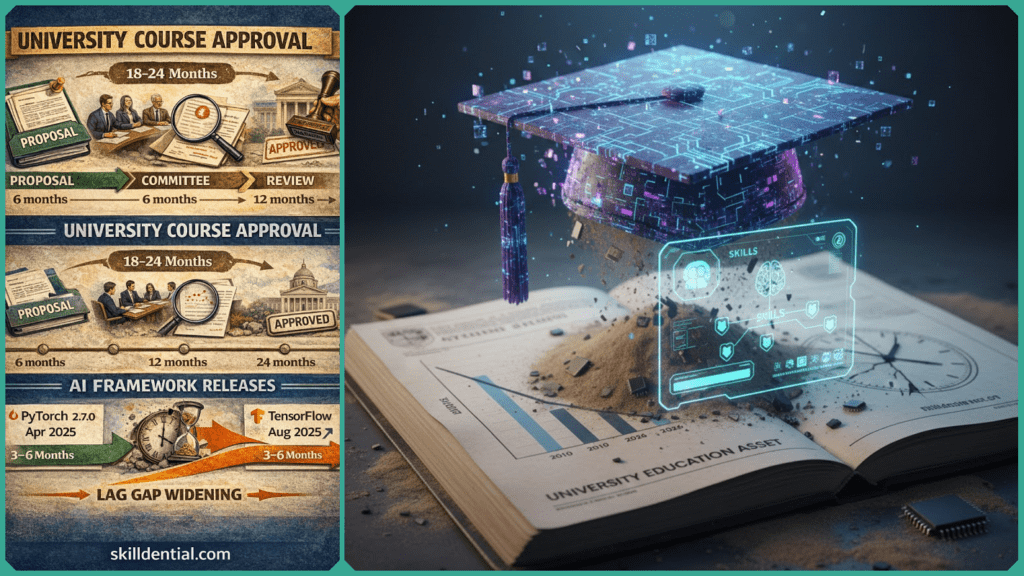
This “Curricular Lag” is a structural failure of institutional bureaucracy. While industry-standard AI frameworks and technical stacks refresh on 3-to-6-month cycles, the academic approval process for new syllabi typically spans 18 to 24 months. For any field requiring a continuous refresh of competencies, the university degree has shifted from a competitive advantage to a lagging indicator of past effort. Survival in the 2026 labor market now requires a pivot from static credentials to dynamic, real-time proof of work.
Key Data Integration
| Metric | Institutional Speed | Market Reality |
| Skill Half-Life | N/A | 2.5 Years |
| Update Frequency | 18–24 Months | 3–6 Months |
| Value Projection | Static/Appreciating | Rapidly Depreciating |
Why Is University Education Depreciating?
The fundamental driver of this depreciation is the widening “Velocity Gap” between academic institutional cycles and market innovation. In the 2026 labor market, university education functions as a static snapshot of a dynamic environment.
The Skill Obsolescence Trap
A standard four-year degree confers technical knowledge that now carries a half-life of roughly 2.5 years in domains such as AI, cybersecurity, and data science. This means that by the time a student enters their junior year, half of their freshman-year technical curriculum is already outdated.
Critical Metric: According to the World Economic Forum’s Future of Jobs Report 2025, approximately 39% of workers’ core skills are expected to transform or become outdated by 2030 due to generative AI and automation.
Institutional “Curricular Lag”
The structural rigidity of higher education creates a permanent delay in value delivery. The process of updating or launching a new technical course typically requires:
- Departmental Review: 3–6 months
- Committee Approval: 6–12 months
- Catalog Publication: 6 months
This 18–24 month approval cycle is incompatible with a technology landscape where frontier AI frameworks and MLOps standards refresh every 3–6 months.
The Shift to “Just-in-Time” Validation
As a result of this lag, the market has pivoted. While university education remains a valid indicator of foundational discipline and “soft” digital skills (critical thinking, collaboration), it is no longer a reliable signal of technical readiness. Employers in 2026 increasingly prioritize Proof of Work—real-time portfolios and micro-credentials—over the “lagging indicator” of a four-year diploma.
What Is the Half-Life of Knowledge?
The “half-life of knowledge” is a critical metric for evaluating the ROI of any educational investment. It measures the time required for half of a specific body of knowledge to become obsolete or lose its market value. In 2026, this metric reveals a profound mismatch between the duration of university education and the shelf-life of technical competencies.
The 2.5-Year Decay Rate
While a standard university education requires a four-year commitment, technical skills—particularly in AI, software engineering, and data analysis—now carry a half-life of just 2.5 years. Stanford insights and current industry audits suggest that in frontier fields like Generative AI, this decay can accelerate to as little as 2 years.
This creates a “negative equity” scenario for graduates:
- Freshman Year: 100% Curriculum relevance.
- Senior Year: Only ~25% of the technical foundations learned as a freshman remain at the cutting edge.
- Conferral: The degree is effectively “outdated at the point of delivery” for high-velocity technical roles.
Market Implications: The 2026 Reskilling Mandate
This mismatch is driving a global shift in human capital strategy. Data from the World Economic Forum (WEF) indicates that 59% of the global workforce will require significant reskilling by 2030 to remain competitive amid rapid AI integration. For the individual, the primary risk is no longer “failing to graduate,” but “failing to refresh.”
Case Study: Skilldential Career Audits
In recent technical career audits conducted by Skilldential, strategic professionals with traditional CS degrees were found to be struggling with “credential stagnation.” However, those who implemented portfolio pivots—supplementing their university education with real-time project evidence—saw a 40% faster transition into new roles.
How Does Curricular Lag Occur?
The “Curricular Lag” is the primary structural friction point preventing university education from maintaining market relevance. This phenomenon is not a failure of faculty expertise, but a byproduct of institutional bureaucracy designed for stability rather than speed.
The 18–24 Month Approval Pipeline
The standard lifecycle of a new course or major update in higher education involves a rigid, multi-phase sequence:
- Syllabus Design & Consultation: 3–6 months.
- Departmental & Faculty Reviews: 3–6 months.
- Institutional Committee Approval: 6–9 months.
- Catalog Publication & Student Enrollment: 6 months.
By the time a curriculum is “live,” it has already aged significantly relative to the industry standards it aims to teach.
The High-Velocity Contrast: AI Frameworks
The inadequacy of this cycle is most visible when contrasted with the release schedules of industry-standard tools. In the time it takes a university to approve a single elective on machine learning, the foundational frameworks undergo several major version shifts.
- PyTorch (v2.x Series): Recent history shows major releases every 3–6 months (e.g., v2.6.0 in January 2025 followed by v2.7.0 in April 2025).
- TensorFlow: Maintains a similarly aggressive cadence, with v2.20.0 launching in August 2025.
The Institutional Paradox
A university education is fundamentally built on a 4-year batch-processing model. However, technical domains now operate on a continuous-deployment model. When the toolsets of a profession change twice within a single academic year, a 24-month approval process ensures that the institution is teaching history rather than practice. For the strategic professional, this confirms that formal degrees are no longer a viable source for “edge” skills; they are merely foundations for the lifelong learning required to bridge the lag.
Why Proof of Work Beats Degrees
In the 2026 talent market, the “signal” provided by a university education has shifted from a leading indicator of potential to a lagging indicator of past activity. To maintain a competitive edge, professionals are pivoting toward Proof of Work—a dynamic, verifiable record of current technical output.
Leading vs. Lagging Indicators
A degree confirms that an individual met a set of academic standards roughly four years ago. In contrast, Proof of Work (e.g., a GitHub repository, a deployed AI agent, or a live marketing campaign) demonstrates what an individual is capable of today.
As technical domains face rapid obsolescence, employers have shifted their heuristic: they no longer ask “Where did you study?” but rather “What have you shipped?” In high-growth sectors like CS and engineering, the premium once placed on institutional prestige is shrinking in favor of functional competency.
Comparative Performance Metrics
| Metric | Degree (Lagging Indicator) | Proof of Work (Leading Indicator) |
| Timeline | 4 years in the past | Real-time / Current projects |
| Knowledge Relevance | 2.5-year half-life (Depreciating) | Continuous / Iterative (Appreciating) |
| Market Validation | Institutional accreditation | Peer-reviewed / Market-tested |
| Hiring Impact | Standard entry requirement | 40% faster job placement |
| Primary Examples | CS Bachelor’s, MBA | GitHub, Technical Portfolios, Campaigns |
The Diminishing Returns of the Diploma
For specialized roles, the ROI of a university education is facing a “point of diminishing returns.” When the cost of tuition continues to rise while the “shelf-life” of the taught curriculum shrinks, the degree becomes an inefficient vehicle for skill acquisition. Strategic careerists now treat the degree as a foundational baseline, while using Proof of Work to signal the high-velocity skills that actually drive hiring decisions.
What Is a Career Maintenance Schedule?
To survive the 2.5-year half-life of technical skills, the modern professional must abandon the “Finished Education” mindset. In 2026, high-performers treat their careers like Continuous Deployment (CD) in software engineering: a system of constant updates, testing, and small-batch releases rather than a single, massive “graduation” event.
The Quarterly Skills Audit
Just as a university degree depreciates, so does your professional “stock.” A Career Maintenance Schedule requires a quarterly audit to identify which competencies are moving from Growth to Obsolescence.
- Inventory Your Assets: List your core technical tools (e.g., Python, AWS, Specific AI Frameworks).
- Assess Depreciation: Identify which tools have had major version releases or are being phased out by industry leaders.
- Identify the Gap: Determine the “Delta” between your current stack and the 3–6 month industry release cycles.
The 10-Hour Sprint: Just-in-Time Learning
To counter the “Curricular Lag” of traditional university education, you must implement a “Just-in-Time” (JIT) learning model.
- Allocation: Dedicate 5–10 hours weekly to active upskilling.
- Micro-credentials: Prioritize targeted certifications (e.g., DeepLearning.ai, AWS Specializations, or industry-recognized badges) that can be completed in weeks, not years.
- The 2.5-Year Rule: If a skill is central to your role, it must be refreshed or advanced every 24 months to prevent “Asset Decay.”
Prioritize Leading Indicators (Proof of Work)
While a degree is a “lagging indicator,” your Proof of Work is your “leading indicator.” Use your maintenance hours to build artifacts that signal real-time competency.
- Open Source & Public Portfolios: Contribute to active repositories (GitHub) or publish technical case studies.
- Feature Flags for Careers: Use new skills in small, low-risk “side projects” before deploying them into your primary job role. This mirrors the software practice of testing new code in production without risking the entire system.
| Action | Frequency | Goal |
| Skill Audit | Quarterly | Identify “Depreciating” knowledge. |
| Micro-learning | Weekly | Close the “Curricular Lag” gap. |
| Portfolio Ship | Bi-Annually | Update “Proof of Work” artifacts. |
University Education FAQs
To conclude this analysis, here are the most frequently asked questions about the shifting value of university education in 2026.
What defines the half-life of skills?
The half-life of a skill is the time it takes for half of its market value or technical relevance to decay. In 2026, Harvard and Stanford insights confirm that technical skills (AI, cloud architecture, data engineering) hit a half-life of 2.5 years. This means that without continuous learning, your technical “utility” drops by 50% every 30 months.
How long does university course approval take?
On average, a new course or significant curriculum update takes 18 to 24 months to move from design to the classroom. While some agile institutions (like Staffordshire University) have implemented “fast-track” validation processes that can take as little as 18 weeks, the majority of traditional universities still operate on multi-level committee reviews that struggle to keep pace with industry releases.
Do degrees lose value post-graduation?
Yes, particularly in technical sectors. While a university education still provides a critical “entry visa” into the professional world, its status as a “competitive advantage” diminishes rapidly. As the supply of graduates increases and AI automates entry-level tasks, the wage premium for a degree alone is shrinking, making “Degree Plus” (degree + certifications/portfolio) the new standard for high-earning roles.
What is “Proof of Work” in hiring?
Proof of Work refers to verifiable, tangible evidence of your skills, such as GitHub repositories, live websites, technical whitepapers, or creative portfolios. Unlike a degree, which is a lagging indicator (showing you learned something years ago), Proof of Work is a leading indicator of what you can produce right now. In 2026, 75% of tech recruiters prioritize these deliverables over institutional pedigree.
How often do AI frameworks update?
Industry-standard frameworks like PyTorch and TensorFlow now release major updates every 3 to 6 months. For example, in 2025, PyTorch released version 2.6.0 in January and 2.7.0 in April. This high-velocity cycle is the primary reason a four-year university education often includes outdated technical information by the time a student reaches their senior year.
In Conclusion
In the 2026 labor market, the value of university education is no longer a static achievement but a depreciating asset that requires active management. The data confirms a widening gap between institutional speed and market reality:
- Skill Half-Life: Technical competencies now decay by 50% every 2.5 years.
- Curricular Lag: Traditional academic update cycles of 18–24 months cannot compete with AI framework releases every 3–6 months.
- Market Pivot: 59% of the workforce requires immediate reskilling as employers shift to a “Skills-First” hiring model where Proof of Work outperforms stagnant degrees.
Final Recommendations
To transition from a “Lagging Indicator” (the degree) to a “Leading Indicator” (Proof of Work), implement the following technical career roadmap:
- Quarterly Skill Audit: Assess your stack against current job descriptions. If a core tool has moved two versions beyond your knowledge, your value has depreciated.
- 5-Hour Weekly Sprint: Dedicate time to “Just-in-Time” learning via micro-credentials and technical documentation to bypass the curricular lag.
- Ship Public Artifacts: Maintain a GitHub repository, a technical blog, or a project portfolio. These serve as real-time verification of your ability to execute in the 2026 economy.